Wirecard’s real business relied on small number of customers
FT exclusive: An internal spreadsheet shows how only 100 clients generated majority of revenues in 2017
Wirecard relied on a small number of customers for the majority of its genuine sales, according to an internal company spreadsheet that shows for the first time the real business behind the fintech group’s facade.
The German payments company filed for insolvency last week after acknowledging that €1.9bn of cash probably did “not exist” and the business that accounted for about half of its reported revenues had been misrepresented.
A snapshot of Wirecard’s clients in 2017, reviewed by the Financial Times, gives an indication of the real size and shape of the company, with only 100 customers accounting for more than half of its sales.
The document provides fresh evidence that Wirecard comprehensively misled the market about its scale. It also shows that it processed payments for a variety of controversial businesses that have drawn regulatory scrutiny in a number of jurisdictions.
In 2017 Wirecard claimed publicly to serve 33,000 large and medium-sized merchants, and 170,000 small businesses, a global reach that helped make the company an investment sensation.
The internal file seen by the FT, entitled “Customer list — Jan-Jun 2017 (global)”, suggests Wirecard’s customer base was in fact much smaller, and far more lopsided.
Prepared by staff at the request of then chief executive Markus Braun, an enormous spreadsheet was shared by email between 10 employees in October 2017, showing 107,000 clients, with the transaction volume and resulting Wirecard sales generated by each. As a payment processor, Wirecard generates revenue by taking a cut of merchants’ transactions.
The file reviewed by the FT shows figures equivalent to about half the sales and transaction volume the company reported for the first six months of 2017. That seems likely to represent the genuine business. Statements from Wirecard last week, a special audit by KPMG and previous reporting by the FT indicate that the other half of the reported business might never have existed in reality.
Wirecard did not respond to a request for comment.
A lawyer for Wirecard’s former chief Mr Braun, who was arrested last week on suspicion of false accounting and released on bail, said “the assumptions and imputations” in the FT’s questions about the spreadsheet were “incomprehensible” to his client and “obviously based on information taken wholly out of context”.
Mr Braun was providing “absolute and unlimited co-operation to the public prosecutor in Munich to clarify the criminal liability”, he said.
In 2017 Mr Braun was boasting of Wirecard’s cutting-edge technology, including “a data layer that also now takes new and state of the art instruments in the area of machine learning and artificial intelligence into account”.
To generate information on its own customers, however, Wirecard staff needed to use an unsophisticated Excel spreadsheet that reflected the same paperwork weaknesses described in a special audit by KPMG. Thousands of client names appear to be duplicates. The FT has also excluded six Indonesian financial institutions that were said to contribute €200,000 of sales on an improbable €190bn of transactions, possibly the result of the wrong currency being used.
The remaining data show €292m of sales from processing €18bn of transactions, compared with the €616m of revenues from processing €37.9bn of payments that Wirecard claimed at the time.
An outsized amount comes from a small group of important customers, including the UK-based online bank Monzo, Hungarian low-cost airline Wizz Air, and Marathon Alderney, the parent of online gaming site Marathon Bet. The top 200 contributed €193m in sales, two-thirds of the total, according to the file.
Wizz Air and Monzo no longer use Wirecard. Marathon did not respond to a request for comment.
Other examples of Wirecard customers include the Cypriot online brokers Rodeler and Hoch Capital, which were recently banned from operating in the UK by the Financial Conduct Authority. They did not respond to requests for comment.
The 21st largest customer in the first half of 2017 appears to have been a Polish entity used by Qnet, a multi-level marketing group that has its headquarters in Hong Kong, which has faced complaints in India over whether it engaged in pyramid scheme behaviour.
“Wirecard has been very good to us in the sense of the rates that it gives us,” said Zaheer Merchant, Qnet’s director of corporate affairs. Pointing to a 2017 judgment in India, he said: “The supreme court order that we received was that Qnet is not a scam company.”
The overwhelming majority of customers listed in Wirecard’s spreadsheet were tiny: 67,000 small customers in Brazil together contributed just €9m of sales in the period. A further 30,000 customers were listed as together responsible for €1.7m of transactions in the six months, and zero sales.
A significant part of the remainder comes from the pornography industry, with some clients paying unusually high rates for payments processing.
Wirecard’s roots lie in processing payments for porn and gambling websites, and its willingness to continue working with customers in adult entertainment was unusual for an established “acquirer”, industry jargon for a business that belongs to the Visa and Mastercard networks and helps companies take card payments.
“Most acquirers won’t do adult due to the reputation issues and the risk that charges are reversed due to consumer complaints,” said Chris Jones, a payments expert who runs PSE Consulting. Such business tends to be dealt with by specialists in high-risk payments.
The German company appears to have an unusually lucrative relationship with a collection of almost 4,000 porn, dating and related customer service websites registered to 175 companies in the UK and Cyprus.
Pornographic websites in the network typically advertised three-day free trials, before charging $39.95 per month after that. Wirecard kept about 15 per cent of the transaction volumes generated by these customers in the first half of 2017, according to documents reviewed by the FT.
That compares with rates of about 3 per cent the German company charged larger porn purveyors, such as Luxembourg-based LiveJasmin and the US-controlled Chaturbate.
Charging such a high rate raises fresh questions about Wirecard’s compliance with anti-money laundering regulations.
Nicolette Kost De Sèvres, a lawyer at Mayer Brown, said that in terms of anti-money laundering monitoring, “this is a serious trigger, the 15 per cent. In business practices I would wonder why the merchant would accept to pay so much with the competition and availability of payment processors.”
Many of the pornographic websites were nearly identical in structure, administration and in their use of similar dated technology. More than 1,200 websites were registered by 68 supposedly independent UK companies, for which the directors and owners all provide the same correspondence address in Essex.
When signing up to free trials or subscriptions at sites in this network, the FT repeatedly found that transactions were automatically blocked by the card issuer, or experienced attempts - for example by the website mytrashyamateurex.com - to deceptively authorise charges that were higher than the advertised prices. Letters requesting comment sent to 137 individuals associated with the companies did not receive a response.
Wirecard appears to have processed at least €30m of high-margin transactions for these porn and dating websites over the period, generating €4.5m of sales from the British and Cypriot companies behind them. Taken together, the group would have been Wirecard’s sixth-largest customer at the time.
National mask mandate could save GDP from a 5% cut, Goldman says
An national mandate to wear face masks could save the U.S. economy from additional lockdowns that would knock 5% off of GDP, according to a Goldman Sachs note.
Goldman Chief Economist Jan Hatzius and his team found that the link between face masks and COVID-19 health and economic outcomes is significant.
“We find that face masks are associated with significantly better coronavirus outcomes,” Hatzius wrote.
According to Goldman's baseline estimate, a national mandate could increase the percentage of people wearing masks by 15 percentage points and cut the daily growth rate of confirmed cases by 1.0 percentage point to 0.6%.
Based on the economic effects of earlier lockdowns, the Goldman economists estimate that a face mask mandate could potentially avert lockdowns that would otherwise cuts almost 5% from GDP.
Gapping down
In reaction to disappointing earnings/guidance:
- IHG -2% (provides RevPAR expectations and reopening updates), MLHR -1.9%
Other news:
- OCX -47.4% (DetermaDx study endpoints were not achieved)
- ZYNE -41% (announces top line results from pivotal CONNECT-FX trial of Zygel in Fragile X Syndrome; did not achieve statistical significance in primary or key secondary endpoints)
- VRCA -19.9% (provides regulatory update pertaining to VP-102)
- LQDA -17.6% (to acquire RareGen through all-stock merger, aprices offering of 9,375,000 shares of its common stock at $8.00 per share)
- ERII -15.3% (will exit its licensing deal with Schlumberger)
- INO -7.7% (clinical data of INO-4800, its vaccine candidate against novel coronavirus from the first two Phase 1 clinical trial cohorts)
- IIPR -5.9% (upsize and pricing of an underwritten public offering of 2,683,363 shares of its common stock at $83.85 per share)
- OSMT -4.4% (submits amended NDA for arbaclofen extended release tablets to FDA)
- CRSP -4% (commences $325 mln common stock offering)
- RDS.A -2.3% (provides Q2 update)
- MAG -1.9% (entered into $50 mln sales agreement)
- XLRN -1.7% (announces $400 mln offering)
- PTON -1.2% (falls a bit as LULU will acquire home fitness co Mirror)
- BA -0.8% (Norwegian Air cancels orders for 97 of Boeing's planes)
Analyst comments:
- HFC -2.3% (downgraded to Underperform from Market Perform at Cowen)
- OKTA -2.3% (downgraded to Neutral from Buy at BTIG Research)
- CHGG -0.7% (downgraded to Neutral from Buy at Citigroup)
Gapping up
In reaction to strong earnings/guidance:
- CAG +12.9%, XLNX +7% (guides JunQ and SepQ above consensus), MU +6.2%, JEF +5.8%
M&A news:
- LULU +4.1% (to acquire in-home fitness company MIRROR for $500 mln)
Other news:
- BLNK +58.1% (extends momentum)
- NLS +10% (in sympathy with LULU acquiring home fitness co Mirror)
- IFRX +7.7% (is now assessing different strategies for a potential pathway to regulatory approval for IFX-1 in the United States and plans to engage with the FDA on next steps)
- SPG +7.2% (provides reopening update; declares Q2 dividend of $1.30)
- ARYA +4.7% (shareholders approve combo with Immatics Biotech)
- WDC +3.1% (in sympathy with strong MU earnings)
- SGEN +2.8% (announces "favorable" results from Phase 2 trial of tisotumab vedotin)
- MRNS +2% (provided a pipeline update)
- GMAB +1.3% (announces "favorable" results from Phase 2 trial of tisotumab vedotin)
Analyst comments:
- CROX +3% (upgraded to Buy from Hold at Loop Capital)
- HOLX +1.6% (upgraded to Outperform from Market Perform at Cowen)
- TOL +1.6% (upgraded to Outperform from Mkt Perform at Keefe Bruyette)
- ACRE +1.4% (upgraded to Outperform from Mkt Perform at Keefe Bruyette)
- TME +1.1% (upgraded to Buy from Neutral at UBS)
Early premarket gappers
- Gapping up:
- BLNK +47.9%, XLNX +6.5%, JEF +5.8%, SPG +5.3%, MU +5.3%, SGEN +4%, LULU +4%, NLS +1.9%, GMAB +1%, WDC +0.6%, ARYA +0.5%
- Gapping down:
- OCX -47.4%, LQDA -23.6%, VRCA -23%, ERII -13.6%, IIPR -4.8%, CRSP -3.5%, RDS.A -2.7%, BA -2.6%, XLRN -1.7%, MLHR -1.5%, PTON -0.6%
83 Tons Of Fake Gold Bars: Gold Market Rocked By Massive China Counterfeiting Scandal
Over the years, we have periodically reported of the occasional gold bar discovered as counterfeit in Manhattan's Diamond District which instead of containing the yellow precious metal would be filled with gold-plated tungsten or in some cases copper. The news would spark a brief wave of outrage, prompting physical gold holders to run ultrasound spot checks of their inventory, at which point interest would wane and why not: buyer, after all, beware in gold as in every other market, and if someone is spending thousands to buy fake gold, well that's Darwinism in action.

Yet one market which seemed stubbornly immune to any counterfeiting was that of physical gold in China, which was odd considering that over the past decade China had emerged as the world's biggest counterfeiter of various, mostly industrial metals used to secure bank loans, better known as "ghost collateral", and which adding insult to injury, would frequently be rehypothecated meaning often several banks would have claims to the same (fake) asset.
All that is about to change with the discovery of what may be one of the biggest gold counterfeiting scandal in recent history. And yes, not only does it involve China, but it emerges from a city that has become synonymous for all that is scandalous about China: Wuhan itself.
With that preamble in mind, we introduce readers to Wuhan Kingold Jewelry Inc., a company which as the name implies was founded and operates out of Wuhan, and which describes itself on its website as "A Company with a Golden future."
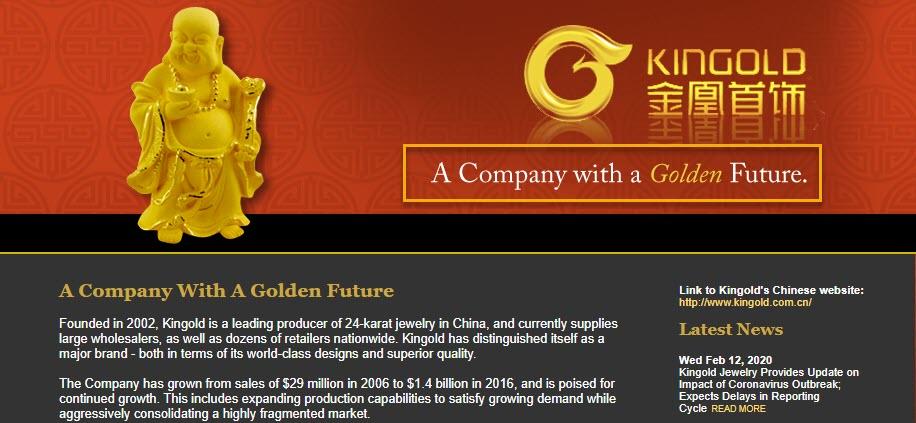
In retrospect, it probably meant "copper" future, because as a remarkable expose by Caixin has found, more than a dozen Chinese financial institutions, mainly trust companies (i.e., shadow banks) loaned 20 billion yuan ($2.8 billion) over the past five years to Wuhan Kingold Jewelry with pure gold as collateral and insurance policies to cover any losses. There was just one problem: the "gold" turned out to be gold-plated copper.
Some more background: Kingold - whose name was probably stolen from Kinross Gold, one of the world's largest gold miners - is the largest privately owned gold processor in central China’s Hubei province. Its shares are listed on the Nasdaq stock exchange in New York (although its current market cap of just $10MM is a far cry from its all time highs hit when the company IPOed on the Nasdaq around 2010) . The company is led by Chairman Jia Zhihong, an intimidating ex-military man who is the controlling shareholder.
What could go wrong?
Well, apparently everything as at least some of 83 tons of gold bars used as loan collateral turned out to be nothing but gilded copper. That has left lenders holding the bag for the remaining 16 billion yuan of loans outstanding against the bogus bars. And as Caixin adds, the loans were covered by 30 billion yuan of property insurance policies issued by state insurer PICC Property and Casualty and various other smaller insurers.
The fake gold came to light in February when Dongguan Trust (one of those infamous Chinese shadow banks) set out to liquidate Kingold collateral to cover defaulted debts. As the report continues, in late 2019 Kingold failed to repay investors in several trust products. To its shock, Dongguan Trust said it discovered that the gleaming gold bars were actually gilded copper alloy.
The news sent shockwaves through Kingold’s creditors. China Minsheng Trust - another shadow banking company and one of Kingold’s largest creditors - obtained a court order to test collateral before Kingold’s debts came due. On May 22, the test result returned saying the bars sealed in Minsheng Trust’s coffers are also copper alloy.
And with authorities investigating how this happened, Kingold chief Jia flatly denies that anything is wrong with the collateral his company put up. Well, what else could he say...
As Caxin notes, the Kingold counterfeiting case echoes China’s largest gold-loan fraud case, unfolding since 2016 in the northwest Shaanxi province and neighboring Hunan, where regulators found adulterated gold bars in 19 lenders’ coffers backing 19 billion yuan of loans, or about USD $2.5 billion. In that case, a lender seeking to melt gold collateral found black tungsten plate in the middle of the bars.
In the case of Kingold, the company said it took out loans against gold to supplement its cash holdings, support business operations and expand gold reserves, according to public records. It then appears to have decided to apply a gold-layer to tons of copper and pretend it was money-good gold collateral. And even more shocking, for years nobody checked the authenticity of the pledged collateral!
In 2018, the company beat a number of competitors in bidding to buy a controlling stake in state-owned auto parts maker Tri-Ring Group. Kingold offered 7 billion yuan in cash for 99.97% of Tri-Ring. The Hubei government cited the deal as a model of so-called mixed-ownership reform, which seeks to invite private shareholders into state-owned enterprises. But Kingold has faced problems taking over Tri-Ring’s assets amid a series of corruption probes and disputes involving Tri-Ring.
After obtaining the test results, Minsheng Trust executive said the company asked Jia whether the company fabricated the gold bars: “He flatly denied it and said it was because some of the gold the company acquired in early days had low purity,” the executive said. In a telephone interview with Caixin in early June, Jia denied that the gold pledged by his company was faked.
“How could it be fake if insurance companies agreed to cover it?” he said and refused to comment further. Well, the answer is simple: the insurance companies were in on the scam, but that's a story for another day.
In early June, Minsheng Trust, Dongguan Trust and a smaller creditor Chang’An Trust filed lawsuits against Kingold and demanded that PICC P&C cover their losses. PICC P&C declined to comment to Caixin on the matter but said the case is in judicial procedure. A source from PICC P&C told Caixin that the claim procedure should be initiated by Kingold as the insured party rather than financial institutions as beneficiaries. Kingold hasn’t made a claim, the Caixin source said.
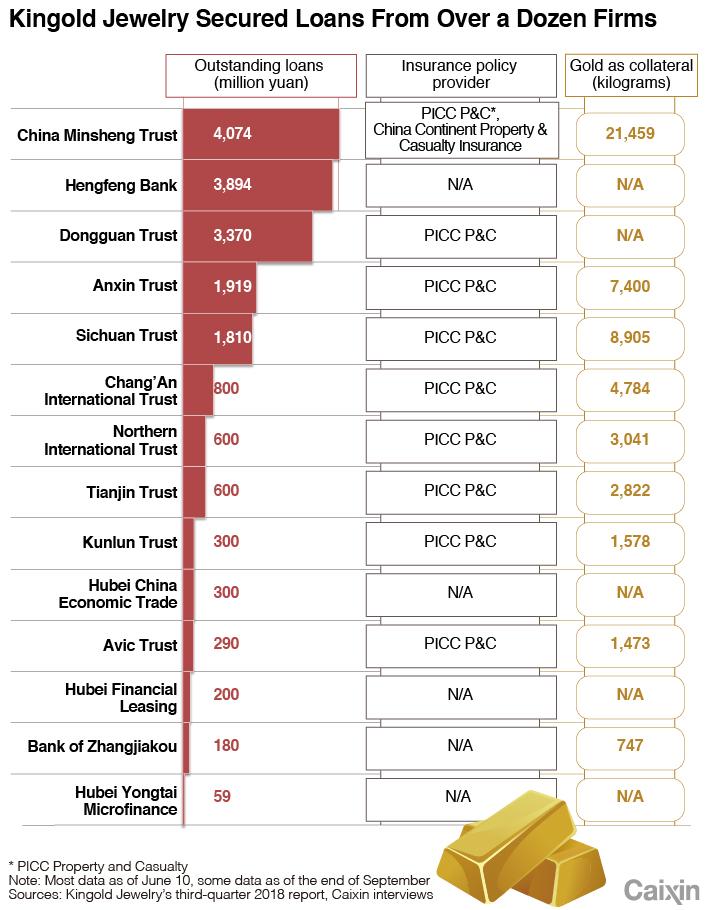
In total, Kingold pledge tens of thousands of kilograms of gold to no less than 14 creditors amounting to just under 20 billion yuan.
Caixin learned that the Hubei provincial government set up a special task force to oversee the matter and that the public security department launched an investigation. The Shanghai Gold Exchange, a gold industry self-regulatory organization, disqualified Kingold as a member as of last week.
Following Dongguan Trust and Minsheng Trust, two other Kingold creditors also tested pledged gold bars and found they were fake, Caixin learned. A Dongguan Trust employee said his company reported the case to police Feb. 27, the day after the testing result was delivered, and demanded 1.3 billion yuan of compensation from PICC P&C’s Hubei branch.
Meanwhile, Kingold defaulted on 1.8 billion yuan of loans from Dongguan Trust with an additional 1.6 billion yuan due in July.
The 83 tons of purportedly pure gold stored in creditors’ coffers by Kingold as of June, backing the 16 billion yuan of loans, would be equivalent to 22% of China’s annual gold production and 4.2% of the state gold reserve as of 2019.
In short, more than 4% of China's official gold reserves may be fake. And this assume that no other Chinese gold producers and jewelry makers are engaging in similar fraud (spoiler alert: they are.)
* * *
Founded in 2002 by Jia, Kingold was previously a gold factory in Hubei affiliated with the People’s Bank of China that was split off from the central bank during a restructuring. With businesses ranging from gold jewelry design, manufacturing and trading, Kingold is one of China’s largest gold jewelry manufacturers, according to the company website.
The company debuted on Nasdaq in 2010. The stock currently trades around $1 apiece, giving Kingold a market value of $12 million, down 70% from a year ago. A company financial report showed that Kingold had $3.3 billion of total assets as of the end of September 2019, with liabilities of $2.4 billion.
Jia, now 59, served in the military in Wuhan and Guangzhou and spent six years living in Hong Kong. He once managed gold mines owned by the People’s Liberation Army, which means he likely has connections all the way to the very top.


Jia Zhihong
“Jia is tall and strong,” one financial industry source familiar with Jia told Caixin. “He’s an imposing figure and speaks loudly. He is bold, reckless and eloquent, always making you feel he knows better than you.”
Several trust company sources said Jia is well connected in Hubei - the epicenter of the coronavirus pandemic - which may explain Kingold’s surprise victory in the Tri-Ring deal. But a financial industry source in Hubei said Jia’s business is not as solid as it may appear.
“We knew for years that he doesn't have much gold ― all he has is copper,” said the source, who declined to be named.
Local financial institutions in Hubei have avoided doing business with Kingold, but they don’t want to offend him publicly, the source said. Why? Because of his extnesive connections with the Chinese army.
“Almost none of Hubei’s local trust companies and banks has been involved in (Kingold’s) financing,” he said.
That explains why most of Kingold’s creditors are from outside Hubei. Caixin learned from regulatory sources that Minsheng Trust is the largest creditor of Kingold with nearly 4.1 billion yuan of outstanding loans, followed by Hengfeng Bank’s 3.9 billion yuan, Dongguan Trust’s 3.4 billion yuan, Anxin Trust & Investment Co.’s 1.9 billion yuan and Sichuan Trust Co.’s 1.8 billion yuan.
But wait, counterfeiting gold is just the tip of the company's fraud iceberg: several industry sources told Caixin that the institutions were willing to offer loans to Kingold because Jia promised to help them dispose of bad loans.
Hengfeng Bank is the only commercial bank involved in the Kingold affair. The bank in 2017 provided an 8 billion yuan loan to Kingold, which in return agreed to help the bank write off 500 million yuan of bad loans, bank sources said. Kingold repaid half of the debts in 2018. But the loan issuance involved many irregularities as access to the pledged gold and testing procedures was controlled by Kingold, one Hengfeng employee said.
The loan was pushed forward by Song Hao, former head of Hengfeng’s Yantai branch. Song was placed under graft investigation in March 2018 in connection with the bank’s disgraced former Chairman Cai Guohua, whose downfall led to a major revamp in the bank’s management. In 2019, Hengfeng’s new management sued Kingold for the unpaid loans and moved to dispose the collateral. But a test of the gold bars found they are “all copper,” the bank source said.
It is still unclear whether the collateral was faked in the first place or replaced afterward. Sources from Minsheng Trust and Dongguan Trust confirmed that the collateral was examined by third-party testing institutions and strictly monitored by representatives from Kingold, lenders and insurers during the process of delivery.
"I still can’t understand which part went wrong," a Minsheng Trust source said. Bank records showed that the vault where the collateral was stored was never opened, the source told Caixin.
The falling dominos
Public records showed that Kingold’s first gold-backed borrowing can be traced back to 2013, when it reached an agreement for 200 million yuan of loans from Chang’An Trust, with 1,000 kilograms of gold pledged. The two-year loan was to fund a property project in Wuhan and was repaid on time. Before this, Kingold’s financing mainly came from bank loans with property and equipment as collateral.
It appears that one way or another, the company realized that it could fabricate gold ownership and receive money in exchange for what were basically worthless copper bricks painted as gold; and thanks to Jia's military connections nobody would ask any other questions.
As a result, starting in 2015, Kingold rapidly increased its reliance on gold-backed borrowing and started working with PICC P&C to cover the loans. In 2016, Kingold borrowed 11 billion yuan, nearly 16 times higher than the previous year’s figure. Its debt-to asset ratio surged to 87.5% from 43.4%, according to a company financial report. That year, Kingold pledged 54.7 tons of gold for loans, 7.5 times higher than the previous year.
It is now safe to assume that most of that gold never existed.
A person close to Jia said the surge of borrowing was partly due to Kingold’s pursuit of Tri-Ring. In 2016, the Hubei provincial government announced a plan to sell Tri-Ring stakes to private investors as a major revamp of the Hubei government-controlled auto parts manufacturer.
In 2018, Kingold was selected as the investor in a deal worth 7 billion yuan. According to the investment plan, Kingold’s purchase of Tri-Ring was part of a strategy to expand into the hydrogen fuel cell business, which is obviously a "logical" fit for a company involved in gold jewelry. Sources close to the deal said Kingold was attracted by Tri-Ring for its rich holding of industrial land that could be converted for commercial development.
Yes, at the very bottom of the fraud we finally get to the one true and endless Chinese asset bubble: real estate.
A Dongguan Trust investment document showed that Tri-Ring owns land blocks in Wuhan and Shenzhen that are worth nearly 40 billion yuan.
The deal drew immediate controversy as some rival bidders questioned the transparency of the bidding process and Kingold’s qualifications.
And here things get even crazier: according to Kingold’s financial reports, the company had only 100 million yuan of net assets in 2016 and 2 billion yuan in 2017, sparking doubts over its capacity to pay for the deal. Despite the fuss, Kingold paid 2.8 billion yuan for the first installment shortly after the announcement of the deal. The second installment of 2.4 billion yuan was paid several months later with funds raised from Dongguan Trust.
In December, Tri-Ring completed its business registration change, marking completion of Kingold’s takeover. However, the new owner has since faced troubles mobilizing Tri-Ring’s assets because of a series of corruption probes surrounding the auto parts maker since early 2019 that brought down Tri-Ring’s former chairman. As Caixin the notes, a majority of Tri-Ring’s assets were frozen amid the investigation and subsequent debt disputes, limiting Jia’s access to the assets.
The fraud is finally exposed
Hobbled by the Tri-Ring deal, which cost billions of yuan but has yet to make any return, Jia’s capital chain was eventually broken when Hengfeng Bank pushed for repayment, triggering a series of events that brought the fake gold to light, said a person close to the matter. Insurers’ involvement was key to the success of Kingold’s gold-backed loan deals. The insurance policies provided by leading state-owned insurers like PICC P&C were a major factor defusing lenders’ risk concerns, several trust company sources said.
“Without the insurance coverage from PICC P&C, (we) wouldn’t issue loans to Kingold as the collateral can only be tested through random picked samples,” one person told Caixin.
PICC P&C’s Hubei branch provided coverage for most of Kingold’s loans, Caixin learned. All the policies will expire by October. As of June 11, 60 policies were still valid or involved in lawsuits.
PICC P&C faces multiple lawsuits filed by Kingold’s creditors demanding compensation. But a PICC P&C spokesperson said the policies cover only collateral losses caused by accident, disasters, robbery and theft. Not fraud, and certainly not losses when the collateral never even existed!
Whose fault
Wang Guangming, a lawyer at Dacheng Law Offices, said the key issue is what happened to the pledged gold and which party was aware of the falsification. If Kingold faked the gold bars and both the insurers and creditors were unaware, the insurers should compensate the lenders and sue Kingold for insurance fraud, Wang said. Insurers are also responsible to compensate if they knew of Kingold’s scam but creditors didn’t, Wang said.
If Kingold and creditors were both aware of the fake collateral, insurers could terminate the policies and sue the parties for fraud. But if insurers were also involved in the scam, then all the contracts are invalid and every party should assume their own legal responsibilities, Wang said.A financial regulatory official told Caixin that previous investigations of loan fraud cases involving fake gold pledges found there was often collusion between borrowers and financial institutions.
Earlier this year, PICC P&C removed its Hubei branch party head and general manager Liu Fangming. Sources said staff members involved in business with Kingold were also dismissed. PICC P&C said Liu’s removal was due to internal management issues. It didn't answer Caixin’s question about whether Liu was involved in the Kingold scandal.
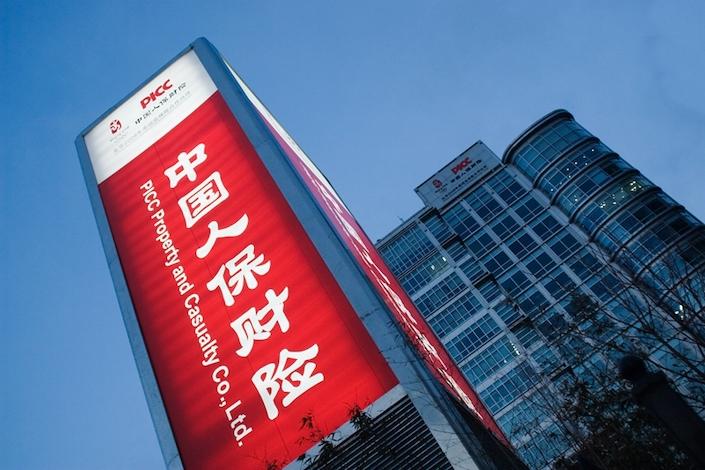
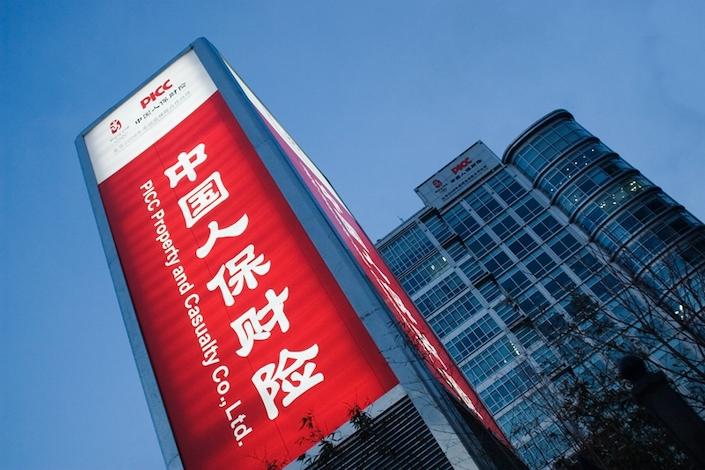
PICC P&C’s Hubei branch provided insurance for most of Kingold’s gold-backed loans.
* * *
The above story is shocking in exposing just how multi-faceted fraud is in China: capitalizing on pre-existing cronyism and connections with China's powerful army, the founder of Kingold was allowed to basically do anything he wanted, no questions asked, including counterfeiting over 83 tons of gold bars to get billions in funds to participate in China's housing bubble, only for a series of unexpected events to unwind the frauds one after another and expose the type of sordid scandal that is at the heart of most Chinese "enterprises" and business ventures.
As for the gold, yes - several billion in gold bars never existed and yet resulted in a cascade of subsequent cash flow events allowing tens of billions in funds to be released, "benefiting" not only founder Jia, but China's broader economy. Which is, needless to say, terrifying: because whereas just after the financial crisis China was engaged in building ghost cities, everyone knew these were a symbol of demand that would never materialize, even if the cities themselves did exist. However, it now appears that a major part of China's subsequent economic boom has been predicated on tens of billions in hard assets - such as gold - which simply do not exist.
As for what this means for the price of gold... well, Kingold is certainly not the only Chinese company engaging in such blatant fraud, and the consequences are clear: once Chinese creditors or insurance companies start testing the "collateral" they have received in exchange for tens of billions in loans and discover, to their "amazement", that instead of gold they are proud owners of tungsten or copper, they have two choices: reveal the fraud, risking tremendous adverse consequences and/or prison time, or quietly buy up all the gold needed to literally fill the void from years of gold counterfeiting.
Something tells us option two will be far more palatable to China's kleptoculture where one domino cold trigger a collapse of the entire financial system. What happens next: a panicked scramble to procure physical gold, one which even our friends at the BIS will be powerless to stop from sending the price of the precious metal to all time highs.
How Bad is America’s Coronavirus Explosion? Much Worse Than You Think.
America Has More New Coronavirus Cases than Europe, China, and India — Combined
Just how badly has America — or the Trump administration and the Republicans — botched Coronavirus?
You know things are bad. But only some global context reveals just how staggeringly bad they really are.
America had 41,000 new Coronavirus cases yesterday. That’s an all-time high. As in, since the beginning of the pandemic, in March. America hasn’t flattened the curve — it’s still marching relentlessly upwards.
How much is 41,000 new cases — just yesterday?
Here’s what it means in global terms. India had 15,000 cases. Europe had 16,000 — and that includes Russia. China had just 13.
America has more new Coronavirus cases than Europe, India, and China — combined.
Dumbfounded?
(By the way, if you doubt China’s numbers, go ahead and add a zero. Go ahead and add two zeroes. Doesn’t really change a thing.)
Let’s continue with context. What does that really mean?
Europe’s population is 740 million. India’s population is 1.35 billion. China’s population is 1.4 billion. Together, that’s roughly about half the planet.
America’s population is…330 million.
America had new more Coronavirus cases than half the planet. In just one day.
That’s a glimpse of how badly America’s botched Coronavirus. Now you begin to see the epic scale of the failure. America has more cases than half the world? Than Europe, China, and India — combined? What the? The numbers are both staggering and surreal.
So staggering and surreal, that I don’t think Americans have fully processed them yet. I don’t blame them. This is a catastrophe moving faster than the human mind’s capacity to really comprehend it.
So let me continue with some global context.
There are about 9.6 million reported Corona cases worldwide. America alone has 2.5 million. That’s 26% of global cases. America makes up just 4 percent of the world’s population — but it has 26% of the globe’s Coronavirus caseload.
Let me put that another way. Yesterday, there were about 167,000 Corona cases reported worldwide. America had 41,000. That’s about 25 percent. America had 25% of the world’s Coronavirus cases today — and that number’s rising — and yet it has less than 5% of the world’s population.
Are you seeing what a colossal failure this is? It isn’t just one of the greatest public health failures in modern history — it’s one of the greatest failures, period.
So how will all this evolve?
Consider the varying shapes of the globe’s Corona curves. Europe — aside from foolish Britain and poor old Sweden — genuinely flattened the curve, meaning the daily incidence dropped right back down to minimal levels. How did that come to be? By now, you know the story: lockdowns, testing and tracing, a society willing to cooperate, swift, decisive leadership.
In America, none of that happened. First, as the now-infamous story goes — the one history will recount, horrified — first, Trump denied, then he minimized, then he told people to drink bleach, then he cut funding for the WHO, and right now, he’s trying to rip apart what little health insurance Americans have, while dismantling Coronavirus testing centers.
What the?
Trump seems almost gleeful that a lethal pandemic is raging through America. What else did you expect, though, from the kind of man who puts kids in cages? But I digress.
The result is that Europe’s and America’s curves look completely different now: Europe’s really is a wave — the thing we speak about when it comes to pandemics — but America’s isn’t. Europe’s rose, crested, and fell. But America never really stopped having a first wave — and now that wave is a tsunami, in global terms.
America’s Coronavirus pandemic isn’t like the rest of the world — it’s a massive tidal wave, towering over the rest of the world, looming fifty stories tall, its shadow stretching back all the way inland, comparatively, one which has yet to crest and fall at all.
How did that come to be? And what happens next?
In the absence of leadership from the top, American states were left to take their own actions. And because Red States are run by figures every bit as ignorant, foolish, and childish as Trump…they didn’t fight the virus, they fought against fighting the virus.
Texas’s governor made it illegal to make people wear masks…not to make people not wear them. I know, that puts your mind in knots — it’s not my fault, it’s because the illogic is twisted upon itself like a pretzel of idiocy. Arizona’s governor followed. Across America, Red States reopened, cheering, before a damned thing had really been done to contain the virus…while most of the world looked on, wondering: “What the? Do these morons have a deathwish?”
Remember just a week or two ago…when, in Red State after Red State, people celebrated the summer by…getting half-naked in pools full of complete strangers…in the middle of a deadly global pandemic? What the?
The world, it turned out, was right. What happened next was as predictable as it was tragic as it was idiotic. The virus surged to all time highs.
Where will it go next?
Well, consider these three ugly facts. One, there’s still no national strategy, plan, or agenda. Two, Americans — especially leaders, like governors and so forth — still don’t really know what global best practices are. Do you think the Governor of Texas knows how New Zealand defeated the virus? Do you really think he cares? Three, Americans are still resisting lockdown — politically, culturally, and socially. No, maybe not you. But the American Idiot. The Red Stater who’ll get naked in a pool during a pandemic, and then go home and vote for the kind of Greater Idiot who makes it illegal to wear a mask.
These three facts alone say that the virus in America is just going to continue climbing and climbing. Red States, now, are putting some half-measures into effect. But they are half measures, too little, too late, and barely enforceable at this point, anyways, when the point has been made. That point is this: Free-dumb is what matters most in America. So Americans have their free-dumb now — but they are also among the people in the world most likely to catch the virus and die.
All this lines up neatly — and unfortunately — with the predictions of people like me, who’ve been saying that America needed to do far more, far faster, to contain the virus. Not just for the sake of public health.
As the pandemic continues, the effects will be disastrous. The economy will not be able to reopen — really reopen — as it is, hesitantly, cautiously, across Europe. Instead, Americans will face a kind of dystopian choice: you venture out to get your daily goods, at the risk of your life. Maybe you’re forced back to work — it’s your life, or your livelihood. They will shoulder the burden of the risk of a virus their failed institutions have not allowed them to contain or manage.
All of that will plunge the economy into a depression — that much is already beginning, the 14th week now of more than a million people claiming unemployment.
As the economy goes into depression, something even more bizarre will begin to happen. Because no real effort has been made to contain the virus, because Americans have to simply bear the risk of the pandemic themselves, they will have to work and venture out and so forth. That means the pandemic will probably go permanent. Unlike in much of the rest of the world, which has beaten back the virus, it will become a kind of new illness that’s just a part of daily American life, like the flu, only worse. You got Corona? Too bad. That’s just yet another risk of living in this failed society — like having no healthcare, savings, retirement, another way that you have no safety or shelter from failed institutions and systems.
America will be one of few countries in the world which never really beats Coronavirus — it will enter a kind of permanent viral winter.
As Coronavirus goes permanent in America, the world will have to quarantine it. That’s already begun: Europe and Japan have already discussed closing themselves to Americans.
How prosperous do you think an isolated America will be? It will do less business. It will trade less. Fewer ideas will flow through it. It will become something — finally — very much like the Soviet Union, an ailing society, shunned by the world.
There’s one kind of person for whom all that’s very good news. Have you guessed it yet? Who wanted America to be isolated in the first place? To be a society of unimaginable cruelty, where brutality and violence reign? Who’s the most narcissistic individualist of them all? Who believes absolutely in free-dumb?
That’s right, Trump. And his army of American Idiots. An isolated, poor, authoritarian America is what they’ve always craved.
That’s why Coronavirus is ripping through Red States. Because the American Idiot wants to live in a kind of medieval society, made of mass death, barbarity, and cheering folly. As long as they have their pool parties, their dictator, and their minorities to hate…what do they care?
America has 26% of the world’s Coronavirus cases — and just 4% of its population. It has more new cases than Europe, China, and India — half the planet — combined. What does the American Idiot care? They have their free-dumb. They can carry a gun to Starbucks, and infect a whole town on the way. Yay! I’m free!
That, my friends, is the tragedy of folly. It’s where a society like America — legendary for its brutality and cruelty — ends up. Shrugging with indifference at mass death, as a pandemic tears it limb from limb. The whole world looks on at America, horrified, making plans to build a wall around it, as it descends into sickness, poverty, despair, and impotence. Donald Trump and his idiot army cheer in glee. They finally got what they always wanted.