Bus. Of Fash. : How to Survive the Future of Retail

How to Survive the Future of Retail
Covid-19 is a once-in-a-century event that will eradicate many retail species and accelerate the growth and evolution of 'apex predators' like Amazon, Alibaba, Walmart and JD.com. Only the fittest will survive.

Films about the future very often present the world that awaits us as a dark dystopia dominated by a handful of malevolent mega-corporations, controlling much of consumer life on Earth. Robocop’s Omni Consumer Products, Alien’s Weyland-Yutani or Blade Runner’s Tyrell Corporation are only a few examples of such futuristic corporate nation states operating with impunity in a world in which they’ve become pervasive. In a post-pandemic retail landscape, such corporations will no longer reside solely in novels or films. They will become a reality.

When we do finally emerge from the coronavirus pandemic, the world of retail will be a very different place. The scattered bones of small to medium-sized businesses, troubled legacy brands, ailing distribution formats and cash-strapped retailers and shopping mall owners will be strewn across the landscape.

Covid-19 is the commercial equivalent of a meteor impact: an existential, once-in-a-century event that will change the chemical composition of the industry’s atmosphere. The result will be a complete eradication of many retail species, frantic adaptation by others and the rapid growth and evolution of a few. A new class of predator will emerge: an entirely novel, genetically mutated species of retailer that faces few threats. In nature, they’re referred to as apex predators. In retail, they’re called Amazon, Alibaba, Walmart and JD.com.

The Rise of ‘Apex Predator’ Retailers

As a group, their annual revenues amount to approximately $1 trillion. Their collective active customer counts reach into the billions. They know no geographic, temporal or categorical boundaries. Minor fluctuations in their share prices on any given day can equal or exceed the entire market value of corporations like the Ford Motor Company.

While fatal for so many retailers, Covid-19 has been and will continue to be an intravenous drip of metabolic steroids for these apex predators. As a species they will all emerge from this crisis bigger, stronger and with more power than ever before. While many retailers swooned under revenue declines of up to 80 percent, these giants posted results deserving of a double take.

Evolution, though, is a double-edged sword. As with any predator that rises to the top of the food chain, their increasing size proves both an advantage and a hindrance to their continued dominance. Their outsized metabolisms require ever larger, more nutrient-rich prey.

This is not to suggest that there aren’t some obvious sources of enhanced revenue and profits currently in front of them. Penetration into new growth markets such as India, Latin America and Sub-Saharan Africa provide rich new hunting grounds. There is also increased focus on membership and subscription programs, locking customers into ongoing auto-replenishment systems for routine and regular household purchases. Enhanced share of fashion and especially of the luxury markets holds potential, particularly for Amazon, which has until now been seen as a pariah by luxury brands. Media and music platforms, as well as advertising revenue, all provide significant opportunities for continued growth and expansion. Moreover, increased deployment of robotics, as Amazon founder Jeff Bezos put it, “vaccinate” their supply chains to future crises and drive even more human costs and labour issues out of their back-end operations.

But not even these categories and technologies will offer enough nutritional value to sustain the kind of jaw-dropping gains investors will have come to expect from these behemoths by the time Covid-19 becomes a memory — which could be years from now. So, in order to fuel their continued growth, these apex predators will need to find entirely new food sources with higher caloric content — much higher than can be achieved by merely peddling more running shoes, electronics and household items.

This news should be cause for worry among all businesses, but it should be particularly concerning for incumbents in sectors that have been ruled largely by gated oligopolies such as the banking, insurance, healthcare, education and transportation sectors. Not only have these sectors been traditionally reticent to self-disrupt, Covid-19 has shone a bright light on their respective vulnerabilities. And that has the apex predators circling their prey.

While fatal for so many retailers, Covid-19 has been and will continue to be an intravenous drip of metabolic steroids for these apex predators. As a species they will all emerge from this crisis bigger, stronger and with more power than ever before. While many retailers swooned under revenue declines of up to 80 percent, these giants posted results deserving of a double take.

Evolution, though, is a double-edged sword. As with any predator that rises to the top of the food chain, their increasing size proves both an advantage and a hindrance to their continued dominance. Their outsized metabolisms require ever larger, more nutrient-rich prey.

This is not to suggest that there aren’t some obvious sources of enhanced revenue and profits currently in front of them. Penetration into new growth markets such as India, Latin America and Sub-Saharan Africa provide rich new hunting grounds. There is also increased focus on membership and subscription programs, locking customers into ongoing auto-replenishment systems for routine and regular household purchases. Enhanced share of fashion and especially of the luxury markets holds potential, particularly for Amazon, which has until now been seen as a pariah by luxury brands. Media and music platforms, as well as advertising revenue, all provide significant opportunities for continued growth and expansion. Moreover, increased deployment of robotics, as Amazon founder Jeff Bezos put it, “vaccinate” their supply chains to future crises and drive even more human costs and labour issues out of their back-end operations.

But not even these categories and technologies will offer enough nutritional value to sustain the kind of jaw-dropping gains investors will have come to expect from these behemoths by the time Covid-19 becomes a memory — which could be years from now. So, in order to fuel their continued growth, these apex predators will need to find entirely new food sources with higher caloric content — much higher than can be achieved by merely peddling more running shoes, electronics and household items.

This news should be cause for worry among all businesses, but it should be particularly concerning for incumbents in sectors that have been ruled largely by gated oligopolies such as the banking, insurance, healthcare, education and transportation sectors. Not only have these sectors been traditionally reticent to self-disrupt, Covid-19 has shone a bright light on their respective vulnerabilities. And that has the apex predators circling their prey.

Banking, Transport, Healthcare, Education.... What’s Next?

Six years ago, Alibaba’s Ant Financial didn’t exist. Today it is valued at more than Goldman Sachs with a $150 billion valuation, meaning that if it was stripped out of Alibaba, it would stand as one of the 15 largest banks in the world. Ant also offers credit cards, credit scoring, loans and wealth management. And if that weren’t impressive enough, the Ant Financial fund Yu'e Bao is now the world’s largest money market fund at over $250 billion.

Alibaba is hardly the only apex predator venturing into the banking and payments sector. By 2019 Amazon had built, bought or borrowed at least 16 different fintech products and platforms, stitching them together to fuel growth of their ecosystem. It has also been active in providing loans to its merchant partners and providing payment terms to customers, all in an effort to serve its own ends: more merchants and more customers with more money to spend with more merchants. And Amazon might just decide to offer some sort of quasi-checking product to Amazon Prime members, who make up roughly half the American adult population – something experts in the sector have already cited as entirely possible.

Then there’s the insurance sector. Through Amazon Protect, the company is already offering insurance on consumer goods ranging from electronics to appliances. There’s no reason to believe that as Amazon further expands the realm of its offerings into homes, luxury items, automobiles and other major purchases that it will not also seek the insurance revenue that comes with them. And it's not alone.

In 2018, JD.com received approval for a 30 percent investment in Allianz China, making it Allianz’s second largest shareholder. Only a year earlier, JD.com’s investor partner Tencent made a similar entry into the market, buying a majority stake in Weimin Insurance Agency and receiving approval to sell insurance products over Tencent’s digital network.

These apex predators are also coming for shipping and delivery. FedEx Chairman Frederick Smith said during an interview in March 2017, “Well, let’s make sure we understand the definitions; Amazon is a retailer, we’re a transportation company. So, what that means is, we have a tremendous amount of upstream hubs, sortation facilitates, flights, trucking routes and so forth. Amazon is about you coming to their store.” He went on to say, “Amazon doesn’t deliver many of their own packages at all.” Suffice to say, his comments didn’t age well.

In the years that followed, almost as if to vex Smith personally, Amazon expanded its logistics footprint, enlarged its fleet of owned trucks, leased cargo jets and grew its Amazon Flex delivery program, sort of an Uber for parcel delivery. Little more than two years later, as it became apparent that Amazon was no longer a customer but a competitor, FedEx announced that it was ending its ground delivery deal with Amazon. What few realised at the time was that Amazon was already delivering 50 percent of its own parcels to consumers. FedEx was dead. They just didn’t realise it yet.

This year, Amazon tipped its hand a little further, acquiring self-driving transport company Zoox for $1.2 billion, and revealing plans for an autonomous taxi company. There can be little doubt that such a venture would also include the advent of autonomous delivery vehicles that would dramatically reduce Amazon’s last-mile expense. As with most things Amazon, I expect they will perfect the science and technology of shipping to a point that, like Amazon Web Services, it’s offered as a service to other companies, yielding yet another multi-billion-dollar revenue stream.

Healthcare is also on the agenda. Covid-19 thrust many of us forward into the world of digital healthcare with new velocity. As The New York Times writer Benjamin Mueller put it, “In a matter of days, a revolution in telemedicine has arrived at the doorsteps of primary care doctors in Europe and the United States. The virtual visits, at first a matter of safety, are now a centerpiece of family doctors’ plans to treat the everyday illnesses and undetected problems that they warn could end up costing additional lives if people do not receive prompt care.”

The global healthcare market is estimated to be approximately $10 trillion and will grow at a CAGR of 8.9 percent to nearly $11,908.9 billion by 2022, according to a recent market report. In the United States alone, healthcare spending amounts to close to $4 trillion. Meanwhile, the global ePharmacy market was valued at $49.7 billion in 2018 and is projected to reach $177.8 billion by 2026. And both Amazon and Walmart have been salivating over the opportunity.

In one of its most decisive moves in the space, Amazon partnered with JPMorgan and Berkshire Hathaway to provide a new healthcare programme for their combined 1.2 million employees. The venture, dubbed Haven, takes direct aim at many of the long-recognised deficiencies in the American health system, such as soaring costs, onerous administration processes and a bias toward treating illness, rather than promoting health.

If that weren’t enough, Amazon’s $1 billion acquisition of PillPack gave it pharmacy licenses in all of the 50 US states. The company’s massive and ongoing investment in grocery provides a natural tie-in with health and wellness and its physical locations — like Whole Foods — provide on-the-ground destinations for future medical clinics in high-income markets.

Walmart is assisting with the kill. In June of 2020, Walmart announced that it was acquiring technology as well as intellectual property from CareZone, a start-up that focuses on helping people manage multiple medications. The company’s multi-pronged approach on both pharmacies and healthcare clinics makes it, in Morgan Stanley’s estimation, “a sleeping giant to watch,” in the healthcare sector.

Alibaba also wants a piece of health insurance. The company currently offers healthcare through Ant Financial, which, almost immediately upon its introduction, attracted 65 million users with the goal of eventually netting 300 million users — or just shy of the population of America — on one healthcare plan. This would make it larger than any other insurance entity.

Education is also in their sights. Covid-19 has forced hundreds of millions of students worldwide onto online learning platforms, many of which were cobbled together quickly and imperfectly by colleges and universities. Many incumbent institutions and educators themselves had resisted the pull of online education, citing academic concerns, but it would be naive to believe the reluctance isn’t also tied to fears of lost tuition fees.

The Chinese education market is estimated to be worth 453.8 billion yuan or $65 billion in 2020, according to a report from iiMedia. Tencent, China’s primary social platform and 18 percent owner of JD.com, is stepping up to take a share with what it calls “Smart Education,” a complete educational platform for K-12, vocational schools and ongoing education students that the company hails as “a more fair, personalised and intelligent education.” With over 1 billion active users, the penetration of programs like Smart Education could be staggering.

Similarly, Alibaba has its own stake in the education market. It currently offers Banagbangda meaning “Help me answer,” a homework helper app. In addition Alibaba’s Youku, who recently launched a video platform, has launched a study at home platform. This, in combination with the company’s DingTalk online collaboration tool, positions it to be a player in China’s exploding education market.

Break Them Up?

In the pre-pandemic world antitrust investigations abound. But the pandemic has made these apex predators a truly indispensable lifeline for their customers, their merchants and, ultimately, to their respective national economies. Given that political fire is usually a product of voter sentiment, it’s reasonable to assume that these companies will be treated with kid gloves, at least in the short-term. They will have become just too indispensable. Besides, governments, many of them in chaos, have bigger fish to fry.

The result of this unique window of opportunity will allow for an almost inextricable penetration of these companies into the lives of global consumers. Much the same way we forget how much we depend on electricity until there’s a power outage, these apex retailers will become the essential utilities that power our consumer lives. This will not only catapult their growth to new heights, but also allow these mega-marketplaces to establish a secure foothold in these new and exponentially more profitable categories. It’s that penetration into highly profitable categories that will put these brands in a position to use their product marketplaces less as a source for revenue and profit and more as an instrument purely aimed at acquiring more customers — bread crumbs that bring a steady stream of shoppers, who once converted can then live much of their lives inside the ecosystems these brands offer.

It becomes quite easy to imagine a future state where you receive one monthly charge for everything from the food in your refrigerator and the shoes on your feet to your home insurance and the cost of your kid’s tutoring and all provided by one company. And this will spell disaster, not just for many retailers but for any business that sells anything to human beings on earth. Having embedded themselves in so many aspects of consumer life, they will form a barbed-wire fence of value around their customers that becomes almost impenetrable. The result will be an almost total domination of the middle-ground in every market and category.

SURVIVING PREDATOR GIANTS

So, where does that leave everyone else? How will businesses survive in the lengthening shadows of these giants? While it may seem a death sentence for competing retailers, it need not be. That said, for those residing amongst these apex predators, a radical rethinking of their competitive positioning and the value they offer the market will have to happen.

A good place to begin is by acknowledging that beyond the human and economic toll exacted by Covid-19, the pandemic has also acted as a temporal wormhole pushing almost all of society from the industrial to the digital age. Work, education, entertainment, communication and even social experiences themselves have had to rapidly evolve and adapt to a physically distanced world. Sure, it’s a change that was steadily underway pre-pandemic, but the virus ripped the bandage off. We have crossed the digital divide and burned the bridge that got us here.

Media Is the Store, The Store Is Media

If it wasn’t already becoming obvious, Covid-19 finally slapped the retail industry into seeing that physical stores are not only an impractical and expensive means of distributing products, but that they’re incredibly vulnerable to disruption. Increasingly frequent interruptions brought on by social unrest, climate change and, of course, pandemics all spell potential trouble for physical stores in the future. In a world where our iPhones are open for business 24/7, the inherently limited availability and access offered by brick-and-mortar stores renders them increasingly inconvenient.

But to be clear, this in no way negates the value of physical stores as community gathering places, brand culture hubs and experiential playgrounds. It is however time to stop considering them an effective means of product distribution. Stores must become more about distributing experiences and less about distributing goods. Because the two are rapidly trading roles.

In the minds of today’s consumers, “the store” actually starts with media experiences. TikTok is the store. Instagram is the store. YouTube, my television and gaming console or a virtual fashion show on my mobile — these are all fast becoming the store. The apex predators have already accepted this reality by building commerce, finance, entertainment and streamlined logistics into every media experience hosted on their platforms. Indeed, for these giants, media has not only become the store, it’s a more efficient, contextual and effective transaction point. In 2016, Jack Ma called this “the new retail.” In four short years, it’s become table stakes.

Meanwhile, smart brands have also awakened to the idea that physical stores can be an incredibly effective means of acquiring new customers and promoting online sales, especially given the skyrocketing cost of digital advertising. Physical stores can also be a tremendously cost-efficient hub for last mile delivery, regardless of how the shopper chooses to buy.

The moral of the story is that if you can’t serve your customers through every media touchpoint, you’re going to go out of business. If your brick and mortar stores are not creating vastly positive and memorable physical media experiences and brand impressions you’re going to go out of business. And if you can’t effectively weave these two, media and store, together in a way that removes buying friction and adds radical experiential value for customers, you’re going to go out of business.
Positioning in a Post-Pandemic World
Most crucially, with the centre of the market across categories commandeered by the apex predators, all retail brands will have to rethink and reestablish their market positioning.
Historically, we’ve viewed market positioning as a value spectrum ranging from commodity to luxury, with most brands seeing themselves somewhere in the middle. But if any single phenomenon has defined the last 50 years in developed economies it has been the evaporation of the middle market, forcing brands to push to the extremes of value.
More recently, we’ve added in the dimensions of customer convenience versus customer experience as a means of further defining brand positioning. The assumption has been that a customer experience-focused brand could somehow get away with not being so convenient and vice versa. But in a post-pandemic world, convenience and customer experience will no longer be mutually exclusive or optional for brands — it doesn’t matter if you’re Gap or Gucci, your products will have to be shoppable, purchasable and shippable every minute of every day.
Moreover, in a world where the default option for almost all product needs is a handful of mega marketplaces, all other brands will have to establish vastly more distinct value propositions.
The 10 Retail Archetypes
Retailers who intend to survive in a post-pandemic world will have to secure a position based on what I see as ten distinct retail archetypes. Each represents a valuable and ownable market position, provided a brand dedicates all organisational energy and resources to operationalising it. While the concept of brand archetypes is not new, these retail archetypes are aimed at being less esoteric and offering a greater sense of how to operationalise a chosen position. Which one are you? Or better yet, which one should you become?
1. The Renegade: Renegade retailers challenge incumbents in a market by identifying creative product or operations-related unlocks that radically alter the price-value equation. They leverage technology, people, supply chain efficiency and systems thinking to redefine customer experience in their chosen categories. The Renegade dedicates all its energy, resources and assets to its battle against the status quo. It highlights the inherent shortcomings of the current customer experience in their category and underscores its unique method as the way of the future. These brands differentiate themselves on the basis of product and/or experience and reinforce their anti-status quo approach at every touchpoint.
  • Points of differentiation: Uniquely easier or better buying system
  • Examples: Warby Parker, Casper, Costco
2. The Activist: Activist retailers use their businesses to support social, economic or environmental causes. They not only champion their cause; they bake it directly into their products and their business model. They align every communication and experiential touchpoint back to the North Star of their cause. Customers and employees select activist retailers based on their own sense of moral alignment with the cause.
  • Points of differentiation: Societal good and ability to affect change
  • Examples: Body Shop, Patagonia, Bombas
3. The Storyteller: Storyteller retailers are those that grow so large, ubiquitous and iconic they supersede their own product category. They come to represent a higher societal ideal or aspiration. These retailers, often vertically integrated brands, spend the majority of their effort creating compelling content, editorial, events and experiences both on and offline, resulting in a deep sense of community affiliation. In essence they are branded media companies that sell quality products. Storyteller retailers see their stores not as mere distribution channels for product, but as stages that can be used for media production, live-streaming and community events.
  • Points of differentiation: Content and community
  • Examples: LVMH, Nike, Apple
4. The Artist: Artist retailers very often sell products that are similar or even identical to those of other retailers, but through their sheer creativity and capacity for stagecraft they design experiences around those products that are highly unique, engaging and differentiated, thus winning them distinct positioning. These are retailers that differentiate based on customer experience both on and offline. They measure their stores not only from the standpoint of traditional retail metrics but also for the media value of each positive consumer impression.
  • Points of differentiation: Customer experience, retail theatre and engagement
  • Examples: Showfields, Camp, Selfridges
5. The Tastemaker: Tastemaker retailers are those whose products or brands are not necessarily unique but may indeed be more difficult to find. Tastemaker assortments are carefully sourced, curated and merchandised with a clear nod to the more discerning shopper in a particular category or those aspiring to a particular lifestyle. And beyond products, some tastemakers will even curate unique brands and businesses in one central location, saving shoppers the time and effort of researching on their own.
  • Points of differentiation: Deep knowledge of trends and ability to expertly curate products and experiences
  • Examples: Neighborhood Goods, Gadget Flow, Williams Sonoma
6. The Oracle: The oracle retailer is one who delivers unparalleled expertise within a specific category. These retailers go beyond simply offering product knowledge by hiring and nurturing passionate category enthusiasts to engage customers and speak from personal experience about the use of their products. The emphasis on service and knowledge makes them appealing to both professional and consumer users.
  • Points of differentiation: Unparalleled product expertise and customer support
  • Examples: B&H Photo, Recreational Equipment Inc.
7. The Concierge: Concierge retailers are those that deliver highly personalised and engaging experiences to their shoppers. These retailers thrive by taking service to the level of an art form, both online and off. They place emphasis on customer delight and afford employees significant autonomy in proactively satisfying customers, resolving issues and exceeding expectations. Concierge brands win by maintaining a painstakingly complete understanding of unique customer needs and preferences.
  • Points of differentiation: Benchmark levels of service, intimacy and guest experience
  • Examples: Publix, Nordstrom
8. The Clairvoyant: The clairvoyant retailer is one that uses both technology and human intuition to actually predict needs, preferences and desires on the part of its customers and proactively present products on that basis. Unlike those that provide latent recommendations based on customer buying habits, clairvoyant retailers actually use their skill to present opportunities for discovery and surprise.
  • Points of differentiation: Ability to leverage deep data insights to customise product recommendations
  • Examples: Stitch Fix, Pop Sugar
9. The Engineer: Engineer retailers figure shit out. They use technology to solve product or service design problems that elude other brands, thereby creating solutions for consumers. These retailers excel at design thinking in all aspects of their go-to-market propositions, from what they sell to how they sell it.
  • Points of differentiation: Differentiates on design and technological prowess
  • Examples: Dyson, Away, Google
10. The Gatekeeper: Gatekeeper retailers are those that maintain position through regulatory or financial barriers to entry. They often dominate a market completely or as part of a small oligopoly. It’s important to note that while this ensures their existence in the short-term, it also makes them constantly vulnerable to attack from renegade retailers that may infiltrate their walled categories. The gatekeeper is both an enviable yet precarious market position for any incumbent.
  • Points of differentiation: Differentiates on size, legislative barriers or market exclusivity
  • Examples: Verizon, CVS, Luxottica
In the post-pandemic era, every retailer will need to determine which of these archetypes they are or can become and dedicate every resource to proving it each day.

Four Operational Dimensions
This model can be further understood by breaking it into four distinct operational quadrants. For some retailers, their primary source of dominance will lie in the content they are able to produce. This may take the form of media, events, shows and other means of entertainment and community building. For others, dominance may be found in the realm of customer experience, focusing on means of engaging the shopper both physically and emotionally across the shopping journey, incorporating sensory elements. Others still will lay claim to the mantle of expertise and knowledge in their category, investing in benchmark training, certifications and programs to get products into the hands of employees. And finally, some retailers will dominate through a laser focus on creating and selling aesthetically and functionally superior products.
No single position is necessarily more or less effective than another. But it is essential that a clear choice be made and that every element of the marketing and operational plan serve to bolster that position. Too many brands that we work with tend to look initially at these options and declare themselves “a bit of everything.” But there will be no free buffet in the post-pandemic landscape.
Survival will lie in becoming a fully evolved incarnation of a specific archetype and positioning one’s brand as far from the perilous middle of their market as possible. This is not to suggest that retailers cannot mix attributes from adjacent quadrants. The brand that excels at expertise can also differentiate in experience. The brand that dominates in content may also choose to differentiate on product. What retailers must not do is attempt to be a little bit of everything. When that happens, they run the risk of being pulled into the centre of the market and within striking distance of apex predators.
Covid-19 has set fire to the old-growth forest that was pre-pandemic retail. While devastating on a human and economic level, the effects of the pandemic will also clear out decades of rotting industry underbrush. Only the healthiest and genetically soundest species of retail business will remain. And perhaps, if there’s any silver lining at all, it’s that such a burn will offer fertile ground and ample sunlight for new and extraordinary retail concepts to be born out of the ashes.

WWD : Nicolas Ghesquière Lenses Louis Vuitton’s Fall Campaign

EXCLUSIVE: Nicolas Ghesquière Lenses Louis Vuitton’s Fall Campaign
The designer's extensive "portrait gallery" is as direct, sharp and carefully considered as his fashions — with a joyful touch.


Confinement pushed many fashion people to be creative in different ways, to move outside their comfort zone and usual perimeter of expression.
It gave Nicolas Ghesquière the bold idea to shoot Louis Vuitton’s fall campaign, his extensive “portrait gallery” as direct, sharp and carefully considered as his fashions, though with a lighter spirit. He even coaxed some full-on smiles.
“It was something I wanted to do for a long time, in a very humble way,” he said. “I thought it was interesting to add a new point of view for Vuitton, and they were kind enough to agree to take a risk on a very young, new photographer.”
Ghesquière laughed. He’s actually not such a newbie, recalling that he photographed his designs earlier in his career “to try to give them that second dimension,” and for years toted an old Leica to snap personal pics, accumulating boxes and boxes of images. “I think maturity, probably, and experience give you confidence to take positions you never took before,” he mused.


Mariam de Vinzelle Courtesy Photo
His pitch to Vuitton chief executive officer Michael Burke and executive vice president Delphine Arnault was to bring coherence and unity in communication across multiple categories of product. “And I told them, ‘I think I’m ready to do that,’” he related in an exclusive interview.
Indeed, the campaign, slated to run over three months after it breaks Aug. 1 in Le Figaro, amalgamates what would have been several campaigns: showcasing not only the fall runway collection, but also the new Since 1854 range, plus permanent products designed long before Ghesquière arrived at the French luxury house in 2013.


Ghesquière acknowledged that one of the most challenging aspects was photographing the leather goods. “You know how essential handbags are at Vuitton, and we love handbags, but it is so hard to give handbags a great visual effect,” he said.
French actress Léa Seydoux, in perhaps the most joyful of the images, found a way to suspend a monogram Dauphine bag over her forearm and elbow as she folds her arms behind her head and lets out a laugh.
“There are so many things that I like about this picture: the attitude, the fact that he captured a genuine moment where I was laughing. He didn’t ask me to laugh on purpose,” Seydoux marveled. “As with everything he does, Nicolas was a pro. He knew exactly what he wanted, talked me through the brief and took the time to explain what he wanted to achieve. He guided the team and me throughout the session, creating a really relaxed atmosphere, so we got the shot very quickly.”
Léa Seydoux Courtesy Photo
Ghesquière said his motivation to shoot a campaign was to “show that I could have a point of view.”
To be sure, the French designer said he has long been inspired by fashion photography “so it was interesting to be on the other side of the camera,” he said. “Some people have this crazy capacity to be so photogenic, and some other people that are so gorgeous in real life are not that easy to photograph. I mean, it is the reality and this is a discussion I have had with many photographers.”
He’s worked with the crème de la crème: Annie Leibovitz, Bruce Weber, Steven Meisel, David Sims, Juergen Teller, Collier Schorr, Inez van Lamsweerde and Vinoodh Matadin among them. What’s more, Irving Penn has shot the designer’s portrait, and he attended a Penn fashion shoot for American Vogue featuring model Gemma Ward.


All have different working methods, and Ghesquière gleaned many insights.
“Some people can catch the moment very quickly, and the first picture will often be the right one. Bruce catches that moment of emotion that is very raw, and David has that gift, too,” he said. Penn, meanwhile, was all about building up the image slowly and methodically. “The way he was putting the girl and the clothes and the composition together was exactly like what you can imagine a painter would do, and the time for him was limitless,” Ghesquière said. “He could take days to do one shot.”
During his debut Vuitton shoot, “what I was looking for was the direct emotion,” Ghesquière said. “So I was the more quick type. I was trying to get something right at the beginning of this session.”
A heritage trunkmaker still closely associated with travel, Vuitton campaigns have been shot all over the world, from the swamps of Cambodia and downtown Moscow to Pompano Beach, Fla., and the storied Île Saint-Louis in Paris.
Yet Ghesquière decided to stay put, inviting the entire cast and crew to his Paris apartment, where he could closely follow all safety precautions to protect everyone from the coronavirus.
“I wanted to welcome people at home, to make them comfortable, and to set up a relationship of trust,” he said, also describing the space as very feng shui. “Today I think home means a lot to people. In the moment we all just went through, going home, being at home, is even a stronger symbol than before. So that was why I wanted to do it there.”
Dina Asher-Smith Courtesy Photo
The designer assembled a large and diverse cast for the shoot. They include British sprinter Dina Asher-Smith, transgender model Krow Kian, actress Stacy Martin and the Congolese-Belgian singer known as Lous and the Yakuza. Ghesquière said he was often sneaking off to the makeup area to listen in on conversations, always curious to know about the personalities he recruits, their artistic expressions, and their interests.
“You have to try to shoot models for who they are in real life, not because they are models,” he said, noting, for example, that sleepy-eyed Mariam de Vinzelle is studying engineering and talks science as fluently as the designer does fashion history. “She’s a model, but I see her more as the student she is,” he said.
For Seydoux, who will be seen late this year in the James Bond film “No Time to Die” and in Wes Anderson’s “The French Dispatch,” the designer “wanted to catch that sense of humor she has in real life and this lightness,” not forgetting her inimitable mix of French beauty and Hollywood glamour.
Martin, who stars in the acclaimed sci-fi film “Archive,” said Ghesquière approached the shoot with a “precise eye” and clear intentions.
“Nicolas always seems to see beyond the clothing — he creates not only a silhouette but also a character in a distinctive world. I think that’s why I respond to it so much, it echoes cinematic worlds,” she said. “He looks for what magnifies women and makes them feel unique by going past the conventions of beauty and fashion.”
French actress Marina Foïs lauds Ghesquière’s bold use of color and mash-up of references in his fashions, and yet “no one disappears behind what they wear,” she says. “What strikes me about these photos, mine and the others, is the directness, the strength of the gazes and the truth of the smiles. It’s simple and sophisticated.”
Ghesquière worked with professional crews to achieve the lighting and framing he had in mind, leaving him free to conjure moments he described as simple, positive and at times joyful. “It’s also the message I wanted to give,” he said.
“Probably my work when I do fashion shows is much more about drama, because the fashion show is usually quite dramatic. And I thought the campaign would be interesting if I could achieve a different kind of emotion,” he said.
Ghesquière acknowledged that he had to occasionally resist the urge to drop the camera, and jump onto the set to adjust the clothes, leaving that job to stylist Marie-Amélie Sauvé, who draped a hoodie over Asher-Smith’s head, a wink to her athleticism.
He said it was inspiring to see how “all these elements came together with great coherency. There is a strong proposition at Vuitton that says a lot about how much people are working together in that brand.”
The designer also felt a strong sense of accomplishment having followed his clothes from their creation to the “final point,” which is the campaign. “It was interesting to take control of that and to really go through the whole process until photographing the clothes,” he said. “I took so much pleasure to do it. It was a joyful experience, and safely done. I shot the different talents one by one.”
Very few designers pick up a camera themselves, with the late Karl Lagerfeld perhaps the most accomplished of them all, having lensed campaigns for Chanel, Fendi and his own brand for decades, along with advertisements for Dom Pérignon, Adidas and Coca-Cola. Hedi Slimane followed in his footsteps and shoots all brand imagery for Celine.
Recently, Valentino’s Pierpaolo Piccioli and Balmain’s Olivier Rousteing picked up a camera to shoot their resort campaigns.
Ghesquière made it clear his expansive fall campaign is not a one-off.
“Yes, I hope to continue shooting,” he said, “but I also want to keep working with great talents. Vuitton is so large and we always need different images.”
Ghesquière suggested to Burke and Arnault that he could do a “working session” just to reassure them he was up to the task, but they did not insist.
“They were very supportive right at the beginning, they never saw any picture that I did before. And they really trust my vision from in the first minute I shared the idea of this project with them. It was really great to explore a new artistic expression I could add to the Vuitton story we’ve been telling over the last years,” Ghesquiere said, describing himself as “someone that could really put together this message with a lot of unity, a universal message about what is Louis Vuitton today and how it can reflect the world of today.”
According to Burke, Ghesquière offered “a more focused point of view” for Vuitton at a time when new media is exploding. “There are very few global buys anymore,” he said. “We’ve empowered completely all our countries and regions.”
Also, Vuitton is forgoing the past impulse to dedicate campaigns to certain seasons or product categories. “People want to see Nicolas’ point of view on the Vuitton woman,” he said. “There’s more movement, more attitude, more inclusivity — all the things that resonate with digital media platforms.”
While he didn’t give numbers, Burke said Vuitton would spend more on advertising in the second half of 2020 than the same period last year, reflecting a rebound in business in many markets, and unspent monies carried over from the first half. It is also to support a stronger pipeline of new products, headlined by Since 1854, a range of clothes and leather goods featuring a new jacquard.
Burke said the new campaign would lead to a sequel, done with the same dedication to diversity and inclusion, and a reliance on local casting. While the latter was a necessity this year due to travel restrictions, Burke said “that’s also the future.”
While he didn’t rule out campaign shoots in cities other than Paris, Burke said Vuitton would rely on talents in town at the time rather than flying in models, singers and actresses from all over the world. “It makes for a much more authentic set,” he said.
Vuitton will also run separate campaigns for its men’s product universe and high jewelry in the second half, he noted.
Deciding to shoot the women’s campaign was not the only new idea Ghesquière had during lockdown.
“I took that opportunity to step back, to think more deeply about how I do things,” he said. “I want to be an actor of change. To change in everyday actions, in everyday decisions is important.”
In lieu of a destination cruise show — Vuitton has shown as far afield as Brazil and Japan — the designer created a more concise collection of about 20 looks, pouring a lot of energy into fabric development, including a new monogram toile incorporating playing-card motifs.
“It is a very strong statement in fashion, I did it with the same honest message, the same conviction, with no compromise,” he said. “It pushed us to go straight to the essentials, maybe to do fewer prototypes, to waste less maybe, to be more focused on the message.”
He said he was heartened by the positive feedback, though he still plans to do a physical show in October,
“I’m going to do digital stuff like everyone, I’m working on different projects that can reach the people who will be far away from us unfortunately,” he said. “But I need a physical, live event that will take place in Paris and I’m doing everything to make it happen, limited obviously by the sanitary conditions. I really hope the fashion week will exist. Everyone has a responsibility and the big brands are important in this calendar.”
He allowed that the show is likely to be smaller, “more adapted to what we’re going through.”

WWD : Moncler’s Remo Ruffini on Digital Transformation, Keeping Brand in Top Lea

Moncler’s Remo Ruffini on Digital Transformation, Keeping Brand in Top League
As he commented on the company's first-half results, impacted by the COVID-19 pandemic, the chairman of the brand explained how he sees growth through a new digital strategy.

MILAN — For the first time, Moncler SpA reported on Monday a loss in the first half of the year, impacted by the COVID-19 pandemic — but the company is setting the foundations for a digital transformation that aims to double the share of its online business in three years.

The online business now accounts for 10 percent of revenues, said Remo Ruffini, chairman and chief executive officer of the company, admitting this was “a super ambitious challenge.”

In an interview with WWD, Ruffini underscored that the challenge in being digitally native is “to create a strong digital culture within the company, changing the mind-set and vision of people.”

He drew a comparison with the early days of Moncler, when he shifted the company from a wholesale model to a retail one.

“This is a next step for the company at a time when those that will not become digital first will be downgraded to the B league. I want Moncler to remain in the main championship, modern and ready for the future.”

The luxury company is bringing its e-commerce platform in-house, upon the expiration date of its contract with the Yoox Net-a-porter Group after nine years.

Moncler paid tribute to the YNAP collaboration, describing it as “fruitful” and instrumental in helping to grow the brand’s sales online “well beyond expectations.” Bringing its e-commerce in-house will begin with the U.S. and Canada in October and be completed in 2021.

In addition, Moncler will launch a fully integrated omnichannel e-commerce platform in 2021. The new platform will be inspired by the world of entertainment, and will be focused on ease of navigation, customized content and product personalization features.

Moncler’s digital strategy predates the months of lockdown, and Ruffini pinpointed the launch of Moncler Genius in 2018 as “a turning point” for the company. He noted however, that the pandemic had accelerated the use of technology, also in Italy, becoming “inevitable.”

The digital platform must be employed not only for communication but also commercially. “We must know how to communicate and sell, but even more create a physical experience beyond the simple transaction. Retail must be transformed as a site where you create the brand and the experience,” he explained. Accordingly, while believing in quality wholesale, he sees problems ahead for this channel, if customers are no longer fascinated by the transactional experience and he pointed to past points of reference such as Barneys.

The digital channel must be kept in mind when designing the product, he contended. “I always say to my team, you can’t have a number of black jackets on the web. Tell me, how can a consumer differentiate them? You can’t touch the fabrics. The design must be digital first so that when you see it on mobile it gives an emotion.”

Ruffini admitted the company had “a good digital structure before, but it was a division. Now it must be part of the company, which must become digital, also throughout the supply chain, production, and processes. You can buy technology but the true difficulty is to change the culture and convince everyone.”

Asked if this new strategy will alter the stance on Moncler’s retail distribution, Ruffini said: “In terms of doors, we are fortunate compared with our competitors because we started later, and our 213 doors are strategically right, I believe. The physical experience is always important but we must change it and we must talk to our sales associates to create the right culture. It’s no longer only about the number of pieces sold, it’s more complicated. Omnichannel is the foundation, but unfortunately there is no help-book that you can write and send to stores, it’s a cultural change and we must transfer it to our regions and sales associates.”

He underscored that Europe and the U.S. should mirror China’s single platform, WeChat, integrating all the different platforms used now, from Facebook to Instagram. “We must learn from them, China represents around 15 percent of our sales, but at a cultural level we can only learn from them.”

Moncler Genius launches its new project once a year, in February, and Ruffini said it was too early to have a point of view on the presentation format. “We must be flexible.” He complimented how brands had recently shown their men’s or resort collections, either digitally or physically. “They respected the moment and consumers perceived it. Digital will be fundamental to consolidate the perception of the brand. Of course a collection must be beautiful, but it’s no longer only about that. It’s the creative project and the communication that count. Consumers expect something more and they have a different attitude. I don’t think we’ll see the crowds waiting for shows outside anymore. The values have changed.”

Ruffini noted that this “new approach requires a rapid organizational, cultural and technological revolution — not evolution — and opens us up to a future full of creativity and experimentation as well as interactions with our consumers on all social channels.”

To support this plan, Moncler has created a new “Digital, Engagement and Transformation” function, which will help implement the brand’s strategy across all digital channels, to create new services and experiences for consumers.

The strategy requires Moncler to be more in tune with local cultural details and to be able to execute in a timely manner. In China, for example, the company is strengthening its local digital team with specialist roles dedicated to the definition of a targeted strategy and to digital innovation and experimentation.

On- and off-line will coexist on Moncler’s omnichannel model built around a customer who follows non-linear purchasing paths and who interacts with the brand in brick-and-mortar stores, as well as online and across social channels.

The new approach will allow Moncler to collaborate with other digital commerce channels.

As reported, the 7 Moncler Fragment Hiroshi Fujiwara collection was released on July 2 and the company developed a hybrid physical and digital strategy running through Japan, China and Europe. The project blended different media, connecting e-tailers, partners and wholesalers, tailoring each activation to the regional culture. On Monday, Moncler revealed that the Weibo livestream for the 7 Moncler Fragment Hiroshi Fujiwara collection generated 32 million views in one day. This is encouraging Moncler to continue to implement and experiment real time, live sales and livestreaming programs, to create customer engagement and develop a community.

In addition, the new “Monclient” application is a tool that helps staff in stores to advise on products available both on location and across all other sales channels, and to manage digital payments and after-sales requests without going through checkout, while also being able to view information relating to the customer and their preferences.

The digitization of the RFID-NFC anti-counterfeiting system, which already allows a customer to identify the garment through a smartphone, is evolving through blockchain technology.

Moncler is also investing in digital intelligence, digital performance and consumer insights tools with a new set of technological platforms to build data and a complete consumer overview. The use of artificial intelligence, already applied to quality control and warehouse management, demand planning and store replenishment, will be extended to new areas such as product recommendations on the e-commerce channel, client service interactions, merchandising and pricing.

Meanwhile, during a call with analysts on Monday, Ruffini acknowledged it was “not easy” for him to comment on the negative figures of the first half saying “there are things that are not planned in life and business,” highlighting the importance of being “agile and flexible, pushing the limits.” Speaking of the digital transformation, he said it was “now or never,” adding on a positive note that “the desire for beauty and uniqueness will never change.”

Moncler reported a net loss of 31.6 million euros in the first six months of the year. This compares with a profit of 70 million euros in the first half of 2019.

Earnings before interests and taxes fell to a loss of 35.5 million euros compared to an operating profit of 102.6 million euros in the same period last year. This includes extraordinary costs related to the COVID-19 pandemic of about 40 million euros, comprising of extraordinary inventory writedowns of about 30 million euros and donations to the city of Milan of about 10 million euros.

In the period ended June 30, consolidated revenues were down 29 percent to 403.3 million euros, compared with 570.2 million euros in the first half of 2019.

Moncler underscored that the second quarter suffered the temporary closure of more than 50 percent of its stores for about two months, along with a significant reduction in traffic in the opened stores, with a revenue decrease equal to 51 percent.

That said, the company noted double-digit growth in Mainland China and in the online business in the second quarter.

Sales in Italy were down 39 percent to 42 million euros, hurt by the lockdown and the lack of tourists, in particular in the second quarter.

In the Europe, Middle East and Africa region, revenues decreased 23 percent to 130 million euros. In particular, in the second quarter, France underperformed compared with the regional average, while Germany and Scandinavia outperformed, benefiting from less stringent measures. Paris, like Milan, was dented by the lack of tourists, said chief marketing and operating officer Roberto Eggs during the call.

In Asia and the Rest of the World, revenues dropped by 27 percent to 181.6 million euros. South Korea outperformed the rest of the region, mitigating the negative performance of Japan, Hong Kong and Macau, the areas most affected by containment measures against the virus. “Mainland China showed a strong pace of recovery in the second quarter, recording double-digit growth rates, and June was very good,” said Eggs.

The company in the period entered new markets with the opening of a store in Kiev, for example. Eggs said 10 openings are planned for the rest of the year, including a banner in Barcelona in December and one in Paris on the Champs Elysées.

The Americas marked a decline of 40 percent to 50 million euros with a similar performance in both channels. In particular, in the second quarter, the results in the U.S. were heavily impacted by the pandemic. The performance in June was “encouraging,” said Eggs, with a faster recovery than in Europe.

“We don’t expect a recovery of travel in 2020, but rather a gradual improvement in early 2021, and believe there will be more opportunities with local travelers,” said Eggs.

Chief corporate and supply officer Luciano Santel said that while the company succeeded in cutting production of the fall collection, 95 percent of the spring 2020 collection had been produced by the time COVID-19 hit, so part of this will be carried over into spring 2021. He added that he did not see additional writedowns in the second half of the year.

WWD : Kering Net Profit Drops 63.4% in H1 After Sales Slump

Kering Net Profit Drops 63.4% in H1 After Sales Slump
Despite an "encouraging" recovery in the Asia-Pacific region, Kering does not expect lost revenues to be offset in the second half.

PARIS — Kering said net profit fell 63.4 percent in the first six months of the year after the coronavirus pandemic forced it to close stores and factories worldwide and brought tourism to a halt — and the French luxury group does not expect its lost revenues to be offset in the second half.

Group revenues in the three months to June 30 fell 43.5 percent to 2.17 billion euros, representing a decline of 43.7 percent in comparable terms. This came on the heels of a 15.4 percent drop in the first quarter.

In percentage terms, the decline was greater than the one recorded by sector leader LVMH Moët Hennessy Louis Vuitton, which on Monday reported a 38 percent drop in second-quarter sales, but was below a consensus of analyst estimates, which called for a 48 percent fall.

Kering flagged an “encouraging” recovery as stores reopened, particularly in the Asia-Pacific region, and saw a 72.4 percent jump in online sales in the second quarter. But organic sales at its cash cow brand Gucci fell 44.7 percent during the period, compared with a 23.2 percent drop in the prior three months.

Luxury stocks took a hit on Tuesday on the back of the LVMH results — despite the fact that it flagged a strong rebound in China — and Moncler posting a first-half loss for the first time in its history.

“It is fair to say that the first half of 2020 has been the toughest period we have faced,” François-Henri Pinault, chairman and chief executive officer of Kering, said in a statement issued after the market close.

“Our results today underscore the extent of the disruption exacted by the pandemic on our operations. Even more importantly, the resilience of our performances validates our model and supports our confidence that we will come out of this crisis even stronger,” he added.

Kering, whose brands also include Saint Laurent, Bottega Veneta and Balenciaga, posted net income of 569.3 million euros in the first half. Recurring operating profit was down 57.7 percent to 952.4 million euros, yielding an operating margin of 17.7 percent, down from 29.5 percent in the same period last year.

“The lack of visibility about how the worldwide personal luxury goods market will evolve in the next few months makes it impossible to forecast the group’s second-half sales with any sufficient degree of reliability. However, the loss in revenue experienced in the first six months of the year should not be offset in the second half,” Kering predicted.

It declined to forecast its recurring operating margin for 2020 as a whole, but said the cost-cutting measures implemented in the first half should benefit results during the second part of the year.

Gucci saw wholesale revenues shrink as the market struggled and it continued to streamline its distribution. “As stores reopened, the house regained a favorable momentum with local customers in its main markets. Online sales performed particularly well in the first half, up 51.8 percent,” Kering said.

Saint Laurent posted a 48.4 percent drop in like-for-like sales, following a decline of 13.8 percent in the first quarter, reflecting its exposure to Western Europe and North America.

After bucking the general trend last quarter, Bottega Veneta also turned negative, with organic sales falling 24.4 percent, though the drop was contained by positive momentum in the stores that remained open and a rebound in mainland China and South Korea.

Other houses, a segment that includes Balenciaga and Alexander McQueen, saw sales decrease by 44 percent. Balenciaga maintained a double-digit operating margin during the first half, but watch manufacturers were heavily impacted by the sharp contraction in their market, Kering reported.

Wired : A Helicopter Ride Over Mars? NASA's About to Give It a Shot

A Helicopter Ride Over Mars? NASA's About to Give It a Shot
“I see it as kind of a Wright brothers moment on another planet,” says the project's chief engineer at JPL.
PHOTOGRAPH: NASA/JPL-CALTECH

LATER THIS WEEK, NASA plans to launch its fifth Mars rover, Perseverance, on a six-month journey to the Red Planet. Perseverance will boot up a mission to collect samples of Martian dirt that might have traces of ancient life, so that they can be returned to Earth by another mission later this decade. It will also carry a payload unlike anything that’s ever been boosted into space: a small autonomous helicopter called Ingenuity. Sometime next spring, probably in April, Ingenuity will spin up its rotor blades and become the first spacecraft to go airborne on Mars.
“I see it as kind of a Wright brothers moment on another planet,” says Bob Balaram, the chief engineer for the Mars helicopter project at NASA’s Jet Propulsion Laboratory. “It’s a high-risk, high-reward mission that could enable us to go to lots of places we haven’t been able to go before.”
Satellites are good at getting a global understanding of a planet, and the rovers are great at exploring a relatively small amount of terrain in minute detail. For everything in between, it helps to have an airborne system. A rover can only cover a few dozen kilometers over the course of several years, but future extraterrestrial drones could easily cover that in a day. They could take aerial snapshots to help a rover plot the best path or collect samples and return them to a stationary lander for analysis. Ingenuity won’t be able to do any actual science, but it’s the first step toward an extraterrestrial aircraft that can.

Ingenuity’s hardware—cameras, communications equipment, avionics—is stuffed in a small cube that will be suspended in the air by four spindly legs that make it look a bit like a robotic insect. Up top, there are two pairs of rotor blades, each four feet in diameter, sandwiched between Ingenuity’s body and a rectangular solar panel. The whole apparatus weighs less than a full two-liter soda bottle, but it's hardy enough to withstand the extreme environments it will face during launch, landing, and its day-to-day existence on the Martian surface.
Once Perseverance arrives on Mars, it will spend a few weeks checking out its systems. If everything looks good, its first order of business will be to find a clearing in the rock-strewn Jezero crater to drop off its passenger. (And it will literally be dropped—the helicopter is attached to the belly of the rover.) Once the rover and the helicopter part ways, the chopper’s days are numbered. Balaram and his team will only have a month to conduct up to five test flights. “The whole intent of this campaign is to get engineering data so we can say this worked the way we thought and there were no surprises on Mars,” says Balaram. “Beyond 30 days, we’d just be a distraction.”


Like the Wright brothers’ famous flight test at Kitty Hawk, on its first flight Ingenuity will only be in the air for a few seconds. This hop will be a nearly exact replica of flight tests Balaram and his crew did back on Earth so they can make an apples-to-apples comparison of the helicopter’s performance against expectations. If everything goes well, Ingenuity will attempt increasingly challenging flight profiles. The helicopter is designed to fly up to 15 feet in the air and can travel up to three football fields from its takeoff point. Its batteries limit it to just 90 seconds of flight time, but this will be more than sufficient for the types of flight demos it will do on Mars.

For Balaram, the first Martian flight has been a long time coming. He cooked up a plan for an extraterrestrial chopper in the late 1990s—although the idea wasn’t exactly new—after seeing a conference presentation by Ilan Kroo, an aerospace engineer at Stanford University who had spent the past few years working on a coin-sized atmospheric research drone called the mesicopter. As Kroo and his team knew all too well from their research, aerodynamics becomes soupy at small scales, which makes controlling flight difficult. "We soon realized that flying mesi-scale devices on earth was very similar, at least aerodynamically, to flying larger vehicles on Mars," says Kroo. "We started working with Bob Balaram and the Jet Propulsion Lab to take our tiny rotor designs and scale them up to fly on Mars."
Balaram and Kroo submitted a proposal for a Mars helicopter to NASA in the early 2000s, but the proposal was never funded despite positive feedback from reviewers. (Balaram blames budget cuts at the agency.) The idea languished on the shelf for another 15 years until Charles Elachi, the director of NASA’s Jet Propulsion Laboratory, asked Balaram to rework the proposal and submit it as a possible ridealong experiment for the agency’s newest rover. In 2018, NASA officials announced that the helicopter would be the scientific sideshow on the Mars 2020 mission. By that point, R&D on the chopper was well underway.
NASA tapped AeroVironment, a drone manufacturer in California, to build the hardware for the mission. The company has a lot of experience operating autonomous aircraft in extreme environments—and a bit of history with NASA. In 2001, the company contracted with the agency to build a solar-powered drone that managed to fly at 96,000 feet; 20 years later, the record still stands. That altitude on Earth is comparable to flying near the surface on Mars because of the planet’s tenuous atmosphere. But flying a small helicopter on Mars makes piloting a giant solar powered wing on Earth look easy.
“We had to keep everything super lightweight to make the whole program work,” says Ben Pipenberg, an aeromechanical engineer at AeroVironment. “We really tried to pull every milligram out of every single component, because that’s really what it takes to get the weight low enough to fly on Mars”
The Ingenuity team had to balance the stringent weight requirements with competing demands on durability and performance. Even though the chopper’s weight was capped at four pounds, it had to be strong enough to withstand the intense forces it would encounter during launch and landing. Its hardware also had to meet the demands of the mission, like having a motor that can spin the rotor blades five times faster than a typical helicopter so it can generate lift. Oh, and it will need a computer powerful enough to run the machine vision algorithms the helicopter will use to autonomously navigate the Martian landscape. It’s a lot to ask of a machine that weighs less than a laptop.
“This pushed every single technical discipline,” says MiMi Aung, the project manager for Ingenuity at NASA’s Jet Propulsion Laboratory. “There were a lot of unnerving moments.”
To trim weight, engineers at AeroVironment made the blades out of foam and wrapped them in carbon fiber, and used more exotic materials, like beryllium metal matrix composites, for other body components. For avionics and power supply, the team turned to commercial off-the-shelf parts. Ingenuity stores its power with a common lithium ion battery and its computer is a Qualcomm Snapdragon processor, which is found in a variety of smartphones. They might not be quite as immune to failure as the hardware on the Perseverance rover, but they’re cheaper than using space-grade hardware while also meeting the helicopter’s performance requirements. Since Ingenuity isn’t critical to the rover’s main mission, the JPL team could afford to take a chance on some smartphone components.
There was also the challenge of simply figuring out how to test the thing. “Nobody has done this before, so the team had to invent a way to incrementally test the vehicle while another team is inventing the helicopter in parallel,” says Aung. “We were really paranoid, and we had to be, because we were under a lot of time pressure to progress fast enough to catch the rover launch. So we really had to think ahead.”

The team built two prototypes of Ingenuity: one for environmental testing and the other for flight tests. Environmental testing is the art of making life hell for a spacecraft. A prototype of Ingenuity was exposed to extremely cold temperatures to mimic conditions on Mars, it was placed near small detonations to make sure it could withstand the explosive shocks from the charges on the rover used to deploy the landing parachute, and it was blasted with the biggest and baddest stereo system around to see if all its nuts and bolts will hold tight when exposed to the extreme vibrations of a rocket launch.
The flight tests took place in a giant 25-foot diameter vacuum chamber that was pumped full of carbon dioxide to replicate the composition and thinness of the Martian atmosphere. The gravity on Mars is only about one-third as strong as on Earth, and since NASA hasn’t yet figured out how to manipulate gravity itself, the agency’s engineers have to compensate in other ways to create a realistic Martian scenario. For Ingenuity, this meant attaching a gravity offload tether to the vehicle. The tether looks a bit like fishing line and can be dynamically adjusted to pull up on the helicopter just enough to simulate the effects of reduced gravity while it’s flying.
As far as physics is concerned, flying a helicopter on Mars is fundamentally the same as flying a helicopter on Earth: The blades spin and pull air downward fast enough to generate lift. But the devil is in the details, and hands-on flight experiments helped the Ingenuity team discover some quirks about flying a chopper on another planet. During one early test, an AeroVironment engineer found that he was able to flawlessly pilot an Ingenuity prototype in an open vacuum chamber. But once the chamber was sealed and the air pumped out to replicate Martian conditions, the helicopter started behaving erratically and became difficult to fly. “That’s when we realized maybe the control isn’t as straightforward as we think it is,” says Balaram.
On Earth, helicopter blades have a natural tendency to flap as they rotate due to the length of the blades and the turbulent aerodynamic environment around the rotor. The feedback from this flapping would make a helicopter nearly impossible to control if it weren’t for the fact that the Earth’s thick atmosphere damps the vibrations to a manageable level. But as the AeroVironment engineer discovered, Mars’s atmosphere is too thin to have this flap damping effect, and as this ripples through the machine it wreaks havoc on its controls. “This had all our NASA helicopter experts tremendously excited, because to them it was like seeing everything with fresh new eyes,” says Balaram. To compensate for this effect, the Ingenuity team rebuilt the blades to make them stiffer.
There’s a lot riding on the accuracy of the flight test results. Unlike the Ingenuity prototypes, which have logged hours of flight time, the helicopter headed to Mars has only spent a few minutes in the air on Earth. “We didn’t want to wear out the system in the process of testing it,” says Balaram. By the time NASA abandons Ingenuity on the Martian surface, the intrepid little helicopter will have flown for fewer than 30 minutes.
Balaram says that NASA is already working on the next generation of extraterrestrial choppers, and the engineering data collected by Ingenuity during its flight tests will directly affect their development. These future helicopters may look a lot different than Ingenuity—one design NASA is studying has six rotors, for instance—and they’ll certainly be larger.
But the first scientific flight on another planet may not happen on Mars. In 2025, NASA plans to send a small nuclear-powered quadcopter called Dragonfly on a mission to hunt for life around Titan, Saturn’s largest moon. Dragonfly will be much longer-lived than Ingenuity—it’s expected to spend two years hopping around on the moon’s surface—and it will have a 2 mile altitude range. Titan is generally considered to be the easiest place to fly in the solar system because of its extremely dense atmosphere and low gravity. “You could strap on wings and fly there yourself, if you didn’t mind the cold,” Balaram says. For now, though, we’ll have to make do with a helicopter.

TechCrunch : Google is building a new private subsea cable between Europe and th

Google is building a new private subsea cable between Europe and the US
Image Credits: Google
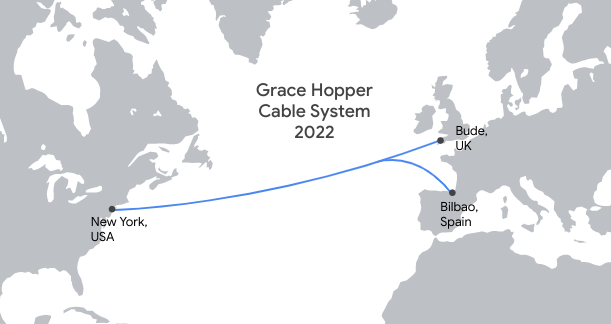
Google today announced its plans to build a new subsea cable with landing points in New York in the U.S. and Bude, U.K. and Bilbao, Spain in Europe. The new cable, named after the pioneering computer scientist Grace Hopper, will join Google’s various other private subsea cables like Curie between the U.S. and South America, Dunant between the U.S. and France and Equiano between Europe and Africa.
The new cable is scheduled to go online in 2022 and will be built by SubCom, which Google also contracted for work on its Dunant and Curie cables.

Image Credits: Google

Google plans to launch a new Google Cloud region in Madrid in the near future, so it’s maybe no surprise that it is also looking at how it can best connect the region to its global network. The new cable marks Google’s first cable to Spain and its first private subsea cable route to the U.K.
The cable will feature 16 fiber pairs, which is a pretty standard number, but as the Google team stresses, it will be the first to use a new switching architecture the company developed in cooperation with SubCom. This new system is meant to provide increased reliability and to enable the company to better move traffic around outages.
Grace Hopper will be Google’s fourth wholly owned cable. In addition to these private cables, the company is also a member of a number of consortiums that jointly operate cables around the world. In total, Google has now announced investments in 15 subsea cables, though it is also reportedly part of the upcoming Blue-Raman Cable that will run between India and Italy via Israel. The company has yet to confirm its participation in this project, though.

(ZH) Goldman Warns "Real Concerns Are Emerging" About The Dollar As Reserve Curr

Goldman Warns "Real Concerns Are Emerging" About The Dollar As Reserve Currency; Goes "All In" Gold


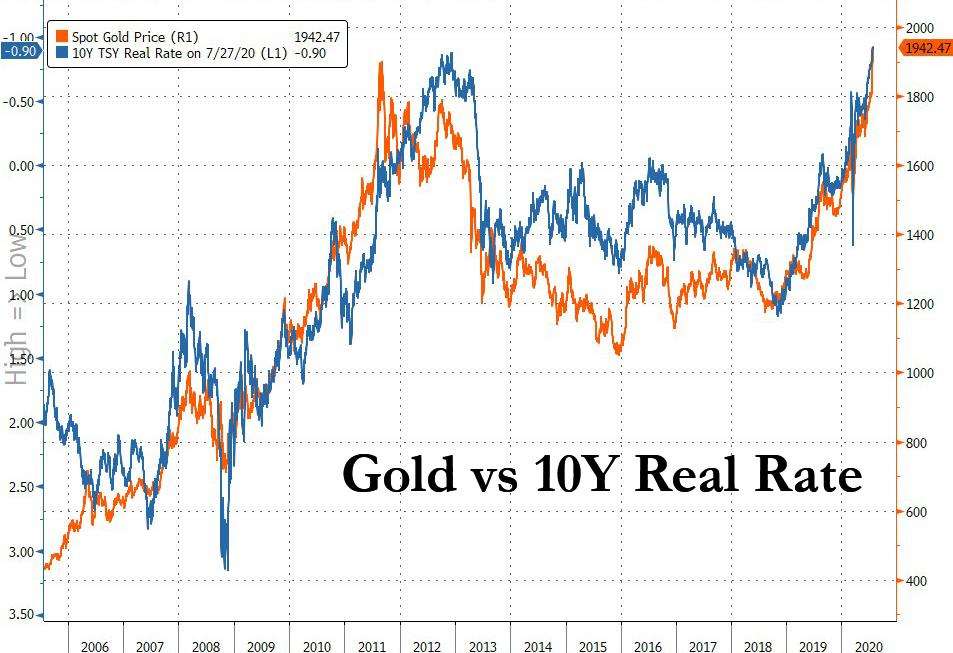
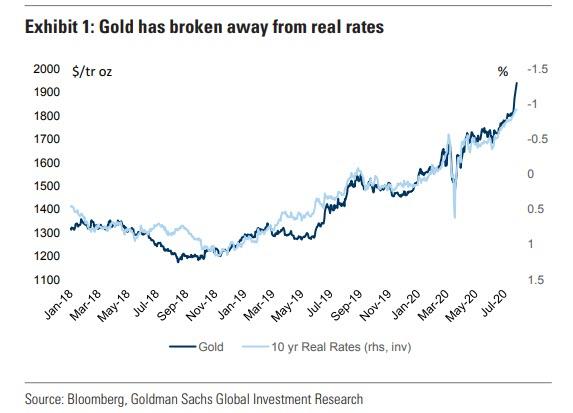
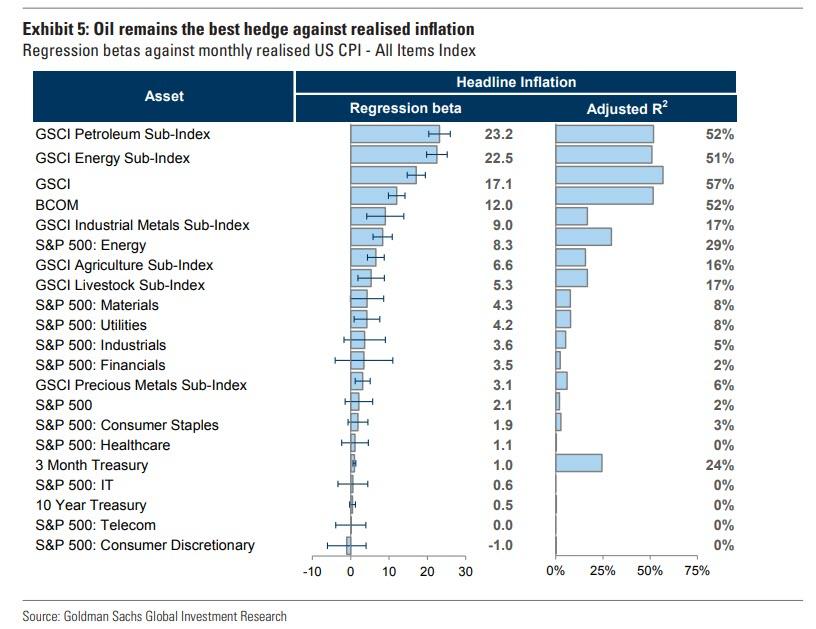
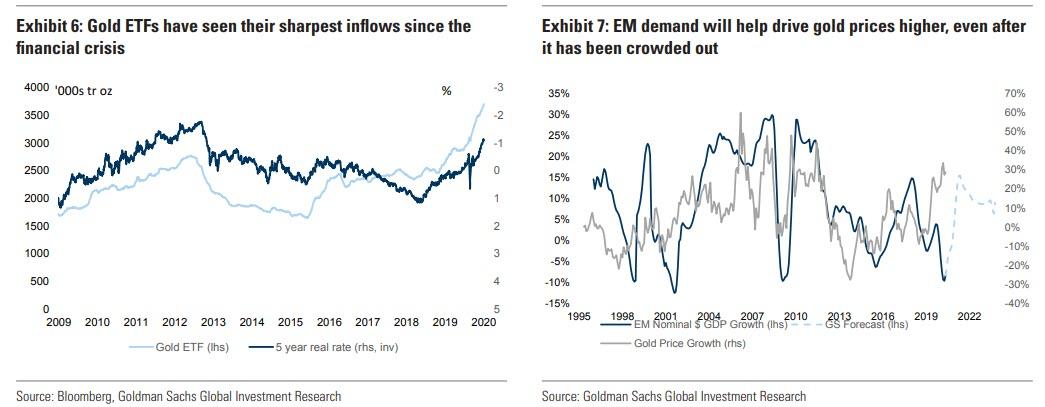
In his morning critique of goldbugs' resurgent optimism about the future of gold, which has exploded alongside the price of precious metals, which in turn have been tracking the real 10Y rate tick for tick...
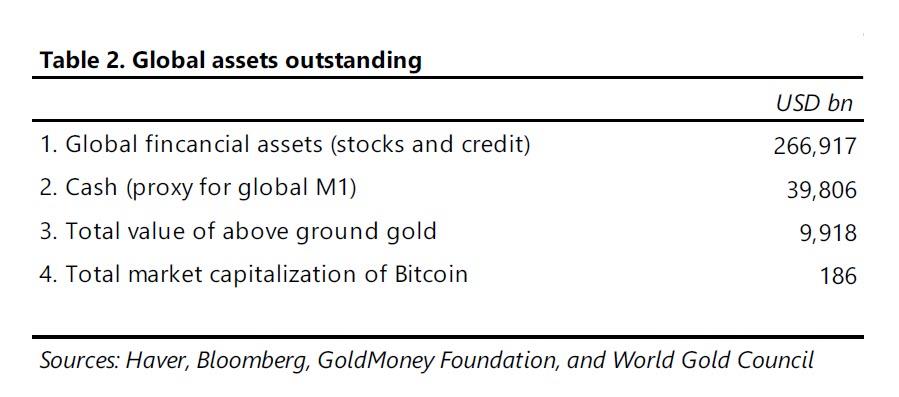
... Rabobank's Michael Every argued from the familiar position of one who views the modern monetary system as immutable, and bounded by the confines of the dollar as a reserve currency and financial assets as a bedrock of modern household wealth, of which as Paul Tudor Jones recently calculated there is over $300 trillion worth, compared to just $10 trillion in total gold value.

Indeed, according to Every, the surge in gold is meaningless because "if you buy gold, technically that is going to make you money. And yet that money is still going to be priced in US DOLLARS – and that gives the whole game away."
Like fans of the England football team, gold fans can dream of the distant past when gold was the centre of the global monetary system; but they can keep dreaming if they think those days are ever going to return. Gold may be an appreciating asset, but all the evidence suggests that it won’t be one that is of any direct relevance to day-to-day life, finance, and business. Your currency won’t be tied to it. You won’t get paid in it. You won’t spend in it or save in it (other than to the switch back to US Dollars). You won’t be doing deals in it or importing in it."
Yes but... what if your currency ends up getting tied to it? What if you do get paid in gold? What if you save in gold without any intention of switching back to dollars?
In short, what if the dollar is no longer the world's reserve currency?
Impossible you say... well, we would disagree. After all, in a world where there is over $100 trillion in dollar-denominated debt which can not be defaulted on and thus must be inflated away, the "exorbitant privilege" of the dollar has become a handicap. But don't take our word: here is Jared Bernstein, Obama's former chief economist warning all the way back in 2014 in a NYT op-ed that the US Dollar must lose its reserve status:
There are few truisms about the world economy, but for decades, one has been the role of the United States dollar as the world’s reserve currency. It’s a core principle of American economic policy. After all, who wouldn’t want their currency to be the one that foreign banks and governments want to hold in reserve?
But new research reveals that what was once a privilege is now a burden, undermining job growth, pumping up budget and trade deficits and inflating financial bubbles. To get the American economy on track, the government needs to drop its commitment to maintaining the dollar’s reserve-currency status.

Agree or disagree with Bernstein's ideology, never has his assessment about the state of the American economy been more accurate than it is now.
To be sure, since then there have been a handful of other "serious" economists suggesting that the only way the US economy can "reboot" itself and reset its economic engine is for the dollar to lose its currency status, but it is only in the past few days - when the dollar plunged and gold soared to new all time highs - that we have seen a barrage of Wall Street reports contemplating what until recently was viewed as impossible: a world where the dollar is not the reserve currency.
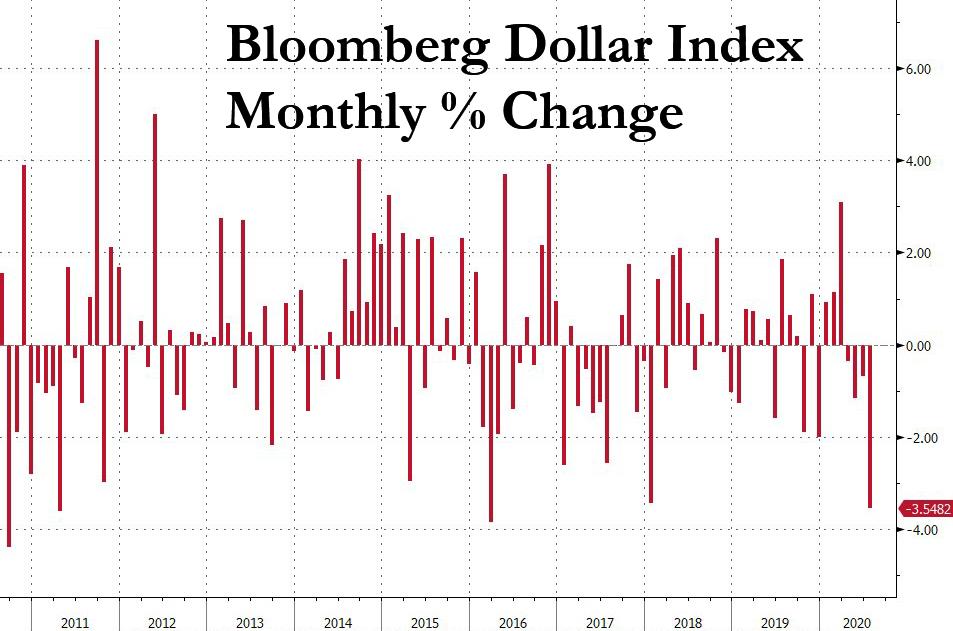
Meanwhile, after its explosive burst higher in March and April, the Bloomberg Dollar Spot Index is on course for its worst July in a decade. The drop comes amid renewed calls for the dollar’s demise following a game-changing rescue package from the European Union deal, which spurred the euro and will lead to jointly-issued debt.
Which brings us to this morning, when none other than the world's most influential investment bank Goldman Sachs, by way of its chief commodity strategist Jeffrey Currie, wrote that "real concerns around the longevity of the US dollar as a reserve currency have started to emerge."
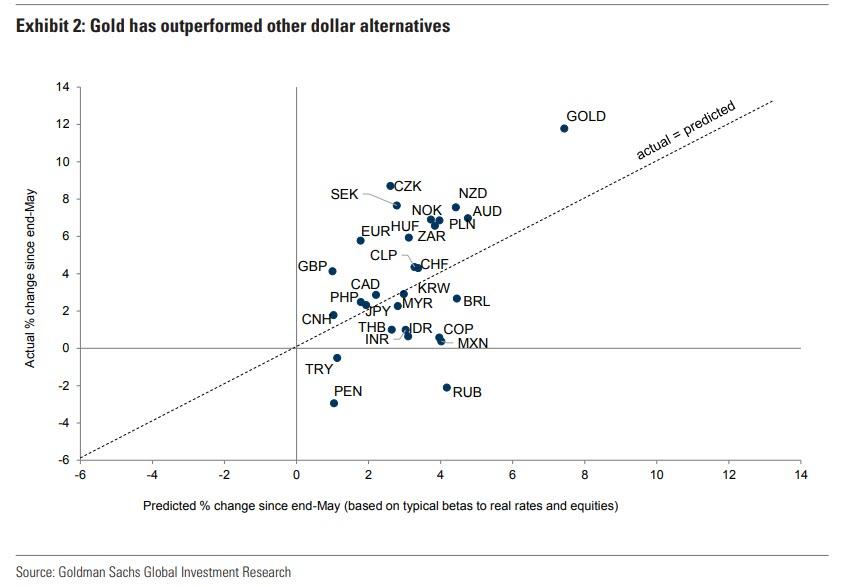
Specifically, Goldman looks at the recent surge in gold prices to new all-time highs which has "substantially outpaced both the rise in real rates...
... and other US dollar alternatives, like the Euro, Yen and Swiss Franc"...
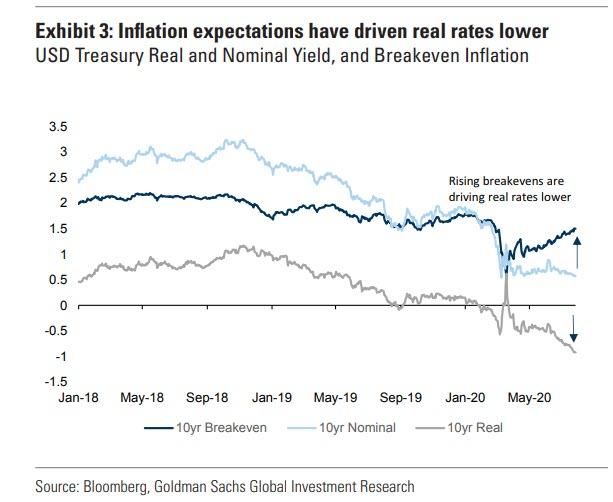
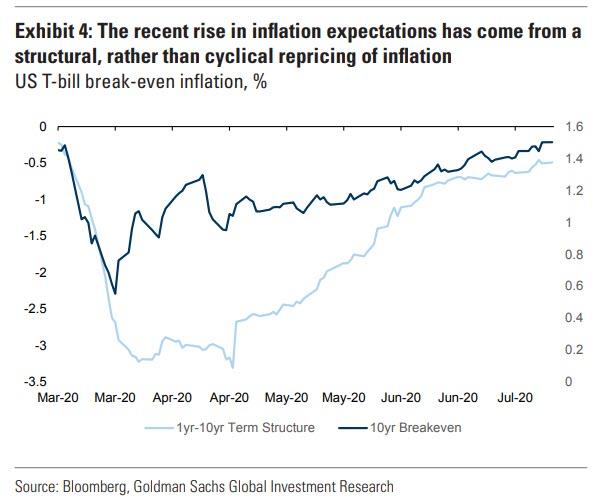
... with Currie writing that he believes this disconnect "is being driven by a potential shift in the US Fed towards an inflationary bias against a backdrop of rising geopolitical tensions, elevated US domestic political and social uncertainty, and a growing second wave of covid-19 related infections."
This, combined with the record level of debt accumulation by the US government, means that "real concerns around the longevity of the US dollar as a reserve currency have started to emerge."
Then, Currie reminds his clients that he has "long maintained gold is the currency of last resort, particularly in an environment like the current one where governments are debasing their fiat currencies and pushing real interest rates to all-time lows, with the US 10-year TIPs at -92bp is 5bp below the 2012 lows," and we indeed noted Currie's reco to buy gold one day after the Fed went all-in on March 24.
Four months later, the urgency is even greater, and Currie writes that "with more downside expected in US real interest rates we are once again reiterating our long gold recommendation from March and are raising our 12-month gold and silver price forecasts to $2300/toz and $30/toz respectively from $2000/toz and $22/toz."
There are other reasons why Goldman believes that Gold's surge is only just starting: "This relentless decline in real interest rates against nominal rates bounded by the US Fed has caused inflation breakevens to rise (see Exhibit 3) in an environment that would ordinarily be viewed as deflationary, i.e. a weakening US labor market as the country re-enters lockdown."
This is bad, and is usually described by what may be the most loathed word in the banker lexicon: "stagflation."
Which also explains the "irony" of the response: the greater the deflationary concerns that policymakers must fight today, the greater the debt build up and the higher the inflationary risks are in the future according to Currie, who expands further on this critical topic:
The deflationary shock caused by the pandemic drives the need to expand balance sheets to support demand today, as seen in the latest US $1.0 trillion Phase 4 stimulus and the €750 billion pan-EU recovery fund. The resulting expanded balance sheets and vast money creation spurs debasement fears which, in turn, create a greater likelihood that at some time in the future, after economic activity has normalized, there will be incentives for central banks and governments to allow inflation to drift higher to reduce the accumulated debt burden.
Indeed, this has already been seen in recent FOMC minutes, as discussions of explicit outcome-based forward guidance raises the prospect for Fed-sanctioned overheating of the economy.
And despite the longer-term nature of these risks, Goldman argues that "asset managers have real concerns today about persistent unanticipated shifts in inflation that can create large discrepancies between current expected real returns and actual realized returns" and this is manifesting itself in the continued faith in the dollar.
What about the gold price? Here is Currie's explanation why gold will continue to surge:
The key point from a hedging perspective is that asset managers care about the level of inflation, not the changes in inflation, and from a level perspective, inflation hedges like commodities and equities are likely far cheaper today than in the future when inflation could arrive. When discussing the drivers of investment demand for gold and commodities, it is important to distinguish between debasement and inflation. The key is that the current debasement and debt accumulation sows the seeds for future inflationary risks despite inflationary risks remaining low today. While debasement in many cases leads to inflation, it is not always the case as witnessed over the past decade. Equally, the best debasement hedge (gold) is not always the best hedge against inflation (oil). Indeed, the word debasement comes from adding base metals like tin or copper to the precious metals that acted as hard currency; therefore, owning the pure precious metal is then the best hedge against debasement.
However, this does not mean gold is the best hedge against inflation — a common misconception of many investors. Gold doesn’t appear significantly in any CPI anywhere in the world. As a result, oil and other commodities that drive the items actually found in different CPIs are the best hedges against inflation. But
Next, Currie goes on to explain why oil may be the best pure play commodity hedge to inflation, "today the risk is from debasement of fiat currencies that sows the risk for inflation and gold is the best hedge against debasement. Further out as inflation risks rise, oil and equities hedge unexpected and expected inflation respectively better than gold (see Exhibit 5), and given the size of the bond portfolios built over the past decade that will need to be hedged against inflation risks, the sheer size of investment demand for commodities is likely to be massive, underscoring the need to act today. "
Hence, gold at $2,000 and soon... $3,000, $5,000 and much more. Indeed, even at $10,000/oz, the total value of gold would be just around $50 trillion, which is still orders of magnitude below the value of global financial assets that need to be hedged (and which according to Paul Tudor Jones is around $270 trillion).
As Currie then notes, the result of this growing debasement risk is that "DM investment demand strength has continued with ETF additions in both Europe and US running high (see Exhibit 6). We see this trend persisting for some time as investment allocations into gold increase inline with allocations to inflation protected assets, similar to what happened after the financial crisis. Following the GFC, inflation fears peaked only at the end of 2011 as the bounce back in inflation ran out of steam, bringing the gold bull market to a halt. Similarly, we see inflationary concerns continuing to rise well into the economic recovery, sustaining hedging inflows into gold ETFs alongside the structural weakening of the dollar, we see gold being used as a dollar hedge by fund managers. Indeed, decomposing our gold forecast, with returns of 18% over the next 12 months, we estimate 9% of the growth is driven by 5yr real rates going to -2% over the next 12 month, (an est. elasticity of 0.1), while the second 9% comes from the 15% increase in the EM dollar GDP (an est. elasticity of 0.5) (see Exhibit 7)."
On top of these known flows, a large share of physical investment demand in gold is non-visible according to Goldman, in particular vaulted bar purchases by high net worth individuals. Looking at net Swiss imports one can see that gold stocks in Switzerland, where most of these private vaults are located, have been building at close to a record pace.
And in case that wasn't enough, "the stretched valuations in equities, low real rates and high level of economic and political uncertainty all point toward continued inflows by high net worth individuals," in Goldman's view.
But wait there's more, with Goldman singling out the potential of a fresh EM demand surge: Indian gold imports are still down 80% yoy in June and the Chinese gold premium is beginning to turn negative again (see Exhibit 9). More recently, however, the weakness in EM demand has been driven more by gold’s high price, as consumers cannot afford to buy gold products at those levels. However, EM currencies are no longer under pressure and India has begun to see the rupee strengthen over the past month. EM growth is also beginning to recover with EM activity entering positive YoY territory in June for the first time since January and our economists seeing the worst of
the EM outlook behind us (see Exhibit 10). EM retail investment demand is also boosted by easier monetary policy together with continued inflation driving EM real rates down. In India, policy rates fell below the YoY inflation rate for the first time since 2013."
Taken together, and in light of the declining faith in the dollar as a reserve currency, Goldman believes that these factors create a perfect setup for a rebound in EM demand for gold similar to 2010-11:
We will likely see this demand materialize when price stabilizes somewhat and DM investment purchases slow down, creating more room for EM consumers. We feel that for now, investors should not be concerned by weak EM demand prints.
As a final point, Goldman also spared some love for silverbugs, raising its silver forecast to $30/toz on a 3/6/12 month horizon, "pulled upward by higher gold prices and better prospects for silver industrial demand, particularly in solar energy (c.15% of silver demand). Both the European Green Deal and Biden’s war on climate change plans imply a doubling every year of solar panel capacity installations in both the US and Europe. At the same time, silver demand in consumer electronics is benefiting from the transition to working from home as it is heavily used in consumer items such laptops, mobile phones and televisions. Even housing demand, where silver is used in light switches, looks to be better than expected with property sales in both US and China rebounding strongly. Silver has rallied almost 30% over the past few weeks but its ratio with gold is only back to its level at the beginning of this year of 80."
Currie's final point on silver:
Historically there has been a tight relationship between silver industrial demand and the gold-silver price ratio. If silver industrial demand next year is 5% higher versus its 2019 level, the gold-to-silver ratio would fall further to 77. Assuming this ratio, our $2300/toz gold target would imply a $30/toz silver price.
That sounds awfully familiar: here's why: