>>> Up
* Ageas SA/NV Raised to Buy at HSBC; PT 46 euros
* BIC Raised to Neutral at Oddo BHF (+)
* Carnival Plc Raised to Hold at Berenberg; PT 800 pence (+)
* Davide Campari-Milano NV Raised to Neutral at Mediobanca SpA
* Castellum Raised to Neutral at Goldman; PT 169 kronor
* Danske Bank Raised to Buy at Citi
* Deutsche Beteiligungs AG Raised to Buy at M.M. Warburg (+)
* Elekta Raised to Equal-Weight at Morgan Stanley; PT 86 kronor
* Endesa Raised to Buy at JB Capital Markets; PT 27 euros (+)
* Exel Raised to Hold at Portzamparc; PT 39 euros (+)
* Ferguson Raised to Buy at SocGen; PT 8,500 pence (+)
* Finnair Raised to Buy at Carnegie; PT 55 euro cents
* Foxtons Raised to Hold at Peel Hunt; PT 36 pence
* Gerresheimer PT Raised to 115 euros from 75 euros at Berenberg
* HSBC Holdings Raised to Buy at Investec; PT 395 pence
* Imerys Raised to Buy at HSBC; PT 41 euros
* Intesa Sanpaolo Raised to Neutral at Oddo BHF (+)
* Kamux C Raised to Buy at SEB Equities; PT 10.30 euros
* NCAB Group Raised to Buy at Carnegie; PT 250 kronor (+)
* Nokian Renkaat Raised to Hold at SEB Equities; PT 20 euros
* Nordea Bank Raised to Buy at Citi
* Reckitt PT Raised to 9,400 pence from 9,000 pence at Barclays (+)
* Ricardo Raised to Hold at Panmure Gordon; PT 324 pence (+)
* Sodexo Raised to Buy at Deutsche Bank; PT 70 euros
* Swedbank Raised to Buy at Citi
* Verallia SA Raised to Buy at Berenberg; PT 31 euros
* Zalando Raised to Buy at SocGen
>>> Down
* Aggreko Cut to Hold at Investec; PT 440 pence (+)
* ASML Cut to Market Perform at Bernstein; PT 292 euros
* ASML ADRs Cut to Market Perform at Bernstein; PT $322
* Cegedim Cut to Reduce at Gilbert Dupont; PT 28 euros (+)
* Embracer Group AB Cut to Hold at SEB Equities; PT 135 kronor
* Endesa Cut to Neutral at Citi; PT 24.50 euros
* Kingspan Cut to Hold at HSBC; PT 59 euros
* LVMH Cut to Sell at LBBW; PT 325 euros
* Neste Cut to Hold at SocGen; PT 41 euros
* Seche Environnement Cut to Neutral at Oddo BHF (+)
* Vontobel Cut to Hold at Octavian; PT 70 Swiss francs (+)
>>> Initiation
* BASF’s 3Q Outlook May Be Taken Poorly, Cash Flow Strong: Baader (+)
* PharmaSGP Holding Rated New Buy at Berenberg; PT 42.50 euros
* Vitec Rated New Buy at Jefferies; PT 885 pence
>>> Call
* Capgemini Update ‘Positive,’ Highlights Resilience, Goldman Says (+)
* Carrefour French Hypers Work in Progress, But LatAm Shines: Citi (+)
* Ferragamo 2Q Sales Disappoint, Consensus to Come Down: Analysts
* Next 2Q Sales Beat Helped by Online, Store Reopenings: Berenberg (+)
* Puma 2Q Broadly in Line With Estimates, Morgan Stanley Says (+)
* Sanofi ‘Strong’ Results Helped by Regeneron Revaluation: Goldman (+)
DAX:
- Deutsche Bank (DBK TH) +2.5%
- Deutsche Bank Sees Full-Year Revenue Slightly Better: TOPLive
- Bayer (BAYN TH) -0.4%
- Deutsche Post (DPW TH) -0.4%
- Cromwell, IGIS Asset Buy Italian DHL Logistics Portfolio
- Allianz (ALV TH) -0.4%
- Infineon (IFX TH) -0.5%
- Fresenius SE (FRE TH) -0.8%
- Siemens (SIE TH) -0.8%
- E.On (EOAN TH) -1%
- E.On Affirmed at BBB+ by Fitch
- Wirecard (WDI TH) -2.7%
- Wirecard Scandal Is Now Part of the Post-Merkel Power Play
- BASF (BAS TH) -2.8%
- BASF Sees Sluggish Third Quarter as Chemical Demand Remains Low
MDAX:
- Delivery Hero (DHER TH) +1.7%
- Uniper (UN01 TH) +0.7%
- Telefonica Deutschland (O2D TH) +0.6%
- Telefonica Deutschland 2Q Adj. Oibda EU552m, est. EU567m
- Lufthansa (LHA TH) +0.5%
- Osram (OSR TH) +0.3%
- Osram 3Q Profit Sinks Less than Expected on Cost Savings
- Thyssenkrupp (TKA TH) -0.7%
- Aroundtown (AT1 TH) -0.8%
- ProSieben (PSM TH) -0.9%
- Aareal Bank (ARL TH) -1%
- Airbus (AIR TH) -1%
SDAX:
- Jenoptik (JEN TH) +4.4%
- DWS (DWS TH) +3.6%
- DWS Second Quarter Net Inflows Beats Estimates
- Steinhoff (SNH TH) +2.4%
- DIC Asset (DIC TH) +1.8%
- DIC Asset First Half FFO EU50.6 Mln, +18% Y/y
- LPKF (LPK TH) +1.8%
- Sixt (SIX2 TH) -1.3%
- Nordex (NDX1 TH) -1.4%
- Corestate (CCAP TH) -1.5%
- Deutz (DEZ TH) -2.1%
- Wacker Neuson (WAC TH) -2.4%
-
AMS (DQW1 TH) +2.3%
- AMS Second Quarter Adjusted Ebit Beats Estimates
- TUI (TUI1 TH) +2.3%
-
Deutsche Bank (DBK TH) +2.1%
- Deutsche Bank Sees Full-Year Revenue Slightly Better: TOPLive
- AstraZeneca (ZEG TH) +1.8%
- Delivery Hero (DHER TH) +1.4%
-
Glaxo (GS7 TH) +1.3%
- Sanofi, Glaxo to Supply U.K.; China Cases Up: Virus Update
- Sanofi (SNW TH) +1.2%
- Sanofi’s Outlook Improves as Key Drugs Offset Covid Disruption
-
Solvay (SOL TH) +1.2%
- Solvay Hastens $352 Million Cost Cut to Cope With Aircraft Slump
- BP (BPE5 TH) +1.1%
- TOTAL SE (TOTB TH) +0.8%
- Fraport (FRA TH) -1.1%
- Intesa Sanpaolo (IES TH) -1.2%
- MTU Aero (MTX TH) -1.5%
- Safran (SEJ1 TH) -1.5%
- Vestas (VWS TH) -1.5%
- Siemens Gamesa (GTQ1 TH) -1.7%
- Rational (RAA TH) -2.1%
- ASML (ASME TH) -2.2%
- Worldline (WO6 TH) -2.8%
-
BASF (BAS TH) -3.2%
- BASF Second Quarter Adjusted Ebit EU226 Mln, -77% Y/y
Asian stocks struggled for a clear direction on Wednesday as investors awaited the conclusion of the Federal Reserve’s policy meeting. Treasuries held overnight gains and the dollar steadied.
Shares slipped in Japan, where Fitch Ratings lowered its outlook on the country’s debt and earnings at Canon Inc. disappointed. Stocks saw modest gains in Hong Kong and South Korea, and outperformed in China on low volumes. S&P 500 futures fluctuated after the benchmark closed lower, with worse-than-estimated results from the likes of McDonald’s Corp. and 3M Co.weighing on shares. Gold slipped toward $1,950 an ounce.
US After Hours FEYE +12.1%, AMD +10%, SBUX +5.7% up big on earnings; STX -7.8%, EBAY -3.1%, V -2.2% lower on earnings
Nikkei -0.99% Hang Seng +0.12% CSI +1.39% Shanghai +1.05% Shenzen +1.64%
Eur$ 1.1731 CNH 7.0029 CNY 7.0028 JPY 105.09 GBP 1.2921 CHF 0.9174 RUB 72.5166 WTI$41.04 0.00%
S&P -0.20% Nasdaq -0.10% EuroStoxx -0.52% FTSE -0.48% Dax -0.57% SMI -0.41%
Macro :
- Fed Extends Emergency Loan Programs. Aid Talks Stall: Daybreak
- BIDEN SAYS PROFESSIONAL SPORTS 'PROBABLY' WON'T BE POSSIBLE
- GM, Ford May Top Estimates After One of the Toughest Periods Yet
Keep an eye on :
- AENA SM : Aena First Half Loss EU170.7 Mln Vs. Profit EU559 Mln Y/y
- AIR FP : Airbus Is Among Investors in Private Equity Aeronautics Fund
- AIR FP : Spain Prime Minister, Airbus CEO to Meet July 30: Confidencial
- ATC NA : Altice USA to Sell Lightpath Stake to Morgan Stanley for $2.3b
- ATE FP : Alten 1H Rev. Falls 4%; Sees FY Organic Sales Falling About 12%
- AMG NA : AMG Second Quarter Revenue $207.6 Mln
- APAM NA : Aperam Second Quarter Ebitda Beats Estimates
- AMS SW : AMS Second Quarter Adjusted Ebit Beats Estimates
- ASM NA : ASMI Third Quarter Revenue Forecast Beats Estimates
- SAN SM : Santander Posts 2Q EU11.1 Bln Loss, 12.6 Bln Impairment (1)
- BAS GY : BASF Second Quarter Adjusted Ebit EU226 Mln, -77% Y/y
- BCP PL : BCP First Half Net Income EU76 Mln, -55% Y/y (1)
- BGBIO NO : BerGenBio to Set Up New Covid Study After Accord Funds Pulled
- BESI NA : BE Semiconductor to Offer EU150m 2027 Convertible Bond: Terms
- BB FP : BIC Second Quarter Comparable Sales Growth -21.5%
- EN FP : Bouygues: AGM to Vote on EU1.70 Div on Sept 4 for 2019
- BVI FP : Bureau Veritas First Half Revenue 3.8% Above Estimates
- CAP FP : Capgemini Reports 1st-Half Estimated Revenue of EU7.58b
- CA FP : Carrefour’s 1H Results Are ‘Well Above’ Consensus, Barclays Says
- CGG FP : CGG Second Quarter Segment Ebitdas Misses Lowest Estimate
- CSGN SW : Credit Suisse Set to Merge Investment Bank and Trading in Revamp
- CSGN SW : Credit Suisse CEO Ready to Make Mark, Address Weaker Fees: React
- DBK GY : Deutsche Bank Turnaround Gets Another Boost From Trading Rally
- DTE GY : T-Mobile’s Demand Shows Thirst for Rights Offerings: ECM Watch
- DIC GY : DIC Asset First Half FFO EU50.6 Mln, +18% Y/y
- DWS GY : DWS Second Quarter Net Inflows Beats Estimates
- ELI BB : Elia Group First Half Adjusted EPS EU1.75 Vs. EU1.87 Y/y
- ENC SM : Ence Second Quarter Loss EU13 Mln
- RF FP : Eurazeo SE First Half Net Asset Value Per Share EU70.70
- EUCAR FP : Europcar 1H Revenue Down 38% Y/y; Holds Cautious View on 3Q
- FUR NA : Fugro First Half Adjusted Ebitda Beats Estimates
- GAM SW : *BANTLEON VOTING RIGHTS IN GAM RISE TO 10.08% FROM 5.23%: SIX
- IMA IM : BC Partners Strikes Deal to Take Italy’s IMA Industria Private
- IFCN SW : Inficon Second Quarter Net Income $12.9 Mln, +9.3% Y/y
- ISP IM : Intesa’s Set to Gain Control of UBI After 72% of Shares Tendered
- JUP LN : Jupiter Cuts More Than Half of Merian Staff After Acquisition
- KER FP : Kering 1H Ebit Ahead of Expectations, Bernstein Says
- KER FP : Gucci Owner Sees Online Leading Recovery After Sales Plunge
- SKB GY : Koenig & Bauer 1H Ebit Loss EU40.9 Mln Vs. Profit EU0.6 Mln Y/y
- LEHN SW : Lem First Quarter Ebit CHF13.3 Mln, -20% Y/y
- LUNE SS : Lundin Energy Second Quarter Ebitda $335.1 Mln, -19% Y/y
- MMT FP : M6 First Half Revenue -22%
- MDM FP : Maisons Du Monde First Half Ebitda EU68.8 Mln, -29% Y/y
- MELE BB : Melexis Second Quarter EPS Beats Highest Estimate
- NEOEN FP : Neoen Sees Full Year Ebitda Margin Above 80%
- NESN SW : Nestle Purina to Spend $167m Expanding Plant in Pennsylvania
- NETWLN : Network International to Buy DPO for $288m, Place 50m New Shares
- NEX FP : Nexans Sees Full Year Ebitda EU310 Mln to EU370 Mln
- NXI FP : Nexity First Half Revenue EU1.72 Bln, -6.7% Y/y
- OMV AV : OMV 2Q Net Income Slumps to EU24m on Lower Oil Price, Demand
- OSR GY : Osram 3Q Profit Sinks Less than Expected on Cost Savings
- REE SM : Red Electrica Second Quarter Revenue 2.1% Below Estimates
- RNO FP : Nissan -10.2% In Tokyo
- ROG SW : Roche Says Phase III Covacta Study Did Not Meet Primary Endpoint
- SPM IM : Saipem Second Quarter Revenue Misses Lowest Estimate
- SFER IM : Ferragamo Sees July Improvement, Led by China, Japan, Korea
- SAN FP : *SANOFI RAISES 2020 GUIDANCE, NOW SEES 6%-7% EPS GROWTH
- SAN FP : Sanofi, Glaxo to Supply U.K. Up to 60m Covid-19 Vaccine Doses
- SU FP : *SCHNEIDER RE-ESTABLISHES 2020 TARGETS, RESUMES SHARE BUYBACKS
- SOI FP : SOITEC Holder CEA Investissement to Offer 1.07m Shrs
- SOLB BB : Solvay Second Quarter Adjusted Ebitda Beats Highest Estimate
- SOP FP : Sopra Steria First Half Revenue EU2.17 Bln, -1.8% Y/y
- SPIE FP : Spie First Half Ebita EU93.3 Mln, -40% Y/y
- STM FP : STMicroelectronics Prices $1.5b of 5Y, 7Y Convertibles Mid-Range
- O2D GY : Telefonica Deutschland 2Q Adj. Oibda EU552m, est. EU567m
- TSLA US : *TESLA RATING RAISED TO B+ FROM B- BY S&P; OUTLOOK STABLE
- TFI FP : TF1 Second Quarter Advertising Rev. EU244.4 Mln, -41% Y/y
- TLW LN : Tullow Sees Up to $1.7b of Writedowns as It Cuts Price Forecasts
- UCB BB : UCB, Roche Sign License Pact for Alzheimer’s Disease Treatment
- UCG IM : UniCredit to Reinstate Capital Distribution Policy From 2021
- VPK NA : Vopak Second Quarter Revenue Misses Lowest Estimate
- WDI GY : German Regulator Misinformed Bundestag on Wirecard, Spiegel Says
- WDI GY : Wirecard Scandal Is Now Part of the Post-Merkel Power Play
- WDI GY : German Watchdog Says Wirecard Testimony to Lawmakers Was Correct
>>> Up
* Ageas SA/NV Raised to Buy at HSBC; PT 46 euros
* *CARNIVAL PLC UP TO HOLD AT BERENBERG; CARNIVAL CORP STAYS SELL
* Davide Campari-Milano NV Raised to Neutral at Mediobanca SpA
* Castellum Raised to Neutral at Goldman; PT 169 kronor
* Danske Bank Raised to Buy at Citi
* Elekta Raised to Equal-Weight at Morgan Stanley; PT 86 kronor
* Finnair Raised to Buy at Carnegie; PT 55 euro cents
* Foxtons Raised to Hold at Peel Hunt; PT 36 pence
* Gerresheimer PT Raised to 115 euros from 75 euros at Berenberg
* HSBC Holdings Raised to Buy at Investec; PT 395 pence
* Imerys Raised to Buy at HSBC; PT 41 euros
* Kamux C Raised to Buy at SEB Equities; PT 10.30 euros
* Nokian Renkaat Raised to Hold at SEB Equities; PT 20 euros
* Nordea Bank Raised to Buy at Citi
* Sodexo Raised to Buy at Deutsche Bank; PT 70 euros
* Swedbank Raised to Buy at Citi
* Verallia SA Raised to Buy at Berenberg; PT 31 euros
* Zalando Raised to Buy at SocGen
>>> Down
* ASML Cut to Market Perform at Bernstein; PT 292 euros
* ASML ADRs Cut to Market Perform at Bernstein; PT $322
* Embracer Group AB Cut to Hold at SEB Equities; PT 135 kronor
* Endesa Cut to Neutral at Citi; PT 24.50 euros
* Kingspan Cut to Hold at HSBC; PT 59 euros
* LVMH Cut to Sell at LBBW; PT 325 euros
* Neste Cut to Hold at SocGen; PT 41 euros
>>> Initiation
* PharmaSGP Holding Rated New Buy at Berenberg; PT 42.50 euros
* Vitec Rated New Buy at Jefferies; PT 885 pence
>>> Call
* Ferragamo 2Q Sales Disappoint, Consensus to Come Down: Analysts
Kering Banks on Young Consumers After Worst Quarter on Record
The French luxury group said Millennial and Gen Z customers were the first to return to its stores.
PARIS — Fresh off its worst quarter on record, Kering is betting that Millennial and Gen Z customers will help it bounce back from the coronavirus crisis in the second half, led by a recovery in the key Asia-Pacific region.
Net profit fell 63.4 percent in the first six months of the year after COVID-19 forced the French luxury group to close stores and factories worldwide, and brought tourism to a halt. Kering warned that it does not expect its lost revenues to be offset by the end of the year.
Group revenues in the three months to June 30 fell 43.5 percent to 2.17 billion euros, representing a decline of 43.7 percent in comparable terms. This came on the heels of a 15.4 percent drop in the first quarter.
In percentage terms, the decline was greater than the one recorded by sector leader LVMH Moët Hennessy Louis Vuitton, which on Monday reported a 38 percent drop in second-quarter sales. But it was below a consensus of analyst estimates, which had called for a 48 percent fall.
Kering flagged an “encouraging” recovery as stores reopened, with sales in mainland China rising more than 40 percent in the second quarter, and positive trends emerging in Europe and the U.S. from mid-June. In addition, the group reported a 72.4 percent jump in online revenues during the period.
But organic sales at its cash cow brand Gucci fell 44.7 percent in the second quarter, compared with a 23.2 percent drop in the prior three months.
Luxury stocks took a hit on Tuesday on the back of the LVMH results — despite the fact that it also flagged a strong rebound in China — and Moncler posting a first-half loss for the first time in its history. Kering was dragged down by the sell-off, losing 2.7 percent to close at 483.20 euros on the Paris Stock Exchange.
“It is fair to say that the first half of 2020 has been the toughest period we have faced,” François-Henri Pinault, chairman and chief executive officer of Kering, said in a statement issued after the market close.
“Our results today underscore the extent of the disruption exacted by the pandemic on our operations. Even more importantly, the resilience of our performances validates our model and supports our confidence that we will come out of this crisis even stronger,” he added.
In particular, the brand believes that its focus on sustainability and diversity will serve it well amid the current retail sector upheaval, said Jean-François Palus, group managing director of Kering.
“We have no doubt that luxury is here to stay, and the appetite of Millennial and Gen Z customers is not diminishing. As a matter of fact, they were the first ones back in our stores as we reopened,” he told a conference call on Tuesday.
“But trends we have flagged in the past are intensifying, not just under the influence of COVID-19, but also stimulated by the push for inclusivity and transparency we are seeing more and more today. These trends are well aligned with our culture and core values,” he added.
Palus cited the example of Gucci’s sustainable Off the Grid collection, launched last month with a campaign featuring personalities including actress Jane Fonda and rapper Lil Nas X.
The pandemic has also accelerated efforts to reduce waste. “We are working at all levels of the value chain, lowering the number of prototypes, reducing production waste and livestreaming fashion shows, to name a few. COVID-19 has proved a major driver of awareness and push to virtualization in this regard,” Palus said.
Finally, Kering has intensified its use of artificial intelligence to power everything from product recommendations to supply chain forecasting.
“We are not only pleased that all these projects were already under way when things got tough, giving us a significant head start, but we were also able to further enhance them in real time under particularly demanding conditions,” he said.
“We are confident in our ability to return to growth and higher profitability as soon as the worldwide environment stabilizes,” Palus concluded.
Kering, whose brands also include Saint Laurent, Bottega Veneta and Balenciaga, posted net income of 569.3 million euros in the first half. Recurring operating profit was down 57.7 percent to 952.4 million euros, yielding an operating margin of 17.7 percent, down from 29.5 percent in the same period last year.
“The lack of visibility about how the worldwide personal luxury goods market will evolve in the next few months makes it impossible to forecast the group’s second-half sales with any sufficient degree of reliability. The loss in revenue experienced in the first six months of the year should not be offset in the second half,” Kering predicted.
It declined to forecast its operating margin for 2020 as a whole, but said the cost-cutting measures implemented in the first half should bolster results during the second part of the year.
Gucci saw wholesale revenues shrink as the market struggled and it continued to streamline its distribution. “As stores reopened, the house regained a favorable momentum with local customers in its main markets. Online sales performed particularly well in the first half, up 51.8 percent,” Kering said.
Chief financial officer Jean-Marc Duplaix said the recovery in Asia-Pacific started in mainland China and spread to South Korea and Taiwan, while Hong Kong and Macau remained depressed. “Some Asian markets, as well as all key European countries, are heavily penalized by the lack of Chinese tourism,” he noted.
Saint Laurent posted a 48.4 percent drop in like-for-like sales, following a decline of 13.8 percent in the first quarter, reflecting its exposure to Western Europe and North America.
After bucking the general trend last quarter, Bottega Veneta also turned negative, with organic sales falling 24.4 percent, though the drop was contained by positive momentum in the stores that remained open and a rebound in mainland China and South Korea.
Other houses, a segment that includes Balenciaga and Alexander McQueen, saw sales decrease by 44 percent. Balenciaga maintained a double-digit operating margin during the first half, but watch manufacturers incurred losses as their markets contracted sharply, Kering reported.
“We are very pleased with the resilience of our brands in this context but we remain very vigilant about the trends for H2. There are a lot of moving pieces. The only one thing we know and we are clear about is the lack of tourism that will continue in 2020, and probably at least for the first half of 2021,” Duplaix said.
“What we know and we are convinced of is that the e-business will continue to grow,” he added.
Online sales accounted for 13 percent of Kering’s retail revenues in the first half, versus 6 percent in the same period a year ago, with Saint Laurent and McQueen launching Chinese web sites in June.
“In North America, where e-comm was already a key channel, it reached record levels. In Asia-Pacific, penetration roughly doubled year-on-year, with plenty more potential. In all regions, trends kept a very strong momentum, near or above triple-digits in June, despite gradual store reopenings,” Duplaix said.
Palus dismissed the prospect that Kering would offload its loss-making brands, which include men’s wear label Brioni.
“We think that they have their place in our portfolio of brands, and we are quite confident that when the environment stabilizes, they will have a decent growth pattern and they will come quickly back to profitability,” he said.
Analysts said the results indicated Kering was successfully containing costs, partly because it is able to adapt its outsourced production to drops in demand.
Piral Dadhania, analyst at RBC Capital Markets, said although Gucci has a disproportionate weight on the group’s sales and EBIT, some of the other assets, such as Bottega Veneta and Balenciaga, have potential in the medium term.
“Investments and significant progress in recent years of the Kering corporate platform (logistics, digital, personnel, retail network) set the business up well to continue nurturing assets in our view,” he said in a research note on Tuesday.
CEO Talks: SMCP’s Daniel Lalonde Draws Up New Plans for Business
“We’re not looking to replicate what we had before,” said the executive.
PARIS — Who’s hankering for a return to normal? Not Daniel Lalonde. The chief executive officer of SMCP, the group behind accessible luxury labels Sandro, Maje, Claudie Pierlot and De Fursac, is not looking back — the world has changed. He’s developing a business plan for the new order.
The group reported a 45.8 percent decline in second quarter sales to 265.7 million euros, reflecting the steep impact of coronavirus shutdowns and slow path to recovery, with the sharpest declines coming from the Americas. Across France, its biggest market, and the rest of Europe and the Middle East region, sales were down 46 percent and 54.9 percent, respectively. The Asia Pacific region clocked the best performance, down 19.5 percent, with the company flagging that growth returned to China in June.
“My objective is not to return to the performance and levels of 2018 and 2019 — for me, that’s the past,” said Lalonde, speaking from his modern and airy corner office overlooking ornate, historic buildings in the center of Paris.
“We’ve had a transformation and we’re not looking to replicate what we had before,” said the executive, who had embarked on a reflection on the company’s strategy before the coronavirus hit Europe.
While the message is clear in his mind, and he has begun communicating it to his teams, for some, it is not obvious, he noted.
Listed on the Paris Stock Exchange in 2017, the group has made store network expansion its key source of growth, adding new stores at a pace of 80 to 90 a year. That strategy was appropriate for broadening the group’s geographic reach outside of France, but the environment has now changed, in the executive’s view.
Lalonde is putting the finishing touches on new plans that reflect an emphasis on organic growth.
“My growth in the future — we will tailor it to have a bigger proportion of like-for-like growth,” he said.
“That’s a big pivot point,” he continued.
In the past, two thirds of the group’s growth came from expanding store space while a third came from like-for-like figures.
“It was the right strategy for building the brands in China, and expanding abroad,” said Lalonde.
In the future, more than 50 percent will be like-for-like growth, a shift he predicts will take place “fairly quickly.”
Stores, meanwhile, will become larger, and “more expressive,” with more personalized brand appeal, in his description.
“I expect to do half of the physical stores that I used to do,” he noted. The fast pace of expansion that reflected a strategy of increasing the group’s presence in markets abroad continues to make sense in China, however, where there is still room for more stores, added Lalonde.
In the Americas, the strategy has been to focus on digital means first, then complemented with physical stores, which reflects the future strategy in other markets.
“Our objective and ambition is to become a global leader in accessible luxury,” noted Lalonde, estimating the group’s current position as one of the top ten players worldwide.
“I want to, by the time we finish our plan, to move positions,” said the executive, describing his idea of becoming a “very modest LVMH of accessible luxury,” referring to LVMH Moët Hennessy Louis Vuitton, the luxury group that dwarfs rivals with a vast stable of 70 high-end brands.
One day, further in the future, Lalonde, envisions a larger accessories pole for the group.
“We have ambition to get into other sectors later,” said Lalonde, hinting at the accessories category as a potential area for future expansion. The group has focused on accessories of its brands in recent years, and they now account for around 10 percent of group sales, a proportion Lalonde sees rising into the “teens,” he said.
In the current environment, there has been talk of consumers gravitating to the least-expensive or higher-end labels, but Lalonde predicts people will be drawn to the ‘best-in-class’ brands at all ranges.
Reflecting on the ways in which the coronavirus crisis has changed the landscape that the group operates in, he listed several.
“There has been a massive acceleration of — I’d say, first of all — brand purpose,” he said.
“I think you have to not only have great product, service, etc., you have to stand for something as well,” he continued.
“What we’ve done for that, all our brands have done a deep dive in the last year, some very recently, re-going back to the roots, clarifying its DNA, all its brand environments to make sure that it’s very unique, captures the essence, and has purpose,” explained the executive.
Collection structures have been reviewed, the number of SKUs per collection has been reduced over the past year, from around 400 down by around 20 percent, and the company is trying to better manage inventory levels to have less product. There are no plans to reduce the time allowed for designing products, however.
“As you look at your business holistically we thought maybe there’s an opportunity to produce less and to reduce the number of references available because we think it will have an impact on our business, on our sales and it will make our stores look better, it will be more qualitative, for the experience as well,” he noted. The group will continue to lower SKUs slightly more while focusing on managing global inventory.
“If you do that well, you don’t miss a beat,” he said.
“There’s been a massive acceleration of sustainability,” he continued, noting while this is not new, the movement has been “amplified incredibly.”
“If you weren’t there before, it’s hard to get there so quickly,” he said.
SMCP plans to reveal specific objectives around sustainability at an investor day this fall, with initiatives at the group level — which is setting overarching objectives as well as with each brand.
Sourcing, much of which comes from Eastern Europe, is mostly separate for each brand — as set up by Sandro founder Evelyne Chétrite and her sister Judith Milgrom, founder of Maje — although negotiations can take part at the group level in the case of common suppliers.
The company does not source textiles through its owner, Chinese textile group Ruyi Group. Ruyi Group owns around 54 percent of SMCP, and has made headlines in recent months for struggling to meet debt payments, prompting speculation it could sell assets, which also include Lycra, Gieves & Hawkes and Cerruti.
Lalonde is interested in speeding up production time, from the current average of five to nine weeks replenishment time.
Online sales accounted for 15 percent of overall sales last year, rising quickly in just a few years, but Lalonde doesn’t want to have to discuss such figures in the future — it’s about having one integrated channel, he insists. The group has been building an omnichannel, or integrated system over the past two years, starting with Maje. It is designed for smoother online sales deliveries, allowing for shipment of products from stores, using algorithms to track merchandise. While SMCP was behind peers in this area five years ago, the new system will help it shoot ahead of others, estimated the executive.
“I think here we’re going to break through,” he said.
Meanwhile, the coronavirus crisis has brought on the need to attend to relations with landlords, and the company has been renegotiating rents worldwide. Lalonde has himself called the top 20 landlords every six weeks to readjust terms.
“How do you share the pain, how do you equitably share the impact between retailers and brands and landlords — that’s what we’re trying to find, is that line where it seems fair for both,” said the executive.
At the end of the first half of the year, SMCP counted 1,650 points of sale, including some 326 operated by external partners in markets like Russia and the Middle East.
When it comes to rent negotiations, variable rent contracts help hedge against lower sales, going down when business drops, but in the case of fixed rents, quickly becomes an issue.
“The issue is when you don’t have a variable rent and you have a high base rent. With lower sales, this has a big impact — and that’s what we’re trying to solve with all these landlords,” he said.
“It’s going, I’d say, relatively well but we haven’t solved all the issues yet for this year and more importantly for 2021 — it’s still a work in progress,” he said, noting arrangements vary according to each landlord.
A large proportion of selling points are in department stores — around 40 percent — which are mostly based on concessions contracts.
“We don’t do wholesale — I’m allergic to wholesale. I’m convinced we have the right sales model,” he said.
“The fact that we run a concession model, I think we’re more in control of our own destiny, we’re able to work with the department store but we have personnel there that is trained for our brands — we make sure that there are good levels of inventory, we can float goods in, and we are able to control the customer experience, because it’s our people,” he said, touting the strategy’s benefits.
The group’s labels are in leading department stores around the world, though fewer in the U.S., serving as a draw for space dedicated to more affordable apparel.
“Often we’re the traffic builders for accessible luxury — if you want to have a successful accessible luxury wing, you get Sandro, Maje,” he said.
The labels typically have the “best location and the biggest location” in the stores, he asserted.
The brands are in stores including David Jones in Australia; La Rinascente, Harrods, Selfridges, Galeries Lafayette, Le Bon Marché in Europe, and, in the U.S., Bloomingdale’s, Saks Fifth Avenue and Nordstrom, as well as Hudson’s Bay in Canada.
“There are still a lot who prefer a wholesale model” in the U.S., he noted, adding that it’s the only market where this is the case. U.S. department stores make up less than one or two percent of the group’s sales, he said.
“We don’t compromise on our business model — we could have more doors in the U.S. but we choose not to because I don’t want to compromise on our business model — either it’s a concession or if it’s not a concession then, no, thank you very much,” he said.
Reflecting on the overall mission of the group’s brands, Lalonde said he has slightly adjusted his message.
“Our mission of the overall company is still the same but I’ve tweaked it,” said the ceo, before rattling off his terms: “Inspire Parisian chic around the world as passionate and responsible entrepreneurs.
“We’re very much a company of entrepreneurs,” he said, noting SMCP, which counts around 6,000 employees worldwide, hires entrepreneurs “just like our founders were.”
“We ask and try to find people to join us who have the notion of treating the company like it’s their business, like it’s their own business,” he said.
The executive said the group, which recently secured a 140 million euro guarantee from the French government, has sufficient financing to weather the crisis this year and next.
China Has Quietly Cut Dollar Usage In Cross-Border Trade By 20%
The chorus calling for a weaker dollar is getting louder, and now includes none other than a stark warning from Goldman Sachs, which in a stunning shot across the bow of the modern monetary system warned overnight that U.S. monetary and fiscal policy (i.e., helicopter money a/k/a MMT) is triggering currency "debasement fears" and that for the first time "real concerns are emerging" about the future of the dollar as a reserve currency.
And while the DXY Index got a rare reprieve from the selling on Tuesday - despite Goldman's ominous warning - gold continued marching higher, even as technical indicators show signs of near-record overextension.

As Bloomberg's Ye Xie summarizes, "it seems like a perfect storm for the U.S. currency: the relentless decline of real yields, the U.S.’s inability to control the virus, the overhang of the twin deficits and the dear valuation." Adding to reserve currency concerns, Bridgewater’s Ray Dalio - who is clearly talking either his or Beijing's book although these days the two appear interchangeable - warned a Sino-U.S. "capital war" could harm the dollar.
Meanwhile, as Rabobank's Michael Every has been discussing for the past few months, with the U.S. now using the privileged role of the dollar for political gains, such as penalizing banks over issues in Hong Kong and Xinjiang for instance, it will naturally alarm politicians in other countries, Xie adds.
Indeed, as Xie adds, China is already is quietly reducing its reliance on the dollar in cross-border trade and services. The percentage of the payments and receipts denominated in yuan in total FX transactions by banks for their clients increased to 37% in June, from 19% two years ago, according to data compiled by the State Administration of Foreign Exchange, with the Bloomberg strategist also calculating that the usage of the dollar has declined to 56% from 70% - a decline of ~20%.
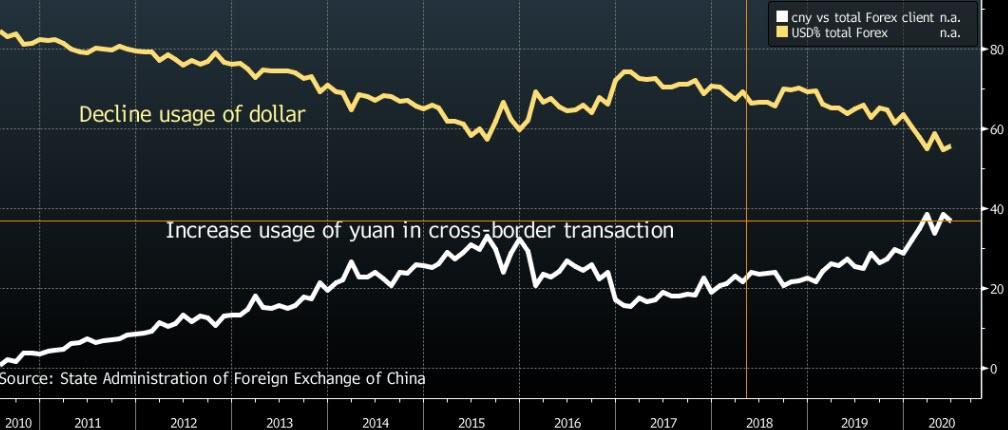
While this shift partly reflects local companies’ desire to limit their exposure to FX volatility, it may also mirror an intentional nudge from the authorities... and it’s not just trade.
Picking up on his recent observation that Jack Ma's decision to list his giant Ant Group in Shanghai and Hong Kong (where it is seeking a $200BN valuation) instead of the US, coupled with the exodus of U.S.-listed Chinese companies from America, Xie writes that this underscores the shift in capital markets, and adds that "by extension, one has to wonder what Beijing might to do with its $1.1 trillion Treasury holdings."
Guo Shuqing, the party secretary of the PBOC, delivered a stern warning on the U.S. currency last month: "Some people say, 'Domestic debt is not debt, but external debt is debt. For the United States, even external debt is not debt.' This seems to have been the case for quite some time in the past, but can it really last for a long time in the future?"
As Xie concludes referring to the chart above, "apparently China isn’t waiting to find out the answer."
Nike to Open First European House of Innovation in Paris
The store on the Champs-Élysées spans four floors and 26,000 square feet.
Nike is set to make a big statement about the future of retail in the heart of Paris. The activewear giant on Thursday will open its first House of Innovation store in Europe — and third overall — at 79 Avenue des Champs-Élysées.
The four-level, 26,000-square-foot store, called House of Innovation 002, is housed in an historic 1928 building that over the years has housed a car showroom, movie production studio and even a nightclub.
Nike spent four years readying the location, both inside and out, to create what Cathy Sparks, vice president and general manager of Global Nike Direct Stores and Services, said is a “tent-pole experience” intended to provide a “peek behind the curtain” to showcase the biggest and best of what the brand has to offer.
The House of Innovation replaces an older store on the storied avenue that closed in December when its lease expired. The new store was originally supposed to open last fall, but construction delays and then the coronavirus pandemic pushed the opening to this week.
Sparks said in light of how the world has changed in the past few months, Nike was actually happy to have extra time to prepare the store to meet the current reality of COVID-19 life. With the safety of its employees and customers in mind, Sparks said Nike instituted the safety precautions it first implemented in China and North America including “re-engineering the seating” in the footwear area, installing lighting that would be effective with social-distancing protocols, adding hand sanitizer stations and putting in large fitting rooms. “Our store team had a couple of extra months to get ready, so we’re really comfortable with the precautions we put in place,” she said.
The store is intended to be “a digitally powered and deeply immersive retail journey” and includes dedicated floors for men, women and children. It also offers the brand’s latest and greatest features such as Shop the Look, Scan to Try, Self-Checkout and bookable appointments in the Expert Studio and Nike by You personalization areas.
Among the features that set the store apart are its focus on women’s merchandise and the enhancement of the company’s kids’ experiences, Sparks said.
Upon entering, customers will find the Nike Arena, or what the company calls “the grand stage, where we bring our brand-defining innovation stories and immersive experiences to life.” Consumers can find out what is new in the store, book appointments with brand experts, make returns and pick-up orders placed online.
Near the entrance is what the company is calling Mission Control, a large wall with screens that is intended to connect consumers to sporting events around the city, exclusive member benefits and activations at other House of Innovation locations worldwide.
This floor also houses the Paris Shop, which will offer localized products and artist collaborations including one with Arthur Teboul, a French graphic and type designer and typographer who reinvented the souvenir T-shirt with new interpretations of Parisian landmarks. Other local artistic partners include Marc Armand, a Parisian artistic director; Marylou Faure, a graphic designer and illustrator, and the Paris-based art creative agency Golgotha and photographers Gorau+Phong.
The second floor is the women’s and children’s department and it includes the full range of the brand’s female-targeted offerings including its Victory Swim and Pro Hijab collections. The store also offers the company’s largest children’s assortment in France and will include the Fly Ease footwear.
Sparks said Nike realized it could be doing more for kids and developed a Kids Pod, which is making its debut in this store. It includes an interactive gaming station where kids can compete against others or play solo. “We can’t wait to see how it does,” she said, adding that the concept will be rolled out to other locations in the future.
Men’s wear is housed on the third floor and will include the brand’s running collection, along with soccer jerseys and the Jordan collection.
The lower level is devoted to the SneakerLab, which will offer a large assortment of the brand’s footwear as well as exclusive access to special product. The store also offers the Nike Reuse-a-Shoe program, where customers can recycle used shoes and the brand will turn them into Nike Grind, a material used in the store’s floors and walls. Nike Grind is also used on running tracks, courts, turf fields, gym floors and playground.
The store will mark the in-store introduction of Space Hippie, a shoe collection whose Flyknit yarn is made from 85 to 90 percent recycled materials such as plastic bottles, T-shirts and post-industrial scraps. It will also carry the Air Zoom AlphaFly Next% shoe, in which Eliud Kichoge broke the two-hour marathon mark in Vienna.
Sustainability is a focus and the store is operated entirely by renewable energy sources and used 85,000 kilos of sustainable materials in its design.
The Nike app will play an important role for customers in Paris. Among the features that are being offered include the ability to reserve product that will be held at the store. Anyone with the app will also receive a notification on new features and content when entering or approaching the store. Members can scan product barcodes on the app to check inventory in the store and learn more about the product. An order can then be placed in-store or online via the app.
Once in the store, customers can scan apparel and footwear barcodes and an associate will bring the product to them at a service hub on each floor. There are special Nike Fit areas where customers feet can be scanned to ensure their footwear is the right size and model. And the Paris store is the first to offer a Nike Bra Fit service, which uses the same machinery used for the shoes to match a customer’s body type to the proper bra style and size.
Sparks believes the launch of this female-focused solution is a game-changer. “We cracked the code on bra fit,” she boasted, adding that for women, “there is no sports if there’s no bra.”
The store will also be equipped with self-checkout stations where shoppers are able to fold and bag their purchases themselves after placing their orders on the app.
The House of Innovation 002 follows the first, 001, which opened in Shanghai in fall 2018, three weeks before House of Innovation 000 opened on Fifth Avenue in New York City. Sparks said even though Shanghai was first, New York’s House of Innovation replaced the storied Niketown store and was intended to be the “biggest and boldest” statement the brand could make.
She said despite the pandemic, Nike is optimistic that the store will perform well and although the app allows for a lot of contactless shopping options, she believes people are ready to shop in-person again. “We’re continuing to invest in digital, but we know that having a physical presence is critical,” she said.
The House of Innovation concept is intended for key global cities on the “world’s biggest stages,” she said. There are 12 of these around the world and Sparks said the company will eventually open additional units, although no other locations have been identified as of now.
Instead, Nike is putting more emphasis on its other concepts: Nike Live, a small-store option that is currently being tested in California and Asia. The company also has the larger, digitally powered Nike Rise concept, the first of which opened earlier this month in Guangzhou, China. Sparks said that store has “exceeded our financial expectations and the customer response has been enormous. They’re deeply engaging with our digital experiences.”
On its fiscal fourth-quarter earnings call on June 25, Nike said despite a coronavirus-fueled loss of $790 million in the period, it experienced a 79 percent surge in digital sales. Much of that has been fueled by the Nike app.
Nike set a goal in 2018 to reach digital sales penetration of 30 percent by fiscal year 2023, but that number was actually reached in the fourth quarter, and sales hit $5.5 billion for the full year. The company now expects 50 percent of Nike’s overall business to come from digital penetration in the foreseeable future, with the largest growth and market share opportunities in women’s and apparel.