WWD : Kering Net Profit Drops 63.4% in H1 After Sales Slump

Kering Net Profit Drops 63.4% in H1 After Sales Slump
Despite an "encouraging" recovery in the Asia-Pacific region, Kering does not expect lost revenues to be offset in the second half.

PARIS — Kering said net profit fell 63.4 percent in the first six months of the year after the coronavirus pandemic forced it to close stores and factories worldwide and brought tourism to a halt — and the French luxury group does not expect its lost revenues to be offset in the second half.

Group revenues in the three months to June 30 fell 43.5 percent to 2.17 billion euros, representing a decline of 43.7 percent in comparable terms. This came on the heels of a 15.4 percent drop in the first quarter.

In percentage terms, the decline was greater than the one recorded by sector leader LVMH Moët Hennessy Louis Vuitton, which on Monday reported a 38 percent drop in second-quarter sales, but was below a consensus of analyst estimates, which called for a 48 percent fall.

Kering flagged an “encouraging” recovery as stores reopened, particularly in the Asia-Pacific region, and saw a 72.4 percent jump in online sales in the second quarter. But organic sales at its cash cow brand Gucci fell 44.7 percent during the period, compared with a 23.2 percent drop in the prior three months.

Luxury stocks took a hit on Tuesday on the back of the LVMH results — despite the fact that it flagged a strong rebound in China — and Moncler posting a first-half loss for the first time in its history.

“It is fair to say that the first half of 2020 has been the toughest period we have faced,” François-Henri Pinault, chairman and chief executive officer of Kering, said in a statement issued after the market close.

“Our results today underscore the extent of the disruption exacted by the pandemic on our operations. Even more importantly, the resilience of our performances validates our model and supports our confidence that we will come out of this crisis even stronger,” he added.

Kering, whose brands also include Saint Laurent, Bottega Veneta and Balenciaga, posted net income of 569.3 million euros in the first half. Recurring operating profit was down 57.7 percent to 952.4 million euros, yielding an operating margin of 17.7 percent, down from 29.5 percent in the same period last year.

“The lack of visibility about how the worldwide personal luxury goods market will evolve in the next few months makes it impossible to forecast the group’s second-half sales with any sufficient degree of reliability. However, the loss in revenue experienced in the first six months of the year should not be offset in the second half,” Kering predicted.

It declined to forecast its recurring operating margin for 2020 as a whole, but said the cost-cutting measures implemented in the first half should benefit results during the second part of the year.

Gucci saw wholesale revenues shrink as the market struggled and it continued to streamline its distribution. “As stores reopened, the house regained a favorable momentum with local customers in its main markets. Online sales performed particularly well in the first half, up 51.8 percent,” Kering said.

Saint Laurent posted a 48.4 percent drop in like-for-like sales, following a decline of 13.8 percent in the first quarter, reflecting its exposure to Western Europe and North America.

After bucking the general trend last quarter, Bottega Veneta also turned negative, with organic sales falling 24.4 percent, though the drop was contained by positive momentum in the stores that remained open and a rebound in mainland China and South Korea.

Other houses, a segment that includes Balenciaga and Alexander McQueen, saw sales decrease by 44 percent. Balenciaga maintained a double-digit operating margin during the first half, but watch manufacturers were heavily impacted by the sharp contraction in their market, Kering reported.

Wired : A Helicopter Ride Over Mars? NASA's About to Give It a Shot

A Helicopter Ride Over Mars? NASA's About to Give It a Shot
“I see it as kind of a Wright brothers moment on another planet,” says the project's chief engineer at JPL.
PHOTOGRAPH: NASA/JPL-CALTECH

LATER THIS WEEK, NASA plans to launch its fifth Mars rover, Perseverance, on a six-month journey to the Red Planet. Perseverance will boot up a mission to collect samples of Martian dirt that might have traces of ancient life, so that they can be returned to Earth by another mission later this decade. It will also carry a payload unlike anything that’s ever been boosted into space: a small autonomous helicopter called Ingenuity. Sometime next spring, probably in April, Ingenuity will spin up its rotor blades and become the first spacecraft to go airborne on Mars.
“I see it as kind of a Wright brothers moment on another planet,” says Bob Balaram, the chief engineer for the Mars helicopter project at NASA’s Jet Propulsion Laboratory. “It’s a high-risk, high-reward mission that could enable us to go to lots of places we haven’t been able to go before.”
Satellites are good at getting a global understanding of a planet, and the rovers are great at exploring a relatively small amount of terrain in minute detail. For everything in between, it helps to have an airborne system. A rover can only cover a few dozen kilometers over the course of several years, but future extraterrestrial drones could easily cover that in a day. They could take aerial snapshots to help a rover plot the best path or collect samples and return them to a stationary lander for analysis. Ingenuity won’t be able to do any actual science, but it’s the first step toward an extraterrestrial aircraft that can.

Ingenuity’s hardware—cameras, communications equipment, avionics—is stuffed in a small cube that will be suspended in the air by four spindly legs that make it look a bit like a robotic insect. Up top, there are two pairs of rotor blades, each four feet in diameter, sandwiched between Ingenuity’s body and a rectangular solar panel. The whole apparatus weighs less than a full two-liter soda bottle, but it's hardy enough to withstand the extreme environments it will face during launch, landing, and its day-to-day existence on the Martian surface.
Once Perseverance arrives on Mars, it will spend a few weeks checking out its systems. If everything looks good, its first order of business will be to find a clearing in the rock-strewn Jezero crater to drop off its passenger. (And it will literally be dropped—the helicopter is attached to the belly of the rover.) Once the rover and the helicopter part ways, the chopper’s days are numbered. Balaram and his team will only have a month to conduct up to five test flights. “The whole intent of this campaign is to get engineering data so we can say this worked the way we thought and there were no surprises on Mars,” says Balaram. “Beyond 30 days, we’d just be a distraction.”


Like the Wright brothers’ famous flight test at Kitty Hawk, on its first flight Ingenuity will only be in the air for a few seconds. This hop will be a nearly exact replica of flight tests Balaram and his crew did back on Earth so they can make an apples-to-apples comparison of the helicopter’s performance against expectations. If everything goes well, Ingenuity will attempt increasingly challenging flight profiles. The helicopter is designed to fly up to 15 feet in the air and can travel up to three football fields from its takeoff point. Its batteries limit it to just 90 seconds of flight time, but this will be more than sufficient for the types of flight demos it will do on Mars.

For Balaram, the first Martian flight has been a long time coming. He cooked up a plan for an extraterrestrial chopper in the late 1990s—although the idea wasn’t exactly new—after seeing a conference presentation by Ilan Kroo, an aerospace engineer at Stanford University who had spent the past few years working on a coin-sized atmospheric research drone called the mesicopter. As Kroo and his team knew all too well from their research, aerodynamics becomes soupy at small scales, which makes controlling flight difficult. "We soon realized that flying mesi-scale devices on earth was very similar, at least aerodynamically, to flying larger vehicles on Mars," says Kroo. "We started working with Bob Balaram and the Jet Propulsion Lab to take our tiny rotor designs and scale them up to fly on Mars."
Balaram and Kroo submitted a proposal for a Mars helicopter to NASA in the early 2000s, but the proposal was never funded despite positive feedback from reviewers. (Balaram blames budget cuts at the agency.) The idea languished on the shelf for another 15 years until Charles Elachi, the director of NASA’s Jet Propulsion Laboratory, asked Balaram to rework the proposal and submit it as a possible ridealong experiment for the agency’s newest rover. In 2018, NASA officials announced that the helicopter would be the scientific sideshow on the Mars 2020 mission. By that point, R&D on the chopper was well underway.
NASA tapped AeroVironment, a drone manufacturer in California, to build the hardware for the mission. The company has a lot of experience operating autonomous aircraft in extreme environments—and a bit of history with NASA. In 2001, the company contracted with the agency to build a solar-powered drone that managed to fly at 96,000 feet; 20 years later, the record still stands. That altitude on Earth is comparable to flying near the surface on Mars because of the planet’s tenuous atmosphere. But flying a small helicopter on Mars makes piloting a giant solar powered wing on Earth look easy.
“We had to keep everything super lightweight to make the whole program work,” says Ben Pipenberg, an aeromechanical engineer at AeroVironment. “We really tried to pull every milligram out of every single component, because that’s really what it takes to get the weight low enough to fly on Mars”
The Ingenuity team had to balance the stringent weight requirements with competing demands on durability and performance. Even though the chopper’s weight was capped at four pounds, it had to be strong enough to withstand the intense forces it would encounter during launch and landing. Its hardware also had to meet the demands of the mission, like having a motor that can spin the rotor blades five times faster than a typical helicopter so it can generate lift. Oh, and it will need a computer powerful enough to run the machine vision algorithms the helicopter will use to autonomously navigate the Martian landscape. It’s a lot to ask of a machine that weighs less than a laptop.
“This pushed every single technical discipline,” says MiMi Aung, the project manager for Ingenuity at NASA’s Jet Propulsion Laboratory. “There were a lot of unnerving moments.”
To trim weight, engineers at AeroVironment made the blades out of foam and wrapped them in carbon fiber, and used more exotic materials, like beryllium metal matrix composites, for other body components. For avionics and power supply, the team turned to commercial off-the-shelf parts. Ingenuity stores its power with a common lithium ion battery and its computer is a Qualcomm Snapdragon processor, which is found in a variety of smartphones. They might not be quite as immune to failure as the hardware on the Perseverance rover, but they’re cheaper than using space-grade hardware while also meeting the helicopter’s performance requirements. Since Ingenuity isn’t critical to the rover’s main mission, the JPL team could afford to take a chance on some smartphone components.
There was also the challenge of simply figuring out how to test the thing. “Nobody has done this before, so the team had to invent a way to incrementally test the vehicle while another team is inventing the helicopter in parallel,” says Aung. “We were really paranoid, and we had to be, because we were under a lot of time pressure to progress fast enough to catch the rover launch. So we really had to think ahead.”

The team built two prototypes of Ingenuity: one for environmental testing and the other for flight tests. Environmental testing is the art of making life hell for a spacecraft. A prototype of Ingenuity was exposed to extremely cold temperatures to mimic conditions on Mars, it was placed near small detonations to make sure it could withstand the explosive shocks from the charges on the rover used to deploy the landing parachute, and it was blasted with the biggest and baddest stereo system around to see if all its nuts and bolts will hold tight when exposed to the extreme vibrations of a rocket launch.
The flight tests took place in a giant 25-foot diameter vacuum chamber that was pumped full of carbon dioxide to replicate the composition and thinness of the Martian atmosphere. The gravity on Mars is only about one-third as strong as on Earth, and since NASA hasn’t yet figured out how to manipulate gravity itself, the agency’s engineers have to compensate in other ways to create a realistic Martian scenario. For Ingenuity, this meant attaching a gravity offload tether to the vehicle. The tether looks a bit like fishing line and can be dynamically adjusted to pull up on the helicopter just enough to simulate the effects of reduced gravity while it’s flying.
As far as physics is concerned, flying a helicopter on Mars is fundamentally the same as flying a helicopter on Earth: The blades spin and pull air downward fast enough to generate lift. But the devil is in the details, and hands-on flight experiments helped the Ingenuity team discover some quirks about flying a chopper on another planet. During one early test, an AeroVironment engineer found that he was able to flawlessly pilot an Ingenuity prototype in an open vacuum chamber. But once the chamber was sealed and the air pumped out to replicate Martian conditions, the helicopter started behaving erratically and became difficult to fly. “That’s when we realized maybe the control isn’t as straightforward as we think it is,” says Balaram.
On Earth, helicopter blades have a natural tendency to flap as they rotate due to the length of the blades and the turbulent aerodynamic environment around the rotor. The feedback from this flapping would make a helicopter nearly impossible to control if it weren’t for the fact that the Earth’s thick atmosphere damps the vibrations to a manageable level. But as the AeroVironment engineer discovered, Mars’s atmosphere is too thin to have this flap damping effect, and as this ripples through the machine it wreaks havoc on its controls. “This had all our NASA helicopter experts tremendously excited, because to them it was like seeing everything with fresh new eyes,” says Balaram. To compensate for this effect, the Ingenuity team rebuilt the blades to make them stiffer.
There’s a lot riding on the accuracy of the flight test results. Unlike the Ingenuity prototypes, which have logged hours of flight time, the helicopter headed to Mars has only spent a few minutes in the air on Earth. “We didn’t want to wear out the system in the process of testing it,” says Balaram. By the time NASA abandons Ingenuity on the Martian surface, the intrepid little helicopter will have flown for fewer than 30 minutes.
Balaram says that NASA is already working on the next generation of extraterrestrial choppers, and the engineering data collected by Ingenuity during its flight tests will directly affect their development. These future helicopters may look a lot different than Ingenuity—one design NASA is studying has six rotors, for instance—and they’ll certainly be larger.
But the first scientific flight on another planet may not happen on Mars. In 2025, NASA plans to send a small nuclear-powered quadcopter called Dragonfly on a mission to hunt for life around Titan, Saturn’s largest moon. Dragonfly will be much longer-lived than Ingenuity—it’s expected to spend two years hopping around on the moon’s surface—and it will have a 2 mile altitude range. Titan is generally considered to be the easiest place to fly in the solar system because of its extremely dense atmosphere and low gravity. “You could strap on wings and fly there yourself, if you didn’t mind the cold,” Balaram says. For now, though, we’ll have to make do with a helicopter.

TechCrunch : Google is building a new private subsea cable between Europe and th

Google is building a new private subsea cable between Europe and the US
Image Credits: Google
Google today announced its plans to build a new subsea cable with landing points in New York in the U.S. and Bude, U.K. and Bilbao, Spain in Europe. The new cable, named after the pioneering computer scientist Grace Hopper, will join Google’s various other private subsea cables like Curie between the U.S. and South America, Dunant between the U.S. and France and Equiano between Europe and Africa.
The new cable is scheduled to go online in 2022 and will be built by SubCom, which Google also contracted for work on its Dunant and Curie cables.

Image Credits: Google

Google plans to launch a new Google Cloud region in Madrid in the near future, so it’s maybe no surprise that it is also looking at how it can best connect the region to its global network. The new cable marks Google’s first cable to Spain and its first private subsea cable route to the U.K.
The cable will feature 16 fiber pairs, which is a pretty standard number, but as the Google team stresses, it will be the first to use a new switching architecture the company developed in cooperation with SubCom. This new system is meant to provide increased reliability and to enable the company to better move traffic around outages.
Grace Hopper will be Google’s fourth wholly owned cable. In addition to these private cables, the company is also a member of a number of consortiums that jointly operate cables around the world. In total, Google has now announced investments in 15 subsea cables, though it is also reportedly part of the upcoming Blue-Raman Cable that will run between India and Italy via Israel. The company has yet to confirm its participation in this project, though.

(ZH) Goldman Warns "Real Concerns Are Emerging" About The Dollar As Reserve Curr

Goldman Warns "Real Concerns Are Emerging" About The Dollar As Reserve Currency; Goes "All In" Gold


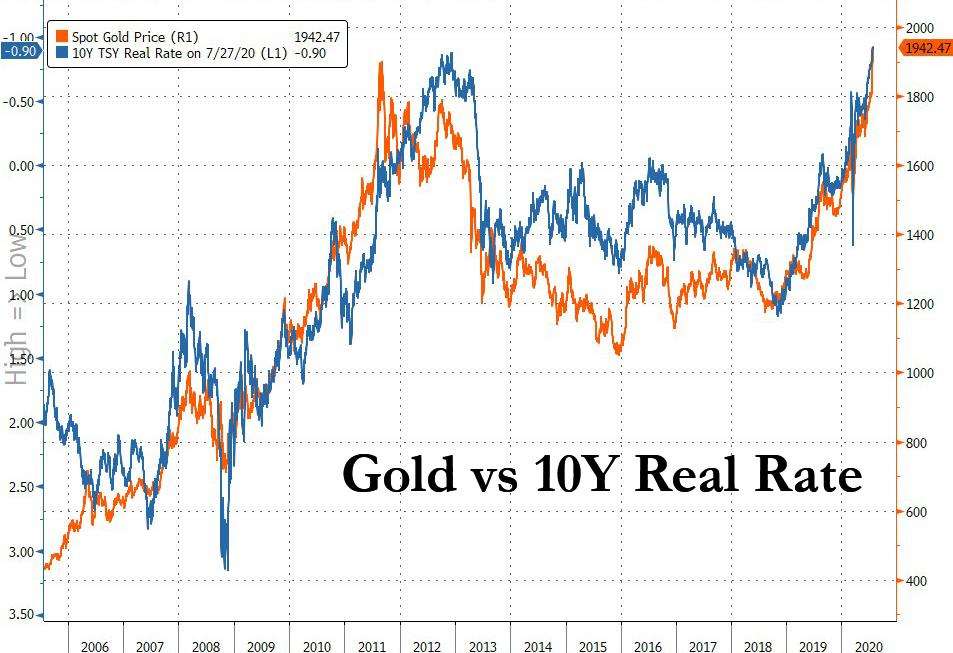
In his morning critique of goldbugs' resurgent optimism about the future of gold, which has exploded alongside the price of precious metals, which in turn have been tracking the real 10Y rate tick for tick...
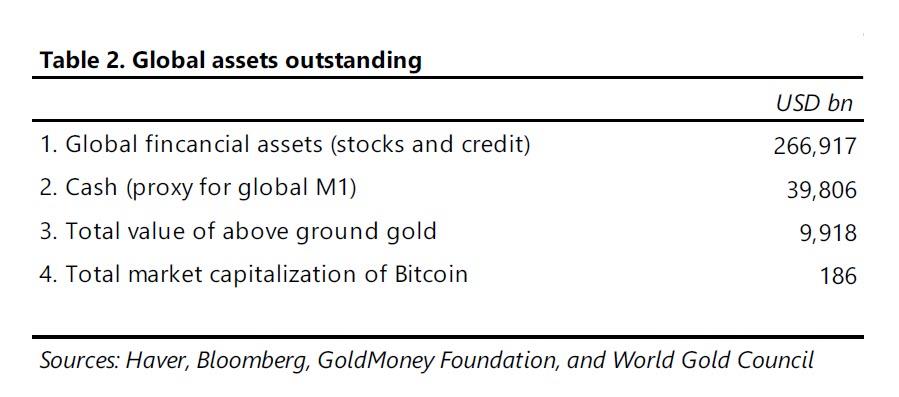
... Rabobank's Michael Every argued from the familiar position of one who views the modern monetary system as immutable, and bounded by the confines of the dollar as a reserve currency and financial assets as a bedrock of modern household wealth, of which as Paul Tudor Jones recently calculated there is over $300 trillion worth, compared to just $10 trillion in total gold value.

Indeed, according to Every, the surge in gold is meaningless because "if you buy gold, technically that is going to make you money. And yet that money is still going to be priced in US DOLLARS – and that gives the whole game away."
Like fans of the England football team, gold fans can dream of the distant past when gold was the centre of the global monetary system; but they can keep dreaming if they think those days are ever going to return. Gold may be an appreciating asset, but all the evidence suggests that it won’t be one that is of any direct relevance to day-to-day life, finance, and business. Your currency won’t be tied to it. You won’t get paid in it. You won’t spend in it or save in it (other than to the switch back to US Dollars). You won’t be doing deals in it or importing in it."
Yes but... what if your currency ends up getting tied to it? What if you do get paid in gold? What if you save in gold without any intention of switching back to dollars?
In short, what if the dollar is no longer the world's reserve currency?
Impossible you say... well, we would disagree. After all, in a world where there is over $100 trillion in dollar-denominated debt which can not be defaulted on and thus must be inflated away, the "exorbitant privilege" of the dollar has become a handicap. But don't take our word: here is Jared Bernstein, Obama's former chief economist warning all the way back in 2014 in a NYT op-ed that the US Dollar must lose its reserve status:
There are few truisms about the world economy, but for decades, one has been the role of the United States dollar as the world’s reserve currency. It’s a core principle of American economic policy. After all, who wouldn’t want their currency to be the one that foreign banks and governments want to hold in reserve?
But new research reveals that what was once a privilege is now a burden, undermining job growth, pumping up budget and trade deficits and inflating financial bubbles. To get the American economy on track, the government needs to drop its commitment to maintaining the dollar’s reserve-currency status.

Agree or disagree with Bernstein's ideology, never has his assessment about the state of the American economy been more accurate than it is now.
To be sure, since then there have been a handful of other "serious" economists suggesting that the only way the US economy can "reboot" itself and reset its economic engine is for the dollar to lose its currency status, but it is only in the past few days - when the dollar plunged and gold soared to new all time highs - that we have seen a barrage of Wall Street reports contemplating what until recently was viewed as impossible: a world where the dollar is not the reserve currency.
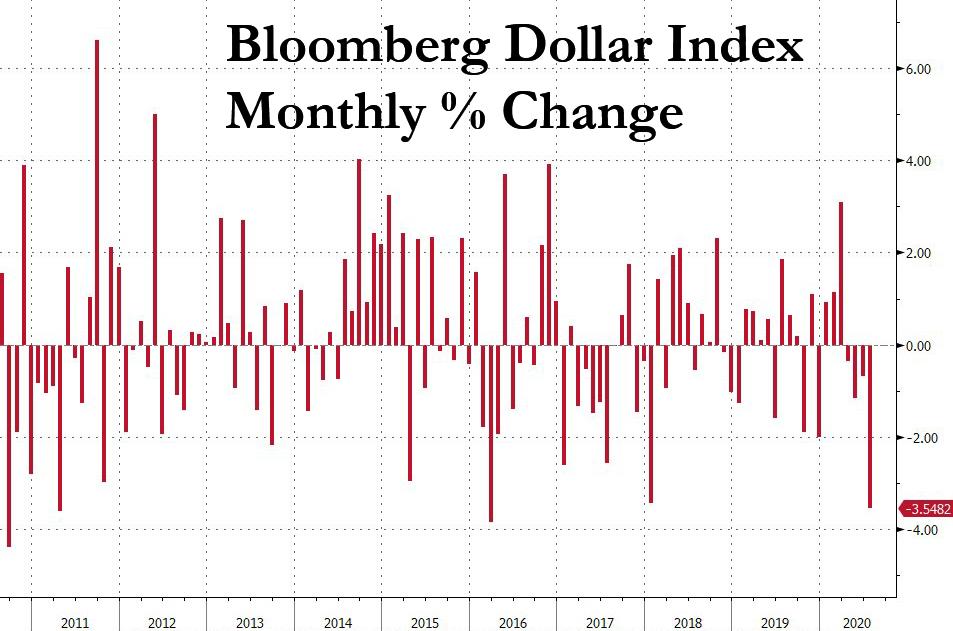
Meanwhile, after its explosive burst higher in March and April, the Bloomberg Dollar Spot Index is on course for its worst July in a decade. The drop comes amid renewed calls for the dollar’s demise following a game-changing rescue package from the European Union deal, which spurred the euro and will lead to jointly-issued debt.
Which brings us to this morning, when none other than the world's most influential investment bank Goldman Sachs, by way of its chief commodity strategist Jeffrey Currie, wrote that "real concerns around the longevity of the US dollar as a reserve currency have started to emerge."
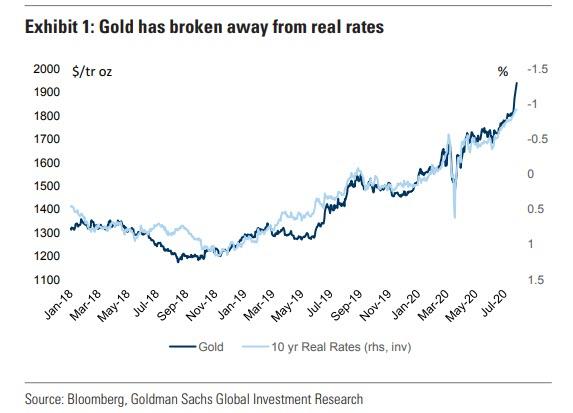
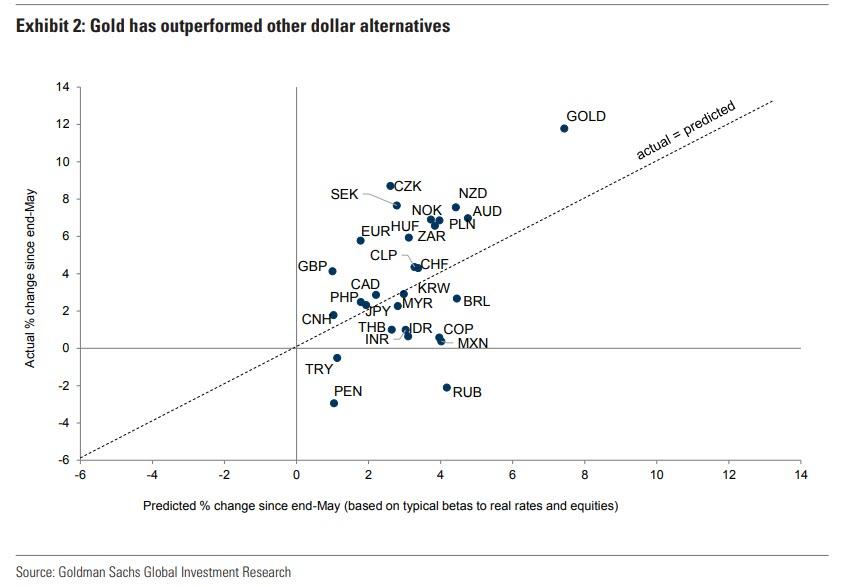
Specifically, Goldman looks at the recent surge in gold prices to new all-time highs which has "substantially outpaced both the rise in real rates...
... and other US dollar alternatives, like the Euro, Yen and Swiss Franc"...
... with Currie writing that he believes this disconnect "is being driven by a potential shift in the US Fed towards an inflationary bias against a backdrop of rising geopolitical tensions, elevated US domestic political and social uncertainty, and a growing second wave of covid-19 related infections."
This, combined with the record level of debt accumulation by the US government, means that "real concerns around the longevity of the US dollar as a reserve currency have started to emerge."
Then, Currie reminds his clients that he has "long maintained gold is the currency of last resort, particularly in an environment like the current one where governments are debasing their fiat currencies and pushing real interest rates to all-time lows, with the US 10-year TIPs at -92bp is 5bp below the 2012 lows," and we indeed noted Currie's reco to buy gold one day after the Fed went all-in on March 24.
Four months later, the urgency is even greater, and Currie writes that "with more downside expected in US real interest rates we are once again reiterating our long gold recommendation from March and are raising our 12-month gold and silver price forecasts to $2300/toz and $30/toz respectively from $2000/toz and $22/toz."
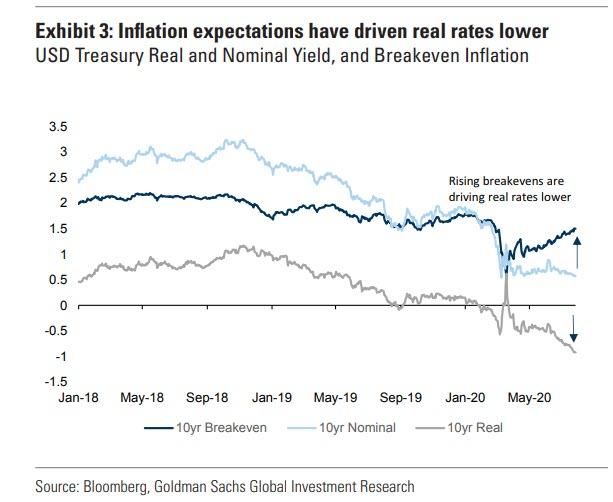
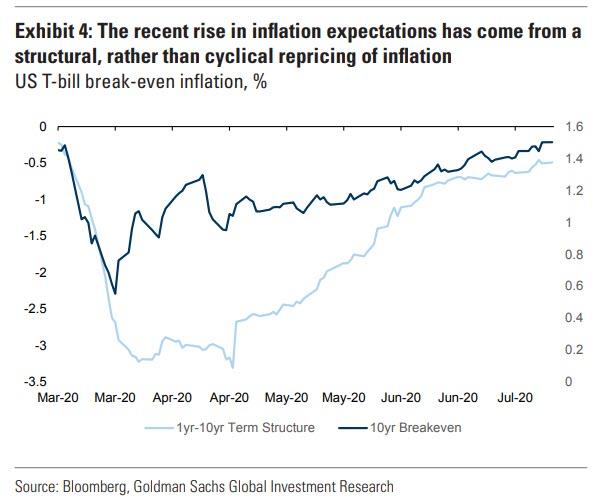
There are other reasons why Goldman believes that Gold's surge is only just starting: "This relentless decline in real interest rates against nominal rates bounded by the US Fed has caused inflation breakevens to rise (see Exhibit 3) in an environment that would ordinarily be viewed as deflationary, i.e. a weakening US labor market as the country re-enters lockdown."
This is bad, and is usually described by what may be the most loathed word in the banker lexicon: "stagflation."
Which also explains the "irony" of the response: the greater the deflationary concerns that policymakers must fight today, the greater the debt build up and the higher the inflationary risks are in the future according to Currie, who expands further on this critical topic:
The deflationary shock caused by the pandemic drives the need to expand balance sheets to support demand today, as seen in the latest US $1.0 trillion Phase 4 stimulus and the €750 billion pan-EU recovery fund. The resulting expanded balance sheets and vast money creation spurs debasement fears which, in turn, create a greater likelihood that at some time in the future, after economic activity has normalized, there will be incentives for central banks and governments to allow inflation to drift higher to reduce the accumulated debt burden.
Indeed, this has already been seen in recent FOMC minutes, as discussions of explicit outcome-based forward guidance raises the prospect for Fed-sanctioned overheating of the economy.
And despite the longer-term nature of these risks, Goldman argues that "asset managers have real concerns today about persistent unanticipated shifts in inflation that can create large discrepancies between current expected real returns and actual realized returns" and this is manifesting itself in the continued faith in the dollar.
What about the gold price? Here is Currie's explanation why gold will continue to surge:
The key point from a hedging perspective is that asset managers care about the level of inflation, not the changes in inflation, and from a level perspective, inflation hedges like commodities and equities are likely far cheaper today than in the future when inflation could arrive. When discussing the drivers of investment demand for gold and commodities, it is important to distinguish between debasement and inflation. The key is that the current debasement and debt accumulation sows the seeds for future inflationary risks despite inflationary risks remaining low today. While debasement in many cases leads to inflation, it is not always the case as witnessed over the past decade. Equally, the best debasement hedge (gold) is not always the best hedge against inflation (oil). Indeed, the word debasement comes from adding base metals like tin or copper to the precious metals that acted as hard currency; therefore, owning the pure precious metal is then the best hedge against debasement.
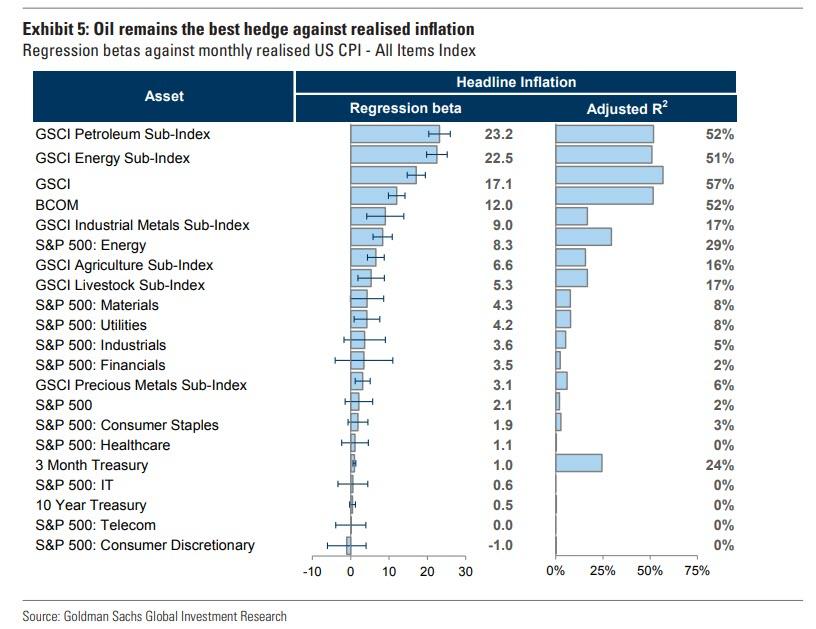
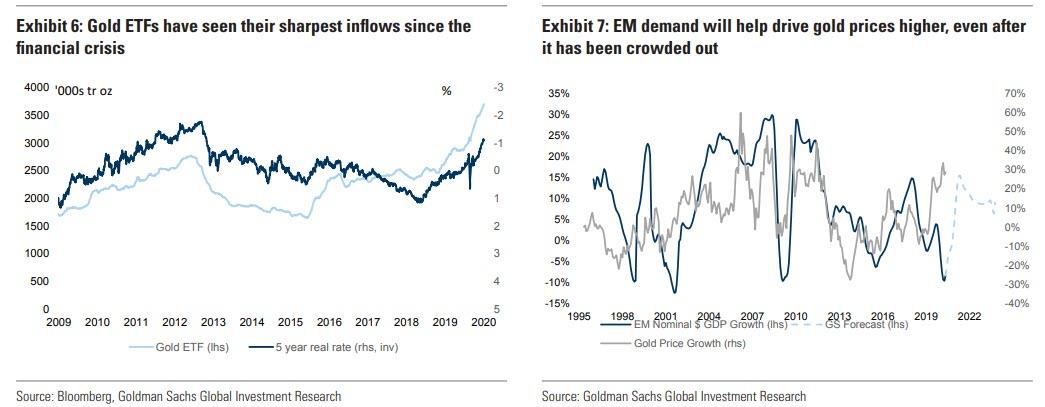
However, this does not mean gold is the best hedge against inflation — a common misconception of many investors. Gold doesn’t appear significantly in any CPI anywhere in the world. As a result, oil and other commodities that drive the items actually found in different CPIs are the best hedges against inflation. But
Next, Currie goes on to explain why oil may be the best pure play commodity hedge to inflation, "today the risk is from debasement of fiat currencies that sows the risk for inflation and gold is the best hedge against debasement. Further out as inflation risks rise, oil and equities hedge unexpected and expected inflation respectively better than gold (see Exhibit 5), and given the size of the bond portfolios built over the past decade that will need to be hedged against inflation risks, the sheer size of investment demand for commodities is likely to be massive, underscoring the need to act today. "
Hence, gold at $2,000 and soon... $3,000, $5,000 and much more. Indeed, even at $10,000/oz, the total value of gold would be just around $50 trillion, which is still orders of magnitude below the value of global financial assets that need to be hedged (and which according to Paul Tudor Jones is around $270 trillion).
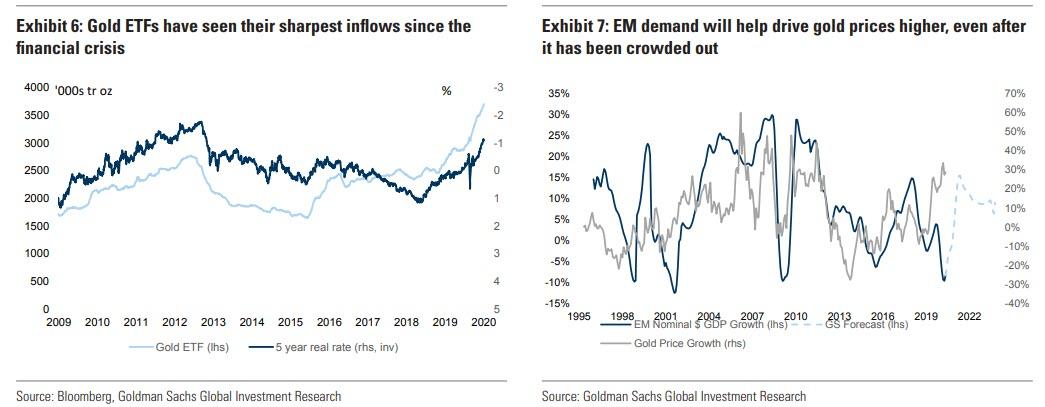
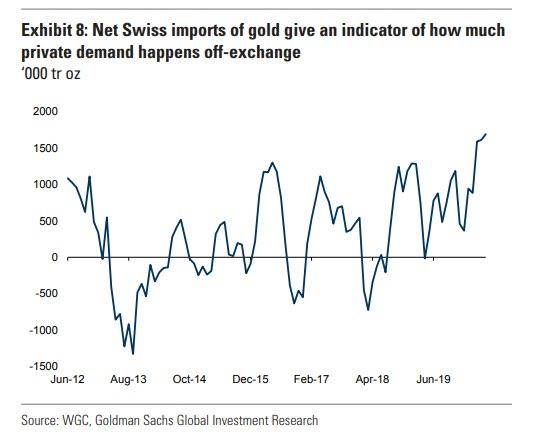
As Currie then notes, the result of this growing debasement risk is that "DM investment demand strength has continued with ETF additions in both Europe and US running high (see Exhibit 6). We see this trend persisting for some time as investment allocations into gold increase inline with allocations to inflation protected assets, similar to what happened after the financial crisis. Following the GFC, inflation fears peaked only at the end of 2011 as the bounce back in inflation ran out of steam, bringing the gold bull market to a halt. Similarly, we see inflationary concerns continuing to rise well into the economic recovery, sustaining hedging inflows into gold ETFs alongside the structural weakening of the dollar, we see gold being used as a dollar hedge by fund managers. Indeed, decomposing our gold forecast, with returns of 18% over the next 12 months, we estimate 9% of the growth is driven by 5yr real rates going to -2% over the next 12 month, (an est. elasticity of 0.1), while the second 9% comes from the 15% increase in the EM dollar GDP (an est. elasticity of 0.5) (see Exhibit 7)."
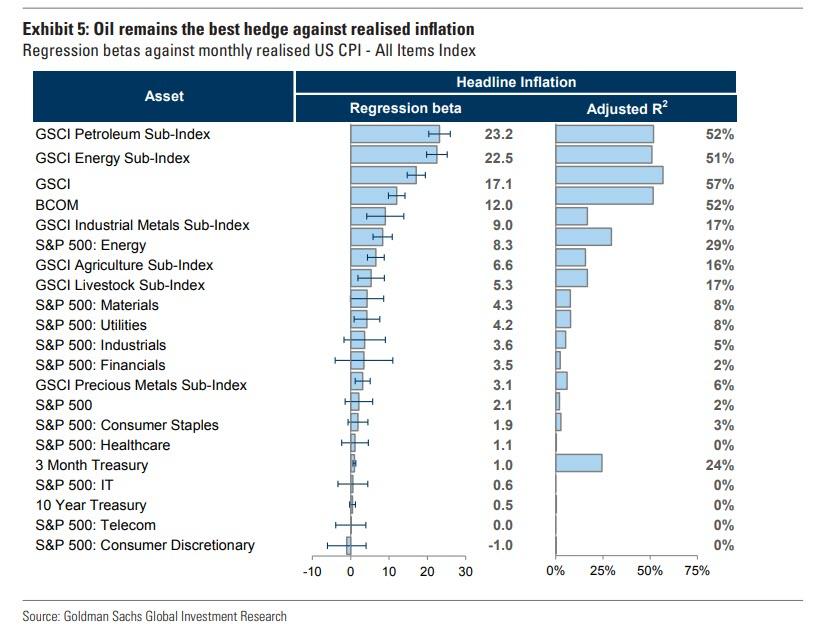
On top of these known flows, a large share of physical investment demand in gold is non-visible according to Goldman, in particular vaulted bar purchases by high net worth individuals. Looking at net Swiss imports one can see that gold stocks in Switzerland, where most of these private vaults are located, have been building at close to a record pace.
And in case that wasn't enough, "the stretched valuations in equities, low real rates and high level of economic and political uncertainty all point toward continued inflows by high net worth individuals," in Goldman's view.
But wait there's more, with Goldman singling out the potential of a fresh EM demand surge: Indian gold imports are still down 80% yoy in June and the Chinese gold premium is beginning to turn negative again (see Exhibit 9). More recently, however, the weakness in EM demand has been driven more by gold’s high price, as consumers cannot afford to buy gold products at those levels. However, EM currencies are no longer under pressure and India has begun to see the rupee strengthen over the past month. EM growth is also beginning to recover with EM activity entering positive YoY territory in June for the first time since January and our economists seeing the worst of
the EM outlook behind us (see Exhibit 10). EM retail investment demand is also boosted by easier monetary policy together with continued inflation driving EM real rates down. In India, policy rates fell below the YoY inflation rate for the first time since 2013."
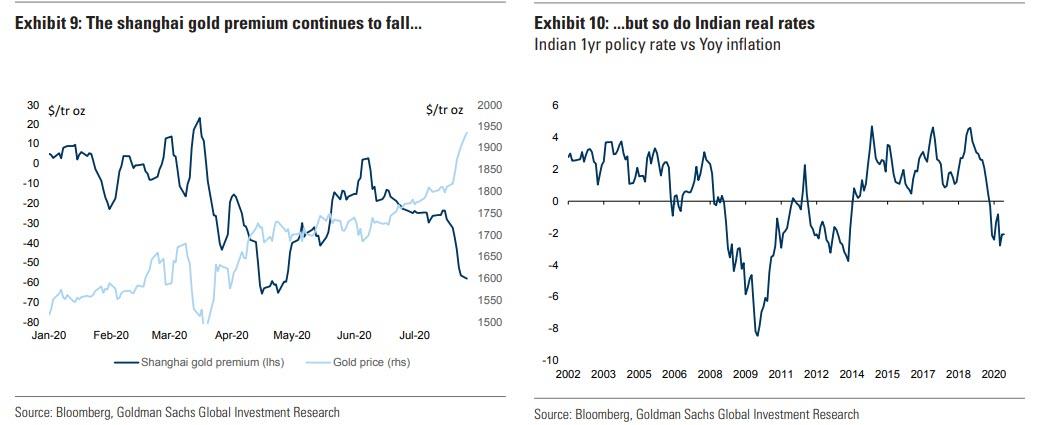
Taken together, and in light of the declining faith in the dollar as a reserve currency, Goldman believes that these factors create a perfect setup for a rebound in EM demand for gold similar to 2010-11:
We will likely see this demand materialize when price stabilizes somewhat and DM investment purchases slow down, creating more room for EM consumers. We feel that for now, investors should not be concerned by weak EM demand prints.
As a final point, Goldman also spared some love for silverbugs, raising its silver forecast to $30/toz on a 3/6/12 month horizon, "pulled upward by higher gold prices and better prospects for silver industrial demand, particularly in solar energy (c.15% of silver demand). Both the European Green Deal and Biden’s war on climate change plans imply a doubling every year of solar panel capacity installations in both the US and Europe. At the same time, silver demand in consumer electronics is benefiting from the transition to working from home as it is heavily used in consumer items such laptops, mobile phones and televisions. Even housing demand, where silver is used in light switches, looks to be better than expected with property sales in both US and China rebounding strongly. Silver has rallied almost 30% over the past few weeks but its ratio with gold is only back to its level at the beginning of this year of 80."
Currie's final point on silver:
Historically there has been a tight relationship between silver industrial demand and the gold-silver price ratio. If silver industrial demand next year is 5% higher versus its 2019 level, the gold-to-silver ratio would fall further to 77. Assuming this ratio, our $2300/toz gold target would imply a $30/toz silver price.
That sounds awfully familiar: here's why:

FT : European regulators delay new rules on failed trades

European regulators delay new rules on failed trades
Lobby groups say planned changes will be harmful to stability of bond and exchange traded fund markets

European markets regulators are planning a year’s delay to a new rule imposing penalties on trades that fail to settle on time, after market participants said the coronavirus pandemic had made it impossible to hit next February’s deadline.

Authorities are planning to push back the regime until February 2022, the European Securities and Markets Authority said on Tuesday.

That would mark a second delay for the controversial rules, which lobby groups around Europe have argued will be harmful to the functioning, liquidity and stability of the region’s bond and exchange traded fund markets.

In a letter to Esma, made public on Tuesday, the European Commission noted that “stakeholders” had complained about the tight timeline for implementation, and had argued that the choppy trading of the past few months “would have been significantly worse” if the regime had been in place.

EU watchdogs are taking aim at trades that fail to complete — either because the buyer does not deliver the funds to pay for the deal or because the seller does not supply the securities.

At the moment, failed trades are settled informally between the parties. Under the new rules, trades that fail to settle — usually within a window of two or three days — would face a mandatory “buy-in” to close the deal.

The counterparty, clearing house or central securities depository will be required to buy the asset at the prevailing market price, while the institution responsible for the failure will have to pay an initial penalty, based on the value of the security — as well as any difference between the buy-in price and the original deal.

Investment banks balked at the proposals, saying penalties for failures could push up the cost of trading by billions of euros a year. Big banks each have to deal with about 10,000 failed trades every day in their core European markets, according to Cognizant, a New Jersey-based provider of IT services.

Critics also warned that the new regime would make buying illiquid securities more expensive and more difficult, using the market dislocations of March and April to underline their point.

ICMA, the bond industry trade association, welcomed news of the delay and urged regulators to revise the mandatory buy-in rules as “it is widely recognised that there are a number of design flaws in the . . . framework”.

Regulators had already pushed back an initial launch date of November because users said they needed more time to test new IT systems. The original timeframe also clashed with the implementation of new global standards for software that carries financial messages.

Last month the UK said it would not implement the failed-trade regime once it left the transition period to exit the EU, in one of the first examples of Britain indicating where its financial services laws will diverge from the bloc

FT : Federal Reserve extends emergency lending facilities by 3 months

Federal Reserve extends emergency lending facilities by 3 months
Programmes brought in to shore up financial markets during pandemic will now expire at end of year

The Federal Reserve is extending the emergency lending facilities it set up to shore up financial markets during the pandemic until the end of the year, in the latest sign of its concern that the coronavirus crisis will continue to weigh on the US economy.

The board of the US central bank announced the decision on Tuesday as its monetary policymakers began a two-day meeting. The lending facilities, which were designed to support short-term funding and corporate debt markets and to offer loans to struggling midsized businesses, were due to expire at the end of September.

“The three-month extension will facilitate planning by potential facility participants and provide certainty that the facilities will continue to be available to help the economy recover from the Covid-19 pandemic,” the Fed said.

The facilities had “provided a critical backstop, stabilising and substantially improving market functioning and enhancing the flow of credit to households, businesses, and state and local governments,” it added.

Fed officials had signalled that the lending facilities would be in place as long as they were needed and would not be allowed to lapse prematurely.


The Federal Reserve is extending the emergency lending facilities it set up to shore up financial markets during the pandemic until the end of the year, in the latest sign of its concern that the coronavirus crisis will continue to weigh on the US economy.

The board of the US central bank announced the decision on Tuesday as its monetary policymakers began a two-day meeting. The lending facilities, which were designed to support short-term funding and corporate debt markets and to offer loans to struggling midsized businesses, were due to expire at the end of September.

“The three-month extension will facilitate planning by potential facility participants and provide certainty that the facilities will continue to be available to help the economy recover from the Covid-19 pandemic,” the Fed said.

The facilities had “provided a critical backstop, stabilising and substantially improving market functioning and enhancing the flow of credit to households, businesses, and state and local governments,” it added.

Fed officials had signalled that the lending facilities would be in place as long as they were needed and would not be allowed to lapse prematurely.


The Federal Reserve is extending the emergency lending facilities it set up to shore up financial markets during the pandemic until the end of the year, in the latest sign of its concern that the coronavirus crisis will continue to weigh on the US economy.

The board of the US central bank announced the decision on Tuesday as its monetary policymakers began a two-day meeting. The lending facilities, which were designed to support short-term funding and corporate debt markets and to offer loans to struggling midsized businesses, were due to expire at the end of September.

“The three-month extension will facilitate planning by potential facility participants and provide certainty that the facilities will continue to be available to help the economy recover from the Covid-19 pandemic,” the Fed said.

The facilities had “provided a critical backstop, stabilising and substantially improving market functioning and enhancing the flow of credit to households, businesses, and state and local governments,” it added.

Fed officials had signalled that the lending facilities would be in place as long as they were needed and would not be allowed to lapse prematurely.

Reuters - Thyssenkrupp must quickly present strategy, steel solution -Deka - Reu

Thyssenkrupp must quickly present strategy, steel solution -Deka - Reuters News
28-Jul-2020 16:31:49

Elevator sale expected to close on Friday - sources
Deal will give Thyssenkrupp 17.2 bln euros in proceeds
Group must spell out how money will be spent - Deka
By Christoph Steitz

FRANKFURT, July 28 (Reuters) - Conglomerate Thyssenkrupp TKAG.DE must soon find a solution for its struggling steel unit and say how it will spend the 17.2 billion euros ($20.2 billion) in proceeds from the sale of its elevator division, a top-20 investor said.

"There has to be a solution for steel in the near term. It would be good if there was clarity until the next annual general meeting," said Ingo Speich, head of sustainability and corporate governance at Deka Investment, Thyssenkrupp's 11th-largest shareholder, who has been an outspoken critic of Thyssenkrupp's performance in the past.

Speich's remarks come ahead of the deal's closing, which sources say is expected on Friday.

Thyssenkrupp's next AGM is scheduled for Feb. 5, 2021.

The group has said it might sell, keep or merge its steel division with a peer, with Salzgitter SZGG.DE, Tata Steel TISC.NS, SSAB SSABaST and Baoshan Iron & Steel 600019.SS all considered potential partners, sources have said. (Full Story) (Full Story)

"Completely divesting steel will be difficult," Speich said, adding a joint venture or merger with a peer would be the most likely options.

"Time is against Thyssenkrupp and in favour of its peers," Speich said.

The sale of elevators to a consortium of Advent, Cinven CINV.UL and Germany's RAG foundation will effectively hand Thyssenkrupp a financial lifeline to turn around its other business units, which range from car parts to submarines.

But the group has signalled that most of the proceeds will be used up by cutting down debt, paying off pension liabilities and for offsetting business lost thanks to the coronavirus pandemic, leaving little to fund future projects.

One of the people said that less than 2 billion euros might be available to invest in growth.

Thyssenkrupp's shareholders are not expected to get a share either, Speich said: "The company needs every cent."

Thyssenkrupp declined to comment.

>>> US Gapping down

Gapping down
In reaction to disappointing earnings/guidance
:

  • HOG -4.9%, AUDC -4.6%, NXPI -4.3%, CRSP -4.1%, EDU -4.1%, FFIV -4%, AWI -4%, NOV -3.7%, YNDX -3.6%, JJSF -3.1%, MMM -2.6%, ABG -2.5%, MCD -2.3%, CNC -1.8%, ROK -1.7%, PCH -1.4%, ST -1.4%, ARE -0.9%, QTS -0.6%, SSD -0.6%, WDR -0.6%, CINF -0.5%, MSCI -0.5%

Other news:

  • NMRD -21.7% (announces shelf offering for sale shares of its common stock and warrants)
  • CRMD -13% (stock offering)
  • BTAI -2.4% (commences offering of $200 mln of its common shares; also files mixed securities shelf offering)
  • ING -2.3% (will book goodwill impairment in Q2 of approximately €300 mln)
  • INTC -0.8% (announces organizational changes)

Analyst comments:

  • RDFN -2.6% (downgraded to Negative from Neutral at Susquehanna)
  • TSLA -1.8% (downgraded to Underperform from Mkt Perform at Bernstein)

>>> US Gapping up

Gapping up
In reaction to strong earnings/guidance
:

  • AMKR +16.6%, OMF +13.9%, MEDP +11.7%, VCRA +11.5%, HSTM +10.4%, FIX +8.2%, CVLT +7.4%, PII +7.2%, TNET +6.8%, AJRD +5.5%, IRDM +4.8%, IBTX +3.6%, IBTX +3.6%, PFE +3.4%, SHW +3.3%, MDC +3.2%, LXFR +2.7%, AGNC +2.7%, GLW +2.4%, OTIS +2.2%, RTX +2.1%, CMI +2.1%, LH +1.8%, MLM +1.8%, SPGI +1.7%, XRX +1.4%, JBT +1.2%, DHI +1.2%, HUN +0.9%, MO +0.8%, CR +0.7%, WAT +0.7%, FBC +0.6%

Other news:

  • SPPI +49.4% (announces "positive" top-line results from ZENITH20 Phase 2 trial)
  • LUMO +18.2% (to sell its Priority Review Voucher to Merck)
  • BSM +12.3% (increases dividend)
  • BLNK +6.1% (announces collaboration with EnerSys (ENS) to develop high-power wireless and enhanced DC fast charging systems)
  • BNTX +4% (BNTX and PFE choose lead mRNA vaccine candidate, starts global Phase 2/3 study)
  • CTSO +3.8% (REFRESH 2-AKI trial receives recommendation for study resumption from Data Monitoring Committee)
  • PFE +3.5% (BNTX and PFE choose lead mRNA vaccine candidate, starts global Phase 2/3 study)
  • CHMA +3.3% (announces data from CHIASMA OPTIMAL Phase 3 trial)
  • ACIU +3.1% (reports new data for its next generation alpha-synuclein positron emission tomography-tracer during an oral presentation at the Alzheimer's Association International Conference)
  • BHC +2.8% (Glenview (Larry Robbins) increases holding and discloses 5.9% active stake)
  • TCRR +2.5% (commences public offering of 6 mln shares)

Analyst comments:

  • SHOP +2.6% (upgraded to Buy from Neutral at Goldman)
  • NET +2.2% (upgraded to Buy from Hold at Jefferies)
  • CVNA +1.2% (initiated with an Overweight at Piper Sandler)
  • SR +1% (upgraded to Overweight from Equal Weight at Wells Fargo)
  • ATHM +0.7% (upgraded to Outperform from Neutral at Credit Suisse)