>>> TradeGate Pre-Market Indications

DAX:
  • VW (VOW3 TH) +1%
  • Fresenius SE (FRE TH) +0.9%
  • Delivery Hero (DHER TH) +0.9%
  • Allianz (ALV TH) +0.9%
  • BASF (BAS TH) +0.9%
MDAX:
  • Fraport (FRA TH) +2.2%
    • Fraport Raised to Buy at MainFirst; PT 50 euros
  • Gerresheimer (GXI TH) +2.1%
  • Cancom (COK TH) +1.5%
SDAX:
  • Hornbach Baumarkt (HBM TH) +2.1%
  • Tele Columbus (TC1 TH) +1.9%
  • Corestate (CCAP TH) +1.6%
  • Schaeffler (SHA TH) +1.6%
  • Hamburger Hafen (HHFA TH) +1.4%
  • Eckert & Ziegler Strahlen- und Medizintechnik AG (EUZ TH) -1.1%

FT : Danish companies urged to reinstate guidance for investors

Danish companies urged to reinstate guidance for investors
Regulator pushes for information on 2020 outlook despite Covid-19 uncertainties


Danish companies have been some of the few to reinstate full-year guidance with their second-quarter results as Denmark’s financial regulator pushed them to tell investors how the rest of 2020 could be despite the coronavirus pandemic.

Companies from shipping group AP Moller-Maersk and brewer Carlsberg to wind turbine maker Vestas and jeweller Pandora have reintroduced their outlook for this year’s sales or profits in recent weeks.

The Danish Financial Supervisory Authority told companies to give guidance wherever possible when reporting second-quarter results even if great uncertainty remained over how Covid-19 could affect the economy and individual industries.

“Markets need information from companies, especially in times of uncertainties,” said Anne Bruun, director of capital market regulation at the FSA in Copenhagen. “It is not possible to suspend your guidance ‘forever’.”

Businesses around the world are grappling with how coronavirus is changing demand for their products and consumer behaviour as well as whether a second wave of the pandemic could come this autumn.

Many Danish companies have reinstated their guidance but with a bigger range of outcomes than before to reflect the uncertainty, a flexibility the Danish FSA gave them.

Maersk, the world’s largest container shipping line, suspended its guidance for full-year operating profits of about $5.5bn in mid-March. On Wednesday, it raised its guidance to $6bn-$7bn and warned it could be changed should countries lock down a second time owing to Covid-19.

Soren Skou, Maersk’s chief executive, said he did not want to give guidance “only because the FSA wants us to” but stressed that the company was now halfway through its crucial third quarter giving a “reasonable idea” of how the first nine months will turn out.

Alexander Lacik, chief executive of Pandora, noted that none of his rivals had provided guidance but added that the Danish jeweller’s outlook was “relatively wide”. It forecast a drop in full-year underlying sales of 14-20 per cent while its operating profit margin should be 16-19 per cent, causing its shares to fall 7.5 per cent on Tuesday.

“The guidance is built on the fact that we don’t see any more major lockdowns. We do anticipate that there will be some flare-ups, but nothing that will last for long. If there are major national lockdowns, we will need to revise. Every business person is hoping for the best, but planning for the worst,” he added.

Danish companies have also been helped by reporting relatively late, with some of them putting out second-quarter results more than a month after Swedish groups, helping give them better visibility on the third quarter.

Cees t’ Hart, chief executive of Carlsberg, said the brewer had “an important part of the summer under our belt” so felt “confident” on its outlook even as it disappointed investors. “If there’s a huge second wave, we have another issue,” he added.

Ms Bruun said the regulator believed that if companies kept silent on their guidance for too long it would “harm the market”. She added: “Covid-19 is still creating uncertainty, but that is the kind of reality companies are working in with political or economic uncertainties around the world.”

>>> Europe : Brokers Upgrades & Downgrades -24th of August 2020

>>> Up
* EasyJet Raised to Buy at MainFirst; PT 700 pence
* Fraport Raised to Buy at MainFirst; PT 50 euros
* Rockwool PT Raised to 2,600 kroner at Barclays
* Stratec PT Raised to 136 euros from 111 euros at Deutsche Bank
* Zurich Airport Raised to Hold at MainFirst; PT 130 Swiss francs

>>> Down
* Elekta Cut to Hold at Handelsbanken; PT 105 kronor
* Keller Cut to Hold at Jefferies; PT 640 pence
* Latour Cut to Sell at Handelsbanken; PT 152 kronor
* Royal Unibrew Cut to Sell at Handelsbanken; PT 600 kroner
* Straumann Cut to Hold at Deutsche Bank; PT 920 Swiss francs
* Wolters Kluwer Cut to Hold at Berenberg; PT 69 euros

>>> Initiation
* Dechra Pharma Rated New Sell at Liberum; PT 2,740 pence

>>> Call
* Elekta Downgraded, Covid Effect Weighs on Sales: Handelsbanken
* Wolters Kluwer Cut to Hold as Valuation Now Fair, Berenberg Says

>>> What to look at today - 24th of August 2020

Stock futures in Europe and the U.S. rose along with equities in Asia on signs of a thaw in U.S.-China tensions, with investors also looking ahead to a policy speech by Federal Reserve Chair Jerome Powell later in the week.
Hong Kong shares outperformed, aided by a rally in WeChat owner Tencent Holdings Ltd. and signs of progress on the virus front. People familiar with the matter said President Donald Trump’s team is privately seeking to reassureU.S. companies that they can still do business with the WeChat messaging app in China.
Equities in South Korea, Japan and China were also higher with Euro Stoxx 50 futures. S&P 500 contracts rose modestly after U.S. shares ended Friday with a fourth week of gains. Gold began the week on the back foot. The 10-year yield on New Zealand bonds fell to a record low after the central bank fell short of its quantitative easing buying target. Treasuries and the dollar were steady.

Nikkei +0.29% Hang Seng +1.43% CSI +0.88% Shanghai +0.21% Shenzen +1.36%

Eur$ 1.1803 CNH 6.9147 CNY 6.9182 JPY 105.83 GBP 1.3105 CHF 0.9114 RUB 74.6889 WTI$ 42.41 +0.17%

S&P +0.41% Nasdaq +0.48% EuroStoxx +0.80% FTSE +0.63% Dax +0.85% SMI +0.51%

Macro :
- Stressed About U.S. Stocks, Investors Are Betting Big on Europe
- CVC, Advent Preparing Joint Bid for Italy Serie A Rights Stake
- Social Influencers Feed the Robinhood Hunger for Investing 101
- Hedge Against Flare-Up in China Tensions With U.S., SocGen Says

Keep an eye on :
- AFP SW : Aluflexpack First Half Sales EU115.5 Mln, +14% Y/y
- CS FP : AXA, Bharti to Combine India Non-Life Ops Into ICICI Lombard
- BSGR NA : B&S Group First Half Ebitda EU35.3 Mln, -33% Y/y
- BO DC : B&O’s New Chairman Ditches Plan to Find a Buyer, Borsen Reports
- BT/A LN : BT Group Board on Alert for Takeover Approaches, Sky Reports
- AFX GY : Carl Zeiss Sues Rival for Patent Royalties on X-Ray Microscopes
- MOWI NO : Mowi Gets Record Fine After Salmon Escape in Chile, NTB Reports
- NPRO NO : Norwegian Property Offering Prices 97.5m Shrs at NOK11.30/Shr
- RATOB SS : Ratos Has Reversed the Trend, CEO Wistrom Tells Dagens Industri
- STB NO : A $91 Billion Asset Manager Dumps Exxon, Chevron on Climate

(ZH) BofA: "It Is Unrealistic To Have Widespread Vaccine Availability In Q1 2021

BofA: "It Is Unrealistic To Have Widespread Vaccine Availability In Q1 2021"


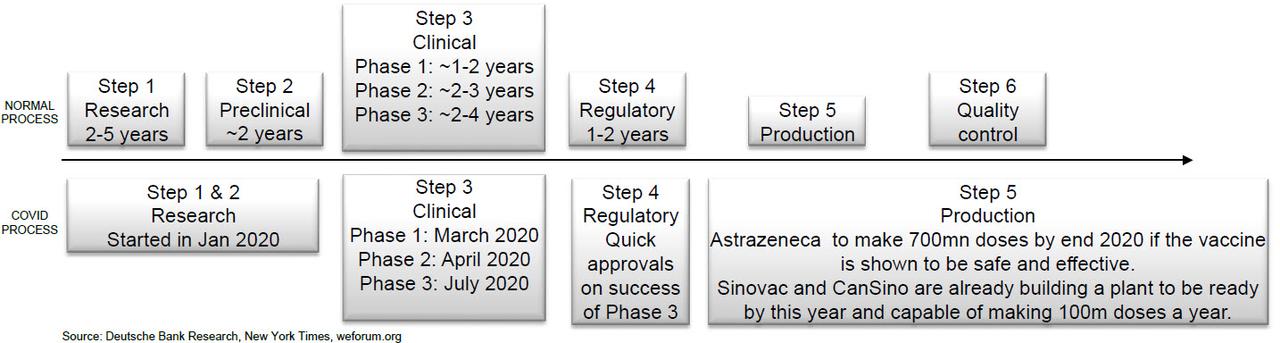
As Deutsche Bank wrote at the start of August, whereas vaccines normally require years of testing and additional time to produce at scale, amidst the covid pandemic scientists are hoping to develop a coronavirus vaccine within an extremely truncated timeframe of only 12 to 18 months. The reason for that while normally a vaccine takes years to develop using a traditional process, with covid things are far more accelerated...
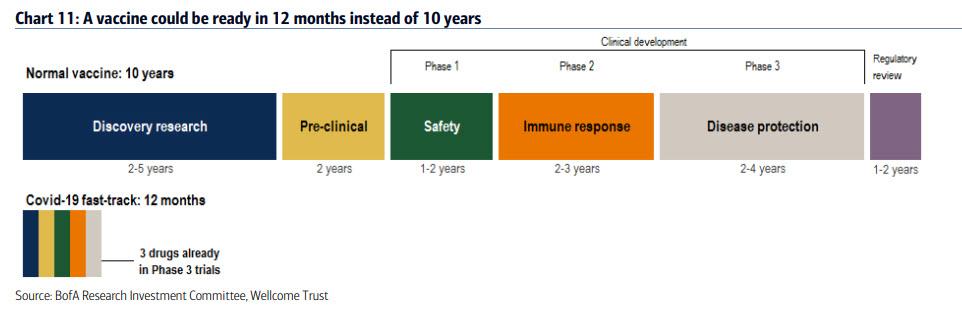
... with BofA showing how what is typically a 10 year process could - in theory - be compressed to just 12 months:

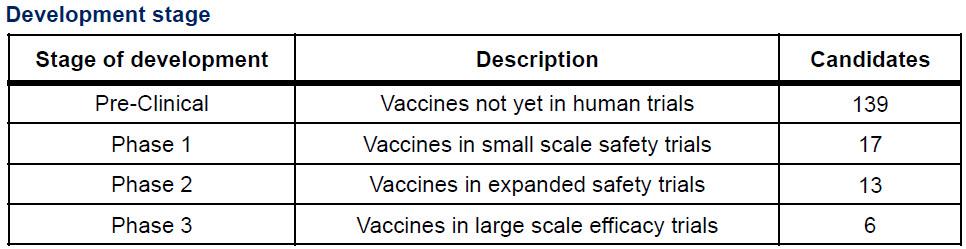
... and furthermore, there are already no less than 160 covid vaccine candidates currently in process as the following table shows...
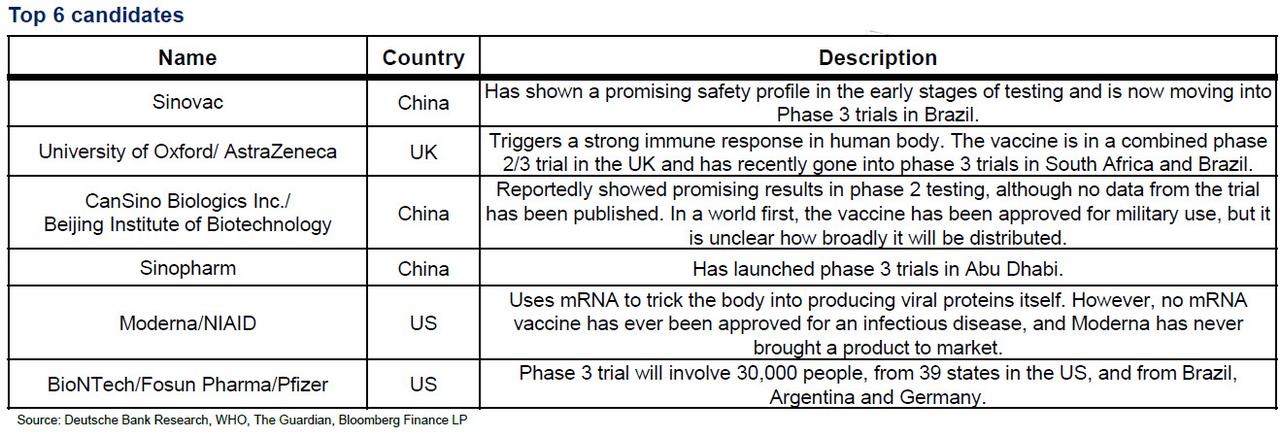
... with the top 6 listed below.
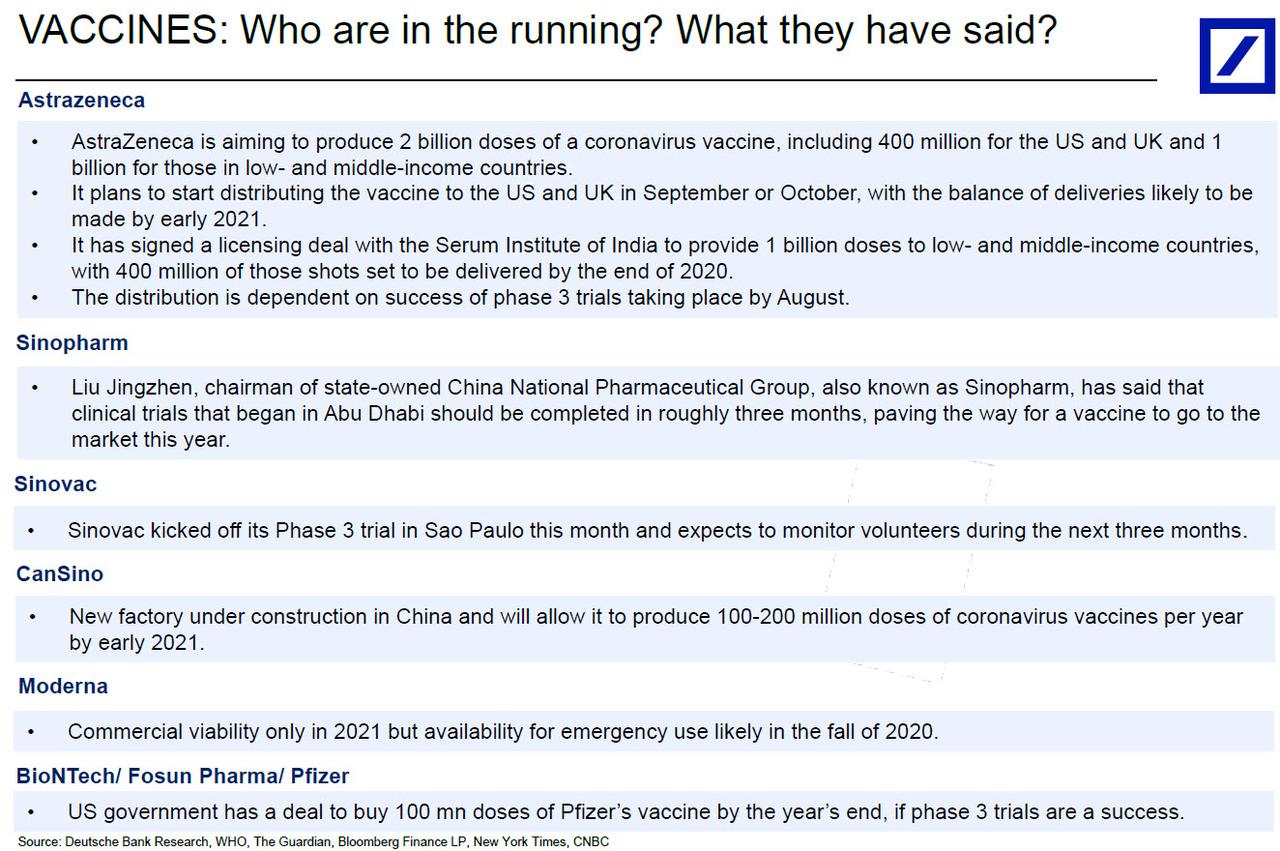
Here is what the top vaccine makers have said publicly about the state of affairs courtesy of Deutsche Bank.

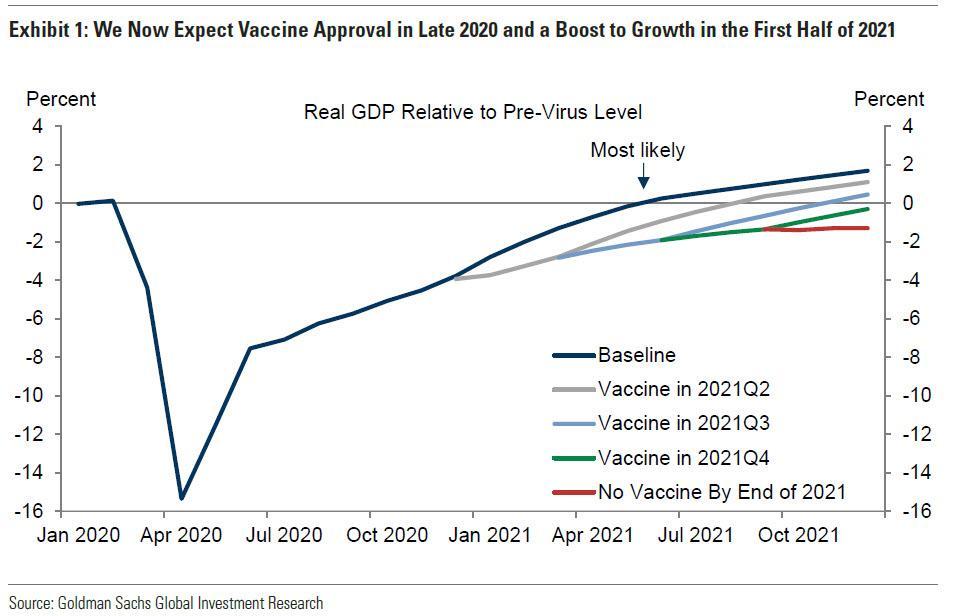
Still, there are caveats and there is a distinct possibility a vaccine - which many sellside analysts view as a "magic bullet" to rebooting the economy and renormalizing pre-covid growth rates - may not emerge any time soon as various roadblocks remain. That however did not stop Goldman from boosting its economic outlook and raising its GDP forecast for 2021 for one simple reason: as we reported two weeks ago, the bank now believes that "at least one vaccine will be approved this fall with widespread distribution and positive growth effects felt in the first half of 2021".
As a result, Goldman now expects GDP growth of +10% in Q1 2021, +8% in Q2 2021, +4% in Q3 2021, and +3% in Q4 2021 (an upgrade vs. +8%, +6.5%, +5%, +4% previously). This raises 2021 growth to +6.2% on an annual average basis (vs. +5.6% previously) and +6.2% on a Q4/Q4 basis (vs. +5.9%).
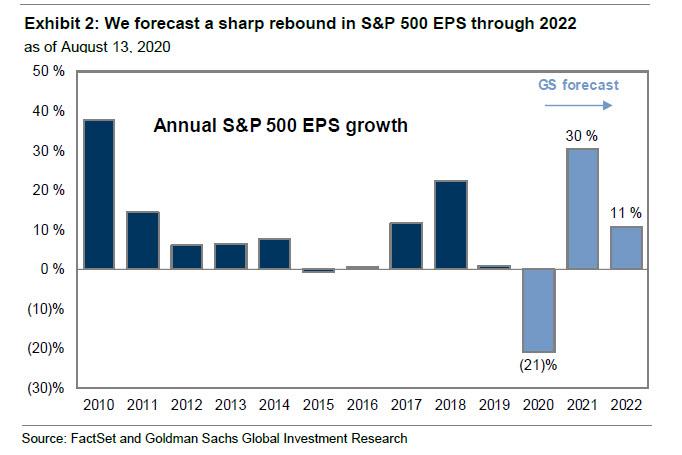
This renewed economic optimism also prompted the bank's chief equity strategist David Kostin to raise both his EPS forceast and his S&P price target to 3,600 last weekend (the real reason of course is that the S&P had run far away from Goldman's prior S&P price target of only 3,000, and the bank had to goalseek a reason to become more optimistic).
Not everyone is that optimistic however.
Countering Goldman's cheerful outlook, Bank of America last week wrote that it does "not think that it will be realistic to have widespread vaccine availability (hundreds of millions of doses) in the US and Europe sometime in 1Q21. We think that there are considerable vaccine process development and manufacturing risks, which could compromise sufficient and timely vaccine supply, including potential setbacks in process validation, scale up, technology transfer, raw material shortages (e.g., glass vials), etc. Outside of the US and the main countries in Europe, COVID-19 vaccine supply could also be compromised by "vaccine nationalism" (that is, the rich countries of the world prioritizing and hoarding vaccine supply domestically before making vaccine(s) available elsewhere)."
Elaborating on this skeptical timeline view, in a note from Bank of America last week titled "The economics of a vaccine", the bank's chief global economist Ethan Harris wrote that it will take a significant amount of time from proving a vaccine is effective to distributing it broadly to the population. The lags include:
  1. Production time (unless it is one of the candidates doing production in advance),
  2. Distribution (requires setting up drive-throughs and other broad distribution systems),
  3. Second shot (a few weeks after the first),
  4. Time to determine efficacy (roughly a month) and
  5. Time to uncover longer-term side effects and durability (a year perhaps).
Harris then writes that in listening to the experts, including our healthcare analysts, there are a number of potential pitfalls in developing, producing and distributing a vaccine. Three stand out to Bank of America.
1. Partial success. Talking to healthcare analysts, success in finding a vaccine is not a binary outcome. Vaccines can be approved even if they only provide protection for half of the people taking them, they may prevent serious illness rather than prevent infection altogether, immunity may not last long, particularly if the virus mutates frequently, and side effect may be prohibitive for some vulnerable groups. Distributing a vaccine that either doesn’t work or ends up with serious side effects could damage the economy more than having a long delay in finding a vaccine.
2. Vaccine nationalism. There is already a scramble to be first in line for the vaccine, with a number of countries lining up supplies for one or several of the candidate vaccines. Here, BofA worries about history repeating itself. Early in the crisis there was a similar scramble for masks and other supplies, with a variety of efforts to hoard supplies. Will this compromise the efficiency of production and distribution across global supply chains?
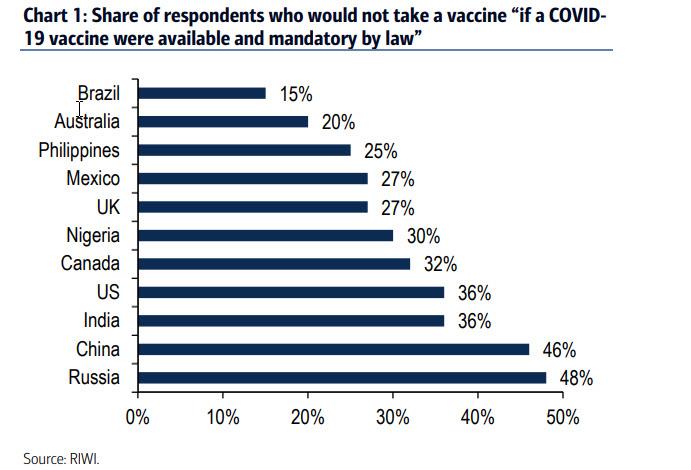
3. Vaccine phobia. Even in the best of times, many people refuse to get a flu shot. Americans seem particularly skeptical about public health policy. If masks are unacceptable, what about shots of a brand new drug? A RIWI survey in June and July found big differences across countries (Chart 1). This would suggest that if anything, the initial take-will be very slow. After all, there have been a lot of confusing public health messages, particularly in the US. Yet even BofA admits that "such caution is to some degree warranted, with the vaccines being rushed to market without knowledge of the long-term side effects."
Why all the focus on vaccine timing? As Harris continues, reading the commentary in the press, he gets the sense that many investors see a vaccine breakthrough as a game changer, quickly pushing the global economy back to full employment.
In Harris' view, while that may have been the case had there been a miracle cure or vaccine in the Spring, as it would have shortened the shutdown and avoided deep damage to the economy, however, over time the story has shifted and is continuing to shift. Economies have all reopened to some degree. People have learned to function with the virus and have restructured activities accordingly. We can see this in the way countries that have not contained the virus—like the US—can “bend the case curve” with relatively modest changes in behavior. Still, we must also contend with headwinds to growth from second-round effects: the damage to confidence and balance sheets, businesses slowly (and not so slowly) going under and investment plans canceled.
It is worth hammering home this point. Every recession starts with one or several shocks and yet continues even when the shock abates. Consider two factors that are important in many recessions: central bank tightening to fight inflation and surges in oil prices. Both generally reverse over the course of the recession and yet the downturn continues. A classic example is the recession of 1982.
It is also important to note that rolling out a vaccine will not immediately end all social distancing behavior. Some people will respond quickly as pent-up demand is released, taking that long-delayed vacation, for example. However, the majority of people will re-engage slowly as they become more comfortable that the health risk is indeed gone. Some activities could take very long to fully recover. One final headwind: after pouring stimulus into the economy, developed-market monetary authorities are almost out of ammunition and fiscal authorities will likely pull back a bit, letting the economy wobble along on its own.
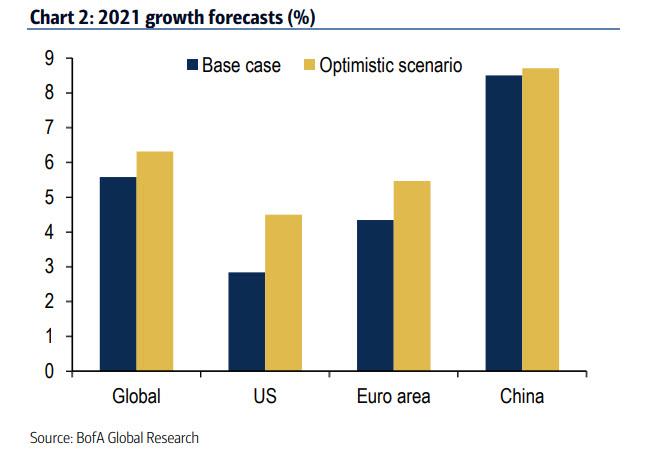
So putting it all together, BofA's baseline remains unchanged (and not in pursuit of goalseeking a narrative driven by the S&P500's relentless ascent, unlike Goldman), namely that a vaccine is widely disseminated in the developed world in 3Q 2021, but rolls out much more slowly in parts of the developing world. Under a "realistically optimistic scenario" BofA simply assumes the process is accelerated by two quarters so that the roll-out is in 1Q rather than 3Q.
BofA's "realistically optimistic scenario" for growth,which incidentally coincides with Goldman's new baseline, is shown below .
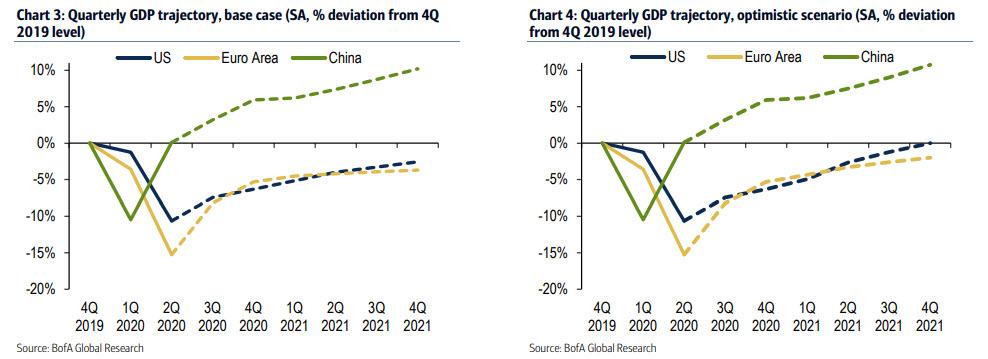
Globally, in the event of a vaccine, BofA expects the addition of 70bp to growth in 2021. The stimulus varies across countries. In general, countries that have had the most trouble containing the virus will tend to respond more to a vaccine — hence the US benefits more than Europe, which in turn benefits more than China. As Chart 3 and Chart 4 show, an early vaccine would allow US GDP to return to 4Q 2019 levels by 4Q 2021, although the output gap remains as growth lags potential; Euro area GDP would not quite return to 4Q 2019 levels even with an early vaccine, largely because fiscal stimulus has been too small and too delayed.
China is expected to surge even in the base case as the virus is already largely under control. But GDP should still remain below potential through the end of next year in both scenarios. Similarly, there is limited upside from an early vaccine in most of emerging Asia because so much progress has already been made in staving off the virus. Other emerging markets should benefit more than EM Asia, but less than DM, because broad inoculation will probably happen a little later.

    FT : Bets against US stocks drop to 15-year low as market rallies

    Bets against US stocks drop to 15-year low as market rallies
    Short-sellers left nursing heavy losses from jump in tech share prices

    Short positions in US stocks have dropped to their lowest level in more than a decade, as this year’s record-breaking rally inflicts big losses on investors seeking to profit from declining share prices.

    Short interest as a proportion of market capitalisation for the median stock in the S&P 500 index fell to 1.8 per cent at the beginning of this month, according to figures from Goldman Sachs, the lowest since the bank began tracking the data in the 2004. That compares to 2 per cent at the start of the year, and an average of 2.4 per cent over the past 15 years.

    For tech and health stocks, the year’s best performing sectors, short positions relative to market value now stand at or close to the lowest level for the period analysed by the bank.

    The US stock market tumbled earlier this year as the Covid-19 pandemic spread around the globe. From the previous market peak in February to its lows in early March, short positions notched up paper gains of $375bn, according to S3 Partners, a data provider.

    But stocks have since rebounded sharply, adding more than 50 per cent to the value of the S&P 500, taking it to a record closing high last week. Mark-to-market losses on short positions now sit at $383.5bn since the March lows.

    Stocks with the biggest amount of short interest have fared better than those with the least, intensifying the blow for short sellers, according to IHS Markit, a data provider.


    “Similar results may be expected for the small-cap universe . . . but observing the same in the large-cap space is striking,” said Sam Pierson, director or securities finance for IHS Markit. “The rally has been a challenging time for directional short selling.”

    Bets against Amazon, Apple and Facebook, three of the top five largest companies in the S&P 500, are among the worst-performing for short-sellers this year as tech-focused giants have powered the rally.

    Investors betting against Amazon have weathered paper losses of $4.6bn as the stock has jumped 51 per cent since February, while those waging on a fall in Facebook shares are down $1.6bn for the period, according to S3.

    Those positioned for a drop in Apple’s stock falling have lost $4bn in that time. Last week the iPhone maker became the first US company to hit a market capitalisation of $2tn, just two years after breaking the $1tn mark.

    Tesla, which is not in the S&P 500, has been the worst short bet across the US market since the February peak. Short sellers have suffered paper losses of $13.8bn, according to S3 data, as the carmaker’s stock has soared more than 120 per cent over the period to close at a record high on Friday.

    Elon Musk, chief executive of Tesla, has for years sparred with investors betting against the company’s stock and lost month taunted short sellers as the company’s stock rose by selling red satin shorts on Tesla’s website.

    But as tech stocks have rallied, many other sectors have been left behind.

    Share prices of a fifth of S&P 500 companies were more than 50 per cent below their all-time highs at the close on Friday, while the average stock in the index is 28.4 per cent below its peak, according to Cornerstone Macro, a research group.

    FT ; Trump considers fast-tracking UK Covid-19 vaccine before US election

    Trump considers fast-tracking UK Covid-19 vaccine before US election
    FDA could use emergency authorisation rules despite fears over high-profile resignations due to safety concerns

    The Trump administration is considering bypassing normal US regulatory standards to fast-track an experimental coronavirus vaccine from the UK for use in America ahead of the presidential election, according to three people briefed on the plan.

    One option being explored to speed up the availability of a vaccine would involve the US Food and Drug Administration awarding “emergency use authorisation” (EUA) in October to a vaccine being developed in a partnership between AstraZeneca and Oxford university, based on the results from a relatively small UK study if it is successful, the people said.

    The AstraZeneca study has enrolled 10,000 volunteers, whereas the US government’s scientific agencies have said that a vaccine would need to be studied in 30,000 people to pass the threshold for authorisation. AstraZeneca is also conducting a larger study with 30,000 volunteers, although the results from that will come after the smaller trial.

    Making a vaccine available before the election could allow US president Donald Trump to claim he has turned the tide on a virus that has killed more than 170,000 Americans following widespread criticism of his handling of the pandemic. In his convention speech on Thursday night, Joe Biden, Mr Trump’s Democratic opponent, said that the US response to the virus was the “worst performance of any nation”.

    However, if the Trump administration does rush through emergency authorisation ahead of the election by skirting normal government guidelines, it could dent already shaky public confidence in the safety of vaccines ahead of one of the largest mass-immunisation programmes in US history.

    Mark Meadows, White House chief of staff, and Steven Mnuchin, Treasury secretary, have told top Democrats that the administration was considering fast-tracking a vaccine, according to one person briefed on a July 30 meeting the pair held with Nancy Pelosi, the Democratic Speaker of the House of Representatives.

    Mr Meadows said in the meeting that there could be emergency authorisation, possibly for the AstraZeneca vaccine, in September. Mr Mnuchin added that the administration expected an EUA for a vaccine before full approval, said the person, who added that Ms Pelosi warned that there should be “no cutting corners” in the vaccine approval process.

    A spokesperson for the Treasury secretary said: “Secretary Mnuchin did not make any comments regarding AstraZeneca, nor is he familiar with the specifics of the AstraZeneca vaccine candidate. He is also not aware of any plans the FDA may have regarding any emergency use authorisation for any potential vaccine, beyond what he has heard publicly stated.

    “The secretary believes, and has always believed, that any decision on vaccine candidates and any possible EUA is up to the FDA.”

    The White House did not comment.

    If the FDA, which is led by commissioner Stephen Hahn, were to grant emergency approval to the AstraZeneca vaccine based on the Oxford study, it could provoke a string of resignations from the agency.

    Earlier this week, Peter Marks, director of the FDA’s Center for Biologics Evaluation and Research — which is responsible for assessing the vaccines — told Reuters that he would resign if the agency were to approve a jab before definitive data showing it was safe and effective.

    “I could not stand by and see something that was unsafe or ineffective that was being put through,” Dr Marks said. “You have to decide where your red line is, and that’s my red line.”

    He went on: “I would feel obligated [to resign] because in doing so, I would indicate to the American public that there’s something wrong.”

    Mr Marks declined to comment to the FT.

    Michael Caputo, a spokesperson for the US health and human services department — which contains the FDA — said any claim that the administration would issue an EUA before the election was “absolutely false”.

    Mr Caputo said the administration was hopeful that a vaccine would be developed by the first quarter of 2021.

    “We have always been working towards that goal. I’ve never been told at any point in time that that goal has changed,” he said. “Talk of an October surprise is a lurid resistance fantasy. Irresponsible talk of an unsafe or ineffective vaccine being approved for public use is designed to undermine the president’s coronavirus response.”

    On Saturday, Mr Trump lashed out at the FDA in a tweet that appeared to accuse the agency of slowing down enrolment in coronavirus vaccine and drug trials to delay the results of studies until after the election.

    “The deep state, or whoever, over at the FDA is making it very difficult for drug companies to get people in order to test the vaccines and therapeutics,” Mr Trump wrote in a tweet that tagged Dr Hahn. “Obviously, they are hoping to delay the answer until after November 3rd. Must focus on speed, and saving lives!”

    Ms Pelosi hit back at Mr Trump in a press conference on Saturday.

    She said: “The FDA has a responsibility to approve drugs, judging on their safety and their efficacy, not by a declaration from the White House about speed and politicising the FDA.”

    She added: “This was a very dangerous statement on the part of the president. Even for him, it went beyond the pale in terms of how he would jeopardise the health and wellbeing of the American people.”

    Two of the people briefed on the plans said that the relatively small UK trial was not designed to produce sufficient data of the kind that would be required for emergency authorisation in the US. US drugmakers Moderna and Pfizer, which are also trialling vaccines, both plan to enrol 30,000 participants in Phase III studies they started in July. Moderna said it would complete enrolment by the end of September, while Pfizer has said it has already enrolled 11,000.

    One of the people briefed on the plan said: “I don’t see a way forward for [AstraZeneca],” based on the 10,000-person trial. “They’re not going to get there. They won’t have the clinical end points”

    The person predicted that if Dr Marks were to quit, other scientists in his division of FDA would follow suit.

    A spokesperson for AstraZeneca said it had “not discussed emergency use authorisation with the US government” and that it “would be premature to speculate on that possibility”.

    Paul Offit, a vaccine expert at the Children’s Hospital of Philadelphia, said it would be “very disappointing” if the Trump administration were preparing such a plan before it had even seen the data because it risked “politicising the science”.

    He said even if the study were successful, a 10,000-person trial would not be large enough to rule out rarer side effects. “The job of the FDA is to protect the American public if they see these data as inadequate.”

    Dr Hahn faced criticism earlier this year after the FDA granted emergency approval for hydroxychloroquine — an unproven drug repeatedly touted by Mr Trump — before reversing its decision when multiple studies showed the drug was not an effective treatment for coronavirus.

    Public health officials in the US have repeatedly stressed the importance of following normal processes when approving a Covid-19 vaccine.

    In June, Francis Collins, director of the National Institutes of Health, told CNN: “Each vaccine needs to be tested on about 30,000 volunteers. We don’t believe that we have enough power in the analysis, to be able to document the vaccine works unless you get to roughly that number.”

    Robert Redfield, head of the Centers for Disease Control and Infection, told the FT on Friday: “Although we have talked about doing this at ‘warp speed’, it is not through any cuts in our efforts for vaccine safety or scientific integrity. I am confident there will be all the rigour we have always had for developing vaccines for human requirements.”

    One person working on the US effort to find a vaccine said the Trump administration’s exploration of ways to circumvent normal procedures had prompted infighting among the government’s top scientists. Anthony Fauci, director of the National Institute of Allergy and Infectious Diseases, and Dr Collins are stressing the importance of scientific rigour whereas Moncef Slaoui, the White House’s vaccine tsar, wants to forge ahead, the person said.