Electrek : Elon Musk’s Boring Company to join Tesla in Austin for new tunnel pro

Elon Musk’s Boring Company to join Tesla in Austin for new tunnel project

Elon Musk’s Boring Company has announced that it is joining Tesla in Austin, Texas for a new tunnel project.

It is already starting to hire.


The Boring Company is already involved in several tunnel and ‘Loop’ projects in Los Angeles, Las Vegas, and in Maryland.

A ‘Loop’ consists of a tunnel with Tesla vehicles moving passenger autonomously at high speeds inside.

Now it is adding another one to the list.

The Boring Company has posted several jobs in Austin, Texas and tweeted something that makes it sound like they want to build a tunnel in the city:

“Rumor has it that “Austin Chalk” is geologically one of best soils for tunneling. Want to find out? Austin jobs now available.”

Musk’s startup is going to join its other company, Tesla, in Austin.

The project that they are going to be working on is currently unknown, but Musk has gained experience working with county officials, which is going to be helpful in pushing such a construction project through the approval process.

Electrek’s Take
Elon has talked about the Boring Company building loops and hyperloops at Tesla locations before, including between Fremont factory and Gigafactory Nevada.

I wouldn’t surprised if Boring Company coming to Austin would have something to do with Tesla.

I bet that they will be leveraging Tesla’s Gigafactory Texas project to build a Loop to Austin and then try to expand the Loop throughout the city — not unlike how they used the Las Vegas Convention center project to launch the Las Vegas loop.

If Elon can also use Tesla’s experience working with Austin officials for the Gigafactory project in order to seek approval for a Boring Company Loop, it could greatly increase the project’s chances of happening.

>>> US Close Dow +2.95% S1P +1.17% Nasdaq -1.53% Russell +3.70%

Closing Stock Market Summary

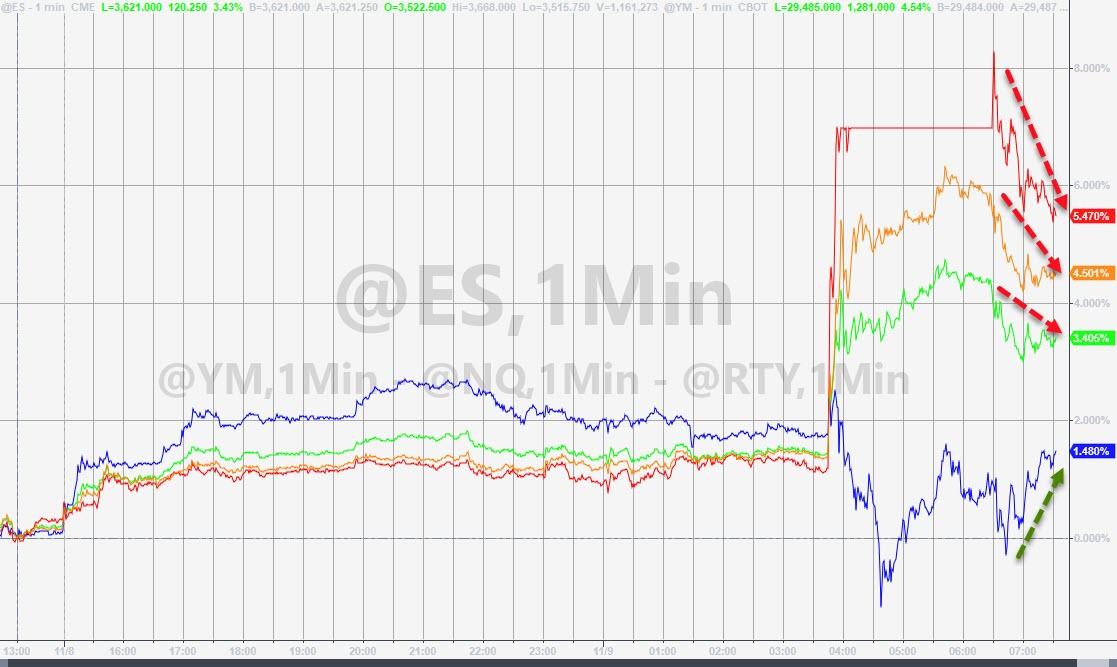
The S&P 500 advanced as much as 3.9% on Monday after Pfizer (PFE 39.20, +2.80, +7.7%) and BioNTech (BNTX 104.80, +12.80, +13.9%) announced that their collaborative COVID-19 vaccine was more than 90% effective in patients without evidence of prior infection. Investors took profits, though, leaving the benchmark index up 1.2% for the session.  

Investors also rotated out of growth stocks and into value/cyclical/small-cap stocks, which benefited the Dow Jones Industrial Average (+3.0%) and Russell 2000 (+3.7%) at the expense of the Nasdaq Composite (-1.5%). Each index set new intraday highs shortly after the open, but gradually retraced gains throughout the day and into the close. 

Pfizer and BioNTech plan to request FDA emergency use authorization for their two-dose vaccine later this month, providing hope that the economy can return to pre-pandemic levels in 2021 and re-instill a sense of normalcy. Distressed cyclical sectors were the biggest beneficiaries of this hopeful thinking. 

The energy (+14.2%) and financials (+8.2%) sectors finished comfortably atop the leaderboard, aided by noticeably higher oil prices ($40.31, +3.17, +8.5%) and curve-steepening activity caused by selling in longer-dated Treasuries. The consumer discretionary (-1.6%), information technology (-0.7%), consumer staples (-0.5%), and communication services (-0.3%) sectors closed lower. 

The 2-yr yield increased two basis points to 0.18%, while the 10-yr yield increased 11 basis points to 0.96%. The U.S. Dollar Index advanced 0.6% to 92.82. 

In other important news, Joe Biden was projected the winner of the U.S. presidential election, although President Trump did not concede and said he would file legal challenges. Note, media reports indicated that Mr. Trump would unlikely succeed in overturning the election results. 

It's worth mentioning that at one point today, the S&P 500 was up as much as 11.5% in less than six sessions. Presumably, that left it primed for profit taking amid an understanding that the market still has to get through the new wave of coronavirus and uncertainty surrounding another stimulus package. 

Separately, McDonald's (MCD 213.22, -3.34, -1.5%) beat EPS estimates and said it will test a plant-based burger in several markets. Biogen (BIIB 236.26, -92.64, -28.2%) shares plunged 28% after the FDA's Advisory Committee rebuked the company's Alzheimer's drug. V.F. Corp (VFC 77.81, +7.80, +11.1%) agreed to acquire Supreme for $2.1 billion. 

Investors did not receive any economic data on Monday. Looking ahead, investors will receive the JOLTS - Job Openings report on Tuesday.

  • Nasdaq Composite +30.6% YTD
  • S&P 500 +9.9% YTD
  • Dow Jones Industrial Average +2.2% YTD
  • Russell 2000 +2.2% YTD

NY Post : Ex-TikTok CEO Kevin Mayer joins Len Blavatnik’s investment firm

Ex-TikTok CEO Kevin Mayer joins Len Blavatnik’s investment firm

Kevin Mayer — who just finished a short-lived stint as TikTok’s chief executive and was once seen as a contender for the top job at Disney — has joined billionaire Len Blavatnik’s Access Industries.

Access said Monday that Mayer will become a senior advisor to the Ukrainian-born tycoon’s investment firm, focusing on its media-related businesses and identify new potential business opportunities for the company.

Access’s media investments include Warner Music Group, the third-largest music recording company that reps the likes of Cardi B., Ed Sheeran and Bruno Mars, as well as Deezer, a Paris-based music streaming platform.

Mayer formerly served as chairman of Disney’s direct-to-consumer division and international unit where he oversaw streaming properties like Disney+ and Hulu. He was widely rumored to be an in-house favorite to succeed Bob Iger as CEO, but in February, the company promoted Bob Chapek, who ran Disney’s theme parks and consumer-products unit, to the top job.

In May, Mayer left the Mouse House to become CEO of ByteDance’s popular short-form social media app, TikTok. He would also run China-based ByteDance’s global expansion effort, including its music and gaming businesses.

But Mayer resigned from the company just four months later as the Trump administration pressured ByteDance to sell its US operations, citing national security concerns. In a letter to staffers, Mayer explained that the political climate had shifted and that the CEO role at Tiktok would be changed due to the expected sale of the app’s US business.

Microsoft had considered taking over TikTok both by itself or in a deal with retail giant Walmart. Separately, software firm Oracle and Walmart also pursued TikTok and other potential buyers have considered it. A deal hasn’t been completed.

Mayer said in a statement Monday that he is looking forward to helping Access “on the success of its leading media and entertainment businesses as a key component of my future endeavors.

FT : UK High Court blocks £5bn lawsuit against BHP over Brazil disaster

UK High Court blocks £5bn lawsuit against BHP over Brazil disaster
Largest group claim in English legal history struck out as ‘abuse of process

The UK High Court has thrown out a £5bn lawsuit against the world’s biggest mining group BHP brought on behalf of more than 200,000 Brazilians seeking damages from a deadly dam failure in 2015.

In a judgment published on Monday, Mr Justice Turner struck out the group claim — the largest in English legal history — saying the proceedings amounted to a “clear abuse of process”.

“In particular, the claimants’ tactical decision to progress closely related damages claims in the Brazilian and English jurisdictions simultaneously is an initiative the consequences of which, if unchecked, would foist upon the English courts the largest white elephant in the history of group actions,” he said.

The decision follows an eight-day jurisdictional hearing in July that sought to establish if BHP, which has headquarters in the UK and Australia, could be held liable for the conduct of foreign subsidiaries.

Nineteen people died when a dam holding waste material from an iron ore mine in the Brazilian state of Minas Gerais collapsed just over five years ago. The Fundão tailings dam was owned by Samarco, a joint venture between BHP and Vale, the world’s biggest producer of key steelmaking ingredient iron ore. 

The claimants contend that BHP, through Samarco, was ultimately responsible for the dam failure because it repeatedly ramped up iron ore production and storage of the toxic tailings despite warnings that this would compromise its safety.

Tom Godhead, a partner at law firm PGMBM, which is representing the claimants, called Monday’s judgment “fundamentally flawed” and said it would appeal.

 “BHP have succeeded, once again, in delaying the provision of full redress for the victims of the worst environmental disaster in Brazilian history,” he said. “Elements of the judgment have no proper basis in both English and European law, such that we are overwhelmingly confident that it will be overturned.”

BHP said the ruling was a “strong endorsement” of its position that the proceedings were “unnecessary” because they duplicated matters already covered by the work of the Renova Foundation, which it set up in 2016 with Vale to carry out repair and compensation work. Renova has already spent £1.4bn.

“The decision also reinforces that the compensation and remediation schemes in Brazil managed by Renova — and supervised by the Brazilian Courts — are the most appropriate means for individuals and communities to pursue their claims and seek reparation,” BHP said 

Monday’s ruling comes 18 months after the UK’s Supreme Court said thousands of Zambian villagers could bring a legal challenge in the English courts against mining company Vedanta over alleged pollution in Zambia.

“The prospect of attempting to manage the claims of over 200,000 claimants where such a high proportion of them are taking (or have taken, or reserve the right to take) steps to achieve compensation in Brazil for the same losses as those in respect of which they wish to establish a right to damages against the defendants in England is nothing short of alarming,” said Mr Turner in his judgment.

(ZH) "Epic" Quant Carnage As Momentum Plunges Most On Record Amid "Insane, Tecto

"Epic" Quant Carnage As Momentum Plunges Most On Record Amid "Insane, Tectonic" Rotation


What was already a dismal year for quant funds is about to get absolutely catastrophic.
After a historic headfake, which saw the Nasdaq soar higher overnight on hopes that the Fed may have to step in with more monetary easing to offset the economic slowdown that would result from rising covid cases, this morning's Pfizer news appears to have effectively tabled the covid threat with markets exploding to new all time highs, and unleashing an organic reflation trade in lieu of a "Blue Wave", one which has sent the 10Y yield surging to 0.96%, the highest level since June...
... which while benefiting small caps and tech stocks, has crippled duration/growth names, i.e., the tech/FAAMG/Nasdaq complex.

And as investors scramble to cover small-cap short and flee the tech names which had massively outperformed this year, and which form the core of the momentum trade, the market-neutral Momentum factor is getting absolutely destroyed, plunging by the most on record.
Commenting on today's action, Nomura x-asset strategist Charlie McElligott writes that following the "de-risking into the election event" which as he explained last week was mostly about the initial VaR-down transitioning to a massive “gross-up” redeployment in underlying status quo “momentum” Equities books on post-election clarity, "the the issue now isn’t directional as far as risk deployment goes…instead, for the masses, the challenge is going to be about dispersion, because the 5+ year legacy crowded-positioning of the "everything duration" goldilocks momentum trade—long secular growth vs short cyclical value—is likely going to see tectonic movement and at the very least, tactical unwind to play for this “economic reopening” forward view."
As Bloomberg notes, even before today's quant carnage, Sanford Bernstein quant analysts warned over the momentum factor’s soaring valuations, which they calculated at more than two sigme above its historic average in the U.S. and Europe; in the US, a measure of crowding in the factor has surged anew to multi-year highs.

Today's historic move also represents Wall Street's latest fiasco in a year in which it repeatedly failed to capture the market's upside, because as we noted yesterday heading into this week and with some clarity on the election front, attention had turned to the coming covid developments as Morgan Stanley wrote last night in "With Little Or No Stimulus Coming, Pandemic Developments Become Critical For Markets."
To be sure, the market is as usual getting ahead of itself, because even if those 40% of Americans who refuse to get immunized somehow volunteer for the vaccine, there is a very long way to go before any one of the candidates receives regulatory approval and is distributed widely enough for restaurants, offices, planes and shops to see a recovery in demand. Cited by Bloomberg, Evercore ISI estimates normal life won’t return until the third quarter of next year.
None of that matters to stocks, however, which are soaring on the twin tailwinds of a possible burst in monetary stimulus/more QE as Congress gridlock means a smaller fiscal injection, coupled with the pricing in of the reflation to be unleashed by the elimination of covid some time in 2021, and for the clearest indication look no further than the VaR-shocking move higher in Treasury yields.
"Reduced political uncertainty alongside strong results from Covid vaccine trials and improving fundamentals paves a way toward higher equity prices and a cyclical/value rally," Evercore strategists wrote.
Going back to McElligott, he concludes that with the i) full-throttle “economic reopening” joy following the PFE Vaccine headlines and ii) the still-present risk of a “Blue Wave” dynamic still a low-delta “thing” due to Georgia run-off potentials, the "Rotation Reflation Reopening Relief trade will be insane today - but for FAR, FAR BETTER REASONS than just the unlimited govt spending expansion thesis alone" — which is why the Russell 2000 has exploded higher even as the Nasdaq remains flattish, in a pure unwind of "Secular over Cyclical" status quo trades.
To the Nomura strategist, this means that today is going to be an epic "Value over Growth and Momentum" trade of right-tail outlier proportions, which will sting multi-year consensus “everything duration” secular-over-cyclical positioning with Size (Small over Large), Beta, Vol, Leveraged Balance Sheet, PMI Sensititives and Yield Sensitives all set to explode higher in sympathy, and which are only tactically owned but recently paired-back after the election outcomes.
Translation: the paradox of today's explosion higher across markets is that it may result in one or more quant (and not only) funds capitulating and liquidating.

WWD : Rupert’s Dream Realized: An All-Embracing Platform for Digital Luxury

Rupert’s Dream Realized: An All-Embracing Platform for Digital Luxury
Richemont’s chairman said the China-focused, global partnership with Farfetch and Alibaba will help smaller luxury players “fight giants like Amazon,” and give fashion and accessories brands greater access to a market with explosive growth.

LONDON — It may have taken a while, and met with some resistance, but Richemont chairman Johann Rupert is, at last, seeing his dream of a wide-open digital platform for luxury take shape, thanks to his allies – and erstwhile competitors — Alibaba, Farfetch and Artemis.

It’s clear that Rupert feels vindicated by the creation of a new, global strategic partnership that will see Compagnie Financière Richemont and its Chinese ally Alibaba pour hundreds of millions of dollars into the fashion retail platform Farfetch Ltd., and into a new joint venture called Farfetch China.

The partners said the ultimate aim of their alliance is to provide luxury brands with “enhanced access” to the China market, and to fuse physical and digital retail at a time when more people are shopping online, but still hungering for in-store experiences.

As part of the deal, Farfetch will also launch on Alibaba’s luxury platforms in China. The model is similar to what Net-a-porter and Mr Porter, both of which are owned by Richemont, have done as part of a separate JV with Alibaba inked in 2018.

As part of the alliance unveiled on Nov. 5, a steering group to include Rupert and Kering chairman and chief executive officer François-Henri Pinault will be created.

The alliance answers a call that Rupert made more than five years ago. In 2015, he argued that luxury players would ultimately be stronger together, and invited the likes of Kering and LVMH Moët Hennessy Louis Vuitton to take a stake in Yoox Net-a-porter Group>

His idea was to create a “neutral” digital platform where luxury brands and retailers could sell alongside each other, share tech tools — and still remain competitive. Rupert’s luxury peers didn’t take him up on the offer, so Richemont ended up buying the remaining shares of YNAP in 2018, and it now owns 100 percent of the company.

“We’re not big enough, or tech-savvy enough, to do this on our own. All of the luxury goods industry combined would have difficulty in fighting giants like Amazon, which is why I asked everybody, in 2015, to invest in Yoox Net-a-porter,” said Rupert on a call on Friday to discuss Richemont’s first-half results for fiscal 2020-21.

“I was really looking at a business model, like Spotify, where the content owners have shares in a platform that is run autonomously. Then you, as a content owner, have access to all of the technology and systems to serve your clients. That is our view.”

Not everyone feels the same as Rupert, who was prescient in his call for competitor cooperation in fashion and luxury. Since 2015, myriad companies have joined The Fashion Pact, committing to key environmental goals, and standing shoulder-to-shoulder in their efforts to fight climate change.

As recently as January, Bernard Arnault of LVMH expressed skepticism about online pure players, and accused them of profiting from the sale of fakes.

“They’re all losing money. That’s not a great sign. And the bigger they get, the more money they lose. We’ve been asked several times to participate in these businesses, and I’ve always said ‘no,’” Arnault told reporters and analysts at LVMH’s annual results press conference in Paris.

Arnault also mentioned that LVMH had created a “small e-commerce site” called 24S, which he said “is also losing money, but it’s not losing a lot, because it’s small. We’re growing it modestly. We hope to find a way to make it profitable, but for the time being, we haven’t.”

Coincidentally — or maybe not — 24S launched its Chinese web site just as news of the Farfetch China venture landed. Now, LVMH and 24S will have to compete in the region against three industry giants — Richemont, Farfetch, and Kering (through Artemis, the Pinault family’s holding company) — all of which will be powered by Alibaba’s tech and data systems.

In addition, since Arnault hit out at Amazon, the U.S. online giant has launched Amazon Luxury Stores, a by-invitation-only platform located inside the Prime app. Brands including Oscar de la Renta, Roland Mouret and Car Shoe have joined and there are plans to expand the offer to Europe.

During the call on Friday, Rupert pointed out that while Richemont did not initiate discussions with Farfetch about the latest deal, it was high time that a large-scale luxury tech partnership took shape.

“I think I made it clear in 2015 that this is not about a [land] grab, but rather something that is necessary to serve our clients properly, especially the next generations, who will expect it. It’s going to be part of their lives,” said Rupert, who went on to quote Federico Marchetti, the founder of Yoox and chairman and ceo of YNAP.

“Federico said a mobile phone today is like the new nicotine, a packet of cigarettes. You don’t go anywhere without them. In China, everything is done with mobile, all the shopping is done with mobile, and that has enormous implications for how you get attention from customers. How do you compete for 15 seconds for eyeballs, and for traction?”

Being able to plug into Alibaba’s systems is a big win for players such as Richemont, Kering and Farfetch: The online giant offers a sophisticated commercial ecosystem, with AliPay, credit plans so that consumers can spread the cost of purchases, and marketing platforms with livestream influencers who push product 24/7. People can bank, pay bills and basically live their lives — as consumers — without ever having to leave the site.

Rupert is keen, too, on the fusion of digital and physical experiences — especially given the spike in online sales during lockdown — and believes it makes for more sales.

“New retail is not only about online shopping. We’re finding that people are browsing online, and may visit the store as a means of reflection, a way to make up their mind. We know that when they enter the store after looking online, the conversion ratio is much higher. We wish to be able to use that system for customers in the best possible way,” said Rupert.

As part of the new deal, Alibaba and Richemont will each invest $300 million in Farfetch Ltd. via private convertible notes, and will plug an additional $250 million each into a new joint venture called Farfetch China. They will have a combined 25 percent stake in the entity that will include the current market operations of Farfetch.

Artemis has also agreed to increase its existing investment in Farfetch with a $50 million purchase of Farfetch’s class A ordinary shares.

Rupert stressed that the big luxury groups and retail platforms have a lot to offer the likes of Alibaba, namely a talent for tasteful curation.

“You need selective distribution, and what interested Alibaba was the model of curation, which is highly attractive. You don’t want to be given a choice of 5,000 items, so curation is important and will always be. We’re hoping in time to build a model that covers both the selective distribution and the platform business. We can learn from each other in this.”

During the call, Rupert took the opportunity to say that Richemont wasn’t for sale, nor was the group interested in mergers.

He said “people talk about us selling, but we’re not interested. We are not interested in mergers. We have already cooperated in terms of eyewear [with Kering], and we’re prepared to do deals as long as they make commercial sense, and we’re prepared to work together where it makes the most sense.”

Richemont’s chief also weighed in regarding the ongoing impact of COVID-19, and said it had served as a successful “stress test” for the company, which ended the first half with a net cash position of 2.11 billion euros in the six months ended Sept. 30, compared with 1.77 billion euros in the corresponding period last year, thanks to a successful euro-denominated bond placement and a freeze on the annual dividend.

Rupert said with a new wave of lockdowns across Europe, the company is better prepared than in the spring, and can continue manufacturing.

“I suppose we will continue to have lockdowns and won’t go back to a normal life until next summer, in the Northern Hemisphere, at least. The lockdowns have luckily not closed the production facilities. We have taken enormous safety measures,” he said, adding that staff had done “a remarkable job to get through lockdown, and supply the incredible demand in China.”

As with other luxury goods companies, a strong rebound in China bolstered sales at Richemont in the second quarter. The country is now the luxury giant’s largest market, edging the U.S. out of its top position.

In the first half ended Sept. 30, Richemont saw sales decline 26 percent at actual exchange rates to 5.48 billion euros, and profits fall 82 percent to 159 million euros.

First-quarter sales were down 47 percent, but they recovered quickly as the months progressed. In the second quarter, sales fell by 5 percent at actual rates, and 2 percent at constant ones.

China boosted Richemont’s performance, with sales in the region up 78 percent at actual rates in the half. That growth was able to mitigate the overall decline in Asia-Pacific of 6 percent in the period, and a 44 percent decline in Europe. The U.S. saw a 33 percent decline in sales.

Jewelry outperformed the other categories. Richemont said first-half sales at its jewelry maisons were 18 percent lower than in the comparative period. Following a drop of 41 percent for the first quarter of the financial year, sales returned to positive territory, with 4 percent growth in the second quarter.

Operating profit in the division fell 24 percent in the first half to 922 million euros.

Rupert said throughout the first six months of the financial year, the pandemic impacted trading and operations “with unprecedented levels” of disruption.

“All regions, channels and business areas were affected, notwithstanding a 78 percent increase in China versus the prior-year period at actual exchange rates,” Rupert said, adding that a “strong presence in China and an acceleration in digital initiatives have partially mitigated the consequences of temporary store closures and a halt in tourism worldwide.”

He said Richemont’s maisons were “swift to build on past investments in digital infrastructure and maintain direct engagement with clients,” prompting online sales to grow at a triple-digit rate. “Our efforts to improve the quality of our distribution networks and inventories at our multibrand retail partners also helped lessen some of the negative impacts of the pandemic.”

Online retail was the most resilient channel, according to Richemont, with sales falling 4 percent to 1.21 billion euros at actual exchange rates. China, the company added, showed triple-digit online retail sales growth while the Middle East and Africa also showed “strong growth.” Operating losses in the division widened 33 percent to 138 million euros.

Richemont’s specialist watchmaking division took a beating, with sales contracting 38 percent to 966 million euros, due to the closure of multibrand brick-and-mortar stores. The division saw an operating loss of 8 million euros, compared to a profit of 285 million euros in the corresponding period last year.

As reported, the company placed a 2-billion euro denominated bond in a bid to strengthen its cash position through COVID-19. The bond will mature in three tranches, in 2028, 2032 and 2040 and Richemont said it was given an A-plus rating by Standard & Poor’s in recognition of the company’s strong balance sheet.

WWD : VF to Acquire Supreme, Valuing Brand at $2.1 Billion-plus

VF to Acquire Supreme, Valuing Brand at $2.1 Billion-plus
From collaborator to member of the family: the Street leader is joining the apparel giant, which owns Vans, The North Face, Timberland.

Supreme has found its new home at VF Corp. with a $2.1 billion deal guaranteed to reverberate through the tight knit streetwear community and on Wall Street.

The Denver giant said it signed a definitive merger agreement to buy the New York skate-based company, which sits at the white hot center of the streetwear world and saw its valuation more than double in three years.

Founder James Jebbia and the rest of Supreme’s leadership team will stay at the brand and remain based in New York City, where the company got its start as a skate shop on Lafayette Street.

VF said the business, which is understood to be wildly profitable, will be “accretive” to its adjusted earnings per share in the fiscal year that ends in April. Next year, the company is expected to add at least $500 million in revenues and 20 cents of adjusted eps to VF’s take.

Steve Rendle, VF’s chairman, president and chief executive officer, stressed in an interview with WWD that the closely watched street brand is going to stick to its knitting under VF’s ownership.

“This will take time,” Rendle said. “We talk about a light-touch integration with this business because it’s very successful, operating at a very high level today. We’ll take our time to get to know each other. This brand will continue to operate as it always has, we do not look to come in and make any changes. We’re here to help, support and enable.”

Jebbia added in a statement: “We are proud to join VF, a world-class company that is home to great brands we’ve worked with for years, including The North Face, Vans, and Timberland. This partnership will maintain our unique culture and independence, while allowing us to grow on the same path we’ve been on since 1994.”

The market has in a sense come around to Supreme’s way of seeing the world. As a direct-to-consumer based brand with a vibrant web business and very strong brand profile, it is what many companies are looking to transform into now with the pandemic reordering the landscape.

Just as VF can offer Supreme operational support, and international and data savvy, Supreme also has some tricks to teach VF.

Rendle pointed approvingly to the brand’s “approach to consumer engagement, their thoughtful focus on delivering quality product at a really consistently high rate and their deep understanding of what their customers are expecting.”

He also noted the deal fits squarely into the evolution of VF, which jettisoned its mass denim business, moved to Denver and has been focusing on the direct-to-consumer business and working to put the consumer at the center of all it does.

Supreme stays famously close to its consumer, a devoted following happy to line up in the rain to get the latest looks. Jebbia has built a monster brand that still has just 12 stores and its e-commerce site, which generates over 60 percent of its revenues.

By selling to VF, Jebbia and team join a company known for successfully bringing brands onboard without losing their DNA.

And as different as they are, VF and Supreme play in many of the same spaces.

“We have a good understanding of this customer,” Rendle said. “About $3 billion of our revenue is already derived from adjacencies to this marketplace, but Supreme sits at the center of this aspect of the market and we couldn’t be more excited to have them join us.”

Scott Roe, executive vice president and chief financial officer, said VF is buying 100 percent of Supreme and that, while the deal initially values the company at $2.1 billion, that number could rise with a potential earn out.

Roe described that as a “very fair price on both sides.”

It also shows considerable growth in the valuation at Supreme, which saw private equity giant buy a 50 percent stake at a $1 billion valuation in 2017.

VF is clearly buying Supreme for its brand profile and growth rate, not the potential for cost savings.

“We really don’t have synergies baked into this financial model,” Roe said. “That doesn’t mean there won’t be some. I’m sure there’s going to be points where we can help them, but it’s going to have to be brand appropriate and it’s going to have to be under the direction of the leadership and it has to make sense for the consumer and their business.

“We’re not coming in with a new plan or approach, because frankly they’re pretty darn good at it,” he said. “Supreme has done a masterful job in the COVID period and maintained that flexible connection with this consumer. When stores closed, their online business was robust and through the COVID period they’ve actually grown their business at a high-single digit rate year-to-date and even accelerated recently.”

VF said Supreme represents a “$1 billion global opportunity over time through international and direct-to-consumer expansion, core pillars of VF’s 2024 strategy,” according to VF.

The deal is expected to be completed this calendar year and will see Carlyle and Goode Partners sell their stakes.

VF will give additional details on the deal on a conference call with investors this morning