FT : Xavier Niel-backed Spac looks to build organic food ‘champion’

Xavier Niel-backed Spac looks to build organic food ‘champion’
French billionaire part of trio seeking to raise up to €350m via blank-cheque company

Three prominent French businessmen, including telecoms billionaire Xavier Niel, have joined forces to create a blank-cheque company that caters to the demand for organic food and more sustainable consumer goods.

They plan to raise €250m-€350m via a “special purpose acquisition company” that will be listed on the Euronext exchange in Paris.

Mr Niel has teamed up with Centerview Partners banker Matthieu Pigasse, although the sectoral expertise and strategic vision comes from their partner, Moez-Alexandre Zouari. The 49-year-old French entrepreneur has built a small empire in food retail as the franchise partner of supermarket chain Casino, and also jointly owns frozen-food group Picard.

Their new shell company, or Spac, will be called 2MX Organic in a nod to its founders’ initials and their target market.

Like other Spacs, it plans to raise cash from investors on the basis that managers will buy a company or return the money after a certain date if they are unable to complete a purchase.

“We want to build a European champion in organic food,” said Mr Zouari in an interview. “People want to consume differently nowadays, not only for their health and wellbeing but for that of the planet.”

The men have mapped out a strategy to consolidate Europe’s fast-growing but fragmented organic food market. They want to create a “vertically integrated” group, so would consider acquisitions both in retail and in the production of organic foods or sustainable household products.

Deutsche Bank and Société Générale will carry out the bookbuilding from Monday, with a target of selling 25m shares for €10 each. The shares are expected to start trading by mid-December.

The trio want to capitalise on the momentum among consumers and investors increasingly looking for companies built around environmental, social and governance (ESG) themes.

“Our objective is to do the first acquisition as quickly as possible in 2021,” said Mr Pigasse. The first deal should be worth “around €2bn” so as to serve as a platform for subsequent deals.

“We have four or five targets in mind already, and want to be quite ambitious for the first acquisition,” said Mr Niel.

Long a niche corner of finance, Spacs are one of the hottest trends on the US equity market because they offer a faster route to market without the cumbersome process of a traditional initial public offering. Hedge fund stars such as Bill Ackman and former banker Michael Klein have adopted them, and banks reap lucrative fees from the transactions.

Spacs have raised a record $64bn in the US this year, according to Bloomberg, against $786m in Europe.

Mr Pigasse and Mr Niel created France’s first Spac in 2015 with the aim of consolidating the television production industry. Their company, Mediawan, has since bought roughly 30 businesses to become a leader in scripted drama in Europe, highlighting how Spacs can be used to raise money quickly for dealmaking.

The pair hope to repeat Mediawan’s experience in a new sector — consumer goods with a sustainable twist — by capitalising on Mr Zouari’s expertise. “He is the well-kept secret of French retail,” said Mr Niel.

Mr Niel sought to distance the trio’s long-term approach from the get-rich-quick tactics used by some Spac sponsors in the US. At Mediawan, he and Mr Pigasse have not taken money out and have continued to back its expansion.

“We are here to build up a real company that will operate and expand over time,” said Mr Niel of the new Spac.

The three will buy at least €6m worth of shares in a separate share sale reserved for them, and will collectively own roughly 30 per cent of the company after the listing.

Mr Zouari said he would separately seek to buy up to €30m worth of shares in the main rights offer, depending on availability.
Le Figaro : Le bio nouveau pari du tandem Niel-Pigasse

EXCLUSIF - Associés au distributeur Moez-Alexandre Zouari, les deux hommes se lancent sur le créneau de la consommation responsable.

Le succès de Matthieu Pigasse et Xavier Niel dans l’audiovisuel leur a ouvert l’appétit. En quatre ans, partant de zéro en créant Mediawan avec Pierre-Antoine Capton, le banquier d’affaires et le fondateur d’Iliad ont créé un champion européen de la production. Après une boulimie d’acquisitions (vingt-sept, dont AB, Lagardère Studios et 3e œil), Mediawan est devenu un groupe réalisant un milliard d’euros de chiffre d’affaires.

» LIRE AUSSI - Xavier Niel, l’amateur de paris sur la presse

Cette recette, Pigasse et Niel veulent l’appliquer pour bâtir «un acteur européen de la consommation durable, alternative et responsable». Associés à Moez-Alexandre Zouari, propriétaire d’un groupe exploitant 200 Franprix et Monop’, ils ont créé 2MX Organic. Aujourd’hui coquille vide, 2MX Organic veut vite se transformer en géant de la production et de la distribution de biens de consommation responsables dans l’alimentation, la santé, l’hygiène et la beauté. Elle compte parmi ses administrateurs Cécile Cabanis, numéro 2 de Danone, et Gilles Piquet Pellorce, ex-patron de Biocoop.

L’idée a germé fin 2019, après le rachat par la famille Zouari de 42 % des surgelés Picard, pour lequel elle était conseillée par Matthieu Pigasse. «Matthieu m’a proposé de rencontrer Moez, raconte Xavier Niel. Je vois un entrepreneur non tech, ce qui me change, me raconter qu’il fait du commerce de proximité d’une manière différente de ses rivaux.» Prévue pour trente minutes, la rencontre dure trois heures. Xavier Niel, qui n’est pas un expert du commerce de détail, préfère juger sur pièce. «Quand je lui ai demandé de me montrer un magasin, Moez m’a proposé de le retrouver le lendemain matin à 6 heures, poursuit Xavier Niel. Il m’était impossible de prétexter un autre rendez-vous à cette heure-là pour refuser.» Les deux hommes visitent des magasins des Zouari avant de faire la tournée des rivaux. «Chez lui, j’ai vu des salariés souriants et heureux, des magasins au sol clair et aux fenêtres ouvertes, résume Xavier Niel. J’ai compris pourquoi il cartonne. C’est un entrepreneur fantastique.»

Le trio partage la conviction que «les modes de vie et de consommation sont en train d’être révolutionnés par la conjonction de trois crises, économique, énergétique et sanitaire, résume Matthieu Pigasse. Nous voulons encourager et accélérer la transition vers ce nouveau monde où les Européens pourront consommer mieux, à un prix accessible, en quantité suffisante, en toute sécurité et dans le respect du bien-être animal.»


Peu importe que les enseignes observent un grand écart entre les intentions d’achat et la réalité et craignent que la crise entraîne une guerre des prix plutôt que de la qualité. Moez-Alexandre Zouari n’en démord pas: «Les consommateurs ne veulent plus arbitrer entre la fin du monde et la fin du mois. Ils savent désormais qu’ils ont à travers leur portefeuille un réel pouvoir, et ils veulent consommer autrement: moins, mais mieux et responsable. Cela favorise l’essor de l’économie circulaire et de la seconde main dans l’habillement, et celui des circuits courts et de modèles comme “c’est qui le patron?” dans l’agroalimentaire.»

» LIRE AUSSI - Consommation responsable: les bons créneaux de l’écologie au quotidien

Peu importe que les préoccupations des deux «M» et du «X» à l’origine de 2MX Organic soient déjà depuis des années celles de nombreux géants de l’industrie et de la distribution. Carrefour a ainsi fait de la transition alimentaire l’épine dorsale de son plan de transformation et Unilever se fixe pour objectif de réaliser 1 milliard d’euros dans les produits végans d’ici à 2025… «C’est le syndrome Tesla, rétorque Moez-Alexandre Zouari. Quand vous parlez de voiture électrique autour de vous, tout le monde vous répond Tesla et personne n’évoque les constructeurs historiques. Peu importe que la plupart se soient mis à l’électrique, c’est Tesla la référence. Avec 2MX Organic, nous voulons créer le Tesla du consommer responsable.» Les associés veulent investir sur les poches de croissance d’un marché global de l’alimentation stable, et consolider ces segments fragmentés.

«Notre atout face aux industriels et aux distributeurs établis est que nous partons d’une page blanche pour construire un modèle alternatif et casser la logique qui a abouti à des aberrations sur toute la chaîne, de la production agricole à la distribution, avec des salades composées qui font le tour du monde avant d’arriver dans nos assiettes» , résume Xavier Niel. «Les géants de l’industrie et du commerce ont du mal à sortir de leur modèle hérité des années 1970 et 1980, fondé sur la surconsommation, la guerre des prix et les promos» , ajoute Moez-Alexandre Zouari.

Les associés, qui ont investi chacun 2 millions d’euros, détiendront 20 % de 2MX Organic. La société a obtenu samedi le visa de l’AMF pour son introduction à la Bourse de Paris, la plus importante de 2020. D’ici jeudi, 2MX Organic compte lever 250 à 300 millions d’euros. Ces dernières semaines, épaulés par la Deutsche Bank, Zouari, Niel et Pigasse ont présenté leur projet par visioconférence à plusieurs dizaines d’investisseurs américains et européens, des fonds et des family offices. «Nous avons rencontré beaucoup d’investisseurs souhaitant accompagner cette révolution de la consommation, mais qui n’avaient pas d’appétit pour les acteurs traditionnels de l’industrie et de la distribution, raconte Moez-Alexandre Zouari. C’est cela, le syndrome Tesla.»

» LIRE AUSSI - Les enseignes au garde-à-vous devant les «consom’acteurs»

2 MX Organic aura, comme Mediawan à ses débuts, le statut de Spac (special purpose acquisition company), un véhicule boursier dédié à la réalisation d’acquisitions dans lequel seuls des investisseurs qualifiés peuvent intervenir. «Forts de cette première levée de fonds, nous disposerons d’une force de frappe de 2 milliards d’euros environ pour notre première acquisition, que nous espérons boucler d’ici un an au plus tard» , prévient Matthieu Pigasse.

Cette première acquisition sera-t-elle un distributeur? «Pas nécessairement, précise Moez-Alexandre Zouari. Ce pourra être un industriel ou une société de service. Nous ne nous interdisons rien, et nous regardons tout. Nous sommes capables d’accompagner et de transformer une société que nous aurons ciblée.» Le trio a une grosse dizaine d’entreprises-cibles dans son radar pour sa première acquisition, pour la plupart des entreprises familiales en croissance et rentables. Mais il prévoit bien d’autres rachats par la suite pour se rassasier.

WSJ : Tesla’s S&P 500 Debut Is Set to Put $100 Billion in Trades in Motion

Tesla’s S&P 500 Debut Is Set to Put $100 Billion in Trades in Motion
Asset managers and trading desks will be scrambling next month to account for the market juggernaut

Additions and subtractions to the S&P 500 are normally a ho-hum affair. The 509th biggest company in the U.S. might jump to 497th place, and thus into the index. Investors who track it buy the one stock and sell another.

But no one has ever tried to add Tesla Inc., TSLA 2.05% a $555 billion company prone to huge swings in price. That’s happening next month, and it’s causing headaches across Wall Street.

To avoid missteps, S&P polled big investors on whether they would prefer adding Tesla’s weight all at once on Dec. 21 or split over two trading days in December—an unprecedented move for S&P.

Asset managers and trading desks across Wall Street have held virtual summits to debate the matter. The vote from many appears to be for the two-day option, partly because of Tesla’s size, along with the potential for elevated volatility in the stock market.

“If we begin to anticipate a worst-case scenario from what could happen from the Thanksgiving holiday, we could expect greater than usual volatility,” said David Mazza, a managing director and head of product at exchange-traded-fund manager Direxion, referring to a possible further surge in coronavirus cases. He endorses Tesla’s addition to the S&P 500 over two separate trading sessions.

Tesla’s addition to the index is expected to be particularly challenging because the company will be the largest to ever join, and it is expected to make up at least 1% of the gauge. At its current value, it would be the sixth-largest company in the S&P 500, just bigger than Berkshire Hathaway Inc. and smaller than Facebook Inc.

The stock, which has a cultlike investor base, has surged more than 40% to $585.76 since Nov. 16, when S&P announced its intended inclusion, extending its gains for the year to sevenfold. The S&P 500 itself is up 13% in 2020.


The decision rests with S&P, which said it intends to announce results of the consultation on Monday. Regardless of the outcome, investors and traders expect the market for Tesla shares to heat up even further ahead of the inclusion. Goldman Sachs Group Inc. GS -0.48% predicts shares will eventually touch $600, a 2% gain from current levels, by the time Tesla joins the index.

Tesla’s inclusion is expected to put more than $100 billion into motion. Index funds will have to sell smaller stocks already in the S&P 500, somewhere between $60 billion and $80 billion depending on Tesla’s market cap, and use that money to buy shares of the car maker, asset managers and traders said.

Actively managed funds benchmarked to the S&P 500 are projected to buy $8 billion of Tesla shares, Goldman said in a recent note. The move will also spur trading within separately managed accounts that use the S&P 500 as a benchmark, as well as hedging activity by trading firms that buy and sell ETFs.

Those sums are big, but investors say Tesla’s addition to the index would normally be manageable in a single day. Shares of Tesla are widely traded, with daily volumes reaching as high as nearly $65 billion in mid-July, suggesting there is enough liquidity to cover the trade.


The trade date, Dec. 18, coincides with a once-quarterly event known as quadruple witching, the Friday near the end of each calendar quarter on which options and futures on both indexes and stocks expire simultaneously. Volume is usually heavy on those days and would help boost liquidity on the day of Tesla’s inclusion, investors said.

They said the curveball is accounting for other potential volatility in the stock market tied to Covid-19 or signs the economic recovery is faltering. The market has been particularly rocky this year. There have been more single-day stock moves of at least 3% for the Dow Jones Industrial Average, S&P 500 and Nasdaq Composite than in any year since 2008.

Investors who had shared their opinion with S&P have offered another suggestion that appears to have earned broad support: breaking the trades up over two different quarters, according to people familiar with the discussions.

A longer break between the trades would help asset managers digest any sharp moves related to Covid-19 or other news the market doesn’t take well and help keep funds in line with benchmarks, investors said.


“A stepped approach over multiple quarters helps with the liquidity challenges. There’s good precedent for it,” said Chris Johnson, head of ETF capital markets at Charles Schwab Corp. , referring to MSCI’s two-phased inclusion of China A-Shares to its emerging-markets index in 2018.

There are also concerns that the flurry of buying that comes with index inclusion will temporarily drive up Tesla’s share price for firms forced to buy around the addition. That means the stakes are high for S&P and index funds, which account for about 41% of the assets that track the S&P 500.

“The people who will pay the price if S&P screws up are the investors in passive S&P” funds, said Ben Inker, head of asset allocation at investment manager GMO, which oversees about $60 billion in assets.

If the huge burst of demand ahead of inclusion disappears, Tesla’s shares could fall dramatically after they join the gauge, he added.

Timing is hard for investors and indexers alike. Yahoo’s market capitalization peaked less than a month after it was added to the S&P 500 in December 1999—just before the burst of the dot-com bubble. Qwest Communications’ market cap peaked the same day it was added to the index in July 2000. Neither stock trades today.

“Why am I the sucker who has to buy it after the stock is up fivefold?” is what one might wonder if forced to buy Tesla shares after such a tremendous run-up, said Mike Bailey, director of research at FBB Capital Partners, which oversees some Tesla shares.

(ZH) Guggenheim To Invest Up To $530 Million In Bitcoin After Roubini Twitter Me

Guggenheim To Invest Up To $530 Million In Bitcoin After Roubini Twitter Meltdown


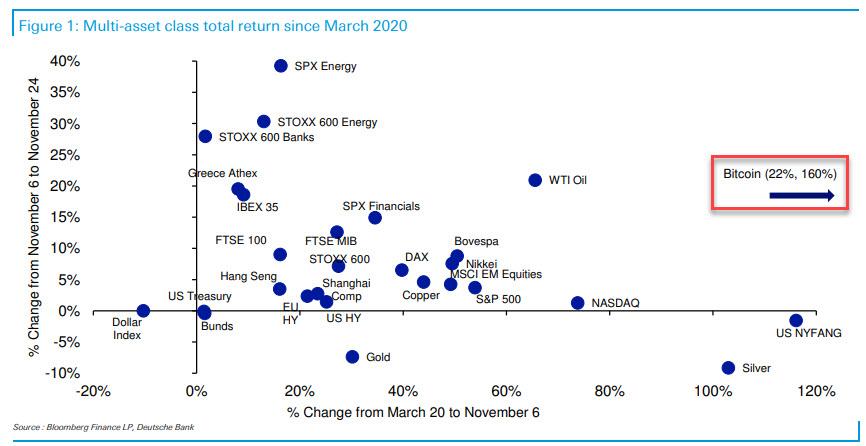
After relentlessly climbing from its March $4,900 lows, Bitcoin finally saw a modest selloff last week after rising 285% from its lows and 160% since the start of the year prompting even establishment banks such as Deutsche Bank to include it in its grouping of key asset categories...
... leading to the now traditional kneejerk response from bitcoin haters such a Nouriel Roubini, who took a bizarre 12-tweet "victory lap" late Thursday as if bitcoin dropping 20% from just shy of its $20K all time high somehow validates his forecast...

... which recall is that bitcoin would "crash to zero" (from his February 2018 CNBC appearance), or that it is a "stinking cesspoll that is in meltdown", when it suffered a similar drop in October of that year, and just generally emerging from the woodwork every time there is a drop in bitcoin as per this tweet.
Incidentally anyone who bought bitcoin in February of 2018 when it was supposed to "crash to zero" is up 150%, outperforming the S&P 4-fold. Then again, by now the market has learned to take Roubini's "hot" takes - which only emerge during sharp bitcoin and gold selloffs - with all the "seriousness" they merit. After all, this is the same Doctor Doom who in 2009 infamously said that "all the gold bugs who say gold is going to go to $1,500, $2,000, they’re just speaking nonsense. Yeah, it can go above $1,000, but it can’t move up 20-30 percent unless we end up in a world of inflation or another depression."

Guess we must be living in a world of inflation or another depression... contrary to what Keynesians such as Roubini would like us to believe.
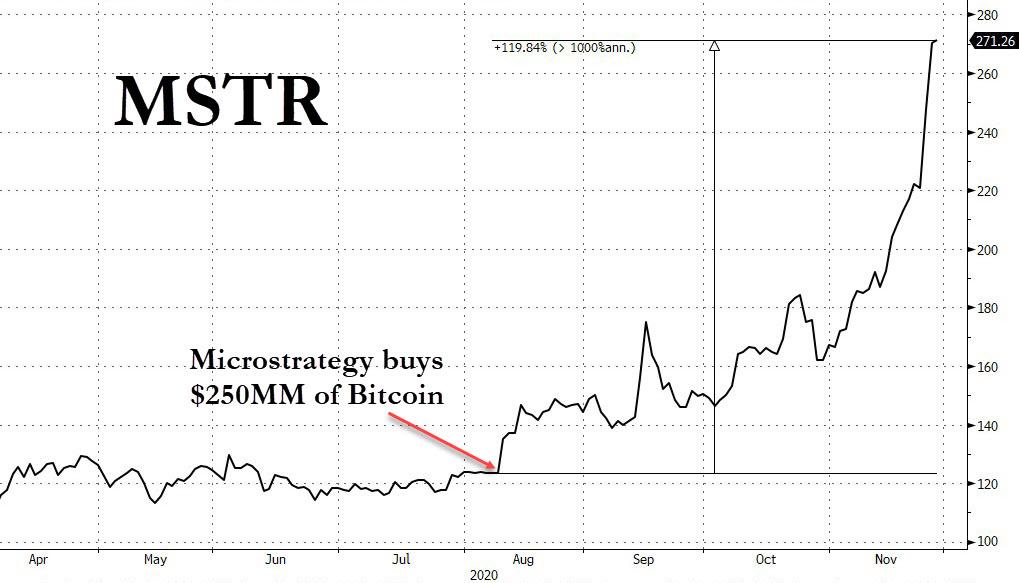
Roubini's dime-a-dozen opinions and meltdowns aside, what really matters is when someone puts their crypto money where their mouth is. Examples of this include the publicly traded business-intel firm MicroStrategy, which on August 11 poured all $250 million of its planned inflation-hedging funds into the digital currency. Its stock is up 120% since then.
Another example is when Jack Dorsey's "other" company, Square, said in October it bought 4,709 bitcoins, worth approximately $50 million, about 1% of Square’s total assets. “Square believes that cryptocurrency is an instrument of economic empowerment and provides a way for the world to participate in a global monetary system, which aligns with the company’s purpose," the company said in a release. Square founder Jack Dorsey has been a advocate of the digital currency, saying in 2018 the cryptocurrency will eventually become the world’s “single currency.” However the founder of Twitter said it could take a long as a decade.
Or it may take far less than that, especially after PayPal announced a few weeks later that it had enabled crypto transactions for all its clients, sparking the latest leg higher in bitcoin.
Which begs the question: whereas in 2017 it was all the rage to pivot to "blockchain", we wonder how long before every public company converts some (or all) of its cash and equivalents into bitcoin similar to MicrosStrategy and Square, in hopes of reaping a quick surge in its stock price. And tangentially with that, how long before established asset managers do the same?
This morning we get an answer when Guggenheim Partners, one of the world's biggest fixed income asset managers, jumped on the bitcoin bandwagon when it announced - appropriately enough one day after Roubini's bitcoin meltdown - that it was reserving the right for its $5.3 billion Macro Opportunities Fund, which aims for total return via fixed income and other debt and equity securities, to invest in the Grayscale Bitcoin Trust, whose shares are solely invested in Bitcoin, and track the digital asset’s price less fees and expenses.
"The Guggenheim Macro Opportunities Fund may seek investment exposure to Bitcoin indirectly through investing up to 10% of its net asset value in Grayscale Bitcoin Trust," the firm said in a Friday filing ; in other words Guggenheim can (and probably will) allocate up to $530MM to bitcoin.
Guggenheim's announcement means that its CIO Scott Minerd joins such legendary traders as Paul Tudor Jones and Stan Druckenmiller, who have already said they’ve put money into the digital asset. More importantly he ensures that laughably clueless hacks, who have zero comprehension of how money or markets operate, will be busy bashing bitcoin for years to come as the cryptocurrency hits $100,000 then $1 million and so on.
Guggenheim’s filing, which describes cryptocurrencies as "digital assets designed to act as a medium of exchange,” also lists a wide variety of risks. Those include prices that “can be highly volatile,” regulatory changes, a crisis of confidence in the Bitcoin network, a change in user preference to competing cryptocurrencies, and trading on “largely unregulated” exchanges that may be more exposed to fraud and failure than regulated, established bourses for other asset classes.
In other words, nothing new for anyone who has been long the cryptocurrency over the past few years, and certainly nothing new for regular readers who bought bitcoin as per our advice back in September 2015 when it was trading just over $200.
What is surprising is that Guggenheim is - for now - sticking only to the Grayscale ETF as a source of crypto exposure: "Except for its investment in GBTC, the Fund will not invest, directly or indirectly, in cryptocurrencies."
We expect that will change soon: after all in the past few weeks, bitcoin futures' open interest surpassed gold's for the first time ever...
... as the investing public increasingly turns to crypto as an alternative to the tsunami of fiat currency debasement and ahead of the central banks' launch of digital currencies some time in 2022.

    FT : Brussels seeks to help banks offload rising tide of bad loans

    Brussels seeks to help banks offload rising tide of bad loans
    Paper will set out ideas for how to tackle forecast increase in corporate distress

    Brussels is planning to lay out a raft of proposals in a bid to make it easier for EU banks to offload soured loans as it anticipates the risk of a pandemic-related wave of corporate distress.

    A European Commission paper due to be published in December will discuss ideas including boosting secondary markets for buying and selling non-performing loans (NPLs) and creating a network of national bad banks across the EU. It will also seek to tackle anomalies in the bank capital regime for distressed assets. 

    Europe is braced for a surge in insolvencies once national business support programmes lapse next year. Brussels officials told the Financial Times that the commission wanted to avoid the mistakes made in the last financial crisis more than a decade ago, when a failure to quickly tackle NPLs impaired banks’ ability to bolster lending once the recovery gathered strength. 

    “Drawing lessons from the last severe economic crisis, it is imperative to address a renewed build-up of NPLs on banks’ balance sheets — as early as possible — in order to combat the implications of the pandemic,” the commission said.

    “Further structural measures” might be needed to “prevent the accumulation of NPLs over the medium term”, the commission said.

    The report has not yet been completed and is expected to be released in the middle of the month. It is being spearheaded by new financial services commissioner Mairead McGuinness.

    A key focus is on the private market for the sale and purchase of bad loans, as officials seek to ensure banks can offload NPLs and keep their books in order. 

    The European Banking Authority has put forward data templates to help investors analyse NPLs, but these are not heavily used, and officials want to boost uptake and further enhance information available to investors — something the European Central Bank has long advocated.

    Among the ideas in play are making the templates mandatory or creating a central data hub for the region. Brussels also wants to tackle discrepancies in the risk weights attached to NPLs in standard bank models, which can vary depending on whether the assets are being bought and sold. It will discuss best practices in national insolvency and debt recovery regimes.

    Although it will float the idea of a network of national asset management companies, a proposal for a Europe-wide bad bank set out by Andrea Enria, chair of the ECB’s supervisory arm, has not won traction in Brussels. 

    Bad banks were used to clean up Spanish and Irish banks after the 2008 financial crisis, but lawyers have questioned whether they could in some situations trigger more recent rules requiring bondholders to be wiped out before public money is used to rescue a bank.

    Mr Enria warned in October that “in a severe but plausible scenario non-performing loans at euro area banks could reach €1.4tn, well above the levels of the 2008 financial and 2011 EU sovereign debt crises”.

    Nicolas Véron, a senior fellow at the Peterson Institute for International Economics, said that while there was a plausible scenario under which there would be a jump in NPLs next year, it was hard to make a confident assessment in advance.

    “There are certainly concerns at this stage that the secondary market for distressed assets is not functioning as well as it could, that there are not enough buyers out there,” he said. “The market is by no means frozen, or dead, but if you take steps like creating an optional public platform it can only help.”

    The eurogroup of finance ministers will on Monday attempt to strike a deal aimed at bolstering the single currency area’s banking sector by agreeing on the early implementation of a long-awaited backstop to its bank resolution fund. 

    One of the key questions remaining to be resolved is whether banks in southern Europe are deemed by northern capitals to have made sufficient progress in paring back risks on their balance sheets, including by reducing NPLs.

    Total NPLs in the biggest 121 eurozone banks more than halved in six years to €506bn, or 3.2 per cent of their loan books, by the end of last year. But Greek banks still have NPL ratios of more than 30 per cent. 

    The ECB warned in its twice-yearly financial stability review last week that “the economic fallout from the pandemic will likely continue to weigh on banks’ asset quality in the latter part of 2020 and into 2021”.