Reuters - Raab: There is a risk of third coronavirus wave

Raab: There is a risk of third coronavirus wave

LONDON (Reuters) - Britain is at risk of suffering a third wave of coronavirus infections if it does not get the approach to lockdown restrictions right in the coming weeks, foreign minister Dominic Raab said on Sunday.

“There’s a risk of that (if) we don’t get the balance right,” Raab told the BBC when asked about a possible ‘third wave’ resurgence of cases in January and February. He said the government was doing everything it could to avoid another national lockdown.

(ZH) The 2021 Liquidity Supernova: Step Aside Fed - US Treasury Will Unleash $1.

The 2021 Liquidity Supernova: Step Aside Fed - US Treasury Will Unleash $1.3 Trillion In Liquidity

One of the most poignant (and painful to some) lessons of the past decade - especially to contrarian, bearish investors such as Odey and Horseman - is that the Fed can keep print money far longer than any short can remain solvent. And while it was considered in poor taste until earlier this year to admit that the market levitation is entirely due to the Fed's manipulation of markets- a task best left to fringe, tinfoil wearing blogs - all pretense disappeared after Jerome Powell nationalized the bond market in March, and just last week Morgan Stanley's chief rates strategist, Matthew Hornbach, admitted that central bank liquidity is the most critical component of rising macro markets: "It both greases the wheels of transactional finance and changes the opportunity set available to investors."
It's also why Morgan Stanley has been especially bullish on markets in 2021: as Hornbach summarized it simply: "When it comes to liquidity, our focus is on both "narrow" and "broad" measures... We expect both types of liquidity to expand in 2021."
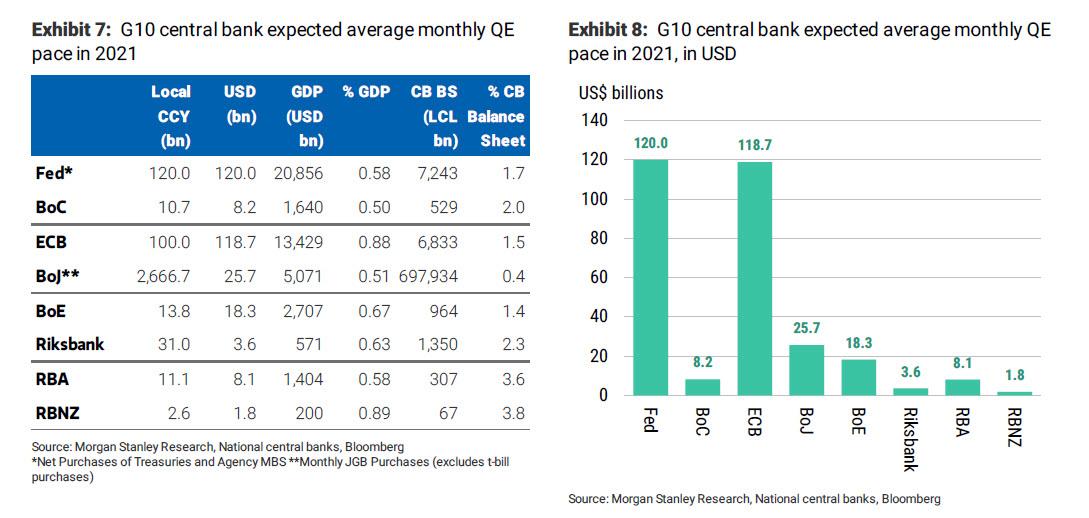
Last Monday we discussed the expansion of the first type of liquidity, namely that provided by central banks. The math was, in a word, staggering: combined, the 8 DM central banks are expected to purchase US$304 billion of securities ($238 billion of which will be government bonds), on average, from private markets every month in 2021 (with the Fed and the ECB naturally doing most of the buying).

Putting this number in context, in total these 8 central banks are expected to add liquidity worth 0.7% of annual nominal GDP, on average, every month in 2021. "That is a rapid pace of global liquidity injection, the likes of which we haven't seen outside of 2020" Hornbach casually inserts.
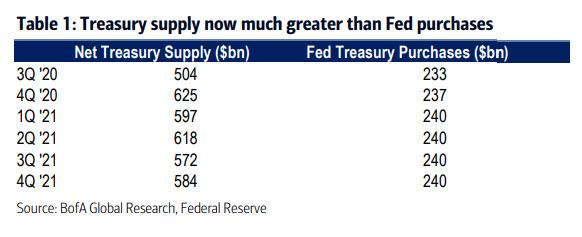
What is even more striking is that this may not be enough: as we showed two weeks ago, after the Fed monetized virtually every dollar of net Treasury issuance in 2020, in 2021 Treasury supply will significantly outstrip Fed purchases (and this is even without factoring in the possibility of another major fiscal stimulus).
Said otherwise, while the Treasury faces net Treasury issuance of roughly $2.4 trillion, the Fed is expected to monetize less than half of this total, or $960 billion. Considering that in 2020 under the auspices of "helicopter money" (from which we remind readers there is simply no coming back) the Fed will have monetized virtually every dollar of net issuance, this is a huge cliff and one which could lead to a shock drop in Treasury prices if the market reprices (lower) its expectations for Fed monetizations.
In other words, the Fed needs to more than double its scheduled monthly QE in 2021 just to catch up to where it was in 2020; and the Fed is hardly alone - in just the past month, the RBA, the BOE and most recently, the Riksbank, all announced expansions to their current QE.
And here comes the twist, because in what may come as a surprise to some, in 2021 liquidity injections won't be limited to QE.

As traders who lived through the reserve squeeze of Sept 2019 recall all too vividly, central bank purchases of securities via QE aren't the only way liquidity can find its way into markets. In the US, the Treasury can increase liquidity by allowing its cash balance - held at the Federal Reserve - to decline. When Treasury issues debt, it can either spend the money on government mandates or it can keep the money in its checking account at the Fed, known as the Treasury General Account (TGA).
To be sure, from a liquidity perspective Treasury debt issuance and the subsequent spending does not impact liquidity on net, in general. When Treasury issues debt, banking system reserves decrease. And when Treasury spends the money, banking system reserves increase.
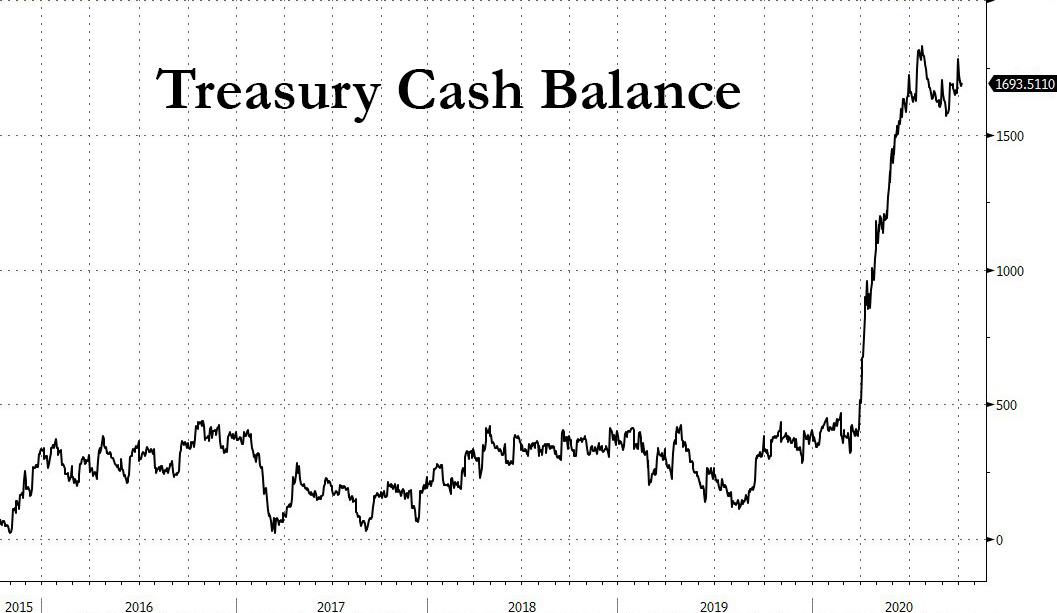
However, as Hornbach reminds us, 2020 was unique in that Treasury issued lots of debt without spending the money, resulting in over $1.6 trillion in Treasury cash available for deployment at a moment's notice, yet due to Congress' inability to reach agreement on a fiscal stimulus, this money was never spent (and may have cost Trump a victory in the election).
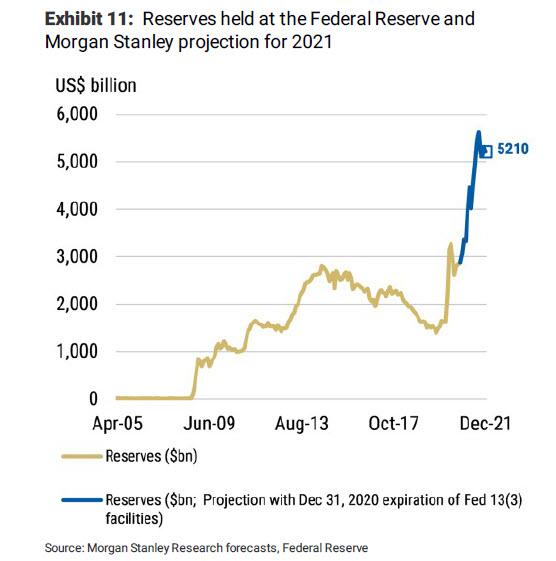
As a result, the cash balance in the TGA increased dramatically, resulting in a massive liquidity drain; in fact were it not for other sources of liquidity injection - such as the Fed injecting hundreds of billions with monthly periodicity - that may have been a huge problem for markets. In any event, as the chart below shows, despite the Treasury's liquidity drain reserves increased in 2020 regardless, surpassing a record $5 trillion.
So what happens in 2021 with all this cash already sloshing around?
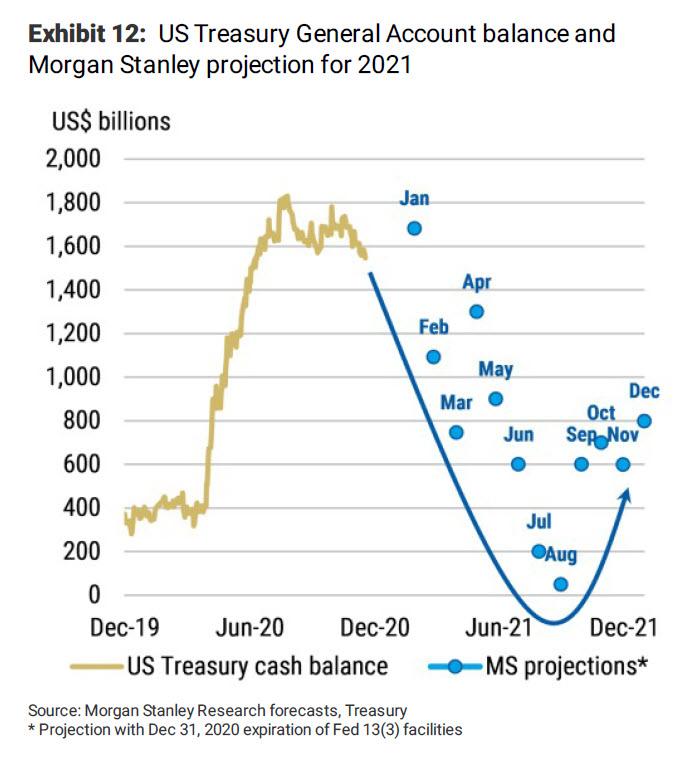
Well, as Hornbach writes, in 2021 the Treasury General Account will experience more volatility due to the debt ceiling deadline, but will initially result in a very large injection of liquidity. The debt ceiling deadline is August 1, 2021. On this date, the US Treasury will not be able to issue any additional debt above and beyond what it needs to cover existing debt obligations. However, what few may be aware of, is that there is a clause written into the law that prohibits the TGA from rising above levels prior to the debt ceiling deadline, which was in 2019.
This means that based on the 2019 debt ceiling, the Treasury cash will need to be at $200 billion by August 1, 2021. As such, there will be significant T-bill paydowns in 2021 through August in order for Treasury to reduce its cash balance - leading to a massive increase in reserves which is entirely apart from those injected via Fed QE, which continues at a pace of $120 billion per month. With the TGA cash currently at just under $1.5 trillion, it means that the US Treasury will unlock $1.3 trillion in liquidity over the next 8 months, more than doubling the liquidity coming from the Fed over the same time period which will be roughly $1 trillion ($120 x 8 months)!
We hope this massive liquidity injection explains why Biden was so interested in getting a former Fed chair - Janet Yellen - in charge of the Treasury. After all, the amount of liquidity to be injected by the Treasury Department will match, almost dollar for dollar, what Jerome Powell will do in 2021.
So when will this liquidity impact markets?
The Fed first announced its QE-driven foray into liquidity provision on Sunday, March 15, and as Morgan Stanley notes, "it took a couple weeks for the liquidity to flow to where it was needed most: the S&P 500 bottomed and the Fed's broad trade-weighted US dollar index topped on March 23."
Since then, the US dollar index has lost 9.4% and the S&P 500 index is up 60%. In addition, US 10y real yields have fallen 100bp while 10y breakeven inflation rates have risen 100bp. In that sense, the injection of liquidity in 2020 has already had an immense impact on markets.
So how do we know markets will feel the impact again in 2021? In the end, liquidity doesn't have to find its way around markets if it doesn't have an incentive. And it certainly doesn't have to find its way into risky assets.
As we saw ahead of the US election, US$ 1 trillion found its way into money market funds (MMFs), given the uncertainty of a well-telegraphed risk event. However, according to Hornbach, in 2021, the sheer size of liquidity entering markets will make it hard for investors to keep it sitting in cash accounts, earning next to nothing. And, given virtual guarantees that most central bank policy rates will remain at effective lower bounds (ELBs) in 2021, and many will remain there in 2022 as well, Hornbach concludes that "investors will have a (performance) incentive to move cash into higher yielding assets."
In the end, it's not possible for us to say exactly when the liquidity will impact market prices throughout the year. Still, once the race for returns begins as we enter the new calendar year (the new fiscal year for many investors), we expect liquidity to venture out of its safe-haven cash-cave - just as long as new, unforeseen uncertainties aren't mounting at the same time.
Translation: buy everything ahead of an unprecedented dollar devaluation orgy.

NYT : Brazen Killings Expose Iran’s Vulnerabilities as It Struggles to Respond

Brazen Killings Expose Iran’s Vulnerabilities as It Struggles to Respond
After suffering a string of audacious attacks, Tehran faces an agonizing choice: embracing hard-liner demands for swift retaliation, or trying to make a fresh start with the Biden administration.

The raid alone was brazen enough. A team of Israeli commandos with high-powered torches blasted their way into a vault of a heavily guarded warehouse deep in Iran and made off before dawn with 5,000 pages of top secret papers on the country’s nuclear program.

Then in a television broadcast a few weeks later, in April 2018, Israeli Prime Minister Benjamin Netanyahu cited the contents of the pilfered documents and coyly hinted at equally bold operations that were already being planned.

“Remember that name,” he said as he singled out the scientist Mohsen Fakhrizadeh as the captain of Iran’s covert attempts to assemble a nuclear weapon.

Now Mr. Fakhrizadeh has become the latest casualty in an escalating campaign of audacious covert attacks seemingly designed to torment Iranian leaders with reminders of their weakness. The operations are confronting Tehran with an agonizing choice between embracing the demands of hard-liners for swift retaliation, or attempting to make a fresh start with the less implacably hostile administration of President-elect Joseph R. Biden Jr.

Driving a carefully circuitous route to the home of his in-laws in a city outside Tehran, Mr. Fakhrizadeh’s car was stopped Friday by a car bomb in a Nissan so laden with explosives that it knocked out a power line, according to Iranian news media and witness accounts. A squad of gunmen then leapt from a black S.U.V., overpowered his bodyguards and unleashed a barrage of gunfire before speeding away as Mr. Fakhrizadeh lay dying in the street.

Mr. Fakhrizadeh’s killing was the latest in a decade-long pattern of mysterious poisoning, car bombings, shootings, thefts and sabotage that have afflicted the Islamic Republic. Most have hit largely anonymous scientists or secretive facilities believed to be linked to its nuclear program, and almost all have been attributed by both American and Iranian officials to Tehran’s great nemesis, Israel, whose officials have all but openly gloated over the repeated success of their espionage without formally acknowledging that Israeli agents were behind it.

Never, however, has the Islamic Republic endured a spate of covert attacks quite like in 2020. In January, an American drone strike killed the revered general Qassim Suleimani as he was in a car leaving the Baghdad airport (an attack facilitated by Israel’s intelligence, officials say). And Iran was humiliated in August by an Israeli hit team’s fatal shooting of a senior Al Qaeda leader on the streets of Tehran (this time at the behest of the United States, its officials have said).

Seldom has any country demonstrated a similar ability to strike with apparent impunity inside the territory of its fiercest enemy, said Bruce Reidel, a researcher at the Brookings Institution and a former official of the Central Intelligence Agency with experience in Israel.

“It’s unprecedented,” he said. “And it shows no sign of being effectively countered by the Iranians.”

With the killing Friday of its top nuclear scientists as well, Iranians are now grappling with a new sense of vulnerability, demands to purge suspected collaborators and an agonizing debate over how to respond at a delicate moment.

Iran has endured four years of devastating economic sanctions under a campaign of “maximum pressure” from President Trump, and many Iranian leaders are desperately hoping for some measure of relief from a Biden administration. The president-elect has pledged to seek to revive a lapsed agreement that lifted sanctions against Iran in exchange for a halt to nuclear research that might produce a weapon.

To pragmatic Iranians, that desire for a fresh start means Mr. Trump’s last months in office are no time for the country to lash back and risk a renewed cycle of hostilities.

But at the same time, some Iranians are openly acknowledging that their enemies in the United States and Israel may take advantage of the current moment to attack Tehran further, squeezing its leaders between domestic demands for revenge and a pragmatic desire for better relations.

“From today until Trump leaves the White House is the most dangerous period for Iran,” Mohammad-Hossein Khoshvaght, a former official at the Ministry of Culture and Guidance, wrote in a message on Twitter.

Retaliation against Israel or Mr. Netanyahu’s main ally, the United States, would play into the hands of Iran’s enemies in the region, who are seeking “to create a difficult situation,” so Mr. Biden cannot revive that nuclear agreement, Mr. Khoshvaght added.

Some hard-liners argued that the killing of Mr. Fakhrizadeh showed that Tehran should give up on holding out for a new start with Mr. Biden, if only because restraint was emboldening its foes.

“If you don’t respond to this level of terrorism, they may repeat it because now they know Iran won’t react,” the conservative political analyst Foad Izadi said in an interview from Tehran.

“There is obviously a problem when you see these types of things repeating.”

Underscoring Mr. Fakhrizadeh’s stature despite his previous anonymity in Iran, its authorities on Saturday announced plans to give him the burial of a national hero at one of the country’s holiest shrines.

Videos circulated of a senior cleric who heads the judiciary praying with the scientist’s family over his body shrouded in an Iranian flag and his face uncovered — an extraordinary and unexplained departure from the Islamic tradition of wrapping the dead from head to toe in a white cloth.

Israel for decades has embraced a strategy of targeted assassinations in attempting to slow down potential progress toward the development of a nuclear weapon among its hostile neighbors. Israeli intelligence agencies have been linked to the killings of scientists working for Egypt in the 1960s and for Iraq in the 1970s for the same reason, historians say.

Iran first accused Israel of killing one of its scientists when he dropped dead in his laboratory after a poisoning in 2007, and a series of more violent attacks on Iranian scientists between 2010 and 2012 have been widely attributed to Israel as well, too.

In one, a bomb in a parked motorcycle blew up a particle physicist as he was lowering a garage door at his home in Tehran. In three others, motorcyclists speeding past the moving cars of three other scientists slapped magnetic bombs to their car doors, killing two and wounding a third. And in a fifth attack, gunmen on motorcycles sprayed a scientist with bullets while his car was stopped at a traffic light with his wife sitting beside him.

Israel has developed a singularly successful track record against Iran in part by concentrating the considerable resources of its spy agencies mainly on its greatest nemesis, said Mr. Riedel of the Brookings Institution.

Israel, he said, has also carefully cultivated ties within countries neighboring Iran as “platforms” for surveillance and recruitment — most notably in Baku, Azerbaijan. Its recent conflict with Armenia has called attention to drones and other weaponry that Israel has furnished to Azerbaijan as part of that relationship.

Israel has made a practice of recruiting native Farsi speakers from among Iranian immigrants to Israel to make contacts or analyze intercepted communications, he added, and Israel has managed to enlist an array of Iranian collaborators as well.

Now, Mr. Riedel argued, the attack on Mr. Fakhrizadeh may be an indication that Israel intends to exploit that network again for similar missions. After an eight-year “hiatus” since the wave of killing from 2010 to 2012, he said, “I think it is a signal that the game is afoot, or coming.”

Speaking on condition of anonymity to discuss covert operations, a senior Israeli official involved for years in tracking Mr. Fakhrizadeh for Israel said it would continue to act against the Iranian nuclear program as necessary. Iran’s aspirations to nuclear weapons, promoted by Mr. Fakhrizadeh, posed such a menace that the world should thank Israel, the official insisted.

In Iran, the killing has already elicited new demands to root out such spies, including from the country’s supreme leader, Ayatollah Ali Khamenei.

In his first public response to the killing, Mr. Khamenei declared that the first priority was “investigating this crime and definitive punishment of its perpetrators.”

Hard-liners blamed the administration of Iran’s president, Hassan Rouhani — a pragmatist who had bet heavily on negotiations with Washington — for the security failures that allowed the attack.

“The night is long and we are awake,” said Hossein Dehghan, a recently announced candidate in next year’s presidential election who is a senior commander of the Revolutionary Guards and the defense adviser to Mr. Khamenei.

“We will come down like thunder on the heads of those responsible for the murder of this martyr and make them regret it,” he continued in a message on Twitter.

Mr. Rouhani, for his part, suggested in a televised speech that Iran would continue what he has called a policy of “strategic patience,” or what his critics call waiting for Mr. Biden.

“We will answer at the right time,” Mr. Rouhani said. “All the enemies should know that the great Iranian people are more courageous and honorable to not respond to this criminal act.”

But within Iranian politics, analysts said, the hard-liners stood to gain the most politically from the attack. Any renewed conflict with Israel bolsters their case against negotiation with its allies in the West, said Sanam Vakil at Chatham House in London.

Since Mr. Biden won the November election, the hard-liners have begun pushing against Mr. Rouhani to defer any negotiations with the new American administration for as long as possible, Ms. Vakil said, because conflict with Washington strengthens their appeal and weakens more pragmatic factions in the Iranian election coming next year.

“So an event like this plays in the hands of the hard-liners,” she said, “because they can push out negotiations until after the Iranian election — and that is what they are gunning for.”

FT : Will Australia’s ‘hydrogen road’ to Japan cut emissions?

Will Australia’s ‘hydrogen road’ to Japan cut emissions?
A joint Canberra-Tokyo effort is designed to create a cost-effective supply chain for an elusive source of clean energy

For more than a century the sprawling lignite mines in Australia’s Latrobe Valley provided the fuel that powered the southern state of Victoria. At its peak five coal-fired power plants burnt the soft, brown sedimentary rock — one of the dirtiest sources of energy — casting vast plumes of toxic smoke into the atmosphere that accounted for more than half of the state’s total greenhouse gas emissions.

Now, with global warming focusing minds in a country where climate policy has brought down governments, the first phase of an energy transition is taking place following the closure of two coal plants and a lignite mine in the valley, which is about 120km east of Melbourne. A Japanese-Australian consortium is set to begin producing hydrogen from brown coal in a A$500m ($370m) pilot project seen by its architects as the first step in creating one of the world’s first zero emission energy supply chains.

Kawasaki Heavy Industries, J-Power and Shell Japan have joined Australia’s AGL Energy and several international partners to produce, liquefy and ship hydrogen to Japan. They intend to burn some of the 5bn tonnes of lignite in the valley, enough to power Victoria for more than 500 years, to produce hydrogen. Eventually, they intend to capture the carbon generated by the process and inject it into undersea basins in the nearby Bass Strait. For now, however, their goal is to prove the viability of the supply chain and the emissions will continue to be released into the atmosphere.

The project, which is co-funded by both governments, includes the development of the world’s first liquid hydrogen transport ship. Tokyo hopes it can provide Japan, a nation that imports 90 per cent of its energy, a viable path towards decarbonisation. With investors such as BlackRock calling for a swifter transition, Canberra aims to use it to diversify its fossil fuel dependent economy, which generates A$70bn a year from exporting thermal coal and LNG to Asia.

For decades hydrogen — the lightest and most abundant element in the universe — has been hailed as a revolutionary, clean source of energy capable of supplying fuel for cars, heat for homes and storing electricity. But it has failed to live up to the hype for several reasons: the high costs of production compared with burning fossil fuels; challenges in transporting the fuel; lack of demand; and the inability of hydrogen fuel cells to compete with internal combustion engines or lithium-ion batteries in electric vehicles.

The companies leading the Latrobe project believe it can become a catalyst towards establishing a global hydrogen economy, which is forecast to be worth up to $11tn by 2050, according to Bank of America. The Latrobe plant is just one of several hydrogen megaprojects in the planning or development phase in nations ranging from Saudi Arabia to China and Spain.

“Clean hydrogen presents a massive commercial opportunity,” says Jeremy Stone, a director of the Australian subsidiary of J-Power. “It is also one of the critical technologies required to decarbonise the global energy system, particularly in energy constrained nations such as Japan.

“We simply can’t wait to deal with climate change,” he adds, “which is why this collaborative project in Latrobe is so important. We need to get going now with all forms of clean hydrogen.” 


Mind-bogglingly stupid’
Yet, the scepticism remains. Tesla co-founder Elon Musk has dismissed hydrogen fuel cells as “mind-bogglingly stupid”, saying it is inefficient to use them in a car compared with charging a lithium-ion battery directly from a solar panel. Other critics ask whether producing hydrogen from fossil fuels can ever be made cost effective or clean given that the industry has so far failed to prove the commercial case for carbon capture and storage.

Nevertheless, a growing number of scientists and investors believe the world is on the cusp of a hydrogen revolution due to technological advances reducing the costs of making, storing and deploying it. They hope the plummeting costs of solar and wind energy could finally make the production of emissions-free “green hydrogen” — made by using renewable energy to split water into hydrogen and oxygen — commercially viable.

The Paris agreement on climate change is driving investment in hydrogen, as nations prepare to meet their commitments to cut greenhouse gas emissions. BP and Danish wind energy group Orsted announced plans for a green hydrogen project in Germany in November and Airbus recently unveiled plans for hydrogen powered passenger planes. In October Japan and South Korea pledged to become net zero emission economies by 2050. China has set a similar target for 2060.

To meet these goals nations will need to deploy massive amounts of solar, wind and hydro power to replace fossil fuels, which still account for four-fifths of global energy production. Renewables already play a vital role in the electricity sector but their intermittent nature is forcing industry to consider flexible solutions involving hydrogen to store, dispatch and ship power when required.

“Electricity is magical, in terms of its versatility and power. But there are some applications where it’s just not the most convenient way of delivering energy to the end user,” says Alan Finkel, Australia’s chief scientist and author of its hydrogen strategy.

He says long distance transportation by truck, train, ship or air and heating buildings — by converting existing pipelines in cities from gas to hydrogen — are key uses for the fuel. Its energy storage potential is vital for Australia, which can ship hydrogen and its derivatives, such as ammonia, to overseas markets to substitute its coal and gas exports, he adds.

“The most marvellous application of hydrogen of all is the ability for us to continue what we’ve been doing for hundreds of years,” he says, “ship energy from a continent where it is plentiful to the continents where it is in short supply.”


Japanese demand
The potential market for Australian hydrogen can be found at the base of Tokyo Tower, where the industrial gases company Iwatani has built a filling station for fuel cell cars. It is one of 135 such stations spread across Japan — symbolic of the decades-long bet the country has placed on hydrogen.

For reasons of energy security and industrial strategy, Japan has long regarded hydrogen as the most attractive potential alternative to fossil fuels, and it has an ambitious strategy to build up use of the fuel. Its plans involve mixing hydrogen with natural gas to burn in power stations and having 800,000 hydrogen vehicles on the road by 2030 — a major advance on the 3,757 sold in Japan to the end of 2019.

Yoshihide Suga, the prime minister, has stressed the importance of hydrogen to hitting the country’s 2050 emissions target, describing it as “a vital key to clean energy,” in October, and urging “revolutionary innovation to build up a low-cost, high-volume hydrogen supply chain”.

Japanese demand for hydrogen reflects its almost total lack of domestic hydrocarbons. Its heavy reliance on oil imports from the Middle East is a source of constant worry to industry and national security planners. Coal from Australia, by contrast, is regarded as one of the nation’s most secure energy supplies.


To try to escape from its dependence on fossil fuel imports, Japan invested heavily in nuclear power, but the Fukushima disaster in 2011 has all but shut the industry down. That leaves renewables. However, Japan’s densely populated, mountainous islands are a difficult place to build large solar farms, while its steep continental slope gives little scope for offshore wind.

The country’s all-important car industry has increased its investment in batteries, following the success of Tesla, but it too is still focused on hydrogen. Toyota is launching the second generation of its Mirai fuel cell sedan, which is aiming for a 30 per cent increase in driving range over the original model’s 312 miles, while Honda offers a fuel cell version of its Clarity vehicle. For the delayed Tokyo Olympics in 2021, Japan intends to have fuel cell buses to shuttle visitors around.

“Electric vehicles have certainly been ahead of hydrogen ones in terms of development and adoption but I think hydrogen is catching up due to advances in high pressure hydrogen gas storage fuel tanks, fuel cell technology and hydrogen production from renewable energy,” says John Andrews, a professor at RMIT University in Melbourne.

“Elon Musk has been rather one-eyed on EVs,” he adds. “Hydrogen vehicles are likely to play a complimentary role in the future because they are particularly useful over long distances and for speedier refuelling.”

The ‘hydrogen road’
The production of hydrogen in Latrobe would be the latest milestone in a decade-long mission for Kawasaki Heavy Industries, the company leading the Australia-Japan supply chain project. In December it launched the world’s first hydrogen carrier, which will ship the fuel the 9,000km from eastern Australia to Kobe, Japan. A gas turbine power plant to be fuelled entirely by hydrogen has already been installed in the Japanese city and will provide heat and power to nearby municipal buildings.

“Kawasaki technology will link production sites to energy consumers, and in so doing give birth to the Hydrogen Road,” says Motohiko Nishimura, head of Kawasaki Heavy’s hydrogen development centre.

He forecasts that supply chains will progressively spread across Asia, much like LNG was imported by Japan, South Korea, China and Taiwan from the 1970s to provide energy. Kawasaki chose Victoria’s lignite deposits as a potential source of energy to produce hydrogen because it offers a cheap and plentiful supply based in a politically stable nation with a long history of shipping energy to Japan, says Mr Nishimura.

Yet, there are plenty of sceptical Japanese experts. “You have to produce the hydrogen, liquefy it, ship it, reconvert it and then use it,” says Hiroshi Kubota, professor emeritus at the Tokyo Institute of Technology. “It’s just a massive waste. This is a kind of national project but I don’t think it is practical or economic for Japan at all.”

Environmental groups have also raised objections to the Latrobe project over its use of brown coal. “The time for digging up dirty, brown coal is over,” says Cam Walker, an activist with Friends of the Earth in Victoria. “We support the development of green hydrogen produced from renewables.”

Mr Nishimura dismisses such criticism. “There is no time to waste in building the skills, infrastructure and market needed to ensure nations can reach their zero emissions goals,” he says. And if the cost of making hydrogen through renewables continues to fall the industry can move away from coal-based hydrogen production. “It will depend on the market,” he adds.

‘Green’ energy
About 70m tonnes of hydrogen are already produced every year, mainly for use in heavy industries, such as oil refining, ammonia and steel production. In the vast majority of cases it is produced through the burning of fossil fuels and the emissions generated are not captured and stored.

These traditional carbon intensive methods can produce so called “grey” hydrogen at costs of about $1 per kg, which compares with costs of $3-7.5/kg for “green” hydrogen, which is made through the use of renewable energy, according to BofA. But costs of renewable energy and the electrolysers used to generate hydrogen from water are falling rapidly.

“We think we’re reaching an inflection point where green hydrogen could supply our energy needs, fuel our cars, heat our homes and be used in industries that have no economically viable alternative to fossil fuels,” says Haim Israel, global head of thematic investment strategy at BofA. 

“We have a long road ahead of us, but this is an energy revolution that’s happening because it must . . . Together with renewable electricity, green hydrogen gives us a shot at attaining a zero carbon-emission global economy by 2050,” says Mr Israel. 

This transition to a solar, wind and green hydrogen economy poses a challenge for economies reliant on exports of fossil fuels, which are now exploring ways to tap into the emerging sector. 

In July a consortium led by Air Products, ACWA Power and Neom announced plans for a $5bn green renewables and hydrogen plant in Saudi Arabia, which aims to begin shipping ammonia to global markets by 2025. Russia recently revealed plans to export 2m tonnes of hydrogen by 2035, in part motivated by concerns that the EU and other customers are embracing zero emissions policies.

Australia’s ruling Liberal party — a staunch supporter of coal and gas — has already begun preparing for an energy transition. In October Canberra awarded “major project” status to a $36bn renewable energy project, which aims to build the world’s biggest power station and export green hydrogen and ammonia from a remote desert in the outback to Asia.

Called the Asian Renewable Energy Hub, it is backed by Vestas, the wind turbine group, Intercontinental Energy, Macquarie Group and CWP Renewables. It involves building a massive solar and wind farm on a 6,500 sq km site in the Pilbara, a region in Western Australia better known as a source of LNG.

As well as exporting energy, the project would aim to supply iron ore miners and LNG producers in the Pilbara. Hydrogen could also attract new businesses to the region, including the production of “green steel”, says Mr Hewitt.

While analysts question whether hydrogen could reinvigorate Australia’s steel industry — which faces tough competition from Asian rivals — many feel the pivot towards a hydrogen economy is beginning to take place due to the falling costs of renewable energy, electrolysers and fuel cell technology.

Bernstein, an investment group, forecasts the cost of producing green hydrogen could fall to less than $2/kg by 2030, which is equivalent to $1/gallon for petrol. Fuel cell costs should decline by 80 per cent over the same period to $30/kW, as the hydrogen industry scales up. By the mid-2020s heavy goods vehicles powered by hydrogen fuel cells could be more competitive than diesel trucks and by 2030 fuel cell cars could rival electric vehicles in terms of the total cost of ownership.

“The pivot toward hydrogen is starting to make compelling business sense,” says Neil Beveridge, analyst at Bernstein. “Those that embrace the energy transition may survive and even thrive, while those that do not risk being confined to history.”
>>> Barron’s Weekend Summary: Ford shares could double if the automaker can stre

Barron’s Weekend Summary: Ford shares could double if the automaker can streamline its design and procurement and ramp up its electric car development

* Cover Story: Positive on F: The world’s fifth-largest automaker is barely in the top 15 by market value, even though it sells about $150B worth of cars and trucks annually, and many Wall Street analysts consider it an also-ran, trailing rivals in the race to produce electric and autonomous vehicles—but if new chief James Farley can streamline design and procurement processes, catch up on electric vehicle development, and clearly communicate a strategy, the shares could eventually double.

* Tech Trader: Positive on AAPL: The company’s newly released line of MacBooks, powered by Apple’s new M1 chip, are drawing strong reviews—the company “has found a way to build a system-on-a-chip that combines computer processing, graphic processing, and memory, adding speed despite lower energy needs, the Holy Grail of computing,” and the new Macs “bring laptops back to parity with tablets and smartphones.”

* Trader: In addition to being added to the S&P 500, TSLA will join the S&P 500 consumer discretionary index as well, which could make the sector far riskier than it already is—investors should considering playing it through alternative indexes or even individual stocks; The S&P 500 energy sector index has gained 34 percent in November, its best month on record, and nearly 90 percent of the stocks in the index had relative-strength indicators above 70, indicating that most of them were overbought, a sign the sector may not keep moving at its current pace.

* Interview: 1) Ronald Cohen, co-founder of Apax Partners, one of the world’s oldest venture-capital firms, discusses impact investing, weighted accounting, and other topics—“Companies are beginning to realize that ignoring the arrival of impact will hold the same risks as ignoring the arrival of technology”; 2) Margrethe Vestager, one of three executive vice presidents in the European Commission, talks about her efforts to lay the groundwork for new laws to “keep Europeans just as safe online as they are in the physical world.”

* Profile: Tom Parker and Jeff Rosenberg are co-managers of the $2.9B BlackRock Systematic Multi-Strategy fund, which “behaves like a truly defensive hedge—the fund is less than half as volatile as the 60 percent stock/40 percent bond Morningstar Moderate Target Risk benchmark.”

* Features: 1) Positive on AZEK: The Chicago-based decking supplier has benefitted from the work-at-home trend, and though it has had a volatile year, its strength in trim, shingles, and other products, and its ability to recycle to create cheap raw materials for decking, should help profit margins expand briskly; 2) Positive on RGS: The owner and franchiser of barbershops and salons in the US, UK, and Canada—including Supercuts, Signature Style, SmartStyle, and Cost Cutters—is the only publicly traded company in the sector, which will help it pull through the pandemic and grow market share as smaller rivals drop off; 3) The feasibility of president-elect Joe Biden’s bold plan for sweeping tax increases on the wealthy has been vastly diminished in the absence of big Democratic wins in the House and Senate, but he could still push through changes—his focus on raising income taxes on the top one percent of earners could appeal to Republicans with a more populist agenda and get pushed through; 4) As tax planning seasons approaches, taxpayers should keep four of Joe Biden’s proposals in mind: an increase in income-tax rates for people earning more than $400,000 to 39.6 percent from 37 percent; capped deductions for top earners; a rate hike on capital gains of more than $1M to 39.6 percent from 20 percent; and a decrease in the estate-tax exemption from $11.58M per person to around $3.5M; 5) Taxable municipal bonds offer an attractive alternative to corporate bonds, with higher yields and lower historical default rates—the market’s obscurity is part of the reason for yields that can be 0.5 percentage point to 1.5 percentage points higher than those of similarly rated corporate debt.

* European Trader: Positive on B&M European Value Retail: UK discount retailer has gotten a boost from the growth of bargain hunting during the pandemic, and has benefited from soaring sales of food, home decor, and furniture because it remained open during lockdowns as an essential retailer.

* Emerging Markets: The likely success of AZN’s coronavirus vaccine, which is cheaper and more durable than those from PFE or MRNA, has “shifted the calculus” for emerging markets, which may have a better chance of getting access to the vaccine than previously; shots from China’s Sinovac project and a budget option from JNJ could also help boost global inoculation.

* Commodities: Analysts predict silver will rise to $30 an ounce in the next year from the current $23.36, and even higher given the large-scale stimulus needed to revive economies, continuing a trend this year that has led to the surge in gold and silver prices as investors hunt for havens.

* Streetwise: GS recently calculated that if shares of AAPL, AMZN, FB, GOOGL, and MSFT fall 10 percent from here, while shares of the remaining S&P 500 members rise 10 percent, the net result would be a gain for the overall index of five percent—and if the tech giants merely stall instead of decline, and the rest rise 20 percent, the index would gain 16 percent.

FT : HSBC considers exit from US retail banking

HSBC considers exit from US retail banking
Options narrow to improve performance at struggling North America business

HSBC is weighing up a complete exit from retail banking in the US after narrowing the options for how to improve performance at its struggling North America business, according to two people familiar with the situation.

Senior management aim to present the plan to the bank’s board in the coming weeks, the people said, as HSBC seeks to allocate resources away from the US in favour of more profitable businesses in Asia.

Closure of the US retail network would mark the end of the lender’s 40-year long attempt to run a full-service, universal bank in the country. The division made a pre-tax loss of $518m in the first three quarters of this year, following losses of $279m last year and $182m in 2018.

HSBC’s American division has been under intense scrutiny for several months as part of the UK lender’s efforts to make even deeper savings than it pledged in February, when it outlined $4.5bn in cost savings and 35,000 job cuts. 

Executives decided the impact of the coronavirus crisis and a prolonged period of ultra-low interest rates required more drastic measures, the Financial Times reported in May.

A full exit from the US is no longer on the table, according to the two people. “The US is an important marketplace,” one said, particularly for HSBC’s investment bank. It is also seeking to grow its US wealth management division.

Managers are likely to also recommend trimming HSBC’s investment bank client roster to focus on international clients, particularly those with Asian and Middle Eastern links, the people said.

Those with only domestic US business, which are less profitable and where HSBC struggles to find an edge against larger Wall Street rivals like JPMorgan and Citigroup, will be de-emphasised. The bank said in the third quarter it had already eliminated $4bn of risk-weighted assets in its US business through “client optimisation”.

HSBC has about 224 branches on the east coast of America, a fraction of the branch network of JPMorgan and Bank of America. It has already pledged to cut around 80 of those sites in the February restructuring. Some insiders argued that the division’s lack of scale makes it hard to turn round, especially in the current economic environment.

Against this backdrop, there is a strong case for completely leaving retail banking, according to one person familiar with the situation. Another option is to adopt a digital-only model focused on international clients from the Chinese or Indian diaspora, although that is a “crowded market”, the person added.

The biggest US banks have been investing heavily in their digital offerings, where online-only players including BBVA’s Simple and Goldman Sachs’ Marcus compete with European fintechs like N26 and Monzo, which launched in the US last year.

HSBC has not made a final decision on the future of its US retail business. “The jury is still out . . . we are examining the financial viability of the cost and the reward of exiting or having a middle strategy where we keep a smaller presence,” one of the people said. The timeframe for a decision could slip to next year. HSBC declined to comment.

At the bank’s third-quarter results last month, HSBC chief executive Noel Quinn pledged to go “further and faster on our cost and risk-weighted asset reduction programmes”, after setting aside $7.7bn for potential loan losses during the pandemic. The lender’s share price is down almost a third this year.

HSBC first entered the US consumer market in the 1980s. A disastrous acquisition of subprime mortgage lender Household International in 2003 caused the bank billions in losses and resulted in misconduct penalties after the financial crisis. It sold off half its branch network and a profitable $30bn credit card business in 2011.

Since then, successive executives have debated how best to restore the US retail operation to sustainable profitability, without much success. It lacks high-margin earnings from unsecured credit card lending, and the subscale wealth and branch network have rarely made money.

FT : Can food delivery services save UK restaurants?

Can food delivery services save UK restaurants?
Deliveroo and Uber Eats offer a lifeline but high fees drive businesses to launch own versions

Shamil Thakrar, co-founder of the Indian restaurant group Dishoom, “can’t stand” serving delivery food.

“I thought what we did was get you in and serve you to the best of our abilities,” he said. “Delivery felt like the opposite of that.”

But as lockdowns have dragged on, Dishoom has done a volte-face. The company has opened six delivery-only “dark” kitchens in London and another in Brighton. It has also hired 50 new chefs to service takeaway demand. “I’m beginning to think . . . we do have a business here,” Mr Thakrar admitted.

The pandemic has exacted a heavy toll on the UK’s 24,400 restaurants, which have either been forced to close or operate under strict restrictions for most of the year.

Sales across the sector were 30 per cent down on last year’s before the second lockdown came into force on November 5 according to research firm CGA. Since then, only those offering takeaway services have been able to trade.

Thousands of operators across the sector have signed up with one or several of the three dominant delivery platforms — Deliveroo, Uber Eats and Just Eat — in order to salvage demand. But not all have done so enthusiastically, with growing complaints that high commissions taken by the apps make it difficult to make money from delivery alone.

Since the first lockdown in March, surging use of delivery apps has been sustained. Deliveroo said that since the second set of national restrictions came in at the start of the month more than 1,400 new restaurants had signed up.

Uber Eats reported a 150 per cent jump in UK deliveries year-on-year in the three months to September. The group’s service now covers 75 per cent of the UK population, up from 50 per cent at the start of the year. Just Eat, the UK market leader by order volumes, said it processed 17m transactions in October, up from 10m in January 2019.

“For restaurants, there is no longer a question mark over food delivery the way there was at the beginning of the year,” said Toussaint Wattinne, general manager of Uber Eats UK.

While the first lockdown brought widespread disruption to food delivery apps when some of their biggest restaurants went offline altogether, many food businesses went into the second lockdown much better prepared.

Andy Hornby, chief executive of The Restaurant Group, which owns the Wagamama chain, said that delivery sales had doubled under lockdown and he expected them to be more than a third of Wagamama’s revenues next year, up from around 25 per cent over the summer.

But commission rates for Deliveroo and Uber Eats are typically about 30 per cent, depending on the kind of order or certain discounts that have been offered to restaurants this year. (Just Eat charges a lower commission at roughly 14 per cent, because most restaurants deliver orders themselves instead of using the larger fleet of couriers that Uber and Deliveroo provide.)


Please use the sharing tools found via the share button at the top or side of articles. Copying articles to share with others is a breach of FT.com T&Cs and Copyright Policy. Email licensing@ft.com to buy additional rights. Subscribers may share up to 10 or 20 articles per month using the gift article service. More information can be found at https://www.ft.com/tour.

That means for many smaller cash-strapped businesses, delivery apps extract a heavy toll.

“If you think you are going to make money with Deliveroo or Uber Eats it is not going to happen,” said Felipe Preece, whose initiative Under One Kitchen helps restaurant owners to make food for several different brands out of their kitchens in order to reduce costs.

Instead, as customers become used to ordering meals online, restaurateurs have begun to seek alternatives that charge less or offer more tailored services — or create their own.

“There is massive disruption coming to the Ubers and Deliveroos of the world,” said Salima Vellani, founder of Kbox Global, which runs several online-only restaurant brands targeting delivery apps from inside hotels, pubs and other underutilised kitchens. “There are so many [new] players coming into that space right now.”

One is Supper, which caters to high end London establishments such as the Harrods Dining Hall and Nobu. Its revenues have increased to some £15m this year, up 700 per cent on pre-Covid levels.

Another is Slerp, which connects restaurants to couriers at a commission rate of 7.5 per cent. Slerp’s founder JP Then started the service in 2016 to manage online orders at his London-based mini-chain Crosstown Doughnuts. After opening it to other restaurants a year ago, Slerp has signed up more than 500 locations, including high-street sushi chain Itsu and the Savoy hotel restaurant.

But Crosstown — like many other Slerp restaurants — also remains on Deliveroo. Mr Then regards Slerp as “complementary”, allowing restaurants to take back control and develop a direct relationship with customers. “It didn’t really make sense as an operator to put all our eggs in one basket,” he said.

But other restaurateurs are shunning shared platforms and striking out alone.

Harry Niazi, owner of Olley’s, a fish restaurant in south London, said that he was still using Deliveroo and Uber Eats for now but this month set up his own app and is “poaching” drivers from the big companies as they come to pick up food.

Olley’s will pay drivers a £5 flat fee to serve a two-mile radius, he said, arguing that this would enable him to drop menu prices that he had increased to cover the delivery aggregators’ rates.


Restaurateurs’ complaints are not confined to fees. Despite assurances from Deliveroo and Uber that they work closely with restaurants to ensure just-in-time pick-ups and careful delivery, some still find couriers who slide pizza boxes sideways under their arms or eat customer orders.

Charlie Mellor, owner of The Laughing Heart in Hackney, co-founded the London-based delivery service Big Night during the first lockdown after receiving so many complaints that he feared customers would not want to return to his restaurant. The Big Night app has surpassed its £100,000 crowdfunding target by 273 per cent and is onboarding restaurants as fast as its eight-strong team allows.

Despite their rapid growth, few suggest these niche start ups will challenge the big delivery apps, which have become one-stop shops for virtually any kind of takeaway food as well as groceries.

The big platforms have lowered their fees in some instances to attract restaurants at a time when the hospitality industry has been left with little choice but to go online. During the second lockdown, Uber and Deliveroo both waived restaurant fees if customers picked up the food themselves.

“The fees that we charge are absolutely essential for us to be able to operate, in a safe and reliable way,” said Uber’s Mr Wattinne, “and to enable restaurants and kitchens to keep hiring across the UK”.

Deliveroo says it offers extra support to independent restaurants, such as promoting them more prominently within its app and lowering sign-up fees. Some restaurants are also able to negotiate lower commissions, for instance if they agree to list exclusively on Deliveroo, or if the app maker expects them to attract a large number of new customers or orders.

Mr Thakrar said he would continue working with Deliveroo as long as it made people want to visit his restaurants. “If your memory of Dishoom is a bad one, we should stop.”

FT : VW holds back on electric supermini

VW holds back on electric supermini
Decision not to launch Polo-sized model for at least three years keeps group out of key market

Volkswagen will not produce a small electric car for at least another three years, leaving the German brand without a rival to the bestselling Renault Zoe even as its parent group ploughs €35bn into becoming the world’s largest manufacturer of battery-powered vehicles.

In a product strategy seen by the Financial Times, VW outlined plans to bring at least a dozen new models to market over the next five years, including a supermini emissions-free vehicle aimed at drivers of its T-Cross or Polo cars.

That car, currently referred to internally only as “small BEV [battery electric vehicle]”, will be priced at €20,000-€25,000 — at least 30 per cent cheaper than VW’s flagship ID.3, which was launched this year.

However, the German carmaker — which has developed its own modular platform for electric cars — does not believe it can make the small BEV profitable for a few years, according to people close to the company, and will not release a new model merely to gain market share.

The German carmaker has already received 40,000 orders for its ID.3, the most basic version of which retails for about €35,000.

The car became the best-selling fully electric vehicle in Europe in October, overtaking rivals from Renault and Tesla, largely because of strong demand in Norway, Germany and the Netherlands, according to research by Berlin-based car analyst Matthias Schmidt.

However VW is still far behind its rivals when it comes to total battery vehicle sales in Europe, and the group is likely to be forced to pay fines for marginally missing strict EU emissions targets for 2020.

Volkswagen, which under chief executive Herbert Diess has been committed to overtaking Elon Musk’s Tesla, has a number of electric launches lined up over the next few years, including its first dedicated electric SUV, the ID.4, which will be sold in Europe, Asia and the US, and the ID.5 coupe.

The company will also update its beloved camper van, known as the “Bulli”, with the fully electric ID.Buzz in 2022.

VW group, which includes brands such as Audi, Porsche and Skoda, plans to sell 3m electric cars a year by 2025 as it races to comply with ever-stricter emissions regulations in the EU and elsewhere.

Brussels is considering tightening its CO2 reduction target for 2030 from 40 per cent to at least 55 per cent — a move that has been criticised by German car lobby the VDA.

However, Mr Diess said tougher targets could present VW with an opportunity. If the new EU measures are introduced, the Volkswagen brand would have to produce 300,000 more electric vehicles a year from 2030 — roughly equivalent to the entire annual output from large plants in Zwickau and Emden, Germany, according to people close to the company.

WSJ : House to Vote on Booting Chinese Stocks From U.S. Over Audit Rules

House to Vote on Booting Chinese Stocks From U.S. Over Audit Rules
Alibaba and other companies could be forced to remove shares from trading in U.S.

WASHINGTON—Lawmakers next week are likely to force Chinese companies with shares traded on American exchanges to finally comply with audit-oversight rules—or leave U.S. markets altogether.

House leaders plan to consider a measure on Wednesday that would force Chinese firms such as Alibaba Group Holding Ltd. either to make the transition to getting an annual audit that is reviewed by U.S. regulators, or remove the shares from trading in the U.S. The House plans to vote under rules that limit debate and require a two-thirds majority for passage, according to an online notice posted Friday.

The legislation, if it becomes law, would give Chinese companies and their auditors three years to comply with inspection requirements before they could be kicked off the New York Stock Exchange or Nasdaq Stock Market.

Chinese officials have criticized the bill, saying that there are better ways to resolve differences between Washington and Beijing over audit inspections, and that delisting Chinese companies would harm U.S. capital markets.

The legislation has bipartisan support. It unanimously passed the Senate in May, meaning it would be eligible for President Trump’s signature if the House approves it. The measure is more punitive than a proposal under consideration at the Securities and Exchange Commission, which would require audit inspection as a condition of continued listing on a stock exchange, but would allow noncompliant companies to trade over the counter.

The Senate bill was sponsored by Sens. John Kennedy (R., La.) and Chris Van Hollen (D., Md.). The legislation is meant to fix the disparate treatment that has applied for years to Chinese companies going public in the U.S. The firms have long been able to sell shares in the U.S., yet their auditors violate a key investor protection because China hasn’t allowed their work to be inspected.

In the U.S., audit supervision is handled by a special watchdog, the Public Company Accounting Oversight Board, which was set up after the accounting scandals that took down Enron Corp. and others nearly 20 years ago.

The SEC has tried for more than a decade to get Chinese cooperation with the PCAOB—from suing Chinese audit firms, to negotiating with Chinese regulators and issuing warnings to U.S. investors about the problem.

China puts up various hurdles to foreign oversight of its companies, including laws that block firms from cooperating with overseas criminal or securities regulatory investigations. China also has a broad view of state secrets, which influences its willingness to let authorities in other countries supervise its domestic firms, according to legal experts.

“I am hopeful if this legislation passes that it would be a lever for the Chinese to sit down and work something out with the U.S.,” said Dan Goelzer, a former SEC general counsel and a former PCAOB member. “It’s not a tolerable situation to go on indefinitely ignoring the fact that one country won’t comply with the same inspection norms that the rest of the world does.”

More than 170 companies based in China or Hong Kong have completed IPOs in the U.S. since January 2014, raising about $58.7 billion, according to data from S&P Global Market Intelligence.

SEC Chairman Jay Clayton supports the legislative action, even as his agency crafts new proposals to enable the sharing of audit work papers between the two countries. “There is broad bipartisan Congressional support, as well as support across the federal financial regulators, for bringing this significant asymmetric treatment to a conclusion on a time frame that allows investors to adjust their holdings as they believe appropriate,” Mr. Clayton said in a written statement Friday.

Still, American investors who own shares of Chinese companies face risks and complications if the legislation forces a mass exodus of them from the U.S. market.

Typically, when the NYSE or Nasdaq delists companies, their shares continue to be traded over the counter, so investors can keep buying and selling them. But Mr. Kennedy’s bill would also ban OTC trading of Chinese companies whose audits hadn’t been inspected after three years.

U.S. investors wouldn’t have an easy way to hold Chinese stocks if such a ban takes effect. Depending on how a company responds, its U.S. shareholders would either sell their shares back to the company, or swap them for shares listed on overseas exchanges.

Some companies have already said they would switch to non-U.S. exchanges if the legislation passes. E-commerce giant Alibaba, which is listed on the NYSE with a secondary listing on the Hong Kong stock exchange, has said the legislation could force its U.S. investors to convert their holdings into Hong Kong shares. But some investors will have trouble doing that, since not all U.S. brokerages offer access to foreign stocks.

“Investors may face difficulties in migrating their underlying ordinary shares to Hong Kong, or may have to incur increased costs or suffer losses in order to do so,” Alibaba said in a July filing with the SEC.

Other Chinese companies may go private instead. The mechanics of that process would be relatively simple, with investors getting cash for their shares. But management teams could buy out American stockholders at a low share price, benefiting insiders at the expense of outside investors.

“They could use the threat of an impending delisting to take the company private at a low price,” said Jesse Fried, a law professor at Harvard University. “Then this law would have made U.S. investors worse off.”