(ZH) Chinese FX Reserves Soar Most In 7 Years As Beijing Starts To Intervene Aga

Chinese FX Reserves Soar Most In 7 Years As Beijing Starts To Intervene Against The Soaring Yuan


A little over five years since China's 2015 devaluation, which sparked an avalanche of FX reserve liquidation as Beijing scrambled to halt a tsunami of capital outflows which at one point culminated in a furious wave of bitcoin buying by Chinese residents, China is once again adding FX reserves at a blistering pace.
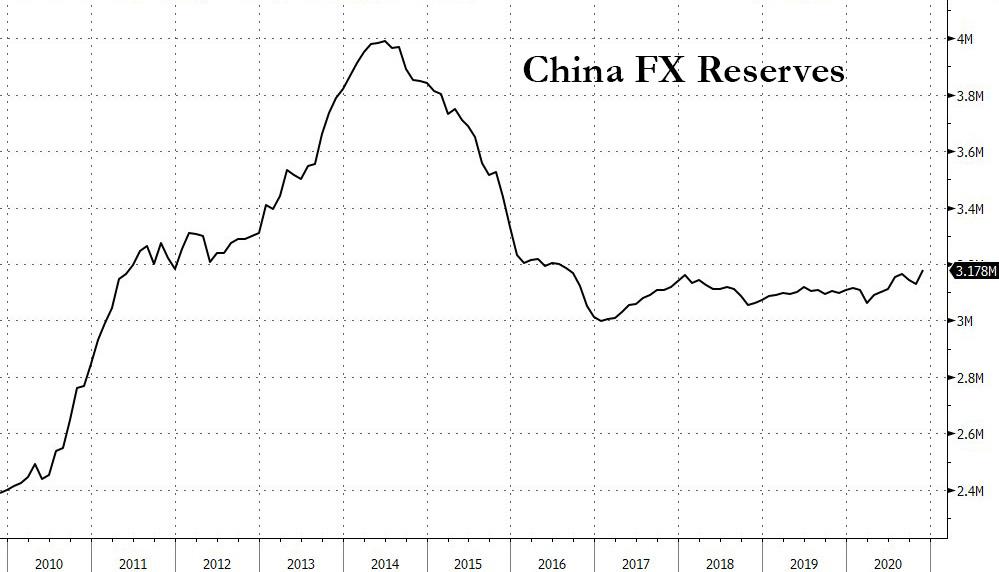
Around the same time that the Chinese National Bureau of Statistics overnight reported a surge in exports and a record trade surplus, the PBOC also reported that at the end of November, China's Forex reserves jumped to $3.178 trillion, beating estimates of $3.15 trillion, and the highest number since August 2016.
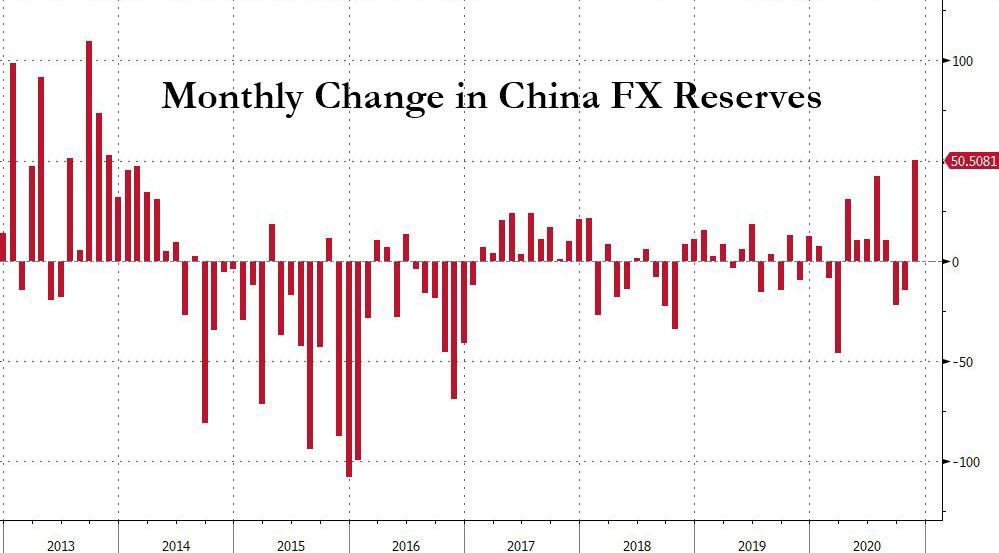
And, at $50.5BN, this was also the biggest monthly increase in FX reserves since November 2013.

And just like the rapid collapse in yuan reserves in the 2015-2017 period was a result of Beijing's scramble to sell dollar assets and halt the plunge in the yuan and stem the tidal wave of capital outflows, with the recent surge in FX reserves, it appears that China’s authorities are finally pushing back on yuan appreciation which has reached a level where concerns about imported deflation are starting to emerge. Furthermore, while a chunk of the jump in reserves was likely based on valuation adjustments and FX rate changes as a SAFE spokeswoman said, it is likely that the bulk was the result of USD-buying intervention.
As Bloomberg's Simon Flint writes, it will be interesting to see just how the authorities slow the pace of yuan appreciation: will they use the daily yuan official fixing, intervention, or further announcements of capital outflow liberalization, to slow the pace of yuan appreciation - should dollar weakness persist in the coming months.
That said, there is always a caveat when dealing with Chinese reserve data: as Flint cautions, these estimates are based on valuation-adjustments can be flawed as we don’t know the exact composition of China’s reserves. Nor is it clear whether China revalues securities within its portfolio on a monthly basis. To get the cleanest picture of Chinese capital flows, it's best to wait for the SAFE dataset on "cross-border RMB flows" which is Goldman's preferred FX flow measure and which gives a far more definitive picture of what's really happening behind China's opaque capital firewall.
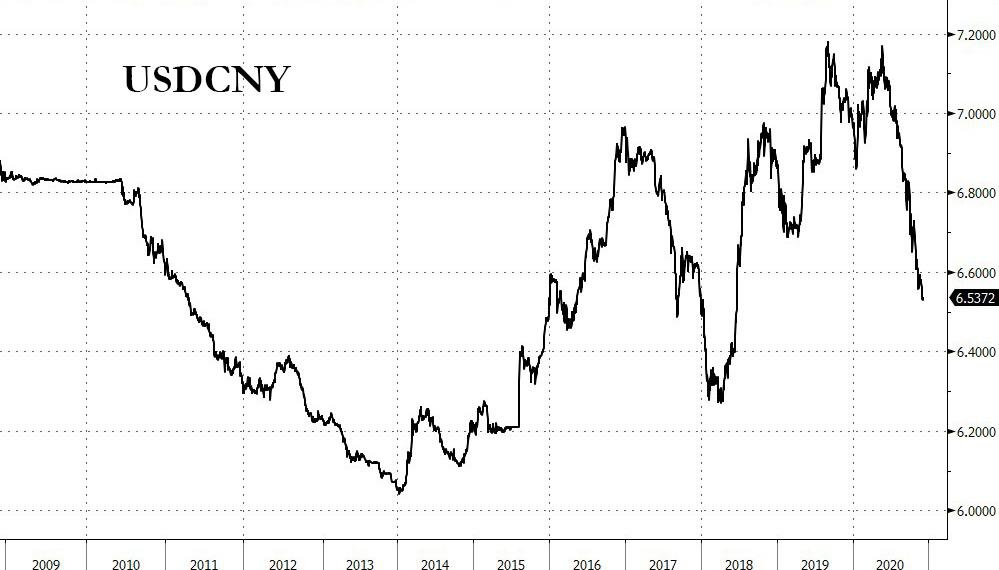
Still, with the Chinese yuan soaring in the past 6 months as the dollar has plunged, and fast approaching where it was around the time of the August 2015 devaluation...

... it is only a matter of time before Beijing will have no choice but to aggressively intervene in the currency market, sending the dollar blasting off in the opposite direction.

(ZH) WHO Envoy: Life Won't Return To Normal For At Least 2 Years

WHO Envoy: Life Won't Return To Normal For At Least 2 Years

The WHO’s special envoy for the global COVID-19 response says that despite the arrival of a COVID-19 vaccine, normal life won’t resume for at least two years.
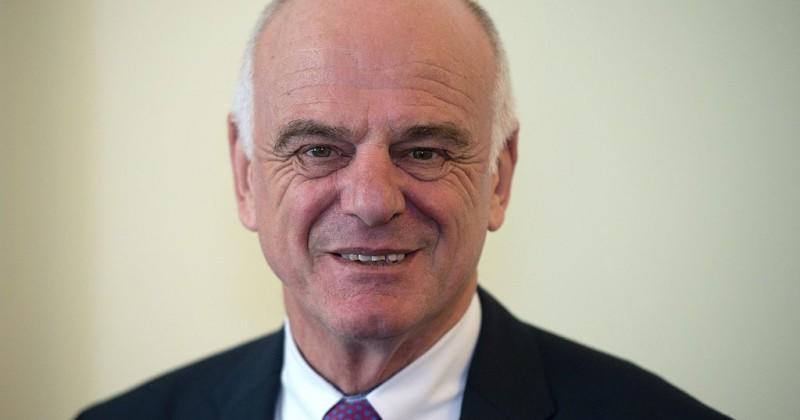
Dr David Nabarro suggested that social distancing and masks were something that would have to continue as a way of “treating this virus with respect.”
“This will mean face masks and physical distancing otherwise the virus does keep on surging. The reality is it will be some months before we can dispense with these precautions,” he said.

When asked when things would return to normal, Nabarro suggested that this wouldn’t occur until the end of 2022 at the earliest.
“I hate making predictions, but let’s just consider it in the big picture. None of us will be safe until the whole world is safe,” remarked Nabarro.
“Big patches of normality are coming up soon, but not everyone will be vaccinated for at least a couple of years. So normal life as we know it is a couple of years away for the world,” he added.
As we have previously highlighted, two years may seem a naive target for a return to normality given that some prominent figures have said the world will never get back to what it was pre-COVID.

“Many of us are pondering when things will return to normal,” wrote World Economic Forum founder Klaus Schwab.
“The short response is: never. Nothing will ever return to the ‘broken’ sense of normalcy that prevailed prior to the crisis because the coronavirus pandemic marks a fundamental inflection point in our global trajectory,” he added.
In addition to Schwab, a senior U.S. Army official said that mask wearing and social distancing will become permanent, while CNN’s international security editor Nick Paton Walsh asserted that the mandatory wearing of masks will become “permanent,” “just part of life,” and that the public would need to “come to terms with it.”
* * *
New limited edition merch now available! Click here. In the age of mass Silicon Valley censorship It is crucial that we stay in touch. I need you to sign up for my free newsletter here. Support my sponsor – Turbo Force – a supercharged boost of clean energy without the comedown. Also, I urgently need your financial support here.

FT : Eurozone chief seizes on virus and Brexit to revive banking union

Eurozone chief seizes on virus and Brexit to revive banking union
Paschal Donohoe to renew efforts for deposit insurance scheme across single currency area

Brexit and the coronavirus pandemic have reinforced the need to solidify the single currency’s foundations, said the president of the Eurogroup of finance ministers, who will seek to revive the bloc’s long-stalled banking union project this week.

Paschal Donohoe, who is also the Irish finance minister, told the Financial Times he would seek to intensify work in four key areas — including divisive plans to create a eurozone-wide bank deposit insurance (EDIS) — as he prepares for a summit of eurozone leaders on Friday.

The package would also include improving the region’s crisis management framework, cross-market integration and tackling the link between banks and their country’s sovereign debt, said Mr Donohoe, who is aiming for a new detailed banking union work plan in the middle of next year.

“There is a renewed responsibility on those within the eurogroup to look at how we can deepen the foundations of the euro and deepen the economic architecture of the euro,” given the economic toll from Covid-19, Mr Donohoe said in an interview. Brexit is a reminder that the euro area and EU need “resilient sources of employment and income growth”, he added.

Eurozone finance ministers last week reached a political agreement on a long-awaited reform to the bloc’s bailout fund, the European Stability Mechanism, removing a barrier that has held back work on banking union project. An attempt late last year by German finance minister Olaf Scholz to end the “continuous gridlock” over the issue foundered after it was overtaken by the Covid-19 crisis.

Mr Scholz’s set of proposals opened the door to the creation of common deposit insurance for eurozone banks — something that has long been resisted by richer northern eurozone countries who fear their taxpayers would be on the hook for bank failures in other parts of Europe. But sealing a banking union deal will require efforts by multiple governments across the euro area, including unpalatable reforms.

Mr Donohoe said the eurogroup had yet to reach an agreement on how to progress with EDIS, acknowledging “heightened concern” of some capitals about greater risk-sharing. But he said the task now was about “building momentum through constant political contact and dialogue”.

“There is a broad understanding in the eurogroup that we need to have the strongest foundations possible for the euro in the coming years,” he said.

This will also entail detailed work on tackling the nexus between banks and their country’s sovereign debt — a so-called doom loop that has long bedevilled the European banking system. The key priorities also include examining how to handle the liquidity needs of a failing bank and ensuring better co-ordination between home and host bank supervisors, bolstering cross-border integration.

The onset of the pandemic has forced Brussels to suspend temporarily the bloc’s fiscal rules as governments turn to fiscal firepower to support beleaguered companies and support employment. Mr Donohoe said that despite the rollout of Covid-19 vaccine in the EU in the coming weeks and months, it was “too early to say what meaningful impact it will have on policy choices in 2021”.

He encouraged governments to continue to support their economies even if growth rates rebounded next year.

“We need to be careful that we don’t assume that higher growth is the same as inclusive growth,” he said. “We have huge employment issues, huge income issues, within the EU as a result of the impact of Covid-19.” 

>>> Europe ; Brokers Upgrades & Downgrades - 8th of December 202

>>> Up
* ASMI Raised to Overweight at JPMorgan; PT 210 euros
* Fielmann Raised to Buy at LBBW; PT 70 euros
* Taylor Wimpey Raised to Buy at Deutsche Bank
* Telenet Raised to Overweight at JPMorgan; PT 44 euros

>>> Down
* Crest Nicholson Cut to Hold at Deutsche Bank
* FFP Cut to Hold at HSBC; PT 100 euros
* InterContinental Hotels Cut to Underperform at Jefferies
* Ipsen Cut to Equal-Weight at Morgan Stanley; PT 85 euros
* Meggitt Cut to Equal-Weight at Morgan Stanley; PT 465 pence
* On The Beach Cut to Underperform at Jefferies; PT 310 pence
* Orange Belgium Cut to Neutral at JPMorgan; PT 22 euros
* SGL Cut to Reduce at HSBC; PT 2.90 euros
* Viafin Service Cut to Reduce at Inderes; PT 16.40 euros
* Whitbread Raised to Buy at Jefferies; PT 4,010 pence
* William Hill Cut to Hold at Jefferies; PT 272 pence

>>> Initiation
* ASR Nederland Rated New Buy at Berenberg; PT 41.70 euros
* Baloise Rated New Hold at Berenberg; PT 182 Swiss francs
* Close Brothers Rated New Hold at Liberum; PT 1,435 pence
* CNP Assurances Rated New Hold at Berenberg; PT 16.50 euros
* Hiscox Rated New Hold at Berenberg; PT 1,085 pence
* Lancashire Rated New Buy at Berenberg; PT 963 pence
* Metro Bank Rated New Sell at Liberum; PT 94 pence
* Netcompany Rated New Buy at Citi; PT 675 kroner
* OSB Group Rated New Buy at Liberum; PT 535 pence
* Paragon Rated New Buy at Liberum; PT 535 pence
* Rolls-Royce Resumed Equal-Weight at Morgan Stanley; PT 132 pence
* Schindler Rated New Reduce at Commerzbank; PT 230 Swiss francs
* SourceBio International Rated New Buy at Liberum; PT 200 pence
* Virgin Money UK Rated New Buy at Liberum; PT 165 pence
* Zur Rose Rated New Buy at Citi; PT 330 Swiss francs

>>> Cal
* European Insurer M&A Just Getting Started, Berenberg Says
* Ipsen Lacks Catalysts, Has Somatuline Overhang: Morgan Stanley
* Taylor Wimpey Upgraded, Crest and Vistry Cut at Deutsche Bank
* Vaccine Will Change Picture for U.K. Leisure, Jefferies Says

>>> What to look at today - 8th of December 2020

Asian stocks drifted Tuesday as swelling coronavirus infections across the U.S. weighed on risk assets overnight. Treasuries held on to Monday’s gains.
Equities fell in South Korea and Hong Kong, and were little changed elsewhere. Japanese shares pared losses as Prime Minister Yoshihide Suga unveiled around $380 billion in fiscal measures to help the economy recover from the pandemic. S&P 500 futures dipped after the benchmark dropped from an all-time high amid fears of restrictions as infections climb. Earlier, the Nasdaq 100 closed higher for a ninth straight day, its longest winning streak in almost a year.
Elsewhere, the pound pared overnight losses as the U.K. backed down from a threat to break the Brexit agreement. The dollar held gains against its major peers. Oil slipped and gold was steady after jumping more than 1% Monday
US After Hours SFIX +34.4%, SMAR +14.4%, COUP +3.6% up on earnings; TOL -3.7% lower on earnings

Nikkei -0.30% Hang Seng -0.61% CSI -0.16% -0.07% Shenzen +0.03%

Eur$ 1.2116 CNH 6.5233 CNY 6.5389 JPY 107.07 GBP 1.3351 CHF 0.8912 RUB 73.5807 TRY 7.8318 WTI$ 45.51 -0.55%

S&P -0.33% Nasdaq -0.21% EuroStoxx -0.14% FTSE -0.41% Dax -0.09% SMI +0.07%

Macro :
- Merkel Wants to Close German Shops After Christmas, Bild Says
- China Removes TripAdvisor App, Alleging Illegal Content
- U.K. to Review Gambling Laws Around Advertising and Online Bets
- Manhattan Luxury-Home Buyers Come Back, Lured by Deep Discounts

Keep an eye on :
- AIR FP : Airbus Targets 530 Jet Handovers for Year in Late Push
- AIR FP : Airbus: No New Orders In Nov.; Jan.-Nov. Net Orders 297
- AF FP : France Prepared to Double Stake in Virus-Hit Air France-KLM
- AM1 FH : Bain-Led Group Extends Offer Period for Ahlstrom-Munksjo
- ALFEN NA : British Gas Signs 3-Year EV Charger Agreement With Alfen
- ATC NA : Altice Holder Lucerne Starts Proceedings Over Drahi’s Offer
- ATC NA : Altice Shareholders Rebel Against Drahi’s Take Private Plans
- AMBU DC : Ambu CEO Gonzalez Buys Shares for $1.21 Million
- BAYN SS : Bayn Group to Offer Up to 9.5m Shares via Carnegie, Bayn Group Offering Prices 9.5m Shares at SEK8.55/Share
- BEIJB SS : EQT Private Equity Acquires Large Stake in Beijer Ref
- BPOST BB : Bpost Sets Dividend Payout Target at 30%-50% of IFRS Net Profit
- CALMA SS : Calmark Sweden to Offer SEK20m Shrs, Calmark Sweden Offering Prices 5m Shares at SEK5.30/Share
- CAST SS : Castellum Raising Entra Offer Would Be Negative: Handelsbanken
- CBK GY : Deutsche Bank, Commerzbank Funded Wirecard Deals in India: FT
- COP GY : CompuGroup Sees 2021 Revenue EU1B
- CSGN SW : Credit Suisse Hires UBS’s Wang as COO for China Onshore Business
- DAI GY : Europcar Accord W/ Post Nord, Mercedes-Benz on Electric Vans
- DBK GY : Deutsche Bank, Commerzbank Funded Wirecard Deals in India: FT
- DBK GY : Citi, Deutsche Bank, ANZ and Six Bankers to Face Cartel Trial
- ENGI FP : Engie Secures $172m With Hannon Armstrong for U.S. Solar Assets
- ENOG LN : Energean Holders Third Point Hellenic Recovery to Offer 6m Shrs
- EQNR NO : Norway Lawmakers Want Firmer Control Over Equinor Governance: DN
- ERA FP : Eramet Mulls Aubert & Duval Sale As Unit Cuts 379 Jobs: Echos
- EUCAR FP : Europcar Gets Consents From Majority of Senior Noteholders
- EUCAR FP : Europcar Accord W/ Post Nord, Mercedes-Benz on Electric Vans
- HLE GY : Hella Boosts FY Adjusted Ebit Margin Forecast
- HUBN SW : Huber+Suhner to Cut Size of Executive Group Management
- HSBA LN : Hong Kong Church Group Says HSBC Freezes Bank Account (1)
- ISS DC : ISS Picks Niels Smedegaard as Chairman to Replace Charles Allen
- KAZ LN : KAZ Minerals Sees FY Copper, Gold Output 2-3% Above Guidance
- KLOVB SS : Klovern Confirms to Get SEK2.06B Before Costs Via Rights Issue
- NAS NO : Norwegian Files for Supplementary Norway Reconstruction Process
- QIA GY : Qiagen Raises 4Q, 2020 and 2021 Views; Expands Supervisory Board
- STORM NO : Storm Real Estate to Offer Up to 42.9m Shrs NOK7/Shr
- VOW3 GY : VW’s Audi Division Raises Forecast for 2020 Net Cash Flow (1)

FT : Amazon fires fuel investor concern

Amazon fires fuel investor concern
Progress on ESG is being obscured by a row over deforestation

It was designed to prove Brazil’s commitment to protecting the Amazon, to highlight how much virgin rainforest remains and to underline the effectiveness of thousands of troops in combating illegal forest fires.

“What I wanted to show them is that we don’t have our arms crossed, we are trying to do the best that we can,” vice-president Hamilton Mourão says of the Amazon tour he hosted for 12 ambassadors last month. “They had freedom to ask whatever they wanted. It was a chance for them to see with their own eyes what they read [about] in the newspapers, books, so they can make a better analysis of what is really happening here in Brazil.”

But days before the plane carrying Mr Mourão and the diplomats took off, fresh data was published showing Amazon forest fires had more than doubled in October from the same month last year. A week after their trip, new figures showed deforestation had shot up 50 per cent in October. The government found itself on the back foot again.

The episode demonstrated one of the difficulties facing global investors as environmental, social and governance (ESG) considerations come to the fore: Brazil generates some of the world’s best and worst numbers, with much of the analysis dominated by an increasingly fierce confrontation over the Amazon.

Satellite monitoring shows a surge in illegal deforestation since hard-right president Jair Bolsonaro took power in 2018, but Brazil still has more preserved rainforest than any other nation. Its energy mix is one of the world’s cleanest, with more than 80 per cent of electricity generated by renewable energy. Its biodiversity exceeds that of any other country. Its Forest Code is one of the world’s most advanced pieces of environmental legislation. Its carbon reduction targets under the Paris Agreement on climate change are among the most ambitious of any large developing economy.


Yet all the world sees, government officials complain, are images of burning trees in the Amazon.

“We are a kind people,” insisted finance minister Paulo Guedes to an audience of US investors in October. “All this story about killing Indians and burning forests is an exaggeration. We have a year and a half [in power]. I don’t believe that the Amazon was burnt in a year and a half. If something is wrong, it was wrong for the last 30 years.”

Essential ESG
The controversy over Brazil’s failure to protect the Amazon is indeed
decades-old, though it has intensified under Mr Bolsonaro because of his rhetoric against environmentalists and the cutbacks his government has made to enforcement. Jaws dropped when he made a speech in September to a remote session of the UN General Assembly claiming that indigenous people were mainly responsible for the forest fires and insisting that Brazil was the victim of a “brutal disinformation campaign”.

This has distracted attention from what financiers in Brazil say is an important new trend: a far greater awareness among local companies of the need to adhere to ESG criteria.

Cassio Gouveia, managing director for investment banking at corporate and investment bank Itaú BBA, says attitudes have changed “dramatically”. Fulfilling ESG criteria, he says, “is a must for any company considering raising equity or debt locally or internationally”.

Brazilian asset managers are also starting to focus on ESG. Fabio Alperowitch, portfolio manager at FAMA Investimentos, an asset management firm, started ethically investing in 1993, the year after Brazil hosted the UN’s Earth Summit in Rio de Janeiro — a groundbreaking event at which countries agreed to tackle climate change.

“For nearly 30 years, practically nothing happened in Brazil in ESG,” Mr Alperowitch says. “Its main topics, human rights and the environment, were seen as topics of the left and as financial markets tend to be conservative, they were repulsed by these topics.

“Now there is suddenly a big demand from investors to talk about ESG.”

But he warns that it may have shallow roots. “Many people are waking up to ESG but doing so without any depth, in a very superficial way. Others simply have a commercial interest in fulfilling a demand for ESG products . . . but are really just greenwashing.”

External investor pressure has been growing. More than two dozen global financial institutions managing over $3.7tn in assets demanded in June that the government curb deforestation, which had created “uncertainty about the conditions for investing in or providing financial services to Brazil”. 

Change of tone
Mr Mourão’s tour for ambassadors was partly a response to that pressure. Other arms of the Brazilian government have also reacted. The central bank has issued guidance on green finance and the agriculture ministry has drawn up a “green investment roadmap” with $163bn of sustainable projects. “I’ve been very impressed with how the central bank has been in the forefront of trying to support sustainable finance in Brazil,” says Paloma Anós Casero, World Bank country director for Brazil.

“Since June we have seen a change of tone in the government,” says one ambassador in Brazil who went on the trip with Mr Mourão. “Criticisms by investors and the private sector have had an economic impact. They did not expect that. They ignore what NGOs say but when private business says there is a problem, they go quiet and listen.”

Listening to investor concerns is one thing; producing results in the war on illegal deforestation across the vast Amazon basin is another.

“We have not yet seen much progress on the [deforestation] numbers,” says Graham Stock, head of emerging markets sovereign research at BlueBay, one of the authors of the June investor initiative. “The fire season was pretty bad this year in Brazil. We need to see progress.”

Last week Inpe, Brazil’s space agency, reported that 11,088 sq km of forest were destroyed between August 2019 and July 2020 — the biggest loss since 2008, and a 9.5 per cent increase on the same period the previous year.

With the inauguration of Joe Biden as US president next year, the pressure will only increase. Mr Biden has promised a $20bn global fund to save the Amazon and warned of “economic consequences” if Brazil does not join — a ploy that drew a typically combative response from Mr Bolsonaro.


One thing business people and investors agree on is that unless Amazon deforestation numbers go down and stay down, and Mr Bolsonaro takes a more pro-conservation line, Brazil risks scaring away more investment money. 

“I’m impressed by the companies . . . by the way we are all thinking in Brazil in the private sector,” says Ilan Goldfajn, the former head of Brazil’s central bank. “But the main challenge has to do with having a macro framework and we cannot avoid having the government involved in that. The government has to embrace sustainability.”

Or, as German ambassador Heiko Thoms puts it when referring to the Amazon: “Only action will matter. We now need to see a clear long-term action plan with clearly defined objectives and numbers.”
FT : Grantham stumbles on $200m profit after Spac swoop on battery maker

Grantham stumbles on $200m profit after Spac swoop on battery maker
Despite big gain, investor thinks blank-cheque listing vehicles are ‘reprehensible’

Famed investor Jeremy Grantham has “by accident” made about $200m from a personal investment in battery-maker QuantumScape after it merged with a listed blank-cheque company — despite deriding the US craze for so-called Spacs as “reprehensible”.

Mr Grantham, the co-founder of Boston-based GMO, is now semi-retired and works primarily in environmental philanthropy. But seven years ago his personal foundation invested $12.5m in QuantumScape, a Stanford University spinout, as part of a series of bets on early-stage “green” technology. 

Mr Grantham stressed that he is a big believer in QuantumScape. But he is taken aback by his gains from investing in the company, which were supercharged since it announced in September that it would secure a slot on the New York Stock Exchange by merging with a special purpose acquisition company set up by Kensington Capital Partners, a Canadian investment group.

“This is unlike anything else in my career. This was by accident the single biggest investment I have ever made,” he told the Financial Times. “It gets around the idea of listing requirements, so it is not a useful tool for a lot of successful companies. But I think it is a reprehensible instrument, and very very speculative by definition.”

Ironically for an investor mostly known for contrarian bets on undervalued, unfashionable companies and industries, the bet on QuantumScape is on track to be one of the most lucrative investments of Mr Grantham’s six-decade career. 

The combination with Kensington Capital Acquisition Corp valued QuantumScape at $3.3bn, but the vehicle’s stock price more than doubled after the deal was announced on September 2, and spiked to a peak of $52.80 after the merger was formally approved and completed on November 30. That marked a quintupling from the Spac’s listing price.

Although the shares have dipped after that frenzy, the newly combined company still boasts an overall market value of roughly $16bn. Mr Grantham holds about 4.8m shares in the company, which at their $44.17 closing level would be worth over $210m.

But he pointed out that the company itself estimates that commercial production of its batteries for electric cars is years away, and compared the current Spac frenzy to some of the wilder schemes launched in the 18th century South Sea Bubble. 


Spacs have taken Wall Street by storm in 2020, generating lucrative returns for their backers as well as large fees for the underwriters and law firms that have helped usher them to market. More than 200 blank cheque companies have listed so far this year, raising a record $66.3bn, according to data provider Refinitiv.

This September, United Wholesale Mortgage agreed to go public by merging with a blank-cheque company in a transaction that valued United at $16bn: the largest deal ever struck by a Spac.

Mr Grantham sees Spacs as symptomatic of what he considers a historic stock market euphoria — which he reckons rivals the peak of the “Roaring Twenties” bull market in 1929 and the dotcom bubble of the late 1990s. Anything to do with electric vehicles has been particularly frothy, he notes.

Other prominent backers of QuantumScape include Microsoft founder Bill Gates, Volkswagen, and Silicon Valley venture capital firms Kleiner Perkins and Khosla Ventures. Mr Grantham’s investment is made through The Grantham Foundation for the Protection of the Environment — which he runs with his wife Hannelore Grantham — and is locked up until June next year. 


Merging with a Spac can provide a company with greater certainty over the proceeds they will raise when coming to market as well as their valuation, which is set just days before a deal is finalised.

However, the structures are costly. Spac sponsors typically take 20 per cent of the equity in the vehicle, a stake that converts to shares of the company it eventually merges with. Would-be investors also face the threat of dilution from the warrants that are granted to investors who helped fund the Spac’s public listing.

“They are enormously expensive. Someone is getting . . . 20 per cent of the company for free,” said Michael Klausner, a professor at Stanford Law School. “The structure has an enormous amount of dilution built in that someone will pay for and so far it has been the Spac shareholders who seem to be haplessly paying for it.”

FT : Passive funds make up 20% of European investment market

Passive funds make up 20% of European investment market
Many fear ‘kickback’ payments linked to actively managed funds will limit growth in region

Index-tracking funds now account for a fifth of the European investment market for the first time, following a surge that has led to passive investing doubling its share of the pie over the past decade.

But some fear the continued existence of “kickback” payments, which reward distributors for selling more expensive actively managed funds, will prevent Europe from following the trajectory of the US, where 40 per cent of money is passive.

“In Germany and France you still have the big kickback model in place [and] the situation is worse in Italy, it’s outrageous, so this is going to hamper the growth of index funds,” said Ali Masarwah, a member of the European research team at Morningstar.

Passive mutual and exchange traded funds constituted exactly 20 per cent of the assets in Europe’s €9.4tn ($11.4tn) long-term fund industry — that is, not including money market funds — at the end of October, according to Morningstar, thanks to growth of 9.5 per cent over the prior 12 months, well in excess of the 2.1 per cent asset growth of actively managed funds.

As a result, index trackers have essentially doubled their market share in the region since October 2010.

Over the same 10-year period, passive’s share of the US market, where the concept was pioneered, has also effectively doubled, from 21 per cent — in line with today’s European penetration rate — to 41.4 per cent.

However, Mr Masarwah did not believe that Europe would follow the trajectory of the US and witness a further doubling of market share during the 2020s because distributors in the region continue to be paid “retrocession” payments. This form of commission paid by asset managers to distributors such as banks for selling their products puts low-cost passive funds at a disadvantage because they tend not to pay such inducements.

“The trajectory will probably not just be a time lag of 10 years. Growth is not that fast in Europe,” he said.

Mr Masarwah pointed to the UK where 26 per cent of assets are now passive* and the Netherlands, where 13.7 per cent of assets are passively run, as countries where retrocession payments have been banned and the interests of financial advisers “are now aligned with their clients” — in other words, they are happy to recommend low-cost trackers if they believe that is in their clients’ best interest.

More strikingly still, Switzerland’s market is 58.7 per cent passive after the country’s highest court ruled in 2012 that rebates — as high as 2 per cent of assets in some cases — belonged to the end-investor. Retrocession payments had generated SFr4.2bn ($4.7bn) for Swiss banks in 2012, according to Finalix, a consultancy, equivalent to 12.4 per cent of their profits.

However, the kickbacks have continued in countries such as Germany, where passive is just 11.1 per cent of the domestic market, France (8.2 per cent), Spain (2 per cent) and Italy (0.05 per cent).

Under the EU’s Mifid II directive, distributors can still receive retrocession payments if they provide execution-only services or offer access to third-party products from a competitor while also providing a “high level” of service, such as ongoing financial advice.

Verena Ross, executive director of the European Securities and Markets Authority, warned of “potential conflicts of interest” and “advisers that almost exclusively recommend in-house products”, in a speech last week, although she added that the payments “can be one effective tool to enable access to higher-quality services and lower-cost products”.

Yet Mr Masarwah criticised the “absurdity” of an arrangement where Italian distributors still sold funds with fees of 2 per cent and German distributors “have a vast interest in upholding the kickback model”.

“The German client is not an investor, he just buys what his adviser tells him to buy, so the advisers’ interest is to earn money by selling,” he said. “Mifid II was supposed to introduce a more investor-friendly regime.”

Richard Withers, European head of government relations at Vanguard, was also critical of the retrocession model. “If a financial adviser is thinking about what is best for their financial position they may be tempted to sell a product that pays a high commission, regardless of whether it’s the best product or not,” he said.

However, Simon Klein, global head of passive sales at German asset manager DWS, believed Mifid II was spurring growth of passive ETFs.

An important driver, he said, was that investors had received their first full-year statement outlining the level of fees they generated for their distributor, thanks to a cost disclosure clause implemented in 2019.

“Now they know what the bank distributor, the adviser was earning. This was eye-opening for many clients,” Mr Klein said. “This has changed already the investor behaviour. This is one of the reasons we are seeing super strong growth in online savings plans in Germany.”

Mr Klein said low interest rates were also spurring demand for cheaper, passive funds, which were also benefiting from the greater transparency stemming from the fact that distributors that still receive retrocessions now have to label themselves “non-independent”.

Mr Withers was hopeful that the rise of online robo advisers, albeit from a low base, would help break the stranglehold of large banks and insurers elsewhere.

The European Commission is due to publish its assessment of the role of inducements in 2022, yet Mr Masarwah feared change would be “very slow”.

“Eventually the passive side is going to win big, but it will probably happen in 10-20 years because of the vested interests which are going to stem the tide.”

FT : EU set to introduce recycling targets for battery makers

EU set to introduce recycling targets for battery makers
Electric car makers will have to abide by tougher environmental standards

Brussels will introduce mandatory recycling targets for battery makers including electric car manufacturers from 2030, as the EU attempts to meet growing demand for vital raw materials without undermining its ambitious environmental goals.

Virginijus Sinkevicius, EU commissioner for environment, oceans and fisheries, told the Financial Times that an update of the bloc’s battery directive will crack down on the use of hazardous materials and propose “ambitious but realistic” recycling targets for materials used in batteries to help create a “sustainable batteries value chain”. 

“Global exponential growth in demand for batteries will lead to an equivalent increase in demand for raw materials — notably cobalt, nickel and manganese. We have to strive for sustainable production and consumption and reduce batteries carbon footprint,” said Mr Sinkevicius. 

The commission will on Thursday propose an update of the EU’s batteries directive for the first time in more than a decade, revamping the legislation to reflect vast improvements in a technology that is seen as a major driver in the transition to clean transport.

European electric carmakers and non-EU manufacturers who want to sell their batteries in the single market will have to abide by tougher environmental standards, said Mr Sinkevicius, adding that Europe was on course to be the world’s second-largest market for electric vehicles over the next decade.

Under the updated regulation, electric vehicles manufacturers would have to disclose the recycled content in their batteries in an attempt to then meet mandatory targets set in 2030 and 2035, said Mr Sinkevicius.

“This is a fundamental first step in closing the loop for valuable materials contained in batteries. We’re going to aim for ambitious yet realistic targets for collection, recycling efficiencies, and the recovery of materials from waste batteries.”

Before settling on the exact targets for 2030 and 2035, Brussels will need to carry out a thorough impact assessment and consult with sectors like EV manufacturers and the chemicals industry. 

In response to concerns that the regulation would stifle the development of clean car technology in Europe, Mr Sinkevicius said the rules would provide “legal certainty” and “incentivise the investment and production capacity for sustainable batteries in Europe and beyond”.


The EU has committed to becoming the first continent to reach net zero emissions by 2050, a goal that will require a radical overhaul of Europe’s energy, transport, and manufacturing sectors.

The commission estimates that lithium, one of the key components of battery cells, has a recycling efficiency of only 50 per cent. Mr Sinkevicius said that rather than encouraging more mining of raw materials like lithium, Brussels wants to meet rising battery demand by creating a secondary market for recycled materials. 

The regulation will also propose measures to extend the life cycle of batteries, by making recycling obligatory for collected waste batteries, and encouraging the repurposing of batteries for “second life”. Brussels also wants to phase out gradually non-recyclable single life batteries — such as those used to power remote controls — but the commission will not impose a target date for their expiry, said the commissioner.

FT ; Deutsche Bank and Commerzbank funded Wirecard’s India deal

Deutsche Bank and Commerzbank funded Wirecard’s India deal
Failed payments group borrowed €250m from the lenders to buy two companies referred to in fraud allegations

Deutsche Bank and Commerzbank provided the bulk of the funding for Wirecard’s acquisition of a pair of Indian companies referred to in the fraud allegations against the defunct Germany payments group, documents seen by the Financial Times reveal.

In 2015 Wirecard turned to the German banks when it agreed to pay up to €340m to a Mauritius-based fund for two India-based sister companies, Hermes i Tickets and GI Technology. The seller, dubbed Emerging Markets Investment Funds 1A, had acquired the targets just weeks earlier from their original owners for less than €40m.

Wirecard said that it never checked who was the ultimate beneficial owner of EMIF 1A, and forensic investigations by Big Four accounting firms EY and KPMG later failed to uncover this.

The unusual sequence of events, the stark increase in purchase price and the unclear ownership of the seller lead to allegations of potential money laundering and embezzlement.

An Indian Wirecard employee in 2016 told EY auditors that “senior management” of the German group was behind EMIF, and EY fraud investigators later referred to “hints” that Wirecard’s then-chief operating officer Jan Marsalek was behind EMIF, according to documents seen by the FT. Mr Marsalek, who is a fugitive and on Interpol’s most-wanted list, always denied those allegations.

According to documents seen by the FT, Deutsche Bank and Commerzbank provided loans of €125m each to Wirecard for the purchase. The loans underline the backing Wirecard enjoyed from some of Germany’s biggest financial institutions during its meteoric rise.

By the end of 2015, Wirecard’s market capitalisation had climbed to €5.7bn, and it went on to peak at more than €24bn in 2018. Hailed for years as a rare German tech success, the company collapsed in June after disclosing that large parts of its operations in Asia were a sham.

People familiar with the transaction told the FT that the two €125m loans were bridge loans, which had a duration of about a year. The loans were repaid by Wirecard long before the company went bust, the people added.

Prior to Wirecard’s insolvency, both German lenders were part of a consortium that provided a €1.75bn revolving credit facility to the payments group, which was 90 per cent drawn. While Deutsche Bank’s exposure stood at €80m, Commerzbank’s was €200m. Wirecard in 2019 had also raised €1.4bn via bonds after receiving an investment-grade rating from Moody’s.

A person familiar with Deutsche Bank’s 2015 decision to finance the Wirecard deal in India said that, at the time, Germany’s largest lender was not aware that the target was acquired from a middleman that had paid just a fraction of the purchase price only weeks earlier.

The first public report about the deal’s unusual circumstances was published by the Foundation for Financial Journalism in early 2018, some two years after the deal was announced.

People familiar with mergers and acquisitions financing said that when granting bridge loans, banks tend to focus their due diligence on the solvency of the buyer, rather than the identity of the seller or the quality of the target. However, the banks normally have access to the buyer’s own due diligence documents, which according to a KPMG special audit into the India deal, disclosed that EMIF had earlier paid a much lower purchase price.

Fabio De Masi, an MP for Germany’s far-left Die Linke party, said it was “surprising how little interest the banks showed in the plausibility of the purchasing price and the ultimate beneficial owner of the EMIF funds”. The €250m provided by Deutsche and Commerzbank “is quite a lot of ‘stupid German money,’” he added.

Deutsche Bank also had a separate business relationship with former Wirecard chief executive Markus Braun, who in late 2017 borrowed €150m from the bank and pledged half of his shares in the company as collateral. Two years later, in late 2019, Deutsche Bank terminated the loan, forcing Mr Braun to refinance it first via Wirecard Bank and then via OLB, a small private-equity owned lender.

Deutsche Bank and Commerzbank declined to comment on their lending relationship with Wirecard, citing client confidentiality rules.