FT : Should zombie companies be feared?

Should zombie companies be feared?
New York Fed research challenges worries over the corporate walking-dead

Many investors fret that a corporate “zombiepocalypse” may be one of the thorniest problems the global economy faces in the coming years. But a bombshell paper by the New York Federal Reserve argues that this fear may be overdone. 

Even before the eruption of coronavirus, concerns that a growing horde of walking-dead companies — usually defined as those unable to cover debt-servicing costs from long-run profits — were pervasive. 

Two years ago, the Bank for International Settlements calculated that the share of zombie companies across the 14 big economies it studied had climbed from 2 per cent in the late 1980s to 12 per cent by 2016. The driver was that they stayed undead for longer than in the past, neither recovering nor dying out. The most likely reasons for this were the falls in interest rates that reduced debt repayments and banks being reluctant to pull the plug.


The trend was no accident. In fact, after the 2008 financial crisis, policymakers considered low rates and forbearance absolutely necessary to prevent a mass corporate extinction event that would have caused many more millions of jobs to disappear. In this, the authorities had learnt from the mistakes of history. 

Back in 1929, Treasury secretary Andrew Mellon advocated the mass liquidation of struggling companies to “purge the rottenness out of the system”. Foreshadowing Joseph Schumpeter’s theory of “creative destruction”, he argued this would be the best way to ensure a recovery. Instead, the Mellon Doctrine helped turn the crash of 1929 into the Depression.

Nonetheless, many economists worry that allowing feeble companies to shamble on indefinitely does entail real, longer-term economic costs. The 2018 BIS paper estimated that “zombie companies” are unproductive, invest less and suck up resources that could otherwise be redeployed in more dynamic areas. Even beyond the zombie company phenomenon, economists fretted that rising corporate indebtedness in general stunts the ability of companies to invest.

These fears have been supercharged in the wake of the coronavirus crisis. Of the many legacies the pandemic will leave in its wake, a monstrous corporate debt burden is one of the biggest. 


The rise in corporate bankruptcies has so far been surprisingly modest, thanks to the extraordinarily aggressive response from governments and central banks, with the latter alone pumping more than $7tn of stimulus into bond markets, according to the IMF.

But the net result has been that the developed world’s corporate debt burden has climbed from an already record 91 per cent of gross domestic product in 2019 to 102 per cent at the end of September 2020, according to the Institute of International Finance. Although rock-bottom interest rates make this more bearable, economists fret that this debt “overhang” will be a millstone around the neck of the global economy for years to come.

Perhaps not, according to the paper published by the New York Fed this month. Using a database across 17 economies going back to the 19th century, Oscar Jordà, Martin Kornejew, Moritz Schularick and Alan Taylor investigated whether big corporate debt build-ups led to deeper and longer recessions, as is historically the case after booms and busts in household or finance industry debts. 

Their conclusion is counterintuitive. “There is no evidence that corporate debt booms result in deeper declines in investment or output, nor that the economy takes longer to recover than at other times,” the paper says. Nor did the economists find any evidence that big corporate debt overhangs made economies more fragile, and prone to less frequent but bigger downturns. 

Why is this? The NY Fed paper argues that corporate bankruptcy and restructuring regimes are generally much more efficient than those for individuals. Both company owners and creditors are best served with a swift resolution. 

However, when creditors are dispersed and combative, contract enforcement is weak or the legal process cumbersome, it can discourage or delay a speedy restructuring or liquidation. This can nurture more undead companies. “More frictions lead to more under-investment and survival of zombie firms, which can impair aggregate productivity growth and slow down the recovery after recessions,” the economists note.

In other words, policymakers should worry less about low interest rates allowing the number of companies to linger in the twilight zone of survival. Instead, they should focus on ensuring that bankruptcies and restructurings are handled as quickly and efficiently as possible.

>>> Stoxx 600 Pre-Market Indications

  • HelloFresh (HFG TH) +6.8%
    • Watch German Lockdown-Winner Stocks on New Restrictions
  • Nibe (NJBC TH) +5.2%
  • Zalando (ZAL TH) +5.1%
    Next (NXG TH) +4%
    • Prolonged Agony, Three FTSE Trades Await Final Brexit Verdict
  • JD Sports (9JD2 TH) +3.8%
  • NatWest (RYS1 TH) +3.7%
    • 2020 Bonus Catch-up and FICC, Equities 4Q Beats Beckon for Banks
  • Persimmon (OHP TH) +3.4%
    • Watch Brexit-Sensitive Stocks as U.K., EU Agree to Extend Talks
  • Just Eat Takeaway (T5W TH) +3.3%
  • Flutter (PPB TH) +3.1%
  • Delivery Hero (DHER TH) +2.3%
  • Axa (AXA TH) -2.1%
  • Banco Santander (BSD2 TH) -2.2%
    • Santander Studies Lower 2020 Bonuses for Executives: Expansion
  • SES (SES TH) -2.2%
  • Renault (RNL TH) -2.4%
  • AstraZeneca (ZEG TH) -2.8%
    • Astra Plots Post-Covid Future With $39 Billion Alexion Deal
  • NEL (D7G TH) -2.9%
  • Deutsche Lufthansa (LHA TH) -3.1%
  • OMV (OMV TH) -3.6%
  • Glencore (8GC TH) -4.1%
  • Rolls-Royce (RRU TH) -6.7%

>>> TradeGate Pre-Market Indications

DAX:
  • Delivery Hero (DHER TH) +2.9%
    • Watch German Lockdown-Winner Stocks on New Restrictions
  • Fresenius SE (FRE TH) +1.6%
    • Fresenius Targets 2021 Improvement, CEO Sturm Tells DPA-Afx
  • Deutsche Post (DPW TH) +0.6%
  • Linde (LIN TH) +0.6%
  • E.On (EOAN TH) +0.5%
  • SAP (SAP TH) -0.4%
  • Daimler (DAI TH) -0.5%
  • Infineon (IFX TH) -0.5%
  • BMW (BMW TH) -0.7%
  • MTU Aero (MTX TH) -0.9%
MDAX:
  • HelloFresh (HFG TH) +6.3%
    • Watch German Lockdown-Winner Stocks on New Restrictions
  • Zalando (ZAL TH) +5.2%
  • Shop Apotheke (SAE TH) +2.5%
  • Gerresheimer (GXI TH) +1.9%
  • Varta (VAR1 TH) +1.4%
  • Airbus (AIR TH) -1.8%
  • Aixtron (AIXA TH) -2.7%
  • Thyssenkrupp (TKA TH) -2.7%
    • Thyssenkrupp No Longer Seeks Aid From Corona Fund, CFO Tells RP
  • Deutsche Lufthansa (LHA TH) -2.9%
  • Fraport (FRA TH) -3.5%
    • Merkel Orders Germany Into Hard Lockdown as Infections Swell
SDAX:
  • Global Fashion Group (GFG TH) +3.7%
  • Dermapharm (DMP TH) +1.9%
  • Nordex (NDX1 TH) +1.4%
  • SMA Solar (S92 TH) +1.1%
  • ADVA Optical (ADV TH) +0.9%
  • Amadeus Fire (AAD TH) -2.8%
  • Hornbach Baumarkt (HBM TH) -3.3%
  • Borussia Dortmund (BVB TH) -5.1%
  • Secunet Security Networks (YSN TH) -5.8%
  • Deutsche PBB (PBB TH) -6.4%

>>> Europe : Brokers Upgrades & Downgrades - 14th of December 2020

>>> Up
* Adevinta Raised to Buy at SEB Equities; PT 160 kroner
* BASF Raised to Outperform at Credit Suisse; PT 73 euros
* EasyJet Raised to Reduce at AlphaValue
* Fiat Chrysler Raised to Buy at Stifel; PT $20.28
* Heineken PT Raised to 105 euros from 95 euros at Jefferies
* K+S Raised to Add at AlphaValue
* Volution PT Raised to 315 pence from 240 pence at Berenberg

>>> Down
* Proximus Cut to Underweight at Morgan Stanley; PT 19 euros
* Valora Cut to Reduce at Baader Helvea; PT 155 Swiss francs

>>> Initiation
* Aena Rated New Hold at SocGen; PT 145 euros
* Anexo Rated New Buy at Panmure Gordon; PT 195 pence
* Hapag-Lloyd Assumed Equal-Weight at Morgan Stanley; PT 80 euros
* PureTech Health PLC ADRs Rated New Buy at Jefferies; PT $63
* Semperit Reinstated Buy at HSBC; PT 33 euros

>>> Call
* Proximus Cut on Cash Flow Outlook, Valuation: Morgan Stanley
* Valora Demand Hit by Lockdowns, Recovery Seen Delayed: Baader

>>> What to look at today - 14th of December 2020

U.S. and European equity futures climbed along with Asian shares as investors took some comfort from further stimulus bill negotiations and the impending deployment of the first vaccine in the U.S. The pound advanced after Brexit talks were extended past a Sunday deadline.
S&P 500 futures gained about 0.5%, with the first deliveries of the Pfizer Inc.-BioNTech SE vaccine in the U.S. due to arrive Monday morning. Meantime, a bipartisan group of lawmakers will unveil a $908 billion pandemic relief bill the same day, although there is “no guarantee” Congress will pass it, a key negotiator said. The dollar dipped and Treasury yields were steady.
Sterling pared some early gains but remained firmer against the dollar. The U.K. and European Union said they will continue talking about a trade agreement, raising hopes of a deal. In Asia, improving business confidence helped Japanese stocks rally to a more than two-year high earlier Monday. Elsewhere, the offshore yuan outperformed.

Nikkei +0.30% Hang Seng -0.56% CSI +0.80% Shanghai +0.56% Shenzen +0.90%

Eur$ 1.2143 CNH 6.5229 CNY 6.5389 JPY 104.01 GBP 1.3328 CHF 0.8886 RUB 73.0089 TRY7.8690 WTI$ 46.88 +0.67%

S&P +0.45% Nasdaq +0.26% EuroStoxx +0.63% FTSE +0.05% Dax +0.60% SMI +0.35%

Macro :
- Germany to Enter Hard Lockdown on Wednesday as Infections Swell
- Gundlach’s DoubleLine Capital to Start Multi-Asset Trend Fund

Keep an eye on :
- ADJ GY : Adler Raises Consus Stake to ~94%; Abandons Public Tender Offer
- AIR FP : Nordic Nations Set Pace in Electric Planes After Green-Cars Push
- AV/ LN : Aviva Said to Work With JPMorgan on Potential Polish Unit Sale
- AZN LN : AstraZeneca to Buy Alexion for $39 Billion: M&A Snapshot
- BHG SS : BHG Group Buys 97.6% of Nordic Nest for $189 Million
- IAG LN : British Airways Teams Up With Hydrogen Flight Startup ZeroAvia
- CCL LN : Carnival, Royal Caribbean Hold Early Talks to Get Vaccines for Shipboard Crew
- CGG FP : CGG Wins Second Major Contract for Survey in Saudi Arabia
- CSGN SW : Credit Suisse Sees Robust Growth in Global Wealth Management: BT
- BN FP : Danone Appoints Cabanis Vice-Chairman of Board
- DEB LN : Authentic Brands Weighs Debenhams, Arcadia Bids: Telegraph (1)
- DBK GY : Deutsche Bank May Move Half of New York Staff Elsewhere, FT Says
- EDF FP : U.K. to Start Talks on Funding Sizewell Nuclear Plant: Times
- ERF FP : Eurofins Technologies Launches Two Covid-19 Tests
- RACE IM : Fiat CEO Manley in pole position for top job at Ferrari - paper
- FRE GY : Fresenius Targets 2021 Improvement, CEO Sturm Tells DPA-Afx
- HAG GY : Germany to Buy 25% Stake in Hensoldt From KKR: Reuters
- HDG NA : Bergson Agrees to Pay EU64 Per Share for Rest of Hunter Douglas
- IMA IM : IMA Approves Issuer’s Notice on Full Mandatory Takeover Bid
- KESKOB FH : Kesko Nov. Sales From Continuing Operations EU875M
- MS IM : Italian Prosecutors Charge Vivendi’s Bollore Over Mediaset Case
- NOVN SW : Incyte/Novartis Covid-Related Ruxcovid Study Misses Main Goal
- PROX BB : Proximus to Buy Mobile Vikings For EU130M From DPG Media
- RECIB SS : EQT Offers to Buy Recipharm for SEK220 in Cash Per Share
- SAN SM : Santander Studies Lower 2020 Bonuses for Executives: Expansion
- SENS SW : Sensirion Boosts FY Revenue Forecast
- RDSA LN : Shell, Eni-led Kazakhstan Venture Pays $1.3b to Settle Dispute
- S30 FP : Solutions 30 Files Complaint Over ‘Destabilization Campaign’
- STCBV FH : Stockmann Gets Extension to Deadline for Restructuring Program
- TSLA US : Are Tesla’s Shares Worth $90 or $780? Wall Street Can’t Decide
- TKA GY : Thyssenkrupp No Longer Seeks Aid From Corona Fund, CFO Tells RP
- VRLA FP : Horizon Agrees to Sell 10% of Verallia for About EU345m
- VIV FP : Italian Prosecutors Charge Vivendi’s Bollore Over Mediaset Case
- VIV FP : Vivendi Said to File Complaint to EU Vs Italy Over Mediaset Case
- VIV FP : Canal+ May Make Offer for French Soccer Rights: Les Echos
- VOW3 GY : VW Labor Officials Signal Backing for CEO Diess, Paper Reports

(ZH) The 'Hannibal Trap' Will Crush Global Wealth

The 'Hannibal Trap' Will Crush Global Wealth

Is the global investment world about to be caught in the Hannibal trap?
Hannibal was considered as one of the greatest military tacticians and generals in history. He was a master of strategy and regularly led his enemies into excruciating defeats.
The trap that investors are now being led into has many similarities with Hannibal’s strategy in his victory over the Romans at Lake Trasimene in 217 BC.
Hannibal was a general and statesman from Carthage (now Tunisia) who successfully fought against the Romans in the Second Punic War.
THE BATTLE AT LAKE TRASIMENE
In 218 BC Hannibal took his troops, with cavalry and elephants, over the Alps and into Italy. Hannibal enticed the Roman Consul Flaminius, and his troops, in 217 BC to follow him to Lake Trasimene in Umbria. The Romans followed Hannibal’s troops into a narrow valley on the northern shores of the lake. When the Roman troops were inside the valley, they were trapped. They had the Carthaginians ahead of them, the lake on their right and hills on their left.
What the Romans didn’t know was that Hannibal had hidden his light cavalry and part of his army up in the hills. So once the Romans were locked into the valley, they were attacked from both ends with nowhere to escape.
Over 15,000 Romans were killed and 10,000 captured in a catastrophic defeat.
So what has Hannibal got to do with the present world? Well, it is pretty obvious. It is all about being led into a fatal trap without even being aware.
COVID ATTACKED AN ALREADY WEAKENED WORLD
As we are approaching the end of an economic era in the world, anything that can go wrong will. The Coronavirus certainly fits that picture, since it could not have hit the world at a worse moment. Whether Covid-19 was accidentally or deliberately created by humans or just a product of nature, we will never learn.
What we do know is that Covid was like putting a match to a timebomb. The timebomb being a global financial system which is about to explode.
Major businesses in retail, leisure, travel, airlines are closing by the day and most won’t open again. Globally, 100´s of thousand of small businesses have closed with devastating effects for their owners.
The coming depression will affect all levels of society.
BILLIONAIRES WEALTH UP 70% IN THREE YEARS
At the top of the global wealth pyramid, we have the biggest wealth trap in history. These are the 2,200 billionaires in the world. In the last three years their fortunes have swelled by a staggering 70% or $4.2 trillion. Their total wealth is now $10.2t.
These billionaires are likely to lose at least 90% of their wealth, in real terms, in the next 5-10 years. But not a single one of them expects this to happen or prepares for it.
As regards the number of millionaires in the world, the estimates vary between 13 and 46 million. Escalating house prices have clearly created a lot of extra millionaires.
GLOBAL DEBT FUELS GLOBAL WEALTH
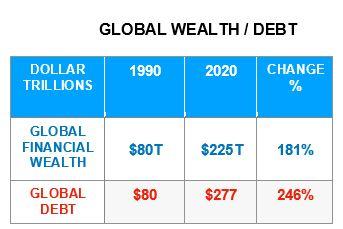
Total global financial wealth is up almost 3x since 1990 from $80 trillion to $225t.
But this massive wealth accumulation is resting on a very weak foundation of debt.
It was only possible to treble wealth by, at the same time, more than trebling global debt from $80t in 1990 to $277t today.
BIGGEST WEALTH TRAP IN HISTORY
So there we have it. The world hasn’t created any net wealth. Instead wealth has just been inflated artificially by credit creation and money printing of the same magnitude.
I do realise that total global debt and global personal wealth is not quite like for like. Still it gives a very good indication how this additional wealth is created since 1990.
Yes, it was created by just simply printing money to the extent of $200 trillion in the last 20 years!
This is clearly the biggest wealth trap in history. Hannibal couldn’t have done it better.
Billionaires, millionaires and ordinary investors have all been sucked into a honeypot believing that they have real wealth based on sound foundations.
What they don’t realise is that they will in the next few years be ambushed by what to them is an invisible enemy.
This will initially involve total debasement of the currency, whether it is dollars, euros, pounds or yen. No they can’t all go down together against each other.
But they will all go down in real terms. Real terms means measured in the only money which has survived in history – GOLD.
The route there will not be straight forward. As currencies collapse, we will most likely first see hyperinflation. That could temporarily boost asset prices in nominal terms but certainly not in real terms.
There will also be an implosion of both the debt bubble and the asset bubbles in stocks, bonds and property.
ROBBER BARRONS
Robber Barrons were feudal lords in medieval Europe who robbed travellers and merchant ships.
The term Robber Barons was used from the 1860s for some of the entrepreneurs at the time. They used unscrupulous methods to acquire wealth, thus the term. Most of them started new industries that became dominant in their field.
They included Rockefeller (oil), Vanderbilt (railroads), Carnegie (steel), Ford (cars), Morgan (banking), and Astor (real estate).
Major fortunes were created by these Entrepreneurs and Rockefeller is still considered the wealthiest man in the world ever, adjusted for inflation. Interestingly, the sectors these millionaires were in are all major industries today except for railways.
The modern “Robber Barons” – Bezos, Gates, Musk, Zuckerberg and Buffet are in diversified areas like online retail, technology, car manufacturing and investments/finance.
FANTASY VALUATIONS
The big difference between the Robber Barrons in the late 19th century and today is how their wealth is measured.
150 years ago valuations were conservative and price earnings ratios for public companies were normally below 10!
Quick jump to today. Amazon has a p/e over 90, Microsoft & Facebook “only” in the 30s, and Tesla has a staggering p/e of 1,100!
So on a historical basis, all of the biggest companies in the world today are grossly overvalued at p/e’s of 32 to 1,100 !!
This is what happens when governments and central banks primary economic strategy consists of creating money out of thin air and then these funds are used to support the stock market.
A major part of the $150 trillion debt created since the Great Financial Crisis started in 2006 has stayed with the banks and not gone to consumers or industry.
Conveniently the money has reached investors and been invested in asset markets as I showed in the Debt/Asset table earlier in the this article.
STOCKS ARE DRIVEN BY LIQUIDITY – NOT VALUE INVESTING
Thus it is debt based liquidity which is primarily driving up asset markets. This is creating fantasy p/e’s and valuations which has very little to do with the growth of industry and finance 150 years ago.
So back to Hannibal although he has been dead for 2200 years.
We have major and potentially terminal problems in the financial system since September 2019. And we have a virus which has led to major parts of the world economy collapsing due to governments handling of this virus, But in spite of these massive problems, stock markets around the world are booming.
HANNIBAL TRAP
We have probably not seen the end of the stock market explosion as I explained in a recent article on the coming LIFTOFF & COLLAPSE. But at some point in the next few weeks or months, the market will burst.
Before this burst every investor, big or small, who has any spare liquidity must be sucked into the market just before the top.
This is the Hannibal trap. Everybody must be hauled into the stocks at the top of the market.
And then BANG! Just like Hannibal totally took the Romans by surprise, so will a violent stock market crash.
But this time it won’t be like in March 2020 with a quick recovery. Yes, of course most investors will buy the dips. That will only increase the pain. Because the coming collapse will be the start of a secular bear market that could last 10 years or more.
And just like Hannibal slaughtered the Romans, the coming bear market will slaughter investors.
Investors could easily see all the bubble assets, stocks bonds and property decline by more than 90% in real terms. Again, real terms mean constant and stable purchasing power.
THE DOW WILL LOSE 97% IN REAL TERMS – GOLD
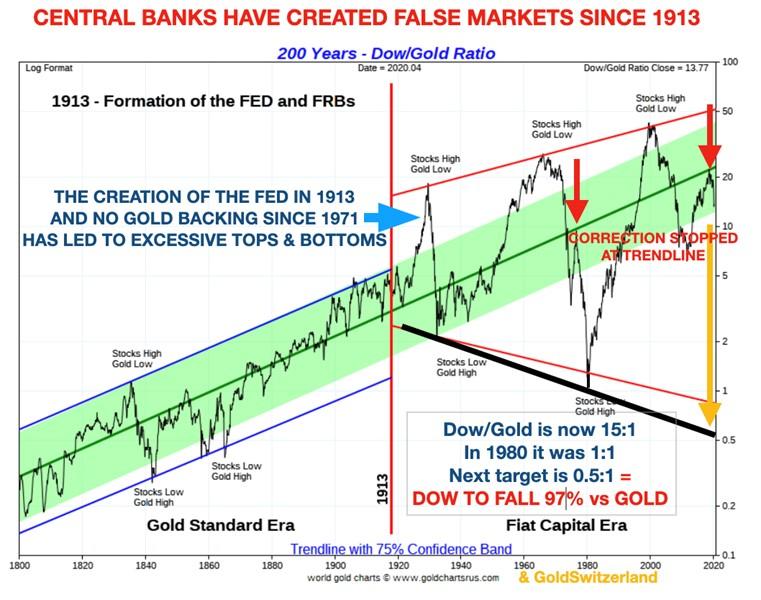
The Dow/Gold ratio is today 15. In 1980 it was 1 to 1. The ratio topped in 1999 and the long term trend is now down as the chart below shows.
The target for the ratio is 0.5 to 1. This means that the Dow will lose 97% against Gold in coming years.
Few people believe this magnitude of decline is possible.
But remember the Dow in itself went down 90% from 1929 to 1932 and that it took 25 years before it recovered.
This time the situation is drastically worse both from a debt point of view and overvaluation of stocks. So 95%+ is not unrealistic.
HISTORY PROVES THAT ONLY GOLD PRESERVES WEALTH IN REAL TERMS
Only gold fulfils the role of always holding its value in real terms. Again history proves it.
One ounce of gold bought a good costume for a man in Hannibal’s days, 2200 years ago, just as it does today.
Since investors have been saved by central banks for decades, they expect the same today. This is why they will stay invested and also buy every dip until they run out of money.
Sadly very few investors will get out before the bottom.
BIGGEST WEALTH DESTRUCTION
That is why we will see the biggest wealth destruction in history. Instead of the 2,200 billionaires currently, the world might have as little as 200 in 5-10 years time (in today’s money).
All businesses will of course not disappear. But earnings will decline dramatically and p/e’s will collapse.
Let’s take a business with a share price of $300 today and earnings per share of $10.
Thus the p/e is 30 (30x$10=$300).
If profits decline by 70% in a recession/depression and the p/e goes to 5 it will look as follows: Eps $3 x 5 p/e = $15 share price.
So this company is still making a profit, albeit smaller. Still, the share price is down from $100 to $15 or by 95%.
P/e’s of 5 or less are not unusual during depressions/recessions. I experienced this in the 1970s. The same happened in the 1930s.
HISTORY, HISTORY HISTORY
Again, as I often stress, the best lessons we learn are from history.
Everyone thinks “It is different today” but I promise it isn’t. Almost everything we experience today has happened before.
So vast fortunes will be wiped out in coming years. And other fortunes will be made in areas like hard assets and the resource industry. Precious metals will be an obvious major beneficiary.
Some of the shrewd Swiss private banks like Lombard Odier advised their clients to hedge their portfolios with gold earlier this year. Very few wealth managers are as clever as 200 year old Swiss banks.
Precious metals mining stocks are likely to do spectacularly well in the coming currency collapse and so will gold and silver.
But the ultimate wealth preservation in the next 10 years is physical gold and silver held outside the banking system as history confirms.
Remember that markets can always go higher even though they are massively overvalued.
But when risk is at a maximum, investment is not about squeezing the last bit of profit out of your portfolio. Instead, it is all about protecting your profits. And you can’t do that by staying fully invested in overvalued assets.
Remember that in a secular bear market everyone is a loser. The trick is to lose as little as possible.

FT : European truckmakers to phase out diesel sales decade earlier than planned

European truckmakers to phase out diesel sales decade earlier than planned
Heads of seven businesses sign joint pledge to ditch traditional combustion engines by 2040

Europe’s largest truckmakers have pledged to stop selling vehicles that produce emissions by 2040, a decade earlier than originally planned.

An alliance of Daimler, Scania, Man, Volvo, Daf, Iveco and Ford have signed a pledge to phase out traditional combustion engines and focus on hydrogen, battery technology and clean fuels.

The industry will spend about €50bn-€100bn on new technologies, Scania chief executive Henrik Henriksson told the Financial Times, ahead of the pledge announcement.

The truckmakers, under the umbrella of EU carmaker association ACEA, are working with the German funded Potsdam Institute for Climate Impact Research to consider the best technologies and approaches.

The pledge signed by the chief executives of the truck and van businesses also calls for widespread investment in energy grids and a higher tax on carbon across Europe to help drive the change.

“If we can make this happen, we need to work all together,” said Mr Henriksson, who chairs ACEA’s commercial vehicle board.

The pledge comes as European regulators and governments seek to phase out emissions from road transport.

The EU plans to reduce CO2 emissions by 50 per cent by the end of the decade.

The UK has said it will end the sale of new petrol and diesel cars including hybrids by 2035, and will consult on trying to end the use of diesel lorries.

Professor Johan Rockström, director of the Potsdam Institute, said that freight delivery is one of the most difficult areas to decarbonise.

“It’s the backbone of any society in the world today, but we have to recognise that they are very dependent on the internal combustion engines to transport all the goods of every industry,” he said.

The institute previously helped the seafood industry decarbonise, by working with its largest players to make changes that smaller companies also followed.

While technologies such as battery electric systems work for inner-city delivery vans, long distance haulage vehicles still require diesel because of the need to charge.

Hydrogen, which requires its own refuelling infrastructure network, is expected by the industry to be a more likely solution for the largest long distance trucks, while biofuels are expected to help cut emissions in the shorter term.

Mr Henriksson added: “There is no silver bullet; it won’t be that one technology will rule everything, there will be parallel technologies over time.

“They will come in different paces, but if we sit and wait for the perfect technology to emerge we will burn the planet.”

Any of the changes will require significant investment in either battery charging bays or hydrogen stations, as well as grid upgrades so the network can handle the sudden rush of demand for a fast-charger on a large lorry.

“The basic grid needs to be concentrated so that we can charge at depots and at highways,” said Mr Henriksson. “That is not a big investment, but that needs to happen.”

The group is also calling for a higher carbon tax in the EU, to disincentivise investments into fossil fuel technology.

Mr Henriksson said: “If politicians continue to subsidise fossil fuels, it will be very difficult for us, we need to change behaviour of our customers, and of our customers’ customers.”

He added: “There are pretty hardcore commitments in this, we are sticking out our neck and saying quite a few things we haven’t in the past.”

WWD : Investors Could Prompt Swift Environmental Progress, Notes Kering Boss

Investors Could Prompt Swift Environmental Progress, Notes Kering Boss
The group is highlighting environmental, social and governance criteria during investor road shows.

PARIS — It’s not just consumers who are clamoring for information on your company’s environmental progress — so, too, are investors, as emphasized by Kering executives on Friday.

Financial markets could play an important role in pushing companies to pursue environmentally responsible policies, said Kering chairman and chief executive officer François-Henri Pinault.

If markets apply the same kind of pressure when it comes to environmental issues and indicators as financial criteria, large international groups of all industries could move extremely fast, predicted Pinault, who spoke at La Tribune’s Forum Zéro Carbon 2020 event in Paris.

“Over the past two years, as a company listed on the stock market, we are doing road shows — presentations to investors around the world — not only on financial criteria but also on criteria specifically linked to the environment and social and governance issues,” he said.

“This is something quite new over the past two years,” added the executive.

Other Kering executives elaborated on the issue, as quoted in a company newsletter distributed Friday, including chief financial officer Jean-Marc Duplaix who said that environmental, social and governance criteria, known under the acronym ESG, have become a key feature of modern capitalism.

“For investors, ESG has gone from being a ‘nice-to-have’ to a ‘must-have,’” said Duplaix. For a roadshow presentation with investors in November, the executive was joined by chief sustainability officer Marie-Claire Daveu, who noted a growing number of requests from investors on such issues.

“The information they seek, along with their questions, is also becoming more precise,” she said, adding that they come from investors of all sizes, from specialized funds to large financial players.

Linking the interest to risk management, Daveu noted that forest fires in Canada and Australia threw the spotlight on how climate change and biodiversity loss have direct consequences on the activities of some businesses.

“The risks have become a reality,” she said.

“This trend is also being driven by asset managers’ clients — who no longer want to invest in problematic sectors of the economy, both for ethical reasons and pragmatic ones: the risk is too great,” said Duplaix.

The lack of common indicators for measuring the performance of companies on the ESG front is a problem, Duplaix added, predicting that within the next four to five years assessment criteria will become uniform.

Pinault emphasized the importance of coordination in the fashion industry and working toward the same goals.

“Alone we won’t manage, if companies work on their own, we won’t reach critical mass,” said Pinault, who set up the Fashion Pact in 2019 at the request of French President Emmanuel Macron, who wanted companies and the government to work together on environmental issues. Experts estimate that to bring change to an industrial sector, at least 20 percent of the volume of activities has to be involved — signatories of the Fashion Pact account for 35 percent, with over 60 companies, spanning producers and distributors, noted Pinault.

Drafting and publishing a profit and loss account to tally the environmental cost of its activities has been key to establishing Kering as an authority on sustainability issues.