Closing Stock Market SummaryThe S&P 500 advanced 0.4% on this shortened Christmas Eve session. The Nasdaq Composite (+0.3%) and Dow Jones Industrial Average (+0.2%) also posted modest gains, while the Russell 2000 (-0.2%) closed lower after opening at a fresh all-time high.
Ten of the 11 S&P 500 sectors finished in positive territory, although there was a shade of defensiveness ahead of the extended holiday break.
Growth-oriented heavyweights like Apple (AAPL 131.97, +1.01, +0.8%) and Tesla (TSLA 661.77, +15.79, +2.4%) exerted influential leadership, the defensive-oriented information technology (+0.8%), real estate (+0.8%), and utilities (+0.7%) sectors were among the biggest gainers, and U.S. Treasuries ticked higher.
The energy sector (-0.6%) was the lone holdout after outperforming yesterday. Other cyclical sectors had struggled with modest losses for most of the day, but buyers stepped into the market before the close to help these sectors recoup intraday losses. Notably, declining issues still outpaced advancing issues at the Nasdaq.
One of the bigger stories today in terms of stock impact came out of China. Specifically, Chinese regulators launched an anti-monopoly investigation against Alibaba (BABA 222.00, -24.18, -13.3%), sending BABA shares down 13.3% at the New York Stock Exchange.
In other interesting developments, the UK and EU finalized a post-Brexit trade agreement, House Speaker Pelosi scheduled a full House vote on Monday to increase stimulus checks to $2000 from $600 after a unanimous consent resolution in the House was blocked, and there was chatter about President Trump possibly delaying the stimulus/government funding bills with a pocket veto.
The 10-yr yield was down three basis points to 0.93% ahead of the bond market close at 2:00 p.m. ET, while the 2-yr yield was down two basis points to 0.11%. The U.S. Dollar Index was down 0.1% to 90.32. WTI crude futures were up 0.3% to $48.24/bbl.
Investors did not receive any economic data on Wednesday and won't receive any until next Tuesday when the Consumer Confidence Index for December is released by the Conference Board.
- Nasdaq Composite +42.7% YTD
- Russell 2000 +20.1% YTD
- S&P 500 +14.6% YTD
- Dow Jones Industrial Average +5.8% YTD
British Government Contracts Firms To Make COVID "Freedom Passports"
The British government has contracted two firms to develop COIVD ‘freedom passports’, that would be used to segregate society between those who have been tested or vaccinated against COVID and those who have not.
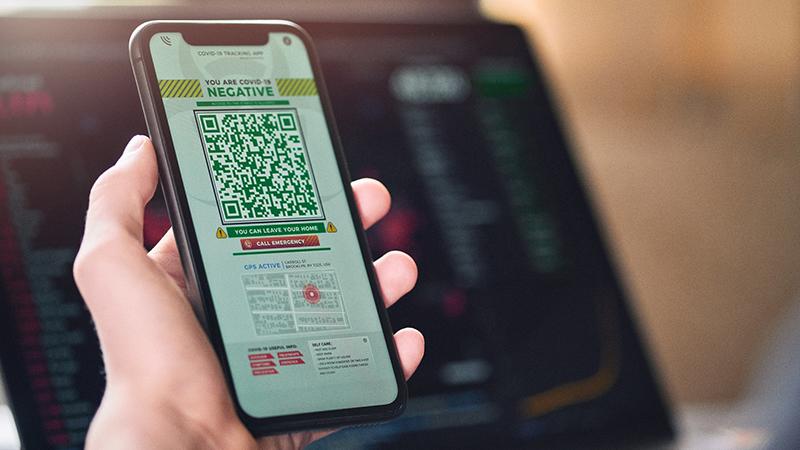
While the government is still saying that it will not introduce such a system, the firms have been given instructions to develop an app based system to integrate a QR code linking to a digital passport.
The QR code would be used to gain entry into pubs, clubs, venues, cinemas, basically anywhere in public.
“After scanning in the code, the venue could refuse entry to those without a recent negative result,” the Daily Mail notes.
The ‘negative Covid-19 test certification’ plans were discovered on the UK Government’s contracts finder.
The site shows that in November a £42,000 contract was awarded to a company called Netcompany UK to develop a ‘Covid-19 Certification/Passport MVP’ (minimum viable product’).
Another contract for £34,000 was awarded to Hub Company to develop an app that would include a personal QR code for COVID tests.
“It is about looking at ways we could use this in future,’ a Deprtment of Health source claimed, adding “It is looking at whether it would be possible.”“There are no plans to introduce immunity passports,” the source also claimed, echoing previous government assurances.
We previously reported, back in November, on the government’s active plans to develop a QR code system to use as an ‘immunity passport’.
The report, stemming from sources close to the government, noted that “Those who refuse to get the Covid-19 jab would likely be refused entry to venues, as part of the same proposals.”
Other reports have suggested that an app already used prominently in the UK by people to book doctor and hospital appointments could implement a vaccination status section that will show whether a person has taken the coronavirus jab or not, and that businesses may use it to refuse entry to those who have not.
Government officials have previously signalled that the system could be integrated with the much maligned NHS ‘track and trace’ app.
Health Secretary Matt Hancock, who has repeatedly refused to rule out making vaccination mandatory for all UK citizens, previously announced that ‘immunity passports’ could be rolled out for those who have antibodies against the virus, allowing them to participate in society.
The system would be similar in nature to that being considered by Ticketmaster, who it was revealed are considering making customers prove they’ve had the vaccine or a negative coronavirus test before allowing them to purchase tickets.
Ticketmaster later clarified that a final decision on such measures would be up to event organizers but that they were still mulling over the implementation of the system.
The spectre of so called ‘immunity passports’ stretches beyond Britain. Recently, the government in Ontario, Canada admitted that it is exploring ‘immunity passports’ in conjunction with restrictions on travel and access to social venues for the unvaccinated.
Last week, Israel announced that citizens who get the COVID-19 vaccine will be given ‘green passports’ that will enable them to attend venues and eat at restaurants.
A litany of other government and travel industry figures in both the US, Britain and beyond have suggested that ‘COVID passports’ are coming in order for ‘life to get back to normal’.
Sam Grant, campaign manager at the civili liberties advocacy group Liberty has warned that “any form of immunity passport risks creating a two-tier system in which some of us have access to freedoms and support while others are shut out.”
“These systems could result in people who don’t have immunity potentially being blocked from essential public services, work or housing – with the most marginalised among us hardest hit,” Grant further warned.“This has wider implications too because any form of immunity passport could pave the way for a full ID system – an idea which has repeatedly been rejected as incompatible with building a rights-respecting society,” Grant further urged.
While some see the idea of ‘immunity passports’ as antithetical to a free society, others support travel bans for the unvaccinated, and are begging for the health passes to be implemented:
President Trump Has Granted Clemency Less Than Every President In Modern History Bar One
Well this is going to break the mainstream media narrative...
As Trump has pardoned some relatively high profile individuals such as Roger Stone, General Mike Flynn, and Paul Manafort, the liberalati has got its gender-neutral panties in a bundle over these "digusting", "corrupt", "cronyism" actions.
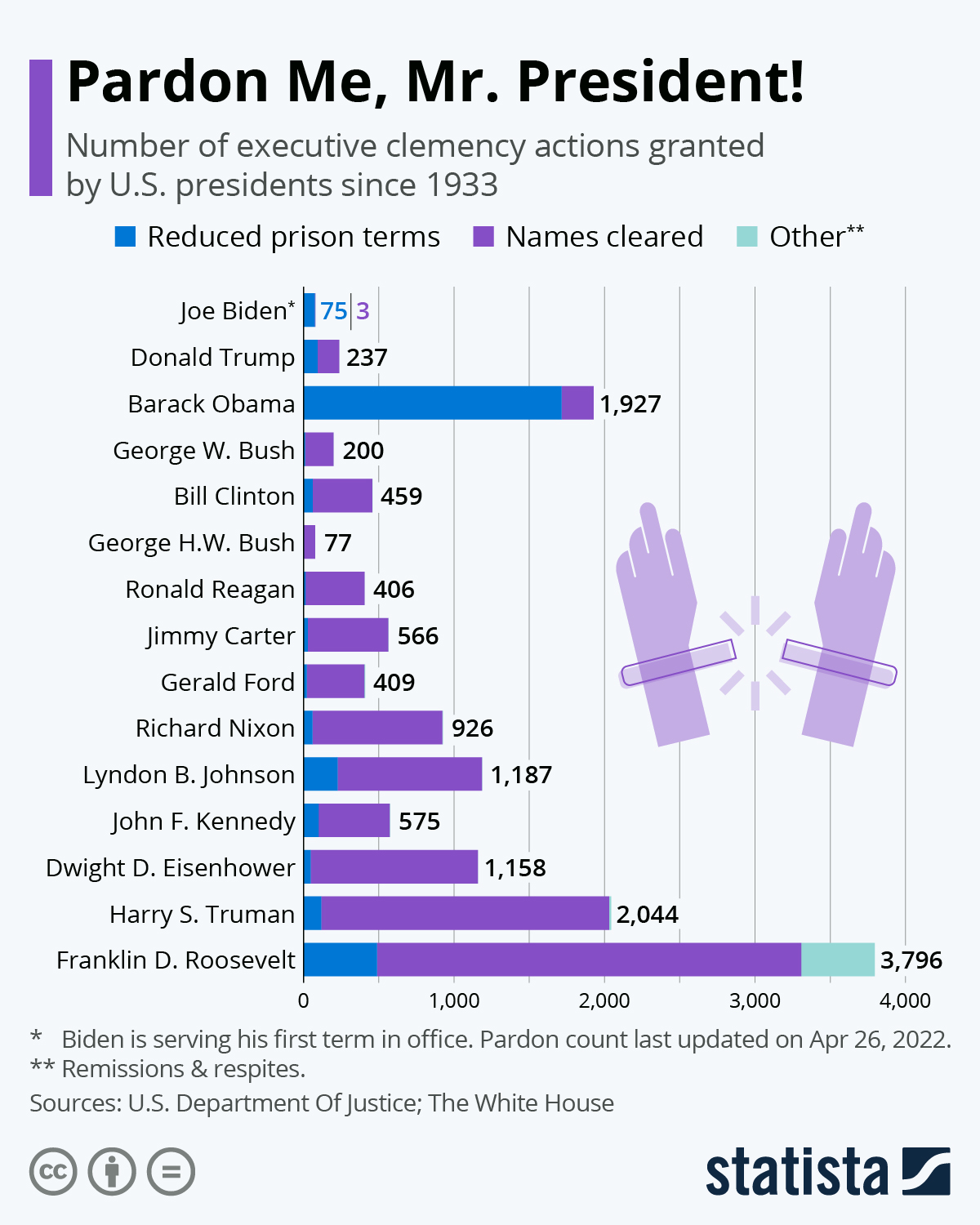
It turns out however that, even including the recent surge, PewResearch reports that Trump has used his clemency power less often than any president in modern history (apart from Bush Senior), according to data from the U.S. Department of Justice.
You will find more infographics at Statista
President Trump has granted clemency or pardoned 98 people in the last four years (76 pardons and 22 commutations). Obama, by comparison, granted clemency 1,927 times during his eight-year tenure, including 212 pardons and 1,715 commutations.
In terms of total executive clemency actions, Obama granted the most since Harry S. Truman
The only modern president who granted clemency less frequently than Trump is George H.W. Bush, who granted 77 pardons and commutations in his single term.
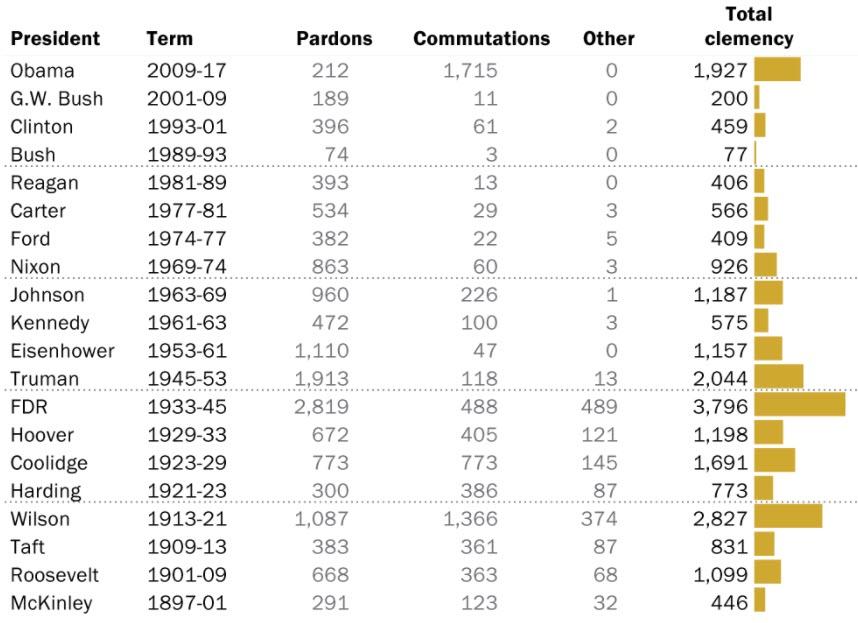
As PewResearch writes, clemency refers to multiple forms of presidential mercy. The two most common forms are pardons, which forgive past crimes and restore civil rights, and commutations, which completely or partially reduce sentences for those in prison or on community supervision. Two less-common forms are remissions, which reduce financial penalties associated with convictions, and respites, which are temporary reprieves that are usually granted to inmates for medical reasons.
The Justice Department’s statistics, it’s important to note, do not count clemency granted through proclamation or executive order, such as the actions taken by Presidents Gerald Ford and Jimmy Carter to forgive thousands of Vietnam-era draft dodgers. The DOJ numbers also count some clemency recipients twice – for example, in cases where someone received both a pardon and a commutation.
While rare so far, Trump’s use of presidential clemency has caused controversy because of the nature of his pardons and commutations. Many of Trump’s clemency recipients have had a “personal or political connection to the president,” according to a July analysis by the Lawfare blog, and he has often circumvented the formal process through which clemency requests are typically considered.
But Trump is far from the only president who has faced scrutiny over his use of clemency. Obama’s frequent use of commutations, particularly for prisoners convicted of drug-related crimes, prompted criticism from Republicans, who said it benefited “an entire class of offenders” and infringed on the “lawmaking authority” of the legislative branch. And President Bill Clinton drew bipartisan condemnation for pardoning a fugitive commodities trader, Marc Rich, on his last day in office in 2001.
When Saul of Tarsus set out on his journey to Damascus the whole of the known world lay in bondage. There was one state, and it was Rome. There was one master for it all, and he was Tiberius Caesar.
Everywhere there was civil order, for the arm of the Roman law was long. Everywhere there was stability, in government and in society, for the centurions saw that it was so.
But everywhere there was something else, too. There was oppression—for those who were not the friends of Tiberius Caesar. There was the tax gatherer to take the grain from the fields and the flax from the spindle to feed the legions or to fill the hungry treasury from which divine Caesar gave largess to the people. There was the impressor to find recruits for the circuses. There were executioners to quiet those whom the Emperor proscribed. What was a man for but to serve Caesar?
There was the persecution of men who dared think differently, who heard strange voices or read strange manuscripts. There was enslavement of men whose tribes came not from Rome, disdain for those who did not have the familiar visage. And most of all, there was everywhere a contempt for human life. What, to the strong, was one man more or less in a crowded world?
And the voice from Galilee, which would defy Caesar, offered a new Kingdom in which each man could walk upright and bow to none but his God. Inasmuch as ye have done it unto one of the least of these my brethren, ye have done it unto me. And he sent this gospel of the Kingdom of Man into the uttermost ends of the earth.
So the light came into the world and the men who lived in darkness were afraid, and they tried to lower a curtain so that man would still believe salvation lay with the leaders.
But it came to pass for a while in divers places that the truth did set man free, although the men of darkness were offended and they tried to put out the light. The voice said, Haste ye. Walk while you have the light, lest darkness come upon you, for he that walketh in darkness knoweth not whither he goeth.
Along the road to Damascus the light shone brightly. But afterward Paul of Tarsus, too, was sore afraid. He feared that other Caesars, other prophets, might one day persuade men that man was nothing save a servant unto them, that men might yield up their birthright from God for pottage and walk no more in freedom.
Then might it come to pass that darkness would settle again over the lands and there would be a burning of books and men would think only of what they should eat and what they should wear, and would give heed only to new Caesars and to false prophets. Then might it come to pass that men would not look upward to see even a winter’s star in the East, and once more, there would be no light at all in the darkness.
And so Paul, the apostle of the Son of Man, spoke to his brethren, the Galatians, the words he would have us remember afterward in each of the years of his Lord:
Stand fast therefore in the liberty wherewith Christ has made us free and be not entangled again with the yoke of bondage.
Retail trading boom spills over into fine wine market
Investors seek opportunities in haven asset that has dodged 2020’s big swings
In a former Bath stone mine 100ft below the rolling Wiltshire countryside, one low-profile company is benefiting from a renewed thirst this year among retail investors for trading markets.
Octavian — a 1m sq ft wine warehouse holding more than 10m bottles at a temperature of 13C to 14C — has received a surge in business as investors have flocked to invest in fine wines.
“We’ve seen a lot more interest from investors wanting to open an account,” said managing director Vincent O’Brien, whose mine was used to store missiles and torpedoes during the second world war before being converted into a wine store about 30 years ago.
Inquiries have more than doubled compared with a year ago, while new account openings are up 70 per cent. Younger customers, in their late twenties and early thirties, were becoming more interested, he added.
A rollercoaster year in financial markets, in which stocks plunged in March over concerns about coronavirus before rebounding to new highs, has prompted a resurgence in retail investor day trading.
Fine wine, an investment market that has fallen in and out of favour with retail investors over the years, is also enjoying renewed interest this year. While only a tiny fraction of the size of global equities markets, it is wine’s ability to act as a haven, rather than to provide astronomical gains, that has attracted investors.
Fine wine gained 4.7 per cent this year to the end of November, as measured by the Liv-ex Fine Wine 100 index, in sterling terms. That compares with a 14 per cent drop in the FTSE 100 index, a 5 per cent decline in the Stoxx 600 and a 14 per cent rise in the S&P 500, in local currency.
Wine’s relatively stable performance, which includes a fall of just 1.1 per cent during March’s market turmoil, comes despite the impact of US tariffs on French wine. It also comes in spite of lockdowns in many countries that forced the closure of restaurants, which are large buyers of wine, and made tastings, a key part of the sales process, more difficult.
Tom Gearing, chief executive of £150m-in-assets Cult Wines which held tastings with wineries over Zoom during lockdown, capitalised on growing investor demand this spring. Spotting an opportunity to pick up wines at bargain prices, he raised a £5m special opportunities portfolio in four weeks from 80 investors, of which 31 were new clients to the company. The portfolio is up 17.5 per cent this year, according to Mr Gearing, who was previously a finalist on the UK version of The Apprentice.
Gregory Swartberg, chief executive of London-based wine investment company Cru Wine, who trades the company’s own money and also on behalf of clients, says his book of clients has risen by about two-thirds this year.
“To our surprise, even considering the fact that restaurants were not taking in a lot of stock and tried to sell stock, [the wine market has] seen a tremendous amount of demand coming from private clients,” said Mr Swartberg.
And at wine merchant Bordeaux Index, the number of new trading accounts opened is 60 per cent higher this year than in 2019. “Most notably, [wine] did not drop materially during the Covid crisis,” said head of wine investment Matthew O’Connell, adding that “wine has shown little correlation with financial assets during disruptive market events”.
Some parts of the market have been especially fizzy. Liv-ex’s Champagne 50 index rose 8.3 per cent, driven by top-end vintage champagnes such as Louis Roederer’s Cristal, Dom Pérignon and Salon. Bollinger’s La Grande Annee 2008, for instance, rose 27.4 per cent. Italian wine, as measured by Liv-ex’s Italy 100, rose 6.7 per cent.
Both have benefited from growing demand in Asia, at the expense of Bordeaux, while Italian wines have benefited from US tariffs on French wine.
The market’s quirks have also thrown up trading opportunities.
There had been speculation, for instance, that Château Lafite Rothschild would change its famous label for its 2018 vintage, which marks 150 years since the Rothschild family bought the Pauillac winery. Cru Wine’s Mr Swartberg bought a large amount of the wine for clients and the company’s own account this summer.
When the label was released two months ago, it featured a tiny hot air balloon with the letters CL — Roman numerals for 150. Mr Swartberg made a quick profit of about 30 per cent as collectors snapped up the wine, which will not be bottled until next year.
While trading costs remain much higher and liquidity is far lower than in stock markets, there are signs that the wine market is becoming easier for retail investors to access. Octavian this year launched a portal allowing its customers to trade with each other. Mr Gearing’s company advises customers on how they should rebalance their portfolios and uses an algorithm to help determine which wines and regions to buy and sell.
“The days when you would get an allocation of wine, put it in the cellar for 10 years and forget about it are over,” said Mr Gearing. “More analytics now allow you to trade.”