SCMP : China’s carmakers are beating internet start-ups in the battle for suprem


From: Laurent Chekroun (MAKOR SECURITIES LO) At: 12/23/20 08:18:38
Subject: SCMP : From Mahathir to Lee Kuan Yew, late scholar Ezra Vogel’s work on Japan an
China’s carmakers are beating internet start-ups in the battle for supremacy in the world’s largest electric vehicle market
  • Conventional carmakers have grabbed a bigger market share, China Passenger Car Association data shows
  • Established carmakers ‘have not been eclipsed by Tesla and the Tesla challengers yet’

Beijing’s encouragement has fired up China’s new energy vehicle sector, pitting start-up electric vehicle (EV) makers against its more established conventional carmakers.
But while US carmaker Tesla has reported rising sales and three New York-listed Chinese EV companies have seen their stocks skyrocket recently, industry observers say the established players will overtake these carmakers on their own turf.
“Conventional carmakers still have an upper hand over the upstart EV makers in terms of production capabilities and sales networks,” said Peter Chen, an engineer with car components company TRW. “They have not been eclipsed by Tesla and the Tesla challengers yet.”
China’s new-energy vehicle (NEV) segment, which covers pure electric, hybrid and fuel cell-powered cars, was the lone bright spot worldwide in the second half of this year, as lockdowns forced factories in the West to shut because of the coronavirus pandemic. Beijing’s cash subsidies and tax exemptions also played their part.
The segment is now expected to report sales of 1.8 million cars next year, compared with an estimated 1.29 million for the whole of 2020. Moreover, according to a consensus among industry officials, NEV sales are expected to hit 3 million in 2025, more than double this year’s projection.

An imminent surge in demand – spurred by government-backed incentives – for EVs in the world’s largest car market is drawing multi-trillion yuan investment and talent, while also whetting an appetite for a larger proportion of the pie among the established players.
In March this year, Tesla and three of its local rivals – NIO, Li Auto and Xpeng – delivered about 13,700 units, or 24.5 per cent of all NEV sales in China. Last month, despite selling a combined 35,765 cars, they accounted for 21 per cent of NEV deliveries.

China Passenger Car Association data shows that conventional carmakers, including ventures between foreign giants and local companies, have grabbed a bigger market share. Of the 10 bestselling marques in November, eight were domestic carmakers, as low-priced EVs made by Great Wall Motors, BYD and Chery proved to be a hit among younger Chinese drivers.

Hongguang Mini EV, an all-electric minicar built by SAIC-GM-Wuling Automobile, a three-way partnership involving China’s largest state-owned carmaker and General Motors, clinched the top spot for a third consecutive month in November by selling 33,094 cars.
“In the future, we will closely gauge customer demand to develop entry-level EVs,” said Zhou Xing, the joint venture’s marketing director. “EV products will be more diversified and individualised based on people’s different habits and demands for transport.”
In comparison, Tesla, in second position, sold 21,604 Model 3s.

“Every first-time middle-class car buyer interested in owning an EV now picks the Tesla Model 3, because they view it as a fashionable car with mature technology,” said Tian Maowei, a sales manager at Yiyou Auto Service in Shanghai. “But those looking for EVs to replace their conventional cars will buy hybrids and pure electric cars made by established brands, such as Volvo and Honda.”
Miao Hua, a sales manager with a payment services company in Shanghai, bought a Volvo XC40 plug-in hybrid worth more than 350,000 yuan recently. “This is my dream auto brand,” the 45-year-old man said. “Conventional car brands have the best styling, carmaking technology, production and workers. They just need to gradually shift their focus from conventional cars to NEVs.”
Booming sales have catapulted Tesla into the top spot, making it the world’s most valuable carmaker. Chinese carmakers have been buoyed by strong investor belief in their growth potential – NIO was valued at about US$62 billion when its stock soared ninefold to a record US$57.20 in November, making it worth more than the century-old Ford Motor Company.

Conventional carmakers, however, have an upper hand. “The established players, all of whom already have their own NEV brands and production, will stage a comeback and still have an overwhelming advantage in terms of sales volumes,” said Qian Kang, who owns a Zhejiang-based car components company. “The question is whether they can upgrade their technology to play a leading role in defining the future of mobility.”

NIO, for instance, has about 180 dealers in China, less than 10 per cent of the network Volkswagen, which has three joint ventures in the country, has access to.

Brian Gu, the president of Xpeng, another Chinese NEV company, said local start-ups were not essentially taking on Tesla. Instead, they were redrawing the landscape worldwide, threatening conventional companies in the process as more drivers abandoned conventional cars.
Opportunities will arise for conventional carmakers once the NEV market grows to a certain scale, said Eric Li, a consultant with Boston Consulting Group. “Powerful automotive firms will be active in developing middle and high-end products in a transition that creates a new battleground for all competitors.”
>>> TradeGate Pre-Market Indications

DAX:
  • Daimler (DAI TH) +1%
    • Daimler Mulls Truck-Unit IPO at End of Next Year: Handelsblatt
  • BMW (BMW TH) +0.3%
  • RWE (RWE TH) +0.3%
  • Allianz (ALV TH) -0.3%
    • Pimco, BlackRock Like Chinese Junk-Rated Developers for 2021
  • Deutsche Bank (DBK TH) -0.5%
    • Deutsche Bank Says Trump’s Personal Banker Vrablic Resigned (1)
  • SAP (SAP TH) -0.6%
    • ClearBridge Intl Growth Adds MercadoLibre, Exits SAP
MDAX:
  • Siemens Energy (ENR TH) +1.6%
    • Reuters: Siemens Energy has no plans to sell Siemens Gamesa -Handelsblatt
  • Thyssenkrupp (TKA TH) +1.4%
  • Deutsche Lufthansa (LHA TH) +1%
    • Lufthansa Will Airlift Food to Britain, Skirting Port Logjam
  • Metro AG (B4B TH) +0.9%
  • Aixtron (AIXA TH) +0.8%
  • Commerzbank (CBK TH) -0.6%
  • Varta (VAR1 TH) -0.7%
  • Shop Apotheke (SAE TH) -1%
  • Rheinmetall (RHM TH) -1.1%
  • Fraport (FRA TH) -1.4%
SDAX:
  • ElringKlinger (ZIL2 TH) +2.5%
  • Westwing (WEW TH) +2.4%
    • As Europe Locked Down, Niche Smallcap Stocks Were 2020 Winners
  • LPKF (LPK TH) +2%
  • Suedzucker (SZU TH) +1.3%
  • Hensoldt AG (HAG TH) +1.2%
  • DIC Asset (DIC TH) +0.9%

SCMP : From Mahathir to Lee Kuan Yew, late scholar Ezra Vogel’s work on Japan an

China’s carmakers are beating internet start-ups in the battle for supremacy in the world’s largest electric vehicle market
  • Conventional carmakers have grabbed a bigger market share, China Passenger Car Association data shows
  • Established carmakers ‘have not been eclipsed by Tesla and the Tesla challengers yet’

Beijing’s encouragement has fired up China’s new energy vehicle sector, pitting start-up electric vehicle (EV) makers against its more established conventional carmakers.
But while US carmaker Tesla has reported rising sales and three New York-listed Chinese EV companies have seen their stocks skyrocket recently, industry observers say the established players will overtake these carmakers on their own turf.
“Conventional carmakers still have an upper hand over the upstart EV makers in terms of production capabilities and sales networks,” said Peter Chen, an engineer with car components company TRW. “They have not been eclipsed by Tesla and the Tesla challengers yet.”
China’s new-energy vehicle (NEV) segment, which covers pure electric, hybrid and fuel cell-powered cars, was the lone bright spot worldwide in the second half of this year, as lockdowns forced factories in the West to shut because of the coronavirus pandemic. Beijing’s cash subsidies and tax exemptions also played their part.
The segment is now expected to report sales of 1.8 million cars next year, compared with an estimated 1.29 million for the whole of 2020. Moreover, according to a consensus among industry officials, NEV sales are expected to hit 3 million in 2025, more than double this year’s projection.

An imminent surge in demand – spurred by government-backed incentives – for EVs in the world’s largest car market is drawing multi-trillion yuan investment and talent, while also whetting an appetite for a larger proportion of the pie among the established players.
In March this year, Tesla and three of its local rivals – NIO, Li Auto and Xpeng – delivered about 13,700 units, or 24.5 per cent of all NEV sales in China. Last month, despite selling a combined 35,765 cars, they accounted for 21 per cent of NEV deliveries.

China Passenger Car Association data shows that conventional carmakers, including ventures between foreign giants and local companies, have grabbed a bigger market share. Of the 10 bestselling marques in November, eight were domestic carmakers, as low-priced EVs made by Great Wall Motors, BYD and Chery proved to be a hit among younger Chinese drivers.

Hongguang Mini EV, an all-electric minicar built by SAIC-GM-Wuling Automobile, a three-way partnership involving China’s largest state-owned carmaker and General Motors, clinched the top spot for a third consecutive month in November by selling 33,094 cars.
“In the future, we will closely gauge customer demand to develop entry-level EVs,” said Zhou Xing, the joint venture’s marketing director. “EV products will be more diversified and individualised based on people’s different habits and demands for transport.”
In comparison, Tesla, in second position, sold 21,604 Model 3s.

“Every first-time middle-class car buyer interested in owning an EV now picks the Tesla Model 3, because they view it as a fashionable car with mature technology,” said Tian Maowei, a sales manager at Yiyou Auto Service in Shanghai. “But those looking for EVs to replace their conventional cars will buy hybrids and pure electric cars made by established brands, such as Volvo and Honda.”
Miao Hua, a sales manager with a payment services company in Shanghai, bought a Volvo XC40 plug-in hybrid worth more than 350,000 yuan recently. “This is my dream auto brand,” the 45-year-old man said. “Conventional car brands have the best styling, carmaking technology, production and workers. They just need to gradually shift their focus from conventional cars to NEVs.”
Booming sales have catapulted Tesla into the top spot, making it the world’s most valuable carmaker. Chinese carmakers have been buoyed by strong investor belief in their growth potential – NIO was valued at about US$62 billion when its stock soared ninefold to a record US$57.20 in November, making it worth more than the century-old Ford Motor Company.

Conventional carmakers, however, have an upper hand. “The established players, all of whom already have their own NEV brands and production, will stage a comeback and still have an overwhelming advantage in terms of sales volumes,” said Qian Kang, who owns a Zhejiang-based car components company. “The question is whether they can upgrade their technology to play a leading role in defining the future of mobility.”

NIO, for instance, has about 180 dealers in China, less than 10 per cent of the network Volkswagen, which has three joint ventures in the country, has access to.

Brian Gu, the president of Xpeng, another Chinese NEV company, said local start-ups were not essentially taking on Tesla. Instead, they were redrawing the landscape worldwide, threatening conventional companies in the process as more drivers abandoned conventional cars.
Opportunities will arise for conventional carmakers once the NEV market grows to a certain scale, said Eric Li, a consultant with Boston Consulting Group. “Powerful automotive firms will be active in developing middle and high-end products in a transition that creates a new battleground for all competitors.”

SCMP : From Mahathir to Lee Kuan Yew, late scholar Ezra Vogel’s work on Japan an

From Mahathir to Lee Kuan Yew, late scholar Ezra Vogel’s work on Japan and China inspired a continent
  • * Vogel’s book, Japan as Number One, helped shape the Malaysian and Singaporean leaders’ domestic and foreign policies and changed Japan’s view of itself on the world stage
  • * The late professor’s legacy also includes a political biography of Deng Xiaoping and a historical study of China-Japan ties

As tributes across Asia continue to pour in for renowned East Asia expert and Harvard emeritus professor Ezra Vogel, observers have highlighted the impact of his research on Japan’s success, which leaders such as Lee Kuan Yew and Mahathir Mohamad not only learned from but adapted to form their own policies.
Vogel’s book Japan as Number One, published in 1979, detailed the path to Japan’s growth and was written mainly as a guide for the United States. But his observations were also keenly noted in Southeast Asia.
In October 1994, Singapore’s then prime minister Lee cited Vogel’s book during a speech in parliament arguing for competitive salaries for ministers and senior public officers.

Lee said even though civil service jobs were viewed as prestigious in Japan, with graduates from top universities competing for places, senior bureaucrats earned less than their counterparts in the private sector.
While the city state’s government could learn from Japan’s emphasis on recruiting the best candidates and the grooming of promising officers for senior positions, Lee said, its model was not entirely applicable for Singapore, being a small and young nation.
“[Singapore] cannot rely on the prestige of public service to make up for lower pay,” the late prime minister said then. “Singapore is a young society, not an established Japan with set traditions. Singaporeans, especially the young, talented and ambitious, gauge their status by material success and visible rewards. Our system must recognise this reality.”

A MODEL TO EMULATE
Leng Leng Thang, associate professor and head of Japanese Studies at the National University of Singapore (NUS), said Vogel’s book was novel in proposing Japan as a model for world economies to emulate.

After the Meiji Restoration of 1868, Japan made rapid strides in industrialisation by boosting its transport and communication networks and revolutionising its light industry. Its devastated economy also rose quickly from the ashes of World War II followed by an era of rapid growth.
By the 1970s, Japan had taken the world by storm with its 9.7 per cent annual growth, while other countries were growing at 2 to 5 per cent.
“What made the world turn their attention towards Japan’s miracle growth was Vogel’s book on Japan as Number One … which became a bestseller,” Thang said.

Vogel also thought Japan’s efforts in twice modernising its institutions – in the late 19th century and after World War II – could “help the US in rethinking its own societal difficulties”, Thang said.
In Malaysia, the book prompted then-prime minister Mahathir in 1981 to launch the Look East Policy, which sought to have Malaysians emulate Japanese work ethics and business management techniques, and to acquire Japanese expertise and capital, through aid, investment and trade cooperation.
In Singapore, the government invited Vogel to visit the island state on various occasions, where he not only met Lee Kuan Yew, but also spoke on television about productivity “which Singapore was highly concerned with” during its economic restructuring in the 1970s and 1980s, Thang said.
Vogel later also wrote The Four Little Dragons, in which he argued that the then newly industrialised economies of Taiwan, South Korea, Hong Kong and Singapore had achieved stellar growth in just a few decades by following Japan’s export-led growth model.

Singapore saw the need to learn from Japan because by the late 1970s, it realised it could not compete with China and neighbouring Southeast Asian countries in supplying cheap labour, Thang said.
Realising the necessity of economic restructuring that would lead to higher value-added, skills-intensive and hi-tech industries, Thang said Singapore identified new sectors in automotive parts, machines tools, medical instruments, computers, software, optics, and chemicals, all of which “Japan is good at”.
The city state also faced rising wage pressures then, with salaries growing at about 20 per cent every year, and workers and businesses were urged to invest in better skills, capital equipment and technology, leading to unhappiness.
“To try to reduce discontent, the [Singapore] government felt that Japanese labour model could be useful to push economic restructuring efforts, such as by encouraging better attitudes, higher productivity, and teamwork,” Thang said.

A CONFIDENCE BOOSTER
Japan as Number One had a huge impact on people in the East Asian nation, with many realising the country had come into its own, said Mike Mochizuki, an international affairs professor at George Washington University and expert on Japan-US relations.
“Japanese had been obsessed about catching up with the West and were feeling especially vulnerable because of the Nixon and oil shocks of the early 1970s,” Mochizuki said.
The “Nixon Shock” refers to policy changes announced in the summer by former US president Richard Nixon in 1971 without prior notification to the Japanese government. The first “shock” occurred in July when Nixon announced his plan to visit China. The second came a month later when Nixon announced his New Economic Program, which included the abandonment of the gold standard, resulting in a major increase in the international value of the Japanese currency.
The oil shocks refers to the oil crisis in 1973 when Opec members proclaimed an oil embargo, affecting countries such as Japan due to their heavy dependence on imported oil.

Vogel’s book not only gave Japanese a sense of confidence but also motivated them to think about how Japan could contribute more internationally, recalled Mochizuki, who added that Vogel introduced him to the world of East Asian studies and encouraged him to study international security policy.
“In 1991, Ezra took me on my first trip to China and connected me to the community of Japan scholars in China,” Mochizuki said. “Since then, I began to focus on Japan-China relations and efforts to promote reconciliation between these two countries.”
Joshua W. Walker, president and CEO of the Japan Society, a non-profit committed to deepening mutual understanding between the US and Japan, said Vogel’s work was without parallel.
“As an author, mentor, policymaker, and scholar he was unmatched and will be deeply missed by all who knew him from the US, Japan, China, and around the world,” Walker said.

JAPAN-CHINA TIES
Although most people would remember Vogel for Japan as Number One, former Singapore diplomat Kishore Mahbubani highlighted two other books which again set Vogel apart as an eminent scholar on East Asia.
“Firstly, he had the courage to write a fair and objective biography of Deng Xiaoping,” said Mahbubani, currently a distinguished fellow with the Asia Research Institute at NUS.
Vogel in 2011 published Deng Xiaoping and the Transformation of China, a landmark biography of the Chinese leader who introduced long-needed market reforms in the 1980s. However, many people also held Deng responsible for declaring martial law and sending troops to deal with the student-led Tiananmen Square protests in 1989.
“In the West, it was politically incorrect to praise Deng because he was responsible for the Tiananmen Square crackdown. Ezra had the courage to praise Deng nonetheless,” Mahbubani said.

“Secondly, he had the courage to write a balanced book on China-Japan relations,” said Mahbubani, referring to China and Japan: Facing History, a book published last year which reviewed the history of political and cultural ties between the two nations over 1,500 years.
Given the neighbours’ highly fraught relationship, Mahbubani said it was brave of Vogel to point out that for most of their history, Japan and China had lived in peace with each other.
Mochizuki, the George Washington University professor, said China and Japan: Facing History was an inspiring work about the long history of the countries’ interactions. “During these troubling times, I cannot think of a more important message for Chinese and Japanese alike,” he said.
Bilahari Kausikan, who retired as permanent secretary of the Singapore Foreign Affairs Ministry in 2013, said Vogel’s “political biography of Deng Xiaoping is perhaps the best to date”.
Kausikan said Ezra last visited Singapore at his invitation in January this year to attend the Middle East Institute’s annual conference, and spoke on what the Middle East could learn from the East Asian model.
Singapore’s Prime Minister Lee Hsien Loong hosted Vogel for dinner, and he also met emeritus senior minister Goh Chok Tong and deputy prime minister Heng Swee Keat in separate meetings.
“Ezra was not just a great scholar but also a wonderful human being,” Kausikan said.

Vogel died on Sunday at the age of 90 due to complications from surgery, according to his family.
He graduated from Ohio Wesleyan University in 1950, and studied sociology in the Department of Social Relations at Harvard, before receiving his doctorate of philosophy in 1958. He spent two years in Japan studying the language and conducting research, and became a Harvard professor in 1967.
Vogel served as director of Harvard’s East Asian Research Center from 1972 to 1977 and director of the programme on US-Japan relations at the Center for International Affairs between 1980 and 1987.
In 1998, Vogel received the Japan Society Award for his outstanding contribution to better US-Japan understanding. He retired from teaching in 2000.

>>> What to look at today -23rd of December 2020

U.S. and European stock futures declined, while Asian equities traded mostly higher after President Donald Trump said he is asking Congress to amend the pandemic aid legislation that was passed earlier this week. Treasuries ticked higher.
S&P 500 futures slipped, though pared losses. Just a day after Congress passed a $900 billion bipartisan relief package, Trump demanded that lawmakers increase the stimulus checks due to go out to most Americans to $2,000 from $600. Investors also continued to assess the vaccine rollout as a new virus variant is leading to more severe lockdowns. Gold climbed while crude oil retreated. Chinese shares outperformed.
US After Hours Pretty quiet after hours; MGNI +15.1% jumps on positive Needham mention

Nikkei +0.33% Hang Seng +0.57% CSI +0.64% Shanghai +0.59% Shenzen +0.54%

Eur$ 1.2187 CNH 6.5381 CNY 6.5475 JPY 103.44 GBP 1.3403 CHF 0.8879 RUB 75.87 TRY 7.6515 WTI$ 46.17 -1.83%

S&P -0.07% Nasdaq +0.10% EurioStoxx +0.05% FTSE -0.20% Dax +0.08% SMI +0.01%

Macro :
- More Than 670,000 Californians Face a Christmas Eve in the Dark
- SEC Confirms Lawsuit Against Ripple Labs, Two of Its Executives
- Barnier Tells EU Envoys a Brexit Deal Could Be Done by Christmas
- UK to Place More Areas Under Tier 4 Lockdown Dec. 26: Telegraph
- Germany Extends U.K. Travel Ban to Jan. 6: Sky News

Keep an eye on :
- AMZN US : Formula One in Talks With Amazon to Stream Grands Prix: FT
- AAPL US : Musk Says Apple Refused to Discuss $60 Billion Tesla Deal
- ASML NA : How China’s Top Chipmaker Can Evade Trump’s Newest Crackdown
- AZN LN : India Likely to Approve AstraZeneca Vaccine by Next Week: Rtrs
- ATL IM : CDP, Funds Present Revised Non-Binding Bid for Autostrade
- DAI GY : Daimler Mulls Truck-Unit IPO at End of Next Year: Handelsblatt
- DBK GY : Deutsche Bank Says Trump’s Personal Banker Vrablic Has Resigned
- ENGI FP : France’s CRE: Gas Regulated Prices +0.2% From Jan. 1
- HEI GY : HeidelbergCement Is Said to Explore $1.5 Billion U.S. Asset Sale
- NOBI SS : Nobia to Post Write-Downs of About SEK149M in 4Q
- SEBA SS : SEB: German Authority Requested DSK to Repay Withholding Tax
- STLN SW : Swiss Steel Says Liwet Blocked Registration of Capital Increase
- TSLA US : Musk Says Apple Refused to Discuss $60 Billion Tesla Deal (1)
- TFI FP : TF1 To Book 4Q EU75M Write-Down on Unify Unit, No Cash Impact
- URW NA : Woodson Reduces Short Position in Unibail to 0.60%
- VWS DC : Vestas Gets 360-MW Wind Order From Brazil’s Casa dos Ventos

Axios : Trump turns on everyone

President Trump, in his final days, is turning bitterly on virtually every person around him, griping about anyone who refuses to indulge conspiracy theories or hopeless bids to overturn the election, several top officials tell Axios.
The latest: Targets of his outrage include Vice President Pence, chief of staff Mark Meadows, White House counsel Pat Cipollone, Secretary of State Pompeo and Senate Majority Leader Mitch McConnell.
Why it matters: Trump thinks everyone around him is weak, stupid or disloyal — and increasingly seeks comfort only in people who egg him on to overturn the election results. We cannot stress enough how unnerved Trump officials are by the conversations unfolding inside the White House.
Top officials are trying to stay away from the West Wing right now.
  • Trump is lashing out, and everyone is in the blast zone: At this point, if you're not in the “use the Department of Homeland Security or the military to impound voting machines” camp, the president considers you weak and beneath contempt.
  • Trump is fed up with Cipollone, his counsel. Some supporters of Cipollone are worried that Trump is on the brink of removing him and replacing him with a fringe loyalist.
A source who spoke to Trump said the president was complaining about Pence and brought up a Lincoln Project ad that claims that Pence is "backing away" from Trump. This ad has clearly got inside Trump’s head, the source said.
  • Trump views Pence as not fighting hard enough for him — the same complaint he uses against virtually everybody who works for him and has been loyal to him.
Pence’s role on Jan. 6 has begun to loom large in Trump’s mind, according to people who’ve discussed the matter with him.
  • Trump would view Pence performing his constitutional duty — and validating the election result — as the ultimate betrayal.
A new fixation: Trump has even been asking advisers whether they can get state legislatures to rescind their electoral votes. When he’s told no, he lashes out even more, said a source who discussed the matter with the president.
  • And in an Oval meeting Monday night, Trump spoke with House Republicans about voting to overturn the result on Jan. 6 — a desperate vote that even Trump has privately acknowledged he's bound to lose.
The person who has the worst job in Washington, according to multiple administration officials: the incoming head of the Justice Department, Jeffrey Rosen.
  • The consensus is he has no earthly idea the insanity he is in for.
  • The next month will be the longest of his life.
Obtained by Axios
Another reflection of Trump’s state of mind:
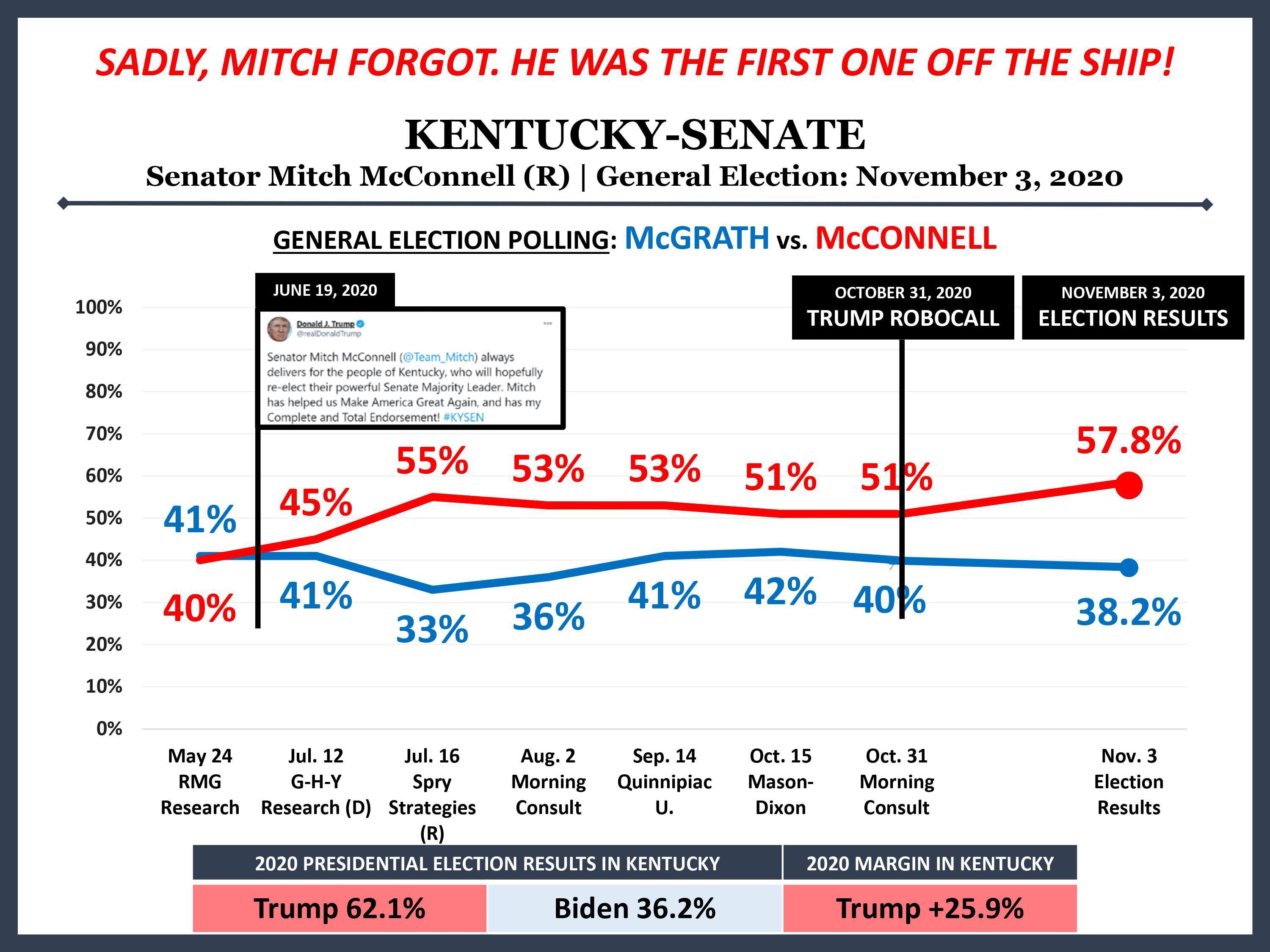
  • As Axios reported Monday night, the president got his personal assistant to email Republican lawmakers a PowerPoint slide (above) attacking McConnell for being "the first one off the ship," and absurdly claiming credit for the Senate majority leader’s victory in his Kentucky re-election.
  • That's quite a message to send two weeks out from crucial runoff races in Georgia, where Republicans need to stay unified.
Where's Jared? A source told Axios that Kushner, who yesterday participated in a tree-planting ceremony in Jerusalem Forest's Grove of Nations, "is focused on the Middle East."
  • It's a perfect visual encapsulation of Kushner's absence — on the other side of the world, planting a tree with Bibi and accepting plaudits, while Trump discusses mayhem with Sidney Powell.

Axios : U.S. charges against Zoom executive highlight tech's China problem

Last week, the U.S. Department of Justice charged a China-based Zoom executive with disrupting video meetings hosted by users outside China that commemorated the 1989 Tiananmen Square massacre. The complaint reveals the now-terminated employee was sending the private data of some U.S.-based users directly to the Ministry of State Security (MSS), China's main civilian spy agency.
Why it matters: Researchers and U.S. government officials have warned that the Chinese government might require China-based employees of U.S. companies to hand over private company data to Beijing. The DOJ's charges indicate those fears are valid.
Details: Xinjiang Jin, also known as Julien Jin, officially served as Zoom's "primary liaison" with Chinese law enforcement and intelligence services, regularly responding to requests from Beijing "for information and to terminate video meetings" hosted on the company's video platform, according to the complaint.
  • Zoom abides by Chinese domestic law for users based in China, handing over information and suspending meetings deemed to be in violation of Chinese law, which can include meetings that discuss politically sensitive topics.
  • But Jin's communications with the MSS and other Chinese officials went beyond what Zoom had authorized, according to the complaint. Jin and others at Zoom (not identified by name in the Justice Department complaint) allegedly provided the Chinese government with information including IP addresses, names and email addresses of users located outside of China, and took actions that resulted in the suspension of service for some users, violating Zoom's terms of service.
  • While in close communication with MSS officials, Jin allegedly fabricated evidence to falsely accuse accounts that held Tiananmen memorials in May and June of this year of promoting terrorism and pornographic content and sent falsified images to Zoom executives, according to the complaint.
The big picture: This is precisely the scenario U.S. analysts and national security professionals have warned might happen to U.S. tech companies with operations in China. That's because China's laws mandate cooperation and coordination between Chinese firms and the Chinese government.
  • A 2015 national security law obligates individuals and companies to provide assistance to the government to "safeguard national security," and a 2017 law requires private-sector cooperation with China’s intelligence services.
  • This means Chinese law requires local employees to assist with government information and censorship — and to keep that assistance a secret upon request.
Put simply, if the MSS was sending these requests to Jin, a Chinese national on Chinese soil, he was required by law to comply and to keep his actions a secret.
  • The system worked as intended — except the Department of Justice decided to pursue what would become a groundbreaking case, using the U.S.' formidable counterintelligence resources to investigate and then press charges.
Zoom executives have long known their China operations carry a degree of risk. Zoom has more than 700 employees in China, many of them part of its research and development team.
  • In its January 2020 filings to the U.S. Securities and Exchange Commission, the company stated its “high concentration of research and development personnel in China” could “expose us to market scrutiny regarding the integrity of our solution or data security features."
  • But despite this risk, Zoom’s official position as stated in its 2020 SEC filings was that its China operations presented a “strategic advantage” because it allowed the company to “invest more in increasing our product capabilities in an efficient manner.” Relocating its product development team outside of China would result in “higher operating expenses.”
What they're saying: "We support the U.S. Government’s commitment to protect American interests from foreign influence. As the DOJ notes, Zoom has been fully cooperating with them in this matter," a statement posted to Zoom's website read.
  • "We are dedicated to the free and open exchange of ideas. As the DOJ makes clear, every American company, including Zoom and our industry peers, faces challenges when doing business in China. We have taken actions to make our values clear."
  • Zoom also said it fired Jin and has placed several other employees on leave as it conducts its own internal investigation.
What to watch: While Zoom said earlier this year it would boost the number of U.S.-based members of its R&D team, Zoom has not indicated it will close its China-based R&D operations. Zoom declined to comment.
  • “If they don’t solve their fundamental problem of their engineering presence in China, all of the other adjacent steps they take are almost immaterial,” Jacob Helberg, now the co-chair of the China Strategy Initiative Working Group at the Brookings Institution, told Axios in June.

FT : Spain’s auto sector collides with Covid

Spain’s auto sector collides with Covid
EU’s second-biggest vehicle producer takes big hit from pandemic

For María Helena Antolín, a leading figure in Spain’s formidable auto parts industry, no sight is as sad as an idled factory. 

The sector is still feeling the impact of stoppages in March and April and other consequences of the coronavirus pandemic. Apart from bars and restaurants, few other industries in the EU’s most badly-hit major economy have fared more poorly.

“It is hard to imagine anything worse than a factory where the work has stopped . . . Covid paralysed all our plants in Spain,” said Ms Antolín, who heads the country’s association of car parts providers and whose family company Grupo Antolín logged worldwide sales of €5bn last year. “In those two months [March and April] total production fell by 85 per cent.”

Yet the auto industry is one of the mainstays of Spanish manufacturing, accounting for some 17 per cent of exports and second only to Germany in terms of EU car production. Its travails highlight the damage the coronavirus crisis has inflicted on even some of the most competitive parts of the country’s economy.

In the past decade the sector played a crucial role in helping the country recover from the 2008 financial crisis, carving out new markets as Spain exported its way back to growth. But the current crisis is very different.

Spain’s 1,000 or so auto parts manufacturers have suffered a full-year drop in sales of 20-30 per cent, compared with a tally of €36bn logged in 2019, Ms Antolín said. Some 6-8 per cent of the sector’s 365,000 jobs have gone. The lost ground may not be recovered until 2023, with growth of only about 10 per cent expected next year, she said.

Noemi Navas, a spokeswoman for Spain’s carmakers’ association, said the shutdown had affected the industry more than any other manufacturing sector. “Factories in other industries just closed for the two weeks when it was obligatory; we were closed for almost two-and-a-half months,” she said. Disruption to the complex supply chain for car parts, the difficulty of guaranteeing workers’ health on assembly lines in the early weeks of the pandemic and a collapse in demand lay behind the lengthy hiatus, she said.

Car registrations have fallen more rapidly in Spain than in any other leading EU economy, in line with a contraction in GDP this year that the government predicts will be more than 11 per cent. Ms Navas’s association expects domestic sales of Spanish-made vehicles this year to reach 800,000 to 850,000 — a drop of about 35 per cent compared with 2019.

According to a recent Bank of Spain study, the crisis has hit the country’s auto industry harder than any other sector except hospitality. The research found that most companies in the industry, including parts suppliers, were making negative returns on their assets, with a quarter registering returns of about minus 30 per cent. More than 60 per cent of businesses in the sector were struggling to pay interest on their debts and 20 to 30 per cent risked insolvency, according to the study.


“The auto industry is more important for Spain than for any other big EU economy with the exception of Germany — in terms of the proportion it represents of value added, exports and employment,” said Oscar Arce, director-general of economics, statistics and research at the Bank of Spain. “It is a pillar of the industrial sector, with a skilled workforce, that played a significant role in the exit from the last crisis.”

The sector was facing a “perfect storm”, with the pandemic coming on top of changing environment regulations, falling domestic sales and reduced purchasing power among young people, he said.

Some industry insiders acknowledge that Spain’s 17 car plants, which are all foreign owned including by Ford, Opel, Daimler and Renault, could also be at a disadvantage compared with factories in the companies’ home markets if production is scaled back. Nissan announced this year it was closing its Barcelona plant.


Exports remain the sector’s lifeblood, with 58 per cent of auto parts and 80 per cent of finished vehicles sold to foreign markets. However, the industry operates a just-in-time supply model, with little stockpiling or spare capacity. “When a production line stops, we stop; if it starts again, so do we,” said Ms Antolín. “We are practically at 100 per cent levels of production now, but we clearly can’t make up this year what we lost in March and April.”

Her association has urged the government to use some of the €72bn in grants it expects from the EU’s €750bn coronavirus recovery fund over the next five years to help fund €5bn of projects to develop battery technology, hydrogen power and so-called smart factories.

Josep Maria Recasens, director of strategy at Seat, Volkswagen’s wholly owned Spanish subsidiary, pointed out that electric cars represent 2 per cent of the country’s vehicle fleet compared with 50 per cent in Norway. He called for government action to help develop an “ecosystem” to allow the technology to develop, including electricity charging points. Spain has fewer than 100 public charging points per 1m inhabitants compared with a European average of almost 500.

“We have to learn from the lessons of the 2008 crisis, when Spain was one of the countries that recovered most slowly,” he said. “A country like Spain depends heavily on services and less on the manufacturing sector.

“Now, when we are seeing margins fall in the banking sector and all the problems of the tourist sector, we have to learn to make the industrial sector more resilient and more robust.” 

(ZH) One Bank Asked Its Clients Where Bitcoin Will End 2021: Here's What They Sa

One Bank Asked Its Clients Where Bitcoin Will End 2021: Here's What They Said

As Deutsche Bank's chief credit strateigst, Jim Reid, writes, "central banks have driven us here and in turn have also driven Bitcoin to the spectacular year."
It's also why in an addendum to his latest monthly survey, Reid explicitly asked Deutsche Bank's clients around the globe where they thought bitcoin would end 2021.
Here are the answers: a vast majority think it goes higher with only 27% thinking under $20,000 in 12 months. 41% think between $20-49,999 in various buckets with 12% thinking over $100,000.
On an average basis, survey respondents think it will be over $40,000 by then, nearly double current levels.