WSJ : China Envisions Its Digital-Currency Future, With Lotteries and a Year’s W

China Envisions Its Digital-Currency Future, With Lotteries and a Year’s Worth of Laundry
In the latest trial, residents in the city of Suzhou won a share of 20 million “digital yuan” to spend on online or offline purchases

BEIJING—The People’s Bank of China on Sunday concluded its second digital-currency pilot program, as the central bank moves closer to a formal rollout that would make China the first major world economy to introduce such a system.

This month, authorities in the eastern Chinese city of Suzhou handed out 20 million digital yuan, equivalent to $3.1 million, to local residents via a lottery. Each of the 100,000 winners received 200 yuan in the new digital currency, which could be spent on online or offline purchases.

The Suzhou pilot included twice as many residents and three times as many merchants as one conducted in October in the southern Chinese city of Shenzhen, the first such trial of the government-backed digital currency.

The trial in Suzhou also expanded the scope of the pilot program by testing the digital yuan on online stores and by introducing an electronic-payment method that doesn’t require an internet connection.

Wang Ju, a 39-year-old Suzhou resident who was selected to participate in the pilot, was impressed to find a pastel-colored replica of a yuan bank note featuring state founder Mao Zedong in her digital-wallet app after following the instructions.

“It’s amazing,” said Ms. Wang, who spent all of her allotted currency buying enough laundry detergent to keep her family’s clothes clean for a whole year. Ms. Wang chose to spend the money at JD.com Inc.’s online shopping platform, which was offering big discounts during its annual “Double Twelve” shopping festival that began on December 12.

Chinese authorities also teamed up with other technology giants, including Meituan and Didi Chuxing Technology Co., to test the use of digital yuan for services such as food delivery and ride hailing respectively.

To buy all that detergent, Ms. Wang had to top up with five yuan from her account at Industrial & Commercial Bank of China Ltd. , since it exceeded the 200 yuan she received from the central bank. “It went through smoothly, like other online payments we did,” she said.

In the first 24 hours of the Suzhou trial, JD.com recorded nearly 20,000 orders paid in the digital yuan, the company said this month.

Besides testing payment on online stores, Suzhou also experimented with the digital currency’s offline-payment function, a feature touted by officials to differentiate the new platform from the electronic payment services already ubiquitous in China, a country where payments are already increasingly cashless.

Unlike payments made through Ant Group’s Alipay and Tencent Holdings Ltd. ’s WeChat Pay, the central bank’s offline-payment feature doesn’t require an internet connection, which could facilitate payments in areas with poor cellular service, officials said. A brief tap of devices between consumer and vendor can process the transaction.

Perhaps even more enticing for many merchants is that the new digital currency offered by the central bank doesn’t involve transaction fees, unlike Alipay, WeChat Pay and Chinese commercial banks.

One Suzhou merchant who participated in the pilot program welcomed both functions. Located on the ground floor of a shopping mall, the nut store often encountered problems with poor cellphone signals when consumers used WeChat Pay or Alipay.

After the nut vendor was chosen to take part in the Suzhou trial, China Construction Bank Corp. , the country’s No. 2 lender by assets, which also assisted the government in experimenting with the new currency, gave the store a domestically-produced smartphone that enables offline payments.

“We just needed a few touches of two cellphones to make the payment go through. It happened in the blink of an eye,” said the store’s manager, Mr. Ma, who declined to give his full name.

The lack of processing fees was another inducement, he said, saving him the three or four yuan for every 1,000 yuan processed that banks and payment firms generally charge. “To be frank, I prefer the digital currency which is backed by the government and charges no payment fee,” Mr. Ma said. “It saves a lot of money.”

China’s central bank said it began work on its digital currency—known as “digital currency/electronic payment,” or DC/EP—in 2014. It has said that the new yuan is a digital extension of physical fiat money endorsed by the government, describing the new currency’s purpose as being to replace some of China’s monetary base—cash in circulation.

Similar to China’s existing commercial digital-payment platforms, consumers must first download a digital wallet onto their smartphones, where they can store money and generate a QR code that is then scanned for payment during each transaction, according to the Suzhou and Shenzhen trials.

For the central bank, part of the appeal of the new digital currency is to create a public alternative to Alibaba and Tencent’s payments duopoly, and to gain more access to transaction data, says Martin Chorzempa, a research fellow at the Washington-based Peterson Institute for International Economics.

“I don’t think it’s about seeing who’s buying diapers or cigarettes today,” he said. “It’s about having more of a real-time understanding of how money is moving in the economy for more of a macro targeting procedure.”

Once it is in widespread use, the digital yuan could also give Chinese regulators more information on money flows, they have said, helping authorities track money laundering and terrorist financing.

Analysts have separately predicted the new currency could allow the central bank to put negative interest rates on cash in extreme economic circumstances, to encourage consumers to spend.

Though it has conducted several rounds of trials, both in public and in private, Chinese government officials haven’t offered a concrete timetable for a full rollout. Chinese central bank Gov. Yi Gang has said only that more rules and regulations are needed.
WSJ : Investors Double Down on Stocks, Pushing Margin Debt to Record

Investors Double Down on Stocks, Pushing Margin Debt to Record
Chasing bigger gains, some have exposed themselves to potentially devastating losses through riskier plays, such as concentrated positions and trading options

Bruce Burnworth used to clip coupons and look for deals before his investment in Tesla Inc. TSLA 2.44% made him a millionaire.

He is part of a widening class of affluent Americans who are doubling, or even tripling, down on this year’s highflying stock market. The S&P 500 has soared 66% since bottoming in March in the early days of the Covid-19 pandemic, while dozens of individual stocks, like Tesla, have surged even higher.

Some investors have been tempted to chase bigger gains—and have exposed themselves to potentially devastating losses—through riskier plays, such as concentrated positions, trading options and leveraged exchange-traded funds. Others are borrowing against their investment portfolios, pushing margin balances to the first record in more than two years, to buy even more stock.


Mr. Burnworth, a civil engineer in Incline Village, Nev., who is nearing retirement age, is using all of those strategies after turning a roughly $23,000 options gamble on Tesla last year into a nearly $2 million windfall. His growing Tesla stake had enabled him to borrow against his position to convert Tesla options into shares that have soared sevenfold this year. He says he also helped his daughter buy a home and purchased a Tesla sport-utility vehicle for another family member.

“Before, I wasn’t doing particularly well financially, Now, I’m well beyond where I wanted to be for retirement,” said Mr. Burnworth, who added that he also sold his own home and used some of the proceeds to buy more Tesla options.

The stock market is on the verge of closing out one of its frothiest runs in years. Some of the biggest fortune makers include Tesla, up 691% so far this year, and fuel-cell company Plug Power Inc., more than 1,000% higher. Zoom Video Communications Inc. has added 451%, while scores of biotech stocks have also soared, including Covid-19 vaccine maker Moderna Inc., up 532%.

“The stock market is euphoric right now,” said James Angel, a Georgetown University finance professor. “A lot of people are extrapolating from the recent past and going, ‘Wow, the market’s gone up a lot and I think it’ll go up more.’ We’ve seen this play out before, and it doesn’t end well.”

In the final week of 2020, investors will be watching for last-minute changes to a Covid-19 relief package after President Trump demanded higher payouts for Americans. The pandemic itself remains in focus as cases, hospitalizations and deaths soar across much of the country.

A strong indicator of stock-market euphoria flashed red last month. Investors borrowed a record $722.1 billion against their investment portfolios through November, according to the Financial Industry Regulatory Authority, topping the previous high of $668.9 billion from May 2018. The milestone is an ominous one for the stock market—margin debt records tend to precede bouts of volatility, as seen in 2000 and 2008.


Investors using margin debt pledge their securities in exchange for loans from brokerage firms to make further investments. They can get into trouble if their collateral falls below a certain threshold, triggering a margin call. They then have the option of either putting up more money or selling the securities underlying the loans.

Many investors also use their margin balances to trade options, contracts that give them the right to buy or sell shares at a specific price, later. Options trading exploded this year as individual investors flocked to the stock market. A record number of options contracts have traded this year. An average of 29 million changed hands each day this year, a 48% jump from 2019, according to data from Options Clearing Corp.

Traders can tap options to hedge their portfolios from stock declines or make bets that major indexes and individual companies will go up or down in value. Using some of the riskier strategies, traders can also lose more than they put in.

Mary Roberts made her first big investment last year, using some spare cash and a leftover retirement account from a previous job to buy up shares of Tesla. Like Mr. Burnworth, her investment portfolio swelled in value this year as the electric-car maker’s stock ran up, leading her to dabble in options trading for the first time using margin debt.

“Having [shares of] Tesla enabled me to do all of this stuff. This was life-changing,” said Ms. Roberts, who is 53 years old and lives in Vancouver, Wash. She and her husband run a chemicals-distribution business that she says has struggled because of Mr. Trump’s trade war with China. Between her investments and her spouse’s, their combined portfolio is now worth seven figures, with two-thirds of that consisting of Tesla stock, Ms. Roberts said.

She says she doesn’t think she will see another year of gains quite like 2020 soon. But she has no plans to sell any of her Tesla stock either and is open to the idea of borrowing more against her portfolio.

“This is what wealthy people do,” Ms. Roberts said.

Of course, individual investors who overextend themselves have been burned before. Scores of investors lost money this year on gambits that backfired, including when oil prices turned negative and shares of Eastman Kodak Co. went on a wild ride.

Joe Phoenix’s crash came in 2018. He had bet heavily against the prospect of volatility resurfacing in the market, amassing more than $1 million using exchange-traded products that delivered the inverse of the Cboe Volatility gauge, or VIX. The products amplified daily moves by three times. And he made a risky bet even riskier by using margin debt.

A spike in volatility in February 2018 wiped out a significant chunk of his gains, knocking his holdings into the hundreds of thousands of dollars. Mr. Phoenix said the devastating loss shook him out of the market by the end of the year. He started trading again by the middle of 2019 after promising himself that he wouldn’t take on that much risk again.

He still trades leveraged ETFs, though. Those products attracted $14.3 billion this year through November, the most since 2008, from investors drawn to the prospect of doubling or tripling the daily moves of the S&P 500, the top 100 Nasdaq stocks and other indexes. The moves work both ways, with such funds falling as much as 15% on some of the market’s worst days this year.

Mr. Phoenix adds that the products give him all of the benefits of margin debt without the worry of a margin call or paying interest.

“This year, I’ve done pretty darn well as far as my emotional reaction to things and being able to cut loose the losers,” said Mr. Phoenix. He said he is up more than 12% since he resumed trading. “If I can do more than 8%, I’m doing pretty good.”

WSJ : China Tells Ant to Refocus on Payments Business

China Tells Ant to Refocus on Payments Business
Order from financial regulators is latest step by Beijing to rein in its largest fintech companies

China’s financial regulators told Ant Group Co., the financial-technology giant controlled by billionaire Jack Ma, to switch its focus back to its mainstay payments business and rectify problems in faster-growing areas such as personal lending, insurance and wealth management.

The order, outlined Sunday by China’s central bank, represents the latest step by Beijing to rein in its largest technology companies, and it could signal Ant will have difficulty making further inroads into lucrative areas it had previously targeted for growth.

Authorities also criticized Ant for its behavior toward competitors and consumers, saying it “despised” complying with regulations. They accused Ant of engaging in regulatory arbitrage and having problematic corporate governance, without providing examples.

The statement from the People’s Bank of China followed a Saturday meeting between the PBOC, Ant, and China’s securities, banking and foreign-exchange regulators. It was written as a Q&A with the bank’s vice governor, Pan Gongsheng.

In the meeting, regulators made several other demands of Ant, the central bank said. These included telling it to safeguard personal data in its credit business, to improve corporate governance, and to act prudently in its financial-services businesses.


Ant said it appreciated the guidance and would comply with the regulatory requirements. The company said it would develop a timetable and a plan of action.

Beijing has gotten tougher on fintech platforms in recent months. Rules introduced in September require Ant and other conglomerates to set up financial holding companies, effectively compelling them to put up substantial capital to back finance businesses they own in areas such as payments and lending. Regulators reiterated this demand to Ant on Saturday.

Separate draft rules would also force companies like Ant to cough up more of their own capital to support online-lending operations.

Last month, Beijing pulled the plug on Ant’s planned initial public offering in Hong Kong and Shanghai. The blockbuster IPO had been set to raise at least $34 billion—but Chinese President Xi Jinping personally decided to halt the deal after Mr. Ma infuriated government leaders with an outspoken speech, The Wall Street Journal has reported.

Xiaoxi Zhang, an analyst at Gavekal Dragonomics, said for now there was no order to break up Ant, buying the company time to get its house in order. “It looks like the authorities mainly want Ant to dial back its business focus back to payment, and put a check on other financial services like online lending,” Ms. Zhang said.

Ant’s origins lie in facilitating online transactions for affiliate company Alibaba Group Holding Ltd. BABA -13.34% However, digital lending has in recent years become Ant’s biggest growth engine. The business’s fast expansion helped underpin the company’s recent stratospheric valuation—but also aroused concern among regulators.

In the first half of this year, Ant’s payments arm accounted for 36% of company revenues, down from 52% in 2018, according to an IPO prospectus. Its lending business, CreditTech, has quickly grown to be Ant’s single biggest source of revenue.

Ant has already moved to dial back risk in lending. On Wednesday, Ant said its Huabei consumer-lending platform had cut credit limits for some younger borrowers to promote “more rational spending habits.”

Alibaba, the e-commerce giant Mr. Ma co-founded, has also come under pressure recently. Its American depositary receipts crashed 13% Thursday after China launched an antitrust investigation into the company.

Crescat Capital December Investor Letter : The End Game (pdf attached)

Dear Investors: Markets are cyclical. Today, stocks trade at record high valuations while commodities are historically undervalued in relation. The setup is in place for a macro pivot in the relative performance of these two asset classes. Comparable conditions were present with the 1972 Nifty Fifty and 2000 Dotcom bubbles as we show in the chart below.

As capital seeks to redeploy towards the highest growth and lowest valuation opportunities, we expect analytically minded investors will soon be rotating, if not stampeding, out of expensive deflation-era growth equities and fixed income securities and into cheap hard assets, creating a reversal in the 30-year declining trend of money velocity.

Barrons : BASF May Have the Right Chemistry to Boost Its Shares

BASF May Have the Right Chemistry to Boost Its Shares

Shares in BASF (ticker: BAS.Germany), the world’s largest publicly traded chemicals maker, have fallen 8.12% over the past five years due to competition from China and weaker global demand for some products.

The company—whose products include absorbent sponges in diapers, foam for car seats, and vitamins—has six interconnected divisions. Manufacturing spans both upstream, where petrochemical products are generated early in the refinery process, and downstream, where plants convert raw materials into finished products such as agricultural pesticides and personal-care items.

Chief Executive Officer Martin Brudermüller, who took the helm in 2018, has focused on increasing profit margins by developing new products downstream. He has also shifted the portfolio of products toward those that command higher prices. Those that don’t—such as construction chemicals and pigments—have been, or are in the process of being, divested.

But auto production, its largest customer, has been hit by the pandemic, causing BASF shares to tumble in April. They fell sharply again in October, to 46.63 euros ($57.09), over fears of a second wave of Covid-19.

The stock has since recovered to €63.53, and represents a potential buying opportunity. Third-quarter results were 30% ahead of the consensus in early October. And as vaccines are deployed, BASF should see a cycle towards growth.

Laurence Alexander, an analyst at Jefferies who has a €68 price target and a Buy rating on BASF, wrote in a note, “We believe the risk/reward remains favorable, given the prospects of a recovery in Chinese demand, better automotive production trends, and…a global restock cycle,” most likely in the first half of 2021.

Tim Jones, an analyst at Deutsche Bank, has a Buy rating on BASF and estimates a 12% increase in its stock price, to €71. “BASF is entering a sweet spot, with three key drivers of the share price,” potentially in the next 12 to 18 months, he wrote in a note. Those drivers are increased demand that boosts earnings, divestment through the IPO of the Wintershall Dea oil-and-gas business, and a cyclical recovery of profit margins.

BASF, based in Ludwigshafen am Rhein, employs more than 117,000 workers and has a market value of €59 billion. It fetches 17.8 times this year’s expected earnings and is valued in line with its peers. The company posted income before tax of €3.3 billion for 2019, down from €5.2 billion because of changes to the way it reported its figures, on sales of €59 billion.

Brudermüller said in a November update that “the fourth quarter continues to present risks, given the uncertainty surrounding the further recovery of the markets, the future course of the coronavirus pandemic, and any renewed restrictions on economic activity to contain the pandemic. We do not see any material new or increased risks as a result of the crisis.”

The business dates to 1865, when BASF produced base chemicals such as ammonia, dyes, and soda ash before diversifying into other chemistries. Its name comes from Badische Anilin und Soda Fabrik, or Baden Aniline and Soda Factory. During World War II, its chemical factory in Auschwitz made Zyklon B, which was used to murder Jews in concentration camps.

Since taking the helm, Brudermüller has set about transforming the company by shifting the culture to make it more entrepreneurial, customer focused, and agile. While the program has run on schedule, the results have been hidden by the impact of Covid and tough economic conditions.

A cost-cutting plan aimed at delivering €2 billion of savings is underway, and by next year the workforce will have been shrunk by at least 6,000 (not including employees from parts of the business that are being divested or floated on the stock market).

The synthesis of these various plans, combined with an improving macro environment, means the chemistry is there to see a reaction in the share price.

>>> Barron’s Weekend Summary

Barron’s Weekend Summary: Six travel and leisure companies stand to benefit from a vaccine-driven rebound in demand
* Cover Story: Positive on WH, NCLH, CZR, VAC, STAY, WYNN: The travel and tourism sector took a massive hit during the pandemic, but some companies have done well recently based on the release of coronavirus vaccines and the belief that travel is set to resume, and they stand to continue benefiting as the pandemic winds down and vaccines are rolled out in increasingly larger numbers.
* Tech Trader: Columnist Eric Savitz says he finds the notion of AAPL becoming a full-fledged automaker to be far-fetched, despite the idea’s obvious appeal—the global auto market had sales of more than $2T last year, making it hard for Apple to ignore—because the company’s expertise is in design, engineering, logistics, and marketing, not in manufacturing.
*Trader: Market technicals suggest that small-caps need some time to cool down—the Russell 2000 traded more than 30 percent above its 200-day moving average this past week, the largest gap on record, according to the Bear Traps Report’s Larry McDonald.
* Interview: Neel Kashkari, chief of the Minneapolis Federal Reserve, talks about the bank’s need to look at disparities across all sectors, as well as the plunge in bond yields and the Fed’s tools, including lending facilities.
* Features: 1) +/- BABA: Beijing continues to target the Chinese e-commerce giant and its leader, billionaire Jack Ma—Raymond James analyst Aaron Kessler says the tricky part with Alibaba will be quantifying the hit to revenue, if any, and that Chinese regulators are likely to go after other companies; 2) Cautious on DAL, LUV, ALGT, RYAAY, GOL: Airline stocks are up as vaccine approvals boost hopes for travel, so they are no longer bargains—the sector has gained 39 percent since early November, versus 13 percent for the S&P 500, and while a few stocks look appealing as longer-term bets, investors “might need to ride out some turbulence”; 3) Positive on YELP: Shares lost 20 percent of their value this year, underperforming the Nasdaq Composite index by more than 60 percentage points, but changes to the company’s business model and hopes of a reopening economy—along with promised buybacks—could send the stock higher; 4) Positive on POOL: Shares of the company, which distributes swimming pool supplies and maintenance equipment, have had a rough ride lately, but continuing lockdowns create “an opportunity for investors to buy into an industry leader with a remarkably stable growth outlook,” since pools will always need maintenance, pandemic or not.
* European Trader: Positive on BASF: Shares of the world’s largest publicly traded chemicals maker have fallen during the past five years amid weak demand and growing competition from China, but a focus on increasing profit margins by developing new products downstream and divesting lower priced products is paying off, and should lead to growth.
* Emerging Markets: Companies in the electric vehicle, e-commerce, and social media sectors in emerging markets are outperforming top players in the US, but their high valuations are making some investment managers nervous, and growing competition from within the EM sector could shake up the landscape, such that hot stocks may “take a breather heading into 2021.”
* Commodities: “Recent unseasonably dry weather in South America, and worries that the lack of moisture will continue, could propel soybean prices more than 40 percent higher in the first quarter of 2021. “
* Streetwise: For most investors seeking to play the fitness boom, “the choice is among already-listed companies that still look reasonably priced, like maybe NLS; or indirect exposure, like with LULU; or even less direct exposure, through Big Tech.”

FT : Search engine start-ups try to take on Google

Search engine start-ups try to take on Google
Challengers such as Neeva bet on alternative approaches as tech giant faces regulatory scrutiny

A new batch of search engine start-ups positioning themselves as potential rivals to Google is hoping that growing regulatory pressure will finally reverse two decades of the search giant’s dominance.

The latest challengers include Neeva, launched by two former Google executives, and You.com, founded by Salesforce.com’s former chief scientist, as well as Mojeek, a UK-based start-up with growing ambitions to build its own index of billions of web pages.

Though their odds of success are long, each sees a different opportunity for a new approach to Google’s familiar list of links and results, which has evolved only incrementally in recent years.

They also hope that a string of recent US antitrust cases against Google at both the state and federal levels may result in an opening up of the field.

“In many ways it’s surprising, given how large of an industry search is, that it hasn’t been fundamentally rethought,” said Richard Socher, You.com’s chief executive, who left Salesforce’s artificial intelligence research team in July.

Google’s share of the global search market has held at more than 90 per cent for most of the past decade. Today, it remains close to its all-time highs of more than 92 per cent, according to Statcounter, which tracks web activity, followed by Bing on 2.9 per cent and Yahoo at 1.5 per cent.

Nevertheless, longstanding Google competitors such as DuckDuckGo are making slow but steady gains. According to Statcounter, DuckDuckGo’s market share has grown from 0.3 per cent to 1.9 per cent in North America in the past five years.

In December, Apple added Berlin-based Ecosia, a non-profit that invests most of its income in planting trees, as one of the inbuilt search options available to users of its Safari browser — the first new addition to its list of Google alternatives since DuckDuckGo in 2014.

“That is the fruit of a lot of years of work,” said Christian Kroll, who founded Ecosia in 2009. “We basically took a lot of time to develop the root system and now the plant is growing.”

Long odds
That painstaking process shows the long road ahead for You.com and Neeva, despite their prominent founders.

You.com is funded by Marc Benioff, Salesforce’s founder and chief executive, and Jim Breyer, a venture capitalist and early Facebook backer. It pitches itself as a “trusted search engine that summarises the web for you”. Mr Socher is betting that advances in AI can be applied to search in more novel ways than Google has yet attempted.

“I want to see more trust, more facts and to some degree more kindness on the internet,” he said. “Those three values are the cornerstones for us to create a new search engine that is more private, more trusted and more convenient in some ways.”

You.com remains in private testing for now and Mr Socher has not disclosed how it plans to make money, though he does not rule out showing advertisements.

Its rival start-up Neeva’s most radical departure from the Google playbook is that it charges a subscription, promising fewer ads and greater privacy.

Bill Coughran, a former Google executive and now Neeva investor at venture capital firm Sequoia, sees his former employer’s reliance on ads as its greatest vulnerability. “The biggest issue is you start to see more and more ads, and it is becoming more complex for the user to understand what is advertising and what is not,” he said.

Neeva, which has raised $37.5m in funding, also combines results from a user’s emails and other personal online information with what it hopes will be higher-quality web results in specific niches, such as product search.

“We envision a search engine very differently,” said Sridhar Ramaswamy, Google’s former head of advertising and co-founder of Neeva.

The two new ventures have emerged this year as Google faces a barrage of regulatory complaints, including two state-led antitrust lawsuits and a federal case in the US, about what critics such as Yelp allege is monopolistic behaviour.

Its would-be rivals hope that could create new opportunities, if only by distracting Google with legal cases or constraining its ability to launch new products.

“For us, antitrust I think will be helpful,” said Mr Socher. “It depends how it is executed.” But he added: “I don’t think antitrust is going to create happy users and customers — ultimately, you have to create an amazing experience.”

Several would-be Google rivals have tried and failed to do that over the past 10 years. Cuil, which was founded by two former Google engineers, raised $33m and built its own index of more than 120bn pages. But it shut down in 2010 after little more than two years in operation, after users complained about the quality of its results.

“Now with Google being watched more closely by regulators, I hope the unfair practices will go away and that will help competition,” said Mr Kroll. “If you are a small search engine, it’s really difficult to get access to technology, to get visibility, to get into those very rare slots in the browsers.”

Winning those default search slots often comes at a price, such as sharing ad revenues, though Mr Kroll declined to comment on its new deal with Apple, which came after a year of discussions.

Another contender
Apple itself appears to be building up its own alternative to Google, increasing its web-crawling activity and handling more queries from the iPhone’s home screen through its own search systems.

Most of Google’s competitors, including Neeva, DuckDuckGo and Ecosia, license their web index from Microsoft’s Bing. But Mojeek wants to build its own index, to become truly independent.

“We are the only real search engine which doesn’t track you,” said Colin Hayhurst, Mojeek’s chief executive.

With £2.3m in funding, most from a single investor, Mojeek’s team of seven staff has gathered and sorted an index of 3.6bn pages. It hopes to reach 6bn by the end of 2021, though that is a far cry from Google’s hundreds of billions.

Mr Hayhurst suggested other search engines that claimed to offer greater privacy still send some data back to Bing. “Most of the search engines aren’t really engines — they are chassis,” he said. “You could say they are pawns in the Google-Microsoft war.”

So far, regulators’ attempts to prise open the search market have struggled. The Android “choice screen” auction, imposed by the European Commission in 2019 after it fined Google $5bn for imposing illegal restrictions on smartphone makers, has not yet made much impact, according to Michael Ostrovsky, a professor at Stanford University.

His recent paper on the Google-run process, which presents new Android users with a choice of search alternatives, found flaws in the way the auction was designed. It tends to favour obscure companies who are most aggressive in their user monetisation, he found, rather than names such as DuckDuckGo or Ecosia that users recognise and might therefore be more likely to choose instead of Google.

“It’s clear that the auction as currently designed is not achieving its objectives,” he said. “What is important is not so much specific regulation but knowing that regulators are out there and paying attention.”

(ZH) Passive Funds To Surpass Active By 2022

Passive Funds To Surpass Active By 2022

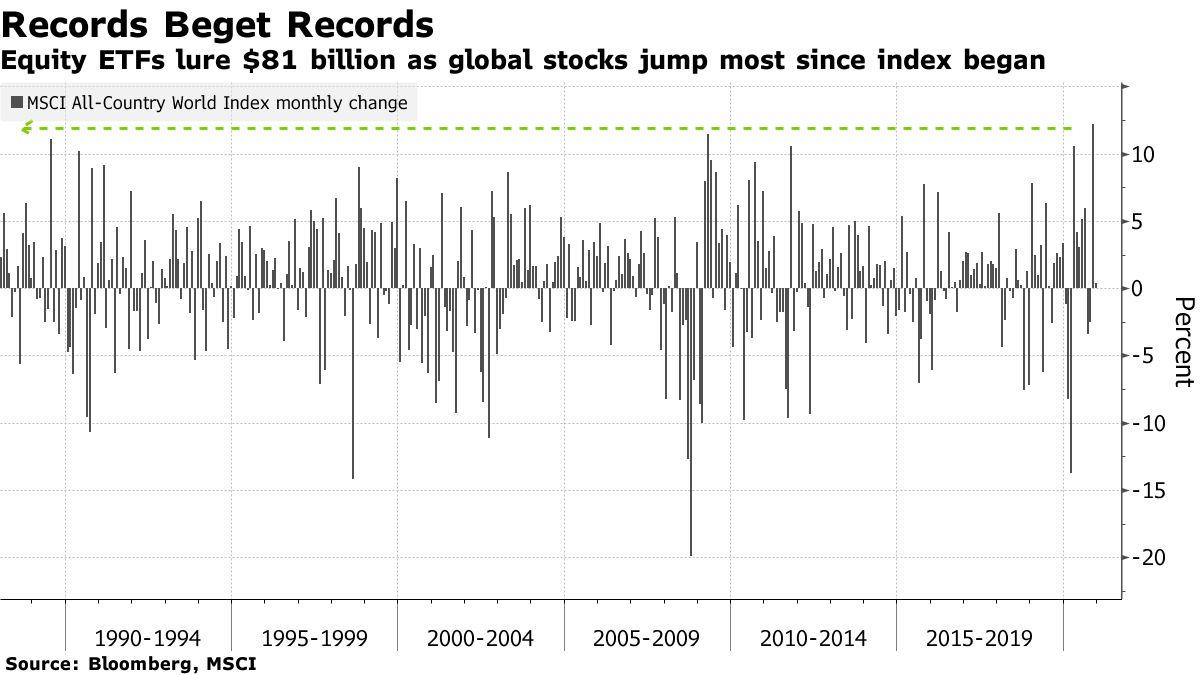
With December's numbers are still pending, November was a blow out month for passive fund inflows in stocks, and as Bloomberg recently reported, after a blistering start to the year for fixed income funds (thanks to the March crash which spooked retail from stocks and into bonds, if only briefly) equity ETFs overtook their fixed-income peers for inflows this year thanks to November’s epic stock rally.
After lagging bond funds for most of 2020, ETFs tracking equities saw a record $81 billion in inflows last month - nearly half of 2020's total in just month - and bringing their total haul for the year to $196 billion, according to Bloomberg data. That catapulted them ahead of fixed-income funds, which attracted $17 billion and have a tally of $192 billion.
The recent surge in ETF inflows is thanks to another unprecedented burst of retail investor euphoria, which is best captured by the mindblowing inflows into Cathie Wood's ARKK momentum/growth/"story"-chasing ETF, the ARKK Innovation ETF (profiled here), which just passed JP Morgan "for the largest actively managed exchange-traded fund" with $18 billion in assets and which owns more than 10% of 15 different stocks.
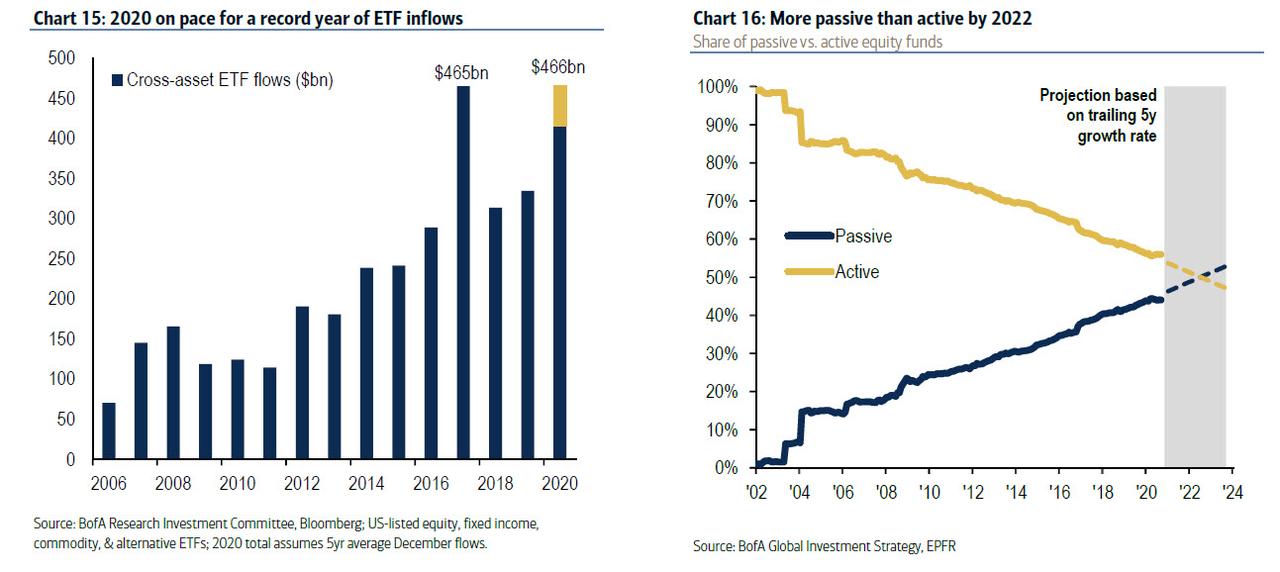
Taking a look at the big picture, BofA writes that exchange-traded funds (ETFs) are on pace to add $466BN, the biggest year of inflows ever (chart below, left), and at the current pace of inflows, a historic inversion is set to take place by 2022, when for the first time ever there will be more assets in passive equity funds than active, meaning humans will officially be a minority when it comes to managing money (thanks Federal Reserve).
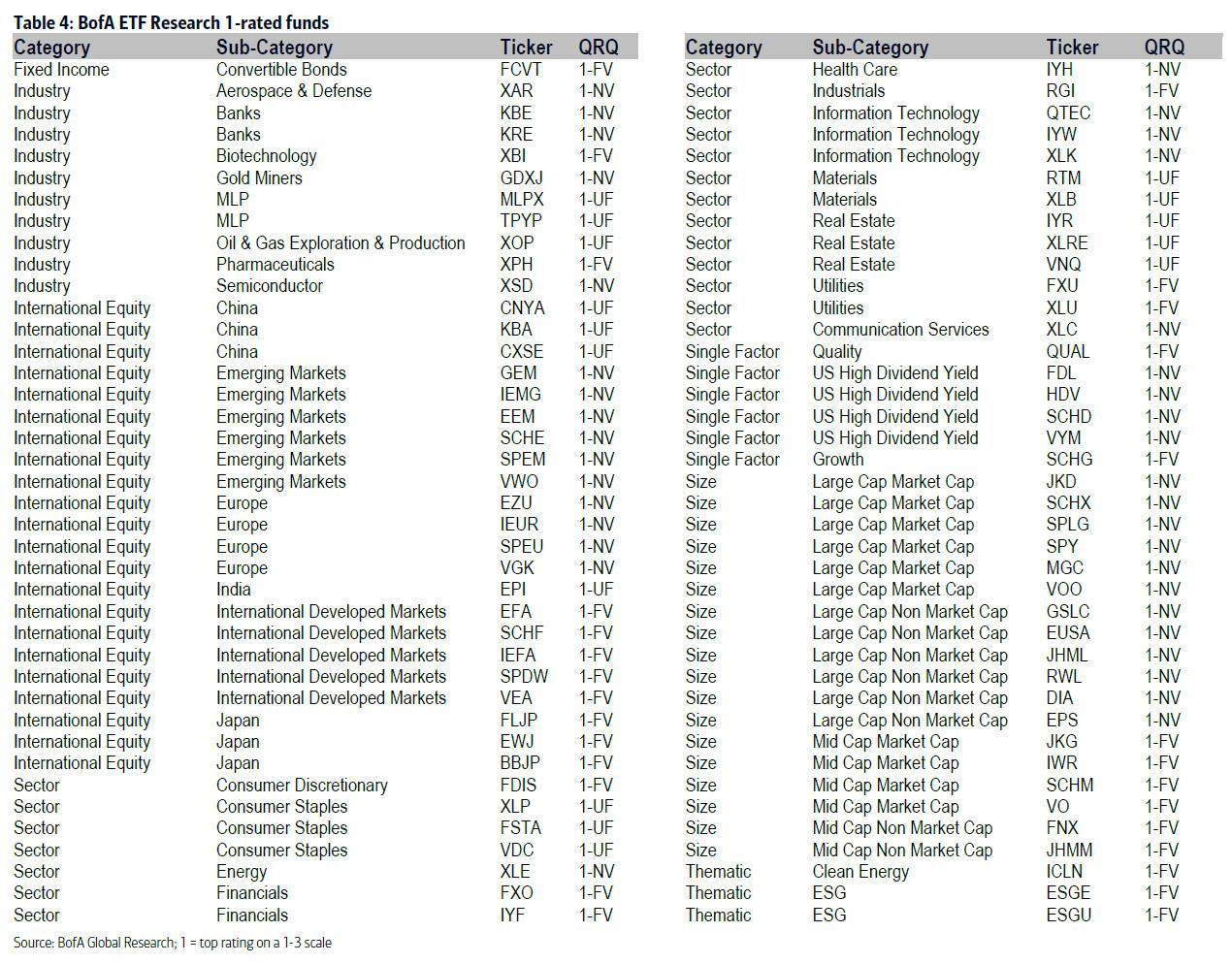
And as the world waves goodbye to fundamental-based investing, and cheers on the arrival of flow and thematic capital allocation (which only an idiot would call "investing"), BofA Research reminds us that it has has the first and only ETF research offering (yes, BofA now rates ETFs not the actual stocks that make them up), with 241 funds rated - some of its top-rated funds are shown in the table below, and notes that it has also recently initiated coverage of the following categories, all of which piggyback either on the unprecedented growth in, well, growth names and the current virtue-signaling crazy for anything ESG/"clean energy":
  • Clean energy: BofA initiated coverage of the clean energy theme, with ratings on four ETFs in "In (Clean) Fuel for growth"
  • Communication services: BofA now covers all GICS Level 1 sectors (link);
  • Growth factor: In Growth for contrarians the bank made the case for rethinking growth benchmarks and rated 6 top ETFs;
  • ESG: ESG investing is having its best year ever with parabolic inflows of $66bn; BofA expected as much in its report "Buying like you mean it" where it rated the ESG space with a favorable outlook.

WSJ : Bond Boom Comes to America’s Colleges and Universities

Bond Boom Comes to America’s Colleges and Universities
Eyeing low rates and financial pressure tied to Covid-19, higher-education institutions are issuing a record amount of debt this year

Faced with a rapid deterioration in their finances in 2020, America’s colleges and universities issued a record amount of bonds this year.

It is a stressful time for higher education. The coronavirus pandemic worsened existing pressures on tuition and auxiliary revenue, with international students opting to study outside the U.S. and money from room and board drying up as schools keep classes online. At the same time, demand for financial aid and costs related to providing protective gear and Covid-19 testing have jumped.

Hoping to address possible shortfalls and take advantage of ultralow rates, universities have flooded the market with debt. With few places to get a return in the bond market, investors have scooped up the issues, which in some cases offer yields of 2% or 3% for debt that matures in 15 to 30 years.

The higher-education sector “becomes attractive because it’s under pressure,” said Daniel Solender, who oversees tax-free fixed-income investments at asset manager Lord Abbett & Co., referring to rising yields on higher-education bonds as schools’ ability to navigate the pandemic came into question. The firm added more than $300 million to its holdings of such bonds this year.

“There are a lot of high-quality institutions with great reputations, great balance sheets, that will find a way to make it through this environment,” he said.


For the year through November, colleges and universities issued more than $41.3 billion in taxable and tax-exempt fixed-rate debt, including refinancings, a record since Barclays began tracking the data. The data included issuance from schools with top-notch credit ratings, including Brown University and the University of Michigan, as well as lower-rated schools like Linfield University in McMinnville, Ore., and Alvernia University in Reading, Pa.

Moody’s Investors Service MCO 1.15% in March lowered its outlook on the entire sector to negative from stable, citing uncertainties and financial challenges brought on by the pandemic. S&P Global Ratings lowered its outlook on a raft of schools in May and no longer maintains a positive outlook on a single one of the schools it rates. Attempting to help alleviate some of the pressure, more than $20 billion was allotted to public and private higher education in the latest Covid-19 relief bill passed by Congress.

John Augustine, who leads the higher-education and academic medical-center finance group at Barclays, said the bond issuance came from institutions trying to reduce their fixed costs. For some, he said, borrowing money at low rates was more attractive than dipping into their endowments at a possible cost to future generations of students.

The New York Institute of Technology refinanced $17 million in debt this summer as it sought to bolster its cash holdings, extending the repayment timeline to 2030 and lowering its annual debt service to around $3 million from upwards of $7 million.

“Trustees were concerned about the market turmoil they saw going on and how that might affect our liquidity,” said Barbara Holahan, chief financial officer and treasurer of the private university.

She said freeing up cash became a bigger priority as international student enrollment fell and expenses rose.

Part of the sector’s appeal for investors stems from the long-term maturity of college and university bonds, said Jim Costello, who heads higher-education finance at J.P. Morgan. JPM -0.44% Corporate bonds rarely last more than a decade, while higher-education bonds typically have maturity dates 30 years out.

“The AAA- and AA-rated schools are pretty unique assets to own,” Mr. Costello said. “It’s very hard for these bond investors to find very highly rated, very long-duration assets.” He said many schools already had planned before the pandemic to issue bonds this year, but that they had subsequently increased the size of their borrowing.

A further boost for the asset comes from investors’ search for yield.

After the Federal Reserve cut rates to near zero in March to help stabilize the economy, investors have reset the benchmark by which they judge the relative attractiveness of various asset classes and risks. That has contributed to soaring equity markets this year, as well as appetite for municipal bonds.

Wofford College in Spartanburg, S.C., opted for a $17.5 million private placement with Synovus Bank in September. The small liberal-arts college was refinancing existing tax-exempt debt, drawn in part by low rates.

Wofford finance chief Chris Gardner said the school wound up cutting its yield on 15-year bonds to 2.1% from 3.39%, saving about $100,000 a year.

“Everybody’s looking for some kind of yield. As low as 2% is, you can compare that to sovereign debt where you’re getting negative yields on half the countries in the world,” Mr. Gardner said.

For decades, colleges and universities largely sold bonds to finance new construction of academic buildings, dorms and sports complexes, and to tackle deferred maintenance. Like many other municipal bonds, these offerings are typically tax-exempt. Some schools issue taxable bonds because they come with fewer restrictions governing use of the funds.

Tulane University in New Orleans received $1.5 billion in orders for $187 million in debt this summer. Institutions that invested include BlackRock Inc., BLK 0.50% Lord Abbett and Vanguard Group, said Tulane operating chief Patrick Norton.

Tulane had the new bonds in the works even before the pandemic to finance new construction and refinance $25 million in existing debt. The school waited until it firmed up plans to bring students back to campus for the fall, ensuring continued cash flows, Mr. Norton said.

It locked in an all-in 3.12% yield on bonds with an average life of almost 20 years, compared with the 3.31% it got on 2017 bonds with an average life of about 12 years.

The University of Wisconsin-Madison hasn’t been as fortunate.

Unlike most public universities, the flagship can’t issue debt of its own because of state statutes. It instead participates in the state’s issuance and refinancing of tax-exempt general obligation bonds. Campus administrators have been citing the pandemic in discussions with lawmakers this fall to press for the ability to issue bonds, said Laurent Heller, the school’s vice chancellor for finance and administration.

Among other pressures, the University of Wisconsin-Madison has been hit by lost revenue related to room and board and its athletics program, whose 80,000-seat football stadium has been sitting empty since March. It has furloughed staff and made other cost cuts but still expects to have a significant budget shortfall in the fiscal year ending in June, he said.

“It’s a part of the tool kit of every major university,” Mr. Heller said. Without the ability to issue debt on its own, “we face more pressure to do immediate expense reductions.”