(ZH) China's Antitrust Crackdown On Tech's Giants Leads To Massive Losses

China's Antitrust Crackdown On Tech's Giants Leads To Massive Losses

China's continued crusade against Jack Ma - which may or may not culminate with Beijing tearing apart his fintech giant, Ant Financial on anti-trust grounds - led to a second day of frenetic selling among China’s largest tech firms, driven by an investor panic Beijing's crackdown on financial intermediaries and antitrust scrutiny would spread beyond Jack Ma’s internet empire and engulf the country’s most powerful corporations.
As Bloomberg reports, Alibaba and its three biggest rivals - Tencent, food delivery giant Meituan and JD.com - were hammered in the past 48 hours, losing nearly $200 billion in the two sessions since Thursday when regulators revealed a probe into alleged monopolistic practices at Ma’s company, which was followed on Sunday by comments from PBOC deputy governor Pan Gongsheng who slammed the world's biggest fintech company, Ant Financial, which is also owned by Ma saying it "must return to its origins in online payments and prohibit irregular competition, protect customers’ privacy in operating its personal credit rating business, establish a financial holding company to manage its businesses, rectify any irregularities in its insurance, wealth management and credit businesses, and run its asset-backed securities business in accordance with regulations."
Traders were stunned by what appears to be the formal start of the Communist Party’s crackdown on not just Alibaba but also, potentially, the wider and increasingly influential tech sphere; as a result they quickly puked the Chinese tech megacaps, with Alibaba falling 8% Monday in Hong Kong, losing $270 billion of value since its October peak. Tencent and Meituan also tumbled more than 6%. Alibaba rival JD.com slid roughly 2%.
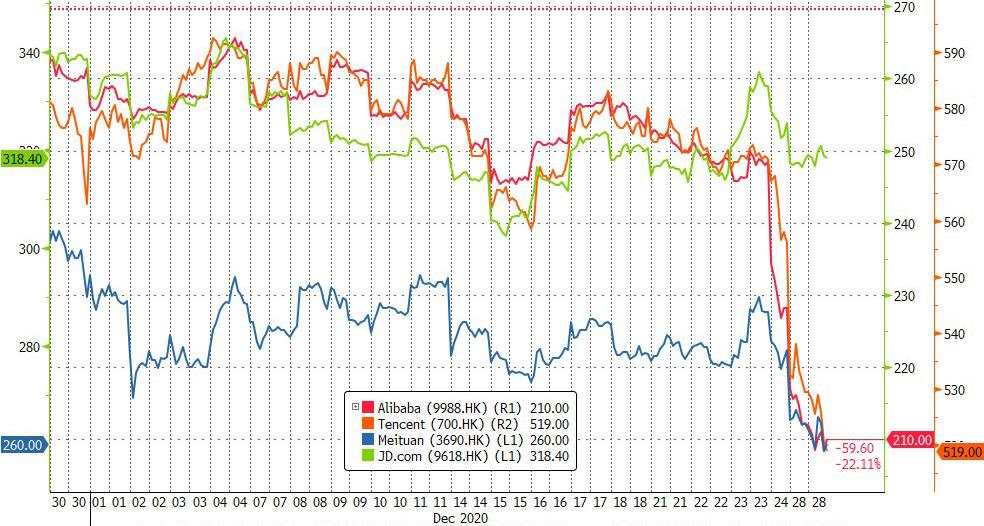
"The Chinese government is putting more pressure or wants to have more control on the tech firms,” Jackson Wong, asset management director at Amber Hill Capital, told Bloomberg. "There is still very big selling pressure on firms like Alibaba, Tencent or Meituan. These companies have been growing at a pace deemed by Beijing as too fast and have scales that are too big."
So far Beijing's ultimate intentions vis-a-vis Jack Ma and his online tech empire remain unclear, but as we noted yesterday, "the worst case scenario would be for Ant to forgo its money management, credit and insurance businesses, halting its operations in the units that service half a billion people. Its wealth management business which includes the Yu’ebao platform that sells mutual funds and money market funds, accounted for 15% of revenue."
Today Bloomberg picks up on this, writing that "investors remain divided over the extent to which Beijing will go after Alibaba and its compatriots as Beijing prepares to roll out the new anti-monopoly regulations. The country’s leaders have said little about how harshly they plan to clamp down or why they decided to act now."
As Bloomberg adds, it’s unclear what concessions regulators may try to wring from Alibaba. Under the existing Antitrust Law, which is undergoing revisions to include the internet industry for the first time, Beijing can fine violators up to 10% of their revenue. In Alibaba’s case, that could mean a levy of as much as $7.8 billion.
Of course, the heavily sold tech names aren't just sitting their: on Monday Alibaba raised its stock repurchase program by $4 billion to $10 billion, effective for two years through the end of 2022. But the buyback program was overwhelmed by fears that the steps taken against Ant are just the tip of the iceberg. While the central bank stopped short of calling for a breakup, the financial services giant now needs to present specific measures and a timetable for overhauling its business.
The State Administration for Market Regulation dispatched officials to Alibaba’s Hangzhou headquarters last Thursday and the on-site investigation was completed on the day, according to local news reports. The People’s Daily -- the Communist Party mouthpiece -- ran a commentary over the weekend warning Alibaba’s peers to take the antitrust investigation into Alibaba as a chance to lift their own awareness of fair competition.
Meanwhile, as we noted over the weekend, the formerly outspoken Ma has vanished from public view since Ant’s IPO got crushed by Beijing in the last moment in November. As of early December, Ma was advised by the government to stay in the country, a Bloomberg source said.
What happens next?
According to Bloomberg, "some analysts predict there’s a crackdown coming, but a targeted one." They point to language in the regulations that suggests a heavy focus on online commerce, from forced exclusive arrangements with merchants known as “Pick One of Two” to algorithm-based prices favoring new users. The regulations specifically warn against predatory pricing - selling below cost - to weed out rivals.
"As this latest investigation occurs at a time when China is ready to take action against monopolistic practices, we think SAMR might want to use BABA’s case as a precedent to send a message to the rest of the industry that the authority is determined this time to address the" pricing issue, Nomura analysts wrote in a note Monday.

FT : AI chipmaker Graphcore raises $222m as it takes on Nvidia

AI chipmaker Graphcore raises $222m as it takes on Nvidia
Latest funding round values four-year-old UK start-up at $2.5bn

Graphcore, the UK-based maker of artificial intelligence chips, has raised $222m in new funding as it braces itself for tougher competition from US rival Nvidia.

The latest round values Graphcore at $2.5bn (without including the new capital raised), up from $1.5bn two years ago, making it one of the UK’s most valuable private tech companies.

Graphcore’s chips — called “intelligence processing units” — are tailored to AI’s specialised data processing requirements. Its IPUs are sold, often through partners such as Microsoft, Dell and Atos, to researchers at Imperial College London and the University of Oxford, as well as financial, healthcare and telecoms institutions.

Nigel Toon, Graphcore’s co-founder and chief executive, said a stronger balance sheet would build confidence among customers and partners after revenue growth was hit by customer purchasing delays this year.

Researchers at Facebook and Google have published papers comparing the performance of IPUs favourably with the graphics processing units most commonly used in AI today. Nvidia has become the leader in GPUs and overtook Intel to become the most valuable US chipmaker this year.

Mr Toon slammed Nvidia’s planned $40bn acquisition of UK-based chip designer Arm from SoftBank as “bad for competition”, “bad for the market overall” and “bad for Britain”.

Chipmakers such as Graphcore would be less willing to work with Arm knowing that it was owned by a competitor, he said, limiting access to its “world-class” processor designs.

Graphcore’s latest financing is led by Ontario Teachers’ Pension Plan Board, along with funds managed by Fidelity International and Schroders, who are all new investors to the Bristol-based company. Some existing investors, including Draper Esprit and Baillie Gifford, also participated.

The new funding comes less than a year after Graphcore closed a $150m extension to its last round and leaves the four-year-old company with about $440m in cash.

“We don’t need to raise any more money anytime soon,” Mr Toon said. “The next step for us probably would be an IPO [initial public offering] of the business at some point, when things are much more predictable in our business.”

There would be no stock market listing in 2021, he added, which would be focused on “growing the company”.

Despite disruption from the coronavirus pandemic, Graphcore launched its second-generation IPU processor on schedule this year, Mr Toon said, with volume production beginning in the fourth quarter.

Graphcore invested $41.8m in research and development in 2019 and since then its headcount has increased further to 450 people. Its annual report for 2019 shows a pre-tax loss of $95.9m, up from $60.3m in 2018, with revenues of $10.1m.

Mr Toon said sales growth this year had fallen short of expectations. “Revenues have not been at the level we had hoped because things have taken longer to come to fruition and some projects have been delayed,” he said.

But Graphcore has built a “phenomenal” pipeline of new customers, he added, which helped win over the new investors. “We’re very hopeful that 2021 is going to be a very strong revenue year.”

WWD : SEC Filing Reveals a Healthy Mytheresa

SEC Filing Reveals a Healthy Mytheresa
The Munich-based luxury website continues to capitalize on the consumer flight to online shopping.

It’s now an open book on Mytheresa’s financials.

The Munich-based luxury website, which also operates two stores, on Monday filed a registration statement with the Securities and Exchange Commission, providing a granular view into the company’s financial performance and operations in advance of its planned initial public offering next year on the New York Stock Exchange.

And apparently the business hasn’t been deeply affected by the pandemic, and has capitalized on the flock to online shopping and exodus from brick-and-mortar shopping.

For fiscal 2020, net income reached 6.4 million euros, compared to 1.7 million euros during fiscal 2019.

Adjusted net income was 19.3 million euros, compared to 15.8 million euros in fiscal 2019.

Volume reached 449 million euros in fiscal 2020, which ended June 30, an 18.6 percent gain from 379 million euros in the year-ago period. In fiscal 2016, the company generated 183 million euros.

In fiscal 2020, about 68 percent of net sales were derived from the company’s top 30 brand partners.

“Our long-standing brand relationships include Alexander McQueen, Balenciaga, Balmain, Bottega Veneta, Burberry, Dries van Noten, Dolce & Gabbana, Fendi, Gucci, Loewe, Loro Piana, Moncler, Prada, Saint Laurent, Stella McCartney and Valentino,” chief executive officer Michael Kliger wrote in a letter contained in the registration statement.

“In fiscal 2020, we offered 13 once-in-a-lifetime experiences, including events in Paris, Milan, Munich, Shanghai, Dubai and New York, featuring Moncler, Altuzarra, Boyy, Paco Rabanne, Gabriela Hearst, Stella McCartney, JW Anderson, Roger Vivier, Khaite and Amina Muaddi,” Kliger wrote. “At almost all of these events our top customers had the opportunity to meet the designers themselves. One of the highlight collaborations in fiscal 2020 was the celebration of our exclusive capsule collection with Stella McCartney, which featured Stella McCartney herself as a Mytheresa Woman in an exclusive video campaign.”

Mytheresa indicated that it “curates” 7,000 stockkeeping units from its top 30 luxury designer brands, and that less than 21 percent of those items overlapped with multibrand competitors as of December 2019.

In fiscal 2020, Mytheresa had 37 capsules and campaigns with exclusive content from brands including Brunello Cucinelli, Christian Louboutin, Moncler, Prada, The Row and Valentino.

Mytheresa’s women’s flagship and men’s store, which are both in Munich, generated about 3 percent of the company’s net sales in fiscal 2020.

As Kliger sees it, “Mytheresa is at the beginning of its journey.”

Among the growth plans cited: scaling organic search content in several additional languages, introducing a new customer acquisition model, enhancing localization and personalization capabilities, accelerating social media channel growth, and investing in categories to complement the women’s business. Mytheresa launched kids in January 2019 and currently sells 50 kids brands, and in January 2020 launched men’s, with more than 100 brands in the category.

Kliger said in fiscal 2020, the company had more than 486,000 active customers, and shipped more than one million orders to 133 countries.

“We achieved this scale and growth while maintaining our commitment to luxury with industry-leading average order values and robust and consistent customer economics, despite a difficult environment.”

Further in the registration statement, the company indicated, “While the pandemic has had a substantial impact on the global economy, we have not experienced material declines in net sales, deterioration in net assets or other adverse effects. While our flagship retail store in Munich was closed at the end of the third and beginning of the fourth quarters of fiscal 2020, before reopening on April 27, 2020, we continued to offer our customers an uninterrupted boutique luxury shopping experience from our online business, which constitutes 97 percent of our net sales.

“To date, we have incurred no significant supply chain or logistics disruptions with our brand partners, shipping providers, or our in-house operations. In response to the pandemic and in coordination with local government requirements, we temporarily closed certain corporate and administrative offices, including our corporate headquarters in Munich, with affected employees working remotely. These closures were limited to our administrative offices, with our warehouse and logistics functions remaining in operation throughout the pandemic. We also implemented safe work and social distancing measures for all employees, including personnel in our central warehouse facility in Heimstetten, Germany.”

By country, Germany is Mytheresa’s single biggest market, accounting for 19.8 percent of fiscal 2020 sales. The U.S. accounted for 10.3 percent of sales, and Europe (excluding Germany) accounted for 39.8 percent of sales. The rest of the world accounted for 30.2 percent of sales.

In other data contained in the registration statement, about 30 percent of sales in fiscal 2020 came from 2.6 percent of Mytheresa customers who are part of the “top customer” program. Those in the program, on average, made 16 purchases during the year, with an average order value in excess of 935 euros. The program offers such benefits as first access to runway and exclusive pieces, previews of new styles, personal shopping services and invitations to events including fashion shows.

In fiscal 2020, the average customer shopped about twice a year and spent about 900 euros, before returns.

In fiscal 2020, mobile orders accounted for 53 percent of net sales, including 42 percent through the app, and 78 percent of page views “underscoring the importance of our mobile-first approach,” the company said.

Mytheresa’s mobile app install base reaches about 2.6 million people and accounted for 78 percent of page views for fiscal 2020. The company had about 2.3 million followers on social media, as of Sept. 30, 2020.

For the three months ended Sept. 30, 2020, net income reached 9.6 million euros, compared to a net loss of 4.3 million euros in the year-ago period.

Adjusted net income was 5.4 million euros, compared to 3.5 million euros in the year-ago period.

Last September. the Neiman Marcus Group emerged from five months of bankruptcy proceedings. The restructuring resolved legal disputes and ownership issues revolving around MyTheresa. The website is now controlled by Ares Management and the Canada Pension Plan Investment Board, which had owned NMG before the restructuring. Neiman’s originally purchased Mytheresa in 2014 and had it operating as a separate subsidiary since 2018, to presumably to protect it from creditor claims.

MyTheresa was worth roughly $822 million in 2018, but there have been other higher and lower estimates. Monday’s filing does not indicate a valuation. The pricing and number of shares to be offered is to be determined. As the registration statement indicates, the global online luxury market — luxury apparel, accessories, beauty and hard goods — is expected to more than triple from 33 billion euros in 2019 to 105 billion to 115 billion euros in 2025, according to Bain & Co.’s Luxury Goods Worldwide Market Study. Based on the 2020 Bain Study, the personal luxury goods market is expected to reach 330 billion to 370 billion euros by 2025, with online penetration expected to grow from 12 to more than 30 percent, from 2019 to 2025.

>>> Stoxx 600 Pre-Market Indications

  • Carnival Plc (POH1 TH) +6.4%
  • TUI (TUI1 TH) +5.6%
  • NEL (D7G TH) +5.3%
  • BT (BTQ TH) +3.7%
  • Orsted AS (D2G TH) +3.6%
    • Orsted Enters $2.7 Billion Deal to Sell Taiwan Wind Farm Stake
  • Glaxo (GS7 TH) +3.5%
  • BAT (BMT TH) +3.1%
  • AstraZeneca (ZEG TH) +3%
  • Siemens Gamesa (GTQ1 TH) +2.4%
  • Vodafone (VODI TH) +2.4%
  • EssilorLuxottica (ESL TH) -0.8%
  • H&M (HMSB TH) -0.9%
  • Anglo American (NGLB TH) -1.2%

>>> TradeGate Pre-Market Indications

DAX:
  • SAP (SAP TH) +2%
    • Qualtrics Files for U.S. IPO Two Years After Sale to SAP (2)
  • VW (VOW3 TH) +0.8%
  • Bayer (BAYN TH) +0.8%
MDAX:
  • Metro AG (B4B TH) +1.5%
  • Deutsche Lufthansa (LHA TH) +1.3%
    • Lufthansa’s Swiss Brand Sure It Can Repay Government Loan: NZZ
  • HelloFresh (HFG TH) +1.1%
  • K+S (SDF TH) +0.9%
  • Freenet (FNTN TH) -0.6%
SDAX:
  • Hornbach Baumarkt (HBM TH) +2.7%
    • Stock fell 3.6% yesterday
  • LPKF (LPK TH) +2.5%
  • Corestate (CCAP TH) +2.3%
  • Dermapharm (DMP TH) +2.1%
  • Deutsche PBB (PBB TH) +1.2%
  • Borussia Dortmund (BVB TH) -1.2%

Reuters - Stock-picking hedge funds land investors double-digit gains in 2020

Stock-picking hedge funds land investors double-digit gains in 2020

Hedge funds, which aim to protect assets in market downturns and have faced criticism for many years for high fees and lacklustre returns, in 2020 showed a divergence in performance.

The average hedge fund made 7.3% in the first 11 months of the year. That underperformed an index tracking the S&P 500, which would have made 14% over the same time frame, according to data from Hedge Fund Research (HFR).

Investors said the performance was still solid given that many of the hedge funds in their portfolios had produced double-digit returns or otherwise preserved assets during the March rut when fears about coronavirus wiped $5 trillion from U.S. stocks.

“Hedge funds broadly managed the year up to March really well - certainly much better than 2008 as a comparison - and they have ended in positive territory,” said Robert Sears, chief investment officer at Capital Generation Partners.

The standouts were long-short hedge funds, which proved to have the top-performing strategy. So-called ‘long-short’ hedge funds, which take bets on stocks rising and falling, raked in gains of 12% over the period, according to recent data from HFR. While that underperformed the broader market, a number of individual firms blasted past that number with high returns.

“On average, hedge funds have done quite well,” said Cedric Fontanille, director and head of investment mandates at investment manager Unigestion. “Long-short equity benefited from the strong momentum of their tech exposure. They had quite a bit at the beginning of the year and maintained it.”

Many hedge funds were heavily invested in stocks that benefited from consumers and workers staying at home during the pandemic, including Zoom Video Communications Inc and Amazon.com Inc.

UK-based Marshall Wace was among the hedge funds to hold a position in Zoom, U.S. filings compiled by Symmetric.io showed. It made 9.4% in its $20 billion strategy for the year to start of December, said a source with knowledge of the firm.

Among the long-short hedge funds to generate double-digit returns were RiverPark Advisors’ $391 million fund, which gained 41.2% through Oct. 31 while Wellington Management’s $1.37 billion financials-focused fund gained 21.2% to Nov. 30, according to data gathered by HSBC and seen by Reuters.

Britain’s Odey Asset Management made 37.3% through Nov. 30 in its long-short fund managed by James Hanbury while Sandler Capital Management’s $2 billion equities fund made 10.8% between the start of the year and Dec. 4, sources close to the firms told Reuters.

Hedge fund peers that bet on mergers and acquisitions made 5.4% over the same period while strategies that invest based on macroeconomic trends made 1.4%, the data showed.

While macro hedge funds generated lower gains on average, according to the HFR data, investors said the strategies in their portfolios had outperformed the market.

“A lot of the old guard performers did well again and most macro managers have ended with a good year,” said Sears at Capital Generation Partners.

“Even the ones that didn’t do quite so well earlier in the year have done well in the later year rally.”

Billionaire Alan Howard’s hedge fund firm made 24% in 2020 to Nov 30 in its $4.3 billion macro master strategy, a source close to the firm told Reuters.

Paul Tudor Jones’s macro Global Fund made 11.9% through Nov. 30, the HSBC data showed.

All of the hedge funds declined to comment on their performance or did not respond to requests for comment.

WSJ : Money Laundering Watchdog Turns Focus to Digital Tools, Extremism

Money Laundering Watchdog Turns Focus to Digital Tools, Extremism
Marcus Pleyer, the president of the Financial Action Task Force, says certain money laundering patterns have increased during the pandemic

The coronavirus halted a wide range of economic activities, but it hasn’t stopped criminals from using the global financial system to commit fraud and engage in other types of illicit behavior.

Yet the pandemic has forced some countries to divert resources away from fighting money laundering and made it harder for compliance officers in the private sector to detect it, according to the Financial Action Task Force.

The organization, which sets international standards and assesses countries’ anti-money-laundering and counterterrorism-financing policies, has been closely monitoring the impact of the pandemic on its global network, says Marcus Pleyer, FATF’s president.

Mr. Pleyer began a two-year term as FATF’s head in July, about two months after the organization released its first report on the AML and CTF risks posed by the pandemic. In an interview with Risk & Compliance Journal, Mr. Pleyer discussed FATF’s priorities under his presidency. Edited excerpts follow.

WSJ: Has the coronavirus pandemic increased the risk of money laundering?

MR. PLEYER: We see an increase in certain crimes and money laundering patterns. For example, fraud connected with government aid. We see fundraising for fake charities. We see counterfeiting of medical goods. Also, cybercrime.

On the other hand, cash intensive crimes where you need to take cash over the border is certainly something that is decreasing.

What worries me a little bit also is that...there has been an impact on [anti-money-laundering] work in the public sector. We see that in some countries resources are diverted to other areas of government.

We also see this in the private sector. When customers are onboarded, the customer due diligence processes are sometimes not driven at the same level as usual because people are working from home or they have different security measures.

WSJ: There seems to be a growing consensus that the traditional anti-money-laundering and counterterrorism-financing regime isn’t working. How might FATF’s standards evolve to address some of those issues?

MR. PLEYER: There is something that really could change the game, and that is not necessarily a revision of the standards. I think the standards are right. Countries need to implement them fully and effectively, and to make this possible countries should look into—and we at FATF will look into—the digital tools that are out there to promote effective implementation of the standards.

That is why under my presidency we issued a priority on digitization, and we will look into what digital solutions exist and how they can be used for AML-CFT. We will look into possible structural legal technical obstacles and how you can address them.

There is some tension between effectively fighting money laundering on the one side and adhering to data protection. I’m pretty sure if we bring together—and that is what I plan to do—people from the AML area, people from data protection and the technical experts, we will find ways to reconcile these two objectives.

WSJ: Is technology the primary solution to the problem?

MR. PLEYER: You cannot make AML more effective by using digital tools only—you need trained people. So it’s also about human resources, in all the parts of the chain of AML. You need them in compliance, you need them with the supervisors, you need them with the financial Intelligence units, you need them with law enforcement.

This is why I encouraged leaders at the G-20 summit to leave AML-CFT very high on the agenda—to invest in law enforcement and provide them with the necessary human resources. But again, [to provide them] also with the digital resources. It’s always the right mixture between human resources, skills and digital tools.

WSJ: A recent report detailing the contents of leaked U.S. suspicious activity reports appeared to show that banks are identifying a lot of suspicious transactions and suspicious actors, but in many cases they’re continuing to do business with them. What does this mean for the continued fight against money laundering and counterterrorism finance?

MR. PLEYER: This has shone light on the problems we have with money laundering and terrorist financing. A high-level comment on this is that in our mutual evaluations, we also see that there is still a lot of room for improvement for all countries.

I want, especially the G-20, to march ahead and be a model for other countries. All countries need to improve, and all parts in the chain need to improve. We are quite good on this planet with technical compliance, with introducing the standards into the legal framework. But everyone needs to step up their effectiveness.

WSJ: What are your other priorities as FATF president?

MR. PLEYER: One is potentially the fastest growing security and terrorist threat globally, and that is the extreme right-wing terrorism. We have seen a 320% rise in attacks over the past five years. [The number of attacks by such groups in the U.S. from 2010 to 2017] has surpassed the number of attacks perpetrated by terrorist groups such as ISIS and Al-Qaeda. We want to understand the financing behind this, to help us detect and prevent those terrorist attacks.

The other issue I want to stress, because it impresses by magnitude, is environmental crime and its link to money laundering. Up to $258 billion in profit are generated by environmental crimes, and we expect an increase by 5% to 7% annually. By going after these profits, our organization can contribute to several global challenges [including] the protection of our precious ecosphere.

And with this Covid-19 pandemic, we have seen that fighting environmental crime, especially illegal wildlife trade, has a connection to health. We need to preserve biodiversity as a buffer between the world of animals and human mankind.

WSJ : SAP Unit Qualtrics Heads for IPO

SAP Unit Qualtrics Heads for IPO
German business software giant SAP paid around $8 billion for the startup two years ago, in one of the biggest acquisitions ever

German business software giant SAP SE SAP 3.85% said it would return Qualtrics International Inc. to public markets, in a listing expected to value the business at least 50% above what it paid for the startup two years ago.

SAP said in November 2018 it planned to buy the customer-relationship management software vendor shortly before Qualtrics was about to go public. SAP paid around $8 billion, one of its largest acquisitions ever, in a bid to keep pace with rivals such as Salesforce.com Inc.

Provo, Utah-based Qualtrics, in a regulatory filing Monday, set an initial price range of between $20 and $24, which would value the company on a fully diluted basis between $12 billion and $14.4 billion, according to a person familiar with the matter. Pricing can change based on investor feedback until the day before a company’s stock starts trading.

SAP CEO Christian Klein in July said the company would take Qualtrics public while remaining the majority shareholder. The deal, he said, would allow Qualtrics to better pursue non-SAP business opportunities.

Qualtrics shares will trade on the Nasdaq under the ticker symbol “XM.” SAP will retain a controlling stake in Qualtrics following the planned IPO, including all of the company’s Class B shares that give it extra voting rights.

The listing comes amid a tumultuous period of the German tech company, in part brought on by the pandemic. SAP in April abandoned its dual-chief-executive structure, less than six months after embracing the leadership model. It said the move was aimed at expediting decision-making during the health crisis after the company cut its full-year guidance. In October, the Walldorf, Germany-based company again cut its outlook as coronavirus cases began to surge again.

SAP’s acquisition of Qualtrics, which closed in 2019, helped the company improve its competitiveness in the cloud-computing market, SAP has said. Shares of companies that provide cloud services, such as Snowflake Inc. and ServiceNow Inc., run by former SAP CEO Bill McDermott, have surged during the pandemic as more businesses have embraced such services. SAP’s shares are down 12.5% this year.

In its filing, Qualtrics said that Silver Lake would purchase $550 million of its stock, including 15 million shares at $21.64 per share and the remainder at the IPO price as part of the offering. Silver Lake, earlier this year, provided financing to pandemic-hit Airbnb Inc. with warrants that, when exercised, would value the company at $18 billion. Airbnb was valued at $47 billion on a fully diluted basis at its IPO price when it made its debut in December. Its stock price has more than doubled since it made its debut.

Qualtrics, in the regulatory filing, said this year’s sales through the end of September rose to $415 million, up from $309 million over the year-prior period. It recorded a $258 million net loss for the first nine months, compared with a $860.4 million loss in the same period a year earlier.

Qualtrics said it has more than 12,000 customers, and over 3,300 employees spread across more than 25 countries. The company was founded in 2002 by Ryan Smith, who served as chief executive until this summer and remains the company’s chairman. Zig Serafin, a former Microsoft Corp. executive, took over as CEO in July.

The planned IPO helps cap a year in which tech companies have seen their valuations soar to the highest levels since the dot-com bubble of the early 2000s. Airbnb is now valued at around $93 billion, far more than traditional lodging companies such as Marriott International Inc. or Hilton Worldwide Holdings Inc.

Snowflake Inc., a data-warehousing company that held its trading debut in September, is worth more than 180 times the $89 million in revenue is earned in the 12 months to October.