Takeover: Carrefour and Couche-Tard bypass Bercy's veto
Faced with the open opposition of the Minister of the Economy, the two groups gave up on a capital-intensive merger but continued discussions "on an industrial and operational level".
January 16, 2021 at 6:06 p.m.
"Season 1 is over, it's time for season 2." After the categorical refusal displayed by Bruno Le Maire, Minister of the Economy, to authorize a sale of the leader of large-scale distribution in France to the Canadian Couche-Tard, Carrefour should announce in the coming hours that the discussions are continuing.
There is no longer any question of capitalistic merger, but "a sharing of experience and cooperation on very industrial and operational subjects", one specifies at the headquarters of the French leader in mass distribution. “Couche-Tard is one of the world leaders in the sale of fuel and its expertise can be invaluable to us. And our know-how in the food industry, and in particular retailer brands, is of great interest to them, ”continues a representative of Carrefour management.
An organized leak?
But the three days of passing arms with Bercy, from Wednesday to Friday, have left their mark. On the side of the French group, we deplore the speed of the reaction of Bruno Le Maire who did not allow to deepen the discussions with the Canadian fiancé. The executives of Couche-Tard, which had sent a letter of intent to Carrefour on January 1, came to discuss it face to face on the 8, before returning to Canada. A new round of discussions was scheduled for Wednesday 13. "On this kind of file, there are crucial points to be explored in more detail on jobs, governance, synergies to know if we can go further," specifies one of the actors in the file. But there it was not possible. "
The leak of the financial agency Bloomberg, on the night of Tuesday to Wednesday, lit the fuse in France. In the staffs of the two groups, it is stressed that neither had any interest in spreading the word about the deal at this stage, in a “follow my gaze” insisting towards the Ministry of the Economy. At the end of the day on Wednesday, Bruno Le Maire, invited from “C à vous” to talk about his book “The Angel and the Beast” (Ed. Gallimard), explains that he “is not in favor of such a operation ”, highlighting the fact that Carrefour is the leading private employer in France and that this merger threatens France's food sovereignty.
Cold snap on Franco-Canadian relations
Rebelote on BFMTV, Friday morning. Bruno Le Maire opposes “a courteous but clear and definitive no” to Couche-Tard's offer. At the same time, the group's founder, Alain Bouchard, landed in Paris. A first meeting brought together 11 am, this Friday morning, in Bercy, the representatives of Couche-Tard already in France and the director of cabinet of Bruno Le Maire. At 4 p.m., the latter received Alain Bouchard. But the interview only lasted "a quarter of an hour," says the Canadian side, quite surprised at this lack of courtesy. “Bouchard left disappointed. He is a respected business leader. No one deserves to be treated like this. "
In Canada, the position of the French government has thrown a chill when the railway manufacturer Bombardier has just been bought by Alstom. The Minister of the Economy of Quebec, Pierre Fitzgibbon, had explained Thursday evening that "Couche-Tard could be a good owner". And Canadian Prime Minister Justin Trudeau, without commenting on the operation, clarified that his government's role was to support his country's businesses, "including when they were looking to expand globally."
Couche-Tard is Canada's leading grocery chain, with 16,000 stores in 25 countries. Reuters / Christinne Muschi
Couche-Tard is Canada's leading grocery chain, with 16,000 stores in 25 countries. Reuters / Christinne Muschi
It is an understatement to say that the argument of a threat to France's food sovereignty in the event of a Carrefour takeover, put forward by Bercy, was little appreciated on the other side of the Atlantic. The Ministry of the Economy denies any embryonic diplomatic crisis with Canada. "Bruno Le Maire called his Quebec counterpart at the end of the day on Friday and the interview went very well", we are told. While driving the nail on the crucial role of Carrefour in the hexagonal food industry.
“How can we not imagine that the fact that a player who weighs 20% of the distribution sector passes under a foreign flag is not likely to destabilize the sector? "We plead in the entourage of the minister, stressing that during the wishes to the economic world, this Friday morning, Christiane Lambert, patron of the FNSEA, first agricultural union of France," thanked the minister ".
"Get to know each other better" by the time of the presidential election
Bercy also sweeps away the risk that this decision poses to foreign investments. "The Franc
Rachat : Carrefour et Couche-Tard contournent le veto de Bercy
Devant l’opposition affichée du ministre de l’Economie, les deux groupes renoncent à un rapprochement capitalistique mais poursuivent les discussions «sur le plan industriel et opérationnel».
Le 16 janvier 2021 à 18h06
« La saison 1 est finie, place à la saison 2. » Après le refus catégorique affiché par Bruno Le Maire, ministre de l'Economie, d'autoriser une vente du leader de la grande distribution en France au canadien Couche-Tard, Carrefour devrait annoncer dans les heures qui viennent que les discussions continuent.
Plus question de rapprochement capitalistique, mais « un partage d'expérience et une coopération sur des sujets très industriels et opérationnels », précise-t-on au siège du leader français de la grande distribution. « Couche-Tard est un des leaders mondiaux de la vente de carburant et son expertise peut nous être précieuse. Et notre savoir-faire sur la filière alimentaire, et notamment les marques distributeurs, les intéresse beaucoup », poursuit un représentant de la direction de Carrefour.
Une fuite organisée ?
Mais les trois jours de passe d'armes avec Bercy, de mercredi à vendredi, ont laissé des traces. Du côté du groupe français, on déplore la rapidité de la réaction de Bruno Le Maire qui n'a pas permis d'approfondir les discussions avec le fiancé canadien. Les dirigeants de Couche-Tard, qui avait envoyé une lettre d'intention à Carrefour le 1er janvier, sont venus en discuter de vive voix le 8, avant de repartir au Canada. Un nouveau round de discussions était prévu mercredi 13. « Sur ce genre de dossier, il y a des points cruciaux à approfondir sur les emplois, la gouvernance, les synergies pour savoir si on peut aller plus loin, précise un des acteurs du dossier. Mais là, ça n'a pas été possible. »
La fuite de l'agence financière Bloomberg, dans la nuit de mardi à mercredi, a allumé la mèche en France. Dans les états-majors des deux groupes, on souligne qu' aucun n'avait intérêt à ébruiter le deal à ce stade, dans un « suivez mon regard » insistant en direction du ministère de l'Economie. En fin de journée ce mercredi, Bruno Le Maire, invité de « C à vous » pour parler de son livre « l'Ange et la bête » (Ed. Gallimard), explique qu'il « n'est pas favorable à une telle opération », mettant en avant le fait que Carrefour est le premier employeur privé de France et que ce rapprochement menace la souveraineté alimentaire de la France.
Coup de froid sur les relations franco-canadiennes
Rebelote sur BFMTV, vendredi matin. Bruno Le Maire oppose « un non courtois mais clair et définitif » à l'offre de Couche-Tard. Au même moment, le fondateur du groupe, Alain Bouchard, atterrit à Paris. Une première réunion a réuni 11 heures, ce vendredi matin, à Bercy, les représentants de Couche-Tard déjà en France et le directeur de cabinet de Bruno Le Maire. A 16 heures, ce dernier a reçu Alain Bouchard. Mais l'entretien n'a duré « qu'un gros quart d'heure », souligne-t-on côté canadien, assez surpris de ce manque de courtoisie. « Bouchard est reparti dépité. C'est un chef d'entreprise respecté. Personne ne mérite d'être traité comme ça. »
Au Canada, la position du gouvernement français a jeté un froid alors que le constructeur ferroviaire Bombardier vient d'être racheté par Alstom. Le ministre de l'Economie du Québec, Pierre Fitzgibbon, avait expliqué jeudi soir que « Couche-Tard pourrait être un bon propriétaire ». Et le Premier ministre canadien, Justin Trudeau, sans commenter l'opération, a précisé que le rôle de son gouvernement était de soutenir les entreprises de son pays, « y compris lorsqu'elles regardaient pour prendre de l'expansion dans le monde ».
Couche-Tard est la première chaîne d’épiceries du Canada, avec 16 000 magasins dans 25 pays. Reuters/Christinne Muschi
Couche-Tard est la première chaîne d’épiceries du Canada, avec 16 000 magasins dans 25 pays. Reuters/Christinne Muschi
C'est peu dire que l'argument d'une menace de la souveraineté alimentaire de la France en cas de rachat Carrefour, mis en avant par Bercy, a été peu apprécié de l'autre côté de l'Atlantique. Le ministère de l'Economie dément tout embryon de crise diplomatique avec le Canada. « Bruno Le Maire a appelé son homologue québécois vendredi en fin de journée et l'entretien s'est très bien passé », nous précise-t-on. Tout en enfonçant le clou sur le rôle crucial de Carrefour dans l'agroalimentaire hexagonal.
« Comment ne pas imaginer que le fait qu'un acteur qui pèse 20 % du secteur de la distribution passe sous pavillon étranger ne soit pas de nature à déstabiliser la filière? » plaide-t-on dans l'entourage du ministre, soulignant que lors des vœux au monde économique, ce vendredi matin, Christiane Lambert, patronne de la FNSEA, premier syndicat agricole de France, « a remercié le ministre ».
«Mieux se connaître» d'ici à la présidentielle
Bercy balaie également le risque que cette décision fait peser sur les investissements étrangers. « La France est le premier pays en Europe dans ce domaine et cette place, elle la doit à l'action du gouvernement actuel », rappelle le cabinet de Bruno Le Maire.
Carrefour et Couche-Tard ont bien pris acte du feu rouge du gouvernement. « Ni les Canadiens, ni nous ne voulons passer en force », confirme-t-on côté français. Place donc à « une phase plus opérationnelle de coopération qui va nous permettre de se connaître mieux et de voir si cela fait sens ». Mais pas question de renoncer donc, même si un rachat, même partiel, n'est plus à l'ordre du jour… En tout cas, dans les dix-huit mois qui viennent. « Nous avons bien compris qu'il y avait une borne avec les prochaines échéances présidentielles? »
Barron’ Weekend Summary: Barron’s Roundtable panelists say that speculation is rampant, and that with stock prices high, good news is already baked into many shares.
* Cover story: The panelists on Barron’s Roundtable, who met on January to discuss prospects for investors and the economy, say stock prices are now sky-high, speculation is rampant, and the good news is firmly baked into many shares, such that 2021 is set to an unexciting year for equities; William Priest of Epoch Investment Partners likes TMUS, AMGN, NEP, NKE, ANET, and DIS; Meryl Witmer of Eagle Capital Partners likes VTRS, HMHC, and Lafarge-Holcim.
* Tech Trader: “The last several years—and the last few weeks in particular—have revealed significant issues wrought by social media,” says columnist Eric Savitz. “But repealing Section 230 isn’t the solution. In fact, it could make things worse.”
* Trader: Cautious on MMM: With the company set to report earnings later this month, several analysts think the shares have more upside, though potential problems could arise from its exposure to legislation regarding water contamination from per- and polyfluoroalkyl substances, or PFAS; Those who doubt that trading has moved away from high-growth tech to economically sensitive stocks should look at what the FAANGs plus MSFT have done since the end of August—they’ve dropped an average of five percent, even as the S&P 500 has gained eight percent.
* Follow-Up: Cautious on GME: Shares rose on news CHWY co-founder Ryan Cohen would join the board, but the surge is likely to be temporary, and the trend of downloading videogames instead of buying hard copies in stores is likely to continue to cause pain; Cautious on INTC: Incoming chief Pat Gelsinger, who takes over on February 15, faces challenges, but his appointment is a step in the right direction, and his technical expertise is a clear contrast to the financial background Bob Swan brought to the job.
* Features: 1) Experts discuss how to improve the rollout of the coronavirus vaccine, including simplifying the process, targeting hard-to-reach groups, an increase in federal spending to help the effort, having groups such as the National Guard help vaccinate people, and creating a new Operation Warp Speed; 2) Positive on TOL: As the nation’s largest luxury-home builder, the company is ideally positioned to take advantage of a growing shift toward bigger, more expensive single-family housing, and its stock, in contrast to its inventory, is inexpensive; 3) Positive on BEAM, BMRN, QURE: Gene editing is advancing so quickly that next-generation technologies are already on the heels of Crispr-Cas9, including a more-precise tool called base editing, and while startups will lose money during clinical trials, many are acquisition targets for Big Pharma.
* European Trader: Positive on WPP: The world’s largest advertising agency is a bellwether for the economic health of different sectors, and shares have been depressed, but its expansion to help clients build e-commerce platforms was prudent, a more integrated approach is resonating with customers, and as the shares recover many analysts see more upside.
* Emerging Markets: In Brazil, generally not a country the inspires optimism, liberal spending to offset rampaging Covid-19 led to a gaping budget deficit last year, and national debt nudging 100 percent of GDP, yet investors are remarkably upbeat, and “The No. 5 emerging market offers a rare bargain basement in a world of vertiginous valuations.”
* Commodities: “Increased global demand, together with recent supply cuts, could spark a more than 20 percent rally in oil prices this year, experts say”—traders wanting to profit from the potential rally should consider buying June-dated futures contracts for light sweet crude on the CME purchasing DBO, which holds a basket of crude oil futures.
* Streetwise: Jeremy Grantham recently wrote that the US stock market is a “real humdinger” of a bubble that will pop by late spring or summer at the latest, and though critics say he calls too many bubbles, the S&P 500 does look pricey, says columnist Jack Hough.
15 essentials for the home gym
Space-efficient equipment to get in shape – from the comfort of your house
Climate graphic of the week: the Great Green Wall scales up
New funding of more than $14bn pledged for planting across almost a dozen countries in region bordering Sahara
The ambitious initiative known as the Great Green Wall received a boost this week with a pledge of $14.3bn in new funding from the African Development Bank, France and the World Bank to plant an 8,000km long and 15km wide mosaic of trees, grasslands, vegetation and plants across the Sahel, the arid savannah on the southern edge of the Sahara
The aim of the project first envisioned in 2005 was to restore the lands suffering from degradation and desertification, and to help the region’s inhabitants produce adequate food, create jobs and to promote peace.
Drought and water scarcity is an acute problem in the Sahel, and most of the dozen or so countries it spans have tried a variety of water conservation measures, such as watershed management, drilling of bore holes and water harvesting techniques.
The Green Wall project had only covered 4 per cent of its target area, according to a UN report last year, and looked well short of achieving its target date of 2030, before the latest funding injection. The funds are about 40 per cent of the estimated $33bn needed to meet its goals by the end of the decade.
“The Great Green Wall is part of Africa’s environmental defence system — a shield against the onslaughts of desertification and degradation,” said Akinwumi Adesina, African Development Bank chairman. “The future of the Sahel region depends on the Great Green Wall. Without the Great Green Wall, the Sahel region as we know it may disappear.”
Despite the slow progress, by 2017 more than 335,000 jobs were created through the project. But the population it will need to sustain with jobs and food in the 11 countries that lie within the Sahel region is expected to triple from 500m in 2020 to more than 1.5bn before the end of the century, according to estimates from the UN’s population division.
The success of the project depends on overcoming many factors. The main hurdle reported by participating countries is the lack of high-level political support for the environmental policy agenda from the governments in the region. There is also poor co-ordination and information sharing at national and regional levels, which results in insufficient collaboration between the countries involved.
The replication of pilot projects that have been successful will be the key to the expansion of the initiative, according to the UN.
MIT Study: Transmission Is Key to a Low-Cost, Decarbonized US Grid
Modeling shows a nationwide transmission network could tap existing solar, wind and battery tech to reach zero-carbon power.
Study after study over the past decade has concluded that expanding the U.S. transmission grid will play a key role in decarbonizing the country’s electricity system.
But a new Massachusetts Institute of Technology study indicates that a massive U.S.-wide transmission build-out could also slash the costs of reaching a zero-carbon grid with wind, solar and battery technologies that are cost-effective today.
Whether it’s politically possible for the U.S. to meet the study’s assumptions of doubling its transmission network capacity and creating new interregional and cross-country links to shift clean energy from where it’s most efficiently generated to where it’s needed remains an open question.
But according to Patrick Brown, the MIT researcher who conducted the study, the costs of doing so would be much lower than forcing regions without transmission connections to overbuild renewables and energy storage to reach the same decarbonization goals.
“It has a huge impact,” Brown said. “The costs are relatively small, and it delivers oversize benefits.”
There are two main reasons for this. First, nationwide transmission allows power-sharing across regions facing widely different weather systems that drive variation in wind and solar generation. This geographic diversity reduces the likelihood that renewables won’t be able to meet demand, thereby decreasing the amount and duration of energy storage required to cover those gaps, he said.
Second, it allows wind and solar development to be concentrated in the sunniest and windiest parts of the country so that more clean energy can be supplied by less installed generation capacity, as well as requiring it to be curtailed less often, Brown said.
All of these benefits can be captured with solar, wind, existing hydropower and lithium-ion battery technologies at projected 2030 prices, he added. That means building out transmission could avoid the need for long-duration energy storage, new nuclear power technologies or green hydrogen and other carbon-neutral replacement fuels for natural-gas power plants — technology options that are often seen as necessary to reach 100 percent carbon-free electricity but which are untested and may not reach cost-effectiveness in the next few decades.
“We don’t want the whole decarbonization plan to be riding on something like that,” he said in an interview. “It’s important to consider the contingency options with technology we can deploy at scale now.”
Breaking down transmission’s costs and benefits
The chart below indicates the linkage between transmission build-out and electricity cost, with costs falling as the integration between existing transmission grid regions increases.
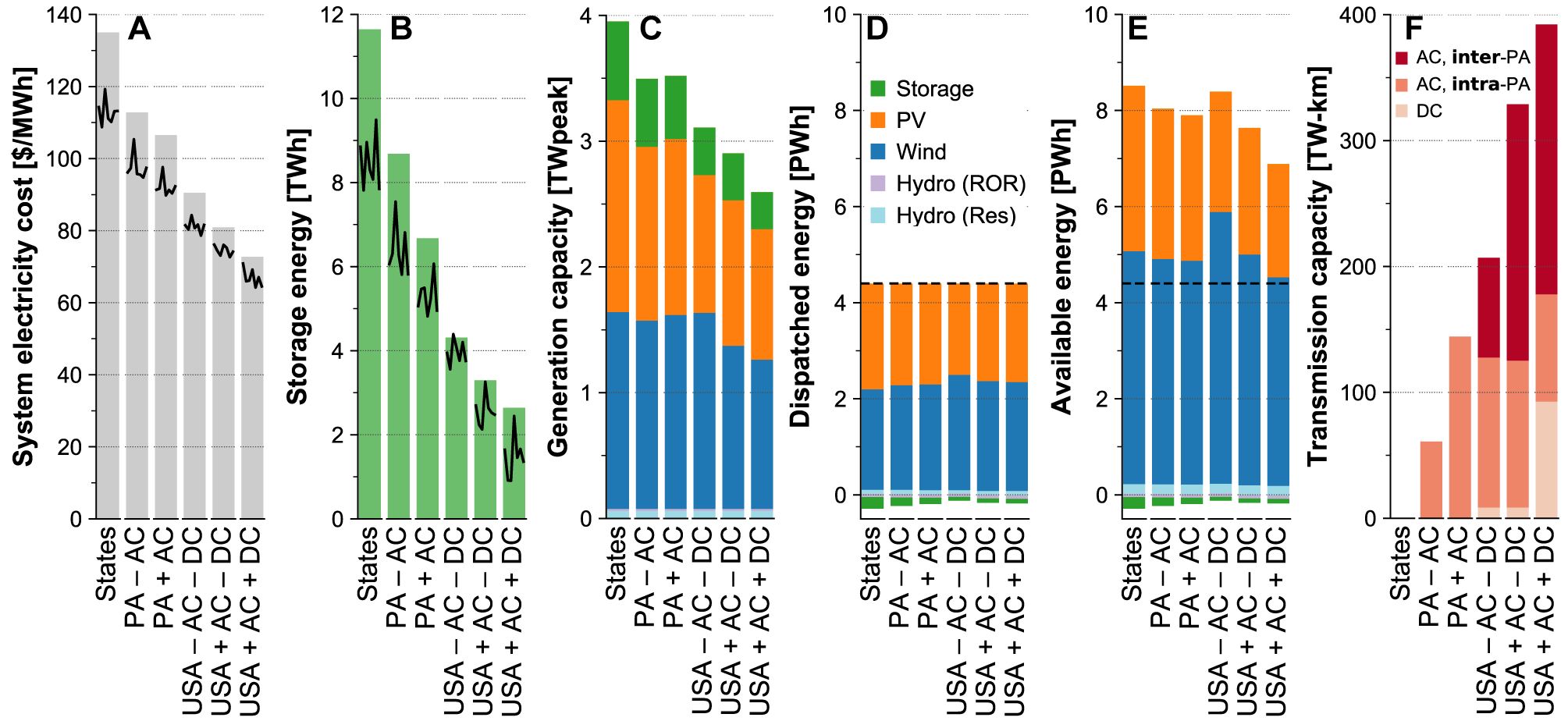
The current status of U.S. transmission integration is approximately represented by the “US-AC-DC” category, which presumes the existence of significant transmission links within the footprints of the country’s existing regional transmission organizations (RTOs) and independent system operators (ISOs) but with relatively little linkage between them.
In this scenario, a zero-carbon electricity system would drive wholesale power costs of about $90 per megawatt-hour on average. That’s roughly three times higher than typical average prices today, but still much less than the estimated $135 per megawatt-hour for reaching zero-carbon in a system limited to state-by-state action alone.
Adding new links between ISOs and RTOs — a major challenge under today’s regulatory and cost-recovery environment — could reduce those costs further to a little more than $80 per megawatt-hour.
And establishing high-voltage direct-current links between North America’s three macro-grids, the Eastern, Western and Texas interconnections, could cut average wholesale costs to just over $70 per megawatt-hour. That’s an even more challenging prospect, but one that the Energy Department’s interconnection seam study indicates could yield a nearly 3x cost-benefit ratio in terms of sharing generation capacity and flexibility across regions.
These results come from a linear optimization model that uses hourly weather data from 2007 to 2013, encompassing heat waves, winter storms and other weather events that can disrupt renewable power supply, Brown noted. It co-optimizes grid capacity investments and hourly operations costs of generation, storage, and transmission to meet projected electricity demand in 2040.
The differences in costs add up to big numbers over the course of the next two decades, he said. Each $10 per megawatt-hour in savings equates to roughly $44 billion per year by 2040.
But the biggest savings may well come at the final stages of decarbonization, which are acknowledged to be the most costly.
“If you want to go to zero-carbon, there’s a very steep additional cost, to go from, say, 90 percent decarbonization to 100 percent,” Audun Botterud, principal research scientist in the MIT Laboratory for Decisions and Information Systems and a consultant on the report, said in an interview. “[But] when you allow for transmission coordination across the country, the cost of going to zero is much lower.”
Translating transmission’s theoretical benefits to the real world
Johannes Pfeifenberger, a principal at energy and economic consultancy The Brattle Group who advised on the MIT study as a visiting scholar, said it adds to a growing body of research indicating the value of transmission when it comes to greening the U.S. grid.
“Over the past 10 years there have been a dozen, maybe two dozen, studies showing that if a higher share of renewable generation is the objective, then a more robust regional and interregional transmission grid is the most cost-effective solution,” he said in an interview. “Patrick’s study shows that even with low-cost storage and renewable resources now available, implementing clean energy policies on a national scale, rather than state by state or region by region, is quite compelling in its ability to reduce the total cost of supplying electricity.”
Similarly, a study from the University of California, Berkeley and GridLab released in June 2020 indicates that achieving a 90 percent clean-powered grid by 2035 could deliver wholesale electricity costs 13 percent lower than today, boosted by about $100 billion in transmission expansion investment.
Another study led by Princeton University released last month, which charts a $2.5 trillion pathway to a zero-carbon U.S. economy by midcentury, indicates that $350 billion in transmission investment will be needed to increase the size of the country’s high-voltage network by 60 percent by 2030 and as much as triple its current scale by 2050.
And a Wood Mackenzie analysis from last month shows that the biggest driver in achieving a 37 percent carbon-free grid by 2030 could come from roughly $70 billion in transmission investment — a relatively small share of the $690 billion in total investment needed to replace fossil fuel power plants with clean energy and batteries.
The big question for studies like these is how their findings might be translated into action in expanding the U.S. transmission grid. After some significant build-outs in the first half of the decade, transmission developments have slowed significantly in recent years, weighed down by the complexities of building massive capital projects across multiple jurisdictions, each capable of halting decade-long development processes through legal or regulatory challenges.
The incoming Biden-Harris administration’s goal of decarbonizing the U.S. electricity sector by 2035 will almost certainly require major changes in transmission planning, siting and cost allocation policies to achieve, according to industry groups and regulators.
The Federal Energy Regulatory Commission and the Department of Energy will play key roles in creating coordinated planning regimes that can shift from current models, which primarily look at relieving existing congestion, toward new approaches that take future clean energy growth needs into account, these observers agree.
“Because transmission has such a long lead time, it’s important to start thinking about these things now,” Brown said.
Netflix is reportedly quietly testing support for iOS 14’s new spatial audio functionality. According to a report from iPhoneSoft, citing an anonymous Netflix developer, the company has been testing spatial audio support on iPhone and iPad since December.
There is actually not much work that would be required on Netflix’s end to support spatial audio. The service already offers a variety of surround sound content, which is what spatial audio converts into virtual surround sound. Many streaming services, including Apple TV+, Hulu, and Disney+ already support spatial audio.
The iPhoneSoft report doesn’t include specific information on when Netflix will roll out spatial audio report, instead only vaguely suggesting a spring release with a “limited” catalog.
What is spatial audio?
The spatial audio feature is exclusive to AirPods Pro and AirPods Max, and the toggle is accessible via Control Center when your AirPods are connected.
Apple says that spatial audio is an immersive experience using directional audio filters to “play sounds virtually anywhere in space, creating an immersive sound experience.” This will put surround channels exactly in the right spot, even as you turn your head or move your device.
Here’s how Apple describes the spatial audio feature for AirPods Pro and AirPods Max users:
Spatial audio with dynamic head tracking brings the movie theater experience right to your AirPods Pro. By applying directional audio filters and subtly adjusting the frequencies each ear receives, spatial audio can place sounds virtually anywhere in space, creating an immersive surround sound experience. Using the gyroscope and accelerometer in your AirPods Pro and your iPhone, spatial audio tracks the motion of your head as well as your device, compares the motion data, and then remaps the sound field so that it stays anchored to your device even as your head moves.
One important thing to keep in mind is that only Netflix’s highest-end Premium tier supports Dolby Atmos surround sound. It’s possible that Netflix also limits Spatial Audio to the Premium subscribers too, but we don’t yet know the details.