FT : Chip shortage forces Audi to delay production

Chip shortage forces Audi to delay production
Chief executive says manufacturing of high-end models hit by ‘a crisis upon a crisis’

Audi will delay the production of some of its high-end cars because of the “massive” shortage of computer chips that is sweeping across the automotive industry, its chief executive said.

The luxury car marque, part of the Volkswagen group, has put more than 10,000 workers on furlough because the chip shortage has slowed its production lines, said its head, Markus Duesmann, in an interview with the Financial Times.

Audi will “do everything we can to keep it below 10,000 [fewer models produced] for the first quarter,” said Mr Duesmann.

The Volkswagen brand itself has said it will make 100,000 fewer cars in the first quarter as a result of the shortage of chips, with Nissan, Honda, Daimler, Renault and General Motors also saying they are facing problems. Ford said it would close its plant in Saarlouis, Germany from Monday until February 19, according to the DPA news agency.

Mr Duesmann described the problems as “a crisis upon a crisis”. Demand for cars slumped for much of last year because of the coronavirus pandemic, prompting auto suppliers to cut their orders for the computer chips that manage everything from a car’s brakes and steering to its electric windows and distance sensors.

But demand for cars jumped unexpectedly in the final three months of 2020, as buyers became more optimistic. Audi had its best quarter ever, largely because of a rebound in China.

“We had a very strong fourth quarter, but in the months before it was not so clear how that would develop, and everybody was quite surprised by the strength of the market in the last few months,” Mr Duesmann said.

This caught out car parts suppliers, who were forced to compete with surging demand from the consumer electronics sector, as new gaming consoles and smartphones hit the market. Carmakers themselves, having switched to just-in-time manufacturing, no longer keep stockpiles of supplies themselves.

Some chip companies have now prioritised the car industry, but the long lead times in chip production mean auto suppliers will have to wait several weeks for their orders to be fulfilled, according to industry insiders.

“There is a very long [supply] chain with different supply levels,” added Mr Duesmann, saying it was smaller auto suppliers that had problems keeping up with the increased demand.

The former BMW executive, who took over at Audi last April, added that the chip shortage might “also affect the second quarter, but only in the order in which we build cars”.

But he said that as things stand, the VW-owned marque’s overall output for 2021 would not suffer as a result, as Audi would make up for lost time in the latter half of the year.

FT : Why the ECB should go Japanese

Why the ECB should go Japanese
Yield curve control makes monetary policy more effective

Amid its pandemic firefighting, the European Central Bank is ploughing on with a strategic review of its monetary policy framework. One previously neglected idea is coming into the discussion. Pablo Hernández de Cos, Spain’s central bank governor, suggests that the ECB could explore “yield curve control”, or the policy of directly setting long-term interest rates.

It is not a novel policy. Since 2016, the Bank of Japan has committed to keeping the market yield on 10-year Japanese government bonds near zero. The BoJ will buy or sell whatever quantity of bonds is needed to meet this goal.

Targeting long-term rates is an alternative to quantitative easing — mass bond buying — and forward guidance. It achieves directly what QE does indirectly: lower long-term market yields on benchmark securities so as to encourage investors to direct capital elsewhere, ideally to productive investment by businesses wishing to expand. It also directly affects the market cost of borrowing for longer periods, which forward guidance tries to achieve by signalling to markets that central banks will keep short-term rates low for some time into the future.

Why use a tool that gets the same results through other means?

The first answer is that it does so more effectively. Compared with QE, directly targeting 10-year borrowing costs takes the guesswork out of how many government bonds the central bank must buy to achieve what it deems appropriate financial conditions. Compared with forward guidance, direct targeting removes the risk to financial intermediaries that the central bank may not make good on its guidance, and change short rates sooner than it now predicts. This also means the central bank does not hurt its own credibility if it needs to tighten sooner than it thought.

A second answer is that precisely because yield curve control makes little difference to other tools today, now is the least disruptive time to introduce it. At some point policy will need changing, perhaps to tighten in a recovery, or perhaps to offset upward pressure on market rates from US budget stimulus.

In either case, yield curve control would let the ECB move or keep long rates where it sees fit, and avoid politically difficult and technically uncertain deliberation of how many bonds to buy. In fact, Japan’s experience shows that explicitly targeting the 10-year rate reduces the need to buy bonds at all. That should be attractive for the ECB. Its original decisions to engage in large-scale bond purchases were politically excruciating, and thus too slow.

A third argument is that lowering — or lifting — rates is far simpler to communicate to the public than bond purchase programmes in the trillions.

What are the arguments against it? One is that yield curve control falls under the treaty prohibition on credit facilities to governments. But why should targeting long-term market rates be less acceptable than buying huge amounts of government bonds to achieve the same result?

Another objection is that there is no obvious long-term bond yield to target. There are 19 eurozone sovereigns, and the ECB currently buys a portfolio of all their debts. But this objection no longer applies. The EU is ramping up the issuance of common European bonds in order to fund its recovery policies. The yield of the 10-year common European bond would be a perfect benchmark for the ECB to target.

This would not address another motive for the ECB’s bond-buying, which is to keep securities markets functioning smoothly, in particular for high-debt eurozone governments. But every economist is familiar with what is known as the Tinbergen rule: for each policy goal you need a dedicated instrument. Market functioning and optimal long-term market rates are different goals. Using yield curve control to achieve the latter leaves bond purchase programmes free to focus on the former.

But yield curve control could have a side benefit, too — one even more important than its main function as a monetary policy tool. Making the common European bond yield an operational target for monetary policy would encourage markets to adopt it as a benchmark for pricing other securities. In time, this would help nudge European banks away from their bias towards holding their own national government’s bonds, a source of instability the ECB and other EU policymakers want to reduce.

Adopting yield curve control today would not just improve monetary policymaking. It would also give significant support to the EU’s policy objective of a banking union. Beyond its price stability mandate, this is a form of support the ECB is treaty-bound to give.

WSJ : NASA’s Delayed Deep-Space Rocket Suffers Test Failure on the Ground

NASA’s Delayed Deep-Space Rocket Suffers Test Failure on the Ground
Latest setback for mammoth booster adds to challenges for prime contractor Boeing’s space ambitions

NASA and Boeing Co. BA -2.66% suffered a potentially major setback in their deep-space ambitions when the engines for a giant new rocket shut down prematurely Saturday during a key test on the ground.

The engines were supposed to produce power for eight minutes but shut down after about 60 seconds while fastened to a stand at the Stennis Space Center in Mississippi. Program officials had said four minutes would be the minimum time to gain confidence in the reliability of the engines, fuel system and surrounding structures.

National Aeronautics and Space Administration officials said they couldn’t immediately determine the cause of the premature shutdown, and therefore it was too early to determine what fixes would be necessary or even if the test needed to be repeated. They said engineers didn’t know whether it was a hardware, software or sensor malfunction.

Boeing is the prime contractor for the mammoth Space Launch System booster, which is more powerful than the Saturn V that blasted Apollo astronauts toward the moon in the late 1960s and early 1970s. It was slated for its first uncrewed launch late this year, but that schedule is now in flux. Political and budget pressures on the program, projected to cost a total of between $19 billion and $23 billion to complete, were already increasing.

Departing NASA chief James Bridenstine repeatedly said in a news conference that the test shouldn’t be considered a failure, because engineers and program managers gained important data. But he also said, “It’s not everything we hoped it would be.”

“Not everything went according to script,” he said. A Boeing spokesman declined to comment.

The setback comes at a difficult time for SLS and Boeing. Industry and government officials expect the Biden administration to shelve President Trump’s vision of landing astronauts on the moon as early as 2024. For many years, influential Senate Republicans have championed SLS—and annually appropriated robust funding for it—despite its troubled development. But with the Senate now controlled by Democrats, those supporters stand to lose significant clout.

Even before Saturday’s failed test, former NASA officials and outside space experts said they expected that for early lunar missions SLS—intended to become NASA’s premier deep-space rocket—might take a back seat to rockets under development by Space Exploration Technologies Corp., run by Tesla Inc. Chief Executive Elon Musk, and Blue Origin Federation LLC, run by Amazon.com Inc. Chief Executive Jeff Bezos.

Months before the test, according to industry officials, leaders of Aerojet Rocketdyne Holdings Inc., which manufactures the SLS rocket’s RS-25 engines, expressed growing concerns the entire SLS program could be curtailed or significantly delayed. These officials said the company leaders were telling supporters on Capitol Hill they worried NASA was considering such commercially developed alternatives to support the initial lunar missions.

Congress originally called for the SLS rocket and a companion deep-space capsule, known as Orion, to take flight by the end of 2016. Later, NASA’s target date for a 2018 uncrewed launch slipped to 2019, and then, partly due to the Covid-19 pandemic, to the end of 2021.

A series of reports by government watchdogs have highlighted scheduling delays and safety issues, while noting that program managers burned through budget reserves and took testing shortcuts to make up time.

Backers of the SLS program have sought to maintain public support for it. With development slow and the first flight expected to lack the fanfare and publicity associated with carrying a crew, proponents had viewed Saturday’s test as a way to generate momentum.

Boeing’s space program has suffered a series of setbacks in recent years. In December 2019, software errors botched the launch of its Starliner space capsule, highlighting recent engineering lapses across the company, which also makes commercial jets and military aircraft.

The Starliner capsule is intended to ferry astronauts to the International Space Station. The SLS rocket, on which Boeing is the prime contractor for the various stages as well as the flight control system, is a separate program. It is intended to carry astronauts to the moon and deeper into the solar system using the Orion capsule, a different spacecraft built by a team headed by Lockheed Martin Corp. LMT -0.05%

(ZH) Everyone Is In The Pool. More Buyers Needed

Everyone Is In The Pool. More Buyers Needed

Everyone Is In The Pool - https://bit.ly/3quo9zi
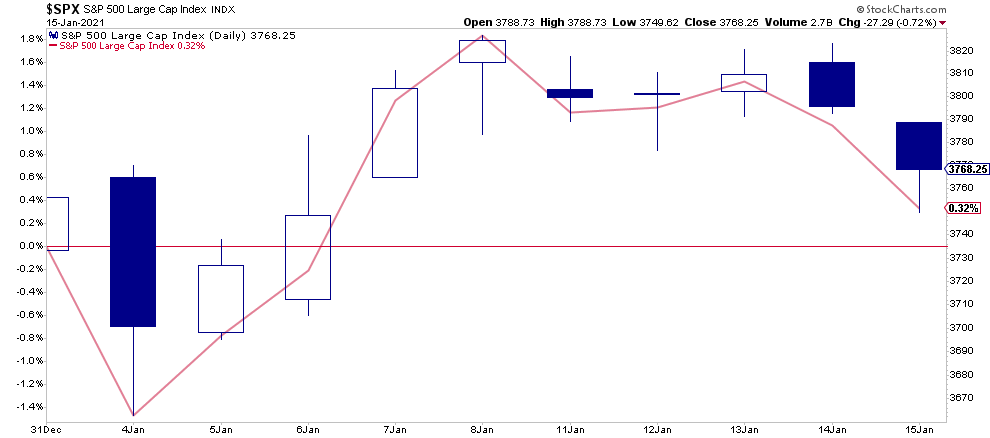
At the halfway point of January, the market has struggled to hold onto its gains. Such is surprising given the recent passage of a $900 billion stimulus bill and Biden’s proposal for another $1.9 trillion on Thursday. With another $2.8 trillion in stimulus hitting the economy, inducing the Fed to do more QE, markets were seemingly unimpressed.
For the first two weeks of January, the market is up by 0.32% YTD.
As we discussed recently in “There Is No Cash On The Sidelines,” the markets are driven by buyers’ and sellers’ supply and demand.
In the current bull market advance, few people are willing to sell, so buyers must keep bidding up prices to attract a seller to make a transaction. As long as this remains the case, and exuberance exceeds logic, buyers will continue to pay higher prices to get into the positions they want to own.”
Such is also the definition of the “Greater Fool Theory:”
“The greater fool theory states that it is possible to make money by buying securities, whether or not they are overvalued, by selling them for a profit at a later date. This is because there will always be someone (i.e. a bigger or greater fool) who is willing to pay a higher price.”
The problem comes when buyers are no longer willing to pay a higher price. When sellers realize the change, there will be a rush to sell to a diminishing pool of buyers. Eventually, sellers begin to “panic sell” as buyers evaporate and prices plunge.
3-Risks In 2021
As we will discuss in a moment, there is ample evidence that “everyone is currently in the pool.” Such leaves the market vulnerable to three risks we debated over the past week:
  1. More stimulus and direct checks into the economy lead to an inflationary spike that causes the Fed to discuss hiking rates and tapering QE.
  2. The current rise in interest rates continues over higher inflation concerns until it impacts a debt-laden economy causing the Fed to implement “yield curve control.”
  3. The dollar, which has an enormous net-short position against it, reverses moves higher, pulling in foreign reserves, causing a short-squeeze on the dollar.
The reality is that both a rise in the dollar, with higher yields, is likely to start attracting reserves from countries faced with economic weakness and negative-yielding debt. Such would quickly reverse the tailwinds that have supported the equity rally since March.
The following video covers the current market exuberance and the importance of the dollar.

The Problem With Monetary Policy
There is also the problem of monetary policy. As discussed in “Moral Hazard,” investors are chasing risk assets higher because they believe they have an insurance policy against losses, a.k.a. the Fed.
However, this brings us to the one question everyone should be asking:
“If the markets are rising because of expectations of improving economic conditions and earnings, then why are Central Banks pumping liquidity like crazy?”
Despite the best of intentions, Central Bank interventions, while boosting asset prices may seem like a good idea in the short-term, in the long-term has harmed economic growth. As such, it leads to the repetitive cycle of monetary policy.
  1. Using monetary policy to drag forward future consumption leaves an enormous void that must get continually refilled in the future.
  2. Monetary policy does not create self-sustaining economic growth and therefore requires ever-larger amounts of monetary policy to maintain the same activity level.
  3. The filling of the “gap” between fundamentals and reality leads to consumer contraction and, ultimately, a recession as economic activity recedes.
  4. Job losses rise, the wealth effect diminishes, and real wealth gets destroyed.
  5. The middle class shrinks further.
  6. Central banks act to provide more liquidity to offset recessionary drag and restart economic growth by dragging forward future consumption.
  7. Wash, Rinse, Repeat.
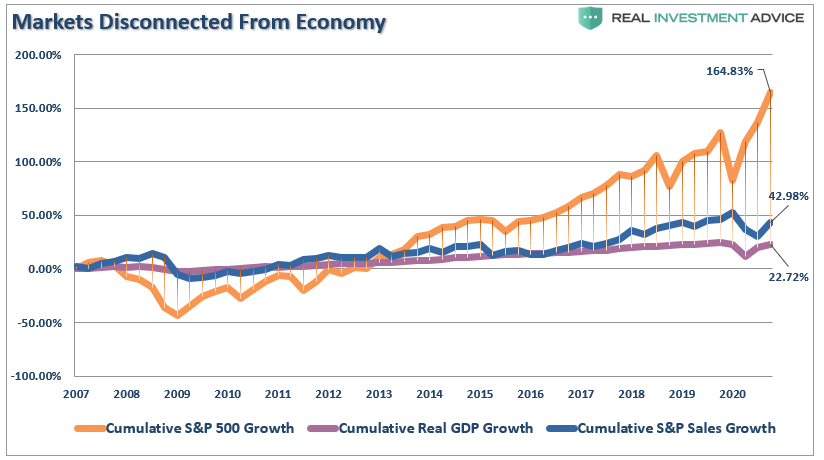
If you don’t believe me, here is the evidence.
The stock market has returned more than 164% since the 2007 peak, which is more than 3.8x the growth in corporate sales, and 7.5x more than GDP.
But, for the 10% of the population that owns 90% of the stock market, the sentiment is now getting extreme.
Sentiment Is Getting A Bit Extreme
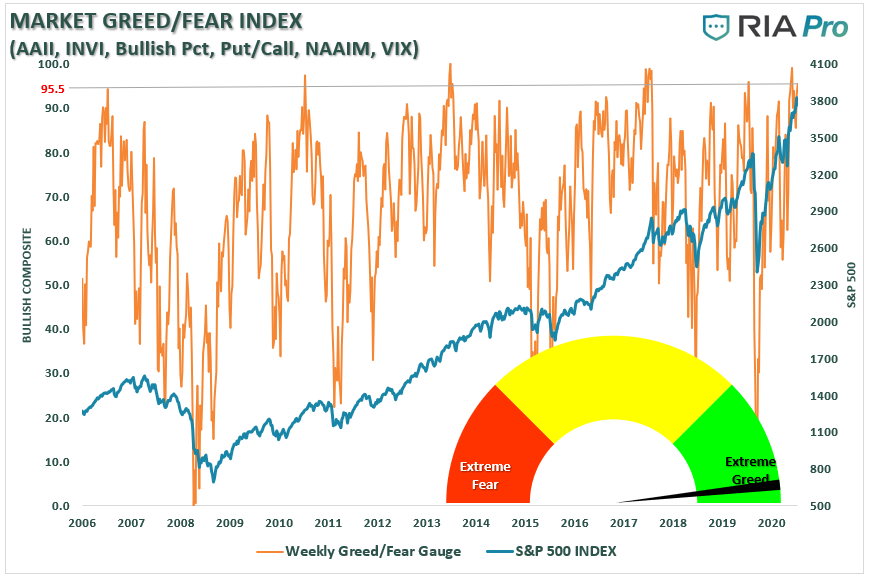
While the video discusses some of the extremes currently developing in the market, none better shows this than our investor sentiment gauge. As explained previously, this gauge compiles several measures of investor “positioning” in the markets in terms of actual equity exposure. As shown, we are at levels that have historically had poor outcomes.
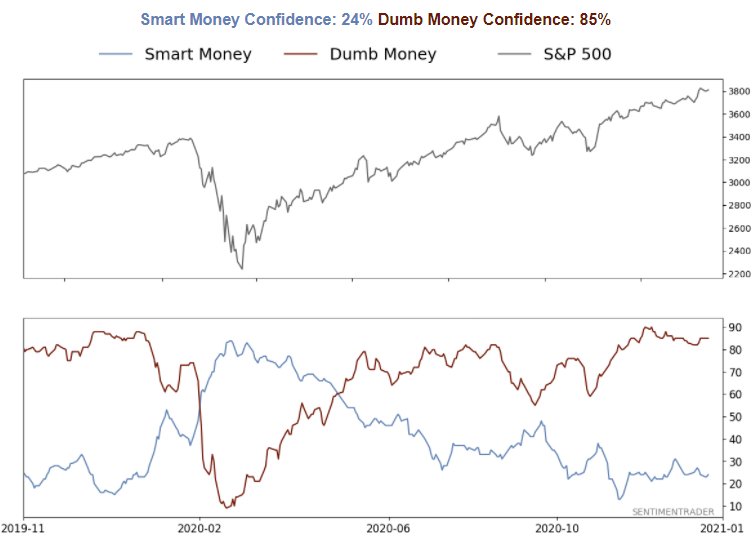
Of course, seeing that, you shouldn’t be surprised to see that retail investor confidence (dumb money) is near its highest levels on record.
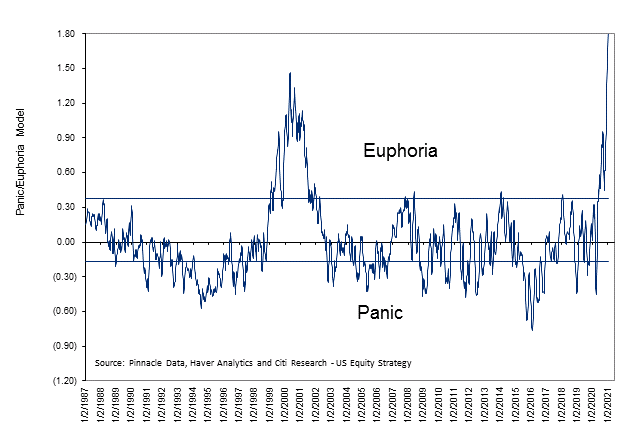
The interesting thing about the market is that investors are rushing into equities in anticipation of an economic recovery. However, while there will indeed be a recovery, it is likely to fall far short of investor expectations. Such is generally the case. However, with “euphoria” now at mania levels, the only question is just how disappointed they will be?
As noted above, it is quite clear everyone is “now in the pool.” Such raises the question of:
“Who is left to buy?”
Technical Warning Signs
While sentiment measures are certainly worth considering, as the old axiom goes, “markets can remain irrational longer than you can remain solvent.” Therefore, from a portfolio management point of view, we want to focus on the technical signs, suggesting that starting to hedge against “risk” is likely prudent.
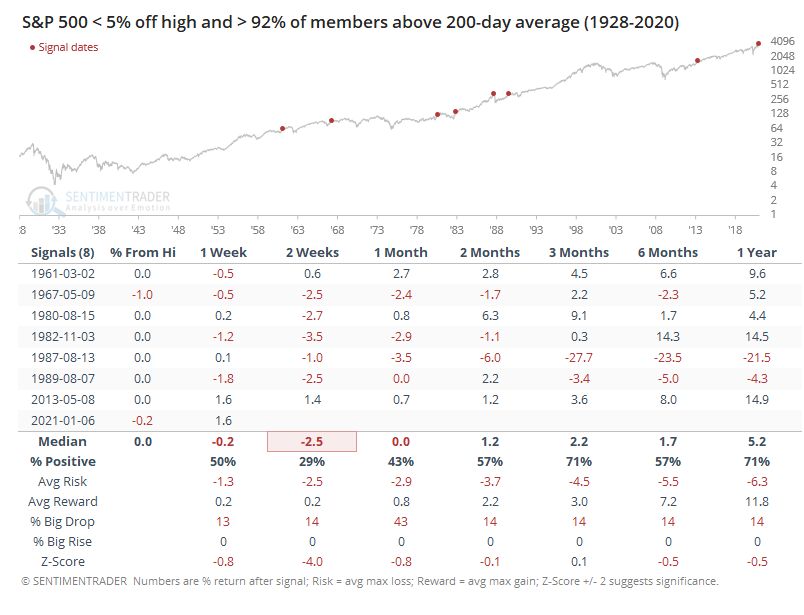
When markets are exuberantly bullish, along with investors believing there is “no risk” to investing, you see virtually every stock moving higher. We can view this specifically in looking at the number of stocks trading above their 200-dma. As noted by Sentimentrader:
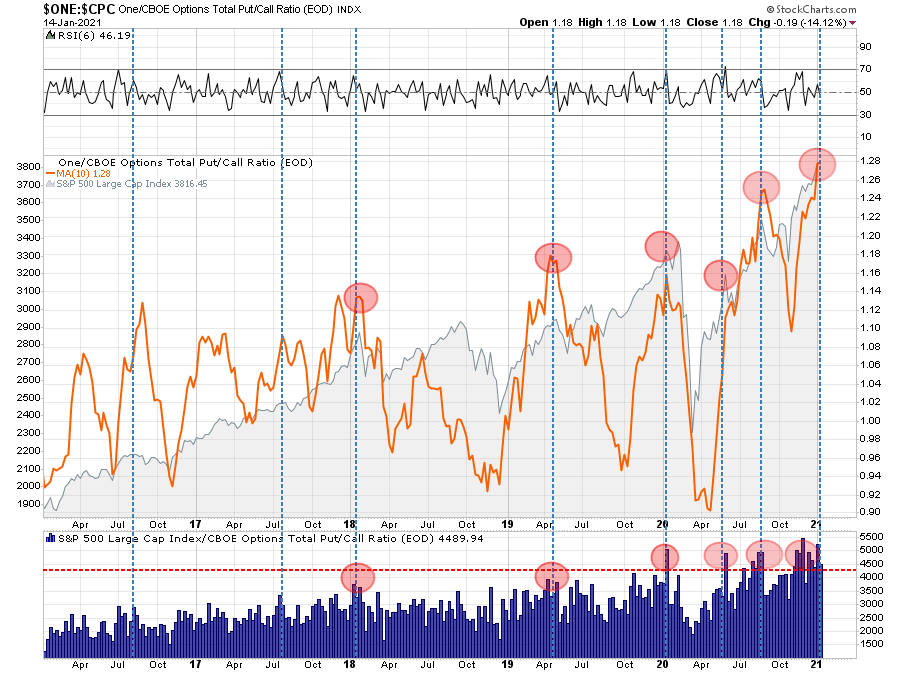
Of course, to no surprise, the put/call ratio is back to a record that usually has preceded short-term corrections.
Such does not mean the market is about to crash, although such would not be unprecedented. The combination of these indicators does suggest that a correction between 5-10% is likely within the next couple of weeks.
What will cause that correction? Who knows. But such is why we have slowly started adding some “risk hedges” back into our portfolios this week. Profit-taking will come next.
A Heat Map Of Valuations
By Michael Lebowitz, CFA
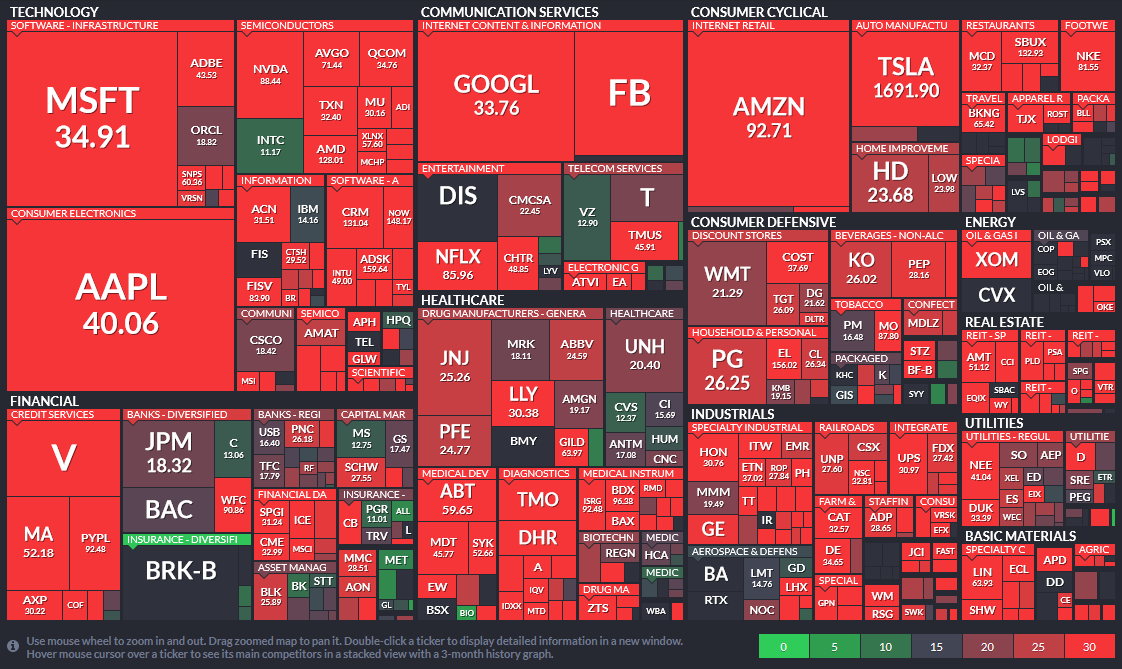
We talk a lot about valuations and their importance, but such discussions can be hard to put into context. Therefore, I have produced a series of charts that visualize various valuations of the S&P 500 companies. Not surprisingly, such also corresponds to the current behavior of Wall Street analysts and investors. Instead of cluttering up the commentary space on RIAPro.Net (30-day Risk-Free Trial),we thought you would better appreciate the charts and can share them more easily in an article format.
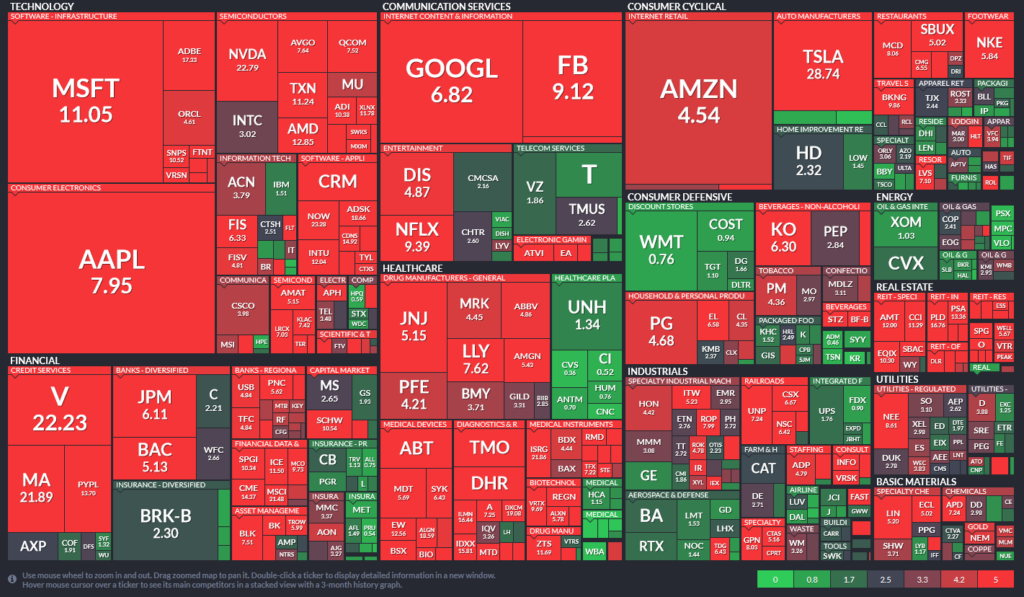
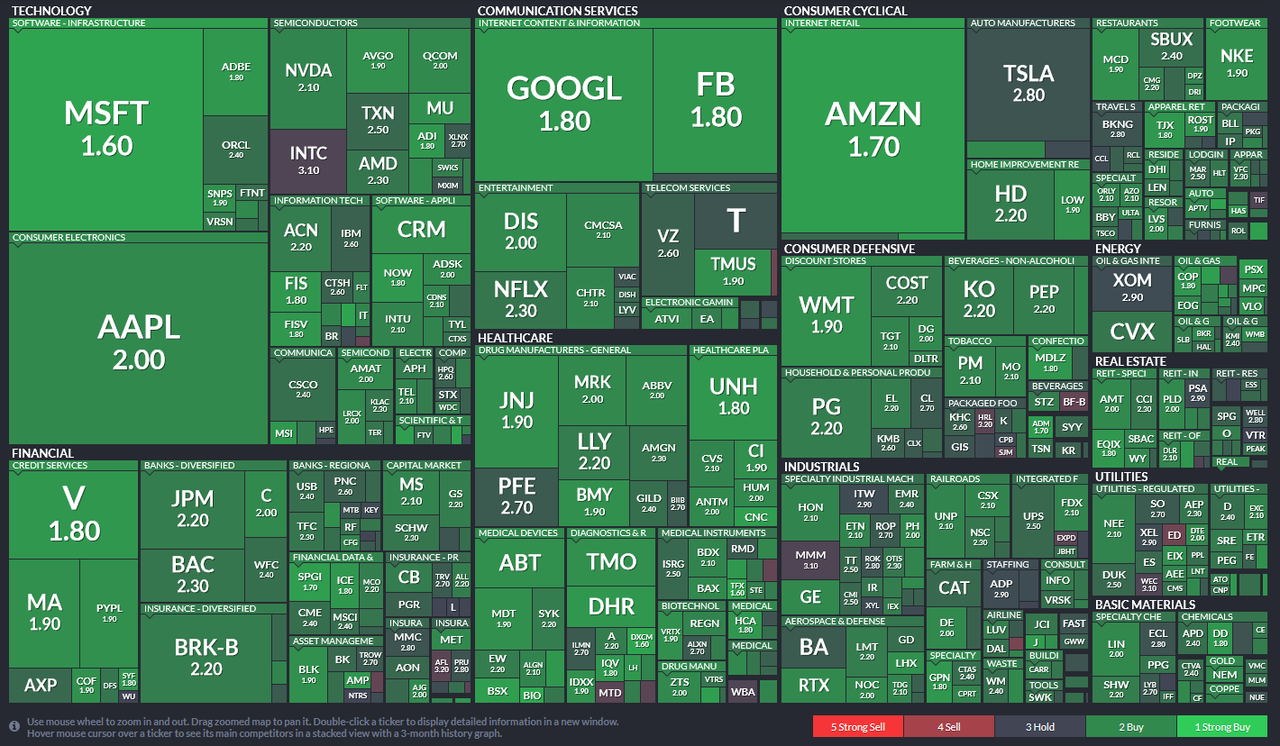
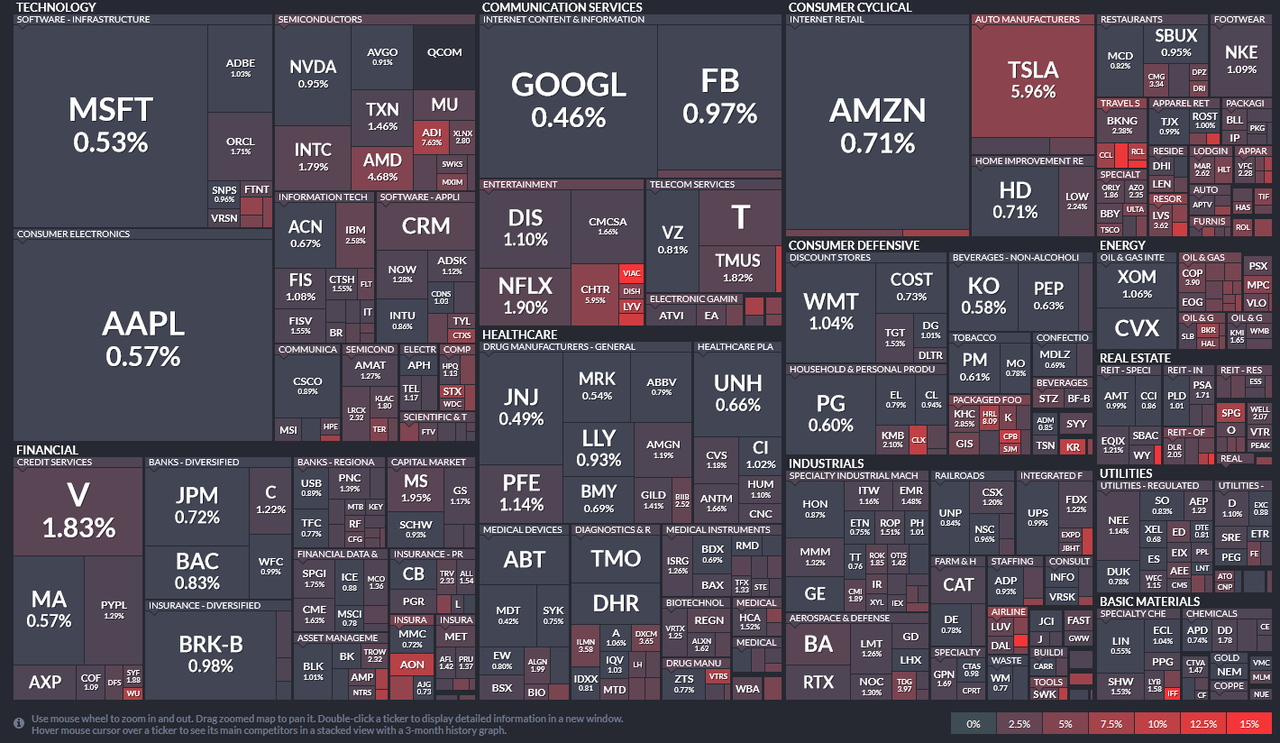
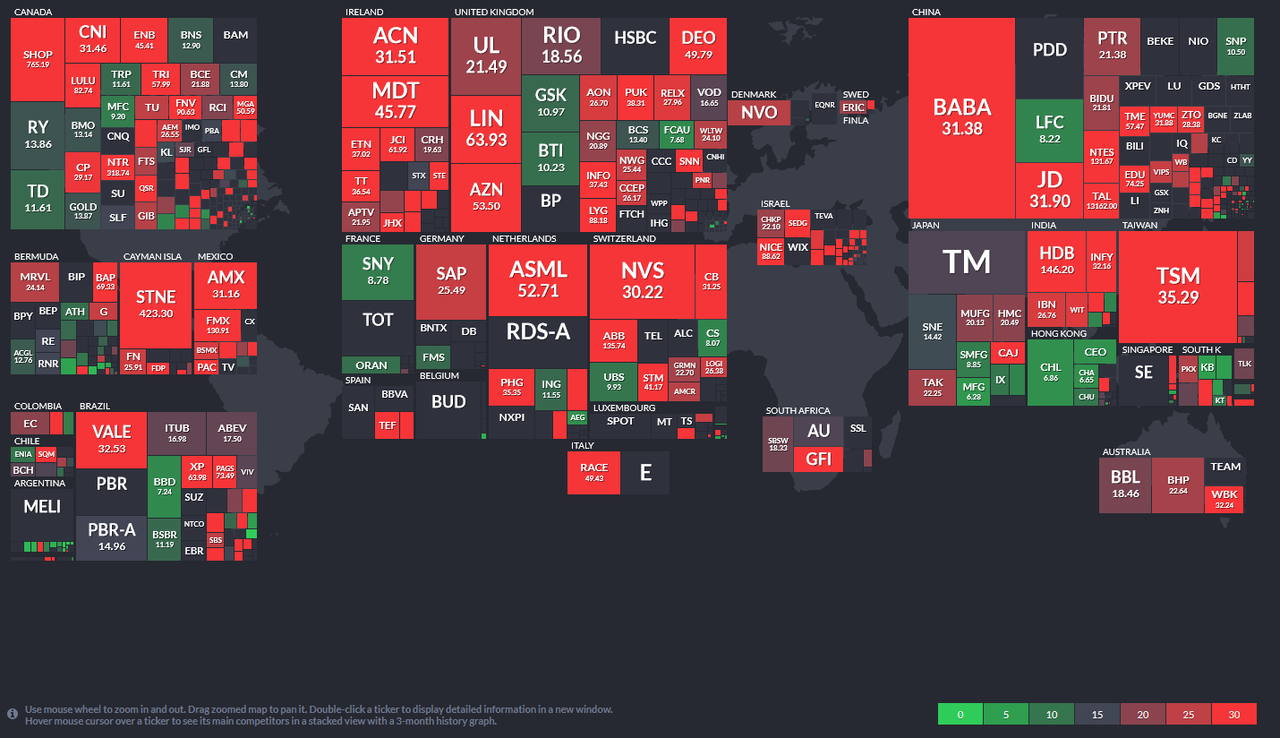
The charts below are called heat maps. What we like about heat maps is their ability to show two data points in one easy to read format. The following maps show the S&P 500 components market cap and along with a second factor. The larger the company’s market cap is in relation to other companies in the sector, the larger the square. Each graph has a scale on the bottom right relating to the second factor. In the first graph (Price to Earnings), the brighter the red, the more overvalued a company is. Conversely, green is relatively cheaper. Companies are sorted by their sectors and sub-sectors.
The first three graphs are popular measures of valuation. The fourth graph shows that analyst recommendations, despite valuations, are pretty bullish. As shown in the fifth graph, investors are also overly bullish as there is a very low percentage of short positions in general. Lastly, the sixth graph shows this is not just domestic, but high valuations are occurring in many other countries.
1. Price to Earnings:
You have to look pretty hard to find stocks that are not wildly overvalued.
2. Price to Sales:
A ratio between 2-3 is considered somewhat normal, especially for well established mature companies.
3. Price to Book:
P/B is also typically in the lower single digits for mature companies.
4. Analyst Recommendations
You have to look pretty closely to find stocks that do not have buy recommendations.
5. Short Interest as a % of total float:
The continual grind higher has scared away almost all short sellers.
6. World Price to Earnings:
These are not as extreme as the U.S., but P/E ratios around the world are very high. Keep in mind that historical P/E ratios in most countries are lower than in the U.S. for several reasons. But importantly, P/E ratios are relative to the country that domiciles the company. Therefore, just because it may appear cheap relative to the U.S. does not necessarily mean it is a value.
No matter how you look at the markets, either from a technical or fundamental point of view, the long-term risk/reward is not favorable.
What eventually derails the bullish bias is unknown. However, what is certain is that when it occurs, given the more extreme levels of leverage combined with a lack of liquidity, the reversion will be swift.
During a bull market advance, investors always take on substantially more risk than they realize. Unfortunately, it is a painful lesson taught quickly and repeatedly throughout history.
FT : US state officials call for greater scrutiny of potential G4S takeover

US state officials call for greater scrutiny of potential G4S takeover
Fears that private-equity backed deal could harm conditions for security guards

US state officials and unions are calling for greater scrutiny of a potential private equity-led takeover of UK security group G4S, amid concerns that it could harm working conditions for hundreds of thousands of low-wage security guards worldwide.

Two private equity-backed bidders are vying for G4S, which operates in 83 countries. If either succeeds, the combined company would be one of the world's largest private-sector employers. 

London-listed G4S is already the biggest private security company in the world, managing prisons in the UK and immigration detention centres in Australia as well as providing transport and security guards for customs and border patrols in the US.

Michael Frerichs, state treasurer of Illinois and an elected Democrat, whose office manages about $35bn and invests in private equity funds, urged institutional investors to demand greater transparency from both suitors.

“Neither bidder has disclosed to us key aspects of their business plan, including how to manage opportunities and risks in the event of a merger,” he said at an online forum organised by the Private Equity Stakeholder Project, a lobby group. “The vast majority of these employees are essential workers, raising the stakes for all stakeholders to review this transaction.”

Tobias Read, the state treasurer for Oregon, said he wanted to “learn more about how the companies will handle complicated questions” including how to protect their workers’ health amid the pandemic. “Some corporations don't really listen to smaller investors . . . as elected officials we tend to have a larger megaphone,” he said.

The G4S board has recommended a 245p-per-share takeover bid from Allied Universal, which is backed by Warburg Pincus and the Canadian pension fund Caisse de dépôt et placement du Québec. But G4S shareholders are yet to approve the deal and appear to be waiting for a higher offer from BC Partners-backed GardaWorld. Shares in G4S closed at 260p on Friday. 

Oregon and Illinois have both previously committed funds to Allied owner Warburg Pincus

G4S has faced investor scrutiny before. In 2019, Norway’s $1tn oil fund sold out of the company after it found that migrant workers in the Middle East were being harassed and paid lower wages than agreed.

The European Works Council, representing G4S employees, has also written to shareholders calling for bidders to both rule out job losses and adhere to pledges on ethical investment. 

The letter notes that Allied’s offer implies “future restructuring and potential redundancies” at the same time as offering a £2m one-year contract for Ashley Almanza, the chief executive of G4S for the past seven years, to oversee the sale to Allied.

PayScale, which tracks wages, says a G4S security guard in the UK earns an average £8.32 an hour and a security officer £8.15 an hour. If Allied succeeds in buying G4S, the combined company would have aabout 760,000 workers globally, while if GardaWorld wins, the enlarged company would have 635,000.

Allied has already pledged to pull out of the G4S business running four out of 13 private jails in the UK, despite the company recently winning a £300m contract by the Ministry of Justice to run a new prison in Northamptonshire.

GardaWorld has said that it would axe the UK management team, including Mr Almanza, although it would retain a UK headquarters. It is in discussions with its banks — Merrill Lynch, Barclays, UBS and Jefferies — as to how much it could raise its offer for the business following an aggressive campaign to discredit its rival.

“We will invest in the business’s growth, empowering and incentivising G4S’s employees to offer excellent service,” GardaWorld said. “In stark contrast, an acquisition of G4S by Allied, combining two of the top three players in the US, would undoubtedly bring massive restructuring in some states, affecting employees.”

Allied said: “We attach great importance to the skills and experience of G4S’s employees.”

G4S said an “important part of reaching agreement with Allied Universal was confirmation that the existing contractual and employment rights of G4S employees will be safeguarded”.

BoF : Inside Farfetch’s Bid to Dominate Luxury E-Commerce — Download the Case St

Inside Farfetch’s Bid to Dominate Luxury E-Commerce — Download the Case Study
During a blockbuster year for online sales, Farfetch surged ahead of rivals to position itself at the front of luxury’s e-commerce race. Can it spin the current momentum into sustainable — and profitable — growth and become the unrivalled platform for luxury fashion online?

A year ago, the biggest players in luxury e-commerce faced an uncertain future. Myriad competitors had flooded a space once dominated by Net-a-Porter, ranging from vast marketplace Farfetch to niche challengers like MyTheresa, MatchesFashion and Ssense. These sites were largely undifferentiated, often selling the same products at the same price, while offering similar customer experiences. That led to high marketing costs, frequent promotions and difficulties reaching the necessary scale to pay off significant investments in technology, logistics, rapid shipping and other white-glove services.

At the same time, luxury brands were ramping up their own e-commerce stores and shoppers were flocking to social media platforms like Instagram for style advice and product curation, eliminating much of the need to digitise the traditional multi-brand retail model. “They’re all losing money. It’s not a good sign,” LVMH chairman Bernard Arnault said in a January 2020 presentation, commenting on the challenges faced by his company’s own multi-brand e-commerce venture, 24S. “The bigger they get, the more money they lose.”

One player in particular faced an uphill battle to reassure investors about its future: Farfetch, the marketplace founded and led by José Neves, which had made a name for itself by short-circuiting luxury brands who were slow to enter e-commerce. Instead of relying on the brands for stock, he had created a platform for multi-brand boutiques around the world to sell their inventories online. A year after raising $885 million in a much-hyped initial public offering, Farfetch faced mounting concerns about its lack of profitability and high costs for acquiring clients. Market support collapsed following an unexpected move to acquire Milanese streetwear manufacturer New Guards Group, and by the autumn of 2019, Farfetch shares were trading at less than 40 percent of their IPO price.

Fast-forward to a year later and the coronavirus pandemic has driven a luxury e-commerce boom. Amid a freeze in long-haul tourism and the intermittent closures of physical boutiques due to coronavirus containment measures, e-commerce has scooped up an unprecedented share of luxury demand.

Farfetch enjoyed the most dramatic turnaround. Its market capitalisation grew by a whopping 475 percent in 2020 — more than other companies that experienced a notable pandemic boom, like vaccine-maker BioNTech (whose shares went up 125 percent) or home cycling hit Peloton (up 432 percent).

Neves has said the company will report positive EBITDA (a measure of profit) for the first time ever for the fourth quarter of 2020. Last November, the company inked a blockbuster deal aimed at accelerating its expansion in China — already the growth driver for luxury and more important than ever following the country’s comparatively swift economic recovery. The partnership signed with Chinese e-commerce giant Alibaba and Swiss luxury group Richemont (alongside Pinault family holding company Artémis) raised $1.1 billion and has pushed excitement about the company to new heights.

Investors are now betting that Farfetch will not only become profitable, but that it can fulfil its mission to become the world’s go-to marketplace for high-end fashion, “connecting creators, curators and consumers.” In short, they’re betting it can be the so-called Amazon of luxury. “If not them, who else could be?” Cowen analyst Oliver Chen said.

In our April 2020 case study, “The Next Wave of Luxury E-Commerce,” The Business of Fashion explored the rise of Yoox Net-a-Porter (YNAP) and how its dominant position in online luxury gradually eroded amid mounting competition from brands’ own websites, marketplaces like Farfetch and niche online boutiques with devoted followings.

Now, we take a closer look at Farfetch, and how it has seized the pandemic opportunity in luxury e-commerce to surge ahead. The value of products sold on its marketplace grew by nearly 50 percent during coronavirus lockdowns in the spring of 2020, and are now close to overtaking the sales of chief rival Net-a-Porter.

Looking ahead, how strong is Farfetch’s advantage in the luxury e-commerce race? A $21 billion market capitalisation certainly sets it apart from the pack. But can Farfetch buck the trend of luxury brands moving to more direct relationships with consumers, both online and off — a strategic shift which risks cutting out multi-brand players? And how will it fend off the challenge from technology giants like Amazon, which is redoubling its efforts to break into selling luxury fashion, or Alibaba, which has invested in Farfetch even as its own high-end venture, the Tmall Luxury Pavilion, continues to gain ground?

We’ll understand what makes Farfetch stand out to investors, including its marketplace model and technology investments, and how fashion brands’ increased appetite for its services allowed it to stage a spectacular comeback in the market and nab a historic deal.

BoF : US Clothing Retail Sales Declined 12 Percent in December

US Clothing Retail Sales Declined 12 Percent in December

The drop, which also includes sales of accessories and shoes, was reported Friday by the Commerce Department. Overall retail purchases at stores, restaurants on online retailers declined for the third month in a row, down 0.7 percent in December.

Data from the National Retail Federation, which does not include restaurants or gasoline and auto sales, showed holiday sales actually grew 8.3 percent year-over-year, with home improvement stores and online retailers driving growth, while apparel chain and department store sales declined.

There are other negative indications showing a slowing US economy this winter. Employers cut 14,000 jobs in December, marking the first decline since the pandemic hit last spring.

But research firm NPD Group, whose data is focused on sales of apparel and personal-care products at multi-brand retailers, reported that sales (including e-commerce) increased 27 percent in the week ending January 9, the largest increase since the start of the pandemic.

Barrons : Why Clover Health Chose a SPAC, Not an IPO, to Go Public

Why Clover Health Chose a SPAC, Not an IPO, to Go Public

When going public is a company’s ultimate goal, the method of doing so isn’t the most important factor.

Consider Clover Health Investments, which provides Medicare Advantage health plans to 57,000 members. The six-year old start-up began the process of going public over the summer, preparing for two scenarios: a traditional initial public offering and a merger with a blank-check company, according to a spokeswoman.

In October, Clover was far down the road with a traditional IPO and had made a number of filings with the Securities and Exchange Commission, according to Andrew Toy, Clover’s co-founder, president, and chief technology officer. The insurtech chose to combine with Social Capital Hedosophia Holdings Corp III, a special-purpose acquisition company backed by the venture capitalist Chamath Palihapitiya, in a $3.7 billion merger. Clover Health (ticker: CLOV) began trading on Jan. 8.

The major reason to merge with this particular SPAC was Palihapitiya, a former Facebook (FB) executive. Palihapitiya has used blank-check firms to buy several companies. His first SPAC, Social Capital Hedosophia, merged with Virgin Galactic (SPCE) in 2019. His second, Social Capital Hedosophia II (IPOB), agreed to a $4.8 billion merger with Opendoor, a real estate start-up, in September. Palihapitiya’s fifth SPAC, Social Capital Hedosophia Holdings V, scooped up SoFi earlier this month in an $8.65 billion deal.

“He’s a great investor,” Toy said.

Clover Health considered the different routes to a public offering. Each method—a traditional IPO, a direct listing, or a SPAC—had benefits and downsides, he said. “Like any choice in life,” Toy said.

Traditional IPOs are a well-defined road to going public, but they can spell trouble if a company tries to list when the stock market is plunging. Roadshows for traditional IPOs aren’t well-suited to younger companies because they don’t offer much time, typically an hour, for management teams to introduce themselves to analysts, Clover executives said. Many startups don’t have years of historical financial information to provide, they said.

Direct listings—where existing shares are sold without the help of underwriters —came about because companies were dissatisfied with the pricings of traditional IPOs, Toy said.

Direct listing, however, generally haven’t allowed companies to bring capital onto the balance sheet, he said. (The SEC in December approved a NYSE rule change that addresses the issue, allowing companies to use direct floor listings to raise capital.)

“SPACs give you something in between and you end up with a tradable company,” Toy said.

One of the major benefits of blank-check companies is that they provide certainty about what investors will be buying into a company, as well as about how much capital will be raised, Toy said.

For example, Clover Health’s merger with Social Capital Hedosophia Holdings Corp III delivered $1.2 billion in gross proceeds to the insurtech. This included a $400 million public investment in private equity, or PIPE, from investors such as Fidelity Management & Research Co, Jennison, Sen. Investment Group LP, Casdin, and Perceptive Advisors.

If Clover Health had stayed with the traditional IPO, the company would have been subject to market conditions two weeks prior to the offering, said Clover Health CEO and co-founder Vivek Garipalli. That means the amount of capital raised would have depended in part on general sentiment about the economy.

The underwriters would have selected the investors the night before Clover went public, Garipalli said. In the sale to Social Capital Hedosophia Holdings Corp III, Clover Health picked its PIPE investors the night before it announced the deal, a spokeswoman said.

In addition to the $400 million PIPE, Clover received up to $828 million of cash held in the trust account of Social Capital Hedosophia Holdings Corp. III. This money, intended for investment in whatever company the SPAC ultimately merged with, came from Social Capital III’s IPO in April.

SPACs typically use an S-4 regulatory filing when they go public, while traditional IPOs use an S-1. The disclosure requirements are the same, Garipalli said, so Clover Health was able to take the information it had provided for the S-1 and put it in the S-4.

Clover was also able to put more information about the outlook, including projections, in the S-4 than it was allowed to include in the S-1, he said, talking more about the business. “It allowed us to have more open conversations. Well-regarded institutions have the ability to digest forward looking guidance,” said Garipalli.