Bill Gross Compares GameStop Short Squeeze To "Populist Political Uprisings"
Until the past week, the only asset class that was mentioned in the same sentence as the South Sea Bubble, was bitcoin for obvious reasons. But now that the nation's collective attention has turned to a new meme, namely the ongoing short squeeze of most shorted stocks by a bunch of millennials and GenZers, we have an excuse to expand the utility of comps with one of the best known periods of euphoria in human history. That's what Bill Gross - fresh from litigating his neighbor - has done in his latest Investment outlook, whose title "Game(Stop), Set, Match" was inspired by Gross' girlfriend former tennis-pro Amy Schwartz...

... and in which he writes that this week's GameStop trading frenzy "has few parallels and is indicative of prior mania tops as far back as the South Sea Bubble of 1720," and "this apparent budding crisis needs regulatory warnings and mainstream media alerts as to the dangers this week, both to overall markets and individual investors."
In other words, the r/wallstreetbets frenzy has provided just the convenient cover for bitcoin to quietly grind higher (especially with the backing of Elon Musk tweets), otesnibly to its next psychological level of $100,000 and nobody will notice, as attention will continue to be glued on which hedge fund blows up next as a result. Incidentally, one can only hope that at some point gold - which is shorted not by hedge funds but the BIS itself - will also catch a bid... but we wouldn't hold our breath.
However, in addition to mere market phenomena, Gross also compares the short squeeze to "populist political uprising characteristics of recent U.S. and other foreign elections" and says that "the will of the "common" investor has imposed significant hurt on short selling, "unpatriotic" hedge funds that have long profited at retail's expense, not only with their 2/20 fee structure but their financial clout to drive equities up or down and to issue capital calls if only to stay alive to rule another day."
Even so, he thinks that while perhaps justified, the recent action is too much and "during those Wednesday hours, investors buying 750% volatility options and who were rooted on by several prominent investors like Elon Musk who should know better, were the fish at the poker table, not part of an educated investment mob storming the Capitol of Capital."
Is he right? Continue reading Bill's latest note.
Game(Stop), Set, Match
The current GameStop short squeeze resembles the populist political uprising characteristics of recent U.S. and other foreign elections. While the Capitol of Capital has not exactly been stormed as in recent weeks, the will of the "common" investor has imposed significant hurt on short selling, "unpatriotic" hedge funds that have long profited at retail's expense, not only with their 2/20 fee structure but their financial clout to drive equities up or down and to issue capital calls if only to stay alive to rule another day.
My heart has been with Main Street for many years and there is no doubt that billions of dollars have flowed if only temporarily to the good guys. But the government cavalry is on the march and deservedly so. The volatility has spread from GameStop to other heavily shorted stocks, to the current darlings called SPACs, and on Wednesday perhaps to the overall market. There is justification to the cries from Senator Elizabeth Warren and future SEC Chairman Gary Gensler to control this new form of social media investing which in and of itself seems democratic, legal, and a wonderful invitation for groups of "investment clubs" to innovate.
Still, a GameStop price move from 20 to 350 during one month in January based not on financial fundamentals but technical momentum has few parallels and is indicative of prior mania tops as far back as the South Sea Bubble of 1720, in which the stated offering prospectus of the day issued a purpose and use of funds for a "venture which we presently know not." You could find the same or similar language describing a modern-day SPAC.
As proof of the price overreach during Wednesday's trading session, annualized volatility for both put and call options with 6 and 13 day expirys were trading at 750% volatility, a level in my memory never previously exceeded. A 750% volatility for 6 and 13 day options implied a 1 standard deviation move (up or down) of 395 points for the period, implying there was a 66% chance of GameStop reaching 760 or declining quickly to near zero. Because the stock price had doubled over the past 24 hours, to some Robinhood traders that seemed reasonable but to me it resembled a mania of epic proportions. A 750% vol was indicative of a modern day Marie Antoinette, telling the masses to "eat cake" because there was no bread and potatoes on the menu, the sustenance of life.
During those Wednesday hours, investors buying 750% volatility options and who were rooted on by several prominent investors like Elon Musk who should know better, were the fish at the poker table, not part of an educated investment mob storming the Capitol of Capital.
In the short and long run, investing well depends not just on the fundamentals of quarterly earnings reports but in this case the astute calculation of value embodied in fairly accurate option models that alert investors to improbable if not outlandish expectations. This apparent budding crisis needs regulatory warnings and mainstream media alerts as to the dangers this week, both to overall markets and individual investors.
A Major Bank Publishes A List Of Shorts That Will Surge Next
First, we'd like to pat ourselves on the back a little.
While most of the US daytrading class is now in a furore over the "discovery" that most shorted stocks tend to outperform - to put it mildly - when a bunch of autists rams illiquid, heavily shorted names up the collective behind of hedge funds which "legally" collude during idea dinners to put on a basket of shorts, hence why stocks like GME can end up with a synthetic short that is higher than the entire float, none of this should be news to regular readers, as the theme of going long the most shorted names is one we first presented and discussed as far back as 2013:
We then reiterated this strategy in 2014...
... 2015...
- Stocks Soar To Best Week In A Year On "Mother Of All Short Squeezes"
- Presenting The Top 50 Hedge Fund Longs And Shorts
... 2016...
... 2017
... 2019
... 2020
And so on.
It took banks about 6 years after our first post on this matter to admit we were right and that going long "the most shorteds" is not only the most profitable strategy but also the most successful one in the past decade; in Aug 2019 Bank of America showed that "buying the 10 most underweight stocks and selling the 10 most overweight stocks by active funds has generated alpha in the past years with the exception of 2017"...
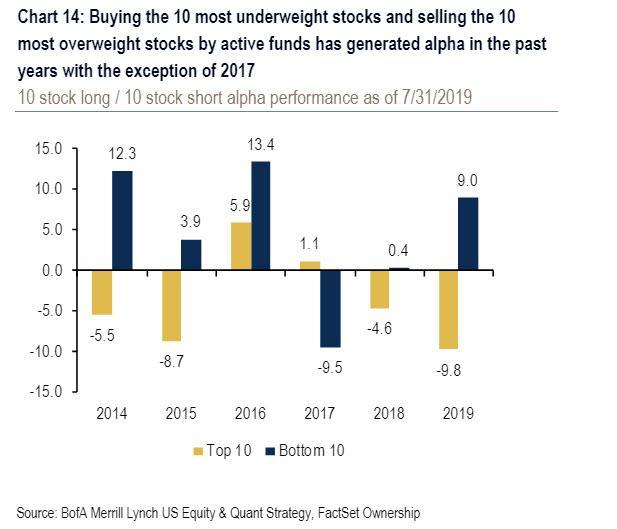
... as we laid out in Going Against The Wall Street Crowd Has Been The Most Profitable Strategy.
What is the point of all this? Simple: for all its tremendous success, r/WallStreetBets has not discovered anything that was not known long ago. It did however succeed in creating what has become the world's biggest daytrading army which, most importantly, is well organized and works as a collective "hive mind." And, at 6 million users strong, or up a record 2 million users in the past 24 hours...
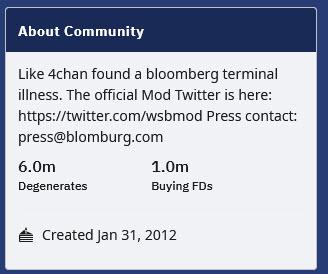
... r/WallStreetBets is now the world's largest decentralized hedge fund, and woe to any billionaire or respected asset manager who stands in its way (as Gabe Plotkin found out the hard way in just 24 hours).
With that said, and well before this week's short squeeze insanity, last Friday when all eyes were only on Gamestop which soared after short seller Andrew Left conceded in his feud with redditors, which sent the company soaring we had some advice for our readers who were despondent that they had missed last Friday's GME "surge" from $43 to $65: not only are much higher prices coming (clearly with the stock trading at $300 now that was correct), but we also published a list of the most shorted Russell 3000 (small cap) stocks which due to their illiquidity would be most susceptible to squeezes. Those names, which we summarized in this post, as we now know are the companies which one week later have absolutely exploded as rolling short squeezes have crushed the hedge fund industry, forcing it to cover, and have quickly become the best trading strategy.
Don't believe us? Last Friday we put together an index tracking the base of the Top 10 shorts. The basket is up more than 3x in one week!
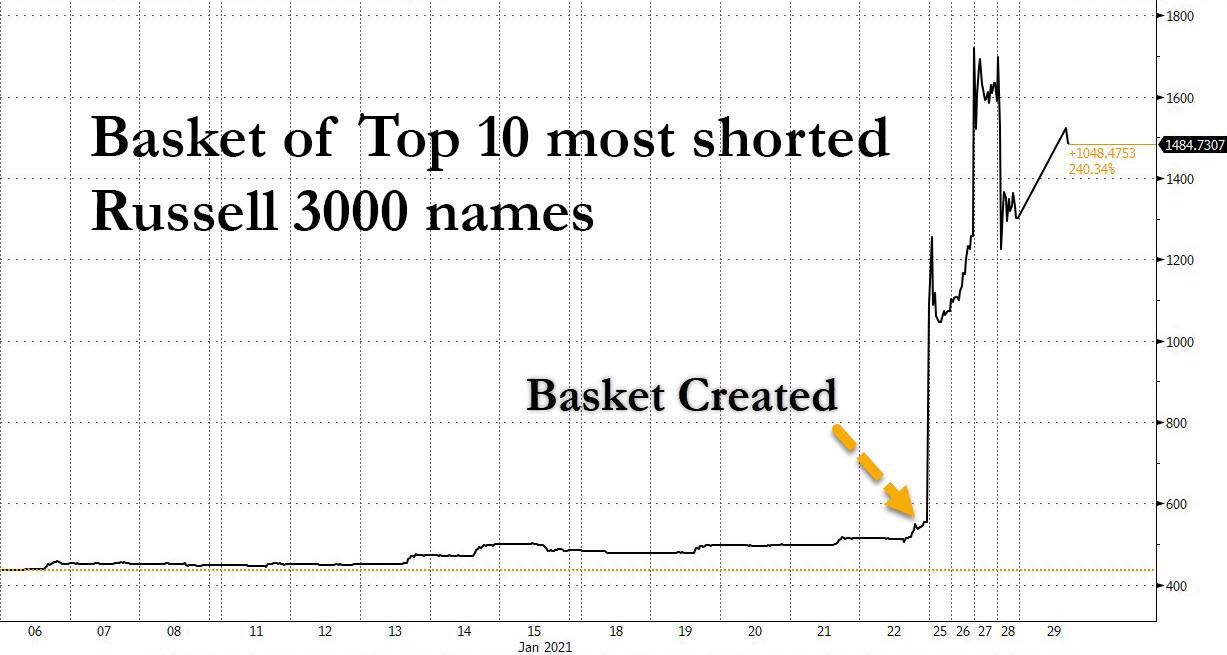
To be honest, it didn't take rocket surgery to figure this out: we merely consolidated our observations over the year past decade regarding most shorted stocks, and combined them with the realization that there is now a credible force - in the face of r/wallstreetbets - that has the capacity to ramp up said names. We then merely extended the logic that applied to GME to other heavily shorted and mostly illiquid names.
Just as we expected, the results were fascinating (and lucrative). What we did not expect was for banks to piggyback on this effort and to publish their own screens of most shorted stocks - after all, doing so could directly harm their biggest clients, the same hedge funds that were short these stocks. After all, the last thing banks can afford is to lose their top customers just to demonstrate that they are smart.
And yet, one week later, one bank decided to break with the herd. In a note published overnight, Jefferies analyst Steven DeSanctis published a note titled "Hedge Fund Holdings: Attack on Shorts; Identifying Names That Could be Targeted" (which we assume was cleared by compliance), and which is set to burn countless bridges between Jefferies and its hedge fund clients that are long the names that Jefferies has identified as the next wave of short squeeze candidates.
This is what DeSanctis said:
"In football, targeting gets you ejected, while in today's market, some cheer you on. The most heavily shorted stocks seeing widest gap in performance EVER in small caps, but we did see a big gap back in Apr. We have portfolios focused on shorts by Hedge Funds, also looking at the 5-heaviest shorts per sector. Besides short interest, we looked at sector wgt changes over time. Industrials continued to become more popular, while Tech relative wgt turned up."
And the punchline:
... the Robinhood and retail investors have been taking their aim at smaller-cap names that tend to lack liquidity. We looked at the net Long and Short portfolios that do not have much liquidity and could see more big moves in these names.
Ok, but we last week we already listed the most likely small-cap, illiquid stocks with outsized short interest (which as we already know exploded higher). How exactly is Jefferies adding any value here?
Well, two things.
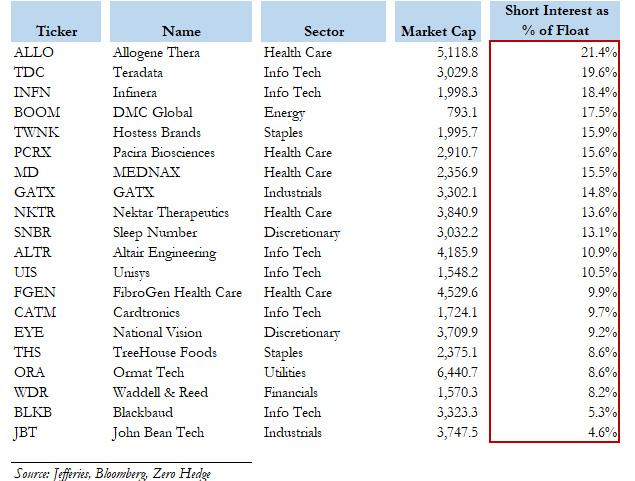
First, the bank realizes that the most-heavily shorted companies are already in play, so instead it looks at the next tier - those companies with a SI of float in the 10-30% range, yet which are sufficiently small cap and illiquid to generate outsized returns one the WSB army rushes them. In short, the bar is getting lowered in terms of which companies are likely to be short squeezed.
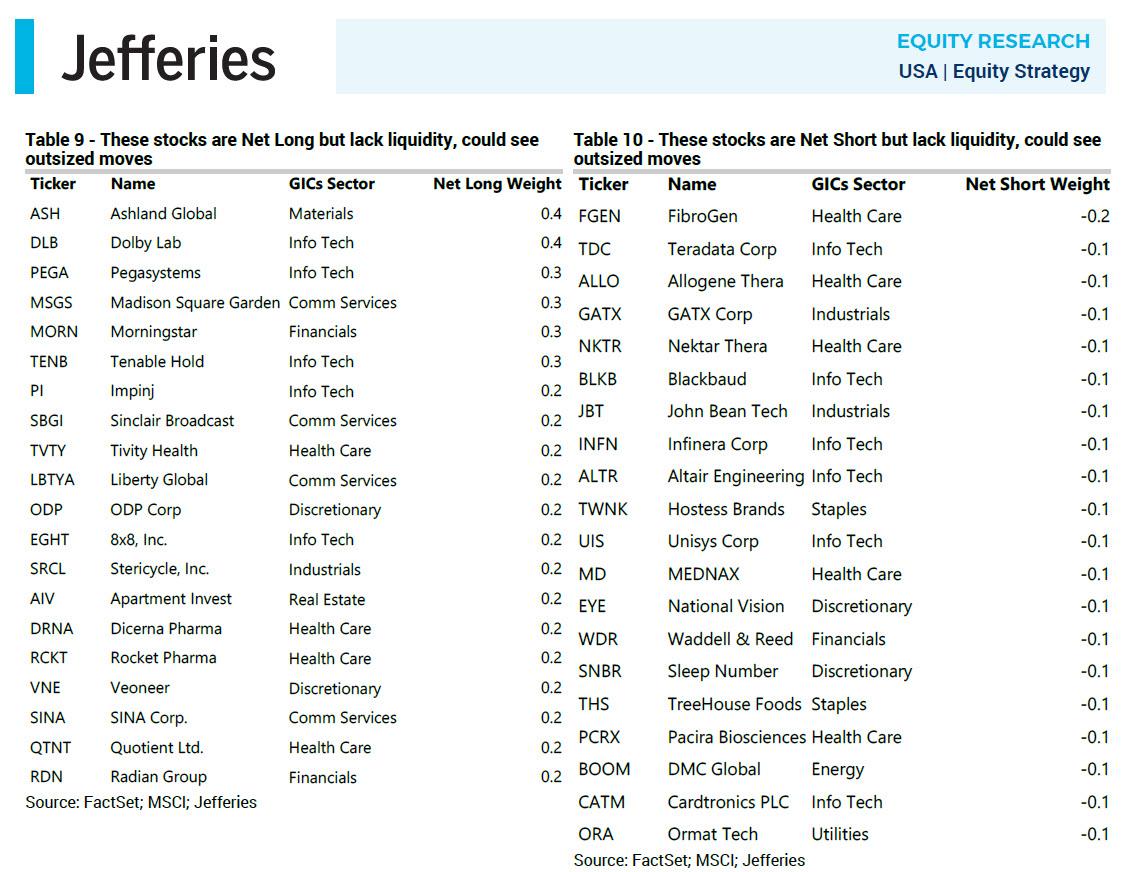
Second, and in going back to our original observation from 2013, Jefferies decided that the most suitable trade here is not to go naked long the most shorted names, but to pair it with a short in the uber-crowded longs which are most likely to drop. We completely agree with this approach, especially since we have observed precisely such a bifurcation between the "most shorted" and "most popular/VIP" baskets in recent days.
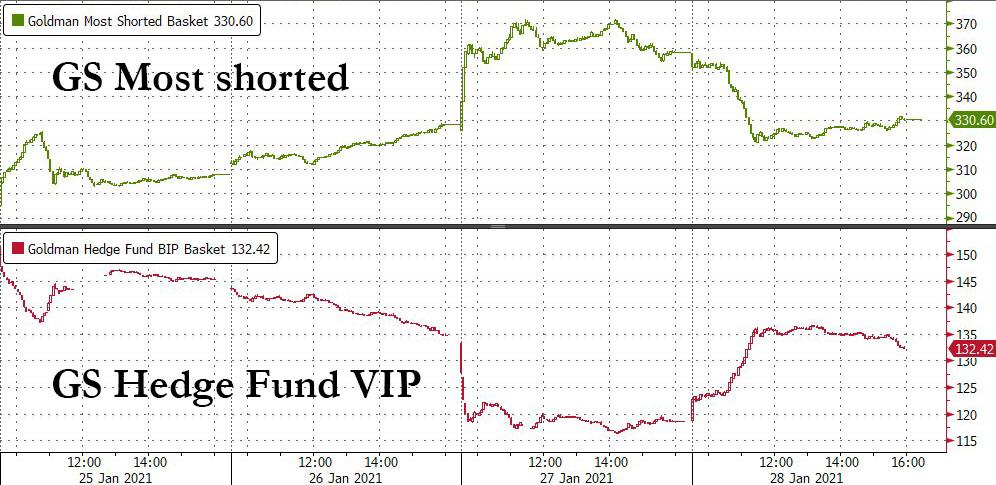
Here are some further observations from DeSanctis:
Short portfolios are getting run over, while Uber Crowded, Popular in red: Looking across the six portfolios we track, we have seen the most-shorted names rise 13.4% this month and they're up 157% from the low. In contrast, the Most Popular Longs by Hedge Funds are off by 4.9%, and the UBER Crowded names have slipped 5.6%. For those names that are owned by Long Only folks but Short by Hedge Funds, these stocks are up 9.6% and 110% from 3/18. This all comes on the back of the S&P 500 being basically flat.Looking for shorts to trade, we offer a few selections on our menu: The data provided by our friends at MSCI allow us to build portfolios based on Net Short positions, those names that have gone from Long to Short. We also add a sprinkle of liquidity, or lack there of, along with biggest shorts by sector. The Margin Table gives you Net Short that are tougher to trade and could see more volatility, especially over the next several days/ weeks.
Ok, enough talk, let's trade. What are the these most shorted names that Jefferies thinks will go up, and alterantively, which are the crowded longs that are set to tumble?
For all those readers who patiently read all of the crap above, here are just the shorts squeeze candidates laid out by Jefferies...
... and here is the full pair trade along with the longs likely to crack:
The wave of populism shaking Wall Street
Retail investors using social media take on the short sellers
Gordon Gekko, the sharp-suited trader who came to epitomise Wall Street, famously said, “greed is good”. The army of retail investors that has flooded into the shares of video game retailer GameStop has taken Mr Gekko’s advice to heart, and turned it against Wall Street to great effect. The rush of money into what was an unloved stock has crushed some big hedge fund investors and signalled a new development in equity markets, where populism, social media and cheap money have combined to upset the status quo.
The flood of speculative retail money into individual stocks has echoes of previous market manias. During the dotcom bubble, day traders used chat rooms and AOL message boards to drive up the share prices of companies that had rebranded themselves as internet stocks. Something similar, but more focused, is happening today. New technology — chat rooms on social media sites, such as Reddit’s WallStreetBets forum, and zero-commission trading apps, like Robinhood — have fuelled the frenzy. This time there is also a palpable sense of anger among many traders, who feel that older generations have cheated them of wealth by mismanaging the economy since the financial crisis.
What also sets the week’s events apart is the manner in which they have unsettled the investment establishment. Hedge funds accustomed to having their own way on short trades — where they bet that the share price of companies will go down — have been overpowered by retail investors and forced to take heavy losses. Many of the small investors say this defeat for big investors is what motivates them, with the little guy for once taking on and defeating the investment Goliaths. It is a sentiment that has its roots in the Occupy Wall Street movement. What today’s retail warriors have proven is that the smart guys are just as vulnerable to excessive market swings as everyone else.
Few ordinary investors are likely to feel sympathy for the hedge funds. But they should not forget that in markets driven by the momentum of passive, index-hugging investment strategies, hedge funds and short-sellers perform an important role in helping to probe corporate performance and improve transparency and price discovery. They have played a central role in helping to uncover frauds such as the Wirecard scandal.
The speculative fervour carries wider risks. Not all of today’s punters will be using savings or government stimulus cheques to bet; some will have borrowed to invest. The use of options trading has only exacerbated the potential downsides for investors. The decision by brokerages to increase margin requirements and, in the case of Robinhood, not to accept trades in GameStop, was a necessary move — even if it sparked the ire of investors and politicians. Regulators will need to tread a fine line: they cannot be seen to be defending the hedge fund Goliaths against retail investors yet they need to ensure an orderly market. The nature of Reddit-based bulletin boards that attract millions of traders means the definition of collusion — normally an issue when policing large institutional investors — may need to be revisited.
The reality is that the shares of GameStop and others will fall. The noise will abate and should not deter long-term investors. But there are broader implications for the credibility of markets. It is important that investing does not become synonymous with gambling for a whole generation of new investors. This would not only be bad for the market but bad for them when they lose — and it would only deepen their antagonism towards Wall Street.
The wave of populism shaking Wall Street
Retail investors using social media take on the short sellers
Gordon Gekko, the sharp-suited trader who came to epitomise Wall Street, famously said, “greed is good”. The army of retail investors that has flooded into the shares of video game retailer GameStop has taken Mr Gekko’s advice to heart, and turned it against Wall Street to great effect. The rush of money into what was an unloved stock has crushed some big hedge fund investors and signalled a new development in equity markets, where populism, social media and cheap money have combined to upset the status quo.
The flood of speculative retail money into individual stocks has echoes of previous market manias. During the dotcom bubble, day traders used chat rooms and AOL message boards to drive up the share prices of companies that had rebranded themselves as internet stocks. Something similar, but more focused, is happening today. New technology — chat rooms on social media sites, such as Reddit’s WallStreetBets forum, and zero-commission trading apps, like Robinhood — have fuelled the frenzy. This time there is also a palpable sense of anger among many traders, who feel that older generations have cheated them of wealth by mismanaging the economy since the financial crisis.
What also sets the week’s events apart is the manner in which they have unsettled the investment establishment. Hedge funds accustomed to having their own way on short trades — where they bet that the share price of companies will go down — have been overpowered by retail investors and forced to take heavy losses. Many of the small investors say this defeat for big investors is what motivates them, with the little guy for once taking on and defeating the investment Goliaths. It is a sentiment that has its roots in the Occupy Wall Street movement. What today’s retail warriors have proven is that the smart guys are just as vulnerable to excessive market swings as everyone else.
Few ordinary investors are likely to feel sympathy for the hedge funds. But they should not forget that in markets driven by the momentum of passive, index-hugging investment strategies, hedge funds and short-sellers perform an important role in helping to probe corporate performance and improve transparency and price discovery. They have played a central role in helping to uncover frauds such as the Wirecard scandal.
The speculative fervour carries wider risks. Not all of today’s punters will be using savings or government stimulus cheques to bet; some will have borrowed to invest. The use of options trading has only exacerbated the potential downsides for investors. The decision by brokerages to increase margin requirements and, in the case of Robinhood, not to accept trades in GameStop, was a necessary move — even if it sparked the ire of investors and politicians. Regulators will need to tread a fine line: they cannot be seen to be defending the hedge fund Goliaths against retail investors yet they need to ensure an orderly market. The nature of Reddit-based bulletin boards that attract millions of traders means the definition of collusion — normally an issue when policing large institutional investors — may need to be revisited.
The reality is that the shares of GameStop and others will fall. The noise will abate and should not deter long-term investors. But there are broader implications for the credibility of markets. It is important that investing does not become synonymous with gambling for a whole generation of new investors. This would not only be bad for the market but bad for them when they lose — and it would only deepen their antagonism towards Wall Street.
Gapping down
In reaction to earnings/guidance:
- CHTR -4.1%, EGHT -3.7%, BZH -3%, AX -2.7%, PLL -2.7% (quarterly update), RDY -2.4%, MDLZ -2.3%, BAH -1.5%, CVX -1.4%, PSX -1.3%, HON -0.9%, SAP -0.7%
Other news:
- OTLK -22.6% (prices offering of 35 mln shares of common stock at $1.00 per share)
- DS -16.9% (prices offering of 20,833,334 shares of common stock at $2.40 per share for gross proceeds of ~$50 million)
- ADMP -12.9% (stock offering)
- EVLO -8.6% (prices offering of 4.5 mln shares of common stock at 15.00 per share)
- STIM -6.7% (prices offering of 4.84 mln shares of common stock at $15.50 per share)
- EGLE -5.7% (SALT to sell to sell SBI Virgo to EGLE)
- DNMR -4.7% (stock offering)
- SALT -4.2% (SALT to sell to sell SBI Virgo to EGLE)
- DX -2.9% (prices 2.75 mln shares of common stock for gross proceeds of approximately $49.1 mln)
- DLX -2.9% (announces new agreement with Truist)
- DCT -2.3% (prices offering of 9 mln shares of common stock at $46.00 per share)
- TALO -1.8% (comments on recent regulatory actions)
- VRTX -1% (FDA clears IND, enabling co to proceed with initiating a clinical trial for VX-880)
Analyst comments:
- AKBA -2.5% (downgraded to Underweight from Neutral at JP Morgan)
- BEAM -2% (downgraded to Neutral from Overweight at JP Morgan)
- JAZZ -2% (downgraded to Equal-Weight from Overweight at Morgan Stanley)
- RGA -1.9% (downgraded to Underperform from Neutral at Credit Suisse)
- CALX -1.7% (downgraded to Market Perform from Outperform at Northland Capital)
- LNC -1.5% (downgraded to Underperform from Outperform at Credit Suisse)
- AUTL -1.2% (downgraded to Neutral from Overweight at JP Morgan)
- DXC -1% (downgraded to Equal-Weight from Overweight at Morgan Stanley)
- GKOS -0.9% (downgraded to Neutral from Overweight at Piper Sandler)
- BAX -0.8% (downgraded to Neutral from Overweight at Piper Sandler)
Gapping up
In reaction to earnings/guidance:
- MSTR +15%, SWKS +12.6% (also approves a new $2 bln stock repurchase program), ERIC +12.3%, WDC +9.8%, RHI +8.8%, ABCB +8.7%, X +6.7%, FHI +5.8%, HLI +4.4%, MATW +4.2%, HTH +3.2%, LYB +3%, DLB +2.9%, LLY +2.9%, ETH +2.8%, FFBC +2.4%, NATI +2.3%, PKX +2.1%, SF +1.9%, SYF +1.7%, FICO +1.6%, AJG +1.4%, JCI +1.3%, PSXP +1.3%, WY +1.2%, CE +1.1% (also increases dividend), TEAM +0.9%, CAT +0.8%
Other news:
- GME +76.7% (extends momentum)
- AMC +43.2% (extends momentum)
- BLCM +38% (FDA lifts clinical hold on Phase 1/2 trial evaluating BPX-601)
- NVAX +37.4% (says its COVID vaccine candidate shows efficacy of 89.3% in Phase 3 trial in the UK)
- ALUS +21.8% (FREYR to List on NYSE through a business combination with Alussa Energy Acquisition Corp)
- BIIB +11.8% (Biogen and Eisai (ESALY) announce FDA's 3-month extension of review period for the Biologics License Application for aducanumab; PDUFA action date is June 7, 2021)
- CBMG +8.9% (received written notice from CFIUS that it had concluded its review of the CBMG Holdings merger and there were no unresolved national security concerns associated; continues to target completion in February 2021)
- PACE +6.4% (Nerdy to become public company via business combination with TPG Pace Tech Opportunities)
- FUBO +5% (prices $350 mln of 3.25% convertible senior notes due 2026)
- BTAI +4.3% (FDA grants orphan drug designation for BXCL701)
- TTI +4.2% (divests interests in CSI Compressco LP And Related Assets for $30.7 mln, provides Q4 guidance)
- ACIU +3.3% (reports progress for therapeutic programs targeting the NLRP3 inflammasome pathway)
- OSUR +3% (OraSure subsidiary DNA Genotek's OMNIgene ORAL included in EUA granted to ambry genetics for use in COVID-19 RT-PCR saliva test)
- NBTX +2.3% (first patient has been injected in a phase I study evaluating NBTXR3)
- RDHL +2% (announces positive DSMB futility review for Phase 2/3 COVID-19 study of opaganib)
- ABG +1.4% (increases its share repurchase authorization)
Analyst comments:
- SLM +6.5% (upgraded to Outperform from Sector Perform at RBC Capital Mkts)
- ICHR +2.9% (upgraded to Outperform from Market Perform at Cowen)
- UCTT +2% (upgraded to Outperform from Market Perform at Cowen)
- BA +1.4% (upgraded to Overweight from Underweight at Morgan Stanley)
Mystery surrounds huge rise in Huawei executives’ social media followings
Twitter takes action after some of Chinese company’s employees in Europe gain outsized audiences
Mike Bai, Huawei’s president of strategy marketing for western Europe, joined Twitter last March, with an anodyne call to “bring digital to every person” to create a “fully connected intelligent world.”
Since then, Mr Bai has not posted a tweet on anything remarkable; mainly a combination of Huawei press releases, links to articles praising the company and criticisms of the US government for its campaign against the Chinese telecoms equipment company.
But Mr Bai has attracted nearly 900,000 followers to his account. In one week in mid-April, he gained more than 160,000 followers in a week, according to Social Blade, a social media analytics company. He now has 18 times the audience of Huawei’s official EU account, which is seven years old.
Mr Bai is not the only Huawei employee with outsized followings on the social media platform. At least six other Huawei employees in Europe created accounts in early 2020 and went on to enjoy apparently huge popularity, gaining thousands or tens of thousands of followers within weeks.
Wells Li, president of human resources for Huawei in Western Europe, joined Twitter in February 2020 and quickly gained his 831,000 followers.
All of the accounts, which often post the same content and almost always retweet each other, also saw a drop of thousands of followers on Wednesday, after the Financial Times asked both Twitter and Huawei about the phenomenon.
Experts said it was unclear why the accounts were so popular, and there was no suggestion that Huawei or any of the employees had done anything wrong.
But Twitter said on Thursday that it had taken action on “thousands of accounts in this instance” that were following the Huawei employees. “Attempts to inauthentically increase followers are not permitted under the Twitter rules,” it said, but added that it was unable at this point to work out who was responsible for creating such large followings and what their motivation was.
Marcel Schliebs, a researcher at the Oxford Internet Institute, said it seemed “suspicious” for “little-known executives of a Chinese firm” to amass such followings so quickly.
He suggested that a third party might have engineered a social media campaign, or perhaps that Huawei had paid to have its employees feature on Twitter’s recommendation lists, and that this had attracted bots, or programs that automatically follow accounts.
The activity on Twitter came at a time when Huawei was attempting to boost its standing in Europe, where its 5G business has been labelled a national security threat by the US. Many of the accounts shared links to Huawei’s website promoting its work in the region and calling for the 5G debate not to be politicised.
The FT also found a handful of what appeared to be fake accounts dedicated to reposting Huawei content. One such account, for example, only had four followers including Huawei’s verified German account. Several bot accounts were suspended by Twitter after the FT flagged them.
The New York Times reported on Friday that a number of Twitter accounts with GAN-generated faces were also linked to a pro-Huawei influence campaign.
Huawei said: “Some social media and online activity has been brought to our attention and it’s suggested we may have fallen short of these policies and of our wider Huawei values of openness, honesty and transparency.”
It said the company had begun an investigation to determine if there was “any inappropriate behaviour with regards to social media”, adding that Huawei had contacted Twitter for help.
Mr Bai and Mr Li did not respond to requests for comment.
GameStop Frenzy Causes Glitches for High-Speed Traders
Brokers were unable to route investors’ orders to Susquehanna and Wolverine
High-speed trading firms that execute orders for individual investors faced technical hiccups this week because of exploding volume in GameStop Corp. GME -44.29% , AMC Entertainment Holdings Inc. AMC -56.63% and other popular stocks.
Brokers that route investors’ orders to Susquehanna International Group LLP and Wolverine Trading LLC had difficulty connecting to the firms on Wednesday and routed their trades elsewhere, people familiar with the matter said.
The two firms, though low-profile, play a key behind-the-scenes role in U.S. stock and options markets, executing orders submitted by investors using online brokerages such as Fidelity Investments, TD Ameritrade and Robinhood Markets Inc. The electronic-trading industry has faced a wave of consolidation in recent years, leaving investors and brokers reliant on a handful of trading behemoths.
Susquehanna informed its clients on both Wednesday and Thursday that it was anticipating heavy load and that they should route orders elsewhere, as the firm bolstered its stock-trading systems to handle the traffic, a person close to the firm said.
Wolverine’s trade-execution platform was stable on Wednesday, according to a person close to Wolverine, though he added that some clients appeared to have difficulty connecting.
About 24 billion shares changed hands in the U.S. equities market on Wednesday, a record, data from Rosenblatt Securities show. Volume in the options market also hit a record of 59 million contracts, Trade Alert data show.
The extraordinary volume occurred as the S&P 500 tumbled 2.6% in its steepest one-day drop since October and day traders piled into stocks and options of GameStop and other companies that have become favorites of Reddit’s WallStreetBets forum.
Two Sigma Securities LLC, which also fills orders for individual investors, faced technical difficulties because of the heavy load, a person familiar with the matter said. The trading firm is affiliated with quantitative hedge fund Two Sigma Investments LP.
Virtu Financial Inc.’s retail platform had an isolated issue that prevented it from accepting orders in all stocks with tickers starting with the letter “A” for about two hours around midday Wednesday, a person familiar with the issue said.
Online brokerages route many of their customers’ orders to electronic trading firms such as Citadel Securities, Susquehanna and Virtu in exchange for cash, a controversial arrangement called payment for order flow.
Critics say such payments skew brokers’ incentives, encouraging them to seek the highest payments rather than ensuring their customers get the best price on each trade.
Brokers and traders say the arrangement benefits investors, who get better prices than they would if their orders were routed to public marketplaces like the New York Stock Exchange or the Nasdaq Stock Market. Payment for order flow is legal in the U.S. and has been a widespread industry practice for years.
Online brokerages themselves have struggled to keep up with the flood of trading activity. In recent days, clients of Fidelity, E*Trade Financial Corp., Charles Schwab Corp. and Vanguard Group have experienced various levels of service disruptions.