WSJ : Melvin Capital Lost 53% in January, Hurt by GameStop and Other Bets

Melvin Capital Lost 53% in January, Hurt by GameStop and Other Bets
Citadel, its partners and Point72 took losses from their investment in the hedge fund

Melvin Capital Management, the hedge fund that has borne the brunt of losses from the soaring stock prices of heavily shorted stocks recently, lost 53% in January, according to people familiar with the firm.

Melvin was founded by Gabe Plotkin, a former star portfolio manager for hedge-fund titan Steven A. Cohen. It started the year with about $12.5 billion and now runs more than $8 billion. The current figure includes $2.75 billion in emergency fundsCitadel LLC, its partners and Mr. Cohen’s Point72 Asset Management injected into the hedge fund last Monday.

As part of the deal, they got non-controlling revenue shares in Melvin for three years. So far, Citadel, its partners and Point72 have lost money on the deal, though the precise scope of the loss was unclear Sunday.

Melvin has massively de-risked its portfolio, said a client. People familiar with the hedge fund said its leverage ratio—the value of its assets compared with its capital from investors—was the lowest it has been since Melvin’s 2014 start. They also said the firm’s position-level liquidity, or its ability to exit securities in its portfolio easily, had increased significantly.

New and existing clients have signed up to invest money into Melvin on Feb. 1, according to the people familiar. It was unclear how much they would be adding.

Melvin had established itself in recent years as one of the top hedge funds on Wall Street, but a short position in GameStop Corp. GME 67.87% hurt the firm in recent weeks. Losses extended beyond GameStop, with declines coming from throughout its portfolio during a period of market turmoil in January. Positions in which Melvin had publicly disclosed owning put options—bearish contracts that typically profit as stocks fall—in its last quarterly regulatory filing soared, while positions in companies it held sold off.

BoF : Alber Elbaz on Making His Return to Fashion

Alber Elbaz on Making His Return to Fashion
The celebrated designer talks to BoF’s Imran Amed about fashion’s new digital landscape and the launch of AZ Factory during Haute Couture Week.

The timing of Alber Elbaz’s return to fashion is apt. After a five-year hiatus following his departure from Lanvin in 2015, the designer debuted his new venture AZ Factory this week. The philosophy underpinning the label, a partnership with Richemont, is to tackle fashion’s challenges of excess, irrelevance and exclusivity with technology, focus and innovation.

In the latest episode of The BoF Podcast, editor-in-chief Imran Amed and Elbaz discuss how the designer fell back in love with fashion why it is necessary to slow the pace of the industry.

  • AZ Factory was born out of Elbaz’s disillusionment with the fashion world. His goal is to bring greater transparency to the design process and a more inclusive feel to customers. His first collection runs from size XS to XXXL. “We always have to remember again and again that this is 2021. How do women live, what do they need, how can I give them what they need?” said Elbaz. “It is taking all this information and processing it and then [giving my] take on it.”

  • The label made a digital debut at Paris couture week with a fashion film. Elbaz said the restrictions created by the pandemic were both a creative challenge and opportunity. “I cannot tell you that it was always easy” Elbaz said. “The night before we air[ed] the film I was still working in editing and looking and changing the music.”

  • One outcome of fashion’s current crisis that the designer is fully onboard with is the move towards a slower pace. Elbaz is increasingly focusing on new and innovative fabrics that require time to fully understand from a design perspective. “I cannot do it every couple of weeks so I know that I will have to keep [it to] two projects [at a time],” said Elbaz.

BoF : What’s Next for Nordstrom

What’s Next for Nordstrom
This week, everyone will be talking about Nordstrom’s plans for 2021, the final rounds of bidding for Topshop and other Arcadia brands, plus a new documentary about the artificial world of influencers. Get your BoF Professional Cheat Sheet.

  • Nordstrom holds an event for investors and analysts on February 4, often an opportunity for companies to reveal major new plans

  • Nordstrom’s sales have slowly recovered from pandemic lows; online sales made up 54 percent of holiday sales, up from 34 percent in the same period in 2019

  • The department store has a goal to generate $500 million in sales from Black and Latino brands over the next five years

A retailer’s annual investor day messaging can range from “stay the course” to “we’re selling the company for parts,” and everything in between. Nordstrom’s event this week is likely to be on the more exciting end of the spectrum. The Seattle-based department store chain has plenty of problems to confront, from a 22 percent drop in year-on-year sales during the key holiday period to the future of its 100 stores (plus 248 off-price Nordstrom Rack locations) as the pandemic drags on. At the same time, there’s reason to believe executives when they inevitably say the worst is over. While still down, sales are improving, and unlike many apparel retailers, Nordstrom is once again profitable.

Expect to hear about new efforts to bolster e-commerce, where sales are strong. Perhaps the company will also provide an update on Nordstrom Local, a pre-pandemic initiative to open inventory-free locations where customers can pick up and return online orders, consult with stylists and more. It’s not clear how this strategy has fared over the last year, but the concept seems ripe for expansion in a post-pandemic world where e-commerce is ascendant and many consumers remain wary of lingering in stores.

The Bottom Line: Nordstrom is also implementing the first stages of a long-term plan to improve its record on inclusion, including hiring more diverse managers and stocking more Black-owned brands. The company told BoF last week it is close to signing the 15 Percent Pledge, which would require major changes to its approach to buying, inventory and marketing. Hopefully more details about how it plans to reach these goals will be forthcoming this week.

FT : GameStop mania: why Reddit traders are unlikely to face prosecution

GameStop mania: why Reddit traders are unlikely to face prosecution
Regulators would need to find evidence of deception to prove market manipulation, say lawyer

Last week’s stock market turmoil sparked a probe by US financial regulators into whether market manipulation was involved, but lawyers doubt it will lead to prosecutions.

The Securities and Exchange Commission announced on Friday it was looking into what happened when users of Reddit chat rooms drove shares in a handful of companies — including the games retailer GameStop — dramatically higher.

But while retail investors succeeded in squeezing large institutional investors, experts do not believe their actions are likely to amount to market manipulation.

“If someone has been posting on a subreddit [messaging board] that they are very enthusiastic and are acquiring shares in a company, and all the while they are selling, then you have a potential violation,” said Joseph Grundfest, a Stanford professor and former commissioner at the SEC.

“But if in all of the tweets and postings there is no misrepresentation, then you could well find that there are no violations in law.”

Last week’s market frenzy has presented regulators with an unusual challenge. While speculation has driven rushes on stocks before, it is rare for retail investors to buy in such numbers that they squeeze out large institutions that have bet against those companies.

The buying spree targeted companies against which institutional investors had taken out short positions, betting on their decline.

Retail investors discussed how, if they bought in enough numbers, they could force short sellers to buy shares to stem their losses, thereby adding fuel to the rally. Traders egged each other on over Reddit message boards, repeating a mantra borrowed from Disney series The Mandalorian: “This is the way”.

Regulators are worried this co-ordinated activity has created a bubble which is likely to burst, potentially causing ruinous losses for some retail investors. Allison Herren Lee, the acting chair of the SEC, said in a joint statement with three other commissioners on Friday: “Extreme stock price volatility has the potential to expose investors to rapid and severe losses and undermine market confidence.”

But if the SEC wants to take enforcement action against any of the market participants, legal experts say they will have a difficult case to prove.

The Securities Exchange Act of 1934 makes it illegal to use “any manipulative device or contrivance” in buying or selling regulated shares.

But manipulation, say legal scholars, is a term of art. “Manipulation is like what [Supreme Court justice] Potter Stewart said about obscenity,” said Todd Henderson, a law professor at the University of Chicago. “You know it when you see it.”

Most commonly, regulators have interpreted manipulative trades to involve deception: whether lying about a company’s performance, or the true owner of a share, or a trader’s true opinion about a company.

And while Reddit users appear to have co-ordinated to help drive up shares in companies whose underlying performance might not have merited it, it is unclear whether they deceived anyone in doing so.

“If you are telling people to buy a company in bad faith, that is manipulation,” said John Coffee, a professor at Columbia Law School and a former legal adviser to the New York Stock Exchange. “But these people are true believers; there is nothing illegal about making wildly optimistic statements.”

The SEC rarely brings manipulation cases at all — they accounted for just 5 per cent of enforcement actions in 2019-2020 — and almost never in cases where they are not alleging deception.

One case that might prove a precedent is the 2001 SEC action against Jonathan Lebed, the New Jersey teenager who made hundreds of thousands of dollars buying stocks in thinly traded companies before hyping them on internet message boards. But Mr Lebed was accused of deception: regulators said he used dozens of different online aliases to create the illusion of widespread interest in those stocks.

Even if regulators do decide that manipulation might have occurred last week, many experts believe they are unlikely to act against day traders who do not have significant individual market power. They point out that Gary Gensler, Joe Biden’s nominee to head the SEC, made his name in the Obama era as a financial regulator who was tough on Wall Street, and is unlikely to prioritise prosecuting retail traders.

“Even if the SEC decides something was wrong here, the decision over whether to go after Joe Bag o’Donuts is a political one,” said Mr Henderson.

The SEC is not only looking into the traders who bought stock last week however: it is also probing the brokerages that enabled the trades, before placing temporary curbs on them, triggering sudden share price drops.

The trading restrictions put in place by online brokerages such as Robinhood attracted the ire of politicians from across the political spectrum, from the progressive congresswoman Alexandria Ocasio-Cortez, to the conservative senator Ted Cruz. Some online commentators even accused the brokerages of being part of a Wall Street plot to protect certain hedge funds whose losses were mounting.

Robinhood, however, said it was required to act because of the extreme volatility in the markets, referring to SEC rules which force brokerages to hold a certain amount of capital as a ratio of outstanding trades. Given the unprecedented volume of trading occurring at the time, legal experts believe the company might have breached these net capital requirements had it not acted to stem the flow of trades and raise capital.

If enforcement action is unlikely, many believe last week’s volatility could trigger a shake-up of rules that were largely written in the era before commission-free trading and widespread use of internet message boards.

“We saw what happened when social media arrived at the US Capitol,” said Jill Fisch, professor of business law at the University of Pennsylvania, referring to the mob attack in Washington DC earlier this month. “Now we are seeing what happens when social media arrives in capital markets, and regulators will have to respond.”
(ZH) Reddit Preparing To Unleash "World's Biggest Short Squeeze"

Reddit Preparing To Unleash "World's Biggest Short Squeeze" In Silver

While all eyes have been focused on GameStop and a handful of other heavily-shorted stocks as they exploded higher under continuous fire from WallStreetBets traders igniting a short-squeeze coinciding with a gamma-squeeze, the last few days saw another asset suddenly get in the crosshairs of the 'Reddit-Raiders' - Silver.
Silver Bullion Market is one of the most manipulated on earth. Any short squeeze in silver paper shorts would be EPIC. We know billion banks are manipulating gold and silver to cover real inflation.
Both the industrial case and monetary case, debt printing has never been more favorable for the No. 1 inflation hedge Silver.
Inflation adjusted Silver should be at 1000$ instead of 25$. Link to post removed by mods.
Why not squeeze $SLV to real physical price.
Think about the Gainz. If you don't care about the gains, think about the banks like JP MORGAN you'd be destroying along the way.
...
Tldr- Corner the market. GV thinks its possible to squeeze $SLV, F-NCK AFTER SEEING $AG AND $GME EVEN I THINK WE CAN DO IT. BUY $SLV GO ALL IN TH GAINZ WILL BE UNLIMITED. DEMAND PHYSICAL IF YOU CAN. F-NCK THE BANKS.
Disclaimer: This is not Financial advice. I am not a financial services professional. This is my personal opinion and speculation as an uneducated and uninformed person.
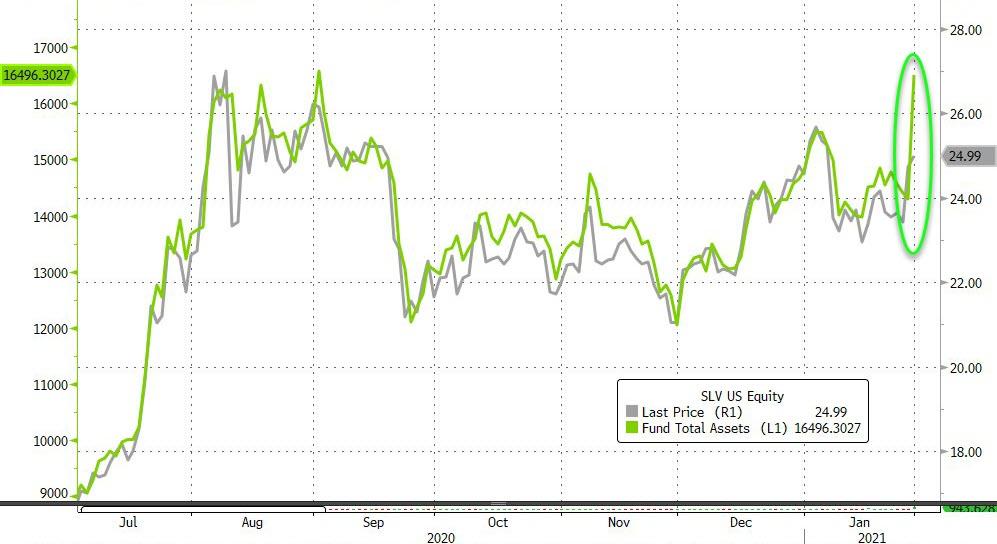
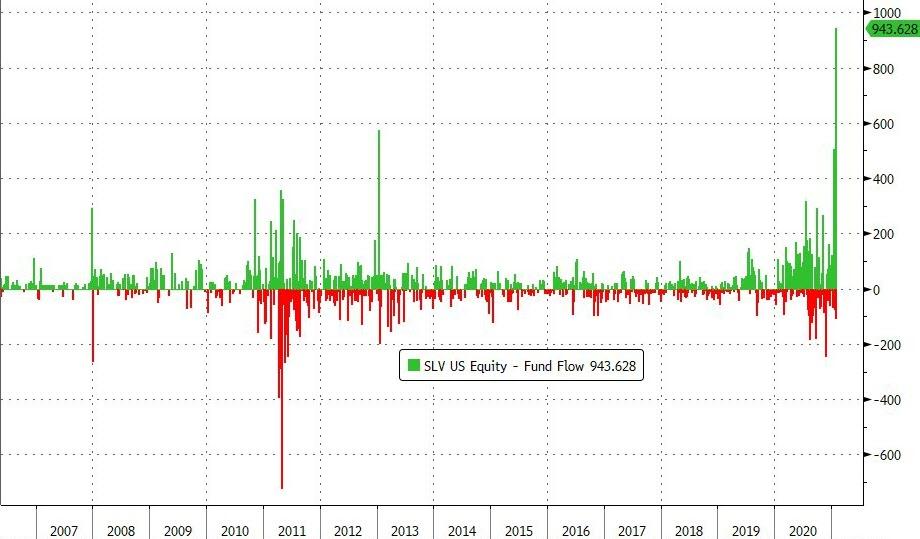
...and judging by the unprecedented flows into the Silver ETF (SLV) they just got started...
SLV saw inflows of almost one billion dollars on Friday, almost double the previous record inflow for this 15 year-old ETF.
Source: Bloomberg
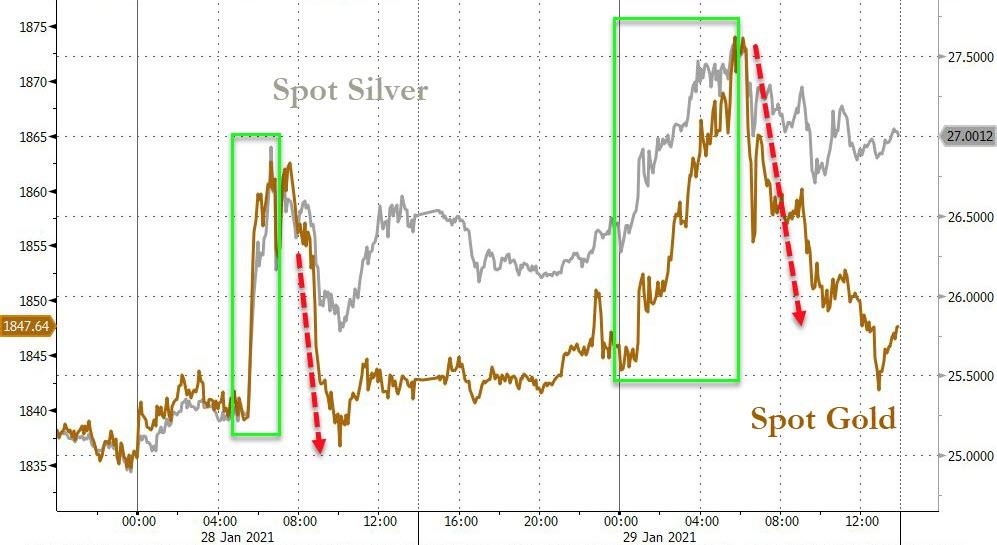
Which helped prompt a spike in SLV off Wednesday's lows of over 11% (and note that every surge in price was mimicked by gold, but gold was instantly monkey-hammered lower after the spike).
Source: Bloomberg
And judging by the asset flow, SLV has room to run here...
Source: Bloomberg
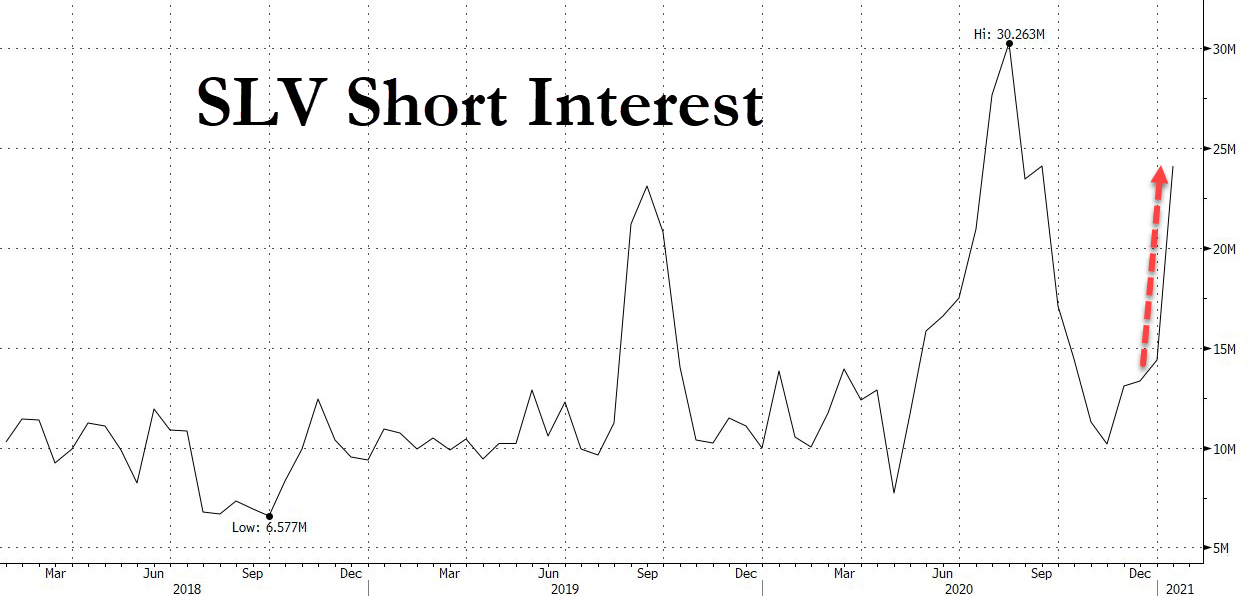
Just as short-interest in the ETF has been building...
Source: Bloomberg
This surge came after Reddit user 'TheHappyHawaiian' posted the following thesis on buying silver noting that "the worlds biggest short squeeze is possible and we can make history."
'TheHappyHawaiian' cites two reasons to buy - The Short Squeeze and Fundamentals.
The short squeeze:
Buy SLV shares (or PSLV shares) and SLV call options to force physical delivery of silver to the SLV vaults.
The silver futures market has oscillated between having roughly 100-1 and 500-1 ratio of paper traded silver to physical silver, but lets call it 250-1 for now. This means that for every 250 ounces in open interest in the futures market, only 1 actually gets delivered. Most traders would rather settle with cash rather than take delivery of thousands of ounces of silver and have to figure out to store and transport it in the future.
The people naked shorting silver via the futures markets are a couple of large banks and making them pay dearly for their over leveraged naked shorts would be incredible. It's not Melvin capital on the other side of this trade, its JP Morgan. Time to get some payback for the bailouts and manipulation they've done for decades (look up silver manipulation fines that JPM has paid over the years).
The way the squeeze could occur is by forcing a much higher percentage of the futures contracts to actually deliver physical silver. There is very little silver in the COMEX vaults or available to actually be use to deliver, and if they have to start buying en masse on the open market they will drive the price massively higher. There is no way to magically create more physical silver in the world that is ready to be delivered. With a stock you can eventually just issue more shares if the price rises too much, but this simply isn't the case here. The futures market is kind of the wild west of the financial world. Real commodities are being traded, and if you are short, you literally have to deliver thousands of ounces of silver per contract if the holder on the other side demands it. If you remember oil going negative back in May, that was possible because futures are allowed to trade to their true value. They aren't halted and that's what will make this so fun when the true squeeze happens.
Edit for more detail: let’s say there’s one futures seller who gets unlucky and gets the buyer who actually wants to take delivery. He doesn’t have the silver and realizes it’s all of a sudden damn difficult to find some physical silver. He throws up his hands and just goes long a matching number of futures contracts and will demand actual delivery on those. Problem solved because he has now matched the demanding buyer with a new seller. The issue is that the new seller has the same issue and does the exact same thing. This is how the cascade effect of a meltup occurs. All the naked shorts trying to offload their position to someone who actually has some silver. My goal is to ensure that I have the silver and won’t sell to them until silver is at a far higher price due to the desperation.
The silver market is much larger than GME in terms of notional value, but there is very little physical silver actually readily available (think about the difference between total shares and the shares in the active float for a stock), and the paper silver trading hands in the futures market is hundreds of times larger than what is available. Thus when they are forced to actually deliver physical silver it will create a massive short squeeze where an absurd amount of silver will be sought after (to fulfill their contractually obligated delivery) with very little available to actually buy. They are naked shorting silver and will have to cover all at once and the float as a percentage of the total silver stock globally is truly miniscule.
The fundamentals:
The current gold to silver ratio is 73-1. Meaning the price of gold per ounce is 73 times the price of silver. Naturally occurring silver is only 18.75 times as common as gold, so this ratio of 73-1 is quite high. Until the early 20th century, silver prices were pegged at a 15-1 ratio to gold in the US because this ratio was relatively known even then. In terms of current production, the ratio is even lower at 8-1. Meaning the world is only producing 8 ounces of silver for each newly produced ounce of gold.
Global industry has been able to get away with producing so little new silver for so long because governments have dumped silver on the market for 80 years, but now their silver vaults are empty. At the end of WW2 government vaults globally contained 10 billion ounces of silver, but as we moved to fiat currency and away from precious metal backed currencies, the amount held by governments has decreased to only 0.24 billion ounces as they dumped their supply into the market. But this dumping is done now as their remaining supply is basically nil.
This 0.24 billion ounces represents only 8% of the total supply of only 3 billion ounces stored as investment globally. This means that 92% of that gold is held privately by institutions and by millions of boomer gold and silver bugs who have been sitting on meager gains for decades. These boomers aren't going to sell no matter what because they see their silver cache as part of their doomsday prepper supplies. It's locked away in bunkers they built 500 miles from their house. Also, with silver at $23 an ounce currently, this means all of the worlds investment grade silver only has a total market cap of $70 billion. For comparison the investment grade gold in the world is worth roughly $6 trillion. This is because most of the silver produced each year actually gets used, as I have mentioned. $70 billion sounds like a lot, but we don’t have to buy all that much for the price to go up a lot.
**If the squeeze happens, it would be like 40 years worth of their gains in 4 months **
The reason that only 8 ounces of silver are produced for every 1 ounce of gold in today's world is because there aren't really any good naturally occurring silver deposits left in the world. Silver is more common than gold in the earth's crust, but it is spread very thin. Thus nearly every ounce of silver produces is actually a byproduct of mining for other metals such as gold or copper. This means that even as the silver price skyrockets, it wont be easy to increase the supply of silver being produced. Even if new mines were to be constructed, it could take years to come online.
Finally, most of this newly created silver supply each year is used for productive purposes rather than kept for investment. It is used in electronics, solar panels, and jewelry for the most part. This demand wont go away if the silver price rises, so the short sellers will be trying to get their hands on a very small slice of newly minted silver. The solar market is also growing quickly and political pressure to increase solar and electric vehicles could provide more industrial demand.
The other part of the story is the faster moving piece and that is the inflation and currency debasement fear portion. The government and the fed are printing money like crazy debasing the value of the dollar, so investors look for real assets like precious metals to hide out in, driving demand for silver. The $1.9 trillion stimulus passing in a month or two could be a good catalyst. All this money combined with the reopening of the economy could cause some solid inflation to occur, and once inflation starts it often feeds on itself.
What to buy:
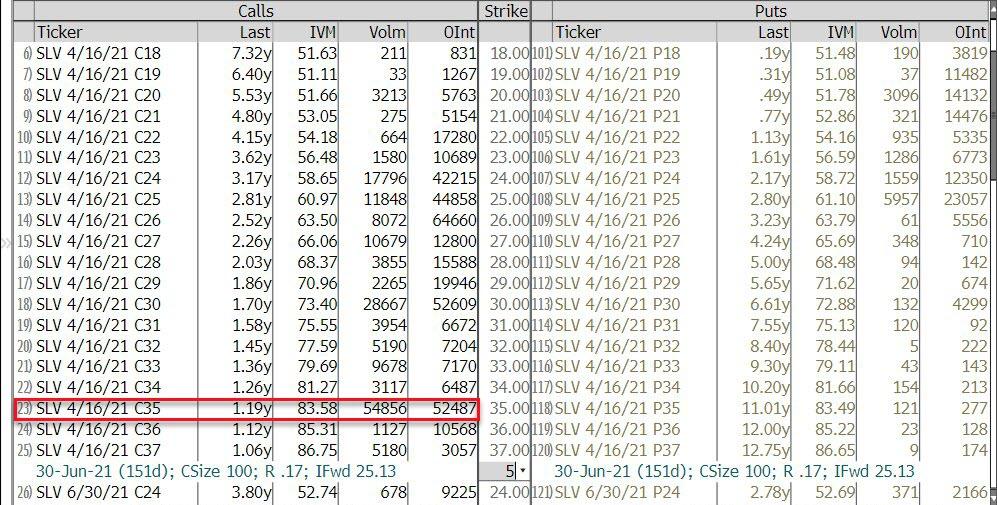
I will be putting 50% directly into SLV shares, and 50% into the $35 strike SLV calls expiring 4/16.
This way the SLV purchase creates a groundswell into silver immediately that then rockets through a gamma squeeze as SLV approaches $35.
Price target of $75 for SLV by end of April if the short squeeze happens.
Edit: for the part of your purchases going into shares, some people recommend PSLV because they think SLV might start lying about having the silver in their vault. Or that the custodian will be double counting, ie claiming that the same silver belongs to multiple people (banking on the fact that people wont all try to get their silver at once). So if you buy SLV shares and calls, that's great. But I think it could be prudent for us to buy options in SLV (no options on PSLV) and shares in PSLV. It all depends on how paranoid you want to be. There is a lot of paranoia in the precious metals world.
Alternate options:
  • buying physical silver; this also works but you pay a premium to buy and sell so its less efficient and you take fewer silver ounces off of the market because of the premium you pay
  • going long futures for February or March; if you are a rich bastard and can actually take physical delivery of 1000s of ounces of silver by all means do so. But if you simply settle for cash you are actually part of the problem. We need actual physical delivery, which is what SLV demands and is why SLV is the way to go unless you are going to take delivery
  • miners; I don’t recommend buying miners as part of this trade. Miners will absolutely go up if SLV goes up, but buying them doesn't create the squeeze in the actual silver market. Furthermore, most silver miners only derive 30-50% of their revenue from silver anyways, so eventually SLV will outperform them as it gets high enough (and each marginal SLV dollar only increases miner profits by a smaller and smaller percentage)
Details on SLV physical settlement:
When SLV issues shares, the custodian is forced to true up their vaults with the proportional amount of silver daily. From the SLV prospectus:
"An investment in Shares is: Backed by silver held by the Custodian on behalf of the Trust. The Shares are backed by the assets of the Trust. The Trustee’s arrangements with the Custodian contemplate that at the end of each business day there can be in the Trust account maintained by the Custodian no more than 1,100 ounces of silver in an unallocated form. The bulk of the Trust’s silver holdings is represented by physical silver, identified on the Custodian’s or, if applicable, sub-custodian's, books in allocated and unallocated accounts on behalf of the Trust and is held by the Custodian in London, New York and other locations that may be authorized in the future."
'TheHappyHawaiian" ends with a call to (financial) arms:
Join me brothers. Lets take silver to the moon and take on the biggest and baddest manipulators in the world.
Please post rocket emojis in the comments as desired.
Disclaimer: do your own research, make your own decisions, everything here is a guess and hypothetical and nothing is guaranteed, not a financial advisor, I have ADHD and maybe other things too.
Bear case: silver does tend to sell off if the broader market plunges so it’s not immune to broad market sell off. It’s also the most manipulated market in the world so we are facing some tough competition on the short side
Interestingly, 'TheHappyHawaiian' dropped this update on 1/29:
Due to the manipulation and collusion of citadel, hedge funds, and brokers to change the rules and rig the game in their favor. Who likely knew ahead of time and bought puts right before and calls at the bottom, GME is too important to abandon still. SLV is still my next play but GME needs to go to $1000 and these people need to go to jail.
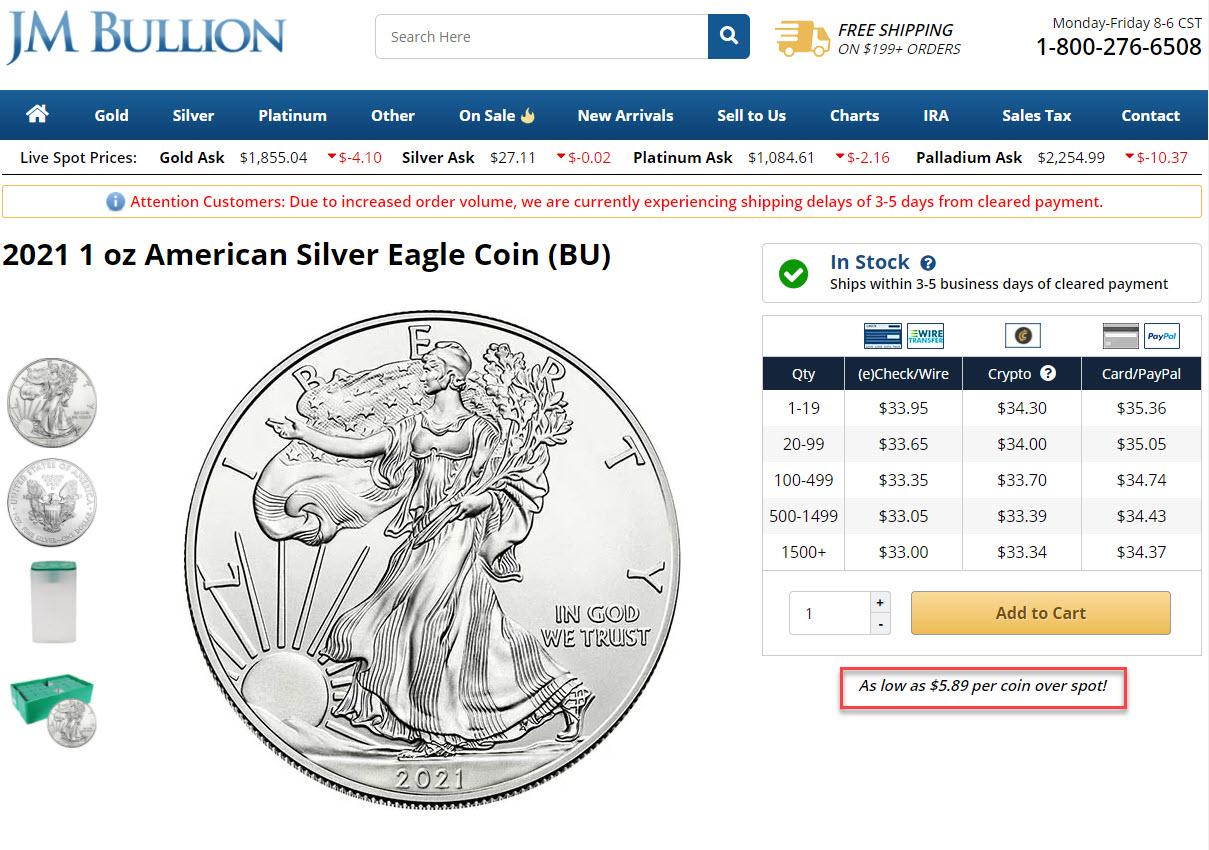
However, judging by the massive physical premiums for silver we are seeing this weekend at APMEX...
... and JM Bullion...
...there are more than a few who are already rotating to SLV from GME.

WSJ : China’s New Covid-19 Outbreaks Trip Up Economic Momentum

China’s New Covid-19 Outbreaks Trip Up Economic Momentum
Demand has taken a hit ahead of the Lunar New Year festival, with people being urged not to travel

BEIJING—China’s economy started the new year on a weaker footing as new coronavirus outbreaks and pandemic-containment measures sapped factory production and weighed on the country’s services recovery, official data showed Sunday.

Official gauges of industrial and services activities eased more than expected in January, with demand taking a particular hit as authorities discouraged travel ahead of February’s Lunar New Year festival, according to data from Beijing’s National Bureau of Statistics.

China’s official manufacturing purchasing managers index softened to 51.3 in January, lower than December’s 51.9 reading and the 51.5 median forecast among economists polled by The Wall Street Journal.

The nonmanufacturing PMI, which includes services and construction activity, weakened even more to 52.4, from 55.7 in December, according to the statistics bureau.

Though both indexes showed activity remaining above the 50 mark that separates expansion from contraction, the new-orders subindex for the nonmanufacturing sector, a key measure of demand, dropped below the 50 line—to 48.7 from 51.9 the previous month—marking the lowest level since February last year, when the Chinese economy was absorbing the very worst of the coronavirus shock.

Sunday’s PMI readings provided the first look at the economic damage wrought by fresh outbreaks of the coronavirus in northern China—the worst since the initial outbreak that began in Wuhan about a year ago. The latest wave has sickened hundreds and put restrictions on the movements of millions of people.

To keep the number of cases from rising further, government authorities nationwide are dissuading residents from traveling during the most important holiday of the year, Lunar New Year, which runs for a week beginning February 12.

The stricter quarantine and testing requirements imposed during this frantic season—when hundreds of millions of people typically travel to see family and splash out on gifts and dining—are likely to restrain economic activity.

Services requiring close human contact have borne the biggest brunt. Subindexes tracking business activity in catering, accommodations, logistics, transportation and entertainment fell sharply into contractionary territory in January, official data showed.

Hunter Chan, an economist at Standard Chartered Bank, expects the damage to persist through the end of the festival in late February, though he is optimistic that the economy will rebound.

“The economy will normalize quickly as effective control measures limit the prolonged impact,” he said.

As coronavirus restrictions threaten a second straight year of Lunar New Year festivities, local governments have in recent weeks rolled out shopping vouchers in hopes of enticing people to stay in place over the holiday and to keep spending.

China’s services and consumption sectors have lagged behind its broader economic recovery over the past year amid lingering concerns over infections and worker incomes that have been squeezed by the pandemic.

China’s 2.3% expansion in gross domestic product in 2020, which made it the only major economy to post growth last year, was powered largely by industrial production, exports and government-backed investment. Retail sales, by contrast, was one of the few closely watched economic indicators to finish 2020 lower than the prior year.

In addition to the weakness in the services sector, Sunday’s PMI reading also showed emerging signs of slowing momentum in the industrial sector, with both demand and production easing.

The subindex measuring manufacturing production fell to 53.5 in January, from 54.2 in December, while total new orders dropped to 52.3 from December’s 53.6 reading. The subindex tracking new export orders also eased to 50.2 from 51.3 in December, but remained above the 50 mark for a fifth straight month.

China’s statistics bureau said some workers had returned to their hometowns in anticipation of the tightening control measures, leading to a labor shortage at some factories.

Barrons : Gold Prices Started the Year on a Sour Note. Here’s Why Investors Migh

Gold Prices Started the Year on a Sour Note. Here’s Why Investors Might See a Turnaround.

Gold started the new year on a sour note, with prices trading lower for the first month of 2021. But many analysts are confident that the longer-term outlook remains promising for the precious metal.

Gold futures settled at $1,844.90 an ounce on Jan. 27 to trade about 2.7% lower in January. That follows a roughly 24% gain in 2020.

“Higher Treasury yields and the recent bounce in the [U.S. dollar], both of which rely on economic strength,” are the main short-term factors that have held gold prices back since the U.S. presidential election in November, says Peter Grosskopf, chief executive officer of Sprott. However, “we believe the markets are more dependent on government stimulus and money printing than they have ever been historically.”

He sees gold prices this year rallying to more than $2,000, with a rise to fresh record highs by midyear, as expectations that U.S. President Joe Biden and Treasury Secretary Janet Yellen will “stand behind their rhetoric” and “deliver stimulus in large increments,” are great for gold in the short- and long-term. Yellen suggested as much in testimony to the Senate Finance Committee earlier this month when she said the smartest thing to do is to “act big” to help struggling Americans.

Biden, meanwhile, has rolled out a $1.9 trillion coronavirus relief plan that includes cash payments to Americans.

The president’s proposed plan offers a tailwind for gold prices, says Jason Teed, co-portfolio manager of the Gold Bullion Strategy Fund (QGLDX). “The Biden administration is likely to use more fiscal tools to stimulate the economy than a Republican-dominated administration, meaning that debt levels will remain high, and go higher, which will potentially be positive for gold in the long term,” he says.


Long-term debt of the U.S. government and inflation levels are likely to be “the strongest influencers” on the price of gold, he says.

So far this year, however, gold has seen lackluster moves. “Long term price growth from inflation isn’t likely to occur quickly, so the only major move [for gold] would likely be due to a potential double-dip recession from the Covid pandemic,” says Teed.

He believes there is “very little in the way of headwinds for the price of gold” this year, and sees “potential for the metal to increase, though likely at a more modest pace than in 2020.”

Key to the outlook for gold will be the continuing rollout of the Covid-19 vaccines and their impact on the economy.

A “wave of market enthusiasm” began in late 2020 as the first Covid-19 vaccines were administered, raising hopes for growth in gross domestic product and “easing safe-haven demand” for gold, says Cailin Birch, global economist at The Economist Intelligence Unit.

However, gold prices are likely to remain fairly high throughout the first half of 2021, around $1,860, as “reality sets in” that it will take at least six months for vaccination rates to reach a level that will speed up the U.S. economic recovery, she says.

Prices for the metal may drop noticeably in the third quarter to an average $1,775 as GDP growth accelerates, then to around $1,750 in the fourth quarter, says Birch. The economic recovery will be gradual in 2022 to 2023, preventing a sharper drop in gold prices,” she says.

For now, the main factor to watch will be the vaccination effort, she says. “If vaccination rates rise faster than we currently expect, this would boost economic prospects and further reduce safe-haven demand,” Birch says. On the downside, the emergence of new Covid-19 variants threatens to set back progress, and drive investors back into haven assets such as gold, she adds.

>>> Barron’s Weekend Summary

Barron’s Weekend Summary: The trends behind the recent GME saga aren’t going away, and are already having an impact on Wall Street

* Cover story: The trends involved in the recent GME stock saga—in which individual investors and day traders took on Wall Street hedge funds—aren’t going anywhere and are already having a ripple effect; Understanding the changes will be critical to playing the market, even for those who aren’t involved in the online wars over stocks, because the new power of retail investors is clear—and it’s shaking up traditional portfolio managers, who have lost control of the process.

* Tech Trader: Positive on AAPL, MSFT: Apple has increasingly become a broad bet on technology: in its recent earnings report, it beat expectations for every major product line, expanded margins, showed surging demand in China, and in addition has bought back more than $25B in stock—yet while shares are no longer cheap, which is also true of Microsoft, both tech giants seem poised to grow revenue and profits for many quarters to come.

* Trader: The GME short squeeze has quickly become a morality tale of little guys taking on the man, but it’s really just an example of small investors discovering the joys, and potential profitability, of day trading in a way they haven’t since the dot-com boom and bust; It might have been a mob that caused GameStop to surge more than 1,600 percent in January, but traditional investors, such as Scion Asset Management, have been making an argument for buying the stock for several years.

* Profile: Randall Dishmon, senior portfolio manager of the $914M Invesco Global Focus fund, says debates over growth versus value investing styles or whether the US or international markets will dominate miss the point, because markets are going through structural—not cyclical—changes, so he seeks companies thriving amid that scenario (top 10 holdings: CRWD, FB, TWLO, CRM, AMZN, BABA, NOW, MA, ILMN, TMO).

* Features: 1) The third and final installment of Barron’s Roundtable deals with a “seemingly increasingly arcane form of investing—the kind that draws upon rigorous analysis of company fundamentals and equity valuations,” and showcases the recommendations of James Anderson (Tencent Holdings, ASML, Delivery Hero, ILMN, MRNA), Abby Joseph Cohen (PHM, PLD, Trend Micro, Infosys, Deutsche Post DHL Group, FISV, YUMC), Henry Ellenbogen (SAM, INTU, VRM, BKI), and Todd Ahlsten (DE, AMAT, MU, BKNG, CME, DLR); 2) Commodities are starting to revive after a 10-year bear market, and natural resources such as energy, metals, and agriculture look set for an extended run that could be the beginning of a much larger structural bull market; To play the rally, investors can buy funds that hold the physical commodities or their futures contracts, or they can hold the stocks of producing companies (Positive on DBC, GSG, COMB, GLD, SLV, USO, PPLT, DBA, GDX, GDXJ, SIL, XLE, XOP, GHAAX, KGGIX); 3) Cautious on QS: The battery start-up founded by Stanford University scientists a decade ago generates no sales and says it won’t have meaningful revenue until 2026, yet its stock has rocketed 377 percent since August—even after a recent pullback of more than 60 percent from its peak—making it by any measure an overvalued stock.

* European Trader: Positive on Sika: The Swiss chemicals giant suffered from a slump in construction last year due to the pandemic, causing annual sales to fall, but the company, which fetches 38.7 times this year’s expected earnings and is valued in line with its peers, could be a post-pandemic star because of an ambitious acquisition drive and growing business from governments seeking to boost their post-Covid economies.

* Emerging Markets: Investors seem relieved that President Biden has so far not taken any steps to confront China, likely because it will take patience to work through Trump’s legacy—his administration took 200 different actions against China during his last year in office, many of which don’t make sense.

* Commodities: “Gold started the new year on a sour note, with prices trading lower for the first month of 2021, but many analysts are confident that the longer-term outlook remains promising for the precious metal”; Peter Grosskopf of Sprott sees gold prices this year rallying to more than $2,000, with a rise to fresh record highs by midyear.

* Streetwise: GME’s rise “has been attributed to a short squeeze, and to the tendency of heavy call-option buying to push share prices higher, as options market makers hedge their exposure with stock purchases,” says columnist Jack Hough. “Bigger picture, some blame zero-commission trading for a rise in speculation, the pandemic for leaving the young and homebound looking for online adventure, and years of near-zero interest rates for creating buoyant conditions for risky assets.”

FT : European retailers face goods shortages as shipping costs soar

European retailers face goods shortages as shipping costs soar
Importers of consumer items from sports kit to toys cite ‘huge impact’ on business

The spiralling cost of shipping goods from Asia is causing a shortage of consumer goods in Europe for importers of everything from home furnishings, bicycles and sports kit to children’s toys and dried fruits.

A dearth of empty containers in China has quadrupled prices on sea trade routes to Europe in the space of eight weeks, with costs hitting record highs as shippers and freight forwarders compete to secure space on vessels.

As a result, retailers and manufacturers told the Financial Times that they were beginning to experience shortages of both finished goods and components.

Youri Mercier, deputy secretary-general at the Federation of the European Sporting Goods Industry, whose members include Nike, Puma and Adidas, said delays of several weeks were having a “huge impact” on businesses. “If winter collections arrive months late, there is a big problem,” he said. “It’s Covid, Brexit and now this.”

Frucom, which represents European traders of dried fruit and nuts, said in a letter to the European Commission this month that one of its members had been quoted $16,500 to ship a 40ft container, up from $2,150 in November.


“Several members have advised that their customers intend to cancel [goods] contracts this year as this destroys the [profit] margin they may have been able to earn,” the letter said. “Some deliveries scheduled for December are only now reaching our companies.”

Halfords, one of Europe's largest cycle retailers, has reported gaps in its stock caused by shipping problems and mentioned freight costs and disruption in its latest trading update, although it said it had better access to manufacturing and transport capacity than smaller rivals.


Steve Garidis, executive director of trade body Bicycle Association, said: “There's been disruption and the cost of securing containers is up to 10 times higher than a year ago.”

Gary Grant, founder and executive chairman of UK toy retailer The Entertainer, said “ridiculous” freight rates were “having a massive impact” on prices. He usually brings in around 50 containers a week from the Far East but “we are about 200 containers behind where we should be at the moment because we cannot justify paying for the shipping,” he said.

Lorenzo Granata, the owner of Nano Bleu, the largest toy retailer in Milan's historic centre, said: “There is less product availability, which explains soaring costs . . . [Online] platforms and shops that are able to secure products that are widely unavailable can pretty much put the price tag they please on those items.”

Peter Sand, analyst at international shipping association Bimco, said higher prices were predominantly “affecting the small importers and retailers rather than the Tescos, Walmarts and Ikeas of this world” which ship more cargo and tend to be prioritised by carriers.


In a survey of 900 small and medium-sized companies conducted by global freight marketplace Freightos, 77 per cent reported experiencing supply chain difficulties in the past six months.

Helen White, co-founder of UK-based home furnishing group Houseof, said the company would not make any profit on goods shipped since December as a result of increased freight rates. “It’s a nightmare. Not only are prices going up, but it’s hard to get a container even if you are willing to pay $10,000,” she said.

Ms White, who paid $1,600 for a container in November, is letting customers reserve stock for future delivery: “If we could only sell stuff in the warehouse, we’d have nothing to sell.”

The supply constraints are also having an impact on production across the eurozone, according to a rising proportion of manufacturers in a survey by IHS Markit published last week. Supplier delivery times lengthened in January by the largest amount since survey data were first available in 1997 — with the exception of April last year, when supply lines were hit by the pandemic.

The European Association for Forwarding, Transport, Logistics and Customs Services and the European Shippers’ Council warned in a joint letter sent to the European Commission last week that “increased freight rates” and “late delivery” meant many of their members were struggling to keep “supply chains operational”.

The European Commission told the FT that Brussels was aware of “large price increases in container shipping markets recently, both on routes to and from the EU and in other parts of the world”.

But it was unclear at this stage whether the situation was the result of anti-competitive behaviour and whether any intervention from regulators might be warranted.

“In the current situation, many factors could be at the origin of the price hikes, such as fluctuating high demand, port congestion, and shortage of containers, in markets which are intertwined at worldwide level,” the Commission said. “We are discussing with market participants to fully understand the current circumstances, and consider ways forward.”

FT : Jim Chanos laments politicisation of ‘surreal’ GameStop saga

Jim Chanos laments politicisation of ‘surreal’ GameStop saga
Kynikos Associates founder says short-sellers have been ‘beat up and left for dead’ but are still being blamed

Renowned short-seller Jim Chanos says the GameStop saga has been the most “surreal” episode in his career, and worries that things are going “completely off the rails” with populist politicians looking to capitalise on the situation.

“This was a week even us ancients haven’t seen before,” Mr Chanos said in an interview with the Financial Times. “I have been doing this for 40 years and I don’t remember a period like the past 10 days.”

The remarks by Mr Chanos, the founder of Kynikos Associates, come after a dramatic spell for the US stock market. Shares in companies such as video game retailer GameStop and struggling cinema operator AMC Entertainment rose stratospherically as retail traders laid siege to short-sellers betting against the businesses. 

“One of the most surreal aspects is that it has become political and the corollary is they are blaming short-sellers, the guys who got killed,” Mr Chanos said.

The mayhem has captivated Wall Street, as several major hedge funds have been hammered with multibillion-dollar losses inflicted by an amorphous, profane group of day traders loosely organised around a forum on the social media site Reddit, called r/WallStreetBets.

“This week’s Reddit-inspired short squeeze in US equities and deleveraging in global markets is a reminder that social media has not lost its influence on markets simply because Trump left office with a blocked Twitter account,” John Normand, head of cross-asset fundamental strategy at JPMorgan, marvelled in a note to his clients on Friday evening.


Mr Chanos, who rose to fame two decades ago by predicting the downfall of energy giant Enron, said he was particularly shocked by the vitriol aimed at short-sellers — investors that bet shares in companies will fall — given how much they have struggled in recent years.

“This is a euphoric market that has been going from new high to new high,” he said. “Short-sellers have been beat up and left for dead and we’re still blaming them.”

Melvin Capital, a $12.5bn hedge fund run by Gabe Plotkin, was forced to seek a $2.75bn cash injection from larger rivals Citadel and Point72 Asset Management, after losing 30 per cent in the first three weeks of January. 

The New York-firm, which disclosed its bet against GameStop in regulatory filings, attracted the ire of retail inventors who took to online forums such as Reddit to drive up shares in companies the firm was betting against. 

The narrative quickly morphed from a short-squeeze on Melvin — which proved successful because the short position in the company was huge relative to the share float — and into an anti-establishment movement that has been compared to Occupy Wall Street. 

Last week saw a flurry of other hedge funds also ratcheting back shorts and forced to trim long positions, as they battened down the hatches in case the r/WallStreetBets traders targeted their positions. That contributed to the S&P 500 losing 3.3 per cent last week, its biggest weekly loss since the nervy trading that preceded the US presidential election.


But Mr Chanos took umbrage with the idea that GameStop is a political movement about “sticking it to the suits.” He points out that there were a number of hedge funds who had long positions in the company and profited from the rally.

“What has really happened here is a bunch of short sellers and hedge funds have lost a lot of money and a bunch of retail investors as well as a bunch of hedge funds have made a lot of money,” he said. 

Mr Chanos also called the political fury and conspiracy theories that erupted after frenzied trading forced online brokerages, who predominantly cater to retail investors, to clamp down on bets in popular stocks “absurd”.

The Kynikos founder said the moves were primarily due to regulations that require brokerages to post collateral for trades their clients conduct to central clearing houses, and the frenzied activity meant many of them struggled to do so.

“We’re seeing a level of misunderstanding about how markets work that is being brought on by a whole new generation of investors who have never seen a bear market and somehow think that they're being held back from their rightful place at the table by these evil hedge funds,” he said.