FT : Wealthy snap up second-hand supercars after holidays cancelled

Wealthy snap up second-hand supercars after holidays cancelled
Sales under £150,000 rise as pandemic halts exotic trips, says luxury dealer HR Owen

Wealthy buyers snapped up second hand supercars last year after exotic holiday plans were torpedoed by the pandemic, according to the UK’s largest dealer of Ferraris, Lamborghinis and Bentleys.

Prices of some used luxury models fell because of the coronavirus crisis, attracting buyers, said the boss of HR Owen, which also deals in Aston Martin, Bugatti, Rolls-Royce and Maserati brands.

“We saw a significant increase in the sale of used cars in the region of not more than £150,000,” chief executive Ken Choo told the Financial Times. “People said I cannot travel to the Bahamas, so I will buy a used Ferrari or Lambo instead.” 

Demand picked up in the second half of the year, once showrooms had reopened after the shutdown in lockdown, with the months of July to December a “blow out” period amid a flurry of sales, Mr Choo added.

Luxury carmakers that import to the UK also increased sales in the final months of the year as transactions were rushed through before Brexit, which had threatened vehicle tariffs of 10 per cent.

But overall annual revenues at HR Owen fell to £400m from £457m as showroom closures took their toll, with those for new cars dropping a quarter during 2020. Used models experienced a fall of just 2 per cent.

The company, owned by billionaire Vincent Tan’s Berjaya Group, also suffered a fall in pre-tax profits to £3.1m last year from £6.3m in 2019.

Mr Choo expects demand for used supercars to continue as travel restrictions are likely to remain, leaving customers with more disposable income and itching for a discretionary treat.

Like the mass market, the luxury segment of the car industry has also been hit by the pandemic. 

With the forced closure of showrooms during the UK lockdowns, a restructuring during the year led to a 20 per cent reduction in staffing at HR Owen, leaving the company smaller but leaner.

“It was painful, but we were trying to save the other 80 per cent of the staff,” Mr Choo said. “We managed to keep our cash flow healthy and were able to keep our profits above water.

“If things turn hunky dory again, I would like to bring them back.”

Allowing customers to collect cars after ordering online proved a surprise hit.

About 90 per cent of customers even ordered new cars without test driving them during the pandemic, an increasingly common occurrence in mass market retailing but one that is almost unheard of in the luxury segment.

“Pre-pandemic, everybody drives their cars before they buy,” Mr Choo said. 

The company has begun work on a new flagship dealership park in Hatfield, Hertfordshire, with parking for more than 500 cars.

Construction is expected to begin this year and the site will open during 2022, with Bentley and Lamborghini as confirmed brands so far.

WSJ : Argentine Finance Minister Seeks $44 Billion IMF Debt Deal Without Belt-Ti

Argentine Finance Minister Seeks $44 Billion IMF Debt Deal Without Belt-Tightening
Governing coalition faces internal dissension; leftist Vice President Cristina Kirchner opposes spending cuts

With Argentina broke, Finance Minister Martín Guzmán is pushing for a deal by May with the International Monetary Fund to repay $44 billion in debt. To win the IMF’s acquiescence, he’ll narrow a yawning budget gap, he said in an interview on Friday.

It is the traditional path that Argentina, which has defaulted nine times on sovereign debt, has taken when its economy has hit rock bottom, as it has now during a punishing pandemic that led to a 10% economic contraction 2020. But Mr. Guzmán said his plan falls short of the draconian austerity measures the IMF imposed with other governments.

“We are using the negotiations with the IMF as an opportunity to try to break with the patterns of the past,” said Mr. Guzmán, a Columbia University-trained economist.


The twist this time around is that Mr. Guzmán and President Alberto Fernández both belong to a party that has long railed against the IMF, blaming it for Argentina’s problems. And they face a formidable opponent within the governing Peronist coalition that is marshaling lawmakers against the IMF’s belt-tightening policies.

Vice President Cristina Kirchner, leader of a far-left faction, calls for strong state intervention and public spending to preserve the purchasing power of Argentine workers, a policy that marked her two terms as president.

“Here, economic activity is driven by demand. And there is no other way to stimulate demand than through salaries, pensions and affordable food prices,” Mrs. Kirchner said on Twitter. “I tell everyone: All those who are afraid, or who don’t have the courage, there are other occupations besides being ministers or legislators.”

A deal between the administration and the IMF will require congressional approval. Since Mrs. Kirchner presides over the Senate, her consent is crucial.

Mr. Guzmán played down the threat she posed. “The coalition works together, with a shared view,” he said.

The long-term program that Mr. Guzmán has requested of the IMF would allow Argentina to extend debt payments for as much as a decade, including some $5 billion due this year. That will provide financial breathing room.

But Argentina will have to curb spending or boost revenue. Mr. Guzmán plans to narrow the budget deficit this year to about 6% of annual economic output, from 8.5% in 2020.

Mr. Guzmán said the gradual approach to stabilizing the economy is intended to spur growth by lowering inflation by about five points each year. Increasing government revenue would reduce reliance on printing money to cover spending, which fuels inflation and makes debts in dollar terms ever more expensive. Inflation hit 36% in 2020.

Economists are skeptical that Argentina can generate revenue. And they say subsidies and price controls need to be ditched.


Argentina hands out subsidies to electricity companies, heating gas providers and public transport firms to offset the low prices they are forced to charge. Subsidies for public services rose to 2.3% of gross domestic product last year from 1.6%.

Mrs. Kirchner has her eye on October’s midterm elections, when voters could punish her Peronist movement if the IMF deal leads to higher utility prices. Many of her supporters inhabit the poor, densely populated outskirts of cities like Buenos Aires, where aid workers have seen a surge of people at soup kitchens as the poverty rate rose to 45% last year.

Polls show that Argentines are increasingly unhappy with the Fernández administration, having endured one of the world’s longest lockdowns after a decade of high inflation and three years of economic contraction.

Graciela Báez, a 58-year-old small-business owner, has already cut back on buying beef and saw her income fall by more than 50% last year. She worries that an IMF deal would cause further hardship.

“I don’t think they would sacrifice the people who elected them,” Ms. Báez said, “because everyone would oppose it. It would be chaotic.”

The IMF’s managing director, Kristalina Georgieva, has said the IMF’s “commitment will continue as long as necessary for Argentina to be clear about its medium-term objectives.”

“What complicates matters is politics,” said Mohamed El-Erian, chief economic adviser at Allianz SE and president of Queens’ College, Cambridge.

Argentina has received more than 20 financial-aid programs from the IMF since the late 1950s, the latest in 2018 when then-President Mauricio Macri faced a currency crisis.

Agreeing to spending cuts will be difficult for Argentina, which has a long record of reneging on pledges to cut spending and reversing policies implemented by other administrations.

“It’s not clear that the governing coalition has a plan for the country,” says Héctor Torres, a former IMF executive director. “What’s clear is that they have a plan to retain power.”


Mrs. Kirchner’s faction would likely thwart any agreement that could undermine their bid to secure control of the lower house of congress, said Eduardo Levy Yeyati, dean of Torcuato di Tella University’s School of Government in Buenos Aires.

“They are extremely influential, and they will probably stop any fiscal adjustment measure that they think conflicts with their political objective,” he added.

Argentina reached a deal with private bondholders last year to postpone payments on an additional $65 billion in debt, but an IMF deal is essential if the South American country is to regain access to international debt markets.

While regional peers have tapped debt markets for funds to fight the pandemic—Peru recently sold a 100-year bond—Argentina has become even more isolated. Argentines have rushed to the safety of the dollar, draining the central bank’s dollars it holds in cash to about $1.5 billion. The price of Argentine debt has plunged as the government failed to outline plans to stabilize the economy and make future debt payments.

Struggling with falling demand, large companies also struggle because the central bank is unable to provide the dollars needed to service foreign debt or import equipment. Among them is state-run energy giant YPF, which is now seeking to restructure more than $6 billion in debt to fend off its first-ever default.

Among those Argentines struggling is Marta Maturano. She works at a soup kitchen and talks about rising food prices and other hardships people in her neighborhood face.

“We live day to day,” she said. “You can’t save anything.”

FT : Bubble fears grow as China fund launches attract huge inflows

Bubble fears grow as China fund launches attract huge inflows
Growth opportunities leave asset managers struggling to satisfy demand for new products

China’s mutual fund industry assets surged 48 per cent to a record $3.1tn (Rmb20tn) in 2020 but huge demand for new funds is stoking fears that volatile investor inflows could spur a stock market bubble.

China is expected to develop into the world’s second-largest asset management market after the US this decade, providing a huge growth opportunity for investment managers.

UBS forecasts mainland mutual fund assets could reach $16tn by 2030. Assets held in US mutual funds currently stand at about $23tn.

New fund launches in the US and Europe often struggle to attract investors who refuse to make commitments until a three-year performance record is available and a $100m pot of assets established. However, the opposite is true in China where asset managers are struggling to satisfy demand for new products.

New mutual funds launched in China last year attracted net inflows of $389bn, up 90 per cent on allocations to debuts in 2019, according to Z-Ben, a Shanghai-based consultancy that also tallied the rise in the country’s mutual fund industry from $2.1tn to $3.1tn.

Demand was particularly strong for balanced funds that invest in both stocks and bonds where allocations to new launches reached $250bn, up from just $36bn in 2019. Newly launched active equity funds pulled in $36bn, up from the $5.7bn, according to Z-Ben.

About 80 per cent of the total net inflows (excluding money market funds) gathered by Chinese asset managers last year was captured by new launches. But retaining the cash can also be problematic.

“Hyperactive fund churn is a feature of the onshore investment industry,” said Peter Alexander, Z-Ben founder.

Trading on mobile phones is helping drive frenetic inflows and withdrawals as investors often take profits swiftly on early gains from a new launch and jump into another product debut.

Z-Ben estimates that between 20 per cent and 30 per cent of the cash raised by new active equity funds is redeemed within six months.

Investor appetite for new funds has continued in the opening weeks of 2021 with managers seeing massive oversubscriptions ahead of launch day.

E Fund Management shattered the fundraising record for a Chinese manager after receiving orders worth $36bn in a single day for its newest product — the E Fund Competitive Advantage Enterprise Balanced fund. It was capped at $2.3bn.

Mr Alexander said that level of interest was “not an isolated event” as a further 15 funds had also sold out in a single day in January. 

New active equity funds launched this month received subscriptions worth $57.8bn by January 19 but actual capital raised was limited to $27.8bn by managers. That is because more managers are imposing tighter limits on subscriptions and rejecting big-ticket orders to try and control the fever among retail investors.

Whether such measures will work is unclear because regulatory changes are pulling in the opposite direction.

Kelvin Chu, an analyst at UBS in Shanghai, said tighter rules covering wealth management products sold by banks and wealth managers have encouraged more retail investors to invest their savings in mutual funds.

“We expect more household financial assets to shift into mutual funds over the long term,” said Mr Chu.

CrossBorder Capital, a London-based consultancy, estimates that China alone supplied almost one-third of the $22.7tn surge registered in global liquidity in 2020 as central banks turned on the monetary taps to prevent the coronavirus pandemic destabilising financial markets.

“High liquidity ratios are associated with future increases in equity prices,” said Michael Howell, founder of CrossBorder. It is recommending China A shares as a “buy” to clients.

A senior adviser to China’s central bank warned this week that the risk of asset bubbles would increase if monetary policy was not tightened. The comments by Ma Jun, a member of the monetary policy committee of the People’s Bank of China who has also worked at the World Bank and IMF, followed a 34 per cent rise for Shanghai’s stock market composite index since its 2020 low in late March.

The tech-focused ChiNext index has rallied 49 per cent over the same period, drawing in retail investors.

“The PBoC clearly is worried about bubbles, given Ma Jun is speaking openly about it. The rally in Chinese stocks has been alarming and [the equity market] looks exposed if the vaccine rollout doesn’t go smoothly,” said Freya Beamish, chief Asia economist at Pantheon Macroeconomics, the consultancy.

(ZH) Robinhood Caps Maximum Holdings In 36 Stocks To Just One Share

Robinhood Caps Maximum Holdings In 36 Stocks To Just One Share

Something bad is about to go down at Robinhood.
One day after the company drew down on its bank lines and obtain a $1 billion rescue capital investment, the company found itself in lockdown mode, allowing just a handful of shares to be bought at a time, effectively shutting down in all but name (it couldn't risk another day of furious public outcry and massive client departures if it blocked trading completely).
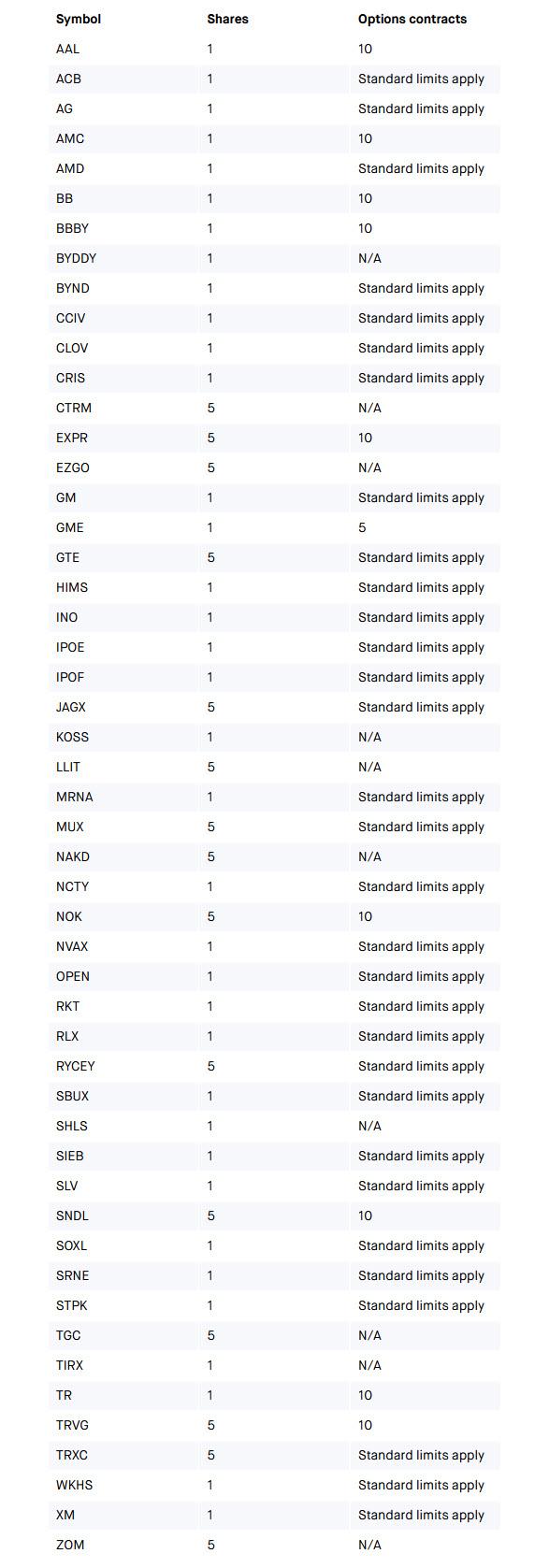
However, just before the close, things got downright surreal when in a blog post the broker - which should probably change its name from Robinhood to Suit - made a shocking announcement: going forward, customers will be subject to maximum aggregate limits in 51 securities of which 14 are capped at position limits of just 5 shares, while allowing total holdings in 36 securities to be just one share!
In other words, as of this moment, no client is allowed to one more than 1 share in names like GME, AMC, AG, BBBY, BYND, WKHS and many others. Even boring, low vol names like GM and SBUX are limited to just one share.
This is what the blog post said:
"The table below shows the maximum number of shares and options contracts to which you can increase your positions. Please note that these are aggregate limits for each security and not per-order limits, and include shares and options contracts that you already hold. These limits may be subject to change throughout the day."
Panicked clients who are wondering if this means that their current holdings which exceed 1 laughable share will be forcefully liquidated can breathe for now: the company said that "outside of our standard margin-related sellouts or options assignment procedures, your positions will not be sold for the sole reason that you are currently over the limit. However, you will not be able to open more positions of each of these securities unless you sell enough of your holdings such that you are below the respective limit." (we expect that to change on Monday, if the company is still around.)
In other words, virtually nobody can buy any new securities.
The company also disclosed that no fractional shares can be bought going forward as "fractional shares are currently position closing only for all of the securities listed in the table above. This means you can sell and close your fractional positions, but you can't open new fractional positions. However, you can still open new whole share positions according to the limits listed above."
Why is this happening? The most likely reason is that between DTC, clearinghouses and other regulatory entities, Robinhood was found to be in another capital deficiency position - even with the billions raised overnight - and it is being forced to delever.
This likely means that Robinhood is as of this moment, scrambling to obtain even more capital, although we somehow doubt it will be just as easy to "take from the rich" as it was late last night especially since the client exodus is surely accelerating.
It also means that we may have to have another "Lehman Weekend" situation on our hands, only this time it will be a "Robinhood Weekend", and an urgent acquisition from a strategic buyer may be required to prevent the worst case outcome. We only hope that the billions in funds held in custody for clients is segregated should the company collapse (pinging Jon Corzine here).
In any case, expect a lot of Robinhood related news over the weekend.
* * *
And as a postscript, while we expect that the turmoil will be contained at Robinhood, whether in the form of new capital infusion, a takeover, or bankruptcy, there is the possibility that the liqudity shortfall goes as far as the clearinghouses. What happens then? Below we excerpt from a monthly letter written by Horseman's Russell Clark who had a good recap of "what if":
Pre-financial crisis, banks and clearinghouses were part of one big and messy system. Banks mainly traded with other banks as it was cheaper, but every now and then they would trade through a clearinghouse. There were two types of trades. Circular trades, which are trades where each bank has a position, but the system has a flat position, and directional trades, where the system would match up buyers who wanted to take a view on future movements of financial markets. Directional trades are more dangerous; risk will be less evenly distributed as it will have no offsetting trades.
When Lehman went bust, LCH, the biggest interest rate derivative clearinghouse, found they only needed one third of the initial margin to cover losses. This encouraged regulators to move clearinghouses to the center of the financial system. However, this has caused two big problems.
Firstly, clearinghouses have no real "skin in the game". They act like a bookie, that takes bets from punters, and transfers money from winners to losers. But how much risk should they take? What is the correct level of initial margin? Clearinghouses used to piggyback on bank's risk measures, but without banks to guide them, how should they set risk? Clearing houses and regulators chose to use a backward-looking model, with risks set from market data from between 3 and 10 years in the past. This has caused the markets to have a built-in momentum model which amplifies cycle both ways. Hence, many of the normal trading rules don't apply. There will be no signs of problems in the market until right at the last moment. Markets are no longer discounting mechanisms and have become more akin to momentum models.
Secondly, banks are now deeply capital constrained, and at the start were very reluctant to move old trades to a centrally cleared model. This problem was resolved through a carrot and stick approach. The stick is uncleared trades carry a capital charge, and the carrot is that the exchanges offer very attractive "netting". What netting means is that banks can give details of all their trades to a third party, and any circular trades can then be netted off thus requiring less margin. LCH claim to have done a quadrillion of compression trades or netting in the last year, this is more than twice the notional of all outstanding interest rate derivatives.
The problem should be apparent. Clearinghouses were safe because, if there was a problem, the circular trades netted off on settlement. But by aggressively netting off at the margin stage they are no longer as safe. In fact they are very risky. This was highlighted by the near failure of a small clearinghouse in Europe last year. Using BIS data on the penetration of central clearing, and pricing of interest rate derivatives as a proxy of initial margins, I would say that initial margin in the system needs to rise by about 6 times to make the system "safe". Looking at previous periods of rising initial margins in 2000-2002 and 2007-2009, the pro-cyclicality of claringhouses should be obvious.
Finally, cash hoarding and repo market problems could be a sign of counterparties beginning to worry about clearinghouses. If initial margins rise significantly, the only assets that will see a bid will be cash, US treasuries, JGBs, Bunds, Yen and Swiss Franc. Everything else will likely face selling pressure. If a major clearinghouse should fail due to two counterparties failing, then many centrally cleared hedges will also fail. If this happens, you will not receive the cash from your bearish hedge, as the counterparty has gone bust, and the clearinghouse needs to pay from its own capital or even get be recapitalised itself. One way to think about it is that the financial crisis only metastasized when MG failed, because at that point, everyone suddenly became un-hedged, and everyone needed to sell.

Barrons : EV Battery Start-Up QuantumScape Is Driven Solely by Promise

EV Battery Start-Up QuantumScape Is Driven Solely by Promise

QuantumScape, a battery start-up founded by Stanford University scientists a decade ago, generates no sales and says it won’t have meaningful revenue until 2026.

Yet its stock has rocketed 377% since August—even after a recent pullback of more than 60% from its peak. QuantumScape (ticker: QS), at a recent price of $47 a share, has a market value of roughly $21 billion, greater than all but one auto-supplier stocks trading in North America.

QuantumScape has generated excitement by pioneering a new battery technology. But by any measure, this is an overvalued stock.

But expensive need not mean a price driven skyward by fads, short squeezes, or other forces, as in the case of GameStop (GME). Overvaluation is everywhere in 2021. The better questions are: How do investors make sense of this? And what to do about it?

QuantumScape isn’t the only stock that has ridden a frothy wave of investor exuberance. There are about 50 companies with less than $1 million in revenue and a market value of more than $1 billion, compared with 22 just two years ago. The combined market value of those 50 companies is nearly $200 billion, versus $64 billion for the 22. What’s more, there are more than 90 firms trading for more than 50 times trailing 12-month sales. In 1999, at the height of the dot-com boom, the comparable number was 16.

The figures don’t include those without any sales, like QuantumScape. Firms are being valued at a multiple of sales years down the road.

That’s true of at least five other electric-vehicle stocks that, like QuantumScape, went public through a special purpose acquisition company, or SPAC, last year. “The multiples are going higher and sales further out,” says Bernstein analyst Mark Newman.

One way overvaluation happens is that valuing high-growth stocks can be difficult. It’s easier to compare stocks to peers. That means that electric-vehicle stocks, like QuantumScape, have a Tesla (TSLA) problem, says Newman. Investors will look at the electric-vehicle maker and say, “If Tesla is worth X amount, then QuantumScape can be worth 10% of that,” he says. That’s dangerous thinking to Newman, because people then assume that such a valuation is inevitable.

QuantumScape CEO Jagdeep Singh tells Barron’s that he leaves valuation to markets and tries to focus on what he can control. We asked him about valuation after the stock had doubled, to $36, around the end of November.

The stock eventually rose above $130. Newman, the only analyst covering the company, says none of his institutional clients are investing in QuantumScape at current levels.

Yet there is serious money betting on QuantumScape. Volkswagen (VOW3.Germany), the Qatar Investment Authority, Bill Gates, Jeremy Grantham, and George Soros’ Quantum Partners are strategic investors.

As is Sun Microsystems co-founder and technology investor Vinod Khosla. In an interview with Barron’s, he made the case for QuantumScape. “EVs will be dominant by 2030,” Khosla says. “The battery will represent 25% of the cost of the EV.” That implies that the battery business will be worth hundreds of billions of dollars in the next decade.


Quantum is working on lithium anode solid-state batteries. Solid state means there is no liquid electrolyte common to today’s rechargeable batteries. Solid-state batteries promise better EV range, life, and safety, with lower costs and faster charging time. No one has been successful yet with solid-state lithium anode batteries.

Khosla doesn’t expect Quantum will be the only player, but he believes that Quantum is in the lead. “Is there a competitor that will have a comparable battery in the next five years? Extremely unlikely,” he says. “That gives us the ability to be dominant in the battery market.”

Dominance for Khosla translates into higher-than-average profit margins. If the car industry reaches 30 million electric vehicles by 2030, as Tesla CEO Elon Musk suggests it will, that would add up to roughly $1 trillion in annual EV sales. By Khosla’s math, that amounts to $250 billion in annual battery sales.

After figuring sales, investors still have to decide what Quantum’s market share and profitability will be. With 10% to 15% share of the battery market and above-average profitability, Quantum could be generating roughly $5 billion in annual earnings before interest, taxes, depreciation, and amortization, or Ebitda, by 2030.

QuantumScape, in its SPAC merger presentation, said it expected to earn roughly $1.6 billion in Ebitda in 2028. That isn’t as bullish as Khosla, whose numbers are aggressive but not unreasonable. The largest auto suppliers earn about $5 billion in Ebitda today.

There is a path for Quantum to be a huge success. But there is still risk.

Investors still interested in holding expensive stocks like QuantumScape can do a couple of things to reduce that risk. For starters, they can hold small positions. Position sizing can help sate investors’ need for growth and limit overall portfolio risk.

Another possibility: They can sell covered call options. Selling a call means selling an option that gives the buyer the right to purchase a stock at a fixed price. This may be risky for the seller, but less so if the seller already owns the stock that may be acquired by the call buyer. Some theoretical numbers can help. The option seller might sell for $5 a call with a strike price of $100 for a share trading at $90. If the stock then rises to $110, the seller of the call is out $15.

But if the seller owns the stock, then they hand over a share to the buyer, essentially selling the stock for $95. The seller also forgoes the upside to $110, but if the stock is pricey, they might not have believed it was worth $95 anyway. And if the stock drops, the call seller still has a position in the shares, plus the $5 from the call buyer. Covered call selling requires experience. New call sellers should start small and ask for help.

The philosophical way to avoid overvaluation requires experience, too. Investors need to build up resistance to the fear of missing out, or FOMO—even if the future turns out to be driven by solid-state lithium batteries.

Barrons : How to Value Ford and GM Stock in an EV World

The car business is one of the biggest, most important, industries on the planet, generating trillions in annual sales and employing millions around the globe.

The rise of electric vehicles is the most significant transportation innovation since people rode horses to work. How traditional auto makers, such as Ford Motor (ticker: F) and General Motors (GM), deal with that trend is the most important issue for car investors in a very long time.

Morgan Stanley analyst Adam Jonas isn’t convinced Ford can be a long term EV winner. He cut his rating on Ford stock to Sell Friday from Neutral. His target price, however, is unchanged at $9 a share.

He believes Ford “has a shot” in the EV race, but “there are several material points around strategy, execution, and transparency that have yet to materialize,” writes Jonas in a Friday report. Jonas actually has an $18 bull case for Ford stock. He just lacks confidence the bull case will come to fruition.

To answer the conundrum of the transition from ICE—internal combustion engine—to EV, Jonas rebuilt Ford’s valuation from the bottom up. He believes Ford’s truck business is worth $4 a share. The rest of the car as well as the European operations are worth negative $2 a share. Ford’s self-driving initiatives are worth $1, and the coming Ford EV business is worth $7.

With a couple of other adjustments, his total for Ford stock reaches almost $14 a share. That’s still higher than today’s price of about $10.74, but there is risk to consider. As a result, he lops off $4 to account for unforeseen developments.

It’s an interesting way to value traditional auto makers in an EV world. Jonas feels better about GM. He rates GM stock at Buy, and raised his price target Friday to $80 from $57.

Jonas goes thru a similar exercise to determine GM stock’s value. His math values the ICE business at $0 a share, and GM’s growing EV business at $52. Then there is $10 each for Cruise automation and GM’s Ultium battery platform. Corvette, GM financial and GM’s connected services business—think On Star—are worth another $28 a share.

He also takes a risk-related haircut to valuation, as he did with Ford valuation, and Jonas believes it comes to $80 a share.

Interestingly, Jonas’ per-share EV valuations for Ford and GM work out to about $74 billion and $28 billion, respectively. That is a fraction of Tesla ‘s (TSLA) value. Tesla, however, is the EV leader. We note that Jonas values GM-EV at roughly 80% of the value of Chinese EV maker NIO (NIO), and values Ford-EV at roughly 70% of the value of XPeng (XPEV), another Chinese EV firm.

Jonas has a Buy rating on Tesla stock and an $810 price target. He does a similar exercise to arrive at Tesla value. Jonas values the Tesla car business at about $315 billion, or about $332 a share. The rest of Tesla’s value, for Jonas, comes from software sales, potential robotaxi businesses, insurance operations, and solar and battery sales. Tesla, don’t forget, has a stationary power business.

Barron’s recently wrote positively about Ford stock, believing that when Ford updates investors about EVs, the market will be pleased. Since that article appeared in November, Ford stock is up about 18%. There is still work to be done, as Jonas points out, but Ford can be a long-term EV winner. In the meantime, investors can still benefit from improving profit margins and new-vehicle programs such as the Bronco and new Ford F150.

Wall Street, for now, clearly prefers GM to Ford. About 90% of analyst covering GM stock rate it at Buy. Only about 20% of analysts who cover Ford stock rate it at Buy. The average Buy-rating ratio for stocks in the Dow Jones Industrial Average is about 57%.

Ford stock is up, despite the downgrade. Even survival for a traditional auto company can be a positive for investors these days. The S&P 500 is down 1%. GM stock is up 0.6% after Jonas’ target-price hike. His $80 target is the new high-water mark on Wall Street.

Barrons : Swiss Chemicals Giant Sika Has a Formula for Growth. That Could Make t

Swiss Chemicals Giant Sika Has a Formula for Growth. That Could Make the Stock a Postpandemic Star.

Swiss chemicals giant Sika suffered from a slump in construction last year due to the pandemic, causing annual sales to fall 2.9%. But shares in the Baar-based firm, which makes chemicals that strengthen and waterproof concrete to improve its functionality, and even change its color, have held up well regardless.

Over the past 12 months, Sika ‘s stock (ticker: SIKA.Switzerland) has returned 36%, trading at about 247.60 Swiss francs (around $280). That’s on top of a stellar five-year run in which the stock gained more than 330%.

Coronavirus lockdowns and their impact on economic activity hampered construction in a third of Sika’s markets. But the company, fetching 38.7 times this year’s expected earnings and valued in line with its peers, could be a postpandemic star.

The business was already doing well, thanks to Sika’s efforts to transform itself into a one-stop shop in some of the specialist areas in which it operates, and helped by its broad product portfolio and wide geographical reach. Better yet, the chemicals it produces help clients achieve greater sustainability as the industry shifts toward energy efficiency.

Despite the strong performance for the shares, further growth could come from two areas: an ambitious acquisition drive, and a boom in trade from governments seeking to breathe fresh life into their economies post-Covid.

Philipp Gamper, an analyst at Switzerland’s Zurcher Kantonalbank, wrote in a January note that Sika aims to achieve annual growth of 6% to 8% by 2023, a pace that can be realized by expanding its distribution channels, broadening its products, and pursuing “an active acquisition strategy targeting three to five purchases per year as a component of this growth.”

Anthony Manning, an analyst at Berenberg, also wrote in a note that construction has largely been deemed an essential industry by governments across the world in the recent crisis. “It is difficult to imagine a comprehensive stimulus package that does not include construction,” he said.

The stock could rise to CHF290, or about 17% above recent levels, according to Christian Arnold, an analyst at Stifel Europe.

The business has a market value of CHF36.2 billion and employs 25,000 staff. In annual figures for the calendar year 2019, pretax profit was CHF966.6 million, up from CHF892.9 million the year before. Net sales last year were CHF8.1 billion.

Chief Executive Paul Schuler tells Barron’s that despite the pandemic, Sika continued its growth trajectory in 2020. “Thanks to our high speed of implementation and the proximity to our customers in all countries, we were able to quickly grasp business opportunities and thus capture further market share,” he says.

The business dates to 1910, when entrepreneur Kaspar Winkler developed a waterproof mortar called Sika-1 (taking the letters Si, from the name of wife Sigrid, and the Ka from his name), which was used to seal the Gotthard Tunnel connecting northern and southern Europe.

It enabled the Swiss railway company to electrify the important connection—which should not get wet—and was used around the world. Sika set up international subsidiaries and floated on the Swiss Stock Exchange in 1968.

Sika has expanded through acquisitions, and executives say the company has a strong deal pipeline. Indeed, the industry is fragmented and ripe for consolidation. Cedar Ekblom, an analyst at Morgan Stanley, wrote in a January note: “We think Sika has the best platform for M&A growth. Shares are expensive, yet we do not think this detracts from its appeal.”

The company is also set to benefit as construction spending picks up and as other sectors recover, such as autos, to which Sika supplies adhesives.

It looks like Sika’s stock has the foundations for a solid 2021.

Barron's : The GameStop Revolt Has Just Begun. Get Ready.

The GameStop Revolt Has Just Begun. Get Ready.

For 10 months, GameStop was a depressing emblem of the Covid-era economy—many of its stores sat closed or empty, dust gathering on out-of-date game discs that had been supplanted by digital alternatives. It has closed about 1,000 outlets since the start of 2019.

Then, for the past three weeks, it became the center of a much larger world, the $36 trillion U.S. stock market. The stock rose more than 1,600%, caused a short squeeze that throttled hedge funds, and became such a topic of fascination that the White House and the Federal Reserve were forced to weigh in.

The people fueling its insane rise made fun of themselves and readily acknowledged that they were involved in a “stupid” experiment to see if several thousand nobodies could take on Wall Street and win.

They won. The strategy wasn’t profound: “I’M HOLDING THIS ONE OUT EVEN IF IT COSTS ME EVERYTHING,” Reddit user atomsej wrote on its popular WallStreetBets forum.

Investors can ignore atomsej—even if the all-caps writing makes that hard—and stay out of GameStop (ticker: GME). But the trends involved aren’t going anywhere and are already having a ripple effect. Understanding the changes will be critical to playing the market, even for those who aren’t involved in the online wars over stocks.

It is remarkable that such a big story starts with such a seemingly insignificant stock. From 2017 to last summer, GameStop shares fell to $4 from $25, yet there were glimmers of hope along the way. Michael Burry, famous for calling the mortgage bubble before the financial crisis, and Chewy co-founder Ryan Cohen disclosed stakes in 2019 and 2020, respectively. Despite skepticism from sell-side analysts, retail investors on forums like Reddit took notice, pointing to Cohen’s success beating Amazon.com in the pet-food business. GameStop announced that it would add Cohen and two other former Chewy executives to its board of directors earlier this month. It also announced holiday sales that largely disappointed analysts. That’s when things got weird, and the stock began to surge.

Users on WallStreetBets coalesced around the stock, countering the huge short interest that had massed against GameStop. The retail investors—some of them taking advantage of government stimulus checks—supercharged the trade with wildly bullish options bets. What started as silliness tapped into a populist movement that downloaded the spirit of Occupy Wall Street directly into millions of smartphones and, from there, into the plumbing of the world’s financial markets.

The new power of retail investors is a “change that is not going to go away,” said New York University professor Aswath Damodaran. “And that’s shaking up traditional portfolio managers, because they’ve lost control of the process.”

Here are the factors that drove the rally and that could affect the market well into the future:

RETAIL RENAISSANCE
In the past year, more new investors have opened accounts at brokers than ever before. U.S. brokers added at least 10 million new retail trading accounts, and a shift to zero trading commissions late in 2019 unlocked a wave of activity that dwarfed even the wild days of the dot-com bubble. Early into the coronavirus lockdowns, when people had little else to do and no major sports to bet on, trading activity started to surge and has not subsided, even as the economy has gradually opened up. Average daily trading at the biggest retail brokers hit a record of 6.6 million a day in December. This month, it soared again, to 8.1 million, according to Piper Sandler analyst Richard Repetto. On Wednesday, equity volume was triple the average day in 2019.

Retail investing has always been a small fish amid the hedge funds and other large institutions that tend to dominate trading. But that’s changing. Before the pandemic, retail trading made up 14% to 15% of equity volume; now, it’s consistently making up more than 20%, Repetto estimates. When that energy is concentrated on just a few stocks, it can make a difference—and in the case of GameStop and several-other bottom-dwelling names, it caused a startling shift.

MORE OPTIONS
Daily options trading has more than doubled since 2019, led by retail investors who can get it free on platforms like Robinhood. As of this month, small buyers account for about twice as much of the options volume as the big and midsize players, according to Deutsche Bank.

In some ways, options live in their own world—like a leveraged side bet on a stock. But they can also have an enormous impact on the underlying stock itself. Market makers who execute options trades have to hedge by buying the stock itself, often in large volumes. That action can cause the stock to rise even more.

The quick score of a bullish options play can be appealing to quarantined day traders, fulfilling both an emotional rush and a financial need—even though most options expire out of the money, making them worthless.


“We are stuck at home, and we are isolated and we are all scared, and a lot of us are hurting for money or struggling, losing employment,” said Austin Wynn, who runs a trading group that gathers on Facebook and the social-media site Discord and plays stocks like GameStop. “And I think it fulfills the high—as much as it may also fill the financial piece for a while.”

GETTING SOCIAL
Making a big bet is easier when all your friends are doing it, too. WallStreetBets began the year with about 1.7 million members and has since surged to more than six million members.

Groups of traders have targeted single stocks before, but never with the velocity and enthusiasm that they embraced GameStop.

“It’s very much a community thing,” said Brandon Luczek, a 28-year-old electronics technician for the U.S. Navy who lives in Virginia. “We were all making money together. People paid off their student loans, people paid off their houses.”


“It definitely felt like I was a part of something big,” Luczek said. He made tens of thousands of dollars on GameStop trades, including as much as $46,000 in a single day by using options.

Along with sharing screenshots of successful trades, the forums are infused with pop culture, profanity, and over-the-top doctored photos.

SHORT ATTACK
It hasn’t all been fun and memes, though. While this new group of traders has adopted a celebratory tone, they also have an us-versus-them mentality. The “them” in this case is whoever might qualify as a Wall Street insider. The gang’s antipathy focused on one group in particular: short sellers targeting stocks they like.

Shorts borrow shares of stocks they expect to fall, with the expectation that they’ll be able to buy them back at a lower price and return them to the lender at a later date. But when stocks start to rise, short sellers are under extreme pressure to buy, because they need to cover their positions and they don’t want to have to buy at even-higher prices. As short sellers panic, the buying pressure grows and the stock soars.

After Citron Research’s Andrew Left argued recently that GameStop would fall to $20 fast, he was widely mocked on the Reddit forum. People signed him up for Tinder and tried to guess his password on Twitter. Left said his family was also harassed. He withdrew from his short position and said he would no longer comment on the stock. “I had no idea what I’d set off,” he said in a video that felt not very different from a hostage scene. On Friday, Citron said it would no longer publish short-selling research after 20 years of doing so. “We will focus on giving long side multibagger opportunities for individual investors,” the firm said.

RIPPLE EFFECT
“I believe there is a systematic targeting of highly shorted stocks,” said Steve Sosnick, the chief strategist at Interactive Brokers, early in the week. He was quickly proved right.

AMC Entertainment Holdings (AMC), a movie-theater chain clinging to its life amid Covid-19 shutdowns and the rise of streaming, has seen its shares soar 278% amid interest from the retail crowd. Other out-of-favor stocks like BlackBerry (BB) and Bed Bath & Beyond (BBBY) surged amid last week’s frenzy.


The most-shorted stocks in the Russell 2000 have risen more than 80% since October, while the least-shorted ones are up less than 20%, according to Société Générale.

As heavily shorted stocks rose, hedge funds that bet against them flinched. The most notable of these was Melvin Capital, a hedge fund run by former SAC Capital portfolio manager Gabe Plotkin. As GameStop spiked, Melvin received $2.75 billion in emergency financing from Citadel and Point72. Melvin said that it had closed out of the GameStop position on Tuesday—a sign of victory for the Redditors. Wall Street’s biggest guns, like hedge fund and market maker Citadel, were in the middle of it, too, in part because of the firm’s market-making business with broker Robinhood and its investment in Melvin Capital.

The action in out-of-favor stocks spooked some hedge funds with sizable short bets. To close out those shorts amid soaring prices, some were forced to raise money by selling shares of well-liked stocks, notes Raymond James strategist Tavis McCourt. A basket of stocks popular among hedge funds saw significant drops during the week. Strategists said the action had quickly bled into even more sectors: The S&P 500 fell 3.3% this past week, its biggest drop since before the November presidential election.

“The next few weeks could be a wild ride,” wrote Oanda analyst Craig Erlam, and, given the market’s frothy valuations, it’s happening at “the worst possible time.”

LESSONS LEARNED
The sense from some on Wall Street was that all of this was wrong—if it didn’t rise to criminality, it at least overturned the order of things. But frankly, it’s not clear there is anything wrong with it. NYU’s Damodaran said he expected there to be continued cries of “ ‘we should regulate this, we should stop it.’ The reality is, I don’t think you can do it.”

The fact that a large number of investors had the same opinion about a stock and drove it to ridiculous levels isn’t illegal. If someone infused those discussions with misinformation, that might be different, and qualify as market manipulation, which is illegal. But finding manipulation in a boisterous online forum is a “needle in a haystack” problem, said Columbia Law School professor John Coffee.


“It is possible there are organized groups within WallStreetBets taking profits,” wrote Philip Moustakis, a lawyer at Seward & Kissel and a former Securities and Exchange Commission attorney, in an email. “It’s also possible this trading truly is as decentralized as it appears. And to the extent there is profit-taking, there is little indication that it is based on false information disseminated to the press, on Reddit, or elsewhere. This feels more like a collective mania: In the joy of gambling, in the joy of ‘owning’ the hedge funds who shorted the stocks.”

The SEC has said it is “monitoring” the situation, and members of Congress said there would be hearings. Those hearings could end up covering much more than why a stock rose. Rep. Alexandria Ocasio-Cortez (D., N.Y.), for instance, criticized Robinhood for blocking access to certain highflying stocks on Thursday. The company said it was forced to act quickly to blunt the impact of market activity, in part because of SEC capital requirements. Other brokers also changed their requirements for investing in the big movers.

“The commission will closely review actions taken by regulated entities that may disadvantage investors or otherwise unduly inhibit their ability to trade certain securities,” the SEC commissioners said in another statement on Friday.

William Galvin, the secretary of the Commonwealth of Massachusetts, said the New York Stock Exchange should halt trading in GameStop stock for 30 days so it can “cool down”—a suggestion that the NYSE didn’t comment on and didn’t appear to be contemplating.

Through the week, a political consensus seemed to be growing that the bad guys in this instance are the old Wall Street players, trying to blame the up-and-comers for making the market rattle. “Fully agree,” wrote Sen. Ted Cruz (R., Texas) on Twitter in response to Ocasio-Cortez, normally his fiercest opponent.


Other entities could face scrutiny, too. There was some evidence that it wasn’t just the little guys participating in the rally. “There’s absolutely institutional money at play here,” David Trainer, CEO of research firm New Constructs and a former analyst at Credit Suisse, told Barron’s. “If you look at the tape, there were 10,000-share blocks being traded,” he said.

If big players simply rode the wave, that would be OK. But if there’s evidence that they were involved in touting the stock, it could invite more scrutiny, Coffee said.

GameStop itself, which has stayed quiet during the run-up, may also face questions, former regulators said. It had announced in December it might sell stock at an “at-the-money” offering, and it could have taken advantage of the run-up to raise money. GameStop didn’t respond to requests for comment from Barron’s on whether it was doing so. Multiple board members declined to comment. AMC and Naked Brands Group (NAKD), whose stock also soared, raised cash during the frenzy.

WHAT’S NEXT
The fastest and biggest impact appears to be on short sellers. Losing an estimated $5 billion can change behavior, of course. Citron’s practice of announcing its short calls to much fanfare is over, and it’s unlikely that other funds will engage in it, either. In general, shorts will have to be both quieter and more careful.

“The thing is not to be short stocks with 150% short interest,” said Jason Mudrick, founder of hedge fund Mudrick Capital Management. “As a risk manager, you have to look at all of these things.”

Regulators will now probably try to impose new guardrails around retail trading. The SEC said last year that it was looking closer at options trading and how brokers disclose risks. Trading on margin could be curtailed, and the rules for getting into options may change.

Brokers will undoubtedly need to make changes, too. Their apps and websites have already been under pressure from a surge of retail trading. And several had to curb trading last week in some stocks for regulatory and financial reasons, angering customers. Ultimately, the brokers facilitated a frenzy they couldn’t keep up with. Now, they will have to adapt or watch their clients disappear. Robinhood, in particular, has much to prove, as the company is expected to go public this year.

Hedge funds—even those that don’t regularly go short—will also have to adjust. Much as they use alternative data to track credit card receipts and get ahead of earnings reports, they’ll now have to watch the message boards. Already, alt-data firms are ramping up their offerings, with web-crawling company Thinknum telling Barron’s that it just launched a product on Thursday specifically to track Reddit. “This new product tracks the number of times NYSE and Nasdaq tickers are mentioned in the top 100 posts on r/WallStreetBets and r/Stocks in real time,” the company said, referring to the popular Reddit forums. Already more than 50 hedge funds have asked about it.

The great innovation of 2021 is a robot that sifts through emojis for investment signals.

No, the retail revolution is clearly not going away, even if some market participants may hope it does. Those in on the fun should expect new margin limits with their brokers and possibly more stringent requirements for complex trading strategies. For everyone else, the message is more complicated. Buy-and-hold investors need to be aware of the trends, but they should stay away from the stocks.

Know this, too: The “crowd-squeeze,” as Damodaran calls the GameStop move, has already shown the potential to be a systemic risk to broader markets, particularly when pricey markets are looking for an excuse to correct.

Old-school investors are wary. Legendary bond investor Bill Gross called on Friday for government action to protect against the fallout of volatile trading. He also thinks that investors need to develop new models that rely “not just on the fundamentals of quarterly earnings reports” but also that “alert investors to improbable if not outlandish expectations.”

Reddit user benaffleks had a different take: “This is a big moment. A tug-of-war between tradition and the future. Hedge fund managers live in the past, and continue to look down upon the retail investors. They truly believe that we, the average retail investors, don’t know anything about finances or the market (which may be true), and we’re just gambling our money away.”

“This is the world they want to live in,” benaffleks added. “This was the past.”