FT : The shackles are off: Unilever goes for growth after UK move

The shackles are off: Unilever goes for growth after UK move
Politically sensitive unification will create a nimbler player in mergers and acquisitions

Launched more than a century ago to help fight cholera in England, Lifebuoy soap last year underwent a pandemic-fuelled revival that made it a global brand worth more than €1bn.

Now Alan Jope, chief executive of the soap’s producer, Unilever, faces pressure to give the whole group a similar boost, after last year unifying its almost century-old Anglo-Dutch structure into a single, UK-domiciled company.

Jope, a 36-year company veteran, argues that the politically sensitive unification will make Unilever, one of the world’s largest consumer goods makers, a nimbler player in mergers and acquisitions markets so it can chase higher growth.

But he told the Financial Times he also had a bigger goal, “to prove incontrovertibly that sustainable business does drive superior financial performance”.

Unilever has spent the past few months releasing ambitious climate and social targets, from net zero emissions in its supply chain by 2039 to ensuring all workers supplying the company receive a living wage by 2030.

The challenge, according to Marcus Morris-Eyton, a portfolio manager at Allianz Global Investors, which owns a stake in the company, “will be balancing this transition towards a more sustainable business without sacrificing too much margin.”


When Jope set out his business strategy on Thursday, reinstating financial targets and focusing on faster growing areas including high-end beauty and plant-based foods, Unilever’s shares fell to a nine-month low.

That was partly owing to tighter than expected margins for 2020, analysts said. While Covid-19-related costs were a factor, shareholders are closely watching profitability.

Among Unilever’s challenges is a homecare business weighted to relatively low-margin laundry products sold in emerging markets, according to Warren Ackerman, an analyst at Barclays.

And while the group has had some pandemic successes — such as launching Lifebuoy in 50 new countries — it has not benefited as much as rivals Procter & Gamble and Reckitt Benckiser, which have larger cleaning portfolios.

Unilever was slow to join the boom in plant-based proteins, although it now wants to increase sales of the meat and dairy substitutes fivefold, to €1bn a year in five to seven years. It also lacks a significant presence in petcare, which has helped fuel growth at rivals Mars and Nestlé.

The company plans to create more brands resembling Dove, its largest, which has over almost 20 years built up a reputation for marketing itself on “real beauty”, for example using non-models in its advertising.

Jope’s mantra is that brands sell better if they are “purpose-led”. Hellmann’s mayonnaise, for example, can be marketed as a way to combat food waste as people eat it with leftovers, he said. Next week’s Super Bowl will feature advertising to that effect.

“Our first priority is to help our brands find their purpose,” said Jope. But he warned that “the clock is ticking for brands that don’t have good growth potential.”


A review of Unilever’s slow-growing tea division, announced a year ago, is likely to result in a listing of most of the tea brands, the company said on Thursday.

Commitments made when the group unified its structure had led to speculation about a larger spin-off: Unilever told the Dutch government that if it were to carve out its food division, that company would be Netherlands-based.

But analysts now agree such a move is unlikely and Jope said the focus was on finding growth potential in the existing business.

Ackerman said he expected activity in high-end beauty, where Unilever said sales were down by low single digits in the pandemic, compared with 20 per cent for some rivals.

Activist investors could pose a threat. While they are not currently active at Unilever, London-based Bluebell Capital Partners is pushing for a new chief executive at French group Danone, while others have targeted Nestlé and Procter & Gamble in recent years.

Unilever, which is aiming to reach underlying annual sales growth of 3 to 5 per cent, compared with 1.9 per cent in 2020 and 2.9 per cent the year before, has traditionally been seen as slow-moving compared with harder-driving rivals such as Reckitt Benckiser. One former staffer called it “bureaucratic”.

But the pandemic unleashed a new agility in adapting to changed consumer behaviour, such as rolling out home deliveries of ice cream, analysts said.

“They are executing better and allocating resources better [in the pandemic], and they need to somehow take this newfound agility and bottle it and use it as a code for how they continue to deliver once hopefully Covid is in the rear-view mirror,” said Ackerman.

Jope will also need to demonstrate that sustainability pays. Switching to renewable energy has proved to be a money saver, he said.

But other initiatives Unilever supports — such as extended producer responsibility, in which companies must pay for green disposal of waste from their products — seem certain to incur costs.

Another example is paying the living wage through Unilever’s supply chain, which Jope said would be funded by savings elsewhere. He believed rivals would come under pressure to make the same shift. 

“We would be interested to see which of our peers stands up and says, ‘We’re not prepared to ensure the payment of a living wage’,” he said.

Unilever was also in talks with national governments about using its ice-cream cold chain to help with vaccine rollouts, said the chief executive.

His plans have won over many former and current staff. Sue Garrard, a former Unilever executive, said she agreed with Jope that “the world is going to be increasingly intolerant of businesses that sell you stuff at the price of trashing the planet”.

Jope’s predecessor, Paul Polman, had long pushed similar green measures, but had a distant relationship with shareholders that turned fractious when he tried unsuccessfully to unify the group as a Dutch, rather than UK, company.

The current chief executive “has taken time to win the confidence of the market,” said Martin Deboo, analyst at Jefferies. “But I think the direction of travel is positive.”
>>> US After Hours Summary: Lots of earnings -- COLM +12%, PINS +9.8%, ATVI +7.4

After Hours Summary: Lots of earnings -- COLM +12%, PINS +9.8%, ATVI +7.4%, SYNA +6.7% on upside; NEWR -12.6%, GPRO -11.7%, U -11.4%, PTON -8%, SNAP -7.1%, SKX -5.3%, WWE -4.9% lower; JNJ applies for EUA for vaccine

After Hours Gainers:

Companies trading higher in after hours in reaction to earnings/guidance: SIEN +29.6%, TDC +16.5%, COLM +12% (also increases share repurchase program by $400 mln), VREX +11.9%, PINS +9.8%, BILL +9.7%, PLT +8.4%, ATVI +7.4%, OTEX +7.2%, ENVA +7%, SYNA +6.7%, LESL +5%, ESS +4.7%, NWSA +4.5%, DLX +3.7%, AOSL +3.5%, ZEN +2.8% (also CFO to depart company), GILD +2.6% (also increases dividend), MCHP +2.3%, CCS +2.3%, MTD +2.1%, FTV +1.7%, DXC +1.5%, PFSI +1.5% (also approves stock repurchase increase), DECK +1.3%, HIG +1.1%, F +1%, AINV +0.7%, MPWR +0.7%, CSL +0.4%, OHI +0.4%, ONTO +0.2%, BHE +0.1%, MTX +0.1%, OFC +0.1%

Companies trading higher in after hours in reaction to news: TTOO +48.3% (announces ability of T2SARS-CoV-2 panel to detect Brazil variant of SARS-CoV-2 virus), MDGL +14% (Jefferies Managing Director highlights name as one with high short interest - CNBC interview), KPTI +8.9% (Jefferies Managing Director highlights name as one with high short interest - CNBC interview), RCKT +7.5% (Jefferies Managing Director highlights name as one with high short interest - CNBC interview), SLM +5% (President Biden considering forgiving student debt through executive order, according to WSJ), JNJ +2% (announces submission of EUA application for investigational single-shot Janssen COVID-19 vaccine candidate), NNDM +1.6% (ADS offering), DAN +1.4% (Carl Icahn discloses 7.45% passive stake), EFX +0.5% (extends employment contract of CEO), RGLD +0.4% (files for mixed securities shelf offering), AVA +0.2% (increases dividend), GOOG +0.1% (TWTR announces new strategic partnership with GOOG Cloud), KSU +0.1% (increases dividend), CORR +0.1% (acquires Crimson Mistream's California pipeline assets; announces internalization of REIT manager)

After Hours Losers:

Companies trading lower in after hours in reaction to earnings/guidance: NEWR -12.6%, GPRO -11.7%, U -11.4%, YRCW -11.3% (also changes name to Yellow Corp. new ticker YELL), TWST -9.2%, PTON -8%, SNAP -7.1%, KBAL -5.9%, SKX -5.3%, WWE -4.9%, PRO -4.4%, SXI -4.4%, SKYW -4.2%, PCTY -3.3%, ARWR -3%, UNM -2.9%, TMUS -2.5%, FTNT -2.4%, LGF.A -1.4%, FLT -1.3%, PFPT -0.9%, MSI -0.8%, NBIX -0.7%, WYNN -0.6%, CPT -0.4%, KN -0.2%, LBRT -0.2%, NOV -0.1%, PRU -0.1%

Companies trading lower in after hours in reaction to news: PTCT -5.3% (hosts call to review results from clinical study of Translarna), GOL -2.8% (Jan traffic data), BLI -2.4% (announces CFO transition), UEPS -2.2% (sells remaining stake in Bank Frick for $30 mln, also reports earnings), OCX -1.7% (stock offering), SBNY -1.3% (stock offering), PLMR -0.8% (provides estimated Q4 catastrophe losses), NOG -0.8% (prices 12.5 mln share offering at $9.75/sh), NVAX -0.3% (starts rolling review process for authorization of NVX-CoV2373 by multiple regulatory authorities), TWTR -0.2% (TWTR announces new strategic partnership with GOOG Cloud), COG -0.2% (provides Q4 operational update), MSFT -0.2% (finds no evidence Solarwinds attack used Office 365), PXD -0.1% (increases dividend), THC -0.1% (Glenview Capital lowers active stake)

>>> US Notable earnings/guidance movers: TDC +10.9%, COLM +9.9%, P

Notable earnings/guidance movers: TDC +10.9%, COLM +9.9%, PINS +8.5%, PLT +7.5%, ATVI +5.5%, ZEN +2.6% on the upside; GPRO -11.5%, NEWR -10.1%, SNAP -8.9%, FLT -6.6%, PTON -5.9%, SKX -4.6% on downside

  • Earnings/guidance gainers: SIEN +29.4%, TDC +10.9%, COLM +9.9%, PINS +8.5%, PLT +7.5%, BILL +7.2%, OTEX +6.3%, ATVI +5.5%, VREX +5.1%, ENVA +4.3%, SYNA +4.3%, DLX +3.7%, LGF.A +3.3%, ZEN +2.6%, CCS +2.3%, DECK +2.2%, PFSI +2%, GILD +1.8%, FTV +1.5%, HIG +1.1%
  • Earnings/guidance losers: U -14.2%, GPRO -11.5%, YRCW -11.3%, NEWR -10.1%, SNAP -8.9%, TWST -8.7%, FLT -6.6%, PTON -5.9%, SKYW -4.8%, SKX -4.6%, SXI -4.4%, PCTY -3.3%, PRO -3%, WWE -2.9%, FTNT -2.7%, ARWR -2.3%, TMUS -1.9%, UNM -1.9%, MCHP -1.2%, DXC -1.1%, MPWR -1.1%

>>> US Close Dow +1.08% S&P +1.09% Nasdaq +1.23% Russell +1.98%

Closing Stock Market Summary

The S&P 500 rose 1.1% on Thursday to extend its win streak to four sessions and close at a record high. The Nasdaq Composite (+1.2%) and Dow Jones Industrial Average (+1.1%) kept pace with the benchmark index, while the Russell 2000 (+2.0%) pulled ahead with a 2% gain. The Nasdaq and Russell 2000 also closed at record highs. 

Ten of the 11 S&P 500 sectors finished in positive territory, including the financials sector (+2.3%) atop the standings in a continuation of its strong performance this week. Bank stocks benefited from another uptick in longer-dated Treasury yields. On a related note, the Bank of England warned UK banks to prepare for the possibility of negative interest rates.  

Apple (AAPL 137.39, +3.45, +2.6%) was a key market-mover today amid reports that it's nearing a deal with Hyundai-Kia to manufacture the "Apple Car," an autonomous electric vehicle. With additional support from earnings-driven gains in PayPal (PYPL 270.43, +18.53, +7.4%) and eBay (EBAY 61.12, +3.08, +5.3%), the information technology sector gained 1.6%.

On the downside, the materials sector (-0.5%) was the lone sector holdout amid lower metal prices and weakness in Air Products (APD 256.70, -19.90, -7.2%) despite its positive earnings report. 

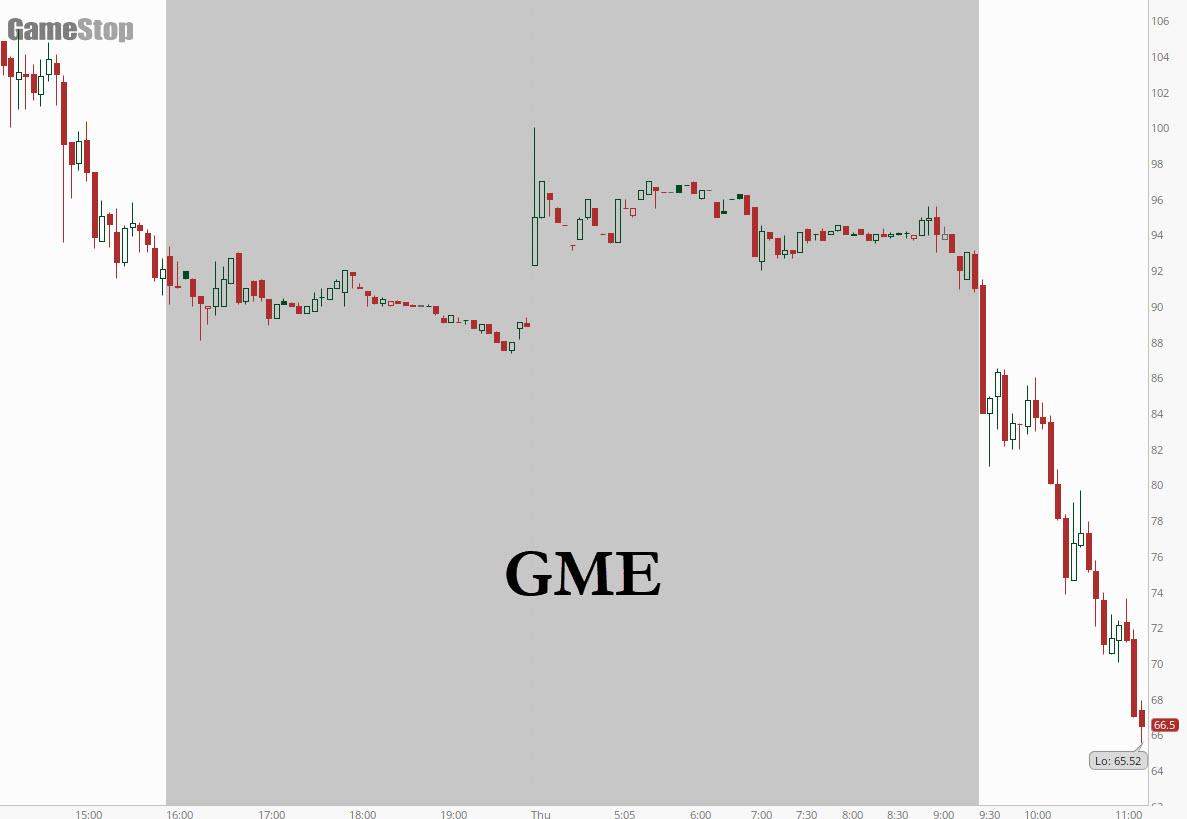
Other laggards included Qualcomm (QCOM 147.97, -14.33, -8.8%), Merck (MRK 76.03, -1.29, -1.7%), UnitedHealth (UNH 329.32, -8.57, -2.5%), and GameStop (GME 53.50, -38.91, -42.1%). Note, the continued weakness in GameStop was cited as a positive factor for sentiment since it appeared to represent the capitulation of last week's short-squeeze mania. 

Qualcomm delivered better-than-expected earnings results but warned that supply constraints are preventing it from fully meeting the robust chip demand. Merck and UnitedHealth said their CEOs will retire later this year; Merck also missed top and bottom-line estimates but issued upbeat FY21 guidance. 

Evidently, the negative reactions today didn't necessarily follow bad news, which likely bolstered confidence in the broader rally effort. 

In the Treasury market, the benchmark 10-yr yield increased one basis point to 1.14% after touching 1.16% at its high. The 2-yr yield was unchanged at 0.11%. The U.S. Dollar Index advanced 0.4% to 91.51. WTI crude futures increased 0.9%, or $0.52, to $55.70/bbl.

Reviewing Thursday's economic data:

  • Initial jobless claims for the week ending January 30 declined by 33,000 from the prior week to 779,000 (consensus 825,000). Continuing claims for the week ending January 23 decreased by 193,000 to 4.592 million.
    • The key takeaway from the report is that the level of initial claims improved; however, they didn't improve nearly enough to drown out calls highlighting the need for additional stimulus and extended jobless benefits.
  • Productivity in the fourth quarter decreased from the previous quarter at an annual rate of 4.8% (consensus -2.8%). Third quarter productivity was revised up to a 5.1% increase from 4.6%. Unit labor costs jumped at an annual rate of 6.8% (consensus 3.3%) following a downwardly revised 7.0% decline (from -6.6%) in the third quarter.
    • The key takeaway from the report is that the drop in productivity was the largest quarterly decline since the second quarter of 1981.
  • Factory orders for manufactured goods increased 1.1% m/m in December ( consensus 0.7%) after increasing an upwardly revised 1.3% (from 1.0%) in November. This is the eighth consecutive monthly increase in factory orders.
    • The key takeaway from the report is that it showed another increase in business spending, as nondefense capital goods excluding aircraft increased 0.7% in December after increasing 1.2% in November.

Looking ahead, investors will receive the Employment Situation Report for January, the Trade Balance for December, and Consumer Credit for December on Friday.

  • Russell 2000 +11.5% YTD
  • Nasdaq Composite +6.9% YTD
  • S&P 500 +3.1% YTD
  • Dow Jones Industrial Average +1.5% YTD

(ZH) Here Are The Companies WallStreetBets May Target Next

Here Are The Companies WallStreetBets May Target Next

With Gamestop stock in freefall, down more than 85% from its all time highs and dragging many of the other most shorted "meme" stocks that soared at the end of January...
... the question on every trader's mind is whether the squeeze (and hedge fund deleveraging) is finally over and is it safe to go back to shorting again?
Addressing this point, JPM strategists published a report overnight in which they note that the most common questions people are asking are “does the de-risking persist?” or“what do we expect going forward?” As JPM explains, it seems likely that we’re through most of the extreme deleveraging, especially among L/S funds, given how much L/S funds de-grossed last week and how negative alpha spreads were. Validating this point, the strategists point to the improving HF returns that are getting reported in the press so far which suggest that there were bright spots within L/S last month, while other strategies generally held up better than L/S. Thus, "the performance risk appears to have been relatively contained despite a couple days of broader pain last week" according to JPM.
That said, not everything has gone right back to the way it was. JPM cautions that while we’ve seen HFs add back to shorts among High SI stocks early this week, "the additions pale in comparison to the large reductions last week." Among Equity L/S funds the % of the North American short book in ETFs has jumped to nearly 18% from under 14% just earlier last month, but it remains below prior highs in recent years. To JPM "this suggests that there’s still room to shift further into ETFs."
Summing up JPM's view, while "the performance rebound likely reduces odds of larger de-risking... that doesn’t mean we couldn’t still see some aftershocks over the next 2-4 weeks given exposure levels (both gross and net) are still quite high, performance is mixed, and the recent events are still very fresh."
To be clear, aftershocks might not have direct impact on broader market returns as it doesn’t seem like HFs are looking to actively reduce directional risk, but it’s not clear that discretionary HF positioning is very “clean” either.
To be sure, while there have been some prominent casualties of the "Reddit rebellion", most notably Melvin Capital which lost more than half of its assets and needed a bailout from Citadel and Point72 and short-seller Citron whose founder Andrew Left last week said that he would not longer pitch short ideas, Bloomberg reports that most hedge funds are "hunting for frothy names to short, even after GameStop":
On the short side, they’re targeting some of last year’s best performers -- those with businesses that will be less robust once people return to their pre-pandemic routines -- as well as industries that may languish because of altered consumer tastes or habits, such as movie-theater operators like AMC.
That said, having fully realized how powerful a coordinated trading effort among its record 8.5 million members could be, the WallStreetBets crowd is unlikely to give up trying to find the next most negatively convex catalyst, by which we mean "inflict the most pain on the professional investing community", and sure enough while attention may have drifted away from Gamestop and AMC, daytraders are now flocking to other, less liquid, corners of the stock market such as small drug developers and pennystocks, just as we expected would happen last week...
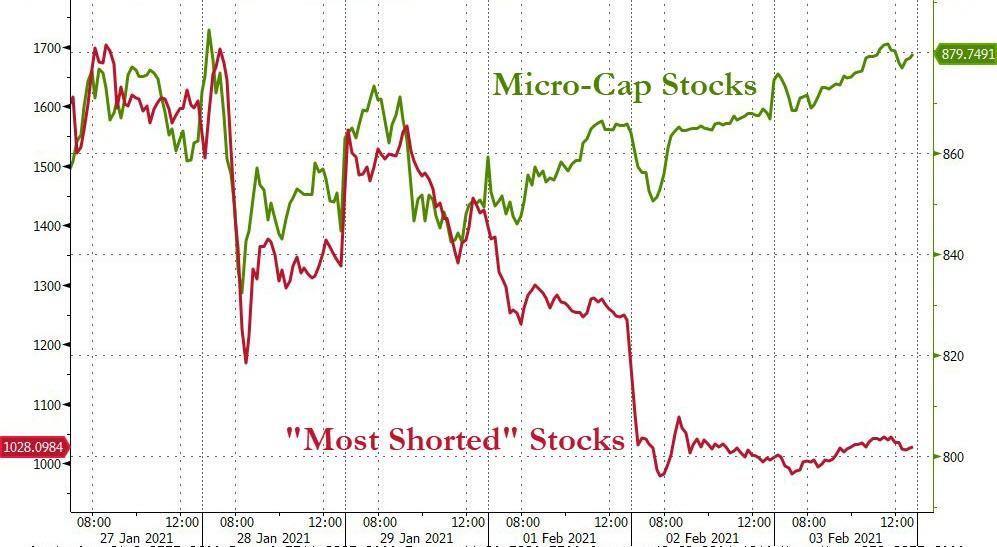
... as a result microcap stonks are soaring while the "most shorted" names are tumbling
As Redditors now use Reddit mostly as a message board on which to coordinate where the next buying spree will strike, they have sparked rallies in micro cap names such as Anavex Life Sciences, Cassava Sciences and MannKind Corp. The gains show that Reddit is continuing to “play a major role in trading action” for single stocks, wrote Jared Holz, a Jefferies health-care equity strategist.
There's also the fact that it is only a matter of weeks before millions of reddit traders receive another check to the tune of (roughly) $1,400 which they can use to ramp up a whole new batch of names, once the latest Biden fiscal stimulus passes some time in late March/early April.
Yet while the next "reddit ramp" is just a matter of time, we expect the sophisticated traders behind these ramps to dig deeper and ignore the lowest hanging fruit. After all, it took just a 2 minutes stock screen to find the most shorted stocks - we doubt that strategist will work again.
So what may work?
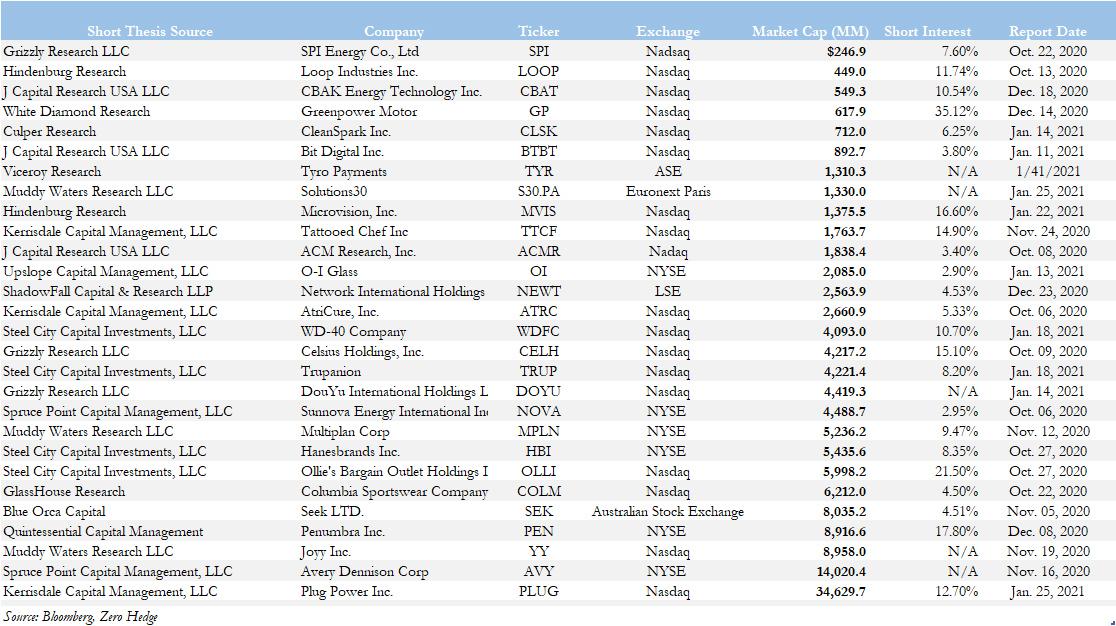
Considering the negative publicity hedge funds have gotten in recent weeks and considering that quite a few of them still remain very short a handful of "idea dinner" stocks - which however are not quite as popular and have not be listed among the top 30 most-shorted Russell 3000 stocks - we thought that the next logical place would be to look at which companies have been targeted in the recent past by prominent short sellers (while they are still around because if Citron's example is copied, soon there will be no public short reports) such as Muddy Waters, Citron, Kerrisdale, Hindenburg Research, Grizzly Research, Blue Orca and hedge funds themselves (as disclosed in their periodic letters to clients) and where there has been a pileup of similarly bearish hedge funds, and where rolling short squeezes could happen next.
And while readers are always encouraged to do their homework and go through recent hedge fund letters and "short" research reports on their own (which our professional subscribers have access to), below we have done some of the legwork and looked at some of the more popular short as disclosed in investing these and hedge fund letters published since Q3 2020. The result, sorted by ascending market cap, are presented below.

>>> Fed’s Bullard (non-voter): Gamestop is a spectacular example of speculation,

Fed’s Bullard (non-voter): Gamestop is a spectacular example of speculation, but not an issue for monetary policy
- Recovery already looks strong without further fiscal spending
- Asset prices are not way out of bonds when compared to pre-pandemic levels of a year ago
- If we play are cards right Fed might be able to move inflation above target during post pandemic boom
- Will look for leadership form Chair Powell about when to start QE tapering discussion; too early to start in midst of pandemic

Le Figaro: The confidences of the CEO of Couche-Tard the man who wants to buy Ca

Le Figaro: The confidences of the CEO of Couche-Tard the man who wants to buy Carrefour

Exclusive Interview - Alain Bouchard, founding president of the Canadian distributor, and Brian Hannasch, CEO of the group, explain why they have not given up on buying the French giant.

LE FIGARO. - Couche-Tard is primarily present in gas stations and convenience stores in North America. Why take an interest in Carrefour, whose store formats and geographic locations are far from yours?

Alain BOUCHARD. - When I was younger, I ran supermarkets before I went to convenience stores and then gas stations. Twenty years ago, I told my associates that we had to diversify into supermarkets. But we decided not to go because there were still a lot of opportunities in our core business. We will continue our acquisition strategy. But if you find opportunities around 100 stores, it is more difficult to find sets of several thousand. It is therefore time to add another axis of growth to our group, with a major acquisition in the supermarkets and convenience stores sector. We chose Carrefour for its exposure to numerous markets, in France, in other European countries and in Brazil. We visited stores and were impressed with its very solid model. We can make it grow even more. Carrefour is under pressure in France and needs huge investments that it cannot make alone. Alexandre Bompard needs additional resources to accelerate his plan.

"READ ALSO - Nicolas Baverez:" Takeover of Carrefour, statist populism "

What was your project with Carrefour?

A. B. - Our plan was to make Carrefour a base of excellence to consolidate the market. Globally, mass distribution needs to be consolidated. Carrefour and Ahold Delhaize are the only groups present in both Europe and America.

Brian HANNASCH. - In France too, there are too many distributors, not to mention hard-discounters and Amazon. We would not have continued with consolidation right away. First, we would have learned to work with the Carrefour teams. It would have taken two or three years for our debt to go down. Then we would have resumed acquisitions in the world. We already have targets.

Casino is also present on two continents. You met its CFO this fall. Have you proposed a merger with this group, less dependent on hypermarkets?

A. B. - When you are a buyer, you need a seller ...

B. H. - I really like the Monoprix format and their presence in Brazil. But Carrefour has a larger geographical presence, and Casino is mainly present in France and Brazil. We really like Alexandre Bompard's plan, his omnichannel approach backed by 8,000 convenience stores, his focus on organic, home delivery and e-commerce.

You proposed to invest 3 billion euros in Carrefour. Were you ready to invest in French hypermarkets as well?

B. H. - We can help Carrefour to further modernize its French assets, for the benefit of the employees who work there and the customers who come there.

A. B. - We would have arrived with a new eye. We have identified huge opportunities to add value to Carrefour.

Bruno Le Maire vetoed your project even before receiving you, and without giving you time to develop your arguments. Do you feel that you have been mistreated by the French government?

A. B. - Politicians sometimes find it difficult to accept major changes in their country. We underestimated this. We thought the French government was encouraging foreign investment in France and hope that is still the case. The Bloomberg agency leak came too soon. We still had to negotiate a few days with Carrefour.

B. H.- We were very close to having an agreement on the principles of the operation, we obviously had a positive reception from the Carrefour administrators informed of the negotiations. Meeting the French government was of course the immediate next step.


Were you upset by the argument of the threat your takeover of Carrefour would pose to the food security of the French and to the agricultural world of our country?

A. B. - This is not a valid argument. I don't see how we could have been a threat. In my opinion, the decision of the French government is mainly linked to the pandemic.

B. H. - Our project was, on the contrary, to strengthen ties with French farmers and food manufacturers. Growing up on a farm in the Midwest, I am aware of these concerns. Offering empty shelves, not supporting local farmers, is not the best way to be a good distributor! We respect the government's position, but we still believe in this project. If one day the political situation changes, we are ready to re-engage.

Are you prepared to wait until after the presidential election, in May 2022, to buy Carrefour?

B. H. - Carrefour is at the top of the list of companies that interest us, but it is not the only one that would allow us to create a global player. By then, we may have moved on.

A. B. - We are not going to stop looking at the possible opportunities. 2022 may be a bit far away. We will see where we are in two years, and if there is an opening before.

How do you convince that consolidation is not a threat?

A. B. - This is not a threat, it is a response to a problem. Carrefour is under pressure, Couche-Tard is under pressure. We are taking initiatives to face it, but you have to be powerful, have the capacity to invest in order to defend yourself and win. The day Amazon bought Whole Foods, shares of distributors plummeted around the world, billions of dollars evaporated. To operate in this environment, you need to have a plan, and to implement that plan, you need money. Those who are unable to invest are in danger.

»READ ALSO - Carrefour, new historical monument

Experts assure that the salvation of food distributors depends on their digitization and their shift towards e-commerce.

B. H. - The future of food retailing is not e-commerce, it is omnichannel. Good distributors are those who are successful in meeting the needs of their customers.

A. B. - I believe a lot in the proximity and the freshness of the products. You are more likely to gain the trust of consumers if you have stores in the city center than if you have a giant warehouse in the Paris suburbs.

What are you looking for with the partnerships being studied between Couche-Tard and Carrefour?

B. H. - We have set up a small team on the Couche-Tard side, and another on the Carrefour side, which will work together for the next forty-five days on four partnership projects. We will see if it is possible to create value for our two companies. Either way, we'll go ahead.

Le Figaro : Les confidences du PDG de Couche-Tard l'homme qui veut racheter Carr

Le Figaro : Les confidences du PDG de Couche-Tard l'homme qui veut racheter Carrefour

Entretien Exclusif - Alain Bouchard, président fondateur du distributeur canadien, et Brian Hannasch, directeur général du groupe, expliquent pourquoi ils n’ont pas renoncé à acheter le géant français.

LE FIGARO. - Couche-Tard est avant tout présent dans les stations-service et les dépanneurs en Amérique du Nord. Pourquoi s’intéresser à Carrefour, dont les formats de magasins et les implantations géographiques sont éloignés des vôtres?

Alain BOUCHARD. - Plus jeune, j’ai géré des supermarchés avant de me lancer dans les dépanneurs, puis les stations-service. Il y a vingt ans, j’avais dit à mes associés qu’il fallait nous diversifier dans les grandes surfaces. Mais nous avions décidé de ne pas y aller, car il y avait encore beaucoup d’opportunités sur notre activité principale. Nous allons continuer notre stratégie d’acquisitions. Mais si l’on trouve des opportunités autour de 100 magasins, il est plus difficile de trouver des ensembles de plusieurs milliers. Il est donc temps d’ajouter un autre axe de croissance à notre groupe, avec une acquisition majeure dans le secteur des grandes surfaces et des magasins de proximité. Nous avons choisi Carrefour pour son exposition à de nombreux marchés, en France, dans d’autres pays d’Europe et au Brésil. Nous avons visité des magasins et été impressionnés par son modèle très solide. Nous pouvons le faire croître encore. Carrefour est sous pression en France et a besoin d’énormes investissements qu’il ne peut réaliser seul. Alexandre Bompard a besoin de moyens supplémentaires pour accélérer son plan.

» LIRE AUSSI - Nicolas Baverez: «Rachat de Carrefour, le populisme étatiste»

Quel était votre projet avec Carrefour?

A. B. - Notre plan était de faire de Carrefour une base d’excellence pour consolider le marché. Au niveau mondial, la grande distribution a besoin d’être consolidée. Carrefour et Ahold Delhaize sont les seuls groupes présents à la fois en Europe et en Amérique.

Brian HANNASCH. - En France aussi, il y a trop de distributeurs, sans compter les hard-discounteurs et Amazon. Nous n’aurions pas poursuivi tout de suite la consolidation. Nous aurions d’abord appris à travailler avec les équipes de Carrefour. Il aurait fallu deux ou trois ans pour que notre dette diminue. Ensuite, nous aurions repris les acquisitions dans le monde. Nous avons déjà des cibles.

Casino aussi est présent sur deux continents. Vous avez rencontré son directeur financier cet automne. Avez-vous proposé un rapprochement avec ce groupe, moins dépendant des hypers?

A. B. - Quand vous êtes acheteur, vous avez besoin d’un vendeur…

B. H. - J’aime beaucoup le format de Monoprix et leur présence au Brésil. Mais Carrefour a une implantation géographique plus vaste, et Casino est essentiellement présent en France et au Brésil. Nous apprécions beaucoup le plan d’Alexandre Bompard, son approche omnicanale adossée à 8000 magasins de proximité, son accent sur le bio, la livraison à domicile et l’e-commerce.

Vous proposiez d’investir 3 milliards d’euros dans Carrefour. Étiez-vous prêts à investir aussi dans les hypers français?

B. H. - Nous pouvons aider Carrefour à moderniser encore ses actifs français, au bénéfice de ses salariés qui y travaillent et des clients qui y viennent.

A. B. - Nous serions arrivés avec un œil neuf. Nous avons identifié des opportunités gigantesques pour ajouter de la valeur à Carrefour.

Bruno Le Maire a mis son veto à votre projet avant même de vous recevoir, et sans vous laisser le temps de développer vos arguments. Estimez-vous avoir été maltraités par le gouvernement français?

A. B. - Les hommes politiques ont parfois du mal à accepter des changements majeurs dans leur pays. Nous avons sous-estimé cela. Nous pensions que le gouvernement français encourageait l’investissement étranger en France et espérons que c’est toujours le cas. La fuite de l’agence Bloomberg est arrivée trop tôt. Nous devions encore négocier quelques jours avec Carrefour.

B. H. - Nous étions très près d’avoir un accord sur les principes de l’opération, nous avions visiblement une réception positive de la part des administrateurs de Carrefour informés de la négociation. Rencontrer le gouvernement français était naturellement l’étape suivante immédiate.

Avez-vous été vexés par l’argument de la menace que ferait peser votre rachat de Carrefour sur la sécurité alimentaire des Français et sur le monde agricole de notre pays?

A. B. - Ce n’est pas un argument valable. Je ne vois pas comment nous aurions pu être une menace. Selon moi, la décision du gouvernement français est principalement liée à la pandémie.

B. H. - Notre projet était, au contraire, de renforcer les liens avec les agriculteurs français et les industriels de l’agroalimentaire. Ayant grandi dans une ferme dans le Midwest, je suis conscient de ces préoccupations. Proposer des rayons vides, ne pas soutenir les agriculteurs locaux, ce n’est pas la meilleure façon d’être un bon distributeur! Nous respectons la position du gouvernement, mais nous croyons toujours en ce projet. Si, un jour, la situation politique change, nous sommes prêts à nous réengager.

Êtes-vous prêt à attendre après l’élection présidentielle, en mai 2022, pour racheter Carrefour?

B. H. - Carrefour est en haut de la liste des entreprises qui nous intéressent, mais ce n’est pas la seule qui nous permettrait de créer un acteur mondial. À ce moment-là, nous serons peut-être passés à autre chose.

A. B. - On ne va pas s’arrêter de regarder les opportunités possibles. 2022, c’est peut-être un peu loin. Nous verrons où on en est dans deux ans, et s’il y a une ouverture avant.

Comment convaincre que la consolidation n’est pas une menace?

A. B. - Ce n’est pas une menace, c’est une réponse à un problème. Carrefour est sous pression, Couche-Tard est sous pression. Nous prenons des initiatives pour y faire face, mais il faut être puissant, avoir les capacités d’investir pour se défendre et gagner. Le jour où Amazon a racheté Whole Foods, les actions des distributeurs ont chuté partout dans le monde, des milliards de dollars se sont évaporés. Pour évoluer dans cet environnement, il faut avoir un plan, et pour mettre en œuvre ce plan, il faut de l’argent. Ceux qui ne sont pas capables d’investir sont en danger.

» LIRE AUSSI - Carrefour, nouveau monument historique

Les experts assurent que le salut des distributeurs alimentaires passe par leur digitalisation et leur virage vers l’e-commerce.

B. H. - L’avenir de la distribution alimentaire, ce n’est pas l’e-commerce, c’est l’omnicanal. Les bons distributeurs sont ceux qui réussissent à répondre aux besoins de leurs clients.

A. B. - Je crois beaucoup à la proximité et à la fraîcheur des produits. Vous avez plus de chance de gagner la confiance des consommateurs si vous avez des magasins en centre-ville que si vous avez un entrepôt géant en banlieue parisienne.

Que cherchez-vous avec les partenariats à l’étude entre Couche-Tard et Carrefour?

B. H. - Nous avons mis sur pied une petite équipe côté Couche-Tard, et une autre côté Carrefour, qui vont travailler ensemble pendant les quarante-cinq prochains jours sur quatre projets de partenariats. Nous verrons s’il est possible de créer de la valeur pour nos deux entreprises. Dans tous les cas, nous irons de l’avant.