Elon Musk pledges $100 million for new X Prize carbon removal competition
A four-year contest seeking a gigaton-level solution
Elon Musk is putting up $100 million as part of a new X Prize Foundation competition focused on carbon removal technology. The contest, announced Monday morning, will run for four years and is open to teams around the globe.
Fifteen teams will be selected for the competition within 18 months. They will each get $1 million, and 25 separate $200,000 scholarships will be given to student teams who enter. The grand prize winner will be awarded $50 million, second place will receive $20 million, and third place will get $10 million.
Winners will have to “demonstrate a solution that can pull carbon dioxide directly from the atmosphere or oceans and lock it away permanently in an environmentally benign way,” according to the X Prize Foundation. Judges will be looking for solutions that could remove one ton of CO2 per day that can scale to gigaton levels. Full competition guidelines will be published on April 22nd.
“We want to make a truly meaningful impact. Carbon negativity, not neutrality,” Musk says in a statement. “This is not a theoretical competition; we want teams that will build real systems that can make a measurable impact and scale to a gigaton level. Whatever it takes. Time is of the essence.”
Musk first announced that he was donating money towards a prize in January, not long after he passed Amazon CEO Jeff Bezos to become the richest person in the world. When that happened, the Tesla and SpaceX CEO asked his millions of Twitter followers for “ways to donate money that really make a difference.” The $100 million is coming from Musk’s own foundation. This donation roughly doubles the amount he has publicly given away to date through the Musk Foundation.
Carbon removal technology is an expensive idea that’s still unproven at scale, with options ranging from funding reforestation projects to physically pulling the greenhouse gas out of the air. But it’s become fashionable as the world heats up. It’s especially popular among major corporations. Last year, Stripe made it possible for businesses that use its payment processing platform to funnel portions of their proceeds towards the development of carbon removal tech.
Perhaps most notably, Microsoft announced in 2020 that it wanted to capture the equivalent of all the carbon dioxide it’s ever emitted. The company pledged $1 billion toward the effort.
Last month, we got the first glimpse at the slight progress Microsoft has made toward that goal. The company purchased contracts to capture 1.3 million metric tons of CO2, or just 11 percent of its total emissions for 2020 alone.
Daimler: Electric Circus
Break-up should unlock the conglomerate discount that has contributed to long-term underperformance
Streamlined, valuable and so comfortable you will not want to get out — Ola Kallenius’s vision for Daimler could be modelled on the German automaker’s luxury sedans, definitely not its trucks. The chief executive confirmed last week he would spin off the group’s lorry business. This week he accelerated the strategy by predicting that electric vehicle profits at standalone car business Mercedes-Benz would match those from combustion engines by 2030.
This is not an outlandish claim, even if the new car company is taking the name of its most iconic marque, best known for large, leather-lined, gas-guzzling cars. The group trails rivals that have already thrown their weight behind electric vehicles. Källenius is right to point Mercedes in the same direction.
Daimler shares have risen 12 per cent since the break-up was announced. The move should unlock the conglomerate discount that has contributed to long-term underperformance. Accounting for about a quarter of sales and operating profits, a standalone Daimler Trucks should command a higher multiple than Daimler’s 12 times expected earnings and might be closer to Volvo Trucks and VW’s Traton at 15 times.
Mercedes-Benz should win its own re-rating if it expands its EV efforts. Källenius has his eye on more than just Tesla’s trading multiple. A dedicated luxury electric vehicle such as Mercedes-Benz’ new EQS will directly compete with the Tesla Model S.
Global EV penetration is expected to be about half of total vehicle sales by 2030. Sales of higher end versions are concentrated in regions where electrification is progressing faster. EV penetration in Europe was already approaching one-fifth by the end of 2020.
A roughly 15 per cent cost disparity between EV and combustion engine cars should disappear by 2025, thinks UBS. Reductions in battery manufacturing and installation costs will halve over the next five years. Growing costs for emissions reduction for combustion power will help to close the profit gap, too. These long-awaited benefits will boost Mercedes-Benz in its conversion.
CARREFOUR - CARREFOUR AND ALTAREA HAVE JUST ANNOUNCED A PARTNERSHIP TO TRANSFORM AND ENHANCE THE VALUE OF REAL ESTATE ASSETS
JPM Highlights The Two Key Reflationary Risks Facing Today's Market
Some observations on the key equity and macro narratives shaping today's trading session, as summarized by JPMorgan's Andrew Tyler.
As the drivers of the global bull market are well known and now consensus, it is worthwhile to investigate the potential risks to the market. 2 risks are rising yields and the level of the USD.
With bond yields expected to rise, the velocity of the move is more important than the absolute levels. An increased velocity in the move may be the market signaling that there are more problems underlying the US economy than headline numbers suggest; one problem is stagflation.
Keep an eye on Wednesday’s CPI number, specifically the core CPI number. An in-line or lower number may be the better outcome for equities.
Further, let’s see how the market digests the $126bn of treasuries coming to market this week.

Meanwhile, looking at cross-assets, JPM's John Normand writes in his latest JPM View note that as the influence of meme stock trading fades, many benchmarks for the global reflation theme are making new all-time highs in price (S&P500, Nasdaq, Russell 2K, Dax), new 2021 highs in yield (US 10Y, inflation breakevens) or new 2021 lows in spreads (DM/EM Credit).
He adds that as the outlook on the global economy and its ability to lift even rich markets is unchanged, it is not the focus of this week's JPM View. Instead, it probes potential correlation breakdowns (beyond the Equity/Bond relationship) that would make markets more challenging. Within Equities, it’s Value rotation that delivers for styles but not for regions. In Currencies, it’s a USD that rises versus the majors but falls versus EM. In Commodities, it’s Oil higher but Base Metals and Bulk Commodities lower. All seem strange, but they aren’t total strangers.

Finally, JPM's Mislav Matejka writes that while the reflation trade is still on track, he focuses on the role a stronger USD could create as a potential headwind across global equities. His thoughts summarized below:
- We continue to believe that most drivers are supportive of reflation trade, and the advancing risk assets. This includes steepening yield curves, likely acceleration inPMIs from Q2, no early withdrawal of excess liquidity, the triggering of VIX buy signal and much improved technical backdrop, among other. Of the potential headwinds, the USD stands out. It has started the year on a firmer note, and the risk is that USD strengthens further,which could impact a number of reflation trades.
- The overall equity market typically performs better when USD is weaker, with the correlation between global equities and USD pretty consistently inverse. If the USD were to show a notable strengthening this year, that would, to some extent, go against JPM's bullish equity market call.
- EM equities traditionally show a strong positive link to EM FX, and inverse to USD. That said, JPM doesn't see USD up vs EM FX this year, and even though CNY appears to have closed the gap with relative performance of Chinese equities - see chart - CNY could strengthen further. JPM remains OW China in a global context, which together with better EM ex China, should allow EM to beat DM this year.

Extraordinary Popular Delusions & The Madness Of (Modern) Crowds
No matter where you look in the market, there are signs of exuberance. As discussed previously, stock market bubbles are about psychology. Throughout history, bubbles are a function of the extraordinary popular delusions and the madness of crowds.
Of course, that is also the name of Charles Mackay’s book, an early study in crowd psychology. The text, first published by Mackay in 1841, debunked everything from alchemy to economic bubbles. However, the three chapters on economic bubbles received praise from the likes of Michael Lewis and Andrew Tobias.
Essential is the understanding of the role psychology plays in the formation and expansion of financial manias. From the 1711 “South Sea Bubble” to the 2000 “Dot.com crash,” all bubbles formed from a similar “panic” by investors to chase ongoing speculation.
Importantly, in all cases, the speculators involved all thought “this time was different.”
Bullish Psychology
William Bernstein, who updated Mackay’s work, suggests that:
“Bubbles are characterized by extreme predictions, tend to dominate conversations and induce people to leave their jobs. The warnings of bubble skeptics get invariably met with scorn and derision.”
Of course, there is nothing “fundamental” included in that definition. As stated, market bubbles are a function of “psychology,” as investors’ herding behavior drives prices higher. Therefore, price and valuations are only a reflection of that psychology.
“In other words, bubbles can exist even at times when valuations and fundamentals might argue otherwise. Let me show you an elementary example of what I mean. The chart below is the long-term valuation of the S&P 500 going back to 1871.”
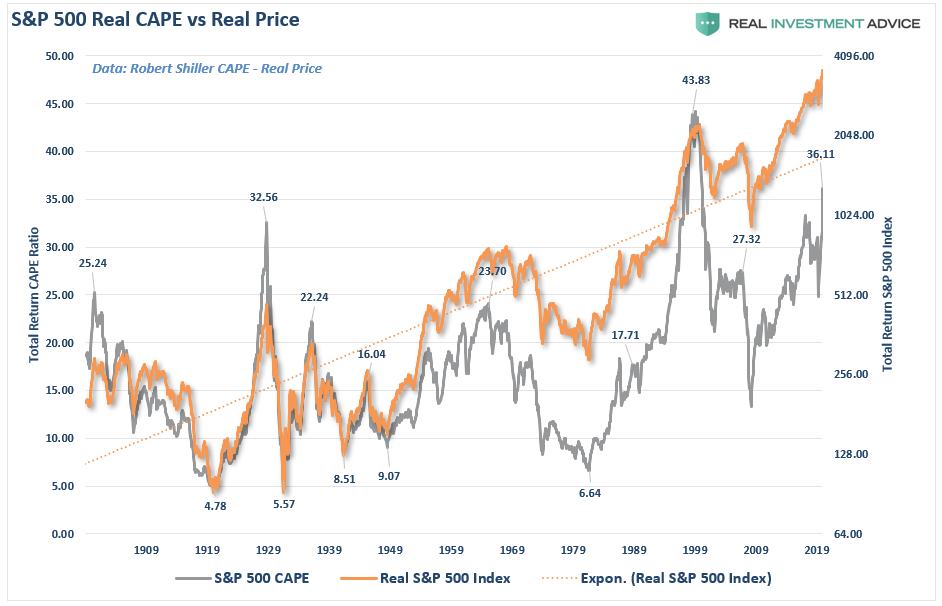
“Notice that except for only 1929, 2000, and 2007, every other major market crash occurred with valuations at levels LOWER than they are currently.”
Secondly, all market crashes, which resulted from the preceding bubble, resulted from things unrelated to valuation levels. Those catalysts have ranged from liquidity issues to government actions, monetary policy mistakes, recessions, or inflationary spikes. Those events were the catalyst, or trigger, that started the “reversion in sentiment” by investors.
What both Mackay and Bernstein suggest is that market bubbles really should be defined as “psychological manias.”
Confirmation Bias
One of the signs that you have entered into a mania phase is when people have trouble absorbing non-conforming information. “Confirmation bias” is a psychological behavior where individuals disregard any information which conflicts with their current beliefs. While that bias has always been problematic for investors, in recent years, as individuals lock themselves inside their “social media echo chambers,” it has worsened.
There are currently many signs of exuberance in the market from retail traders. Most notably has been the surge in speculative “call option” buying. As shown by SentimenTrader.com, despite the recent correction, retail traders got even more aggressive.
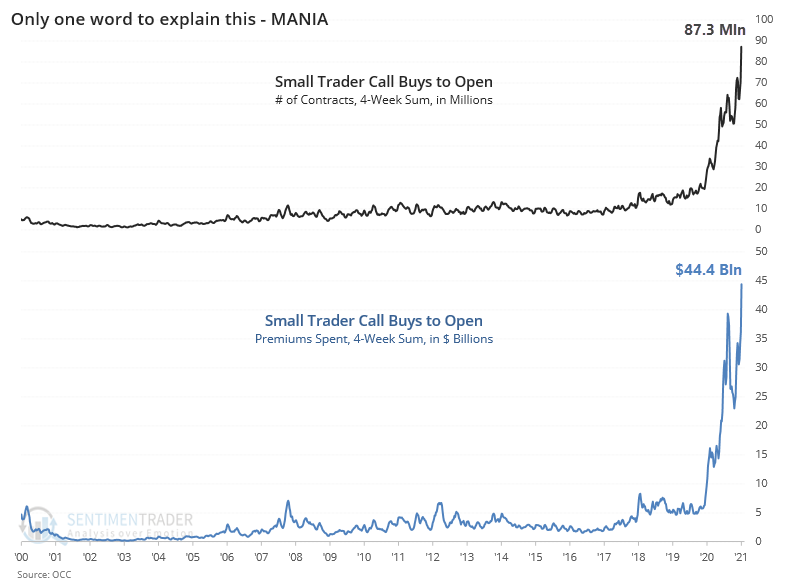
This type of behavior is the “can’t lose” mentality of investors in the market, to MacKay’s point. Such is not surprising, given that every market decline over the last decade got repeatedly met with Federal Reserve interventions. Such fostered the belief the Fed effectively established an “insurance policy” for investors to protect them from loss.
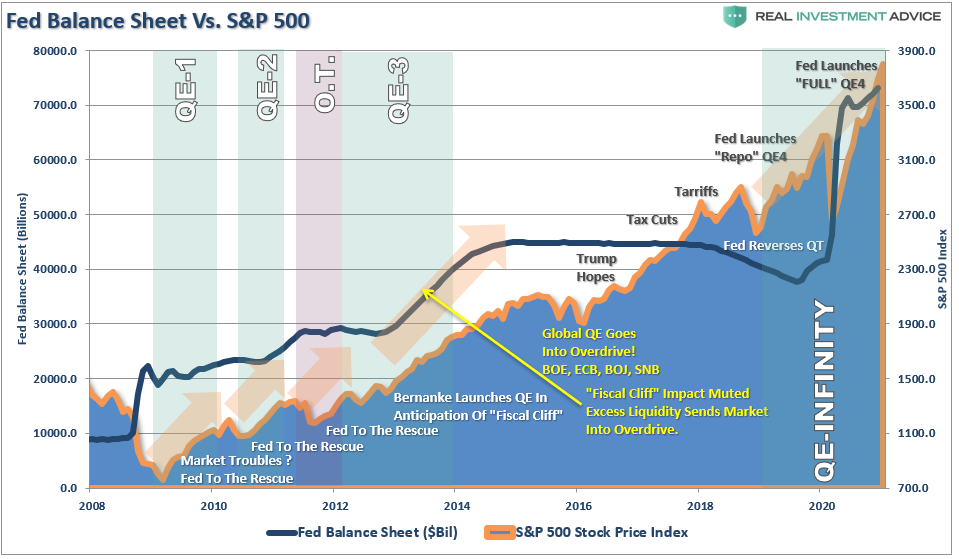
The “perception” of “insurance” emboldened investors, both retail and professional, to take on increasing levels of “risk,” as there has been no penalty for doing so. Yet.
But, as Mackay penned, such is what you would expect.
“In reading The History of Nations, we find that, like individuals, they have their whims and their peculiarities, their seasons of excitement and recklessness, when they care not what they do.We find whole communities suddenly fixate upon one object and go mad in its pursuit. That millions of people become simultaneously impressed with one delusion, and run after it, till their attention is caught by some new folly more captivating than the first.”
More Evidence Of A Bubble
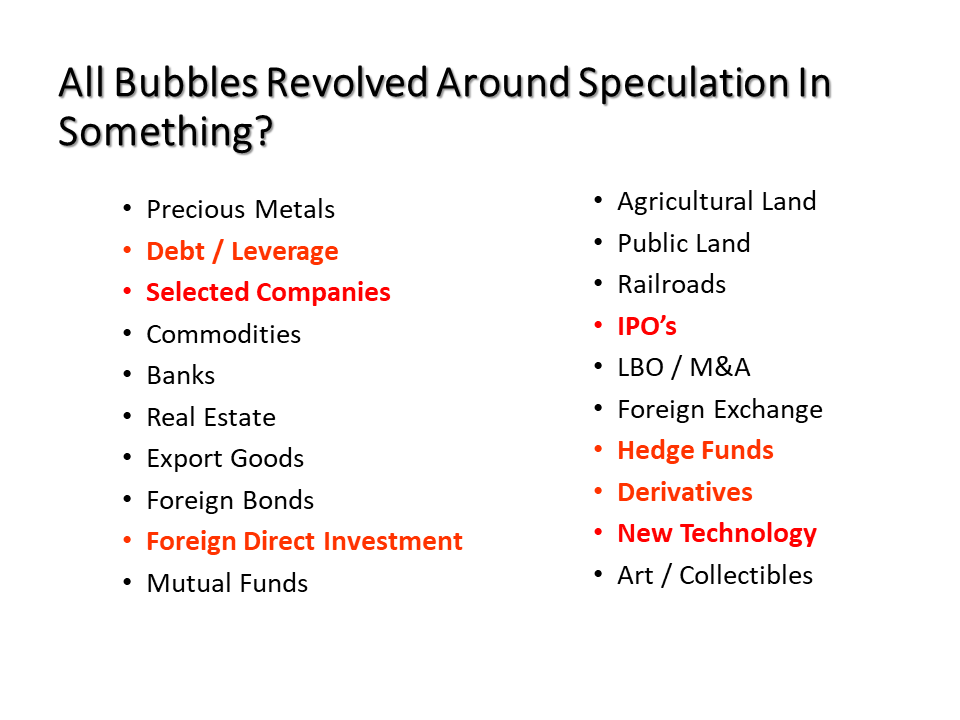
As Mackay notes, there is a long history of bubbles going back to the 1700s. The two tables below show the history of bubbles and what they all had in common.
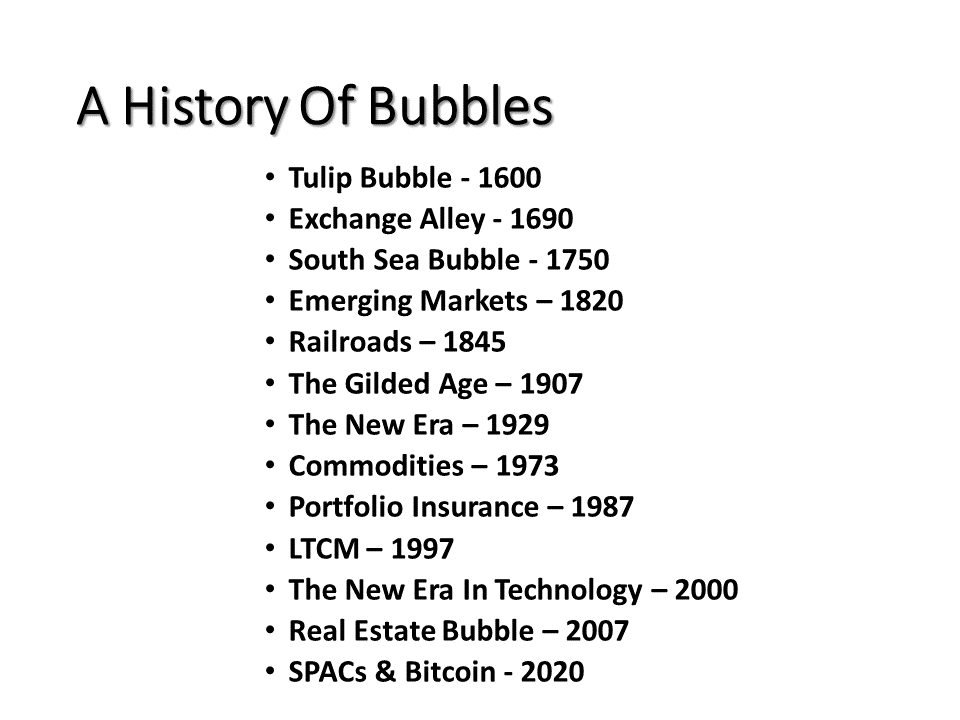
As shown below, the rush for investors to pile into SPACs (Special Purpose Acquisition Companies), or more commonly known as “blank check” companies, aligns with the long history of investor speculations.
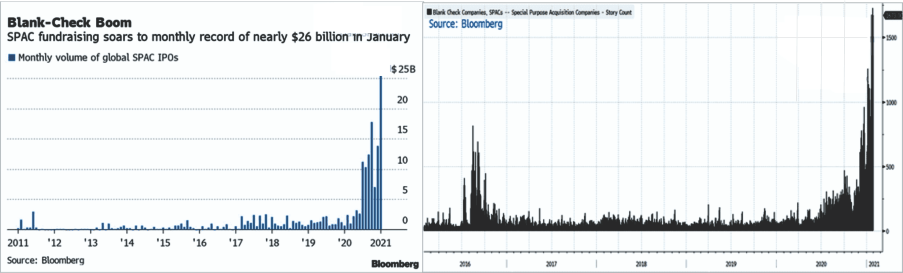
However, it isn’t just investing in companies with “no business” in the hopes they will be able to acquire one and the chase of digital currencies (bitcoin), and companies that are solely dependent on cheap debt for issuance.
A Failure To Think Logically
While it is an unpopular opinion to suggest markets are in a bubble, the implicit denial of its existence, ironically, means otherwise.
However, as investors, recognizing that a “bubble exists” is the first step in avoiding the eventual, and inevitable, deflation when the change in psychology eventually occurs.
Does recognizing the existence of a bubble mean you sell all your investments and move to cash? Of course not.
As investors, we should think logically about the “risk” we have undertaken with our capital. The liquidity fueled bull market of the last decade forgave investors for making investing mistakes. Overpaying for value, investing in fundamentally unsound companies, and speculating without any knowledge of the investment were all forgiven by rising prices. However, when the psychology reverses, those mistakes will both be revealed and brutally punished.
Such is why investors need to have an honest assessment of the current environment, the inherent risks within portfolios, and a strategy for dealing with the eventual reversal.
The process of “thinking logically” comes down to realizing that what we currently believe to be logical thought may be nothing more than a rationalization for outright market speculation. As investors, our focus should be investing capital in a manner that ensures a return greater than the rate of inflation over time with the least risk possible.
Doing The Wrong Thing
As David Robertson pointed out previously:
“Bubbles can be hard to navigate because of their insidious ability to prey on human weaknesses. Long-term investors get lured into making short-term wagers. Risk management discipline gets discarded for a shot at spectacular gains. It is all so tempting and looks so easy. Jeremny Grantham captured this point perfectly:‘And when price rises are very rapid, typically toward the end of a bull market, impatience is followed by anxiety and envy. As I like to say, there is nothing more supremely irritating than watching your neighbors get rich.’So, the trouble with bubbles is they prove very tempting opportunities to do the wrong thing. Many investors will take their chances and disregard the warning. They will follow overly optimistic projections to the top and will also follow them back down to the bottom. Some will try but fail to resist the temptation. Grantham explains the challenge:‘For positioning a portfolio to avoid the worst pain of a major bubble breaking is likely the most difficult part. Every career incentive in the industry and every fault of individual human psychology will work toward sucking investors in.'”
Such is why to survive the deflation of a bubble; we have to refocus our attention on our long-term plan and avoid psychological mistakes.
This Time Isn’t Different.
“This time is different” is the clarion call that goes up during every mania as traditional valuation measures are deemed outdated. In this respect, 2020 was no different. Professor Robert Shiller, the Yale economist who famously declared the 1990s stock market to be irrationally exuberant, recently pronounced the stock market fairly valued. By all measures, the market is more expensive than in 1929, and by some estimates more expensive than in 1999-2000. However, his justification was unprecedentedly low-interest rates.
Equally unprecedented is the disparity between the exuberance on Wall Street and the dismal reality of a virus-riddled economy.
But such is the way it always is during a bubble.
What is essential to survive a bubble is first to recognize you are in one.
That may be the most challenging part of it all.
“Men, it has been well said, think in herds; they also go mad in herds, while they only recover their senses more slowly, and one by one.” – Mackay.