Early premarket gappers
- Gapping up:
- GLUU +33.5%, GRNV +16.5%, SLQT +14.8%, NCTY +14.6%, COLL +11.8%, TLRY +9.3%, FRLN +8.3%, VRNS +6.5%, CHGG +4.7%, AFMD +4.2%, OMF +3.5%, MPWR +3.1%, TGTX +3%, BECN +3%, IPI +2.9%, BLKB +2.3%, SPG +2.1%, AVIR +1.8%, EPC +1.8%, BIDU +1.4%, IT +1.2%, AUTL +1%, EXEL +0.8%, TSM +0.7%
- Gapping down:
- ZOM -24.1%, EKSO -20.3%, CORT -10.8%, KFRC -8.8%, CLF -8.3%, DHT -7%, CDK -6.5%, LBRT -6.4%, SIEN -6.1%, IPWR -5.8%, OPCH -5.8%, OPCH -5.8%, NNOX -5.1%, LMNX -4.9%, IRDM -4.8%, AQUA -4.8%, HQY -4.7%, LSPD -4%, TTWO -3.9%, RAMP -3.2%, BEP -2.9%, NUAN -2.9%, JKHY -2.5%, ACM -2%, LESL -1.8%, TOT -1.1%, AMKR -1%, OPRX -0.9%, PTON -0.9%, OSH -0.8%, WYNN -0.8%
Suez-Veolia war deals a serious blow to stock market law - DJ PlusOlivier Pinaud,AgefiPARIS (Agefi-Dow Jones) - A court ruling blocking a public takeover bid (takeover bid) issued in the middle of the night. A minister of the economy who publicly calls an independent administrative authority. The announcement on Sunday evening of the filing of Veolia's public tender offer for Suez, without the agreement of the latter's board of directors, triggered a chain of unprecedented events for the Place de Paris, bringing the tension between the different parties to its peak.On Monday evening, the Senate Economic Affairs Committee even called on the government to "impose a ceasefire".On this point, the Minister of the Economy rather blew on the embers on Monday. Veolia's takeover bid raises "questions of transparency: why was this offer suddenly made?", Bruno Le Maire wondered, on Europe 1. So much so that he announced "to seize the Autorité des marchés financiers from (Monday) morning ", even if it means calling into question the status of independent authority of the AMF.Unpublished release from the Minister of the EconomyIt is always possible to discuss the real scope of independence, when its president is appointed by the President of the Republic. But never had a Minister of the Economy publicly questioned the AMF. A statement which caused a real stir among stock market law specialists, whereas article 9 of the law of January 2017 on the general status of independent administrative authorities clearly stipulates that "members of independent administrative authorities and independent public authorities do not receive or seek instruction from any authority ".In reality, no one contacted the AMF, nor the Minister, nor a company, nor an investor. Only the authority has the power to take up a case.Risk for the marketBruno Le Maire's statement created all the more turmoil since it came after the decision of the Nanterre commercial court to prevent Veolia from filing its proposed public offer on Suez. This decision taken in summary proceedings, at the request of Suez, and without contradiction, on the pretext that Veolia does not respect its commitment of 'friendliness' vis-à-vis the board of directors of its target, is completely unprecedented. If this summary procedure were confirmed during the decision on the merits issued shortly, this would risk overturning the usual rules of stock market law, normally under the responsibility of the AMF."Prohibiting Veolia from submitting an offer, when any other stakeholder can do so, hinders the proper functioning of the market and the free play of auctions", worries for example Colette Neuville, president of the Association for the Defense of minority shareholders. "Should the reasoned opinion and the conformity of the offer be a prerequisite for its filing?", Ironically fears a lawyer specializing in stock market law.Veolia is expected to request this Tuesday the opening of a withdrawal procedure for the order.The AMF asserts its authorityAfter these two pitfalls, the AMF indirectly reaffirmed its authority on Monday at the end of the day. She confirmed in a notice that she had received Veolia's proposed public offer for Suez as early as Monday morning at 7:00 a.m., about twenty minutes before the order was communicated to Veolia. Moreover, the order was not enforceable against the AMF. This official filing therefore opens the way, despite the Minister's request and the order, for the file to be examined by the AMF's services according to the usual procedure.She has one month to decide whether or not the offer is admissible. Suez will then have the possibility, if it wishes, to initiate an appeal against the admissibility decision. It will then be up to the Paris Court of Appeal to decide.This new surge in testosterone may have the merit of bringing the two players to their senses. During a press conference organized Monday afternoon, Philippe Varin, the president of Suez, and its managing director, Bertrand Camus, said they were ready to find a "negotiated solution" with Veolia. "I remain absolutely open to continue the discussions but this needs to be framed in a much stricter way," said Bertrand Camus. A new meeting with Antoine Frérot is scheduled this week.-Olivier Pinaud, L'Agefi. ed: ECHDISCLAIMER
This information represents neither an offer to buy or sell any security nor, because it does not take into account the differing needs of individual clients, investment advice. Those seeking investment advice specific to their financial profiles and goals should contact their Oscar Gruss & Son Incorporated sales representative. Oscar Gruss & Son Incorporated believes this information to be reliable, but no representation is made as to accuracy or completeness. This information does not analyze every material fact concerning a company, industry, or security. Oscar Gruss & Son Incorporated assumes that this information will be read in conjunction with other publicly available data. Matters discussed here are subject to change without notice. There can be no assurance that reliance on the information contained here will produce profitable results. A security denominated in a foreign currency is subject to fluctuations in currency exchange rates, which may have an adverse effect on the value of the security upon the conversion into local currency of dividends, interest, or sales proceeds. The value of securities and depositary receipts of foreign issuers that are denominated in United States dollars are also influenced by fluctuations in currency exchange rates. © 2020 Oscar Gruss & Son Incorporated. All rights reserved.
>>> Up
* Aggreko PT Raised at RBC on Chance of Higher Bid Emerging
* Alfa Laval Raised to Outperform at Credit Suisse; PT 275 kronor (+)
* Asos Raised to Buy at BofA; PT 5,800 pence (+)
* Ceconomy Raised to Add at AlphaValue
* Cementir Raised to Buy at AlphaValue
* Dialog Semi PT Raised to 70 euros from 60 euros at Deutsche Bank
* Electrocomponents Raised to Overweight at JPMorgan
* GEA Group Raised to Add at Baader Helvea; PT 34 euros
* GEA Group Raised to Add at Baader Helvea; PT 34 euros
* HSBC Raised to Sector Perform at RBC; PT 420 pence
* HSBC Raised to Neutral at BofA; PT 405 pence (+)
* Iliad Raised to Buy at HSBC; PT 190 euros
* IQE Raised to Buy at Stifel; PT 100 pence (+)
* Kungsleden PT Raised to 110 kronor from 92 kronor at Barclays (+)
* Vinci Raised to Buy at HSBC; PT 98 euros
>>> Down
>>> Down
* Carlsberg Cut to Sector Perform at RBC; PT 1,000 kroner (+)
* Dialog Semi Cut to Market Perform at Cowen; PT 67.50 euros
* Dialog Semi Cut to Neutral at Credit Suisse; PT 67.50 euros (+)
* Dialog Semi Cut to Hold at Hauck & Aufhaeuser; PT 67.50 euros (+)
* Dialog Semi Cut to Hold at M.M. Warburg; PT 67.50 euros (+)
* Entra Cut to Equal-Weight at Barclays; PT 205 kroner
* Publicis Cut to Neutral at Oddo BHF; PT 51 euros (+)
* Sagax Cut to Hold at Pareto Securities; PT 165 kronor
* Sagax Cut to Hold at Pareto Securities; PT 165 kronor
* Spire Healthcare Cut to Hold at Liberum; PT 180 pence
* Spirent Raised to Buy at Canaccord; PT 275 pence (+)
>>> Initiation
* Aptitude Software Group Rated New Buy at Panmure Gordon
>>> Initiation
* Aptitude Software Group Rated New Buy at Panmure Gordon
* Inventiva SACA Rated New Buy at Bryan Garnier; PT 26 euros
* JDE Peet's NV Rated New Buy at Berenberg; PT 41 euros
* MPC Energy Solutions Rated New Buy at Fearnley; PT 90 kroner
* Red Electrica Rated New Market Perform at Bernstein
>>> Call
>>> Call
* AMS Results Strong, Though 1Q Sales Guidance ‘Light:’ Vontobel (+)
* Asos Double Upgraded at BofA on Reopening Benefits, Valuation (+)
* Bellway Update Should Provide Some Reassurance, Jefferies Says (+)
* Carlsberg Cut at RBC After Recent Gains; Performing ‘Admirably’ (+)
* Daetwyler FY20 ‘Slightly’ Above Expectations: Vontobel (+)
* Grenke’s COO Resignation a ‘Reputational Disaster’: Commerzbank (+)
* GEA Group Delivering on Margin Improvement, Raise to Add: Baader
* JDE Peet’s Positioned Strongly For Growth, Berenberg Rates Buy
* Lonza on Path to Becoming Health Care Pure-Play, Jefferies Says (+)
* Richemont Upgraded at Citi, Focus Moves Toward Jewelry Business
* Richemont Upgraded at Citi, Focus Moves Toward Jewelry Business
Is Apple About To Announce A $5 Billion Bitcoin Purchase? One Bank Thinks So
Over a month ago, we correctly predicted today's "shock" announcement by Tesla, in which Elon Musk's company decided to pivot once again, this time into the word of cryptocurrencies, by purchasing $1.5 billion in bitcoin (an amount which will give it tremendous leeway in non-GAAP financial when accounting for XBT Mark-to-Market moves, giving it even more buffer to beat estimates).
Discussing the major US companies which we expected would announce shifts away from dollar-based cash into bitcoin, we said "one such company which we are convinced will announce it is converting billions of its existing cash into bitcoin, is none other than Tesla, whose CEO Elon Musk was urged by MSTR CEO Saylor to make a similar move with Tesla’s money. And since Musk, already the world's richest man thanks to the most aggressive financial engineering on the planet, has never been one to shy away from a challenge, we are absolutely confident that it is only a matter of time before Tesla announces that it has purchased a few billion bitcoin."
While as of this morning, this prediction has clearly come true, we'll remind readers that our January forecast had a follow-on component: once Tesla breaks the seal on major companies converting cash (and equivalents, including buybacks) into bitcoin, other companies would quickly follow suit. This prompted us to inquire the general public which company would be next.
Conveniently, just as we were scratching out heads over this critical question - which also answers how Bitcoin will hit $100,000 next - RBC published an initiating coverage report on AAPL (with a street-high price target of $171), in which analyst Mitch Steves explained why he believes that AAPL should focus on developing an "Apple Wallet" concept first (and leave the Apple car for later), in order to leverage its 1.5 billion installed user base and to unveil a Coinbase-like Apple Exchange later which allows bitcoin transactions and which would add about $50 billion in value.
More importantly, the RBC analyst then says that should Apple purchase just $1 billion in bitcoin, or "4 days of cash flow", it would send even more users to "Apple Exchange". To be sure, in the aftermath of Tesla's announcement today, which validates the so-called "use case" and confirms that rising adoption of bitcoin among some of the most advanced companies is just a matter of time, such an outcome is even more likely.
Below we lay out some of the key highlights from Steves' note, in which he first discusses the "low risk, high reward" Apple Wallet opportunity...
When we think of the Apple Wallet, there is a clear opportunity in our view to create a buying and selling mechanism for crypto currencies (in addition to standard payment processing – although not necessary). To be clear, we do not believe Apple needs to hold bitcoin as a balance sheet asset (although it would likely help – more on this later), but rather allow users to buy and sell crypto assets.Taking a big picture view of this, if we look at recent articles from The Block, which suggest Coinbase will be valued at ~$50B (at $200/share), this means Apple could potentially generate a similar or higher amount of value. Why? The firm already has a robust software ecosystem and install base to take significant and sudden market share from crypto currency exchanges (others include Binance, Kraken, and Gemini – all private companies but would be competitors in this situation). Looking at PayPal, for example, the firm now allows for buying and selling of crypto assets but does not allow for crypto assets to be sent off the system to a hardware wallet (individual custody). While many users/customers would not like this aspect, it has not stopped PayPal from generating additional revenue in a closed ecosystem.In fact, if we think about a closed ecosystem, it removes the risk of the asset being removed from an exchange. According to Glassnode, exchange balances are falling and this would disrupt the exchange business model as there would be no assets to buy and sell for a fee.

And while Apple expanding into a market currently dominated by Coinbase and to a lesser extent Paypal, is quite likely, a more controversial thesis proposed by the RBC analyst is that Apple could outright add bitcoin to its balance sheet... just as Tesla has now done. Consider:
While the bigger business is likely in the exchange of assets, we think the firm could also fund its own initiative by adding a small amount of Bitcoin (or another crypto asset) to its balance sheet. If we assume that the firm can add $1B to its balance sheet (only ~4-5 days of cash flow) we think the price of the underlying asset would then go up in a substantial manner. Looking at it from another angle, if we assume that the cost of developing a crypto wallet/exchange on the Apple ecosystem would cost $500M, they could synthetically pay for the development cost by acquiring the underlying asset. For example, if the firm purchased $5B of Bitcoin (20-25 days of cash flow), the price of the underlying asset would need to rise by 10% for the firm to fully fund the entire project in the first place! This is a solid value proposition in our view as the business would be funded without diluting any other projects at the firm (iPhones, potential cars, etc.)
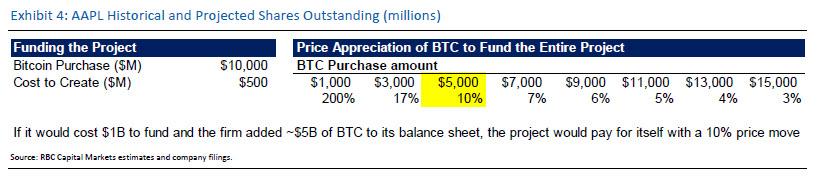
And while our readers are all too aware of MicroStrategy's ongoing accumulation of bitcoin as the company has pivoted from its legacy business model to becoming one of the market's key proxies for bitcoin exposure, Steves then brings up the MSTR case study to those who are unaware.
The firm announced its first purchase of Bitcoin on August 11, 2020 at an average price of $11,653 (21,454 bitcoins). Subsequently, the price of Bitcoin moved to $12,330 by August 17, 2020. Currently the price of bitcoin sits at approximately $37,912, which is well above the original purchase price.
The stock price of MSTR is now almost $1000, a 10x-return in six months. The real question should be not who will, but who won't convert some of their cash to bitcoin.
Steves then also points out the PayPal bitcoin announcement, when on October 21, 2020, PayPal announced that it would allow users to buy/sell/hold crypto currencies in a closed ecosystem. Meaning that individuals cannot send their crypto assets to a hardware/digital wallet and must hold the assets on the PayPal network.
Did Paypal's announcement have any impact? On October 20, the price of bitcoin was $11,927 and the price of the asset closed at $13,083 on October 22, 2020 (just one day after the announcement). It is now $44,000 and rising.
Steves's conclusion is obvious: "if Apple were to announce that the firm is entering into the crypto exchange business and purchasing the assets as a reserve asset ($5B would only represent ~20 days of cash flow), this would likely send the price of the underlying asset up and fund the project entirely", and - judging by the TSLA experience - it would also send AAPL stock to new all time highs, in what is clearly a win-win outcome for everyone. The only question is when will Apple pursue such a strategy.
Actually there is another question: with virtually no market participants in the crypto "proxy" space, what we wonder is how many other companies will follow in Tesla's footsteps and convert some of their cash into a currency which unlike the dollar, has a hard dilution ceiling (only 21mm will ever be created) and thus will preserve its value far, far better than the world's (fading) reserve currency is long forgotten.
Reddit’s Valuation Doubles to $6 Billion After Funding Round
Its WallStreetBets community played a prominent role in recent stock-trading frenzy
Reddit Inc. doubled its valuation to $6 billion in a new round of funding that comes as the social-media company has added users through the Covid-19 pandemic and more recently has gained attention for its role in the recent Wall Street trading frenzy.
Reddit on Monday said it raised $250 million in a late-stage funding round led by venture-capital firm Vy Capital. Previously it was valued at $3 billion after its last funding round in February 2019, according to PitchBook, a provider of private-market data. Current investors in Reddit also include venture-capital firm Andreessen Horowitz and internet conglomerate Tencent Holdings Ltd.
“It’s a good market to fundraise,” Reddit Chief Executive Steve Huffman said in an interview. “Valuations are very high right now. It never hurts to raise money when there’s an opportunity to do so and Reddit had a strong year.” For example, advertising revenue for the company shot up 90% in the December-ended quarter from a year earlier, he said.
The funding for Reddit comes just weeks after upstart audio-chat social network Clubhouse raised fresh capital. Clubhouse was valued at $1 billion last month after securing $100 million in a funding round led by Andreessen, according to PitchBook.
San Francisco-based Reddit, founded in 2005, is known for its message boards on a multitude of topics, as well as its “ask me anything” digital town halls with celebrities, politicians and subject-matter experts. The company, which isn’t profitable, was sold to Condé Nast in 2006, and the magazine publisher’s parent, Advance Publications Inc., spun Reddit off in 2011 and remains a shareholder. The company has raised roughly $800 million since 2011.
Mr. Huffman said Reddit plans to use the new funding to invest in areas such as video, advertising and consumer products, as well as to expand into international markets. Late last year Reddit bought video-sharing app Dubsmash to expand its presence in user-created video, one of the hottest corners of the internet, for an undisclosed sum. “Our strategy isn’t materially changing,” Mr. Huffman said.
Reddit is also planning to double its employee head count this year to around 1,400, Mr. Huffman said, noting that one reason the company raised new funding was to help it attract talent. Reddit recently hired a handful of executives who will start in the coming months, he added, declining to specify their titles or name them.
The financing deal comes after Reddit’s WallStreetBets community gained attention as some members successfully egged on people to buy shares of heavily shorted stocks such as GameStop Corp. U.S. regulators are now probing whether the ensuing market upheaval resulted in securities-law violations.
The incident has helped bring Reddit millions of new users as well as new advertisers, which provide the company’s main source of revenue, Mr. Huffman recently told The Wall Street Journal.
Reddit lets users rate all posts and comments on the platform and relies on tens of thousands of its own users to voluntarily to police speech. By contrast, larger social-media platforms such as Facebook Inc. and Twitter Inc. rely mainly on algorithms and paid help to do that kind of work.
The most recent user numbers from Reddit put the daily average at 52 million as of October, which was up 44% from the same month a year earlier.
Facebook said it had roughly 1.85 billion daily users in the December quarter, while Twitter most recently said it averaged 187 million daily users in the three months ended in September. Snap Inc., the parent of ephemeral-messaging platform Snapchat, ended the December quarter with 265 million daily active users.
- Qiagen (QIA TH) +4.3%
- Quidel Is Said to Weigh Qiagen Deal as Medical M&A Quickens (1)
- Rio Tinto (RIO1 TH) +2.4%
- Imperial Brands (ITB TH) +2.4%
- Reckitt (3RB TH) +2.3%
- Glaxo (GS7 TH) +1.9%
-
Total SE (TOTB TH) +1.8%
- Total Shakes Off Big Oil’s Gloom With Earnings Beating Estimates
- BP (BPE5 TH) +1.6%
- Glencore (8GC TH) +1.4%
-
Randstad (RSH TH) +1.3%
- Randstad 4Q Gross Margin Beats Estimates
- Unilever (UNVB TH) +1.1%
- Tesco (TCO TH) -0.7%
- Uniper (UN01 TH) -0.8%
- Nokia (NOA3 TH) -0.9%
- Equinor (DNQ TH) -0.9%
- Telecom Italia (TQI TH) -1%
- UniCredit (CRIN TH) -1.1%
- Carl Zeiss Meditec (AFX TH) -1.2%
- AstraZeneca (ZEG TH) -1.3%
- Wienerberger (WIB TH) -1.7%
-
AMS (DQW1 TH) -6.1%
- AMS Sees 1Q Revenue $500M to $540M
DAX:
- Delivery Hero (DHER TH) +0.9%
- RWE (RWE TH) +0.7%
MDAX:
- Qiagen (QIA TH) +4.5%
- Quidel Is Said to Weigh Qiagen Deal as Medical M&A Quickens (1)
- Metro AG (B4B TH) +1.7%
- Shop Apotheke (SAE TH) +1.6%
- Siemens Energy (ENR TH) +1.2%
- Fraport (FRA TH) +0.9%
SDAX:
- Grenke (GLJ TH) +5.4%
- Grenke Slumps as Board Member Resigns in Wake of Audits (1)
- Home24 (H24 TH) +4.4%
- Home24 4Q Adjusted Ebitda Margin 4% Vs. 2% Y/y
- Corestate (CCAP TH) +2.4%
- Schaeffler (SHA TH) +2.2%
- Encavis (CAP TH) +1.9%
‘We expect Italy to do its homework’: Draghi and the EU recovery fund
Brussels has a huge amount of money to spend on its member states. So how will it use its leverage?
Nine years ago, Olaf Bussink launched a consultancy business for foreign online retailers looking to set up operations in Italy. His advice to them was simple: don’t.
Bussink discovered that rather than incorporating a company in Italy and setting up a warehouse there, it was easier to send packages to Italian consumers that were shipped in from the Netherlands.
Today his thriving business helps online retailers set up websites in Italian that target local customers, shipping products ranging from electric bikes to cosmetics from the Netherlands that beat local rivals on price and speed.
“It is slightly more expensive to send things from Holland but for my clients the cost of setting up a business in Italy is so much higher,” he says. “Italy has what I call a ‘bureaucracy tax’. My clients can add 10 per cent to their prices compared with Italy-based companies and still be very competitive.”
As Italy draws up the most ambitious reform plans in a generation to relaunch its sclerotic economy, powered by €200bn of EU funds, uprooting these deeply rooted barriers to investment will help define whether the scheme is a success.
The country is turning to Mario Draghi, the former European Central Bank president, to form a new government from the rubble of its latest political crisis. His programme involves harnessing a once-in-a-generation package of grants and loans underwritten by all 27 EU member states, while also pushing through often unpalatable reforms aimed at energising an economy that in real terms has failed to grow since the start of the millennium.
It is hard to overstate the stakes. Draghi’s success or failure in deploying the recovery fund and embarking on key reforms will be critical not only for Italy’s future, but also for the credibility of the EU’s most ambitious joint economic undertaking since the birth of the euro.
“This is a historic chance for the country to invest in its economy and prepare for the future with an ambitious reform plan,” says Manfred Weber, the head of the European parliament’s powerful European People’s party group. “We expect Italy to do its homework, like we expect from all member states. Don’t forget it is an explicit part of the deal. We will stick to it.”
The news that Draghi had been approached by the Italian president to form a government was greeted with huge relief in Brussels and other EU capitals given his reputation as the man who saved the single currency during the sovereign debt crisis.
In a brief speech accepting the request, delivered inside the Italian presidential palace on Wednesday, Draghi made explicit reference to the challenge of ensuring the EU recovery plan is a success.
“We have the extraordinary resources of the EU at our disposal — we have the opportunity to operate with a careful eye on future generations,” he said.
Yet to do so he must first convince enough of Italy’s warring lawmakers to provide him with a stable majority in parliament. This will require bringing politicians into his cabinet from different parties who will have strong views on how the money should be spent.
Draghi’s entrance last week shook the Italian political establishment, prompting fissures in parties and political alliances and forcing leaders to make decisions over supporting him that will define both their own and their country’s future.
Disagreements over how Italy should deploy what is expected to be the biggest chunk of the EU’s recovery fund triggered the series of events that resulted in Draghi receiving the emergency call.
Toxic politics
The country’s unstable previous coalition government, led by the lawyer Giuseppe Conte, was born in 2019 out of an unlikely alliance of the one-time anti-euro Five Star Movement and the staunchly pro-European Democratic party as a way of blocking Brussels antagonist Matteo Salvini’s bid to become prime minister.
Last month, however, former prime minister Matteo Renzi began to attack the coalition’s handling of the recovery spending plans. The former Democratic party leader pulled his small Italia Viva party out of the government, stripping it of its majority in Italy’s upper house and leaving Conte crippled.
As the toxic politics that have already blighted Rome’s plans to tap the fund show, reaping the benefits of this European bounty is far harder than it might look.
The EU has deliberately avoided going down the route of the last sovereign debt crisis, in which the technocratic government of Mario Monti was under pressure to enact brutal economic programmes and a hard-charging austerity drive.
The EU has this time suspended its fiscal rules, allowing the Italian public debt to exceed 150 per cent of GDP, while putting the might of stronger treasuries, including Berlin’s, behind an unprecedented commission borrowing programme.
But that does not mean the new recovery fund riches come without strings attached.
Accessing the money will require a member state to sign up to a swath of regulatory and administrative reforms. These will need to be delivered according to timelines and milestones set in conjunction with the commission, led by president Ursula von der Leyen, as part of so-called recovery and resilience plans.
Historic opportunity
The idea of common European borrowing was profoundly controversial among fiscally frugal northern EU states such as the Netherlands when they agreed to the concept last July.
They signed up in the belief, however, that the commission would enforce tough reforms alongside investment plans aimed at making weaker economies more resilient the next time a crisis comes along.
“The commission is really serious about these reform programmes,” says one senior EU diplomat. “They won’t let us get away with anything.”
Paolo Gentiloni, the Italian commissioner who oversees EU economic policy, sees a big difference between the expected Draghi government and the technocratic Monti regime that led Italy between 2011-13.
The latter served at a time when sovereign debt yields were unsustainably high and the “troika” of the commission, the ECB and the IMF was imposing deeply unpopular reforms on beleaguered euro members such as Greece.
“The Monti mission was a rescue mission. This is a mission to avoid missing out on a historical opportunity — that is why Draghi’s leadership is so important,” explains Gentiloni, himself a former Italian prime minister.
“It is a very different environment from the one we had eight or nine years ago. Some of the problems are still there, but now there is the opportunity to address them in a positive context of a strong boost to growth and the recovery, and not in the context of saving the country from the troika.”
Italy has made advances in areas such as pension and labour market reform in recent decades, Gentiloni says in an interview with the Financial Times, but he cautions that there had been less progress in areas such as speeding up the judicial process and reforming competition rules, as well as curbing red tape.
“I am sure that he [Draghi] will use his extraordinary experience and his strong leadership to make the right things happen,” he adds. “He knows very well all the bottlenecks, the difficulties, the challenges involved in making reforms happen in Italy.”
The country has, for example, one of the slowest legal systems in Europe. A 2018 study by the Council of Europe concluded that the average time for commercial legal cases to be settled was 514 days, among the worst in Europe and longer than in Malta and Turkey.
In 2016, Italy had 4.1 civil and commercial litigation cases pending per 100 inhabitants, compared with 2.4 in France and 0.9 in Germany.
Partly as a result, the country was ranked 58th globally in the World Bank’s Ease of Doing Business report for 2020 — with low results for features such as enforcing contracts and paying taxes. That put it just below Romania, Kosovo and Kenya.
Lucrezia Reichlin, a London Business School professor and former head of research at the ECB, stresses that Draghi is not “some technocrat coming down from the sky” who plans to push the country through “a crash course in liberalising its economy”.
The focus of his proposals to the commission needs to be on addressing “Italy’s structural incapacity to spend money, which is related to the public sector’s ability to make decisions, pursue transparent processes, and undertake auditing,” she says.
This points to one of the commission’s biggest questions about Italy and the recovery fund: whether the country is up to the task of spending such a vast quantity of money wisely over a contracted period of time. Italy’s history here is far from encouraging.
Along with Spain, Italy has one of the worst track records for efficiently spending EU structural funds. In the 2014-20 EU budget period, Spain managed to spend only 36 per cent of those funds by late last year, with Italy only a little better at 43 per cent. By contrast, France’s absorption rate was 61 per cent, and Finland’s was 81 per cent.
Yet together Italy and Spain will receive no less than 40 per cent of the EU recovery fund harvest — dominating the spending programme. This means the reputation of the entire project rests on those countries’ ability to come up with credible programmes that meet the commission’s green and digital priorities and minimise boondoggles, waste and fraud.
Some officials hope the Next Generation EU project — which is officially designed to be temporary — could become a permanent feature of Europe’s set-up. But as Erik Nielsen, chief economist at UniCredit, says, that dream “only has a chance if the money is well spent and certainly not wasted”.
Windfall fears
To date officials have been more encouraged by what they see from Spain than by the draft proposals that have been discussed in Rome. Madrid expects to receive some €70bn in grants over the next three years, followed by roughly the same amount in loans in the period up to 2026.
It has already approved a budget that allows it to borrow €27bn against future grants from the fund, passed legislation last month to eliminate bureaucratic bottlenecks in disbursing the money, and drawn up a list of some 170 reforms to submit to Brussels.
Among the top priorities in the country’s recovery and resilience plan are the digitalisation of Spanish business and the transition to green energy. Big corporates are hurrying to register themselves as possible beneficiaries. Other goals include turning Spain into a hub for the video games industry and boosting the country’s sport sector.
“The country cannot wait for the funds,” says Manuel de la Rocha, the official entrusted by Prime minister Pedro Sánchez to keep track of the resources. “We have a very difficult economic situation, with an 11 per cent fall in GDP last year, and we need to inject funds into the economy right now . . . and accelerate the absorption of these resources.”
But critics of Sánchez’s Socialist-led government demand more transparency over how the funds will be allocated, as they voice concerns about the power the prime minister will wield over the resources.
The anti-bottleneck legislation, which set out the government structures responsible for co-ordinating the funds, was opposed by the main opposition People’s party, the centrist Ciudadanos grouping and Catalan nationalist MPs — only passing because of the abstention of the hard-right Vox party. Pablo Casado, the PP leader, argued it would give the prime minister “a free bar” and lead to “clientelism” that ends in corruption.
The government has rejected opposition calls for an independent agency to administer the funds, arguing that setting up such an institution would waste valuable time and that it would be overwhelmed by the task.
“The government has shown it is willing [to carry out reforms], but governance is a huge issue, with political fragmentation and the rise of populism across southern Europe,” warns Toni Roldán, director of the centre for economic policy at Esade business school in Madrid.
“I fear that with this windfall of money, there will not be substantial reforms. And the commission has little room for manoeuvre, since they would be terrified of assuming the political cost [of halting payments of funds].”
Similar concerns swirl around Italy, which is acknowledged among EU officials and diplomats to be behind Spain when it comes to drawing up its recovery plan ahead of an April 30 target date. Business leaders warn that the existing draft plan, which set out priorities including digitalisation, energy transition, health and education, lacks crucial detail on governance and procedure.
The commission itself also faces a prodigiously difficult task as it prepares to police the countries’ plans. Withholding disbursements of recovery fund money if countries fail to hit their reform and spending deadlines and targets would trigger political uproar. Yet Brussels cannot afford to preside over a project that becomes tainted by squandered billions, abandoned projects and lost opportunities for economy-boosting reform.
Bussink, who has profited by finding ways to navigate Italy’s administrative barriers, stands to lose out if Draghi is successful in overhauling Italy’s economy as part of its recovery plan. But surveying the scene today, he is not overly concerned.
“If shipping got super-efficient here it would hurt me for sure,” he says. “That still wouldn’t take away the bureaucracy. That is the most painful thing, and the hardest thing to resolve”.