(ZH) Archegos Fallout Begins: Nomura Crashes 15% After Reporting Record $2BN Los

Archegos Fallout Begins: Nomura Crashes 15% After Reporting Record $2BN Loss From "Transactions With US Client"

Back in May 2016, Japanese mega-bank Nomura, announced that it had suffered its biggest-ever loss in history (of a rather tame by Western standards $40 million) from a single client, and which it then quickly blamed on an "incompetent" bond trader. Fast forward to today, when Nomura just suffered a far, far greater loss from a single client, this one is anything but boring.
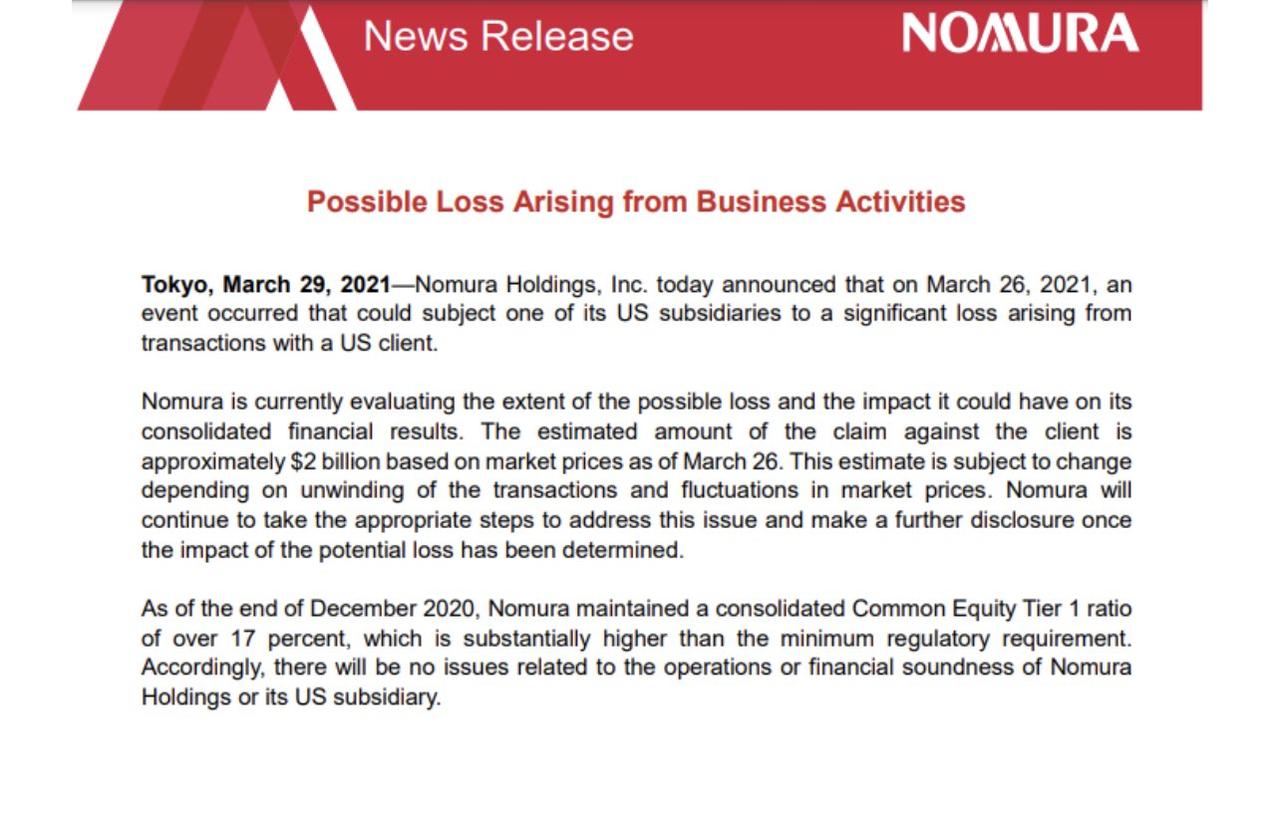
Early on Monday local time, Nomura Holdings said it may have incurred a “significant loss" arising from transactions with a U.S. client.
The estimated amount of the claim against the client is about $2 billion based on market prices as of March 26, the Japanese brokerage said in a statement. The estimate is "subject to change depending on unwinding of the transactions and fluctuations in market prices."
Nomura is currently evaluating the extent of the possible loss and the impact it could have on its consolidated financial results.
The Japanese brokerage also canceled plans to sell dollar-denominated bonds.
The news, incomplete as it may be, was enough to send Nomura stock crashing 15%, wiping out all March gains, and the biggest one day drop in a decade.
While it wasn't immediately clear if Nomura's loss is linked to the spectacular margin call at Tiger Cub Bill Hwang's Archegos Capital which we noted earlier (accurately noting that the unwind is probably not yet done), the two are almost certainly linked especially as some have noted that in the case of Nomura, the bank owned some $10MM shares in Chinese tech firm GSX which imploded, via leveraged swaps to clients. Since GSX was one of the firms aggressively dumped by Hwang, one can see how the house of cards, having crippled Prime Brokers, may be spreading down the investment bank foodchain next.
Meanwhile, as we asked earlier, the real question is whether the liquidation of the handful of highly concentrated stocks is over, or whether the selling cascade is only just starting.
One thing we do know: as of Sunday night, the seller was not done yet, as this Bloomberg headline confirms:
  • *VIACOMCBS HOLDER SAID TO OFFER 45M SHR BLOCK VIA MORGAN STANLEY
Some more details:
Morgan Stanley was shopping a large block of ViacomCBS Inc. shares on Sunday, according to a person familiar with the matter, the latest in a flurry of block trades that began before the weekend.
About 45 million shares were offered Sunday on behalf of an undisclosed holder, the person said. The media giant was also the subject of at least one large block trade on Friday through Goldman Sachs, a person familiar with the matter told Bloomberg at the time.
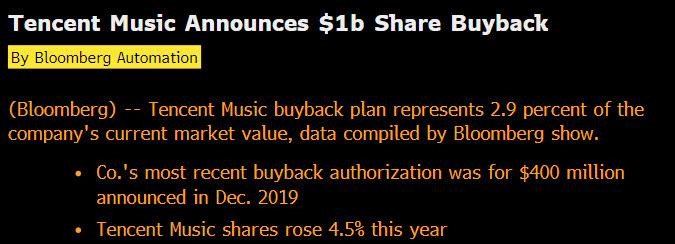
Incidentally, just last Monday, ViacomCBS sold $3BN in common and preferred stock, including 20mm shares of VIAC stock at $85. With the stock now trading at roughly 50% of this price, the company should immediately announce a 20MM shares (or more) stock buyback to i) take advantage of the plunge in the price and ii) to contain investor panic due to one shareholder's forced liquidation. Indeed, moments ago, Tencent just announced a $1BN share buyback to offset just this liquidation-driven drop in the stock price.
And while we wait for that to happen at VIAC, DISCA and other, we still have two big questions: i) is Archegos still dumping, or is this now a fellow Hedge funders who was also margined out on a similar portfolio, and ii) just how bad is the pain - as more prime brokers issue urgent margin calls - and how widespread will the liquidation chain stretch...

FT : Biden’s massive stimulus plan prompts EU soul-searching

Biden’s massive stimulus plan prompts EU soul-searching
Macron floats idea of EU recovery fund boost amid fears of slower economic rebound

Europe’s vaccination travails and hardening lockdowns are forcing the debate over its budgetary response back up the agenda. 

A little-noticed postscript to the EU summit last week was French president Emmanuel Macron’s suggestion that the bloc consider expanding its €750bn pandemic recovery plan — funds for which have yet to be disbursed. 

The EU’s mid-2020 agreement that followed the first wave of the Covid-19 pandemic was up to the mark, Macron told a news conference after the summit. But after second and third waves of the virus, “we will probably have to add to this response”, he said. 

The huge sums being spent under Joe Biden’s $1.9tn US stimulus package have only heightened the arguments for a bigger EU plan, Macron added, noting that the US economy was expected to recover to its pre-crisis level quicker than the EU’s, and the predicted US economic trajectory thereafter was also steeper. 

For EU policymakers, the suggestion that the US has trumped Europe not only in the speed of its vaccine rollout but in the size of its fiscal response clearly rankles. But France is not alone in wondering whether a budgetary boost will be needed in Europe. Italy’s prime minister Mario Draghi shares Macron’s assessment that a bigger recovery fund may be needed, alongside co-ordinated national stimulus plans, said one Italian official over the weekend.

Macron didn’t offer any details, and the reality is that any attempt at enlarging the EU support package would face formidable obstacles — most obviously in northern Europe. The budget deal struck last year, which weighed in at €1.8tn over a seven-year timescale, was attained at punishing political cost. Many officials see the idea that it could be boosted any time soon as far-fetched. 

The European Commission’s focus remains firmly on ensuring the existing Next Generation EU recovery package is successfully implemented. With Germany’s constitutional court throwing sand in the wheels of Berlin’s parliamentary ratification of the extra EU borrowing, this goal can by no means be taken for granted. 

As such, finance ministries’ priorities will probably lie in four areas in the coming months.

Firstly, they need to ensure they secure the commission’s approval of their recovery and resilience plans, which will spell out how they will seek to spend their already agreed Next Generation EU bounty and what economic reforms they will propose.

Macron and his finance minister Bruno Le Maire have already expressed frustration with the process, calling for faster disbursement of the existing recovery fund to member states. “We are too slow and too complicated, we are too tied up in our own bureaucracies,” Macron said last week. 

Secondly, and with equal urgency, politicians will look into whether their national fiscal support plans will need to be boosted in the coming months. This is something France is examining and Italy is likely to do in April. 

Further out, while the eurogroup has committed to a “supportive stance” in the euro area this year and next, ministers will eventually have to tackle the perilous job of gradually paring back budgetary support without inadvertently crashing their economies. 

And finally, after German elections this year, the EU will need to grapple with the politically poisonous question of how to reform its fiscal rules to reflect the prospect of vertiginous public debt and the long-lasting economic legacy of the Covid-19 disaster. 

Speaking after the summit last week, Macron said that the gap between the US and EU recovery paths was worrying and “probably suggests the need for a more vigorous response” in Europe. But the French president faces an uphill battle to turn his words into pan-European action. 


Slow vaccine rollouts in Europe are threatening the survival of businesses in the already battered tourism and travel sectors. That leaves the south of Europe, where tourism accounts for one in six jobs, at risk of further economic decoupling from the north.

WSJ : Ex-Tiger Asia Founder Triggers $30 Billion in Large Stocks Sales

Ex-Tiger Asia Founder Triggers $30 Billion in Large Stocks Sales
ViacomCBS and Discovery stocks fall, as ex-Tiger Asia founder Bill Hwang’s firm takes losses

One mystery in a dramatic year on Wall Street has been the identity of a trader whose persistent purchases have sent shares in ViacomCBS Inc., Discovery Inc. and a handful of other companies surging even when the broader market was down.

People familiar with the transactions say the answer is former Tiger Asia manager Bill Hwang. Late last week Morgan Stanley, Goldman Sachs Group Inc. and Deutsche Bank AG swiftly unloaded large blocks of shares in those companies and others, part of the liquidation of positions at Mr. Hwang’s Archegos Capital Management.

The sales approached $30 billion in value, some of the people said, and fueled a 27% plunge Friday in shares of ViacomCBS—an unusually large decline in a widely held, large-capitalization stock on a day with no significant company-specific news. Billions of market value in other companies were wiped out as the sales continued, surprising market participants who called the size and speed of these stock sales unprecedented.

The liquidations appear to have left Archegos, which managed an estimated $10 billion of personal wealth for Mr. Hwang and his family, under extreme pressure following heavy losses. People close to the stock sales said that the bulk of the selling has been completed.

Class A shares of Discovery dropped $15.85, or 27%, to $41.90 on Friday, the largest percentage decrease since September 2008. And a punishing dayslong selloff for ViacomCBS continued, as the shares dropped $18.12, or 27%, the largest percentage decrease on record, according to Dow Jones Market Data going back to 1990.

Shares of a U.S.-listed Chinese entertainment company, IQIYI Inc., IQ -13.20% also sold in block trades Friday as part of the unwinding, fell 13% to $17.43. Discovery released a statement in response to the selloff on Friday reaffirming its outlook to Wall Street.

The losses mark the latest public setback for the publicity-shy Mr. Hwang, who is best known for his prior firm, Tiger Asia Management LLC, in 2012 pleading guilty to a criminal fraud charge. Tiger Asia also agreed to pay $44 million to settle civil allegations by U.S. securities regulators that it engaged in insider trading of Chinese bank stocks.

Mr. Hwang and Archegos’s co-chief executive, Andy Mills, didn’t respond to requests for comment.

According to people familiar with the fund, the highly leveraged Archegos took big, concentrated positions in companies and held some positions via swaps. Those are contracts brokered by Wall Street banks that allow a user to take on the profits and losses of a portfolio of stocks or other assets in exchange for a fee.

The use of swaps allowed Mr. Hwang to maintain his anonymity, even as Archegos was estimated to have had exposure to the economics of more than 10% of multiple companies’ shares. Investors holding more than 10% of a company’s securities are deemed to be company insiders and are subject to additional regulations around disclosures and profits.

Stock blocks sold Friday amounted to 10% or more of outstanding shares in companies including online luxury retailer Farfetch Ltd. and New York-listed Chinese tutoring company GSX Techedu Inc.

The episode reignites debate over whether the use of swaps presents a market vulnerability.

The dynamics are reminiscent of the market upheaval in late January, when meteoric surges in GameStop Corp. and other companies popular with individual investors upended hedge funds’ short bets against the companies. Here, though, a major actor in supporting companies’ share prices appears to have been undone by his continuing to add to leveraged bets as markets soared. The strategy fell apart when some of those bets started to reverse on him.

Mr. Hwang’s strategy began backfiring in recent weeks, as the stock price of companies in which Archegos had significant exposure, including China internet search giant Baidu Inc. and Farfetch, began to sell off. Baidu’s stock price rose sharply in February, but by mid-March its shares had dropped more than 20% from its highs.

Farfetch’s stock followed a similar trajectory, dropping more than 15% off its February highs by March.

The announcement of additional financing by ViacomCBS early last week put further stress on Archegos, said people familiar with the matter, with news of the deal sparking a slide in the shares and adding to Archegos’s mounting losses. The fund by that time had started selling some of its position in ViacomCBS to try to offset losses, adding to pressure on the stock.

ViacomCBS shares had surged 160% since the start of the year through March 22, with the launch earlier this month of its new Paramount+ streaming service contributing to gains. Discovery also recently launched a streaming service, which analysts said buttressed its stock price.

Still, ViacomCBS’s stock at times rose even as the broader market fell the week of March 15, leading some traders to speculate that a ViacomCBS investor was propping up its price and trying to squeeze short sellers. In a short squeeze, short sellers are forced to buy back shares to close out their losing bets, pushing prices sharply higher in the process.

Similarly, GSX’s resilient stock price, despite heavy attacks from activist short sellers and an investigation by the U.S. Securities and Exchange Commission, had perplexed hedge funds shorting the stock. Goldman and Morgan Stanley on Friday sold a total of nearly 33 million shares of GSX in block trades, traders said.

Multiple banks including Goldman, Morgan Stanley, Deutsche, Credit Suisse Group AG, and UBS Group AG served as prime brokers to Archegos, meaning they processed its trades and lent it cash and securities.

Goldman and Morgan Stanley on Thursday and Friday worked with Archegos to sell some of its stock to help it post more collateral. As part of that process, the banks executed block trades of stocks, including in Tencent Music Entertainment Group, Baidu and IQIYI. IQ -13.20% That wave of selling didn’t give the fund enough assets to post enough collateral.

By Friday morning, many of the banks decided to seize the stock Archegos had already posted as collateral and sell it to cover potential losses, some of the people said. Some of the banks were so concerned about their potential losses that rather than sell in an organized fashion, they chose to sell as quickly as possible.

Goldman Sachs told some hedge funds on Friday that they were selling large blocks of stocks as a result of the involuntary deleveraging of a fund, investors said. The bank’s traders said they would give priority to customers who could buy as much stock as possible or several blocks of stock in different companies. Morgan Stanley similarly marketed a block of stocks in multiple companies Friday, saying buyers couldn’t bid on individual companies in the basket, said investors.

In some instances, Goldman and Morgan Stanley sold slugs of stock in the same company at different times, leaving investors who bought in the earlier trade upset as prices fell further.

Goldman sold 100 million shares of Tencent Music Friday morning in a sale amounting to $1.8 billion; Morgan Stanley followed up with a sale of 36 million Tencent Music shares later in the day for about $600 million, traders said.

Mr. Hwang was one of a select club of analysts trained by hedge-fund industry pioneer Julian Robertson, many of whom went on to become billionaires. He founded Tiger Asia Management LLC in 2001 with support from Mr. Robertson. Tiger Asia was based in New York and went on to become one of the biggest Asia-focused hedge funds, running more than $5 billion at its peak. In 2008, it was one of a swath of funds that suffered losses related to the soaring share price of Germany’s Volkswagen AG .

Mr. Hwang turned Tiger Asia into his family office and renamed it Archegos, according to its website. Archegos describes itself as focused on public stocks in the U.S., China, Japan, Korea and Europe.
WSJ : Japan’s Nomura Says U.S. Client Owes it $2 Billion; Shares Fall 15%

Japan’s Nomura Says U.S. Client Owes it $2 Billion; Shares Fall 15%
It followed turbulent trading on Wall Street involving forced sales of stockholdings by a large, low-profile U.S. investment firm

Nomura Holdings Inc. said it could incur a substantial loss from its dealings with a U.S. client, sending shares in the Japanese investment bank tumbling and forcing it to pull a large bond sale.

The bank didn’t name the client, but its disclosure followed turbulent trading on Wall Street involving forced sales of stockholdings by a large, low-profile U.S. investment firm. In recent days, Archegos Capital Management, run by former Tiger Asia manager Bill Hwang, has liquidated positions approaching $30 billion in value, The Wall Street Journal has reported.

Nomura said an event on March 26 could “subject one of its U.S. subsidiaries to a significant loss arising from transactions with a U.S. client.” The bank said it was evaluating the extent of any loss and the impact on results.

It estimated the claim against its client at $2 billion, based on Friday’s market prices, and said that could change depending on market moves and how transactions were unwound.

Given the bank’s high capital buffers—it had a common-equity tier 1 ratio of more than 17% as of end of December—there “will be no issues related to the operations or financial soundness of Nomura Holdings or its U.S. subsidiary,” it said.

Shares in Nomura fell 15.2% to 611.30 yen per share in the Monday-morning trading session in Tokyo. That put the stock on course for its biggest single-day loss since 2009, Refinitiv data showed. The drop cut Nomura’s market value by nearly $3.1 billion to $17.1 billion, according to FactSet.

Nomura on Monday also scrapped its planned sale of $3.25 billion of dollar bonds, after fixing terms on the three-part bond offering last week. It said it planned to sell similar debt once it had grasped and disclosed the effects of the U.S. episode.

FT : It’s time to abandon autopilot monetary policy

It’s time to abandon autopilot monetary policy
Fed chair Jay Powell’s approach to the risk of inflation after huge stimulus is flawed

US Federal Reserve chair Jay Powell gives the impression of being a measured and cautious policymaker. But beneath the grey suit and mild manner is a man pursuing one of the highest-risk policy experiments in economic history.

Powell is betting that economic growth will come roaring back later this year as the economy reopens, but that inflation, after a brief overshoot of target, will fall obediently back to about 2 per cent and stay there. Thus, there is no need to lift rates this year, or next, or the year after. Only in 2024 does Powell foresee the need for the first hike.

In Powell’s outlook, a 2021 growth rate of 6.5 per cent and unemployment of 4.5 per cent coexist with full-on monetary stimulus, complete with zero interest rates and yearly Fed asset purchases of $1.4tn. If this policy stance seems incongruous, that’s because it is. 

Powell’s policy bet encompasses four distinct flaws of reasoning.

First, the risk-reward of his experiment is wholly asymmetrical, skewed hugely to the downside. If Powell is right, it is unclear what the reward will have been. The downside, however, is incalculable: an entrenched inflation such as we have not known in decades and the need to slam on the brakes through aggressive rate tightening. Given how inflated asset prices are, the bust that would follow would probably be unusually severe and protracted.

Second, the level of inflation vigilance on the part of a Fed chair is a critical component in keeping inflation expectations firmly anchored. An old Wall Street adage states than when the Fed chair starts to panic, investors can relax. Here we have the reverse. Powell’s relaxed stance towards inflation shifts the worrying on to markets.

It is no surprise that in reaction to Powell’s blithe dismissal of the inflation risk, expectations of that (as measured by the gap between nominal 10-year Treasury bonds and inflation-linked debt) leapt ahead to yet another new high in the wake of this month’s policy meeting and press conference.

Third, Powell has repeatedly stated, as cause for his relaxed stance, that inflation has surprised on the downside since the 2008 collapse. This, of course, is true, but perhaps not so relevant. Economists have only recently come to appreciate to what extent fiscal policy was a drag on both growth and inflation during the decade that followed the financial crisis.

In contrast, total pandemic spending, inclusive of the just-passed $1.9tn package, now exceeds $5tn, five times the amount of fiscal spending directed at the recession of 2008-2009.

How does one incorporate into forecasts the impact of the biggest peacetime fiscal stimulus in American history, equal to 25 per cent of gross domestic product? Because there is no precedent, it is extremely hard to do with any precision. Common sense suggests risk of a mighty boost to inflation, far above the Fed’s 2.4 per cent projection for 2021.

Does this incredibly elevated level of economic uncertainty not call for maximum policy flexibility? 

Fourth and finally, Powell should be especially distrustful of himself and his own judgments, for he has first-hand experience in applying the wrong policy prescription. It’s worth reviewing his late 2018 policy blunder for insight into the current situation. 

Powell inherited an interest-rate tightening cycle from his predecessor, Janet Yellen, who first bumped up rates in December 2015 and then waited a full year to pursue three more quarter-point tightenings before again pausing. It was a gentle tightening cycle. In October 2017, Yellen deemed the economy strong enough to replace Fed asset-purchase tapering with outright monthly selling of the Fed’s bond holdings. 

But the tightening of Yellen turned aggressive under Powell, who became chair in February 2018. He raised rates at each of his first four policy meetings and famously told journalists in December 2018 that the bond-selling program was on “automatic pilot”. Markets subsequently went into a tailspin.

What looked to Powell like an inflation threat in 2018 turned out to be a mirage. The lesson learned should have been how difficult it is to spot changes in the economy, how fallible we all are, how murky the field of economics is.

The point is not to rub the 2018 policy error in Powell’s face. Misreadings of the economy are routine, which circles back to my main point. With so little known about the dynamics of consumer price changes, there is no need for the Fed to make multiyear promises to hold rates at zero. It’s time to start the conversation about monetary tightening.

>>> This week's biggest % gainers/losers The following are this week's top perce

This week's biggest % gainers/losers The following are this week's top percentage gainers and losers, categorized by sectors (over $300 mln market cap and 100K average daily volume).

This week's top % gainers
  • Healthcare: PRQR (7.86 +39.36%), CYH (12.98 +9.96%)
  • Materials: OI (14.4 +19.16%), CENX (18.55 +12.02%), NUE (78.76 +10.43%), PKX (71.31 +10.05%), RFP (10.2 +10.03%), CMC (31.6 +9.84%)
  • Industrials: KBR (36.83 +13.66%), KSU (252.94 +12.84%)
  • Consumer Discretionary: MOV (28.07 +16.09%), RH (572.12 +10.96%), MUSA (151.35 +10.24%)
  • Information Technology: ASML (618.83 +13.04%), SNX (116 +12.4%), AMAT (127.37 +10.89%)
  • Financials: BSMX (5.57 +16.42%)
  • Energy: HPR (6.4 +16.36%), BCEI (36.2 +11.76%)
  • Consumer Staples: SFM (27.84 +15.83%)
This week's top % losers
  • Healthcare: ODT (3.12 -83.6%), BCRX (10.26 -22.49%), IONS (42.6 -21.42%)
  • Consumer Discretionary: TOUR (3.45 -29.98%), NEW (4.14 -26.47%), BZUN (34.59 -21.79%), DESP (13.18 -21.27%)
  • Information Technology: MTLS (31.76 -25.78%)
  • Financials: LC (16.06 -26.06%)
  • Energy: DM (15.28 -27.17%)
  • Consumer Staples: RAD (18.72 -26.1%)