>>> ACGA/Makor Oscar Gruss: European Central Bank

 ACGA/Makor Oscar Gruss: European Central Bank


Executive Summary: The ECB has tried to deliver a significant message since ECB President Christine Lagarde’s press conference in mid-March. The ECB’s monetary policy stance reflects the different stages of European economic recovery vis-à-vis the United States.


Disclaimer: The materials and analysis here included are a product of ACG Analytics and is being distributed by Makor and Oscar Gruss as the exclusive brokerage partner of ACG Analytics.  Makor and Oscar Gruss distribute and disseminate the ACG materials and analysis in good faith, however, neither Makor nor Oscar Gruss, nor their its officiated partners and subsidiaries assume or accept responsibility or any legal liability for the ACG materials and analysis.”

WWD : Converse and Kim Jones to Launch First Collab

Converse and Kim Jones to Launch First Collab
The collection led by Jones' take on Converse's Chuck 70 sneaker launches on April 8.

Converse and Dior Men’s artistic director Kim Jones are teaming up for their first collaboration collection, launching on April 8 on the Converse website and select retailers.
Jones describes the new collection, comprised of his take on the Chuck 70 sneaker, and apparel pieces such as a T-shirt, cargo pants, a crewneck sweatshirt and parka as “a modern version of the ‘Take Ivy’ vibe,” he said. “I looked at the Japanese designers readapting American sportswear — recreating that ’50s and ’60s look. Obviously, Converse was the key shoe within all that stuff. Now I’m just putting it all together in a different way.”
The Chuck 70, available in white and black colorways, has been updated with a transparent TPU cage and an outsole reengineered with a diamond grip. In addition, Jones’ name is branded on the sneaker’s tongue and sockliner.

The accompanying apparel features details like a front storm flap and interior storm flap on the water-resistant parka, mesh elements and snap closures on the cargo pants.
This launch follows the debut of Converse’s collaboration with Rick Owens, a square-toe take on the Chuck 70 named the Turbodrk Chuck 70.

(ZH) Rehypothecated Leverage: How Archegos Built A $100 Billion Portfolio Out Of

Rehypothecated Leverage: How Archegos Built A $100 Billion Portfolio Out Of Thin Air... And Then Blew Up

One week after the biggest, and most spectacular hedge fund collapse since LTCM, we now have an (almost) clear picture of how Bill Hwang’s Archegos family office managed to single-handedly make a boring media stock the best performing company of 2021, but then when its luck suddenly ended it was margin called into extinction, leading to billions in losses for the banks that enabled what Bloomberg has dubbed its "leveraged blowout."
Thanks to detailed reports by the Financial Times and Bloomberg, we now have the missing pieces to complete the picture of the biggest hedge fund implosion of the 21st century.
As a reminder, and as we previously discussed, we already knew how Archegos was building up stakes in its various holdings: unlike most other investors, the fund never actually owned the underlying stock or even calls on the stock, but rather transacted by purchasing equity swaps known as Total Return Swaps (TRS) or Certificates For Difference (CFD). Similar to Credit Default Swaps, TRS exposed Archegos to the daily variation margin on the underlying stock, and as such while the fund would benefit economically from increases in the underlying stock price (and, inversely, would be hit by price drops forcing it to put up more cash as margin any day the stock price dropped) it would never be the actual owner of record of the underlying stock. Instead, the stock that Archegos was long would be "owned" by its prime broker, the same entity that allowed it to enter into TRS in the first place. As such Archegos also never had any disclosure requirements, allowing it to transact completely in the dark while being fully compliant with SEC disclosure requirements - since it didn't own the underlying stock, Archegos did not have to disclose it. Simple and brilliant.
This part is important because the lack of a documented trail of ownership to Archegos is what enabled the entire Ponzi bezzle... and the staggering leverage the fund applied to its portfolio. Furthermore, well aware that there was almost no way to verify just how much of a given stock he owned, Hwang proceeded to have nearly identical positions with not one, not two but at least eight prime brokers (the final number is still being determined as more and more come out of the woodwork).
Not that Archegos prime brokers were completely clueless as to what was going on.
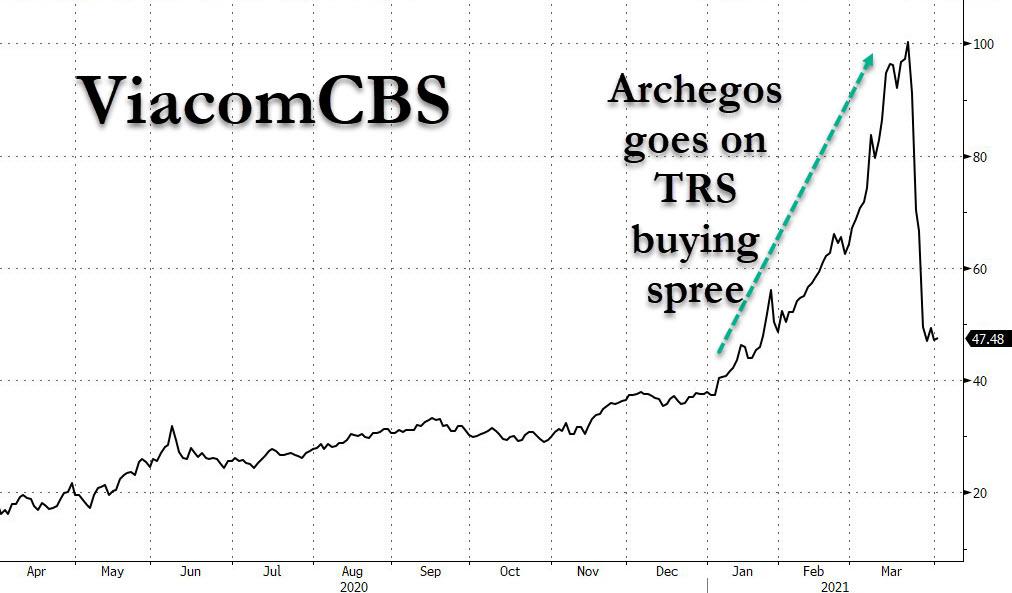
As Bloomberg reports, while much of the investing world watched in stunned silence how an "old media" company - ViacomCBS - shot up almost 300% in weeks, becoming the best performing stock in the S&P500 and prompting investors to speculate that the stock was was either undervalued, or like GameStop, or a takeover target, a handful of execs at Wall Street's top trading firms were aware of what was behind the move: it was Archegos Capital Management, who was building a massive position in ViacomCBS and a handful of other stocks... using leverage the same banks so generously offered with stock which the banks themselves technically owned!
But while banks around the world - from Goldman, Morgan Stanley and Wells in the US, to Credit Susse, UBS and Deutsche Bank in Europe, to Nomura and Mitsubishi UFJ in Japan - kept giving Hwang the leverage he needed to acquire more and more of the stock, until he became the biggest economic if not registered owner of Viacom, what they did not know - thanks to the was Total Return Swaps are structured - was the full extent of his wagers. Which were massive: he stealthily amassed $10 billion of Viacom.
Viacom was just one of many: using even more TRS and even more leverage across even more Prime Brokers, Archegos was able to place colossal wagers while avoiding the disclosures required of most investors. And so "almost invisibly" Hwang accumulated a portfolio which according to Bloomberg sources was as much as $100 billion!
Eventually, Archegos built positions in at least nine stocks that were big enough to rank him among the largest holders, fueled by a level of bank leverage that would have been unusual even for a hedge fund.
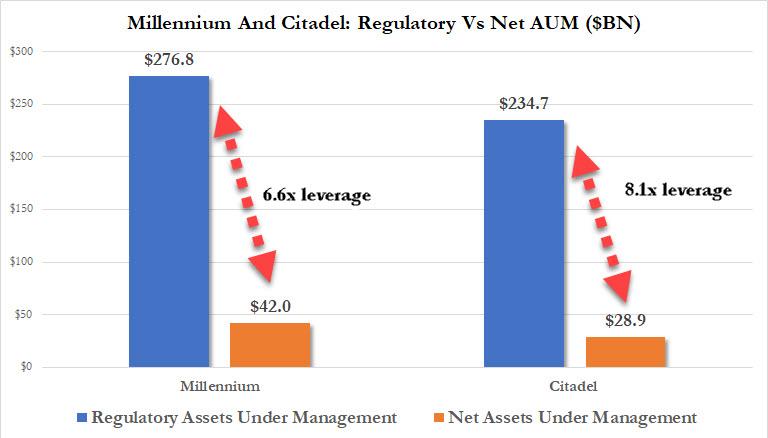
While we previously discussed the leverage aspect of Archegos strategy, here it is again: with Bill Hwuang managing approximately $10BN in assets under management, the multiple Total Return Swaps with unwitting prime brokers allowed the fund to build up a staggering $100 billion in positions, implying a huge 10x leverage. This is the kind of leverage one associated with the likes of financial titans like Citadel and Millennium, not a smallish family office which has zero downside protection (as we would eventually learn).
What is amazing about this unilateral Ponzi scheme is that it relied on what we have dubbed rehypothecated leverage: the fund never even owned the underlying stock which was layered with billions in generous Prime Broker debt, but it was Archegos' Prime Brokers who not only would own the actual stock but would also allow Hwang to add tens of billions in leverage... on an asset that they owned!
What is also remarkable is that Archegos' ponzi scheme could have continued indefinitely if only Viacom stock had i) continue to rise or ii) avoided a crash. After all, having ignited the initial upward moment, Archegos had effectively forced benchmark-tracking investors, exchange-traded funds, CTAs and other momentum investors to buy as well.
Sadly for Hwang (and his Primer Brokers) the upward momentum ended with a bang last Monday, when with its shares trading at $100, Viacom announced a $3BN stock sale, which hammered the stock, followed by a round of analyst downgrades, which sent the stock tumbling. It was at this point that Archegos was now facing tens of billions in margin calls on its VIACA Total Return Swaps from its Prime Brokers.
And therein lies the rub, because when the time came to unwind the Archegos Ponzi, the Prime Brokers' counterparty was not Archegos but other Prime Brokers. This is what led to the infamous meeting late last Thursday, where a bunch of PBs tried to reach an amicable resolution ahead of Friday's bloodbath. As Bloomberg adds, at several points during those exchanges, bankers implored Hwang to buy himself breathing room by selling some stocks and raising cash to post collateral. But "he wouldn’t budge."
As a result, Morgan Stanley and Goldman promptly started dumping blocks of stock backing Archegos TRS in the open market. In doing so the started a margin call liquidation, in which those who sold first - like Goldman, Morgan Stanley and Deutsche - would avoid massive losses, while those who waited like Nomura and Credit Suisse... would not. Indeed, we already knew that Nomura, Japan’s largest investment bank, said its losses could hit $2Bn, while losses at Credit Suisse could be as large as $4Bn according to the FT.
At this point, many questions popped up, especially (and belatedly) inside the banks themselves: as the FT reports, executives within the prime brokerage divisions of at least two banks "are being quizzed by risk managers over why they offered a business as small as Archegos tens of billions of dollars of leverage on trades in volatile equities through swaps contracts,."
As the FT further notes, echoing what we said above, while prime brokerage clients typically provide few details about their other trading activities, "executives from at least two of the six banks are investigating whether Hwang deliberately misled them or withheld vital information about mirror positions he had built up at rival banks, according to people involved in the probes."
Well, no: Archegos did not mislead anyone. He simply used (and abused) a system where - as we put it - one investor can create as much rehypothecated leverage as the investors' banks and Prime Brokers will allow him. In this case we know the number may have been as high as a mindblowing $90 billion.
Naturally, had the banks known that in a worst case scenario they would be facing other banks - since such replicated, or rather rehypothecated position would magnify the risks on each of the trades making a bank less likely to extend so much credit against them - none of this would have been possible. However, as long as everything was going up, and all of Archegos positions were pleasasntly surging nobody seemed to care... or bother to calculate just how big the downside risk was (one can thank the Fed Put for that).
One final remarkable aspect of this whole story is that this is not Hwang's first crisis. In 2012 he submitted a guilty plea on behalf of his hedge fund to a charge of wire fraud, and he resolved related civil claims of insider trading without admitting or denying wrongdoing. Archegos is the family office he formed after winding down that firm, Tiger Asia Management.
However, as if nothing had ever happened, prime brokerages immediately began lining up to help the new business. Morgan Stanley was among his early backers. Deutsche Bank signed him as a client at the urging of at least one senior executive, according to Bloomberg, "who was unperturbed by the insider-trading taint and didn’t believe Hwang had done anything wrong, according to a person familiar with that decision." Ironically, just a few years later, Hwang did something wrong and it would prove to be the biggest hedge fund collapse in post-LTCM history.
Not every bank acted like an idiot: one firm resisted the lure. Archegos approached JPMorgan sometime between 2016 and 2018 and was rebuffed, according to the Bloomberg report. At the time, JPMorgan was still revamping the equity prime-brokerage unit it had acquired with Bear Stearns during the 2008 financial crisis. "Dumb luck or not, the bank dodged a bullet."
* * *
The rest of the story is mostly known, so now what.
Well, as we first hinted and as Bloomberg reports, already regulators are dropping hints of new rules to come, with SEC officials signaling to banks that they intend to make trading disclosures from hedge funds a higher priority, while also finding ways to address risk and leverage.
Senior finance executives acknowledge that a crackdown of some form, whether on borrowing or transparency or both, is inevitable.
Amusingly, and picking up on the FT's reporting, Bloomberg also notes that while some of those firms have disclosed the financial impact of their roles in the Archegos collapse, none is willing to comment on how or why they enabled Hwang to become such a force in the market. After all what can they say: "the other guys vetted him, so we assumed he was clean"...
There are also questions whether Hwang’s counterparties knew about his relationships with other banks and the scale of the leverage he was using for what appear to be concentrated positions in a handful of companies. And - more ominously - if they did not know anything about his exposure, why the hell not? As we reported on Tuesday, JPMorgan (which successfully managed to avoid this scandal completely) estimated that the Prime Brokers facing Archegos may end up absorbing as much as $10 billion in combined losses.
Already credit rating agencies have downgraded outlooks for Credit Suisse and Nomura, citing concerns over “the quality of risk management” while activist investors are demanding better governance and would not mind if senior execs were summarily fired over this episode to restore confidence.
"Risk controls still are not where they should be," David Herro, one of Credit Suisse’s biggest shareholders, said Wednesday in a Bloomberg TV interview. "Hopefully, this is a wake-up call to expedite the cultural change that is needed in this company."
But going back to Bloomberg's original point, for all their silence the prime-brokerage units of Nomura, Goldman Sachs, Morgan Stanley, Credit Suisse and others, had clues about what Archegos was doing. These firms knew about the trades they had financed, of course, and also had some visibility into his total borrowings. And yet they didn't bother to ask about what, if any, risk management was being implemented to avoid an uncontrolled unwind. Or rather, the questions emerged only after the margin call.
What the Prime Brokers also didn't know is that Hwang was taking parallel positions at multiple firms, piling more leverage onto the same few stocks, which brings us back to our rehypothecated leverage concept which we are confident we will use much more in the coming months, especially since "unwinding a series of large, leveraged bets placed by a single account is one thing; doing so when rival banks are liquidating the same positions held by the same client is quite another."
Archegos' own "Lehman moment" came late on March 25 when Hwang’s prime brokers met again and discussed the possibility of standing down temporarily to let tensions ease, as we reported previously, but any attempt at solidarity proved short-lived: shortly after some PBs sent Archegos notices of default, clearing the way for Goldman and Morgan Stanley to dump Hwang's positions.
“Hopefully this will cause the prime brokerages of regulated banking organizations (and their supervisors) to re-assess their relationships with highly leveraged hedge funds,” former FDIC chair Sheila Bair tweeted.
She is, of course, wrong.
In fact, if anything we expect Prime Brokers will make leverage even easier to obtain for non-bank, hedge fund and family office clients, because the one big mistake Archegos (and its Prime Brokers) made was that it was not big and systemic enough to merit a Fed bailout. Now, if Archegos had a portfolio of $200 billion, $300 billion or more, while using Citadel's 50x leverage, now we're talking "size"... size enough for the Fed to step in and make everyone whole on the back of taxpayers... the same way the Fed bailed out Citadel, Millennium and Point72 in September 2019 during the repo crisis (as both Zero Hedge and subsequently Bloomberg, explained).
There is another reason nothing will change: hedge funds, Prime Brokers, banks - in fact the Fed itself - are all incentivized to not look at what skeletons may be found in the closet. Why? Because if the banks are forced to admit that there are more Archegos funds - and there are countless - Prime Brokers will have no choice but to sequester collateral from more clients, sparking more margin calls, leading to more stock liquidations, and resulting in even bigger investor panic. Call it a side effect of building castles on crooked foundations in an artificial, fake, Fed-supported market.
Is another market panic what the Fed wants? Or what the Biden admin wants? Of course not.
Which is why we will get a token Congressional hearing where politicians care more to hear themselves talk than listen to the answers, the banks will slap a few hands, one or two small sacrificial hedge funds will be shut down, and the world will move on, especially once Archegos is no longer on the front page of the financial media.
It's also why when the next major hedge fund implosion does happen, it will be far more catastrophic.

WSJ : Inside Archegos’s Epic Meltdown

Inside Archegos’s Epic Meltdown
Banks enjoyed fees they earned from Bill Hwang, a former hedge-fund manager, then were stunned to learn the extent of his debt-fueled stock bets

Bill Hwang was in trouble.

On Thursday of last week, the firm managing the former hedge-fund trader’s wealth arranged a conference call with executives at some of the largest investment banks in the world. The urgent topic: mounting losses at Mr. Hwang’s family office, Archegos Capital Management, from a handful of large bets on major stocks.

Because the wagers had been made in part with so-called total-return swaps—investments made by banks on behalf of clients for a fee—they had obscured Mr. Hwang’s large exposure to several companies.

Archegos shocked its lenders when it told them the size of its portfolio and how little cash it was holding, said people familiar with the call—not the least because they were all now facing billions of dollars in potential losses themselves.

Now Wall Street is sifting through the aftermath of the biggest single-firm meltdown since the financial crisis. Mr. Hwang alone lost approximately $8 billion in 10 days, a person familiar with the matter said, in what traders and investors say was one of the fastest losses of such a large sum they had ever seen.

The firm’s implosion has rippled through the financial world, eroding tens of billions of dollars from the shares of media conglomerates and investment banks. Japanese bank Nomura Holdings Inc. said it was owed about $2 billion by a U.S. client. Credit Suisse Group AG shareholders are braced for $3 billion or more in losses. People familiar with the matter said the losses were related to Archegos for both banks.

The meltdown has sparked calls for greater scrutiny of the use of swap transactions and more oversight of family offices, which manage the fortunes of wealthy individuals. Family offices have soared in size in recent years and now manage more than $2 trillion. Because they don’t market to outside investors, they are far less regulated than similar vehicles such as hedge funds, which have to regularly disclose their investments.

Wreaking ‘havoc’
“The collapse of Archegos Capital Management and the billions of dollars in losses to investors and other market participants is a vivid demonstration of the havoc that errant large investment vehicles called ‘family offices’ can wreak on our financial markets,” Dan Berkovitz, a commissioner on the U.S. Commodity Futures Trading Commission, said.

Behind the enormous losses was Mr. Hwang, a 57-year-old Korean-born investor, devout Christian and protégé of famous hedge fund veteran Julian Robertson. Mr. Hwang built his fortune swinging for the fences, often focusing his investments in just a few stocks, paying little attention to hedging his positions while borrowing large amounts of money to boost his returns.

His appetite for risk extended beyond big bets. In 2012, his firm Tiger Asia Management LLC pleaded guilty to U.S. criminal charges and settled civil-fraud claims related to allegations of insider trading. Mr. Hwang was barred from managing client money in the U.S.​ with the right to apply to lift the bar after five years. ​A Hong Kong court separately ordered Tiger Asia to pay about $5.8 million to settle claims related to the conduct. ​​

Sung Kook “Bill” Hwang emigrated to the U.S. from Seoul with his family and attended the University of California, Los Angeles, in the 1980s. The son of a pastor, Mr. Hwang became an equities salesman at Hyundai Securities Co. and so impressed Mr. Robertson, the well-known investor who ran hedge fund Tiger Management, that he hired him.

At Tiger, Mr. Hwang sat near Mr. Robertson’s office, researching opportunities. Soon, Mr. Hwang was urging Mr. Robertson to buy Korean shares. Mr. Robertson scored big profits, cementing their relationship.

When Tiger closed in 2000, Mr. Robertson backed Mr. Hwang as he started his own hedge fund, Tiger Asia. In 2001, Mr. Hwang’s firm started with $1.2 billion and he worked at 101 Park Avenue in Midtown Manhattan with several other funds with ties to Mr. Robertson. Those funds regularly met to discuss investment ideas. Mr. Hwang and his analysts rarely participated, eager to keep their strategies to themselves, according to people familiar with the matter. Mr. Hwang even kept information from his own team, leaving some of them to wonder how he was forming his investment decisions, the people said.

Splitting his time between the U.S. and his fund’s Hong Kong office, Mr. Hwang used borrowed money to buy huge chunks of young, growing companies, including LinkedIn. As those stocks soared, Mr. Hwang’s fund grew in size past $5 billion.

Mr. Hwang was open about his faith and liked doing business with other Christians, sometimes commenting if a colleague wore a cross necklace, according to a Wall Street banker who worked with Mr. Hwang. He regularly discussed his charitable foundation with visitors and emphasized the importance that community service played in his life, talking with pride about various projects he and his mother had supported.

Mr. Hwang owned just a handful of stocks, a concentrated portfolio that made his returns more volatile. He liked to focus on stocks that were heavily “shorted,” or had a high level of bearish positions, according to someone familiar with the trades, a stance that can lead to profits if the stocks rise in price.

In many years, Mr. Hwang scored annual gains of between 40% and 80% according to someone close to the firm. Once, a friend asked Mr. Hwang if he had taken profits from a stock that had soared.

“No, I’m still buying,” Mr. Hwang replied, a person familiar with the matter said.

As his gains piled up, Mr. Hwang sometimes viewed his profits through the prism of religion.

“Do I think God loves it? Of course!” Mr. Hwang said in a video, referring to his early investment in LinkedIn. “I’m like a little child looking for, what can I do today, where can I invest, to please our God?”

Working late in the night so he could trade Asian markets, Mr. Hwang hired analysts but made all final decisions, developing a unique approach to elicit information from executives and others. Mr. Hwang liked to ask a probing question and then say little more during the conversation, waiting to hear interesting tidbits of information, according to two executives who interacted with him.

In the fall of 2008, Mr. Hwang was one of a number of hedge-fund investors burned when they wagered against shares of Germany’s Volkswagen AG, which jumped 348% over two days. A former colleague says he was struck by Mr. Hwang’s equanimity during that period, sometimes greeting colleagues with a smile.

By then, Mr. Hwang was a billionaire. Sometimes, he worked on a large boat, friends say, but lived a relatively modest life compared with others on Wall Street. He owned a $3 million home in Tenafly, N.J., but drove an older-model car.

In 2010, regulatory investigations that would span the next several years related to allegations of insider trading had begun. Mr. Hwang has said his regulatory issues revived his Christian faith. “I had, really, a bad business problem. And I knew no matter how much money [and connections] I had…they couldn’t help me,” Mr. Hwang said in a 2018 interview at a Christian conference.

Returned money
Mr. Hwang returned clients’ money in 2012 and turned his firm into an office to manage his family’s wealth. He named it Archegos, which, translated from Greek means “leader” or “prince of Christ.” A Christian ethos permeated the firm, with voluntary Friday morning Bible studies where a recording of Bible readings would play to music.

Around 2015, Mr. Hwang ran into a new problem: Archegos, which he ran like Tiger Asia, had become so big it no longer could focus on shares of Asian companies trading in those markets, which sometimes were too small to enable Archegos to buy and sell without jolting prices.

Mr. Hwang decided to expand the firm’s portfolio into larger U.S. shares. Mr. Hwang told friends he was even more comfortable with trading risks, since the firm managed his own money, not clients’ cash.

By this year, Archegos had built out a network of lenders, called prime brokers, using the services of six different banks—Goldman, Morgan Stanley, Credit Suisse, Nomura, Deutsche Bank and UBS. His use of leverage and willingness to pay fees without haggling made him a lucrative client.

Archegos was regularly putting up $15 of collateral to borrow $85, on the high end of leverage for stock-trading firms with similar strategies, said a banking executive familiar with the borrowing. Some of his lenders balked at those terms, but Mr. Hwang found other willing counterparties.

For most of the past year, Mr. Hwang was on a roll. Stocks owned by Archegos, including ViacomCBS Inc., Discovery Inc. and a U.S.-listed Chinese tutoring company called GSX Techedu Inc. soared, making the fund billions of profits. As the shares rose, the fund added to its top performers, often using derivative trades called swaps agreements. Archegos effectively owned 25% of some companies, according to a person familiar with the matter.

Archegos’s lenders say they were unaware of the extent of trades he was making with other banks, information that would have encouraged them to curb their lending. Banks can ask clients for information on their loans from other banks but clients don’t necessarily have to disclose it or their positions.

The drop
On Monday of last week, everything changed for Mr. Hwang. That day, ViacomCBS, one of his largest holdings whose stock price had risen more than 150% in 2021, announced it would sell new shares. The offering pressured the stock, sending it down more than 25% in the aftermath of the announcement.

Because of Archegos’s highly concentrated positions, the sharp drop in Viacom hit the fund’s portfolio, and many in the market believe that Archegos started selling other stocks in its portfolio to cushion the blow. Those sales sent other stocks it held tumbling, including Discovery. Suddenly, the collateral Archegos had given the banks was no longer enough to back the loans. Banks hit Archegos with margin calls to back up its trades, which initially were met by the fund, but as ViacomCBS fell further on Wednesday, the firm didn’t have the money to provide its lenders, a person involved in the unwinding said.

That forced the banks to sell Archegos’s collateral holdings even as they were tumbling, worsening the selloff. Archegos reduced some of its holdings on Thursday and ViacomCBS shares fell more steeply.

When Archegos called its banks for a meeting, they had different opinions on how to handle the situation.

Representatives from Credit Suisse and Nomura, which faced the most extreme losses, suggested working together over a month to unwind Archegos’s trades. They acknowledged the impediments to doing so, particularly that each bank would need to strike a separate agreement with Archegos to avoid antitrust issues.

Representatives from Morgan Stanley and Goldman Sachs balked at even the idea of doing so, saying that within a day or two the market would get wind of the amount of stock that needed to be sold and pummel them. The meeting disbanded before they agreed to work together.

The call ended Thursday night as the Asian stock market was about to open. The fire sale began.

Mr. Hwang has tried to bolster the spirits of his employees. Last Friday, he held a group call, telling them they were in it together and asking them not to quit. Some employees expect Archegos to file for bankruptcy, said a person briefed on the matter.

“This is a challenging time for the family office of Archegos Capital Management, our partners and employees,” a spokesman said in a statement Thursday. “All plans are being discussed as Mr. Hwang and the team determine the best path forward.”

>>> What to look at today - 2nd of April 2021

Asian stocks rose Friday after U.S. shares reached a record on optimism about a stimulus-fueled economic recovery. Equity trading volumes were below average because of holidays across the region.
Chip-makers bolstered South Korean equities following a report that the U.S. plans to meet with semiconductor and auto companies to discuss the global microprocessor shortage. Markets in Japan and China posted modest gains.
U.S. equity futures edged up after the S&P 500 closed above 4,000 for the first time. Tech shares outperformed and value stocks rallied as traders weighed President Joe Biden’s $2.25 trillion spending plan and signs of faster growth.
Treasuries rebounded after the worst quarter in decades with 10-year yields falling back below 1.7%. The dollar retreated. Oil climbed after the OPEC+ alliance agreed to boost output gradually. In Asia, markets including Australia, Hong Kong, Singapore and India are shut for holidays, as are many worldwide.

Nikkei +1.46% Hang Seng closed CSI +0.56% Shanghai +0.21% Shenzen +0.73%

Eur$ 1.1777 CNH 6.5695 CNY 6.5619 JPY 110.51 GBP 1.3845 CHF 0.9415 RUB 76.10 TRY 8.1219 WTI$ 61.24 -0.34% GOLD 1,730.66 +0.08% BTC 59,450 +680

S&P +0.20% Nasdaq +0.25% EuroStoxx Closed FTSE Closed Dax Closed ...Europe Closed

Macro :
- Archegos Shows Need to Monitor Family Offices, Berkovitz Says
- German Practitioners to Start Vaccinations Next Week: Ministry
- Australia Finds 1 Case of Clotting Following Astra Vaccination

Spacs :
- SPAC Called 5G Edge Wants to Go Public Under Ticker ‘ARK’

Keep an eye on :
- AGS BB : Ageas Sees RPN(I) Effect Boosting 1Q Net by EU1.7 Million
- ALO FP : Alstom Acquires Helion Hydrogen Power, No Financial Terms
- APPS SM : Applus Says Malware Attack Disrupted U.S. Vehicle Inspections
- AT IM : ASTM Offer Approved by Market Regulator, to Run April 13-May 10
- AZN LN : UK Saw 25 New Blood Clot Cases Linked to AstraZeneca Vaccine: FT
- AZN LN : Fauci Says U.S. May Not Need AstraZeneca Covid-19 Shots: Reuters
- BA US : Pratt Signals Long Wait Until 777 Engine Checks Are Completed
- FBAVP BB : BNP Paribas Fortis to Take Over Rest of Bpost Bank by Year-End
- CGG FP : CGG Issues $500M Notes, EU585M Notes Due 2027
- COIN US : Coinbase Files for Direct Listing, Shares to Trade on April 14
- CBK GY : Commerzbank Will Record $550 Million Charge for Job Cuts
- CSGN SW : Credit Suisse Effort to Recoup Greensill Loans Faces Roadblock
- ROO LN : Deliveroo Snubbed US Approach Ahead of Disastrous Float
- DIE BB : Belgian March Car Registrations Rise 56%; D’Ieteren Has 22.7%
- FB US : U.K. May Make Facebook Allow Police Access to Messages: Guardian
- IIA AV : Immofinanz: Transfer of Shares in RPPK Not Done, Pecik Still CEO
- MRNA US : FDA Revises Moderna COVID-19 Vaccine’s EUA to Boost Doses
- NESN SW : Nestle Plans More Acquisitions in Coming Years, CEO Tells FuW
- OSE FP : OSE Immunotherapeutics Covid Vaccine Trial Gets Belgian Approval
- PSH NA : Pershing Square Holdings March Net Performance +0.6%
- PXD US : Pioneer to Buy DoublePoint for $6.4 Billion Amid Permian Push
- PAH3 GY : Porsche Rises as Goldman Sets Street-High PT With 40% Upside
- SON PL : Sonae Unit SFS Signs Partnership Agreement With Banco CTT
- STLA US : FCA US: 5% Increase in 1Q U.S. Total Sales
- STLA IM : Honda to Restart Production at North American Plants Next Week
- SXS LN : Spectris Buys Concurrent Real-Time for $166.7m in Cash
- TGYM IM : Peloton Completes Precor Acquisition
- UAL US : United Airlines Will Soon Begin Hiring Hundreds of Pilots: CNBC

FT : Ex-CFTC chair joins Citadel Securities 27 days after leaving regulator

Ex-CFTC chair joins Citadel Securities 27 days after leaving regulator
Heath Tarbert appointed chief legal officer at Ken Griffin’s market making firm

Citadel Securities, the US market maker owned by billionaire Ken Griffin, has snapped up Heath Tarbert, the former head of the main US derivatives regulator, to be its new chief legal officer.

Tarbert left the Commodity Futures Trading Commission just 27 days ago, having resigned as its chair after an 18-month tenure.

Citadel Securities’ announcement on Thursday marked the latest in a long list of hires from US regulators by Griffin. Tarbert replaces Steve Luparello, Citadel Securities’ general counsel, who is a former director of the Securities and Exchange Commission’s division of trading and markets.

Griffin also hired Gregg Berman, the SEC’s former head of research who examined the role of high-frequency trading on the world’s largest equity market, as well as Ryan VanGrack, who was an adviser to former SEC chair Mary Jo White, among others.

The move has reawakened accusations of a so-called revolving door from public service to private work.

“This is just the latest regrettable example of a senior government official selling out his public service to big finance,” said Dennis Kelleher, president of the advocacy group Better Markets. “This corruption disgusts the American people and Congress should outlaw it.”

Shawn Fagan, chief legal officer of Citadel, the hedge fund also owned by Griffin, said in a statement that “Heath has significant leadership experience and legal expertise, as well as a commitment to advocating for markets that are competitive, transparent and resilient”.

Under Tarbert the CFTC set several records for enforcement, including the most cases in a fiscal year.

The move to Citadel Securities marks a return to commercial work for Tarbert, who previously worked on international relations roles at the US Treasury department and was head of the bank regulatory practice of Allen & Overy, the law firm.

“Citadel Securities has been a leading advocate for open and transparent markets,” he said. “I look forward to working with its outstanding team to build upon the firm’s record of creating better markets for investors.”

Tarbert joins the firm after it has come under intense scrutiny for its position as the largest market maker in the US equity market, and its role in January’s fevered trading of so-called meme stocks such as GameStop and AMC Entertainment.

Buying and selling became so heavy some brokers, such as Robinhood, were forced to restrict trading in GameStop shares, drawing anger from customers and high-profile politicians.

In February lawmakers grilled Griffin on Citadel Securities’ business model, in which it daily draws in thousands of orders from brokers including Robinhood, with some suggesting it causes conflicts of interest.

Griffin’s company executed roughly 14 per cent of all daily stock trades last month, according to data from Bloomberg.

Griffin was joined in his appearance before a congressional hearing by the chief executive of Robinhood, whose chief legal officer is Dan Gallagher, a former commissioner at the SEC.

WSJ : Judge Grants Nike Request to Stop Sales of Satan Shoes

Judge Grants Nike Request to Stop Sales of Satan Shoes
MSCHF says it won’t give away last pair of customized sneakers, which it calls art


MSCHF released the sneakers, which include satanic symbols, in collaboration with Lil Nas X to promote the rapper’s latest song.
A federal judge granted Nike Inc.’s NKE -0.27% request to halt shipments of the Satan Shoes, and the company that released the customized sneakers said it wouldn’t proceed with plans to give away the final pair.
U.S. District Judge Eric Komitee on Thursday granted Nike’s request for a temporary restraining order against MSCHF Product Studio Inc., according to the court docket in the Eastern District for New York. Lawyers for the two sides were in court earlier in the day.
MSCHF last week released black-and-red sneakers with satanic symbols in collaboration with Lil Nas X to promote the rapper’s latest song and music video. Nike filed a trademark lawsuit on Monday and said it hadn’t authorized the product.
As part of the campaign, Lil Nas X had tweeted that he would pick someone on Twitter to get the 666th pair of Satan Shoes. The $1,018 shoes quickly sold out and set off a social-media uproar.


In a statement Thursday, MSCHF described itself as an art collective and the Satan Shoes as artwork. The company said Nike didn’t file a lawsuit against the company in 2019 when it modified another pair of Nike sneakers and called them the Jesus Shoes.
“As a manifested speculative artwork Jesus Shoes conflates celebrity collab culture and brand worship with religious worship into a limited edition line of art objects,” MSCHF said in a written statement. “Last week’s release of the Satan Shoes, in collaboration with Lil Nas X, was no different.”
MSCHF is known for creating publicity stunts and viral products. The company is not a marketing company and does not have clients, according to a representative from its law firm.
The Brooklyn company said it looked forward to working with Nike to resolve the lawsuit, which seeks unspecified financial damages.
“MSCHF strongly believes in the freedom of expression, and nothing is more important than our ability, and the ability of other artists like us, to continue with our work over the coming years,” the company said.