FT : How Lex Greensill helped sow the seeds of Carillion crisis

How Lex Greensill helped sow the seeds of Carillion crisis
Supply chain finance scheme launched in 2012 helped failed contractor mask mounting debt

It was October 2012 and David Cameron was flanked by senior ministers — as well as Australian financier Lex Greensill — as he announced a new scheme designed to speed up payments to government suppliers.

The then British prime minister described the “supply chain finance” initiative as a “win-win” for industry, when the UK had only just emerged from recession. Under the scheme, suppliers’ bills were settled up front by banks, for a small charge, rather than the typical 60 to 90-day wait with contractors. The aim was to ease their cash flow at a time when banks were wary of traditional lending.

Cameron had no idea he was helping create a central plank in Carillion’s later scandal.

The British construction group went into liquidation in 2018 after it could no longer service its £7bn of debt, becoming one of the biggest corporate collapses in recent British history. It had just £29m of cash at the time.

In the midst of the crisis around Greensill Capital, the finance firm that fell into insolvency in March, the connection between Lex Greensill and Carillion has been only a footnote. But the way the outsourcer used supply chain finance to mask its mounting debts — something that helped it to continue to pay bonuses and dividends even as it veered towards collapse — can be traced back to that Cameron announcement.

Cameron revealed a long list of companies that had agreed to use Greensill’s big wheeze, which helped larger businesses to manage payments. Some of those companies quickly realised that loans to cover suppliers’ bills would not show up in their reported debt, helping to flatter their balance sheet.


Carillion’s use of supply chain finance became contentious because shortly after the scheme was launched, the company extended its maximum payment times to suppliers from 65 to 120 days — in effect forcing subcontractors to use the scheme, even if they had to pay a price.

The contractors wooed by Greensill
Cameron “absolutely pushed” the supply chain finance initiative and sent a letter to the government’s 20 biggest suppliers urging them to come to a meeting at 10 Downing Street, where they were pressed to use the scheme, according to one person close to Carillion.

Carillion never used Greensill but its finance team had several meetings with the entrepreneur, who was working as an unpaid adviser in the Cabinet Office — with his own desk and team of four civil servants. Executives had “stars in their eyes about him”, said one former employee.

According to people briefed on the plans, Carillion set up its “early payment facility” — its own version of the scheme Cameron announced — after meeting with Greensill.

Senior executives at some of the government’s other big UK contractors were also called in to meet the entrepreneur.

“There was no real threat but there was a certain pressure put on because the government was a big client,” said the head of one then FTSE 100 contractor. “I thought it was odd that Number 10 pushed the scheme as Greensill was not a government official and interest rates were low at the time.”

“You aren’t going to bite the hand that feeds you,” said an executive at another contractor.

Outsourcers knew Greensill had the patronage of Cameron and Jeremy Heywood, then cabinet secretary, who used to work with the Australian financier at Morgan Stanley. Cameron went on to work for Greensill, lobbying ministers last year on behalf of the company.

Greensill also attended at least two meetings between Carillion and its subcontractors, where they were encouraged to use supply chain finance, said people close to the company. At a 2014 event at Wolverhampton Wanderers football club, next to Carillion’s headquarters, Greensill was billed as the key speaker. 

The company’s use of 120-day payment times meant there was a “huge incentive” to use the scheme, said one subcontractor who attended a Carillion event at the stadium.

At the time Carillion told suppliers it intended “to provide this facility indefinitely as a key part of the UK government strategy to stimulate growth within the economy”.

Greensill told the Financial Times he was not directly involved in the creation of the Carillion early payment facility and refused to comment on the Wolverhampton event. He will provide his own version of events when he gives evidence to a Treasury select committee inquiry on Tuesday. 


Finances not what they seemed
In the six years before its collapse, Carillion reported a robust financial performance. From 2011 to 2016, its reported debt rose only slightly from £839m to £850m.

But in the small print of its annual accounts, borrowing was ballooning. A footnote under “trade and other payables” showed debt in the early payment facility almost tripled, from £263m to £760m. 

As the debt mounted, Carillion continued to award generous pay packages and bonuses to directors and make payouts to investors. 

In the five years from 2012 it paid out dividends of £376m even though its operations generated just £159m of net cash. Richard Howson, then chief executive, who was unavailable for comment, took £5.6m in remuneration and added £1m to his pension, even as the company racked up a £990m pension deficit, for which taxpayers and retired Carillion workers later paid.

Bob Wylie, author of Bandit Capitalism, a history of Carillion, said the company’s early payment system made the balance sheet look “much better than it was”. 

A report by the business select committee in 2018 backed the view that Carillion used the facility to “systematically” shore up its fragile finances and present a “rosy picture” to the markets. Moody’s, the rating agency, argued that as much as £498m of debt was misclassified in the annual accounts. By labelling the early payment facility as “other creditors”, the figure was not incorporated in the company’s debt-to-earnings ratio, a key covenant test between Carillion and its lenders. 

Cameron’s representative said it was wrong to single out Carillion given the wider, successful use of supply chain finance by many companies. “This is utter nonsense,” he said.

Noble Francis, economics director at the Construction Products Association, said Carillion was the “worst abuser of the scheme but many of the largest construction firms have supply chain finance built into their business models as one way of making up for contracts won by bidding at low or negative margins”.

Kier, the struggling UK building contractor, reduced holdings in its scheme at the end of 2020, but said it would continue to offer it as it was “much appreciated by those who use it”. 

But Rudi Klein, an industry expert, is calling for supply chain finance to be banned. “It’s an absolute scam,” he said. “Carillion got free credit for about three months.”

“Why should workers have to pay to get paid? I don’t think the construction industry and David Cameron are going to be forgiven for introducing it.”

FT : Global passive assets hit $15tn as ETF boom heats up

Global passive assets hit $15tn as ETF boom heats up
Exchange traded funds close to eclipsing traditional index trackers for first time

Assets under management in exchange traded funds are eclipsing traditional index-tracking mutual funds for the first time, after the global passive investment industry vaulted past $15tn in assets last year.

ETFs stood at $7.71tn under management at the end of last year — narrowly behind index mutual funds at $7.76tn — according to data compiled for the FT by the Investment Company Institute.

Since then, ETFs are likely to have nosed ahead thanks to powerful inflows this year. Comprehensive global data comes with a lag, but consultancy ETFGI calculates that assets under management in ETFs stood at $8.33tn at the end of March. 

The ascent of ETFs past their older cousins reflects the speed at which they have reshaped the investment industry.

“People are increasingly building entire investment strategies using only ETFs. The choices you have vastly outstrip what you have in traditional index funds,” said Todd Rosenbluth, head of ETF and mutual fund research at CFRA.

Traditional passive mutual funds accept investor money or redemptions at the end of each day, whereas ETFs, first invented two decades later in the 1990s, trade like stocks on an exchange, letting investors hop in and out whenever they want. 

The pandemic-triggered market upheaval of March 2020 failed to dent their growth, with bond ETFs now also quickly gaining ground among investors who were pleasantly surprised by their resilience in the turmoil.


“We’ve seen record inflows over the past quarter, and largely into ETFs,” said Inigo Fraser-Jenkins, a strategist at Bernstein. “There’s an ongoing desire to reduce fees — and that favours the shift from active to passive funds.” 

The shift towards ETFs has been particularly powerful in the US, where they enjoy tax advantages over traditional mutual funds. Sean Collins, chief economist at the ICI, noted that US ETFs held $5.58tn at the end of March, compared with the $5tn in traditional index funds. Actively-managed mutual funds held about $15tn, he said.

Not everyone in the industry has been thrilled by the dramatic rise of ETFs. Some critics worry they lead investors to overtrade, which harms returns and exacerbates the volatility of markets. 

Jack Bogle, the founder of Vanguard, introduced the first index mutual fund for ordinary savers, but was infamously hostile to ETFs and disliked when his old company entered the industry after he retired. However, he conceded before he died in 2019 that ETFs had changed “not only the nature of indexing, but also the entire field of investing”.


Others argue that the flexibility of ETFs means securities that would normally be unavailable to ordinary investors — such as complex derivatives — can be easily packaged and sold to everyone without any restrictions. 

Leveraged ETFs — which use derivatives to deliver enhanced returns, or the inverse returns of an underlying index — have swelled in popularity over the past year, thanks to the retail trading boom.

Assets in products like this fluctuated between $50bn and $70bn over the past decade, but they had grown to almost $135bn by the end of March, according to Morningstar data.

In numbers of funds, ETFs greatly outstrip their predecessors. At the end of last year, there were 6,725 ETFs globally, and just 3,196 traditional index funds, according to the ICI data.


The publicly reported index fund industry is not the entire passive investing universe. Many big institutional investors, such as sovereign wealth funds, manage index-tracking strategies internally, or give bespoke mandates to the likes of BlackRock or State Street Global Advisors. 

BlackRock estimated in 2017 that these non-public indexed strategies amounted to another $6.8tn — split between $5.4tn in tailored mandates and $1.4tn in internal strategies — just in equities. Assuming a similar growth rate to the public index fund universe, that means that there is now likely well over $25tn in benchmark-tracking strategies, index funds and ETFs in total.

“The shift from active to passive investment strategies has profoundly affected the asset management industry in the past couple of decades, and the ongoing nature of the shift suggests that its effects will continue to ripple through the financial system for years to come,” the Federal Reserve noted in a 2019 paper.

WSJ : Economists Disagree Over How Much Covid-19 ‘Herd Immunity’ Needed for Reco

Economists Disagree Over How Much Covid-19 ‘Herd Immunity’ Needed for Recovery
Some say world’s economies could return to normal before such a critical mass of population is vaccinated or otherwise immune

As countries rush to get their citizens vaccinated, a debate is heating up among economists about how much herd immunity matters for the world’s economic recovery—or even if it does.

Some view herd immunity—the point at which a critical mass of a population become immune to a disease-causing virus or bacteria—as a key factor in determining when Covid-19 will be conquered and economies will return to normal. Until herd immunity is reached, some say, governments will restrict activities to prevent the disease’s spread, resulting in fewer goods and services being produced and consumed.

Other economists say businesses can reopen and economic activity can rebound without full herd immunity, and likely will.

Part of the challenge for economists is that it is hard to know exactly when a given place will achieve herd immunity, if ever. For Covid-19, epidemiologists generally believe it will require having at least 60% to 80% of a population develop antibodies, curbing the virus’s ability to spread.


Economists at Goldman Sachs Group Inc. have tried to incorporate immunity estimates into their forecasts by looking at daily vaccination progress around the world and take account of estimates of how many people have already been infected.

According to their calculations, 60% of the population in the U.S. and U.K. are already immune to Covid-19; the biggest economies of Europe will get there by August.

The bank’s data suggest that some emerging markets may also be close to or at herd immunity because of high levels of natural immunity caused by infections. Some 72% of the population in Peru had natural immunity by early May, while 58% in Mexico did, the bank says.

Those estimates are factors in the bank’s relatively bullish economic outlooks. It expects global gross domestic product to grow 6.6% this year, on the high end of forecasts.

Recently, however, some experts have raised questions about when or even if herd immunity is possible—particularly globally. Many countries are reporting vaccination delays and slowdowns, either because they can’t get enough shots or their citizens are reluctant to get inoculated.

Vaccines may also be less effective against new variants of the coronavirus, scientists say, and the longer the disease remains untamed, the greater the chance of new variants.

All those factors are dimming the possibility of a relatively quick global recovery, said Taimur Baig, chief economist at Singapore-based DBS Bank Ltd.

Even if individual countries inoculate the bulk of their populations, because of cross-border travel and trade they will be vulnerable until their neighbors and the rest of the world do too. Mr. Baig said the global economy can’t really return to normal until that happens—likely mid-decade or later. DBS forecasts global growth will be 5.6% this year, a full percentage point lower than Goldman Sachs.

“I think for a while we were all hoping that everything is transitory—that this will pass and at some point in 2022, we’ll be going back to the way things were,” he said. “Probably not.”

Economists at Morgan Stanley don’t see it that way. Places don’t need to achieve herd immunity before their economies normalize, said Asia economist Deyi Tan.

She pointed to China and Taiwan, where strict control measures have effectively tamed the disease despite low levels of vaccinations and immunity. China’s economy rebounded to its pre-pandemic size in the third quarter of last year and its previous level of growth in the fourth quarter, she said. Taiwan’s economic growth rate didn’t seem to be affected by Covid-19 at all, she said.

Such examples are leading Morgan Stanley to view herd immunity as just one factor in the more important task of Covid-19 control, said Ms. Tan. Even without herd immunity, if places can protect their populations that are most vulnerable to the disease and keep infections down, “you would already be making progress in the path of the economic recovery,” she said.

Economies are also adapting to Covid-19 as the pandemic drags on, weakening the correlation between herd immunity and recovery, said Frederic Neumann, co-head of Asian economics research at HSBC. The kinds of Covid-19 restrictions and lockdowns that pummeled economies early in the crisis are having less effect now, as populations get used to things like working from home or having food delivered, he said.

Although herd immunity from an epidemiological standpoint might not occur until 70% of a country’s population is inoculated, many nations are likely to see economies recovering at much lower levels of immunity, he said. For many of its economic forecasts, the bank estimates that Covid-19 disruptions disappear when around 50% of the population is immune.

“The longer this lasts, the more economic activity adjusts to the circumstances,” said Mr. Neumann.

Countries may see economic activity rebound before their populations are fully inoculated, but without herd immunity that recovery may not last, said Katrina Ell, senior Asia Pacific economist at Moody’s Analytics. Until the world is vaccinated, the virus will be able to sneak across borders and disrupt hard-fought economic gains, she said. Countries like Australia that have managed to largely quell infections and reopen businesses have had to clamp down again when Covid-19 outbreaks popped up.

Moody’s Analytics forecasts global herd immunity—which it says will require at least 70% of the world’s population to be inoculated—could be achieved in 2023.

Until then, “it’s going to be a recovery that happens in fits and starts,” she said.

FT : Fevered bidding for bankrupt Hertz reaches courtroom auction

Fevered bidding for bankrupt Hertz reaches courtroom auction
Battle for car rental company comes as travel and leisure industries recover from pandemic

A bidding war for the bankrupt car rental group Hertz will reach its end game when rival private equity bidders square off in an auction to be conducted in a federal bankruptcy court on Monday.

A consortium led by Centerbridge Partners indicated that it would counterbid against a recent proposal submitted by another group led by Knighthead Capital that set Hertz’s enterprise value at $6.2bn.

That figure would allow existing Hertz shareholders to receive a surprisingly generous recovery valued in excess of $2 per share. The battle for the car rental company comes as the travel and leisure industries rapidly recover as vaccination rates soar and the US economy picks up steam.

The punches traded between the two bidding groups started in March when Hertz accepted a bid from Knighthead and its partners Certares Opportunities that valued the company at just $4.8bn. That bid was then topped in April by the Centerbridge group, which includes Warburg Pincus and Dundon Capital Partners.

On Wednesday, the Hertz board determined that the offer from Knighthead received last week constituted a “superior proposal”. Bidding procedures established by the bankruptcy court in Delaware have allowed Centerbridge to trigger the Monday auction.

Early bids by the two groups contemplated junior bondholders receiving equity in the new company while existing shareholders would be eliminated.

A group of hedge funds that accumulated Hertz shares argued that the company’s valuation was large enough to support at least a modest recovery for current shareholders. This group has since joined forces with Knighthead/Certares along with Apollo Global Management to lead a package of $7bn in fresh debt and equity capital to reorganise Hertz. 

Their proposal offers a 50 cents in cash recovery to current Hertz equity holders and allows them to buy equity in new Hertz, either through a rights offering or through warrants. The group has pegged the value of this package at roughly $2.25 per share, according to one person directly familiar with the matter.

Hertz shares rallied last summer to more than five dollars on the strength of retail traders using the Robinhood app. Experts, however, scoffed as it appeared that since junior creditors would receive less than 100 cents on the dollar in the restructuring, the even lower-ranked shareholders would be entitled to nothing.

The Knighthead plan raises enough cash to pay off all creditors in full as well as make the cash payment to shareholders. Hertz’s shares have rallied to $3.48 from a low this year of 66 cents, implying a current market capitalisation exceeding $500m.

The bankruptcy court must approve the winning bidder, which will be followed by a vote on the plan by Hertz claimants. The company is racing to lock in a deal and exit the Chapter 11 process by the beginning of July, the start of the company’s busiest season.

The favourable conditions in the capital markets have enabled the fevered fight for Hertz.

“I can’t recall a better financing market,” William Derrough, Hertz’s investment banker at Moelis & Co, said in court testimony in April.

(ZH) Morgan Stanley Says "Rather Than Getting Excited, It's Getting More Concern

Morgan Stanley Says "Rather Than Getting Excited, It's Getting More Concerned"
BY TYLER DURDEN
SUNDAY, MAY 09, 2021 - 02:55 PM
By Michael Wilson, Morgan Stanley chief equity strategist
The Mid-Cycle Transition
Over the past month, we've taken a different path than most equity strategists. Rather than getting excited about the reopening, we are getting more concerned about (1) execution risk and (2) what's already priced in.
First, on the execution front, there’s growing evidence that supply remains a problem for many companies, just as demand is picking up. These issues have been particularly acute in certain materials and components, and now it’s becoming more apparent that we have labor shortages as well. In addition to numerous surveys and company commentary, Friday’s very disappointing employment report suggests labor availability may be a gating factor on the speed of the reopening. Furthermore, while these problems haven’t broadly affected margins yet, stocks are discounting machines and don’t always wait for an engraved invitation. To prepare for this execution risk, we downgraded small caps and early-cycle stocks like consumer discretionary while upgrading consumer staples and suggesting a move up the quality curve. At the same time, we have maintained our reflationary bias, with overweights in financials, materials and industrials.
We first highlighted these concerns in mid-March and are now even more convinced that they are warranted. On valuation, the risk is elevated too. But, with liquidity still flush and the S&P 500 making new highs every day, few seem worried. For many, the weak payroll number just means more accommodation from the Fed, or at least not a withdrawal any time soon. From our vantage point, the equity risk premium is underpricing these cost/supply issues as well as the other risks we have discussed over the past month. Most notable are the peak rate of change in economic and earnings data, as well as in policy and liquidity; extreme equity supply; and investor leverage. To be fair, the market isn’t completely ignoring these risks. Since mid-February, many stocks and indices have traded lower, some as much as 30-40%, and they aren’t recovering. Longer-duration stocks have been hit the hardest, as back-end interest rates moved higher than most expected this year. Lower-quality stocks have underperformed, too. More recently, the vaunted FAANMG stocks sold off on terrific 1Q earnings results after an outsized run into the event. This was in line with our call for a rotation towards high quality but also a reminder that stocks often peak on good news. From here, it will be important to see which ones can make new highs on the weak payroll report and subsequent lower yields and greater perceived Fed accommodation. We've placed our bet on Alphabet.
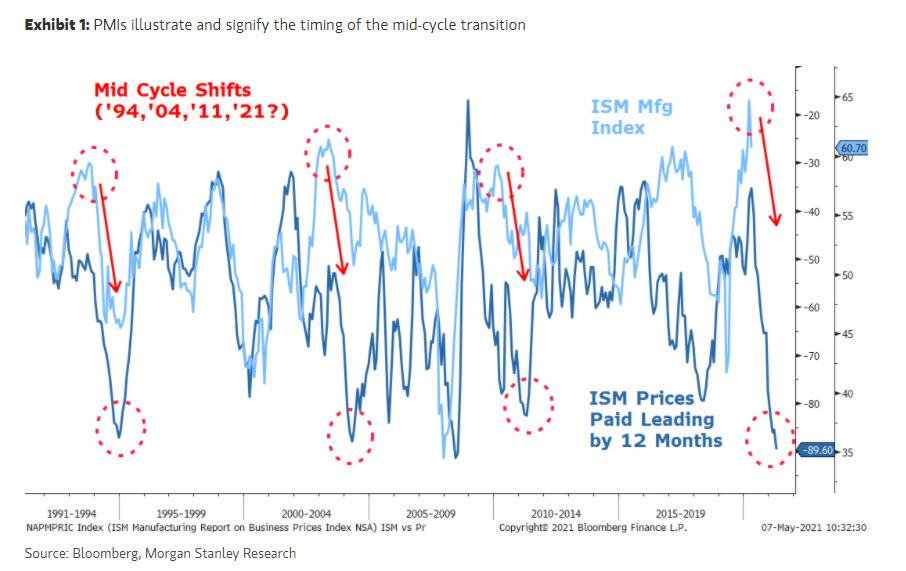
To be clear, this peak rate of change and execution risk are normal as we exit the early stages of a recovery and enter what we call the mid-cycle transition. Perhaps the best way to visualize this is to look at the headline Manufacturing Purchasing Managers Index and Prices Paid component.
In past cycles, 1994, 2004 and 2011 were comparable years. We think that 2021 will be similar for investors – flattish returns for the year with a 10-20%+ correction along the way. During such periods, the game is to be more selective with one’s investments and even more tactical with the rotations under the surface. The first quarter saw full-on cyclical rotation, with both reflation and reopening stocks leading. That is starting to morph now with reflation plays still working well while reopening stocks take a breather on execution risk.
Finally, remember that we’re still only a year from the trough in the recession, and new bull markets tend to last for years. So, whatever correction the market experiences this year, we are likely to make higher highs next year. The goal as an investor is to navigate the mid-cycle transition, avoid the stocks with the biggest drawdowns and be in position to capture the next leg. The first stage of that transition seems to be well along – i.e., taking out the most egregiously valued stocks as rates moved higher. Small caps, early-cycle stocks like semiconductors and lower-quality stocks are now underperforming, along with some reopening plays that got too extended. It’s likely that the S&P 500 will eventually feel it too before the transition is complete.
Bottom line, dreaming about a reopening is likely much easier than doing it. Given that stocks are discounting mechanisms, it’s often better to travel than arrive from an investment perspective. As a result, we think it’s time to be more selective and a tad more defensive until these risks are better reflected in margins/earnings expectations, price, or both. Welcome to the mid-cycle transition!

(ZH) "It's A Hustle": Dogecoin Demolished After Musk SNL Snafu

"It's A Hustle": Dogecoin Demolished After Musk SNL Snafu
Once upon a time Saturday Night Live was a celebration of acting talent, of impromptu creativity and most importantly, of humor, which is why it launched the careers of too many comedians to count. Alas, over the past few decades, SNL lost its way, and become preachy podium for virtue signaling poseurs, for status quo apologists and for countless people who reveled in the "uniqueness" of their identity politics yet can't cobble together a simple joke if America's Universal Basic Income depended on it. It's also why over the past few decades the viewership of SNL collapsed and countless Americans forgot about the show. Well... many got a stark reminder last night when millions turned on SNL for first time in years (or ever) only to be immediately reminded why they never watched it anymore: yet another catastrophically boring, uninspired and trite attempt by a cast of talentless hacks to be funny yet failing miserably.
And then there was Elon Musk.
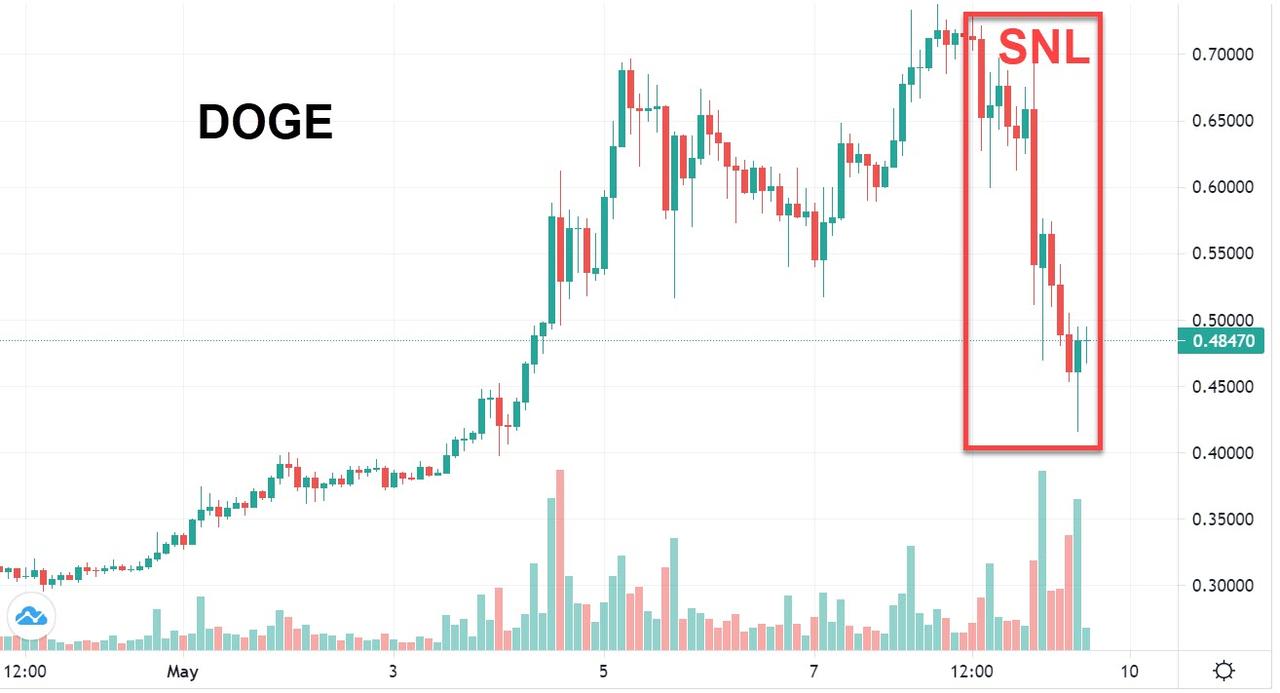
The world's 2nd richest man was the main reason why an entire generation of young Dogecoin "traders" turned on SNL for the first time in their lives.... only to see their favorite joke of a cryptocurrency (which it is by definition) demolished after weeks of breathless buildups for what Elon Musk had in store. Unfortunately, as with most things Musk, the action was all in the fervent anticipation of the main event... which turned out to be a fiasco.
Having surged to a record high of 73 cents (making it the fifth most valuable cryptocurrency) on Saturday ahead of the show, it started to drop as soon as Musk took the microphone....
... then dropped more as Musk's rambling monologue and boring skits failed to excite...
... or properly promote his favorite joke of a cryptocurrency. It ultimately dumped as low as 42 cents at of 8:05 a.m. ET...
... a 35% decline in 24 hours and a disappointment for all those who had expected that Musk's SNL appearance would be the catalyst that pushes the "dog" above parity with the dollar. Or, as Baird's Michael Antonelli put it, "bad jokes and no funny memes leading to a Doge crash absolutely makes sense to me. It’s like an earnings miss but for a new era."
The furious selling that emerged after Musk's appearance also affected Robinhood, which said earlier that it was having some issues with crypto trading, citing high volume and volatility.
So what about the overhyped Musk appearance? It was, in a word, forgettable, his opening monologue flat and boring, which perhaps can be chalked up to Musk's disclosure that he had Asperger's (although maybe Musk has another condition as once again he had some trouble with facts: he said he was the first person with Asperger’s to host the show, which is false: Dan Aykroyd was)...

... in which Musk incorporated his first Dogecoin reference, a throwaway line from Musk's mother who joined him onstage and asked if her Mother's Day gift would be Dogecoin; Musk replied that it would be.
Unhappy with the angle Musk had chosen, just minutes later the doge faithful proceeded to dump the currency. Leading into the episode, Alameda Research trader Sam Trabucco (who said in a previous Tweet that he was “studying the typical SNL episode structure to try and understand when a DOGE mention would be the most natural”) speculated that if a joke or mention didn’t come in Musk’s opening monologue, it would be “all over.” And despite getting a very brief mention during the monologue, traders still responded quite negatively.
What he did next did not help: when Musk was asked repeatedly during the “Weekend Update” segment to explain what Dogecoin is. After reciting multiple facts about the cryptocurrency in the character of a "financial expert", he was asked if Dogecoin was a “hustle.” He responded, “yeah, it’s a hustle" after previously claiming that Dogecoin “the future of currency, it’s an unstoppable financial vehicle that’s going to take over the world.”
Sadly, that skit was also unfunny and fell flat as did most of Musk's other attempts at humor.
Meanwhile as Musk was sweating before the live audience as well as on YouTube (NBC chose for the first time ever to live-stream the episode on Youtube) Barry Silbert — the founder and CEO of Digital Currency Group, the parent company of crypto investment vehicle company Grayscale — announced a public short on DOGE via the FTX exchange. In a series of follow-up Tweets, he revealed that the position was $1 million in size, and that any proceeds or remaining funds after closing the short would be donated to charity.
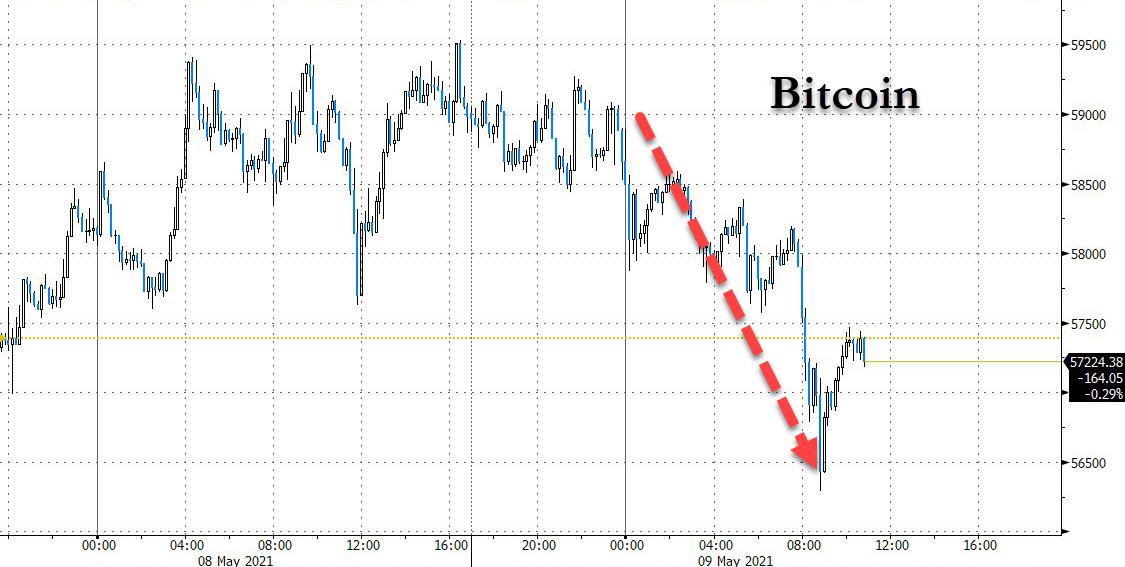
As dogecoin was routed, so was the rest of the crypto space, with bitcoin sliding more than 2% to as low as $56,500 while most altcoins were also dragged lower.
Perhaps sensing that his vastly overhyped appearance would lead to turmoil for dogecoin, on Friday Musk tweeted a that cryptocurrencies are “promising, but please invest with caution" linking to a video that showed him talking about the merits of crypto, particularly Dogecoin. That followed months of Twitter posts from Musk about Dogecoin, all of which exuded praise and snared millions of his easily impressionable followers into buying the "joke."
That said, despite the overnight tumble, Dogecoin is still up more than 16,000% in the past year and while Musk has been among its biggest boosters, fans also include Mark Cuban, Snoop Dogg and Gene Simmons.

>>> Weekend Papers Summary

Weekend Papers Summary
NEW YORK TIMES
Saturday
• Despite the modest rate of hiring in April, there are strong signals that the economy is returning to health as infections ebb, vaccinations continue, restrictions lift, and businesses reopen—and economists predict a big expansion sometime this year.
• Friday’s disappointing jobs report raises questions about President Biden’s strategy to revive the economy, with business groups and Republicans warning that his policies are causing a labor shortage and the potential for runaway inflation.
• The Justice Department under Trump secretly obtained the phone records for three reporters at The Washington Post from the early months of the Trump administration, the newspaper disclosed on Friday.
• Four former Minneapolis police officers were indicted on federal charges of violating the civil rights of George Floyd, a rare instance of the Justice Department seeking charges after a local conviction but before the rest of the case has played out.
• The WHO’s declaration that a vaccine made by China’s Sinopharm is a safe and reliable way to fight the virus marks a significant step toward clearing up doubts about it, after little late-phase clinical trial data was disclosed by Beijing and the company.
• In England, prime minister Boris Johnson’s Conservative Party scored decisive victories in regional elections, leaving the opposition Labour Party struggling, but the populist forces behind the wins are also driving a Scottish independence movement.
• Secretary of State Antony Blinken, meeting with counterparts from China and Russia, said that the US would “push back forcefully” against breakers of international rules, even as he acknowledged such violations under the Trump administration.
• For the first time in more than a century, California recorded a net loss in population last year, a demographic reversal caused by the deadly toll of the coronavirus and declining immigration and birthrates.
• Though a chip shortage is causing trouble for all sorts of industries, the semiconductor field is entering a surprising new era of creativity, as industry giants and start-ups with funding from venture capitalists seek innovations.
Sunday
• One of the nation’s largest pipelines, which carries refined gasoline and jet fuel from Texas to New York, was forced to shut down after being hit by ransomware, a reminder of the vulnerability of US energy infrastructure to cyberattacks.
• Florida and four other states are poised to allow college athletes to make endorsement deals, and with universities in other states anxious about losing recruits, the NCAA may allow all schools to do the same.
• +/- NCLH: The cruise company is threatening to keep its ships out of Florida ports after the state enacted legislation that prohibits businesses from requiring proof of vaccination against Covid-19 in exchange for services.
• The Biden administration and its allies are pushing the notion that caring for children, the sick, and the elderly is just as crucial to a functioning economy as any road, electric grid, or building, part of an effort to boost funding for this so-called human infrastructure.
• To the extent that the Dow Jones industrial average measures the stock market’s affection for a president, its early report card says the market loves President Biden’s first days in office considerably more than it loved Trump’s, says columnist Jeff Sommer.

WALL STREET JOURNAL
Weekend
• “Friday’s lackluster jobs report added fuel to efforts in Florida and elsewhere to reduce access to unemployment benefits that some state and industry leaders say have kept people from returning to the workforce.”
• TSLA chief Elon Musk’s SpaceX has been building a company town in Boca Chica, Florida, pressuring locals to sell their properties and talking of incorporating the town—a move that could give it eminent domain to seize houses.
• Friction between food retailers and suppliers is mounting—large buyers such as WMT and SYY are fining suppliers over infractions like late or incomplete orders, but producers and distributors say labor shortages and supply constraints are the problem.
• The Justice Department proposed a new rule Friday aimed at curbing ghost guns that are assembled from kits sold without background checks and which lack the serial numbers law enforcement relies on to solve crimes.
• The Centers for Medicare and Medicaid Services sent letters to hospitals, warning them to make prices public under a rule that went into effect earlier this year, after many failed to comply with the regulations.
• China’s post-coronavirus recovery has been strong but uneven, but new data suggests the world’s second-largest economy is rebalancing as consumer spending—the weak link so far in the recovery—picks up steam.
• Veterans of financial bubbles see much that is familiar about the present: Stock valuations are their richest since the dot-com bubble, home prices are back to pre-financial crisis highs, and risky companies can borrow at the lowest rates on record.
• China’s big three telecoms—China Mobile, China Unicom, and China Telecom—lost their appeals against being kicked off the New York Stock Exchange, which moved to delist them to comply with a Trump-era investment ban.
• H.O.T.S.: Bitcoin, Dogecoin, Ether, and other cryptocurrencies are now worth a combined $2T, but as with gold, it’s hard to determine what valuation they should carry, since they don’t provide an income stream and aren’t fundamentally useful.

FINANCIAL TIMES
Weekend
• The WHO’s approval of Sinopharm’s Covid-19 vaccine means it could be used in countries suffering from major surges in the virus, including India and Brazil, and the move gives the company a boost despite lingering doubts about its shot.
• French president Emmanuel Macron said the debate over intellectual property for vaccines is less important than existing barriers to the exports of vaccines and their ingredients, and the need to develop voluntary plans for countries to share doses.
• “The ethics of giving Covid-19 vaccines to children has provoked argument, with no simple answers, and how governments response will be a crucial factor in shaping who receives the next billion doses.”
• Big Read piece says “Plant-based milk drinks have become a $17B consumer market—multinational companies are joining dozens of startups by investing in products that mix food science with shifting consumer tastes.”
• Lex Column: Activist investor Edward Bramson has given up on his attempt to oust BCS chief Jes Staley and break up the bank, a plan that never entirely made sense; Without its media unit, the rich valuation at which Singapore Press trades to local developers may narrow; INTU, maker of Turbo Tax, is poised to benefit from “tax return pain” in the US.
• Comment: “When it comes to inflation, how much fortitude does the Federal Reserve have?” asks Sebastian Mallaby. “Millions of Americans are sitting on a mountain of dry powder that could set the economy alight.”

NEW YORK POST
Saturday
• Starting next week, the New York Stock Exchange said it will allow more traders and employees back onto its trading floor in lower Manhattan—they can remove masks at their stations, but must wear them everywhere else.
Sunday
• Virgin Hyperloop is developing the technology for passenger pods that will hurtle at speeds of up to 750 miles an hour through almost air-free vacuum tunnels using magnetic levitation, and they could be commercially viable by 2027.

>>> Barron’s Weekend Summary

Barron’s Weekend Summary: A look at what lies ahead during the next 100 years in business, science, and investing

* Cover Story: At Barron’s recent centennial roundtable, three investment experts—Karen Karniol-Tambour, co-chief investment officer for sustainability at Bridgewater Associates; Tom Slater, head of US equities and portfolio manager of US equity and long-term global growth funds at Baillie Gifford; and Jerry Yang, founding partner of AME Cloud Ventures and co-founder of Yahoo!—talk about what lies ahead in business, science, and investing in the next 100 years, touching on topics such as synthetic biology, space travel, and cryptocurrencies.

* Tech Trader: Christiano Amom, set to take over as chief executive at QCOM next month, talks with Barron’s about 5G technology, which has given the company a major boost; Among its benefits, says Amom, are that it’s great for video, there will be no need for data caps, it’s paving the way for dramatic changes in videogaming and on-demand computing, and it will be crucial for “connected car” technology.

* Trader: Despite the recent payrolls shocker, the economy still looks set to expand strongly over the next few years, which is all value stocks need to beat growth stocks—a stronger economy is already filtering its way into expectations for earnings growth; +/- Cautious on TSLA: Investors are waiting for the next catalyst—bulls hope for more US electric vehicle purchase incentives, and the company’s driver-assistance feature could be cleared in the Texas crash that generated bad PR; Positive on DE, CTVA, FMC, AGCO, MOS, NTR: With growing demand in China for corn and soy for animal feed, commodity prices can remain elevated for the next couple of years—which means agriculture stocks don’t look all that expensive. Interview: Famed stock picker Larry Puglia of T. Rowe Price will retire this year after 30 years at the company—he spoke with Barron’s about what contributed to his success, his outlook for the markets, and a few favorite stocks, including ISRG, Tencent, BABA, GOOGL, and INTU.

* Profile: Michael Plaiss, co-manager of the Performance Trust Municipal Bond fund, says bonds are “much more mathematical instruments” than stocks, and that by analyzing municipal bonds’ prices, yields, maturities, and credit quality, he can successfully determine what their valuations should be.

* Features: 1) Positive on STX: Hard drives have all but disappeared from consumer products, but new enterprise applications are powering a renaissance for the devices, which is good news for Seagate, the only remaining pure-play bet in the sector—investor skepticism about hard drives makes its shares among the cheapest in the market, even after a rally this year; 2) Copper, a linchpin of the old energy economy, will play a crucial role in the new green one—copper cables remain the most cost-effective means of transmitting electricity from solar and wind sources, and it is a key material in charging stations and electric vehicles—GS analysts say there is “no decarbonization without copper,” which they call “the new oil”; 3) Positive on NKE, TJX, RVLV, AEO: As the coronavirus pandemic recedes in the US, cultural changes are bringing big fashion changes, which is good news for retailers—a Jefferies survey found that 23 percent of US respondents named clothing and accessories as a priority for discretionary spending as the environment normalizes, second only to returning to bars and restaurants.

* European Trader: Positive on Auto Trader Group: The UK-based online car marketplace “has found important avenues of growth that have been overlooked by investors,” including added services such as helping customers get financing, and it may begin to offer lucrative transportation services that move vehicles around the country from seller to buyer.

* Emerging Markets: Vietnam’s Communist Party leaders recently agreed to boost investment in the private sector, to 55 percent from 42 percent of gross domestic product by 2025, and they earmarked $119B for infrastructure during the same period—all good news for investors.

* Commodities: “Growth in the electric-vehicle market has been a blessing for metals like copper and lithium. It has also raised concerns about the long-term outlook for oil demand that some analysts say aren’t justified.”

* Streetwise: Wedbush analyst Seth Basham, who recently downgraded BBY to Neutral from Outperform, predicts that home furnishings will outgrow consumer electronics and that consumer spending will shift to travel and entertainment as the economy reopens, but Best Buy chief Hubert Joly says the company’s mission of enriching lives with technology will keep customers coming back.