FT : Spacs lose their deal ‘pop’ as fever fades

Spacs lose their deal ‘pop’ as fever fades
Instead of popping, share prices now typically slide on takeover announcements

Shares in special purpose acquisition companies are sliding following takeover announcements, a marked reversal of the enthusiasm for these vehicles earlier this year which could threaten their ability to do deals. 

Of the 13 Spacs that have announced acquisitions in May, only one is trading above $10, the level at which shares in blank-cheque companies are originally priced, according to a Financial Times analysis of Refinitiv data.

As recently as March, about nine out of 10 traded above $10 in the wake of a deal announcement, according to Spac Research — and many significantly above.

Market experts have attributed the about turn to a withdrawal from the market by institutional investors and a lack of interest from retail traders, who have turned their attention to other speculative assets such as cryptocurrencies.

“The retail component of the deals has been a big issue,” said Ari Edelman, a partner at Reed Smith. “A lot of the activity around Spacs in terms of how the stocks have been trading and the success of the Spacs was very much hinged on retail.”

The Spac boom has largely been underpinned by hedge funds who buy into the structure early and use leverage to juice up returns. But the vast majority of them sell out once a deal has been announced and are replaced by new investors eager to get a slice of the newly listed company. That appears to no longer be the case. 

“The retreat of retail investors has been particularly bad,” said a big Spac sponsor. “Retail drove gigantic speculation from September until the bubble burst [in April] and now the Spac market is dead, dead, dead.” 

Just a few weeks ago, Spacs were almost guaranteed a “pop” in the share price once the company announced its merger target. Sometimes even rumours of a deal, as with Michael Klein’s Churchill Capital IV and Lucid Motors, sent shares in the blank-cheque company up 80 or 90 per cent.

Now even large transactions by household names are failing to attract investors. 

Soaring Eagle Acquisition, a Spac set up by serial sponsor and former Hollywood executive Harry Sloan, is trading below $10 despite announcing last week a $17.5bn deal to take Bill Gates-backed Ginkgo Bioworks public. Similarly, shares in Aurora Acquisition have declined by 10 per cent since it announced a $6.9bn deal with the SoftBank-backed mortgage lender, Better. 

If the trend continues, Spacs may be forced to reprice their deals in order to win shareholder approval. Investors get back about $10 in cash if they decide against the deal and redeem their shares, which is why the $10 threshold is significant.

Aeye, which makes lidar sensors used for autonomous driving, repriced its deal with a Spac sponsored by Cantor Fitzgerald this month, agreeing to a 20 per cent reduction on the $1.9bn valuation it announced in February. The company cited trading in public lidar companies and “changing conditions in the automotive lidar industry” for the difference.

WSJ : Inequality Would Widen if U.S. Policies Spur Sustained Inflation (J.hilsen

Inequality Would Widen if U.S. Policies Spur Sustained Inflation
Cost of living is rising faster than paychecks despite efforts by Biden administration and Fed

By Jon Hilsenrath

Federal Reserve and Biden administration officials say economic inequality is bad and they aim their policies in part at helping to reduce it. In the short run, at least, those policies might be widening inequality, not shrinking it.

In recent months, inflationary pressures have caused the cost of living to rise faster than paychecks, meaning a paycheck hasn’t been going as far as it did before. Consumer price inflation in April rose 4.2% from a year earlier, while hourly pay for production workers rose 1.2%, the Labor Department reported last week.

The department also said that, after adjusting for inflation, wages of production workers and nonmanagers fell 3.3% in April from a year earlier, the largest such decline since an inflation shock and recession in 1980.

Economists, policy makers and many in the voting public have differing views about income inequality, and the increasing concentration of wealth in the top 1%. Some see inequality as a sign of an unfair economic system that the government should address; others say a healthy capitalist economy rewards its most productive citizens.

A fall in inflation-adjusted wages hits low- and moderate-income households especially hard, because they dedicate a larger share of their paychecks to covering daily living costs. The numbers might be temporarily skewed, but if inflation persists and is fueled by the Fed or the Biden administration’s policies, it could raise questions about the costs and benefits of those policies for working Americans.

Economists describe inflation as a regressive tax—meaning it hits low-income workers hardest. “I don’t see anything good happening from an economic inequality perspective,” said Karen Petrou, a financial analyst and author of “Engine of Inequality,” a critique of Fed policy. “Most American households are living hand to mouth.”

Ms. Petrou said a decade of the Fed’s low-interest-rate policies have mostly helped the wealthy by pushing stocks higher. That effect has accelerated recently. While inflation-adjusted wages fell in April from a year earlier, the Dow Jones Industrial Average was up more than 40% over the same period. The wealthiest 10% of U.S. households own 88.5% of stocks, according to Fed data.

There are several reasons why April’s unusual tilt in wages might be an anomaly. Due to Covid-19, the economy in April 2020 was like a patient in shock on an emergency-room table, with vital signs moving wildly in different directions. The crisis drove down prices of restaurant meals, hotel stays and airline tickets amid nationwide business shutdowns, while broad measures of wages oddly went up because low-wage restaurant and hotel workers were sidelined.

That makes it difficult to make comparisons to April from a year ago, as do other factors. Global chip shortages have caused bottlenecks in new car production and pushed households to buy used cars, driving their prices higher. Prices for oil, gasoline and crops are also marching up.

On a month-to-month basis, real wages have fallen in three of the past four months, though they are up from two years ago.

However measured, the recent drop in real wages points to a risk should these trends be sustained. Government efforts to boost economic activity and hiring—through low interest rates and trillions of dollars in new federal spending—could widen inequality if they lead to continued outsize increases in the cost of living.

Mary Daly, president of the Federal Reserve Bank of San Francisco, said she is comfortable with the central bank’s approach. She sees consumer price increases as temporary, driven in part by the weird “base effect” comparisons to last year and by temporary supply bottlenecks that will be resolved over time. In the Bay Area, she notes, lettuce has been in short supply at restaurants, which were locked down for months. She says eventually the lettuce will start showing back up at restaurant kitchens and restaurant salad prices will moderate.

“Demand is coming back with a bang and supply comes back with a lag,” she said. “These are transitory fluctuations.”

Inflation will only become a sustained problem if suppliers and workers embed price increases in longer-run contracts because they see cost upticks as permanent, she said. So far, she doesn’t see that happening, a view she said markets affirm. In the Treasury bond market for inflation-protected securities, called TIPS, investors see inflation of 2.3% five years from now. That is only slightly above the Fed’s 2% goal and less than expected inflation at other recent times, such as in 2011 and 2012.

Forty or 50 years ago, wages tended to go up automatically because of cost-of-living adjustments in union and other labor contracts, Ms. Daly noted. Such adjustments don’t happen as often now. There is a trade-off. The benefit of that is that inflation tends not to go in upward spirals as it did in the 1970s; the bad news is workers can take a temporary hit at times like now.

In the mind of many Fed policy makers, inflation has been too low for too long—undershooting its 2% goal. Most Fed officials see low interest rates as a path to stronger wage growth: By helping to boost demand and push the unemployment rate down, they argue, they are giving workers bargaining power with employers to demand sustainable pay increases that outstrip inflation. That is what was happening in 2018 and 2019, before the Covid-19 crisis.

Money pouring into the economy isn’t just coming from the Fed. A $1.9 trillion coronavirus-aid bill was signed by President Biden in March that sent $1,400 checks to households, extended jobless benefits and expanded child tax credits.

Jared Bernstein, a member of Mr. Biden’s Council of Economic Advisers, said the administration’s policies also are creating opportunities for low-wage workers by boosting demand. “We are creating job and earnings opportunities for workers who have been left behind,” he said.

“It’s important to separate transitory issues from the bigger picture here, which is an economy back on the move,” he said. Inflation, he added, should be a temporary problem, while the jobless rate is coming down fast.

WSJ : China Lands on Mars in Crowning Moment for Space Program

China Lands on Mars in Crowning Moment for Space Program
The success of the Tianwen-1 mission makes China the third nation after the U.S. and Soviet Union to land on the red planet

HONG KONG—China’s space program took a giant leap when it landed a rover on Mars on its first attempt this weekend.

Early Saturday, the China National Space Administration said the lander containing its Zhurong rover touched down on the red planet’s Utopia Planitia, an achievement which establishes the nation as a serious contender in the realm of space exploration. The lander is expected to release the rover in the coming days to explore the surface of Mars.

After the landing, state media ran triumphant videos, with one state agency piece lauding President Xi Jinping for his longheld “space dream.”

The landing also drew praise from the head of science missions at the National Aeronautics and Space Administration as well as Elon Musk, the chief of Tesla and SpaceX.

“Congratulations!! Mars is very difficult,” Mr. Musk tweeted.

Thomas Zurbuchen, an associate administrator of NASA, said on Twitter: “Together with the global science community, I look forward to the important contributions this mission will make to humanity’s understanding of the Red Planet.”

The nine-minute automated landing on Mars came with considerable difficulties given the planet’s thin atmosphere and the inability to communicate with Earth after the process is initiated. That China succeeded on its first try—where other nations have failed—is an important milestone for its space program.

“This is a crowning moment for China,” said Namrata Goswami, a co-author of the book “Scramble for the Skies: The Great Power Competition to Control the Resources of Outer Space.” “It sends a signal to the world that it has caught up with the U.S. in capacity for interplanetary exploration, and that it can be an alternative to the U.S. for space leadership,” she said.

On Saturday, Mr. Xi extended his congratulations to the members of the mission, according to remarks published by the state-run Xinhua News Agency.

“The landing left a Chinese mark on Mars for the first time,” Mr. Xi said. “Thanks to your courage in face of challenges and pursuit of excellence, China is now among the leading countries in planetary exploration.”

Top officials witnessed the landing at the Beijing Aerospace Control Center, Xinhua reported, including vice premiers Han Zheng and Liu He, who read out Mr. Xi’s message.

China’s Tianwen-1 reached orbit around Mars in February shortly after the United Arab Emirates’ Hope spacecraft, which was the first interplanetary probe launched by an Arab country. They joined six other spacecraft already orbiting Mars from the U.S., the European Space Agency and India, all actively studying the desert planet.

Nine days later, NASA’s Perseverance rover landed on the Jezero Crater of Mars, where it will spend the next two years looking for evidence of past life. The rover also carried with it the Ingenuity helicopter drone, which carried out the first controlled powered flight on another planet.

So far, the only space agency that has successfully landed and operated on Mars is NASA. Its first lander, the Viking 1, touched down on the planet in 1976. Its first rover, the microwave-oven-sized Sojourner, landed on Mars in 1997 in a location called Ares Vallis and sent back more than 500 photos. The U.S. has successfully operated five rovers on Mars.

The European Space Agency has tried twice unsuccessfully in the past decades. The Soviet Union also tried twice in the early 1970s at the height of the Cold War space race. Its Mars 2 probe crashed and its Mars 3 lander touched down in 1971, but survived only long enough to transmit a single image back to Earth before failing.

Zhurong will now carry out imaging of the landing site, conduct self-checks and eventually depart from its landing platform, though there hasn’t been official confirmation on when it will begin its journey. It is expected to spend 90 Martian days—known as sols—on the red planet. Sols are about 39 minutes longer than days on Earth.

China’s space agencies got vital practice landing rovers on the moon, but Mars presented tougher challenges and was seen as a barometer of the country’s technological prowess.

Early Saturday, Tianwen-1 began to descend from its parking orbit, according to China’s space agency. The lander and rover separated from the orbiter at about 4 a.m. before flying for around three hours and hurtling toward Mars. The craft entered Mars’s atmosphere at an altitude of 125 kilometers before landing at 7:18 a.m.

The mission’s Mars entry, descent and landing were automated and took around 9 minutes, the agency said. The lander carried out the landing on its own, given the communication delays with Earth.

Tianwen-1, or “Questions to Heaven,” consists of an orbiter, lander and rover. The symbolically named Zhurong is a six-wheeled solar-powered rover. It is smaller than NASA’s nuclear-powered Perseverance, which is currently roving Mars, and not as technologically advanced.

Zhurong is equipped with scientific instruments including remote-sensing cameras and particle analyzers. The mission’s goals include investigating the planet’s soil and looking for signs of subsurface water ice.

“The mission is very ambitious,” Roberto Orosei, a scientist at the Institute for Radioastronomy in Bologna, Italy, said before the landing. “They plan to do, in one go, three steps NASA took several decades to achieve: getting into orbit, landing on the surface and then driving a rover around.”

China conducted its first human space flight in 2003, four decades after the Soviet Union and the U.S. achieved that milestone. Since then, China’s leaders have often equated progress in space with the nation’s rise, financing initiatives with deep pockets and tackling plans with the same precision as its five-year economic plans.

Now it is rapidly achieving new milestones. Last month, China sent the first section of a planned space station into orbit, and is scheduled to launch more components in coming months. It hopes to have the station, seen as a rival to the International Space Station, operational by next year.

While Chinese space technology is still catching up to that of the U.S., China has in recent years moved to bolster its space leadership credentials through international collaborations. In March, China’s space agency and Russia’s Roscosmos State Corporation for Space Activities agreed to team up to form a permanent lunar base and invited other nations to take part.

China was cut off from NASA in 2011 after the U.S. Congress passed a spending bill barring collaboration, in part citing the risk of espionage. Planetary exploration was made a national priority in China’s 2016 economic plan, building off three successful lunar missions—the Chang’e 1, 2 and 3—in 2007, 2010 and 2013. Those missions, scientists say, gave China engineering experience, as well as soft-landing technology know-how.

China became the first nation to land on the far side of the moon in early 2019. After it successfully conducted a lunar sample return mission in 2020, it revealed that it had done 600 practice landings in simulation facilities on Earth, a sign of its heavy investment in space.

Reaching Mars was the bigger goal, and in 2017 Ye Peijian, commander in chief of China’s Chang’e series, stressed the need to exploit a window for landing that occurs every 26 months. He lamented lost opportunities in 2013 and 2015, and said in a televised interview that China “absolutely can’t miss” the window that was open last year.

In China, expectations for the landing had been carefully couched, with scientists repeatedly explaining the extreme challenges of the feat. State media highlighted the high stakes for the team behind the mission: One China Daily article in April detailed how a member of the Tianwen-1 team had postponed her wedding three times to focus on the mission.

Michel Blanc, who was executive director of the International Space Science Institute-Beijing from 2016 to 2018, said he had been impressed by the rapid development of research and infrastructure at the time he was there. Particularly striking, he said, was the development of research in the major labs of the Chinese Academy of Sciences and at top Chinese universities.

Having followed China’s space trajectory for 15 years, Ms. Goswami, the author, said that what sets the country’s space ambitions apart is its vision of space as an economic opportunity.

“For China, space is a critical part of the nation’s infrastructure,” Ms. Goswami said. “Its goal is to become the lead space nation in 20 years, and they will continue marching steadily until they reach that dream.”

FT : Cairn Energy sues Air India in US over $1.2bn arbitration award

Cairn Energy sues Air India in US over $1.2bn arbitration award
Latest step in tax dispute with New Delhi could lead to UK oil group seizing planes and other assets

Cairn Energy is suing state-owned carrier Air India in the US to enforce a $1.2bn award against the Indian government, a process that could lead to it seizing planes and other assets as part of a long-running tax dispute.

The lawsuit, filed in the southern district of New York, seeks to establish that Air India is “the alter ego of the Republic of India and therefore jointly and severally liable for the debts and obligations of India itself”.

An international tribunal in December ordered India to pay Edinburgh-based Cairn $1.2bn in connection with a dispute over retrospective taxes New Delhi sought to levy on the company. 

Prime Minister Narendra Modi’s government has appealed the ruling, though it has said it is in talks with the UK oil and gas explorer.

Cairn previously warned that, if payment from New Delhi was not forthcoming, it would pursue Indian assets in jurisdictions around the world.

In the lawsuit, Cairn argued that any purported distinction between Air India and the state was designed to shield Indian assets from creditors.

A verdict in its favour would allow Cairn to seize assets including planes in the US, where Air India operates a number of long-haul flights. It could also complicate the Indian government’s hopes of privatising the flag carrier to help boost revenues squeezed by the pandemic.

India’s finance ministry did not immediately respond to a request for comment, though local media quoted an anonymous official as saying that India would take all steps to defend itself.

The dispute with Cairn, alongside a similar retrospective tax dispute with Vodafone, has proved damaging for India’s reputation as a foreign investment destination, an area Modi has sought to strengthen.

Under a law passed in 2012, India retroactively demanded $1.4bn in tax payments from Cairn related to the UK group’s flotation of its Indian subsidiary on the Bombay Stock Exchange in 2007. 

An arbitration tribunal found that India had violated its obligations under the UK-India Bilateral Investment Treaty in 2014 when tax officials seized Cairn’s residual 10 per cent stake in the subsidiary, which it sold to Vedanta.

Nirmala Sitharaman, India’s finance minister, last month pushed back against the tribunal’s judgment.

“I’ve recently had a meeting with a representative of Cairn, and we are talking,” she told an event hosted by the Financial Times and Indian Express. “However, the international arbitrations questioning India’s sovereign right to tax is a matter of concern, and to that limited extent, we are worried that it sets a wrong precedent.”

Cairn said it was “taking the necessary legal steps to protect shareholders’ interests in the absence of a resolution to the arbitral award”.

“Cairn remains open to continuing constructive dialogue with the government of India to arrive at a satisfactory outcome to this long-running issue,” it added.

Other companies have gone after state-owned assets in order to settle commercial disputes. ConocoPhillips in 2018 seized products from an oil refinery owned by Venezuelan state-owned oil company PDVSA after it failed to honour an international award of $2bn in compensation for the expropriation of Conoco’s assets in 2007.

FT : Credit Suisse under growing pressure to compensate clients over Greensill

Credit Suisse under growing pressure to compensate clients over Greensill
The collapse of the supply chain finance firm has hurt more than 1,000 of the bank’s customers

Credit Suisse faces growing pressure from prized clients to compensate them for losses following the collapse of supply-chain finance funds linked to Greensill Capital.

The decision whether to do so is one of the first big dilemmas confronting new chair António Horta-Osório in his clean up of the bank, which faces the threat of several class action lawsuits from angry investors.

More than 1,000 Credit Suisse customers invested in the $10bn suite of funds, having been told by the bank’s advisers and marketing material that they were low-risk products, fully insured against losses.

However, the Swiss lender in March suspended the funds, which packaged up invoices owed by Greensill’s customers into investment products. The bank’s clients could lose up to $3bn after several of the companies whose debt the funds invested in said they were unable or unwilling to repay. 

The UK’s Serious Fraud Office on Friday opened an investigation into Sanjeev Gupta’s metals empire, which borrowed $1.2bn through the Credit Suisse funds tied to Greensill. Last month the Financial Times revealed a series of suspect invoices linked to Gupta’s businesses.

Those invested in the funds include a former Qatari prime minister, hundreds of Credit Suisse’s ultra-wealthy European and Asian clients as well as pension funds and listed companies.

The inclusion in the funds of securities linked to yet to be issued invoices contravene the funds’ rules and marketing material, investors told the FT.

However, the bank’s lawyers are confident that the wording in the fund documents allude to the potential for investing in non-standard receivables, according to people briefed on internal discussions.

“It still irritates me that they won’t come clean,” and acknowledge they should compensate clients, said a wealthy individual who was personally invested in the funds and also runs a company that is a major counterparty to Credit Suisse. “The facts are pretty clear, no future invoices.” 

He added that he hoped Horta-Osório would decide to compensate clients, in a replay of his decision when chief executive at Lloyds Banking Group to reimburse customers wrongly sold payment protection insurance.

“Of course it is affecting my relationship with the bank,” the investor told the FT. “Credit Suisse’s client advisers are telling me that ‘it is not my fault’, they agree top management should be acting differently to try to keep the relationship going, but it has been irreparably damaged.”

Sheikh Hamad bin Jassim Al Thani, the former prime minister of Qatar, invested $200m in the Credit Suisse funds, according to Bloomberg. Sheikh Hamad was head of the Qatar Investment Authority when the sovereign wealth fund bailed out Credit Suisse during the financial crisis, and the Gulf state is home to some of the bank’s lucrative clients. A representative for Sheikh Hamad could not be reached for comment.

Credit Suisse has refused to confirm whether participants in the funds will bear any losses, but has so far taken the view that they were professional investors who were aware of any risks.

Chief executive Thomas Gottstein said in March that the scandal “is of course in the first instance foremost a problem for our supply chain fund investors” rather than the bank itself.

The debacle has also ensnared companies in which Credit Suisse is a significant investor.

Swiss diagnostics company Quotient, which makes coronavirus testing kits, invested $110m in the supply-chain funds, but said in a regulatory filing that “any such losses should be borne by Credit Suisse and not by the company or other fund investors”. Credit Suisse Asset Management is a top five shareholder in Quotient, holding a 6 per cent stake.

Nam Tai Property, a US-listed Chinese company that invested $150m in the funds shortly after raising $170m from an emergency private placement last October, said it has sent a demand to Credit Suisse and filed complaints to the Securities & Futures Commission of Hong Kong and Hong Kong Monetary Authority.

Senior executives are wary of compensating clients over fears it would weaken the bank’s hands in insolvency and potential legal proceedings against Greensill, according to people familiar with the matter.

They are also concerned that Finma, the Swiss financial regulator, will regard the decision to reimburse professional investors as a precedent and force the bank to hold more capital as a result.

The pressure comes as several class action lawsuits bringing together scores of ultra-rich investors in the funds are gathering pace in London and Zurich, including ones being prepared by Boies Schiller Flexner and Quinn Emanuel — two law firms previously involved in legal proceedings against the bank.

Credit Suisse declined to comment.

>>> Marathon Petroleum : Comments on Speedway Sale Closing; Despite FTC commissi

Comments on Speedway Sale Closing; Despite FTC commissioners issuing statements, believe we were legally allowed to close the Speedway transaction and are in receipt of the $21B sale consideration

Today provided additional comments regarding the closing of its $21 billion sale of Speedway to 7-Eleven, Inc., a wholly owned, indirect subsidiary of Seven & i Holdings Co., Ltd (3382: Toyko). The parties closed the transaction after all conditions to close were fully satisfied. MPC is in receipt of the $21 billion sale proceeds, and Speedway and its assets are owned by 7-Eleven.

Throughout its thorough evaluation of the transaction, Marathon Petroleum and 7-Eleven worked very cooperatively over many months with the U.S. Federal Trade Commission (FTC) and its staff and will continue to do so going forward. The relevant conditions to close the transaction were satisfied with the expiration of the waiting period under the Hart-Scott-Rodino Antitrust Improvements Act (HSR Act) and the expiration of the parties' timing agreement with FTC staff, which had been extended multiple times. That timing agreement elapsed overnight, with the FTC electing to take no action on the transaction. Upon satisfaction of all conditions to close, the parties finalized the transaction this morning.

In the hours after the closing, two sets of FTC Commissioners elected to issue separate statements both stating publicly that the FTC had indeed taken no action on the transaction during the HSR Act waiting period. MPC supports 7-Eleven's position, released earlier today, that the companies were legally allowed to close the Speedway transaction today and statements or implications to the contrary are false.

MPC is pleased to have closed the transaction, is in receipt of the $21 billion sale consideration and remains committed to the capital return plans announced earlier today.

(ZH) B of A: "Transitory" Inflation And Supply Chain Imbalances Are Hitting Auto

B of A: "Transitory" Inflation And Supply Chain Imbalances Are Hitting Autos Hardest

The auto industry is already stuck between a rock and a hard place, as dealers struggle to get production up to speed despite an ongoing semiconductor chip shortage that has hamstrung production for some of the world's biggest manufacturers.
At the same time, the U.S. is letting the inflation genie quietly begin to slip out of the bottle. As rising prices take hold amidst supply chain imbalances, focus has turned to automobiles. With new car inventory crunched due to production constraints, used car prices have skyrocketed, as we have noted recently.
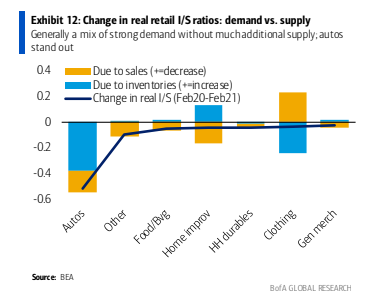
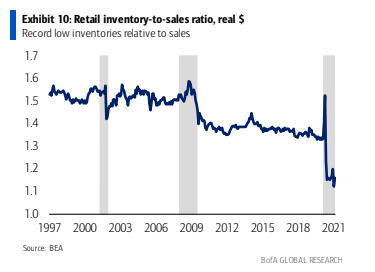
Now, a new note from B of A called "Want to buy a car, good luck" lays out exactly what type of crunch the industry is in - most recently exemplified in the inability for consumers to even rent cars, let alone purchase one. Detailing "lean inventories" and "price pressures", the note first explains that autos are so far the biggest standout for the country's inventory to sales ratio."
The note also takes a grim tone on when things could return to some semblance of normalcy: "This is a function of both demand and supply: the stimulus and reopening-fueled burst in demand was not matched by a comparable gain in supply. Instead, production has been hampered due to COVID-related supply chain issues and labor shortages," it reads. It also says that "transitory" can feel like a long time and that the U.S. economy is still "many months" from feeling more balanced.
Speaking about the supply/demand dynamic of goods causing price spikes, the bank writes: "This highlights the nature of this cycle and the rotation towards goods spending. When producers and companies were first faced with the pandemic, they prepared for a period of weak demand by reducing production and trying to work off inventories. But they were quickly surprised by a dramatic rise in demand for goods, particularly durable goods such as autos, household appliances and electronics. The share of consumer dollars spent on goods has soared to 35.1% as of March 2021, the highest in over 15 years."
The note also points out how inflation is playing a more pronounced role in the auto sector than other sectors. "We wish you luck if you are trying to rent a car," the note dryly says.
It continues:
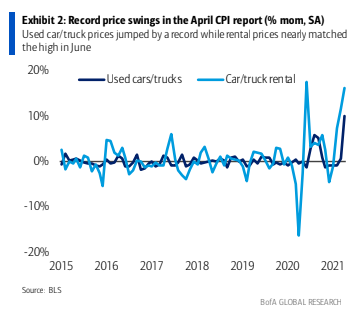
The CPI report highlighted these challenges, revealing a record 10% mom increase in used car prices and 16.2% spike in rental car prices, which was second only to June last year (Exhibit 2). More broadly, core CPI jumped 0.9% mom SA, the biggest monthly gain since 1981 with record increases in a number of categories. Indeed, 0.7pp of the gain in core CPI owed to just eight categories with used car/truck prices having an outsized contribution of 38bp (Exhibit 3).
"The auto sector has seen the most severe drawdown in real retail inventories," the report says.
The imbalances - further exacerbated by whipsawing travel demand and the semi shortage affecting other goods - including electronics - has the bank predicting that core inflation will continue to be robust heading into the summer:
Considering these dynamics, we think core inflation is likely to be particularly robust through August but ease as we head into yearend, with some risk of a negative payback on a mom basis given the noise. We therefore update our core CPI trajectory as shown in Exhibit 4, which will lead the % yoy rate to surge to a high of 3.7% in June before moderating to 3.5% in December (3.4% 4Q/4Q). We view these price pressures as largely transitory, however, with core CPI cooling down to 2.5% yoy through 2022.
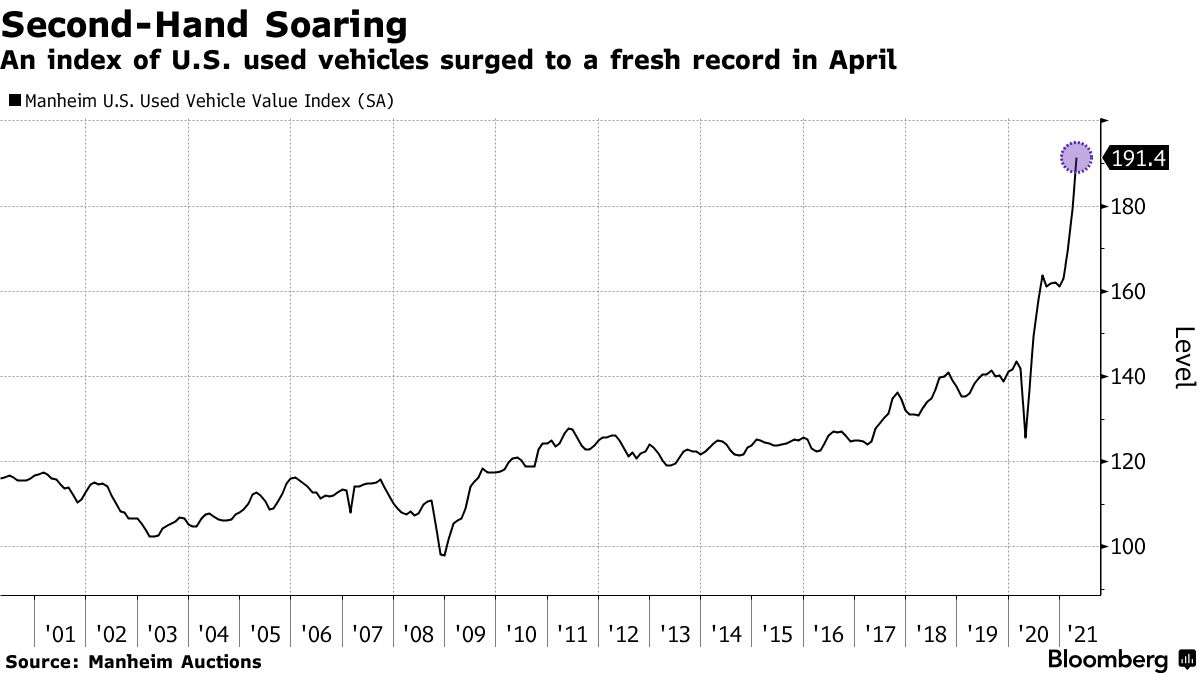
Recall, we noted at the end of April that the Manheim U.S. Used Vehicle Value Index continued to soar, to a new record, as a result of the worsening of a semiconductor shortage, low lot inventories, and a continuing post-Covid "boom". The index was up 6.8% in the first 15 days of April, Bloomberg noted. The index is up an astounding 52% from the same time last year to 191.4.

The data, which is put together by Cox Automotive, "takes into account all U.S. sales through Cox’s Manheim automotive auctions that fall in to one of 20 different market classes".
Cox Chief Economist Jonathan Smoke commented about the spike:
“Demand is perfectly stimulated from improving consumer sentiment, recovering jobs, accumulated pandemic savings, tax refund season, and American Rescue Plan cash payments.
Supply was decimated last year by COVID-19 shutdowns reducing new vehicle production, and used supply was reduced from strong demand last summer.
Production remains limited as supply chains struggle to overcome issues like the semiconductor shortages.”
Recall, we also pointed out last month that low inventories and chip shortages had prices re-accelerating in 2021 - at a stunning rate - after a brief pause from October to December.
B of A concludes that no changes from a monetary policy standpoint are expected until the back end of summer. "We expect little signal about policy in the June FOMC meeting but perhaps some additional clarity shortly after".
In other words: take it from B of A or from us, on both inflation and supply chain imbalances, but it looks almost certain that things are going to get worse before they get better.

WWD : Who Is Halston? Everything to Know About the Iconic Fashion Designer and H

Who Is Halston? Everything to Know About the Iconic Fashion Designer and His Legacy
The fashion designer who defined 1970s style is the focus of the Netflix limited series “Halston” from producer Ryan Murphy.

By Layla Ilchi on May 13, 2021

Roy Halston Frowick, known worldwide as simply Halston, was one of the most influential American designers of the 20th century. He helped define ’70s style with his elegant yet sexy dresses that were staples during the disco era, especially among the group of diverse models who followed him seemingly everywhere, dubbed the “Halstonettes.”
Halston was known just as much for his lavish lifestyle as he was for his designs. The designer and his gang of models and celebrity friends were fixtures on the New York City party scene of the ’70s and ’80s, especially at the famous Studio 54. He also regularly hosted parties at his Upper East Side town house with many of his famous friends, including Liza Minnelli, Andy Warhol, Truman Capote and Elsa Peretti.


Read Next Article
‘Halston’ Finds Its Elsa Peretti in Rebecca Dayan
Everything to Know About Netflix’s ‘Halston’ Limited Series

His party-going inspired some of his most popular designs, including the halter dress, which became a go-to look for many women of that era, including friends like Bianca Jagger, Marlene Dietrich, Lauren Bacall and many others. In his heyday, Halston described his design approach as “editing the mood of what’s happening” and modestly described his success as “a designer is only as good as the people he dresses.”
Reflecting on his career a year before his death in 1990, Halston said his work was “an experiment” that was “revolutionary in its day.”


“I made the change from very structured clothes to a more casual look, and fashionable women picked up on it,” he told WWD. “Whether it was cashmere, jersey or chiffon, it was about a total look. Clothes should be practical, glamorous, functional and spare. But mine weren’t always simple. Some of the simplest looks were actually the most complicated.”
More than three decades after his death, Halston continues to fascinate both the fashion and general worlds. The latest renewed interest in his life and career comes thanks to the Ryan Murphy-produced Netflix limited series “Halston,” in which Ewan McGregor plays the designer. The show offers a dramatized version of how Halston’s career skyrocketed in the ’70s and ’80s and how it was thrown off course by his excessive partying, which ultimately led to him being fired from his own design company in the mid-’80s.
Elsa Peretti and Halston attend the Fragrance Foundation’s dinner together in the Plaza Hotel in 1976. Lynn Karlin/Fairchild Archive/Penske Media
Halston was born April 23, 1932, in Des Moines, Iowa, and studied at Indiana University and the Chicago Institute of Art. Before getting into fashion design, he started his career as a successful milliner, opening his own salon at the Ambassador Hotel in Chicago in 1953.
He moved to New York City five years later, where he worked as a milliner for a year for Lilly Daché before going over to Bergdorf Goodman’s millinery salon. At the department store, Halston grew in popularity with a celebrity clientele that included Kim Novak, Gloria Swanson and Fran Allison. His career was catapulted in 1961 when he custom-designed the pillbox hat that First Lady Jackie Kennedy wore to her husband’s presidential inauguration.
As his clientele increased, Halston expanded into apparel. In 1966, he started designing couture and ready-to-wear collections under his Halston Ltd. business. The collections included accessories like hats, scarves, shoes and jewelry, as well as furs and leather apparel.


Halston debuted his first rtw collection at Bergdorf Goodman with a runway show that presented his millinery skills at their best and a promising start for his later much-sought after apparel. In WWD’s review of the debut collection, Halston was described as a “great milliner who is not yet a great designer of women’s wear,” adding, though, that he has “showmanship and so the show came off.”
In 1970, he established Halston International with Henry Pollack Inc. to offer knitwear and accessories at a more accessible price point. Two years later, he opened Halston Originals, a complete rtw business, and Halston III, an outerwear collection. That same year, he opened his first boutique, on Madison Avenue. He opened a second one in Chicago in 1976.
In 1973, Halston sold his business to Norton Simon Inc. for an estimated price of between $11 million and $12 million. He remained as an executive and the company was renamed Halston Enterprises.
He was also one of the first designers to create a unisex line, developing collections with items like fur coats, argyle sweaters and leather jackets. In 1975, he designed a separate men’s wear collection.
Halston participated in the famous WWD-dubbed “Battle of Versailles” in 1973, where he joined fellow American designers Bill Blass, Oscar de la Renta, Anne Klein and Stephen Burrows to show their designs against five French designers — Yves Saint Laurent, Hubert de Givenchy, Pierre Cardin, Emanuel Ungaro and Marc Bohan — in a fashion showdown meant to raise funds for the restoration of the palace at Versailles. Halston showcased his sportswear designs on several of his famous model friends, including Pat Cleveland, Beverly Johnson and Alva Chinn.
“Americans came, they sewed, they conquered,” read WWD’s front-page headline on Nov. 30, 1973, following the showdown. The “battle” was a showcase of American sportswear at its finest, and was a huge step forward in terms of diversity and inclusivity in the modeling world as 10 Black models were enlisted to sport the American designers’ styles.
The “Battle of Versailles” — while it’s become one of the hallmark moments in the history of American fashion — almost didn’t happen because of Halston. It has been reported that the designer had a disagreement with the choreographer who he enlisted for the show, Kay Thompson, and demanded that the show be called off. The dispute was ultimately resolved, Thompson exited, and the show went on.


Halston’s designs were ubiquitous in the ’70s and ’80s. He was most famous for popularizing ultrasuede, which he used in his signature shirtdresses, jackets and other styles. He was also known for his various dress styles that worked for a wide range of women and body types. In a 1977 interview with WWD, Halston described his design process as “one has to think of every American wardrobe need from the with-it young girls with style to the woman that leads a corporate structure lifestyle. That means I have to have a short dinner look, a gala look, something for entertaining at home and practical clothes that adapt to climate change.”
Designer Roy Halston with models Margaret Donohue and Karen Bjornson in looks from the Halston made to order spring 1981 collection. Tony Palmieri/Fairchild Archive/
Aside from his highly popular halter dress, Halston debuted what WWD referred to as “the swinger” in his spring 1977 rtw collection. The style was a godet-skirted halter dress in a pale peach georgette fabric. The designer said “the cut has the prettiest movement of any dresses I have made recently. It flows a little more — it’s easy to walk in, and easy to run in.”
He expanded his dress offerings over the years to other fabrics and styles, such as graphic printed slipdresses in polyester georgette and wrap dresses in cashmere. In his fall 1977 collection, he unveiled what he called the “High Rise” dress style in wool jersey, charmeuse, chiffon and velvet fabrics with a tied waist he said would “elongate any figure.”
In addition to his disco-inspired clothing, Halston had a robust offering of skirt suits for more professional occasions. He still brought his signature flair to the workwear, specifically a 1979 collection that included skirt suits with an asymmetric collar. “It’s really an abstraction of a collar,” Halston said about the design. “It’s very graphic. With all the business and luncheons taking place across a table, this is something that attracts attention.”
The designer grew his fashion empire through licensing deals for offerings such as fur, luggage, linens and cosmetics. By 1983, it was estimated that Halston Enterprises had generated $150 million in sales. He won several accolades throughout his career, including four Coty Awards for millinery and apparel. In 1974, he was inducted into the Coty Hall of Fame.


The allure of Halston’s designs was often amplified by the group of models — the Halstonettes — that he regularly traveled with and dressed. The models often wore matching, head-to-toe Halston looks and were meant to showcase the designer’s intent on dressing a diverse range of women.
According to Patricia Mears, the coauthor of “Yves Saint Laurent + Halston: Fashioning the ’70s,” the Halstonettes were “striking not only for their tall, lean bodies and beautiful faces, but also their ethnic diversity.” The group included some of the biggest and most revolutionary models of that era, including Pat Cleveland, Alva Chinn, Karen Bjornson and Anjelica Huston, among others.
In 1979, Halston and 27 of his Halstonettes went on an international tour to promote American fashion, visiting cities like Paris, Beijing, Shanghai and Tokyo. WWD reported on the beginning of the tour as Halston and the models arrived at JFK airport.
“Dressed in streamlined sportswear — all in complementary shades of red, black, beige and ivory, so anyone could stand next to anyone else and not clash — and sunglasses as glossy black and secludingly impenetrable as the limos, they watched as piece after piece of matching brown ultrasuede luggage covered the sidewalks.”
More than 500 outfits were packed for the trip, including outfits to wear on the plane and for activities like a tour of the Great Wall of China. “The only thing I didn’t furnish was their underwear and something to sleep in,” Halston said.
Halston with models Alva Chinn and Chris Royer in eveningwear from his 1978 resort collection at Halston’s Olympic Towers headquarters in New York. John Bright/Fairchild Archive/Penske Media
One of the designer’s closest Halstonettes was the late jewelry designer Elsa Peretti, who served as one of his model muses and collaborators. Peretti started her design career with Halston, creating jewelry and accessories that debuted in his rtw collections such as silver-buckled belts and bottle-pendant necklaces.
André Leon Talley described Halston and Peretti’s relationship as “aligned in a universe of elegance,” upon her death earlier this year. He explained, “her bud vase necklaces were such an inventive thing, when they first appeared on the Halston catwalk with a simple blossom thrust inside and worn inside a low-slung halter evening look.”


In a 1971 interview with WWD, Peretti spoke about her close relationship with the designer, saying: “Halston — he is my best friend, my security. He’s also a Taurus. I get along with Tauruses. He knows more about me. He is a very closed man.”
Halston was largely responsible for Peretti’s successful design career. The designer introduced Peretti to Tiffany & Co., which signed her to create a line in 1982. Peretti’s designs for Tiffany had a huge impact on the jeweler’s legacy, as her minimal silver designs have become a core part of the brand’s identity and its revenues.
Peretti was among the many famous figures Halston regularly partied with. The designer was a notorious partygoer and was known for throwing lavish parties at his Manhattan town house at 101 East 63rd Street, which he bought in the mid-’70s. In 2019, designer and CFDA chairman Tom Ford bought the town home for a reported $18 million.
As high as Halston’s career had flown, his star took a severe hit in 1983 when he signed a deal with J.C. Penney Co. Inc. to create a line of lower-priced apparel. The first-of-its-kind line was expected to be revolutionary and generate $1 billion in revenue in its first five years. However, Halston’s association with a midtier retailer made high-end retailers, most notably Bergdorf Goodman, drop his main line from their stores.
Due to his party life and drug use, Halston was fired from his own brand by Norton Simon in 1984 and he lost the rights to design under his name. He spent the remainder of his life trying to regain control of his brand, but was ultimately unsuccessful. He continued designing clothing in a smaller capacity, namely making costumes for Minnelli and dancer Martha Graham. Halston died in 1990 at the age of 57 after battling AIDS-related cancer, Kaposi’s Sarcoma.
After Halston’s death, his namesake company changed hands several times following the Norton Simon acquisition. The company ended up under Revlon Inc. in 1990, which ceased production of Halston’s clothing line, but continued to release fragrances. Halston’s company was then acquired by Tropic Tex in 1996, where it began releasing apparel again designed by Randolph Duke. In 1998, the company was sold to investment firm the Catterton Group, which enlisted designer Kevan Hall to continue designing for the brand. The company was sold again the following year to Neema Clothing, which brought in designer Bradley Bayou from 2002 to 2005.


In 2007, disgraced former film producer Harvey Weinstein teamed with Jimmy Choo co-founder Tamara Mellon and stylist Rachel Zoe in an attempt to resurrect the Halston brand and bring it back to its former glory. With financial partner Hilco Consumer Capital, Weinstein invested $25 million in the company. The resurrection attempt had a rocky start, as the partners disagreed on which designer to bring in to helm the new Halston brand, with both Giambattista Valli and Marco Zanini being considered for the role. The title ultimately went to Zanini, who came to the brand after working under Donatella Versace.
Zanini’s debut collection came during the fall 2008 season with a complete rtw, footwear and handbag assortment. Two looks were also made readily available for consumers to purchase through Net-a-porter. The new Halston collection, however, failed to make an impact, and Zanini was out one year after joining the company.
Marios Schwab was then tapped as the next Halston designer and the company launched a secondary line of affordable offerings, called Halston Heritage, that was based on archival Halston designs.
Actress Sarah Jessica Parker later became involved in the brand after wearing pieces from the Halston Heritage in 2009 when filming “Sex and the City 2.” She was appointed the brand’s president and chief creative officer in 2010, but like many other Halston designers, her tenure didn’t last long. A year after her appointment, Parker left the company. After her departure and a critically panned Halston collection by Schwab, Weinstein exited the company. Schwab also left Halston in 2011.
That same year, Hilco Consumer Capital enlisted former BCBG Max Azria Group president Ben Malka to join Halston as chief executive officer and chairman. The company then focused exclusively on the Halston Heritage line.
Xcel Brands Inc. acquired the H Halston and H by Halston trademarks in 2014, which it brought into QVC and lower-tier department stores, and then acquired the Halston and Halston Heritage trademarks in 2019. Last year, designer Robert Rodriquez was tapped by the company as the new Halston chief creative director to steer the brand into more elevated sportswear reminiscent of the late fashion designer’s original brand.


Even as his brand repeatedly changed hands and struggled, fascination of the designer and his life has never waned. The “Halston” Netflix series is the latest depiction of him. He was the subject of the CNN Films documentary “Halston” released in 2019 and the 2010 documentary “Ultrasuede: In Search of Halston.”