(ZH) Still More Green Hypocrisy In The EU, This Time Hydrogen

Still More Green Hypocrisy In The EU, This Time Hydrogen

Let's discuss the meaning of "Green" EU style.

Hooray More Green Energy!
The EU is cheering a new hydrogen project at a refinery in Germany.
The plant will be built by Shell and ITM power and will be able to produce about 1,300 tonnes of hydrogen per year, which can be fully integrated into the refinery processes, such as for the desulphurisation of conventional fuels. It will be the world's largest hydrogen electrolyser.
Tudor Constantinescu, Principal Advisor, DG ENER at the European Commission stressed the the contribution of green hydrogen to the Energy Union objectives, saying: "Renewable electricity can support decarbonisation not only of the power sector, but, through sectoral integration also of other carbon intensive industries, such as refining. Green Hydrogen is a key enabler in this process, contributing to the Energy Union objectives both in terms of emissions reductions and increased renewables share."
Ten Times the Hydrogen, Ten Times the Cost?
Euractive has some interesting details of the undertaking, allegedly Set to Multiply Capacity tenfold by 2024.
The 10 MW electrolyser, while already Europe’s largest of its kind, is a pilot project for grander ambitions.
If the pilot works out well, the partnership around Shell wants to add another 100 MW of electrolysis capacity which would complete construction in 2024. That would then be the largest electrolyser in the world.
Yet the pilot project depended on financing by the FCH JU at a 50% rate, meaning that the business case for a project ten times larger without public funding would be questionable at best.
Whether those ambitions come to fruition will therefore depend on the carbon price and the amount of additional funding available, which could come from either the EU or Germany.
It is currently unclear whether the FCH JU will again step in and provide funding as it did for the pilot project, as the application review is ongoing, a source told EURACTIV.
European Hydrogen Greenwashing
Eurointelligence looked into the details, and found still more amusing details.
We noted a strange description of how it will work in a Euractiv article sponsored by the Fuel Cells and Hydrogen Joint Undertaking, a public-private partnership between the EU and the European hydrogen lobby. According to the article, the new plant will produce around 1300 tonnes of green hydrogen annually, provided sufficient amounts of renewable energy are available.
If they are not, the alternative will be to used natural gas to produce the hydrogen. And funnily enough, hydrogen produced by the new electrolyser will be used to refine petroleum at Chemicals Park Rheinland, Germany’s largest refinery.
We thought it was strange that Laschet would tout a renewable project given his backing for coal-fired power plants and general aversion to all things green. But we wonder now whether Refhyne will be green after all.
We think it is plausible that the EU’s hydrogen development will wind up being dependent on Russian gas.
The EU's Stunning Green Hypocrisy
With that revealed, let's recap my previous report, The EU's Stunning Green Hypocrisy, At Least Trump Was Honest About Targets
If you took Green targets seriously, you would have to reform the Common Agricultural Policy. But the EU failed to do precisely that when they had an opportunity last year. Instead, the EU resorts to cheating.
The European Commission classifies investment in terms of 0%, 40% and 100% green content, and rounds up the numbers to the next higher target. So 1% becomes 40%. 41% becomes 100%.
When the mendacity of the EU’s climate policy becomes apparent, the centre will not only have lost the victims of the economic crisis, but an entire generation of young voters.
This is the thing with smoke and mirrors: when the smoke lifts, you see clearly.
Too Strict?!
The above snips were also courtesy of Eurointelligence.
Here's another amusing kicker: It also noted "the most recent set of [rounding up] guidelines, published in 2019, were deemed too strict by some member states and industry lobbyists."
Yes indeed. Clearly there is a need to round 1% up to 49% and 50% up to 120% or whatever.
EU Tries to Convince Trading Partners Its Carbon Tax is Not a Tax

Finally, please consider EU Tries to Convince Trading Partners Its Carbon Tax is Not a Tax.
Recap
This new "Green" hydrogen project needs a 50% subsidy, likely depends on Russian natural gas, and will be used to refine oil.
This we call "Green".
EU hypocrisy on Green Energy is endless.
(ZH) Goldman: Here's Why The Shorts Will Have To Cover This Week

Goldman: Here's Why The Shorts Will Have To Cover This Week

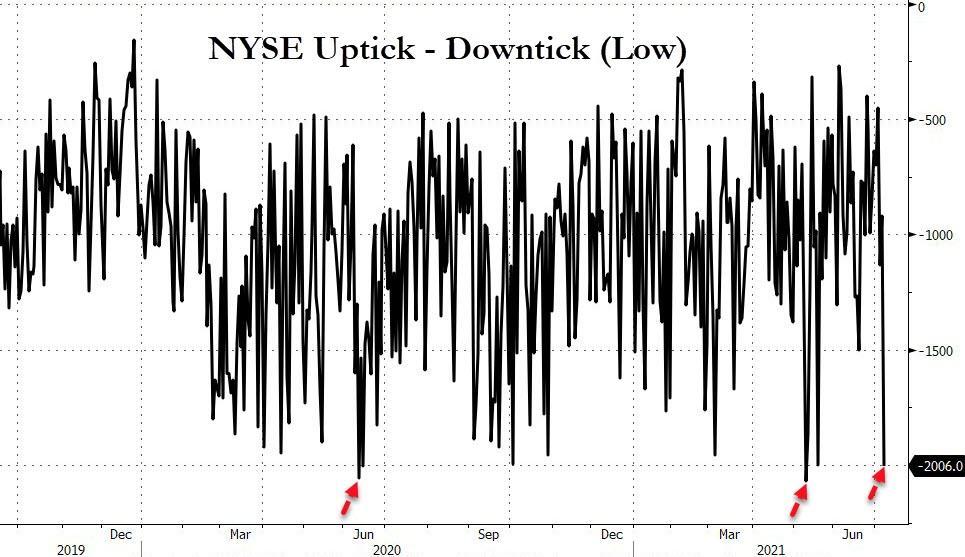
Last weekend, before the S&P broke out into a series of new all time highs despite Thursday's "harrowing" 1% dip, we shared Goldman's observations on why the market was entering the best 2-week seasonal period of the year. Since then, the SPX has hit new all time highs 3 out of the past 5 trading days, and on 9 out of the last 11 even as sentiment substantially declined this week in global equities. For context, on Thursday we observed that the TICK Index logged one of the largest (top 4) selling pressure on the open on record.
For those asking what was behind Thursday's wobble, we mentioned previously listed the reason for the selloff, none of which were new. The general feeling was that equities needed to catch down to other asset classes.
But, as Goldman flow trader Scott Rubner correctly predicted on Friday, when he said that "I think local shorts will need to cover this am" only to see a new all time high in the Dow, S&P and Nasdaq, the selling is pretty much over "as long dealer gamma muted a larger potential drawdown." Another reason why Goldman expects stocks to keep rising: JPM kicks off the defacto new buyback window on Tuesday.
With that in mind, here is a mini thread from Rubner on “where we came from” and where we are going next.
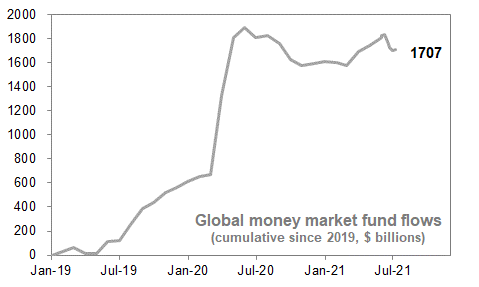
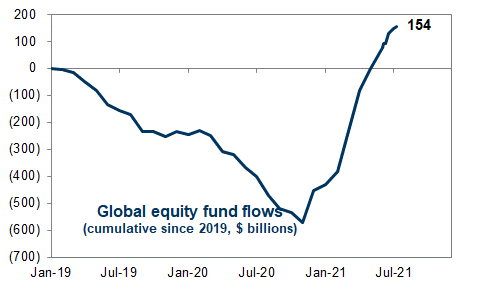
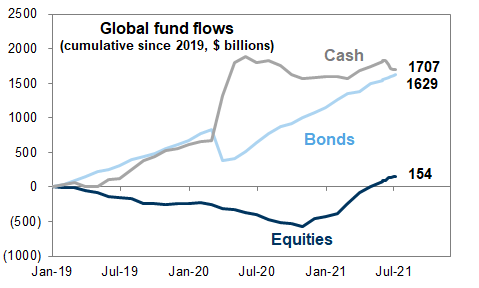
1. GS Wedge: Since January 2019, Money Markets have seen +$1.707 Trillion inflows and Global Bonds have seen +$1.629 Trillion inflows, while Global Equities just +$154 Billion worth of inflows. GS wedge stands at $3.2 Trillion ~ aka the defensive buffer.
2. Cash on the sidelines is waiting for a dip and bought the Thursday dip.
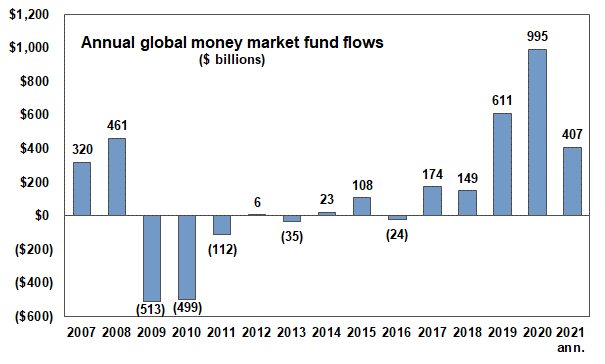
3. 1H 2021 actually logged the 2nd largest money market inflows on record. 1H 2020 was the largest.
4. The cash pile from 2021 has not been reduced.
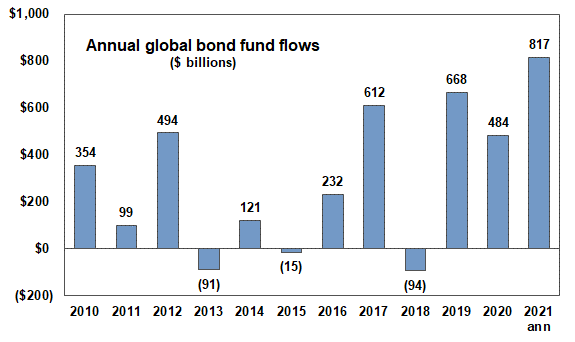
5. 1H 2021 Bond inflows seem significant? On pace for best year in a decade.
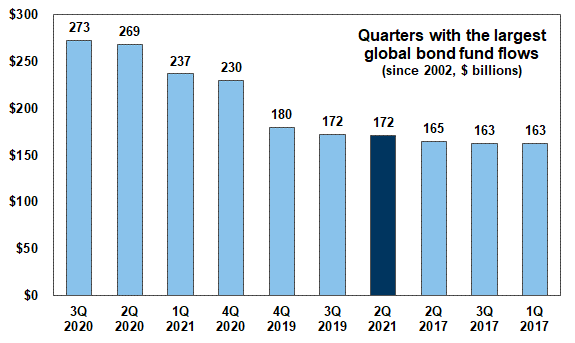
6. Q1 2021 saw the 3rd largest quarterly inflow on record, Q2 2021 saw the 7th largest on record.
7. Global Equity inflows are the biggest story of the year, but do not seem extreme at all when I zoom out.
Goldman's bottom Line: "We are still in the best two week period of the year, equity inflows are large, 401k are going back into stocks at a record pace. I think local shorts will need to cover."

(ZH) Yields Plunge, Dollar Surges As The Reflation Trade Unravels

Yields Plunge, Dollar Surges As The Reflation Trade Unravels

Market Stumbles But Rallies Back
Last week, we discussed the market hit new highs with the index getting back to more extended and overbought conditions. To wit:
“The technical backdrop is not great. With the market back to 2-standard deviations above the 50-dma, conviction weak, and investors extremely bullish, the market remains set up for additional weakness.
However, we are in the first two weeks of July, which tends to be bullishly biased. After increasing our equity exposure previously, we will give the market the benefit of seasonality for now.”
While market volatility did pick up this past week, the index held its breakout support levels and closed at a new high. Such keeps the bullish bias intact. However, as shown, the money flow signals are now back to more elevated levels, which will provide resistance to higher prices short term.
We are still within the seasonally strong period of July, which tends to last through mid-month. However, August and September are typically more challenging for returns. As we stated last week:
“The bulls are indeed in charge of the markets currently, but the clock is ticking.”
The market is also weak from a breadth perspective. While large-cap stocks have done better as of late, the rest of the markets have not. I discuss this in more detail in Friday’s 3-minutes video.

The critical point, as noted in the video, is there has been a definite rotation out of the “reflation trade” (small, mid, emerging, and international markets) into the large-cap names (primarily technology), which is the “deflation trade.”
As we will discuss, the reflation trade ran well ahead of reality. Over the next couple of months, the test will be to see if earnings can support the surge in prices and valuations.
Yields Overbought
We will discuss the “yield warning” momentarily. However, in the short term, yields have gotten very overbought. We suspect we could see a retracement in yields short-term, but such will likely be an opportunity to increase bond exposure in portfolios as we head further into the year.
As shown, previous overbought conditions (indicators get inverted concerning yields) lead to retracements to resistance. Currently, a retracement to 1.5% would be likely. Ultimately, a break below 1.25% will suggest much lower yields are coming.
From a positioning standpoint, we increased our bond duration several weeks ago. However, while we want to increase our exposure eventually, we need to wait for the short-term overbought condition to reverse.
Longer-term, as we will discuss next, we believe yields are potentially headed lower as economic growth and inflationary pressures wane.
Yield Plunge, Dollar Surge
In our #MacroView this week, we discuss the warning sign that yields are sending in more detail. However, importantly, the plunge in yields is suggestive that something in the market is becoming strained. As discussed in that article, when interest rise, and peak, such has corresponded with more negative market outcomes.
Is the current rise in rates signifying the next market downturn? Historically, sharp spikes in rates have done so by slowing economic growth more than expected. However, as we noted previously in our Commitment Of Traders report:
“The number of contracts net-long the 10-year Treasury already suggests the recent uptick in rates, while barely noticeable, maybe near its peak.”
Some of the pressure in bonds has come from the market bracing itself for some large auctions of new bonds next week. A lot of the action on Friday was the shift in focus to next week’s auctions. On Monday, there will be $38 billion in 10-year notes and $24 billion in 30-year bonds on Tuesday.
However, as noted by Zerohedge on Friday:
“But those who are betting on a continued rise in yields may get disappointed for one key technical reason. As Morgan Stanley’s derivatives strategist Chris Metli notes, CTAs – those mindless trend-followers who just ride on momentum waves until they crash, are still short bonds and at current yields have to buy $95bn notional of TY-equivalent duration over the next week.
As Morgan Stanley notes such ‘could continue the bond rally and put pressure on stocks as equity investors fear the bond market knows something they don’t about future growth prospects.'”
The dollar is also confirming the same.
The Dollar Is Confirming The Same
We specifically noted that the dollar was about to rise sharply. To wit:
The one thing that always trips the market is what no one is paying attention to. For me, that risk lies with the US Dollar. As noted previously, everyone expects the dollar to continue to decline, and the falling dollar has been the tailwind for the emerging market, commodity, and equity risk-on trade. So, whatever causes the dollar to reverse will likely bring the equity market down with it.”
While the dollar rally is still young, there was a successful test of the “double bottom” with higher lows. The break above the 50- and 200-dma also suggests the rally is just getting started. A further rally in the dollar will get fueled by additional short-covering.
There is a significant difference between a “recovery” and an “expansion.” One is durable and sustainable; the other is not.
Dollar & Rates Are Warning Signs
Those expecting a significant surge in inflation will likely be disappointed for the one reason which seems to get mostly overlooked.
“If the economy were growing organically, which would create stronger rates of wage growth and inflation, then there would be no need for zero interest rates, continued monetary interventions by the Federal Reserve, or deficit spending from the Government.”
The obvious problem is that not all “spending” is equal. Pulling forward consumption through stimulus is indeed short-term inflationary but long-term deflationary. Moreover, since 1980, there has been a shift in the economy’s fiscal makeup from productive to non-productive investment.
As we have pointed out previously, you can not overstate the impact of psychology on an economy’s shift to “deflation.” When the prevailing economic mood in a nation changes from optimism to pessimism, participants change. Creditors, debtors, investors, producers, and consumers change their primary orientation from expansion to conservation.
  • Creditors become more conservative and slow their lending.
  • Potential debtors become more conservative and borrow less or not at all.
  • Investors get increasingly conservative, and they commit less money to debt investments.
  • Producers become more conservative and reduce expansion plans.
  • Consumers become more conservative, and save more, and spend less.
As we have been witnessing since the turn of the century, these behaviors reduce the velocity of money. Consequently, the decline in velocity puts downward pressure on prices. Moreover, given the massive increases in debt and deficits, the deflationary drag increases as the stimulus fades from the system.
Likely, the dollar and rates already figured this out.
The Reflation Trade Unravels
The importance of this analysis relates to a potential change in investor positioning in the market. To wit:
“The unraveling of the inflation/reflation trade has accelerated over the past week. US 10y bond yields continue to decline and have now broken a crucial technical level. Such could see the rally accelerate sharply, and with it, the continued unraveling of both cyclicals and commodities.” – Albert Edwards
Albert’s comment aligns with our views previously that such would likely be the case.
I believe that the pandemic recession allowed policymakers to cross the Rubicon of fiscal rectitude. They have reached a new land where existing monetary profligacy can now get coupled with fiscal debauchery.
In that respect, I am very much in the inflation/reflation camp. But I think it is a secular theme that will play out later in this cycle. The problem is the markets have been too early in betting on the reflation trade and have gotten set up for a huge disappointment.”
We have previously discussed the change in the deflationary credit impulse. But, importantly, the bond and dollar markets are now reflecting that deflation.
Does such mean the markets will crash tomorrow? No.
What is critical to recognize is that the market is well ahead of what reality will turn out to be. As such, when overly exuberant earnings and economic growth expectations fade, the justification supporting overpaying for assets will run into trouble.

WSJ : Higher Inflation Is Here to Stay for Years, Economists Forecast

Higher Inflation Is Here to Stay for Years, Economists Forecast
Strong economic rebound and lingering pandemic disruptions fuel inflation forecasts above 2% through 2023, survey finds

Americans should brace themselves for several years of higher inflation than they’ve seen in decades, according to economists who expect the robust post-pandemic economic recovery to fuel brisk price increases for a while.

Economists surveyed this month by The Wall Street Journal raised their forecasts of how high inflation would go and for how long, compared with their previous expectations in April.

The respondents on average now expect a widely followed measure of inflation, which excludes volatile food and energy components, to be up 3.2% in the fourth quarter of 2021 from a year before. They forecast the annual rise to recede to slightly less than 2.3% a year in 2022 and 2023.

That would mean an average annual increase of 2.58% from 2021 through 2023, putting inflation at levels last seen in 1993.

“We’re in a transitional phase right now,” said Joel Naroff, chief economist at Naroff Economics LLC. “We are transitioning to a higher period of inflation and interest rates than we’ve had over the last 20 years.”

The inflation measure—the Commerce Department’s core price index of personal-consumption expenditures—jumped 3.4% in May from a year earlier, the biggest increase since the early 1990s.


What Mr. Naroff and the other survey respondents describe is a generational shift from the lower inflation of the past two decades, a shift that could create new challenges for households, policy makers and investors who came to expect inflation closer to or below 2%.

If the economists prove correct, Federal Reserve officials might have to raise rates sooner or more than they expect to keep inflation under control.

The Fed’s preferred inflation gauge—the overall PCE index, which includes food and energy prices—rose 3.9% in May, nearly double the central bank’s 2% target. The Fed, in a report released Friday, repeated its view that inflation has picked up this year due to bottlenecks, hiring difficulties and other “largely transitory factors” related to the economy’s rebound from the effects of the pandemic. Most officials, in projections released last month, believed inflation would decline to around 2% over the next two years, though there was greater uncertainty over how quickly they might need to raise interest rates to get inflation there.

At the Fed’s June policy meeting, most officials projected they would raise interest rates from near zero by 2023. Several expected to raise rates next year. In March, most officials expected to hold rates steady through 2023.

Some 58% of the economists surveyed don’t see the Fed raising interest rates until the second half of 2022 or later.

“Inflation is expected to surge longer and longer—longer than the Fed previously thought,” said Diane Swonk, chief economist at Grant Thornton. “The Fed is now likely to raise rates in the first half of 2023, although some Fed presidents will be nipping at the bit to move sooner.”

Some respondents worry the Fed could move too slowly. “The danger is that monetary authorities are behind the curve,” said Kevin Swift, chief economist at the American Chemistry Council. “I’m not saying hyperinflation is around the corner, just that a lot of things have come together in the last year, and the overall trend of costs across the board is growing faster than in the last five or 10 years.”

Core PCE inflation rose just 1.7% annually, on average, between 1995 and 2019. Now the Fed wants inflation to overshoot 2% for a while to make up for that shortfall.

Another key measure of inflation, the Labor Department’s consumer-price index, which tends to run hotter than the PCE index, leapt 5% in May from a year before, the most in nearly 13 years. Survey respondents expect the department to report Tuesday that the CPI rose 4.7% in June from a year before. They expect the rate to fall to 4.1% by year’s end. Their CPI forecasts for next year and 2023 hover between 2.4% and 2.7%.

Supply-chain bottlenecks, higher shipping costs and labor shortages might prove temporary as the market adjusts to disruptions. However, the combination of plentiful federal stimulus funding, an unprecedented stockpile of household savings and the rollout of vaccines is driving a surge in consumer demand, enabling many businesses to raise prices significantly for the first time in decades. If households and businesses start to expect rising prices, that dynamic can become self-fulfilling.

There are signs that consumers are starting to anticipate higher inflation. Consumer inflation expectations—the rate of inflation the median consumer expects five to 10 years from now—climbed to 2.8% in June, about the same rate as in 2014, according to the University of Michigan Survey of Consumers.

Higher inflation for several years would ripple through the economy in various ways. Consumers could find their household budgets squeezed. Higher borrowing costs could weigh on stock values and could crimp growth in interest-rate-sensitive industries like housing. Higher inflation can also make it harder for businesses to plan longer-term investments.

“It’s disruptive—you can’t be sure of what your costs are, whether you can get supplies or what the costs will be six months from now,” Mr. Swift said. “I’d hate to be in the construction business trying to bid on a job when you don’t know what the cost of steel will be 18 months from now.”

The Wall Street Journal survey of 64 business, academic and financial forecasters was conducted July 2-7. Not all participants responded to every question. The survey archives and forecast data can be found here.

FT : Brussels targets aviation fuel tax in drive to reduce carbon emissions

Brussels targets aviation fuel tax in drive to reduce carbon emissions
Commission to unveil a dozen policies designed to ensure EU can meet pollution goals

Brussels will set out plans this week to increase taxes on polluting fuels and introduce an EU-wide levy on aviation kerosene for the first time, under measures intended to put it at the forefront of global efforts to reduce carbon emissions. 

The European Commission will propose a revamp of its 15-year-old rule book on carbon taxes to provide an incentive for low-emissions fuel and impose levies on heavily polluting energy used in the airline and shipping industry. The measure is one of a dozen policies to be unveiled on Wednesday to ensure the EU can meet a goal of reducing average carbon emissions by 55 per cent by 2030. Others include an extension of the EU’s emissions trading scheme, tougher CO2 rules for cars and a carbon levy on some imports.

A draft legal text of the energy taxation directive, seen by the Financial Times, proposes gradually increasing minimum rates on the most polluting fuels such as petrol, diesel and kerosene used as jet-fuel over a period of 10 years. Zero-emissions fuels, green hydrogen and sustainable aviation fuels will face no levies for a decade under the proposed system. 

The “Fit for 55” package puts the EU at the vanguard of decarbonisation efforts but the proposals risk a backlash from some governments and the public.

Introducing environmental taxes is likely to be among the most politically sensitive measures in the commission’s plans. Unlike most of Brussels’ new green policies, updating the energy taxation directive will require unanimous backing from the EU’s 27 member states to become a reality. 

Paolo Gentiloni, Brussels economics commissioner, has called the reform a “now or never moment”.

“Paradoxically, [the current energy taxation directive] is incentivising fossil fuels and not environmentally friendly fuels. We have to change this”, Gentiloni said at a meeting of G20 finance ministers this weekend. 

The EU’s energy taxation rules date back to 2006 and have created a system that “favours fossil fuel use” owing to a series of exemptions and loopholes for dirty energy across different member states, according to the text. The directive is designed to set a series of minimum tax rates for energy products across the bloc. 

One of the big changes being proposed is an end to exemptions for heavily polluting fuels such as kerosene used in aviation. The draft says jet fuel used in intra-EU flights should be subject to a new minimum rate of taxation, the details of which have not yet been decided, said officials. The rules should, however, exempt cargo-only flights, and apply lower rates for non-commercial flights, according to the draft. 

Although a kerosene tax has been welcomed by many EU countries, it has sparked resistance from the aviation industry. Brussels is also planning to phase out free carbon credits provided to the sector under its ETS. Along with the taxation rules, the phase out of free allowances would significantly increase the pressure on aviation to reduce its emissions or pay for polluting. 

The draft says gradually increasing minimum taxes during a ten-year transition would help avoid the problem of “double taxation” for the maritime and aviation industries which risk being subject to two forms of CO2 pricing. 

Airline group A4E has said new carbon taxes for the sector are “ecologically and economically counterproductive” and that market-based carbon pricing should be the only main form of CO2 pricing placed on the industry. 

“An intra-EU kerosene tax could lead to a competitive distortion within Europe’s internal market and globally,” said A4E. “A possible kerosene tax that would set minimum tax rates for intra-EU flights is likely to have the most negative impact, as it may open the door to different rates inside the single market.”

FT : Spacs are falling short of their promises

Spacs are falling short of their promises
Plenty of people have been buying into their success story but research points to risk for investors

Smaller, newer businesses face all sorts of challenges, some new and some age old. There is increased corporate concentration and the near monopoly power of the digital giants. The cost of complying with many regulations is proportionately higher for them and they have less access to cheap public debt markets than their bigger competitors.

This causes many companies to eye the equity markets for funding, but the initial public offering process can be lengthy and expensive. These days, the executives in charge have another choice: merging with a Spac, or “special purpose acquisition company”. Advocates say these listed blank cheque vehicles can offer a smarter, more reliable and faster way into public markets.

But do they? Spacs, which are shell corporations that go public on a promise to turn themselves into real businesses via mergers within two years, have had a record run recently. In 2021, there have been 30 per cent more Spac issuances than traditional IPOs. Indeed, the number of public companies has declined radically in recent years.

A June OECD report looking at the capital markets found that since 2005 more than 30,000 companies have delisted. That’s equivalent to three-quarters of today’s total of globally listed firms. The number of new listings hasn’t come close to matching this. The result: a shrinking number of companies are using public equity markets, and the money raised there goes to fewer, bigger firms.

Spac fans say the structure is helping redress the balance by making it easier for young companies to enter the market. These deals have also been touted as a kind of “poor man’s private equity”, allowing retail investors to back managers who target and restructure companies much as institutional investors do.

Clearly, plenty of people have been buying this story. In 2020 alone, Spacs raised as much cash as they had done over the entire preceding decade, and 2021 has already surpassed this total. This has led regulators and top investors to label the structure speculative and dangerous, the sort of financial “innovation” that characterises a market top.

Certainly Spacs have some of the same characteristics — relative newness, information asymmetry, moral hazard — as the junk bonds that triggered the 1980s savings and loan crisis or the collateralised debt obligations implicated in the 2008 financial crisis. “Because there is no precedent for them, they can take on risk that is not readily recognised,” says Richard Bookstaber, chief risk officer for Fabric, a risk technology and analysis group. “This gives an advantage to the innovator over the market and regulators.” 

That is clearly problematic. But even more important is whether or not Spacs live up to the promise of being a cheaper, more efficient and more democratic way to bring new companies public.

A recent European Corporate Governance Institute working paper examined the 47 Spacs that merged with target companies between January 2019 and June 2020. It suggests not. While the academic authors found “no evidence that Spacs are hotbeds of fraud or outright investor deception”, they did find that “the costs built into the Spac structure are subtle, opaque, and far higher than has been previously recognised”. 

The Spacs in the study issued shares for roughly $10, and investors valued them at that same amount at the time of merger. But by that point, the median Spac in the study was holding cash of only $6.67 per share.

In effect, these shell vehicles consumed one-third of the cash they raised, or 50 per cent of the money they eventually delivered to the companies they brought public. “These costs are much higher than those for IPOs, even accounting for underpricing, and are roughly twice as high as even Spac sceptics have previously estimated,” the researchers noted.

What’s more, the study also found that Spac share prices tend to fall by about a third of their value within a year of their mergers. Since 2010, there has never been a year in which Spac mergers outperformed the Russell 2000 small cap index. Spac returns do even worse when returns are compared to the IPO index, which goes back to 2013.

The ECGI study notes that Spacs sponsored by large private equity funds and former Fortune 500 executives typically do better. But there are plenty with high-profile sponsors that have tanked, belying claims that the process delivers greater price and deal certainty compared to IPOs. 

We can be grateful that the Spacs in the study were not held mainly by retail investors. Large institutional managers represented 85 per cent of ownership, and 70 per cent of total shares were held by a handful of investors, who the study dubbed the “Spac Mafia.” Indeed, 15 per cent of total post-IPO shares were held by five investors.

One could argue that this means we shouldn’t worry much about the Spac craze. If a few rich investors lose their shirts, so what? Unfortunately, dozens of these companies have recently joined the Russell 3000 index, which is tracked by investment vehicles with $9.1 trillion in assets. Spacs are suddenly much more mainstream.

The US Securities and Exchange Commission, which has a mandate to protect the little guy, is already expressing concerns about Spacs. Given that Spacs are structured to leave investors rather than sponsors holding most of the risk, I can’t imagine a better target for regulators looking to limit moral hazard.

WSJ : President Biden’s Executive Order Opens New Front in Battle With Big Tech

President Biden’s Executive Order Opens New Front in Battle With Big Tech
White House looks to regulatory agencies like the FTC to adopt tougher policies to rein in the power of large tech platforms

WASHINGTON—President Biden’s sweeping new competition order targets big tech companies in ways that could fundamentally alter how they do business.

But it will fall to government agencies to carry out the order, and they could take years to put its ideas into action. The Federal Trade Commission that already has Big Tech companies in its sights is likely to become a particular battleground.

A core thrust of the order is to encourage regulatory agencies such as the FTC to adopt new rules and policies to rein in the growing size and power of large tech platforms such as Amazon.com Inc., Alphabet Inc.’s Google and Facebook Inc. That could prove to be a tall order for the FTC, the principal federal regulator of internet commerce. Some observers say the agency—which had its sails trimmed by Congress in the deregulatory era of the 1970s and 1980s—has struggled to keep up with unfair practices online, particularly in the areas of user privacy, big data and tech mergers.

As the White House detailed its executive order, one Democratic FTC commissioner, Rebecca Kelly Slaughter, said in a tweet, “So excited about @POTUS’s EO on competition; it is an ambitious agenda that will help our markets work better and create a more equitable economy for all people - esp workers, marginalized communities, entrepreneurs, small biz.”

Gary Shapiro, chief executive of the Consumer Technology Association that counts Apple Inc., Facebook and Google among its members, defended the tech industry as competitive and vibrant and took issue with the White House’s action.

“Elements of this executive order threaten our global leadership and hard-won success,” he said, taking aim, in particular, at scrutiny of past mergers and acquisitions. “Prohibiting these acquisitions will dry up venture capital, harm entrepreneurs and small businesses and make our economy less competitive.”

America’s biggest tech companies, Microsoft Corp. Google, Amazon, Facebook and Apple, declined to comment or didn’t immediately respond to a request for comment. They have, in the past, defended their business practices and said they don’t harm consumers.

One of the most far-reaching parts of the order encourages the FTC to establish new rules on online surveillance and the accumulation of users’ data. That could have significant effects on all the big platform companies. A White House fact sheet says that “many of the large platforms’ business models have depended on the accumulation of [extraordinary] amounts of sensitive personal information and related data.”

The executive action also pushes the FTC to establish rules barring “unfair methods of competition on internet marketplaces.” The directive doesn’t call out individual companies, but Amazon, Apple and Google have been in the crosshairs of lawmakers or regulators for the power they wield over parts of their business.

The White House said that companies that run retail marketplaces “can see how small businesses’ products sell and then use the data to launch their own competing products,” and can also “display their own copycat products more prominently than the small businesses’ products.”

The Biden administration also is taking aim at deal making by platforms it views as dominant and trying to fend off future competition. Over the past decade, the White House said, “the largest tech platforms have acquired hundreds of companies—including alleged ‘killer acquisitions’ meant to shut down a potential competitive threat.”

Proposed deals will now undergo tighter scrutiny, particularly in cases such as those involving a nascent competitor. The policy also aims to focus more scrutiny on mergers involving the accumulation of data, competition through free products and effects on user privacy.

FTC Chair Lina Khan and the head of the Justice Department’s antitrust division, Richard A. Powers, in a joint statement said, “We plan soon to jointly launch a review of our merger guidelines with the goal of updating them to reflect a rigorous analytical approach consistent with applicable law.”

TechNet, a network of tech executives and investors, said in a statement that the order’s provisions could discourage innovation and harm consumers.

“They put at risk free services that consumers use to message and call loved ones, get directions, connect with healthcare professionals, consume online content—including news and educational content—and much more,” said TechNet Senior Vice President Carl Holshouser.

The White House also encourages the FTC to adopt rules against anticompetitive restrictions on using independent repair shops or making do-it-yourself repairs of devices. That could have a particular impact on device manufacturers such as Apple that limit who can fix devices such as iPhones without voiding warranties.

Other parts of the order focus on how users are treated by telecommunications companies that provide internet service. The order notes that more than 200 million U.S. residents live in areas with only one or two reliable high-speed internet providers, leading to much higher prices than in markets with more options.

Developing rules to implement the executive order is likely to be a “a long, contentious process that would ultimately end in litigation,” said Robert Kaminski of policy research firm Capital Alpha Partners.

WSJ : President Biden’s Executive Order Opens New Front in Battle With Big Tech

President Biden’s Executive Order Opens New Front in Battle With Big Tech
White House looks to regulatory agencies like the FTC to adopt tougher policies to rein in the power of large tech platforms

WASHINGTON—President Biden’s sweeping new competition order targets big tech companies in ways that could fundamentally alter how they do business.

But it will fall to government agencies to carry out the order, and they could take years to put its ideas into action. The Federal Trade Commission that already has Big Tech companies in its sights is likely to become a particular battleground.

A core thrust of the order is to encourage regulatory agencies such as the FTC to adopt new rules and policies to rein in the growing size and power of large tech platforms such as Amazon.com Inc., Alphabet Inc.’s Google and Facebook Inc. That could prove to be a tall order for the FTC, the principal federal regulator of internet commerce. Some observers say the agency—which had its sails trimmed by Congress in the deregulatory era of the 1970s and 1980s—has struggled to keep up with unfair practices online, particularly in the areas of user privacy, big data and tech mergers.

As the White House detailed its executive order, one Democratic FTC commissioner, Rebecca Kelly Slaughter, said in a tweet, “So excited about @POTUS’s EO on competition; it is an ambitious agenda that will help our markets work better and create a more equitable economy for all people - esp workers, marginalized communities, entrepreneurs, small biz.”

Gary Shapiro, chief executive of the Consumer Technology Association that counts Apple Inc., Facebook and Google among its members, defended the tech industry as competitive and vibrant and took issue with the White House’s action.

“Elements of this executive order threaten our global leadership and hard-won success,” he said, taking aim, in particular, at scrutiny of past mergers and acquisitions. “Prohibiting these acquisitions will dry up venture capital, harm entrepreneurs and small businesses and make our economy less competitive.”

America’s biggest tech companies, Microsoft Corp. Google, Amazon, Facebook and Apple, declined to comment or didn’t immediately respond to a request for comment. They have, in the past, defended their business practices and said they don’t harm consumers.

One of the most far-reaching parts of the order encourages the FTC to establish new rules on online surveillance and the accumulation of users’ data. That could have significant effects on all the big platform companies. A White House fact sheet says that “many of the large platforms’ business models have depended on the accumulation of [extraordinary] amounts of sensitive personal information and related data.”

The executive action also pushes the FTC to establish rules barring “unfair methods of competition on internet marketplaces.” The directive doesn’t call out individual companies, but Amazon, Apple and Google have been in the crosshairs of lawmakers or regulators for the power they wield over parts of their business.

The White House said that companies that run retail marketplaces “can see how small businesses’ products sell and then use the data to launch their own competing products,” and can also “display their own copycat products more prominently than the small businesses’ products.”

The Biden administration also is taking aim at deal making by platforms it views as dominant and trying to fend off future competition. Over the past decade, the White House said, “the largest tech platforms have acquired hundreds of companies—including alleged ‘killer acquisitions’ meant to shut down a potential competitive threat.”

Proposed deals will now undergo tighter scrutiny, particularly in cases such as those involving a nascent competitor. The policy also aims to focus more scrutiny on mergers involving the accumulation of data, competition through free products and effects on user privacy.

FTC Chair Lina Khan and the head of the Justice Department’s antitrust division, Richard A. Powers, in a joint statement said, “We plan soon to jointly launch a review of our merger guidelines with the goal of updating them to reflect a rigorous analytical approach consistent with applicable law.”

TechNet, a network of tech executives and investors, said in a statement that the order’s provisions could discourage innovation and harm consumers.

“They put at risk free services that consumers use to message and call loved ones, get directions, connect with healthcare professionals, consume online content—including news and educational content—and much more,” said TechNet Senior Vice President Carl Holshouser.

The White House also encourages the FTC to adopt rules against anticompetitive restrictions on using independent repair shops or making do-it-yourself repairs of devices. That could have a particular impact on device manufacturers such as Apple that limit who can fix devices such as iPhones without voiding warranties.

Other parts of the order focus on how users are treated by telecommunications companies that provide internet service. The order notes that more than 200 million U.S. residents live in areas with only one or two reliable high-speed internet providers, leading to much higher prices than in markets with more options.

Developing rules to implement the executive order is likely to be a “a long, contentious process that would ultimately end in litigation,” said Robert Kaminski of policy research firm Capital Alpha Partners.

>>> Barron’s Weekend Summary: When GameStop, BlackBerry (BB), and Blockbuster st

Barron’s Weekend Summary: When GameStop, BlackBerry (BB), and Blockbuster started rising last January, it seemed like only a matter of time before they would crash

* Cover Story When GameStop, BlackBerry (BB), and Blockbuster started rising last January, it seemed like only a matter of time before they would crash. Yet, half a year later and the so-called core ‘meme stocks’ “are still trading at levels considered outrageous by people who have studied them for years. New names like Clover Health Investments (CLOV) and Newegg Commerce (NEGG) have recently popped up on message boards, and their stocks have popped, too.” Retail traders, derided as ‘the dumb money’ have “forced the naysayers to capitulate.”

* Tech Trader: Keeping track of your network is a major challenge of modern computing. That’s because the latest information-technology systems “are a messy brew of public clouds, private clouds, old-school data centers, third-party apps, edge computing, and mobile workers. Keeping tabs on what’s working—and what isn’t—is a gigantic challenge. The good news for investors is that the result is an enormous emerging market.” Until recently, users would resort to ‘Infrastructure management tools.’ But the market now uses the term “observability” to describe these tools. Companies like Datadog (ticker: DDOG), Dynatrace (DT), Elastic (ESTC), and Splunk (SPLK) provide observability tools to help IT departments monitor their networks’ health.

* Trader : Because of a quirk, the two publicly traded classes of Alphabet stock are trading at different levels. The nonvoting shares class, whose ticker is GOOG, trades at a premium of 3% to the voting stock, whose ticker is GOOGL. It’s best for investors to choose the class A voting stock.

* Interview: Dallas Fed President, former Harvard Professor and 23-year veteran of Goldman Sachs, Robert Kaplan was the first to speak up publicly, from a small cadre of Federal Reserve officials, about the need to start tightening monetary policy. “Kaplan isn’t a voting member of the Federal Open Market Committee (the central bank’s policy-setting arm) this year, but he will be in 2023. Kaplan is wary of rising inflation, which he views as more persistent than do some of his colleagues, and he is warning of excessive risk-taking and the unintended consequences of policy that is too loose for too long.”

* Profile: Be “greedy when others are fearful and fearful when others are greedy.” That’s ‘standard’ investment advice, but China’s leader Xi Jinping “seems determined to disprove the axiom.” Xi has set his sights on leading technology companies, launching a new and tougher regulatory framework “in what appears to be, at a minimum, an effort to control data on Chinese citizens at home and perhaps also abroad.” These moves, also serve as “rough reminders to China’s increasingly high-profile technocrats that Xi is more powerful than anyone.”

* Features: 1) Luminar Technologies (LAZR) stock may have dropped in 2021, losing about 40% - compared to the S&P gaining 16%, but “director Matthew Simoncini recently bought a large block of shares of the developer of technology to enable self-driving cars.” Luminar went public after it merged with a special-purpose acquisition company in December. The company makes LIDAR sensors, which use lasers “to measure the surroundings of autonomous vehicles.” 2) Virgin Galactic (SPCE) founder Richard Branson is heading to space on July 11 when he will take off from Virgin’s spaceport in New Mexico at about 9.00 am EST. And his flight to space “could be a monumental moment for the fledgling space tourism industry.” Branson, company mission specialists, and pilots, will be the first to take a “passenger trip to space, beating Jeff Bezos’s Blue Origin passenger flight by more than a week.” 3) The recent cyberattack perpetrated during the July 4 weekend on security software provider Kaseya, affecting anywhere between 800 and 1,500 businesses, “exposed what some analysts say will be a growing and evolving threat, boosting their expectations for spending on cybersecurity to the benefit of stocks in the sector.” Cybercrime appears to favor “targeting service providers and supply chains, since hackers know they can affect a large group of people with a single attack.”

* European Trader: EBay has sold all of its classified-advertising business to Norway’s Adevinta last June “in a cash and stock deal that will let the online auctioning group boost its stock buyback program to $5 billion from $2 billion.” Credit Suisse, in a note initiating coverage, says that “Adevinta is an outperform as the world’s largest pure-play classifieds group, and its 210 kroner ($24.03) target is the second highest of sell-side firms, according to data from S&P Capital IQ.”

* Emerging Markets: Barron’s suggests that tech stocks “are not the only Chinese assets that have crashed lately.” Paul Lukaszewski, head of Asia Pacific corporate debt at Aberdeen Standard Investments says that Investors should consider that “spreads on B-rated corporate bonds, which run inversely to price, have jumped by seven percentage points over the past month or so.” “Outside of Asia, credit markets are priced for perfection,” Lukaszewski says. “In China, it’s priced for a meltdown.”

* Commodities: Steel prices have been on a positive trajectory (rising from some $500 to $1,600 per short ton) during the recovery thanks to tight supply, and this has also fueled the price of steel stocks. United States Steel and Cleveland-Cliffs have gained between twice and three times the S&P 500 index’s 15% gain this year, respectively, while Nucor is up nearly 80%. Credit Suisse analyst Curt Woodworth says that “steel stocks aren’t cooling down soon.” Woodworth believes that “the rebirth of the U.S. steel sector is a real event.”

* Streetwise: In late June, Facebook achieved a market value of $1 trillion, becoming just one of five U.S.-listed companies have reached the this mark, “or 0.08% of the total number of stocks currently traded on the New York Stock Exchange and Nasdaq. That’s roughly the odds of a high school basketball player making the National Basketball Association. It’s an elite club.” But, Facebook’s market cap fell slightly in the past week to $980 billion. And “we might be waiting a while for the next entrant. That’s partly because the federal government wants to rein in big business, but also because the current trillion-dollar members have a natural incentive to keep the club small.”