FT : Lower bond yields are no longer good news for stocks

Lower bond yields are no longer good news for stocks
Can too much of a good thing complicate the orderly exit from loose monetary policies?

The sharp drop in yields on US government bonds seen last week is good news for stock investors, or so you would think given recent experience.

But that was not the feeling in markets on Thursday with a broad-based sell-off in equities, leading more people to start asking the key question of whether we could be having too much of a good thing — that is, interest rates that are artificially very low for too long. The question becomes even more important as investors get ready to digest this week news on inflation and US Federal Reserve policy.

Ten-year Treasury yields plummeted from around 1.70 per cent at the end of the first quarter to 1.25 per cent during Thursday’s trading session before recovering somewhat on Friday. Three main explanations have been suggested for this counter-intuitive move given higher growth and inflation outcomes.

The most worrisome is that the markets are pricing a significant deterioration in growth prospects due to less strong data in China and the US, and concerns about the spread of the Covid Delta variant in Europe and much of the developing world. Yet it is hard to argue that these headwinds to the global recovery warrant such a move down in yields, let alone the very low levels of both nominal and real rates.

The second is policy related, centred on the European Central Bank’s signal of a somewhat more dovish policy stance. Again, it is hard to argue consistency with the extent of the move. Also, the ECB announcement coincided with the release of Fed minutes that confirm a slightly less dovish tilt there.

The third, technicals-based explanation for the move down in yields seems more convincing. The more yields fall in such a counter-intuitive mode, the greater the pressure on those brave souls that were still betting bond prices would drop, or who were underweighting their benchmark indices. There might also have been belated buying from pension funds that have given up on waiting for better entry points to buy assets to match liabilities. Indeed, the abrupt nature of last week’s market moves were consistent with “capitulation trades” — as in, “I don’t care about the levels, just get it done”.

For a while now, stocks investors have embraced unnaturally low yields, the centrepiece of central banks’ prolonged reliance on unconventional policies. They reduce the debt burden of companies, allow for very easy debt refinancing and open up all sorts of possibilities for mergers and acquisitions as well as initial public offerings. They also facilitates good old-fashioned financial engineering that alters capital structure in favour of shareholders relative to creditors.

So what follows the markets’ sudden bout of indigestion? The most likely answer is a short-term rebound driven by three behavioural themes that have deeply conditioned investors: TINA, or there is no alternative to stocks with yields so very low; BTD, buy the dip as the liquidity wave continues; and FOMO, fear of missing out on yet another move up in stocks.

While the most probable outcome in the short-term, this should not preclude forward-looking analyses of two associated risks. The first relates to so-called “de-grossing” — that is, simultaneous reductions in risk-taking positions led by those have bet on an improving economy with the “reflation trade”. That would involve cutting overweight positions in risky stocks and underweight exposures in risk-free government bonds, the result of which would be adverse contagion for a bigger set of financial assets.

The other, more worrisome possible future extension of recent events is that the economy and the financial system may have already experienced too much of a good thing.

With the Fed already behind on inflation and with supply side problems proving more persistent, there is growing concern that the more the central bank waits to taper its $120bn of monthly bond purchases the more likely it will be forced into slamming the policy brakes on at some point. In the meantime, speculative excesses would have built up further, more resources would have been misallocated across the economy, and more unsustainable debt would have been incurred.

What is clear to me is that we are moving irresistibly closer to a critical question for the economy and markets, and not just in the US: is there still the possibility of an orderly exit from what has been a remarkably long period of uber-loose monetary policies?

FT : Chip shortage will keep car rental prices high, warns Europcar chief

Chip shortage will keep car rental prices high, warns Europcar chief
Head of auto hire group says there are not enough vehicles to meet demand from holidaymakers

Higher costs for car rental are likely to last until the auto industry’s production squeeze caused by the semiconductor shortage is resolved, the boss of Europcar has warned.

Caroline Parot, chief executive of the largest listed car hire company in Europe, said prices had risen because providers could not source enough vehicles to meet demand from holidaymakers.

Charges are two or three times higher than normal in many popular locations, according to consumer groups and price comparison sites. Higher car rental costs helped drive US inflation to its highest level since 2008 last month.

“We cannot serve everyone we want to because there are not enough cars,” she told the Financial Times.

The chip crisis has led to an acute shortage of new vehicles, with carmakers prioritising retail sales and other channels ahead of rental car providers, which tend to buy in bulk at lower prices.

“People are eager to travel. If you look at the US, there are enough hotels and enough flights, but the car capacity has changed,” she said.

While a lot of international travel in Europe is curtailed, people are increasingly travelling within their own countries.

Parot warned that the rental industry, similar to much of the leisure and tourism sector, has been further hampered by confusion from governments on travel corridors, particularly from sudden and unexpected rule changes.

“Each time a corridor is opened the reservations are exploding and we are full in 24 hours, but then if it is cancelled they are all gone,” she said, saying the rules that governed a closure were never clearly explained.

“The co-ordination across nations is probably what is missing the most,” she added. “Every government is reacting differently.”

She added that the need to ship cars across borders in Europe at short notice and high expense had driven up operating costs, forcing prices even higher.

“If my costs are increasing to serve the customer, the customer will have to pay for it, or I am not sustainable any more,” she said. 

The car industry is not clear when the chip crisis will end, with most manufacturers now expecting disruption into 2022.

Parot said she believes that Easter next year will be “more manageable”, even as demand is expected to return.

The company does not expect to reach pre-pandemic levels of demand until travel between Europe, the US and Asia has resumed, which the group is forecasting for 2023, she added.

Last year Europcar suffered a 45 per cent drop in demand, which still means more than half of its typical business was operating, as people in cities turned to rental cars to get access to private vehicles during the pandemic.

Earlier this year, the company completed a financial restructuring that wiped out €1bn of debt, but placed much of the business in the hands of its lenders.

This year’s revenues will be higher than 2020 levels, but not close to 2019’s because of the impact of the Delta variant, Parot said.

In the short term, the group has begun buying cars from dealerships and other channels as well as its traditional manufacturer orders to try to plug the gaps in its network.

However, lots of potential buyers are chasing available models, and the price of used cars has overtaken new vehicles in some segments.

Last month, the group turned down a €2.2bn takeover offer from Volkswagen.

Parot said that being owned by a carmaker would not necessarily make it easier to source vehicles during the current crisis, adding that the company had twice been owned by manufacturers in its history.

She declined to comment further on the takeover offer.

FT : A fetish of illiquidity is driving finance

A fetish of illiquidity is driving finance
History repeating itself as banks and pension funds bet more on private assets

John Maynard Keynes famously declared in his General Theory of Employment, Interest and Money that “of the maxims of orthodox finance, none, surely, is more antisocial than the fetish of liquidity”.

If the great economist were around today he might have worried instead about the fetish of illiquidity.

The vulnerability of the banking system before the financial crisis was partly attributable to a dramatic liquidity decline. In the 1960s, commercial banks in the UK and much of the developed world held 25 per cent or more of their assets in cash and short term government paper that was free of default risk.

This pained the banks because the return on cash was nil, while the return on assets such as Treasury bills was only marginally above money market rates. So UK clearing banks ran down liquidity to about two per cent before the crisis, without protest from the Bank of England.

This adjustment meant that they were increasing their exposure to higher risk private assets when they happened to be funding their business increasingly from volatile wholesale deposits. This left them dependent on the central bank to sort out the mess in the event of any shock to the system. In effect they outsourced liquidity management to the central bank with liquidity risk ultimately falling on the taxpayer.

Under the rules of the Basel Committee on Banking Supervision, liquidity has since been rebuilt, though nowhere near to 1960s levels. Yet history seems to be repeating itself. Ultra-low interest rates have imposed a tight squeeze on bank profits. This, according to a recent report by the EU’s European Systemic Risk Board, has forced banks into a new search for yield and led them to tilt the composition of their assets towards riskier market segments such as commercial property. They have also increased their exposure to interest rate risk by granting fixed rate loans at longer maturities.

Now a deeper move into real estate is afoot. Lloyds Banking Group announced last week that it was embarking on direct ownership of residential properties for letting, in some cases taking on development risk. Time was when directly owned property was not regarded as fit for bank balance sheets because real estate is relatively illiquid, especially in a downturn. There is added piquancy given Lloyds’ ruinous 2009 acquisition of HBOS, which incurred heavy writedowns in its directly owned residential land and housebuilding operations in the crisis.

The wider financial system has seen a similar retreat from liquidity. Consultants Willis Towers Watson’s latest Global Pension Asset Study shows that pension funds’ asset allocation to private assets including private equity, real estate and infrastructure has gone from seven per cent to 26 per cent over the past 20 years. These funds have sought to harvest an illiquidity risk premium, the extra return above that on quoted equities. The trend is set to continue — witness the C$221bn Ontario Teachers’ Fund’s decision to invest C$70bn in private markets over the next five years.

The financial empowerment of private funds that this will all entail points to further shrinkage in the total pool of equities as private equity re-liquefies the market in corporate control. A new report from the OECD on corporate governance and capital markets after the Covid-19 crisis points out that since 2005 more than 30,000 companies have delisted from stock markets globally. These exits have not been matched by new listings, so there has been a big net loss of publicly listed companies.

That is not all the work of private equity. Among other things it reflects the ready availability of super-cheap, tax privileged debt and the low capital requirement of tech companies. Interestingly, the OECD report records that 23 per cent of all equity raised in the US between 2010 and 2019 went to tech companies. This high number seems counter-intuitive until you recognise that much of that figure relates to phoney tech companies like Uber and Lyft, which rely on labour market regulatory arbitrage to extract value from pedestrian businesses in which technology plays a purely ancillary role.

Increasingly the function of the primary equity market is to fund operating losses until such companies achieve profitability (or not as the case may be). And the structure of capital markets generally is dictated increasingly by ultra-loose monetary policy. The message, once again, is that the Gadarene search for yield inevitably leads to phenomenal mispricing of risk. The risk premium in private markets is dwindling and in some areas may even be illusory.

FT : SoftBank’s second Vision Fund speeds up pace of investment

SoftBank’s second Vision Fund speeds up pace of investment
Japanese group commits $13bn in second quarter as it targets smaller companies

SoftBank’s second Vision Fund poured about $13bn into more than 50 companies during the second quarter, according to two people briefed on the numbers, marking a sharp increase in the pace of its investments.

During the first three months of the year, the fund invested less than $2bn in fewer than two dozen companies, according to public disclosures. Many of its latest investments had not yet been publicly announced, one of the people said.

SoftBank’s increase in spending comes as other deep-pocketed investors such as Tiger Global Management have pumped money into highly valued start-ups, contributing to the most active first half for private tech funding on record.

The first $100bn Vision Fund became known for taking multibillion-dollar stakes in companies such as Chinese ride-hailing app Didi Chuxing and the flexible working group WeWork, subsidising heavy losses as they battled competitors in large markets. 

Its returns have been boosted recently after a number of companies it had invested in came to the public market, including South Korean ecommerce group Coupang and US meal delivery company DoorDash.

With the second Vision Fund, the Japanese group has altered its approach — instead placing more modest bets on healthcare and software businesses rather than multibillion-dollar investments in urban mobility and heavy industries, such as construction.

The first Vision Fund needed to invest at least $100m per deal as part of an agreement with its investors, said one person briefed on the matter, limiting its ability to make investments in relatively young companies.

SoftBank, led by chief executive Masayoshi Son, has committed $30bn of its own capital to the new fund after failing to raise capital from outside backers, such as Abu Dhabi and Saudi Arabia government funds.

Deep Nishar, senior managing partner at the Vision Fund in the US, said the second Vision Fund had begun “partnering at earlier stages in a company’s lifespan” in an attempt to find attractive investments. 

“In the current market environment, the valuations are more attractive in the earlier stages of a company’s life cycle compared to the very late stage,” Nishar said.

Video communications start-up Mmhmm said on Wednesday it had raised $100m in so-called Series B funding led by the second Vision Fund. The fund also led a $140m second round of funding for the artificial intelligence company Vianai Systems in June.

In other start-ups, such as the celebrity video message app Cameo, the second Vision Fund has taken a back seat to rival venture capitalists, investing tens of millions of dollars rather than hundreds of millions at a time.

SoftBank does not expect to raise any money from outside investors for the second Vision Fund, though it could commit more of its own capital, said one person familiar with the matter. The company originally said it would raise as much as $108bn for the fund.

Vision Fund executives have sought to play down WeWork and other high-profile setbacks from the first fund, touting a renewed focus on start-ups making use of artificial intelligence.

The new fund had invested about $20bn in more than 90 start-ups and had plans for investments in at least 30 additional companies, said two people briefed on the numbers. By comparison, the first Vision Fund has invested $85.7bn in under 100 companies.

“There is a reduction in the number of companies being formed that require a lot of capital to succeed to begin with,” Nishar said.

SoftBank has not always had success investing in smaller companies. The consumer goods start-up Brandless and dog walking app Wag both ran into trouble after receiving large investments from the first Vision Fund.

The second Vision Fund has not shied away completely from big bets. In May, the fund led a $775m round of investment in Perch, one of several well-funded groups aiming to consolidate independent Amazon merchants.

Several partners and other high-ranking executives have recently exited the team that manages both the Vision Funds, including Ervin Tu, a partner who oversaw investments in ByteDance and the ride-hailing company Uber. Jeffrey Housenbold, who made many of the fund’s largest consumer investments in the US, left earlier this year.

SoftBank said it had added 30 people to the investment team in the past four months. In February, the fund hired Microsoft executive Nagraj Kashyap as a managing partner to lead investments in consumer companies.

(ZH) Hedge Fund CIO On The DeFi Revolution

Hedge Fund CIO On The DeFi Revolution

By Eric Peters, CIO of One River Asset Management. For those unfamiliar withe Decentralized Finance (DeFi), we urge you to read "Decentralized Finance (DeFi) 101" first.
“Revolutions are defined by the revolutionaries,” said Marcel Kasumovich, our head of research. “History may find them after the fact, but we are living with them in real time. It started with Satoshi’s anonymity. This is part of the revolutionary design. Components of the Bitcoin protocol were invented long before Satoshi brought it together in a single, stable protocol. Adam Back created hash-cash that is the currency unit of the Bitcoin protocol. Satoshi is the Picasso, the creative genius, transforming buckets of paint into an enduring philosophy. Perhaps Satoshi understood there was no timetable for success. It could take days, years, or decades to inspire a generation. The anonymity of Satoshi allows the group to live forever. We are all Satoshi.”

“It is not your average youth movement. It will not be defined by a noisy twitter debate or clever memes,” continued Marcel, placing this moment in historical context. “Vitalik Buterin was inspired by Satoshi, and the Ethereum protocol is going through its most profound transformation since its inception only a short six years ago. Would Satoshi have agreed with the Buterin fork? It is not the point. Splinters in the revolution are precisely part of the creative process; if you are not breaking things on the path to innovation, you are not doing it right. Then there is Stani Kulechov. A student of law in Helsinki Finland with an interest in programming who discovered the world of fintech through the lens of the Ethereum protocol and the smart contracts it could employ. ETHLend was created in 2017, and it is better known as the leading lending protocol of Aave.”


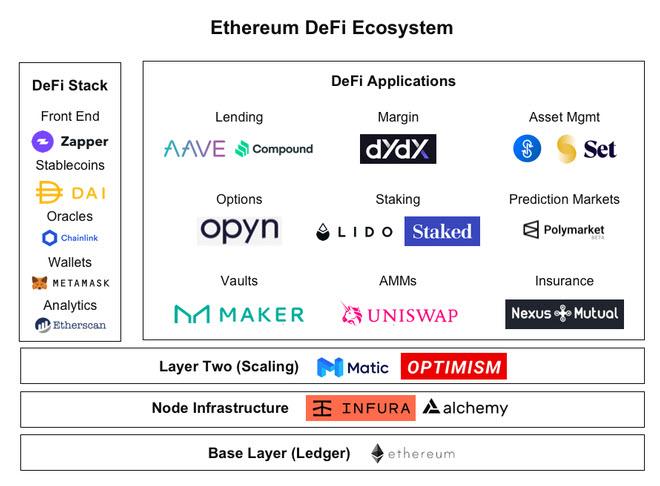
“Aave is now the leader in decentralized finance. There is $10bln of locked capital in Aave protocols. Almost half of the $15bln in DeFi lending happens on the Aave protocol. Of the interest paid through DeFi lending, 46% is done through Aave at an annualized rate of $245mm. It is tempting to trivialize the achievement. After all, total loans and leases in the US commercial banking system are more than $10trln. But keep in mind Stani Kulechov achieved his graduate degree in law in 2018 and his interest in computer programming was cultivated as a teenager. The revolutionaries are not chasing any traditional financial institution. They are chasing a desire to make things better, and a hope for getting closer to the truth. In Kulechov’s words, “DeFi might not replace all TradFi service providers, but it will replace the software and infrastructure that TradFi is based upon”. With no hint of irony, he observes that “TradFi becomes the gateway for DeFi.””
“Regulation. It is the word to put shivers in the spine of any traditional institution evaluating asset allocation in the digital ecosystem. Regulation will not stand for it. Regulation will slow growth. Regulation will redistribute profit. Regulation will force decentralized agencies to be on a level playing field with centralized ones - as though traditional institutions are somehow disadvantaged from capital-starved decentralized players. It is a term used to invoke fear, and it requires far more precision in its mention. The crypto economy is regulated. Ask anybody in the money service business who is registered with FinCEN and provides thousands of monthly reports on suspicious transactions, by regulatory decree. As the crypto economy enters the mainstream, it will blend with TradFi as a matter of practicality. It must and it will.”
“Regulation is the gateway for DeFi to enter the mainstream, and it is already happening. Last August, Aave received an Electronic Money Institution license from the UK Financial Conduct Authority, that allowed the protocol to trial services with UK citizens. Aave Pro will be released in this month, aimed at bringing institutions into the liquidity pool of decentralizing lending. Well-regarded smart contracts will add centralized tools such as whitelisting of addresses and know-your-customer provisions. These are precisely the steps that the FATF regulatory body would desire.”
“There is no turning back,” explained Marcel. “The technology is being tested, adopted, and admired. The revolution is happening from within institutions with leaders who see a better way. It will take time for users to see the value. After all, statues of revolutionaries are only mounted long after their work is done. But make no mistake – the people and firms who underestimate the intelligence, drive and creativity of those working on change are precisely the ones who will be, at best, left behind and, at worst, run-over by the technologies. These are not our parents’ revolutionaries.”
Anecdote
Each generation believes it can create a better world. Were it not so, we would still live in caves. Some generations thirst for change through revolution. That probably has to do with longer term economic and political cycles. But for whatever reason, amongst these revolutionary generations, some are more determined, effective. The 1960s-70s youth seemed radical, but they were far from French revolutionaries. Their actions failed to spark an inferno. My wife Mara grew up in a hippy enclave during that period. Her town sought to opt out of the system by going backward, living off the land, returning to simpler times.
But history rarely turns back the clock for long. That generation never had a credible plan to replace the system with something better. Nor did it have a new technology to amplify force. The establishment knew this. The youth back then presented no real threat, just the appearance of instability. Daisies and LSD.
But today’s youth have built the technologies to power revolution. Their protocols remain nascent, but if they’re allowed to flourish (or if they cannot be stopped), they will credibly replace incumbent industries that the masses have come to despise (retail banks, commercial banks, central banks, wall street, money transfer agents, credit card companies, social media companies, exchanges of every kind, censors, and the list has just started). Someday these technologies may threaten our notion of centralized government control.
In the 1960s-70s, incumbents knew the revolutionaries had no credible plan. This time, revolutionary technologies are already being rolled out. They are more efficient, cheaper, faster. They cut out the middlemen. And empower the individual. Today’s incumbents are threatened with extinction. In fact, if today’s business leaders were 30yrs younger, most would be racing to build their companies/wealth in this new field of blockchain. This is what a credible revolution looks like, waged by brilliant youth, impassioned, with fantastic ideas, immense wealth, and humanity’s most powerful technologies, applied in ways that incumbents can barely understand. And it is too early to tell exactly where this new generation will lead us, only that it is to a profoundly different future.

NY Post : Gigantic diamond sells for $12M in cryptocurrency at Sotheby’s auction

Gigantic diamond sells for $12M in cryptocurrency at Sotheby’s auction

A flawless 101.38-carat diamond was sold at auction for more than $12.2 million in cryptocurrency Friday, making it the most expensive piece of jewelry ever peddled through crypto, according to Sotheby’s.
The massive diamond, called “The Key 10138,” was sold in Hong Kong to an unidentified private collector, said the 277-year-old auction house in a statement.
The gem is one of just 10 diamonds of more than 100 carats ever to come to auction.
The auction house had said it would accept payment for the diamond in either Bitcoin or Ether, but it was unclear which digital coin was used to buy the gem.
Despite the record sale, the diamond sold for less than the upper end of its estimated value of $15 million.
Auction Houses such as Sotheby’s and rival Christie’s have increasingly taken to accepting cryptocurrency as payment this year as the popularity of digital coins surged.
The diamond sold for less than the upper end of its estimated value of $15 million.
REUTERS

“The Key 10138” was sold in Hong Kong to a private collector.
REUTERS
Sotheby’s in May sold a Banksy piece for $12.9 million in crypto — the first instance of a work of physical art sold by a major auction house in exchange for cryptocurrency.
And back in March, Christie’s made waves by selling a non-fungible token for the first time ever. The NFT, or one-of-a-kind, blockchain-based, digital artwork, sold for a staggering $69.3 million.
Even as cryptocurrency has been increasingly embraced by institutions such as Sotheby’s, as well as banks and major US corporations, the value of the digital tokens remains extremely volatile.
Bitcoin, the biggest cryptocurrency by market cap, touched an all-time high of more than $64,000 in mid-April before falling back down and briefly dropping below $30,000, erasing its gains for the year.
Bitcoin was last seen trading at about $33,500 per coin.

NY Post : Adidas auction of Reebok takes a hit as key bidder Authentic Brands dr

Adidas auction of Reebok takes a hit as key bidder Authentic Brands drops out

A key bidder has dropped out of the auction for Reebok, making it more likely that German-based Adidas will take an even bigger hit on its disastrous, 15-year stint as the owner of the struggling sneaker brand, The Post has learned.

As reported by The Post, Authentic Brands Group — a fast-growing licensing firm whose properties include Forever 21, Brooks Brothers and Nine West — offered about $1 billion for Reebok in the auction’s first round, teaming up with Wolverine Worldwide, the footwear maker behind Merrell shoes, Hush Puppies and Stride Rite.

But talks with New York-based ABG recently hit the rocks over Adidas’ demands that ABG operate Reebok as a standalone business, sources said. In addition to paying out fees to Adidas for at least several years through a transition services agreement, Adidas was asking ABG to avoid layoffs of Reebok employees, even as it continued to feed Adidas’ sneaker distribution networks, insiders said.

Instead, ABG’s chief executive — the prolific dealmaker Jamie Salter — had wanted to buy the rights to the Reebok name and integrate its US business with Sparc Group, its joint venture with mall giant Simon Property that runs Aeropostale, Brooks Brothers, Forever 21, Lucky Brand and Nautica. Wolverine Worldwide, meanwhile, was planning to help with sourcing manufacturing overseas.

“Adidas wants to sell Reebok with everything and wipe their hands clean,” a source close to the situation said. But ABG’s Salter “just buys brands and licenses them. There would be job losses in Europe.”

The bid from Authentic Brands — which on Wednesday filed plans to go public with the Securities and Exchange Commission — had stood to be the highest for Reebok. The money-losing label — which lately has made a run to revive its business in a tie-up with rapper Cardi B. — has also attracted bids from buyout firms Advent International, Cerberus Capital Management, CVC Capital Partners and Sycamore Partners, sources said.

Nevertheless, the auction of the 126-year-old shoe icon, which kicked off in February, will only fetch a fraction of the $3.8 billion Adidas paid for it in 2006.

The company’s steep losses — more than $100 million in a year before interest, taxes, and amortization, according to a source — mean potential buyers cannot borrow money to use toward the purchase. It has projected profits within five years under a new owner, but a source said Reebok’s revenue fell last year to $1.5 billion from $1.8 billion in 2019.

Ironically, it’s the partnership with Sparc that would have enabled ABG to pay a higher price for Reebok than rival bidders — partly because of the layoffs it would entail, sources said. Meanwhile, Wolverine is not interested in bidding without Authentic Brands, sources said.

Adidas has set an Aug. 2 deadline for binding, second-round bids. While ABG has dropped out of the process, some insiders aren’t ruling out that it could reach a last-minute compromise with Adidas. Either way, sources expect Adidas will sell Reebok, as a disappointing price tag should not greatly impact its own stock price.

Founded in England in 1895, Reebok took off in the 1980s when it introduced the first athletic shoe specifically designed for women. Reebok has since lost its footing as it seeks to compete with a growing number of women’s fitness brands, including Saucony and Puma.

“Going forward, the company intends to focus its efforts on further streamlining the leading position of the Adidas brand,” the company said in a February press release.

Reps for Adidas and ABG declined to comment.

FILED UNDER ADIDAS , AUTHENTIC BRANDS , JAMIE SALTER

WSJ : Bat Scientists Warn That the World May Never Know Covid-19 Origins

Bat Scientists Warn That the World May Never Know Covid-19 Origins
Researchers believe bats harbor deadly viruses that cause SARS, Ebola and other diseases, but proving it can be frustratingly inconclusive

Since the start of the Covid-19 pandemic, scientists all over the world have been struggling to pin down the origin of the coronavirus that caused it.

Linfa Wang knows they may never succeed.

Dr. Wang, a professor in the emerging infectious diseases program at Duke-NUS Medical School in Singapore, is an expert in bat viruses. He has joined the hunt for the origin of Covid-19 even though he and fellow scientists are still searching for the precise source of a different coronavirus: the one that causes severe acute respiratory syndrome, or SARS. That virus emerged in 2002 and killed nearly 800 people world-wide.

Research on the origin of SARS and other deadly viruses offers a cautionary example of the manifold challenges that confound the pursuit of the origin of SARS-CoV-2, the virus that causes Covid-19.

SARS started as an outbreak in China, rapidly traveled around the world infecting and killing people, and disrupted the global economy. The Chinese government was criticized at home and abroad for not sharing information quickly enough with the public and with World Health Organization officials trying to get a handle on the disease.

Then, as now, suspicions turned to bats. Dr. Wang, now 61 years old, was a member of the 2003 WHO mission investigating SARS. At a meeting in Beijing with his Chinese hosts, Dr. Wang said he raised the possibility that the flying mammals could harbor SARS-like strains that ultimately caused the outbreak. Bats are popular both as food in some areas and traditional medicine in China. They make up a fifth of all mammals, creating a large and mobile group of potential disease spreaders.

To make the case, Dr. Wang collaborated with virus researchers in China for more than a decade, searching for definitive proof.

After preliminary work elsewhere, his Chinese colleagues focused their attention on a large population of horseshoe bats sharing a cave in Yunnan province. Year after year, the researchers scooped up guano from the cave floor and analyzed it for viruses. They drew blood and took saliva and urine samples from the captured bats, trying to avoid being bitten.

In 2017, the scientists proposed their origin theory: They found bats with a coronavirus strain that had the ability to infect humans. The scientists speculated that bats living in the same cave infected each other with different viral strains, which mixed together and eventually created a SARS-like virus that jumped into humans.

After all the painstaking, gritty work, this was the closest they could come to finding the disease’s origin.

“There is still no smoking gun,” Dr. Wang said. “We have never found a bat that is the source of SARS that humans have.”

Political obstacles
From the beginning, today’s search for SARS-CoV-2 has been stymied by political obstacles. China delayed entry to a WHO-led team that went there last January to investigate the outbreak. “No one wants you to find a virus in their country,” Dr. Wang said.

The report released by the WHO-led team after its visit has been criticized for calling the possibility that the virus escaped from a Chinese laboratory highly unlikely. The U.S. and other countries recently called for a second phase of studies to explore the two main hypotheses that the virus resulted from a lab leak or jumped to humans naturally from infected animals.

But politics isn’t the only thing that stands in the way. Scientists studying pathogens that seem to jump from animals to humans don’t always agree on how to interpret their findings. Reaching a consensus can take years—if one comes at all.

In the years after the SARS outbreak, investigators around the world intensified efforts to collect animal samples, hoping to find early warning signals of potential spillovers. They often joined forces when a lethal outbreak emerged. There were plenty, including Middle East Respiratory disease—or MERS—in 2012 and an Ebola epidemic in West Africa, the largest one in history, which lasted from 2014 to 2016. Many times scientists got some answers but weren’t always able to identify the progenitor virus, the virus that led to the one that emerged in humans.

In 2019, for instance, scientists announced that a bat captured at an abandoned mine in Liberia carried traces of the Ebola virus—the first time evidence of the West African outbreak virus was found in nature.

Scientists have spent over 40 years looking for the virus’s natural reservoir since Ebola was first identified in 1976.

“We have accumulated all this data that continues to point to bats but conclusive evidence still eludes us,” said Simon Anthony, a virologist at the University of California, Davis, who was part of a U.S.-funded virus hunting team that yielded the 2019 discovery.

Last year, they finally finished testing more than 45,000 saliva and fecal samples and failed to find the Ebola virus in even one additional bat. “We only have this one positive bat,” Dr. Anthony said. “It’s not enough to be sure.”

Scientists must be cautious when drawing conclusions, Stanford University epidemiologist Stephen Luby said. He was one of the leaders of an investigation into the origin of a deadly Nipah virus outbreak in Bangladesh in 2008.

Interviews with villagers revealed that all of those who had been infected fell ill after consuming raw date palm sap, a popular beverage in Bangladesh.

Villagers had observed bats roosting in trees from which the sap had been collected, and bats are known to harbor Nipah virus. But scientists disagreed if the virus had moved from bats into people due to contamination of the sap.

Infrared video cameras mounted on trees showed bats licking the date palm sap stream 59 times. If a bat had been infected with the virus, the scientists said in a paper about their findings, it could have contaminated the sap and infected the people who drank it.

The photographic evidence made the researchers’ explanations more plausible and accepted by other scientists, but it doesn’t prove that Nipah was transmitted from bats to people that way in the outbreak, Dr. Luby said.

He draws a lesson relevant to the search for Covid-19’s origins. “We don’t have a time machine to go back and observe the first event. You collect evidence and try to tell a reasonable story,” Dr. Luby said. “But the risk is you tell a story that sounds good. It becomes persuasive, even though it’s wrong.”

Bat people
The scientists are a tightknit bunch. They frequently write papers together. They encounter each other in the field and debate origin theories at conferences, then go out for drinks.

Given the sheer number of animals and viruses they needed to survey, “You have to operate from trust,” said Dr. Jonna Mazet, a University of California, Davis, epidemiologist. She is the former global director of a large U.S.-funded early-warning project that supported scientists all over the world hunting for sources of Ebola, SARS and other diseases.

One of the bat scientists stands uncomfortably in the glow of the world spotlight. Dr. Shi Zhengli, a scientist at Wuhan Institute of Virology in Wuhan, China, shares Dr. Wang’s fascination with bats. She teamed up with him to look for SARS-like viruses back in 2004. Her work in caves and in the lab eventually earned Dr. Shi the nickname the “Bat Woman” of Wuhan. The lab is now at the center of the controversy over the origin of SARS-CoV-2. Dr. Shi didn’t respond to a request for comment.

Dr. Wang said he would be astonished if Dr. Shi were involved in a political coverup. “I have hundreds of collaborators and only one or two have lasted this long because we are similar,” he said. “We focus on science.”

The SARS quest
At the beginning, China went to great lengths to hide the full extent of the SARS outbreak from the public and the international community. Information about the disease’s spread was initially kept secret. Eventually, a public outcry by Chinese citizens along with international pressure forced China to take action. Strong public-health measures brought the disease under control within several months.

China initially banned the sale of masked palm civets, animals with a long tail and a white mask across the forehead. Some scientists suspected the virus may have emerged in the animals, which were sold for food.

Dr. Wang, who arrived in China in August 2003 as part of the WHO team investigating the SARS outbreak, wasn’t convinced. Testing of animals sold at live markets in Guangdong, where the earliest identified human cases of SARS occurred, revealed infections in masked palm civets. Dr. Wang thought the civets in the market got infected as people had, because they were susceptible to SARS, rather than the natural reservoir of the virus.

Even so, he wasn’t yet sure bats were the culprit in SARS. “It was difficult to convince people,” Dr. Wang said. “Even myself, I wasn’t 100% convinced.”

During a meeting, Dr. Wang said the then-director of the Wuhan Institute suggested he reach out to Dr. Shi, a scientist in the institute, to discuss the idea. They met the next year at a scientific conference in Wuhan, his first visit to the city. Dr. Shi’s focus at the time was shrimp biology, but she told Dr. Wang that she was interested in animal diseases that cause illnesses in people and agreed bats were worth a closer look.

In a paper the researchers helped write in 2005, they shared data from tests of 408 bats representing nine separate species. They found evidence of SARS-like viruses in horseshoe bats and fruit bats. But they still hadn’t found a bat with a SARS-like virus with the ability to infect civets or humans.

A breakthrough came from a 12-month-long survey at the cave in Yunnan. By collecting fecal samples from the horseshoe bats year-round, the scientists increased their chances of finding bats with active coronavirus infections. They found a SARS-like virus in a bat that in subsequent lab tests did have the ability to infect human cells. In a 2013 paper, they called it “the clearest evidence yet” that SARS not only originated in bats, but could directly infect humans without having to first go through an intermediate animal such as civets. “The eureka moment is a slow process,” said Dr. Wang. “You put the pieces together like a jigsaw puzzle.”

For Dr. Wang, the critical piece of the puzzle came in a 2017 paper, over a decade after his trip to China on the WHO mission. Additional years of collecting bat samples from the same cave led to the discovery of a bat SARS-like virus even more closely related to the SARS outbreak one. They were finally ready to lay out the argument that the epidemic virus originated after a series of recombination events, when bats harboring various SARS-like viruses infected each other, with the viruses swapping genetic material to ultimately create the pandemic strain.

They also issued a warning that other SARS-like coronaviruses capable of infecting people were already circulating among bats in the region. The emergence of another SARS-like epidemic was a very real possibility, they wrote.

Over the years, Dr. Wang and Dr. Shi became friends. He said he was invited to the institute in Wuhan three to four times a year to attend meetings and serve as an expert adviser on projects. He supervised students, some of whom traveled to his lab. Dr. Wang, who grew up in Shanghai, said he and Dr. Shi liked to sing traditional Chinese ballads together at karaoke bars.

In early January, 2020, Dr. Wang was on one of his regular trips to Wuhan, attending meetings on bat coronavirus research. Covid-19 was already spreading in the city.

He used public transportation and took taxis. He went with Dr. Shi and other friends to restaurants. “The best restaurants were crowded,” he said. “In January it was already very dangerous, but I didn’t see it that way.”

He flew back to Singapore on Jan. 18, five days before China locked down the city. He hasn’t been back since.

Unable to travel to China but eager to move forward with his work on the search for the origin of SARS-CoV-2, Dr. Wang collaborated with scientists in Thailand on a paper published earlier this year. The scientists tested fecal samples from 100 horseshoe bats living in a nature sanctuary there. Thirteen swabs tested positive for coronaviruses similar to, but not the same as, SARS-CoV-2.

That inconclusive finding was a reminder of just how hard it is to prove the origin of a deadly virus while bolstering Dr. Wang’s resolve not to give up. “We may never know,” said Dr. Wang. “We will keep looking.”
(ZH) UK Scrambled Sub-Hunting Aircraft As Russian Submarine 'Stalked' Carrier In

UK Scrambled Sub-Hunting Aircraft As Russian Submarine 'Stalked' Carrier In Mediterranean

UK media on Friday revealed another major military close encounter with a Russian vessel following the June 23 Black Sea warning shot incident - but this time in the Mediterranean where a Russian submarine was said to be "stalking" the Royal Navy's Carrier Strike Group in the waters.
The Telegraph on Friday broke the following based on defense sources:
A Russian submarine stalked the Royal Navy’s Carrier Strike Group (CSG) prompting a helicopter hunt for the vessel, The Telegraph can reveal.
Merlin helicopters were scrambled to search for the Russian submarine when the group was passing through the eastern Mediterranean.
HMS Queen Elizabeth, Wikimedia Commons
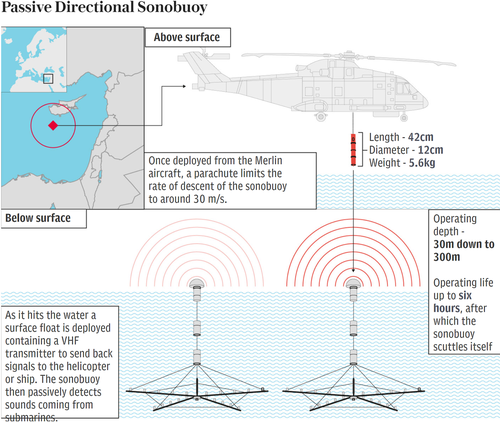
The Royal Navy sub-hunting helicopters as part of their search and identification efforts dropped sonobuoys, specially designed listening and monitoring devices sunk beneath the water which can pick up submarine movements.
The report doesn't identify which specific Russian sub the UK military was on the lookout for, only that it was likely a diesel-electric Kilo-Class submarine from the Black Sea fleet. It was further suggested there was high confidence it was trailing British vessels within the days after the prior Black Sea incident. The sub was said to be stalking the HMS Queen Elizabeth and accompanying strike group vessels.
"The hunt for the submarine took place four days after the confrontation in the Black Sea between HMS Defender, a Type-45 air defence ship, and Russian forces" - The Telegraph report indicates, however, the information is only just now being revealed at the end of this week.
Merlin sub-hunting helicopter, Royal Navy vile image
For years Russia's navy and aerial forces have had a significant presence in the eastern Mediterranean, especially off Syria's coast where the Russian naval base at Tartus is located.
More details on the Royal Navy's scrambling a response effort from The Telegraph report are as follows:
There are seven such helicopters deployed with the group, and these would likely have been operating in coordination with other anti-submarine assets. These include the two Type-23 frigates HMS Kent and HMS Richmond and the Royal Navy’s deployed hunter-killer submarine, thought to be HMS Astute or HMS Ambush.
While the MoD refused to confirm the incident, understood to have occurred on June 27, it said "robust measures" were in place to protect the CSG, which is on its first operational deployment.
Source: The Telegraph
HMS Queen Elizabeth and its escort ships are now out of Mediterranean waters after traversing the Suez Canal, and about to enter the Indian Ocean as part of an eight month deployment.
Currently, NATO and allied vessels continue a heavy presence in the Black Sea, especially given the ongoing Sea Breeze 2021 exercises, which involve Ukraine's military participation as well. This sets the stage for potentially more dangerous close encounters with Russia's military, which has warned it will fire upon any vessel breaching its territorial waters.

>> Weekend Papers Summary

Weekend Papers Summary
NEW YORK TIMES
Saturday
· President Biden signed an executive order on Friday “to increase competition within the nation’s economy and to limit corporate dominance, factors”. The White House blames these factors for having led to “higher prices and fewer choices for consumers while dampening pay and restricting the freedom to change jobs.”
· After 24 hours of gunfire between police and suspects in the assassination of Haiti’s president, national authorities said they had arrested 20 people “and called on the United States to send troops to help protect crucial infrastructure.”
· Rony Célestin, who poses as a self-made multimillionaire, is one of the few lawmakers left in Haiti. And as “only 10 remaining members in all of Haiti’s Parliament, belongs to a tiny circle of leaders with the legal authority to steer the nation out of crisis now that the president is dead.”
· President Biden fired the head of the Social Security Administration, who had been appointed by President Trump’s on Friday, “setting off a possible legal showdown over who rightfully holds the position.”
· Taliban forces entered Kandahar, Afghanistan’s second-largest city, on Friday “in a new phase of a sweeping insurgent offensive that has captured territory across the country since May 1, when U.S. forces began withdrawing.”
· Basking in the glow of his Democratic nomination for mayor of New York City, Eric Adams has started to outline his mission if elected in November: “Making our city safe,” he said in an interview.
· Generation Z, made up by those people born between 1997 and 2012, want to shift away from Email, considering it highly outdated.
· Four years “after a woman was killed and dozens were injured,” the City of Charlottesville, VA., was removed on Saturday at 8:00 am, along with a nearby monument to Stonewall Jackson, another Confederate general.
· Science does not support the notion that “marijuana improves performance…. To the contrary, the evidence is inconclusive at best.”
· The Sea of Marmara, fabled for its blue waters has been suffering from pollution has for a long time, and a paroxysm this year has choked its waters and suffocated marine life.

FINANCIAL TIMES
Weekend
· Business groups have objected to President Joe Biden’s executive order to “curb the power of big business by stamping out anti-competitive practices,” which was signed on Friday as part of the White House’s strategy “to tackle concentrations of corporate power in several sectors.”
· Despite cases of coronavirus and hospital admissions rising every day, Britain is preparing to lift Covid-19 related “restrictions, from social distancing to mask wearing, in a bid to restore normality.”
· Chinese companies “that have the data of more than 1m users will need to pass a security review before issuing shares on overseas stock exchanges, the country’s internet regulator said on Saturday.”
· Intel (INTC) said it would spread its new European $20 billion investment in semiconductor production “across several EU member states, as it lobbies to win the bloc’s financial and political support for the project.”
· Less than 33% of US condominium associations “have sufficient funds saved up for big-ticket repairs such as structural work or replacing a roof, and experts say delays and disagreements are common not just in Florida but across the US.”
· The G20 economy ministers and central bankers gathered in Venice to discuss the G7 and OECD approved proposal to force multinational companies to pay a global minimum corporate tax.
· Bond fund managers “who bucked a market consensus earlier this year that long-term interest rates and inflation were headed sharply higher,” saw higher than expected returns in the past few weeks.
· Spanish Prime Minister Pedro Sanchez has ordered a deep reshuffle of his government “as his ruling Socialists seek to regain the initiative after a series of setbacks on the political, economic and diplomatic fronts.”
· Sarah Friar, the new chief executive of the social network Nextdoor, “is trying to recreate that camaraderie and Blitz spirit, this time, online.” Nextdoor is a niche platform compared with the larger social media platforms, aimed at local news, services and businesses.

NEW YORK POST
· Authorities are searching for a 30-year-old inmate, identified as David Mordukhaev. He fled the Vernon C. Bain Correctional Center, a floating prison barge, on Halleck Street, in The Bronx overnight.
· Younger people are being hospitalized in Spain, which was reopening to facilitate summer season tourism, due to a resurgent coronavirus contagion. “The country has prioritized vaccination for its elderly and at-risk populations, while younger less vulnerable groups have largely eschewed the jab.”
· The Office of the Director of National Intelligence (ODNI) was the subject of jokes on social media for having used a clearly photoshopped image, featuring “smiling, diverse office staffers standing in a lobby, flanked by a woman in a wheelchair and a blind man with a seeing-eye dog.”