After Hours Summary: ZIP +12.6%, RKT +5.5%, DIS +5.4% higher on earnings; WISH -19.8%, SOFI -9.8%, ABNB -4.7%, DASH -3.8% fall on earningsAfter Hours Gainers:
Companies trading higher in after hours in reaction to earnings/guidance: ZIP +12.6%, RKT +5.5%, DIS +5.4%, DOMA +5.3%, LZ +4%, PAGS +3.7%, VIAV +3.4%, GLOB +1.3%, MAX +0.8%, SEER +0.5% (also signs distribution agreement to commercialize Proteograph in China), RSI +0.4% (also names new CEO), SXI +0.2%, AQN +0.1%
Companies trading higher in after hours in reaction to news: FUSN +10.2% (announces expanded R&D collaboration with TRIUMF), CBLI +5.5% (announces collaboration agreement with the La Jolla Institute for Immunology), SMSI +1.6% (names interim CFO), MRNA +1.1% (announces publication of new study showing vaccine maintains antibodies against variations of concern for six months), CRMD +1% (files for $150 mln mixed securities shelf offering), BSX +0.9% (awarded $270 mln Defense Logistics Agency contract), MLM +0.4% (increases dividend), INDB +0.3% (files mixed securities shelf offering), DKNG +0.2% (reports opening day results for first Premier Preseason Access Collection), LEA +0.1% (increases dividend)
After Hours Losers:
Companies trading lower in after hours in reaction to earnings/guidance: WISH -19.8%, XMTR -10.9%, SOFI -9.8%, EAR -9.8%, FIGS -8.9%, BODY -8.9%, TTCF -8.9%, CRCT -8.6%, ABCL -4.9%, ABNB -4.7%, DASH -3.8%, MCW -1.1%, WPM -0.1% (also increases dividend), AGTI -0.1%
Companies trading lower in after hours in reaction to news: PPTA -7.5% (stock offering), RLAY -3% (files for $300 mln common stock offering; also files for mixed securities shelf offering; also reports earnings), NKTX -2.8% (files for $500 mln mixed securities shelf offering), AWK -1.9% (acquires River's Edge water and wastewater systems), IMMR -0.4% (signs license agreement with TITAN Haptics), MYOV -0.2% (names new CFO), CP -0.1% (KSU rejects CP proposal)
How French Energy Traders Sold "Carbon Neutral" Natgas To China That Doesn't Exist
French energy giant TotalEnergies SE orchestrated a "carbon-neutral" liquified natural gas shipment with China National Offshore Oil Corp (Cnooc) last September. The math behind the carbon-neutral fuel "involved googling and guesswork," according to Bloomberg.
An insider who spoke with Bloomberg said junior traders at Total learned about carbon-neutral cargos from a client who had already purchased two from Royal Dutch Shell Plc. They said the inexperienced traders were able to figure out how to neutralize the emissions of LNG through internet searches of green projects they could fund.
The traders were able to find a project thousands of miles away in Zimbabwe that allowed them to fund a carbon-neutral deal that allocated money to brush clearing to reduce wildfires. Bloomberg called the deal "complicated new math." There was limited evidence to support how Total's brush clearing in southern Africa would offset natural gas carbon emissions.
But to make it work, Total's pioneers of carbon neutrality first needed to find green projects capable of meeting two requirements: generate carbon credits backed by an international organization, without costing too much. After struggling to come up with an answer, the team set up a meeting with South Pole, a project developer based in Zurich that came recommended by rival traders. That's how $600,000 from a $17 million LNG transaction ended up, in part, paying for forest protection in Zimbabwe.Source: BloombergThe resulting trade looks like a win for everyone. Total kept its promise to investors to shrink its carbon footprint. Impoverished communities received financial support. And the buyer, China National Offshore Oil Corp., cited the shipment as one of the steps it's taking to "provide green, clean energy to the nation."But climate experts and even a crucial organizer behind the deal say it will do virtually nothing to decrease carbon dioxide in the atmosphere, falling far short of neutral. -Bloomberg


Danny Cullenward, a Stanford University lecturer and policy director at CarbonPlan, a nonprofit group that analyzes climate solutions for impact, called Total's carbon-neutral gas shipment a sham:
"The claim that you can market the sale of fossil fuels as carbon neutral because of a meager few dollars you put into tropical conservation is not a defensible claim," Cullenward said.
He said efforts to prevent wildfires in Zimbabwe could prevent large burns and deforestation. Though villagers in the country have zero interaction in reducing pollution from natural gas - the carbon-neutral gas shipment is merely for governments, energy companies, and consumers to feel good about supporting green causes.
The use of "carbon neutral" and "net-zero" is a marketing ploy and is meaningless in Total's carbon-neutral fuel to Cnooc. Cullenward believes that avoiding deforestation isn't the same as removing greenhouse gases. "This paradigm," he warns, "is encouraging a fictitious engine that doesn't help advance our net-zero goals."
Renat Heuberger, co-founder of the South Pole, the company that helped develop the Zimbabwe project and sold carbon credits to Total, doesn't believe the project in the South African country will offset pollution from natural gas. "It's such obvious nonsense - even my 9-year-old daughter will understand that's not the case. You're burning fossil fuels and creating CO₂ emissions."
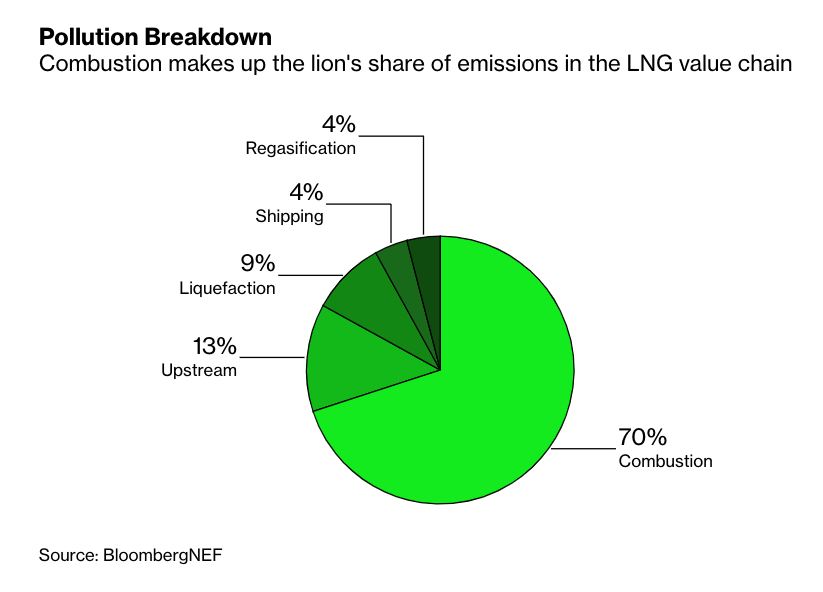
Total's natural gas first began releasing emissions when it was extracted off the Australian coast. Then the gas was piped 553 miles with the risk of leakage. Chilling the gas into a liquid form for shipping to China involves additional emissions. Then loading LNG onto a vessel and crossing the waters to Shenzhen in southern China releases even more emissions.
Source: Bloomberg
Once the shipment arrived, the traders also had to figure out the natural gas emissions burned at Shenzhen powerplants into the electricity grid serving more than 12 million people. Total and Cnooc determined the shipment's emissions were at 240,000 metric tons of CO₂, or about 30,000 U.S. households in a year.
Fauziah Marzuki, an analyst at research group BloombergNEF, said the estimate was fuzzy at best, and there are too many variables to claim Total's LNG shipment to China was carbon-neutral: "No one has convincingly produced an accurate calculation."
Gapping down
In reaction to earnings/guidance:
- LFST -20.2%, DIBS -20%, GOCO -16.8%, AZPN -11.1%, RXT -9.8%, FOA -9.2%, UTZ -8.8%, CPNG -8.7%, MQ -7%, MTTR -6.5%, SDGR -6.5%, CYBR -5.9%, ROOT -4.4%, GRWG -3.5%, BLNK -3.2%, CSIQ -2.4%, BIDU -2%, EBAY -1.7%, DM -1.5%, DCBO -1.4%, ARRY -1.2%, CACI -1%, VRM -1%, PGTI -0.9%
Other news:
- FSR -6.9% (announced Green Convertible Senior Notes offering)
- PTRA -6% (signed long-term supply agreement with LG Energy Solution for EV battery cells)
- CWK -4.4% (announced secondary public offering)
- OMF -4% (prices offering of 7.0 mln shares of common stock held by Apollo Global Management (APO))
- DEA -3% (announced public offering)
- FULC -2.2% (prices offering of 6.6 mln shares of common stock at $19.00 per share)
- GTES -2.1% (prices secondary offering of 25 mln shares of common stock at $16.00 per share)
- NVVE -1.9% (expanded partnership with Blue Bird [BLBD] for electric school buses)
- CNR -1.8% (provides performance updates at Barclays Building & Building Products Virtual Conference)
Analyst comments:
- ARCT -3.2% (downgraded to Underperform from Mkt Perform at Raymond James)
- COHU -2.8% (downgraded to Sell from Neutral at Goldman)
- MU -2.7% (downgraded to Equal-Weight from Overweight at Morgan Stanley)
- BECN -1% (downgraded to Hold from Buy at Berenberg)
- CARR -0.8% (downgraded to Neutral from Buy at UBS)
Gapping up
In reaction to earnings/guidance:
- CLOV +18%, OPEN +17.9%, SONO +11.2%, HIMS +9.8%, FOSL +8.6%, DDS +8.1%, MSP +7.6%, PLTR +7.3%, APP +6%, RIDE +5.7%, UP +5.3%, GDRX +4.2%, OGN +4.1%, AZEK +2.8%, EYE +2.1%, BOX +2.1%, SHC +1.8%, RGLD +1.7%, AVXL +1.6%, NIO +1.5%, BMBL +1.3%, MDP +1%
Other news:
- XONE +38.9% (agreed to be acquired by Desktop Metal [DM])
- CTSO +16.2% (granted a second Breakthrough Device designation for its DrugSorb-ATR Antithrombotic Removal System by FDA)
- XERS +13.6% (announced FDA acceptance of IND application for XeriSol levothyroxine for hypothyroidism)
- TPTX +13.1% (received sixth regulatory designation for repotrectinib from the FDA)
- BLDR +4.5% (authorizes the buyback up to $1 bln of common shares)
- KNBE +3.2% (prices offering of 10,430,910 shares of its Class A common stock by certain selling stockholders at $20.75 per share)
- RGLD +1.7% (acquires 1.0% net smelter return royalty)
- CCCC +1.6% (received FDA orphan drug designation for CFT7455 for treatment of multiple myeloma)
- OCFT +1.4% (Chairman and CEO and certain other members of mgmt intend to purchase up to $10 mln worth of ADSs during a three-month period following today)
- RDN +1.2% (approves $200 mln increase to share repurchase authorization)
Analyst comments:
- MHO +2.3% (upgraded to Outperform from Neutral at Wedbush)
- CARG +1.8% (upgraded to Buy from Hold at Needham)
- LYFT +1.7% (upgraded to Buy from Neutral at Northcoast)
- HFC +1% (upgraded to Equal Weight from Underweight at Wells Fargo)
- CGC +0.8% (upgraded to Hold from Underperform at Jefferies)
Chrono24 Watch Marketplace Gets $1 Billion Valuation
General Atlantic and Bernard Arnault’s Aglaé Ventures participated in the company’s latest fundraising round.
There’s a new billion-dollar darling with a growing resale angle.
Chrono24, a digital marketplace platform for new and pre-owned luxury watches, raised more than 100 million euros, or $118 million, from a group of top-shelf inventors, scoring a valuation of more than $1 billion.
The Series C fundraising round was led by private equity standout General Atlantic and included funds from LVMH Moët Hennessy Louis Vuitton chief executive officer Bernard Arnault’s Aglaé Ventures, Insight Partners and Sprints Capital.
Based in Karlsruhe, Germany, the company has raised more than 200 million euros to date.
Chrono24 plans to use the new money to deepen its presence in the 100 countries where it already operates and to keep ramping up in the pre-owned watch market.
That puts the company in sync with the growing emphasis on resale — which stretches from sustainability-minded consumers to investors and includes The RealReal Inc., ThredUp, Poshmark and more. Platform companies are also in vogue, sitting at the crossroads between buyers and selling and facilitating the transaction.
Chrono24 was founded in 2003 as a peer-to-peer marketplace and has gained real scale as it has evolved. The marketplace carries about 500,000 watches from more than 3,000 retailers and 30,000-plus private sellers, reaching better than 9 million unique visitors a month.
Chrono24 will continue to be led by founder and co-CEO Tim-Stracke, co-CEO Holger Felgner and chief financial officer Stephan Kniewasser.
Stracke said, “As originators of the digital marketplace concept within the luxury watch world, we’ve built a platform that not only supports and encourages evolving consumer behavior, but also provides invaluable proof of concept to an industry that has traditionally shied away from disruption.”
And Jörn Nikolay, managing director responsible for General Atlantic’s operations in Germany, said: “Chrono24 has become a global pioneer in the creation of a cross-border online marketplace for luxury watches, with an innovative model underpinned by transparency and sustainability.”
Muddy Waters comes clean on Tesla
Much has been written about Carson Block, the volatile and sometimes venomous short-seller who runs Muddy Waters Capital. Now, Block is penning some rare words of his own.
Block just sent clients his first shareholder letter since starting a hedge fund in 2015. In the letter, obtained by DealBook from a source familiar with the fund, Block, a longtime critic of Elon Musk, Tesla’s C.E.O., said that his firm’s multiyear bet against the electric carmaker had been sent to “heaven,” with no plans to revive it.
Block said Musk’s “narcissism” drew his disdain and stoked the belief that Tesla’s business would crater. But Block added that he underestimated Musk’s ability to raise capital in huge amounts, reinvent himself and captivate shareholders.
“The market cap, the luster, the élan of Elon, is still there,” Block wrote, in explaining why his bets against Tesla have gone away.
“Tesla shorts have focused on Tesla’s lack of scale to compete in EVs with GM, Ford, VW, etc.,” Block wrote. “They are correct in that lack of scale would have been the death of Tesla. But they were looking at the wrong scale. Tesla is here not because it has scale in terms of manufacturing base or unit sales. It has scale because of its capital base,” he said of Tesla’s $700 billion market cap. He added:
One could look at Tesla’s market cap and think it’s fragile — that reality will shatter it. However, Tesla should be able to raise many billions before its cap becomes sub-scale — and keep in mind that Tesla equity raises tend to push the stock higher. (Those “dumb money” investors actually knew that capital base scale is what mattered all along.)
Evergrande’s Enormous Bill Finally Comes Due
China’s most indebted property company is selling off strategic assets, but that probably isn’t enough to save it
The troubles of China’s most indebted property developer are still far from over.
Shares of China Evergrande rose 11% this week due to a company announcement that it is in talks to sell part of its stake in listed subsidiaries including its electric-vehicle unit and its property-management arm. But the company’s financial situation remains dire. Evergrande’s stock has lost almost 80% since July last year. Its bonds are trading at distressed levels: Some of them are worth less than half of their par values.
Evergrande’s stakes in the two listed companies are valued around $16 billion, which could help relieve some immediate liquidity pressure. In particular, the property-management company, which is profitable with a stable business, could be appealing to other developers. Its unprofitable EV unit, which is carrying heavy debt and has yet to sell a single car, could be harder to unload. The value of Evergrande’s 65% stake in its EV unit is around $10 billion, a drop of more than 80% since February. Evergrande has already raised around $400 million this month by selling a 7% stake in its internet unit to investors including Tencent.

Still, the company needs to sell even more assets to plug its financial hole. Evergrande had around $104 billion of interest-bearing debt as of March, but that isn’t even the most urgent problem. It doesn’t have any bonds due until March next year. The bigger worry comes from its unpaid suppliers and contractors—many have sued to get their money back and some have managed to get some of Evergrande’s assets frozen.
For example, Shenzhen-listed Leo Group said last week that it is suing Evergrande for $55 million including unpaid advertising fees and commercial acceptance bills that are overdue or nearly due. Construction-material company Lets Holdings said it would stop accepting commercial acceptance bills from Evergrande. The company already owns around $5 million of such bills.
Such small amounts add up: Evergrande had nearly $100 billion of trade payables as of December. Lawsuits and asset freezes could lead to a downward spiral as other suppliers and contractors pile on—relatively small debts from Evergrande’s perspective could be existential issues for its suppliers. Evergrande’s big creditors may be more motivated to negotiate a solution, but it is harder to coordinate with so many smaller businesses.
Evergrande managed to lower borrowings last year partly by increasing its payables, but it will be impossible to pull this off now. More cautious suppliers also mean Evergrande may find it harder to complete existing projects. Other developers may be interested in buying some of Evergrande’s projects, but Beijing’s clampdown on leverage in the sector, which triggered the current crisis, may also limit their ability to do so.
The government is unlikely to let all this unfold into a disorderly scramble, especially when it involves many small businesses and buyers of Evergrande’s presold apartments. But it is also unlikely to let credit keep flowing into Evergrande to continue its debt-fueled growth. The developer will need to keep selling assets and accept being cut down to size. Evergrande’s shareholders, in particular, may not come out unscathed.