(ZH) The Mysterious $4 Billion Kazakhstan-Based Brokerage Behind An Opaque Hedge

The Mysterious $4 Billion Kazakhstan-Based Brokerage Behind An Opaque Hedge Fund's 500% Returns

Just your average, run-of-the-mill, hedge-fund-investing-in-a-brokerage-based-in-Kazakhstan returning 500% story. We know, the newswires are flooded with them, and you're tired of hearing about them, right?
That, of course, is sarcasm.
But for the part about returning 500% based on the operations of what some would call an opaque overseas entity. And it's all because of a mysterious and obscure brokerage called Freedom Holding Corporation, which purports to provide "retail securities brokerage, research, investment counseling, securities trading, market making, corporate investment banking, and underwriting services". Among those services, it claims to open up access to U.S. markets to people overseas.
Freedom claims it is even able to get its hands on hot U.S. IPO listings, according to a Bloomberg look into the company.
Russian billionaire Timur Turlov, who is 33 years old and listed as Freedom's CEO and Chairman, told Bloomberg: “We remain one of the few floodgates to the Western market for customers from our region.”
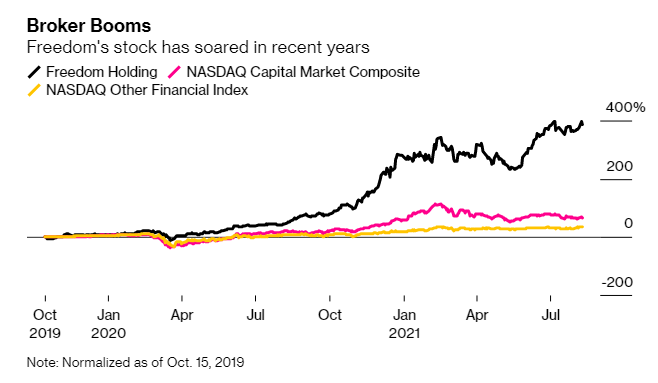
And the hedge fund posting the incredible returns runs through Belize and is "personally controlled" by Turlov. The fund's connections across Wall Street has "secured access to hot new stocks in America" and is allowing Russians, Kazakhs, Uzbeks and Ukrainians to have access to U.S. IPOs, Turlov says.
The arrangement is being done in a manner where the more shares of Freedom that Turlov's customers buy, the more exposure to U.S. listed IPO's they get
Freedom claims to have given its clients access to more than 100 U.S. IPO's, including Airbnb and Bumble.
Turlov explained that he gets in on the names through "an affiliate of a hedge fund that buys the shares from underwriters and passes them along". Of course, Bloomberg continued to note, that firm's identity is "confidential" and doesn't appear in SEC filings.
Reena Aggarwal, director of Georgetown University’s Center for Financial Markets & Policy, told Bloomberg she had "never seen" anything like the arrangement.
Freedom's IPO business is a "marginal" part of the business, Turlov told Bloomberg. Its pre-tax profit was up about 6x in the FY ending March 31, 2021, to $173 million. The brokerage says it has 290,000 customer accounts - a large number for a small region.
Yet the access to IPOs is described as "Freedom’s specialty, their absolute advantage," by Daniyar Temirbayev, who heads the Qazaq Association of Minority Shareholders.
Turlov founded freedom in 2008, and his firm now has 100 branches, more than 2,000 employees, and is worth almost $4 billion. Turlov controls almost three quarters of the company and has made himself a billionaire "several times over".
Not everyone is buying the story right away, however. When asked what chance Freedom would have to getting in on oversubscribed IPOs, Jay Ritter, a finance professor at University of Florida in Gainesville, replied: "Zero".
You can read Bloomberg's full profile of the business here.
(ZH) Rosenberg: Why I No Longer Invest In Stocks And Bonds

Rosenberg: Why I No Longer Invest In Stocks And Bonds

I’ve touched upon this subject in my subscription newsletter, but I had no plans to write anything more until I got a note from a friend, mentioning a particular investment analyst and his views on investing over the next few years. I had to agree that it was brilliant analysis, but at the same time I knew that I’d never do anything about it, because I simply can’t bring myself to put money into “the markets” anymore.
As a young man I spent time learning the nuts and bolts of investing: Price to earning ratios, book values, charting, puts, calls, covered positions, and so on. And when I had extra money, I tended to put it into the markets and use my tools. But I can no longer do that, and I think explaining why may be useful.
There are three reasons for this conviction of mine, and so I’ll list them below. But I’m listing them in reverse order, because reason number one stands above the others: By itself it would prevent me from investing in the usual way. I think all three reasons are strong, but reason number one is pivotal.
Reason #3
Reason number three is simply that the markets no longer make sense. In fact, I’ve now taken to calling them “exchanges,” not wishing to denigrate the concept of markets.
The technical tools the eager young men and women of previous generations used no longer hold. They were never perfect, of course, but now they are superfluous: What central banks and governments buy go up, and that’s almost the end of it. There are complexities and complications, of course (corporate buy-backs are second-order effects of zero-bound interest rates rather than direct actions), but the essence of the matter is clear enough.
The factors driving prices are no longer those of voluntary participants; rather, they are the actions of a small elite who stand out of sight.
And so I’ve lost all trust in the market actions we used to assume. They still hold in black markets and in the cryptosphere, but not in the government-regulated markets. Does anyone still believe that European bond markets are driven by fundamentals?
I know people are going along because it’s the only big game in town, but that strikes me as insufficient cause.
Reason #2
Reason number two is simply that the big “markets” are not just relics of the past, but have become enemies of the future. Let’s be honest and admit that 401Ks and other pension vehicles are compliance tools, directed toward the partly-moneyed class. They tie people to the status quo and penalize leaving it.
It used to be that markets were fairly democratic operations, in that prices were determined by the uncoerced actions of millions of people. That was never entirely the case, of course, but there was substantial truth to it. That, in turn, left markets open to progress: the doors were not shut to something new and frightening to entrenched interests.
Now, unfortunately, the situation has radically changed; business people must be ideologically pure in order to thrive. Mike Lindell of My Pillow makes a perfect example: He produces a product that people like and he conducts honest business. And yet, his advertising is banned by the status quo because of his political opinions. That is direct tyranny; it is anti-market, anti-liberty, and anti-future.
This is what has happened to the markets over the past few generations, and Lindell is but one example. The “markets” are no longer markets; they’ve become appendages of a totalitarian system, and I no longer want to play.
Reason #1
The deep reason that free markets matter is not economic, but moral. What matters most is not that free markets work (even though they do), but that they are the only moral way for humans to arrange their affairs. Everything else involves coercion; everything else minimizes human growth and development.
The financial advisor my friend noted had figured out how to benefit from the abuse being hurled at business by the “green” regulations that are being forced upon Europeans, and which will follow to North America if possible. And again, the analysis was accurate.
What, however, is the benefit of profiting from the abuse and semi-enslavement of millions of people? Shall we be proud of our cleverness and brag about it at cocktail parties? Is “number go up” all there is?
I fully understand about being desperately in need of money: Been there, done that. And so I’m willing to cut plenty of people plenty of slack in that regard; but where does it end? Once we have enough to be comfortable, do we still scratch and claw for every dollar, trying our best to believe that maximization is a worthy goal?
I won’t go much further on this (see FMP #112 and #103 if you’re interested in more) , but the idolization of markets that began in about 1980 gave investors a way to avoid moral concerns: Private commerce, free market, case closed. Except that even perfect markets can’t cleanse bad actions: Markets are neutral platforms; the only morality they have is the morality we bring to them.
My point here is that the best possible ROI (return on investment) isn’t an automatic virtue, and a large number of investments in “the markets” support abuse and even death.
Easier for me to say than the young and desperate, I know, and so I’m not trying to cast stones. But still, someone needs to say this.
We all draw our lines in different places – very little in this world is completely pure – but pretending there are no lines to be drawn is clearly wrong. Injecting morality into a market is our job; if we don’t do it, it won’t be done.
And so, that’s why I’ve left the investment exchange. “What, then, shall I do with my money?” is another question, and I’m not going to address it today. Beside, it’s not that hard to answer, once you want an answer.

>>> Soros Fund (George Soros) discloses updated portfolio positions in 13F filin

Soros Fund (George Soros) discloses updated portfolio positions in 13F filing: New FIGS DIDI PPD positions, Exited BIDU TME VIPS

Highlights from 2021 Q2 filing as compared to Q1 2021:
  • New positions in: FIGS (~3.17 mln shares), DIDI (~2.72 mln), PPD (~2.09 mln), VER (~2.02 mln), INFO (~1.35 mln), NUAN (~1.35 mln), MGLN (~0.38 mln), ASO (~0.31 mln)
  • Increased positions in: OPEN (to ~1.8 mln shares from ~0.7 mln shares), MXIM (to ~1.09 mln from ~0.3 mln), ELAN (to ~2.25 mln from ~1.6 mln), CLVT (to ~1.45 mln from ~0.85 mln), ARMK (to ~2.25 mln from ~1.95 mln)
  • Maintained positions in: OTIS (~0.6 mln shares)
  • Closed positions in: VIAC (from ~4.31 mln shares), TME (from ~1.65 mln), VIPS (from ~1.55 mln), BIDU (from ~0.35 mln), MU (from ~0.15 mln), FTCH (from ~0.13 mln), COUR (from ~0.11 mln), WAL (from ~0.1 mln)
  • Decreased positions in: VICI (to ~1 mln shares from ~3.29 mln shares), QS (to ~1.61 mln from ~3.32 mln), LQD (to ~0.58 mln from ~1.59 mln), DEN (to ~0 mln from ~1 mln), UPST (to ~0.15 mln from ~0.6 mln), LBRDK (to ~3.98 mln from ~4.2 mln)

>>> Trian Fund (Nelson Peltz) discloses updated portfolio positions in 13F filin

Trian Fund (Nelson Peltz) discloses updated portfolio positions in 13F filing: Confirms increased JHG holding, Lowered PG SYY (confirmed) MDLZ holdings

Highlights from 2021 Q2 filing as compared to Q1 2021:
  • Increased positions in: JHG (to ~21.22 mln shares from ~16.37 mln shares), CMCSA (to ~20.8 mln from ~19.86 mln)
  • Maintained positions in: IVZ (~36.76 mln shares), GE (~32.2 mln shares), WEN (~26.63 mln shares)
  • Decreased positions in: PG (to ~5.79 mln shares from ~8.88 mln shares), SYY (to ~17.88 mln from ~20.6 mln), MDLZ (to ~8.64 mln from ~9.38 mln)

>>> Carl Icahn discloses updated portfolio positions in 13F filing: Increases XR

Carl Icahn discloses updated portfolio positions in 13F filing: Increases XRX holding, Confirms lowered OXY holding

Highlights from 2021 Q2 filing as compared to Q1 2021:
  • Increased positions in: IEP (to ~237.65 mln shares from ~221.75 mln shares), XRX (to ~31.14 mln from ~28.77 mln)
  • Maintained positions in: CVI (~71.2 mln shares), CLDR (~52.33 mln shares), NWL (~43.7 mln shares), CNDT (~38.15 mln shares), BHC (~34.11 mln shares), FE (~18.97 mln shares), LNG (~16.17 mln shares)
  • Closed positions in: TEN (from ~9.59 mln shares), HLF (from ~8.02 mln)
  • Decreased positions in: OXY (confirms: to ~49.13 mln shares from ~86.03 mln shares), DK (to ~7.46 mln from ~10.54 mln), WBT (to ~11.15 mln from ~11.94 mln)

>>> Baupost Group (Seth Klarman) discloses updated portfolio positions in 13F fi

Baupost Group (Seth Klarman) discloses updated portfolio positions in 13F filing: New SJR NE positions

Highlights from 2021 Q2 filing as compared to Q1 2021:
  • New positions in: SJR (~7.53 mln shares) GTX (~3.58 mln), NE (~0.1 mln)
  • Increased positions in: MU (to ~7.16 mln shares from ~5.42 mln shares), TBPH (to ~9.91 mln from ~8.74 mln), FB (to ~1.55 mln from ~1.3 mln)
  • Maintained positions in: PCG (~30.66 mln shares), TBIO (~18.04 mln shares), VSAT (~16.29 mln shares), ADV (~12.2 mln shares), ATRA (~8.48 mln shares), GOOG (~0.29 mln shares)
  • Closed positions in: FOXA (from ~7.61 mln shares), FOX (from ~5.68 mln), PEAK (from ~4.97 mln), FNF (from ~3.04 mln)
  • Decreased positions in: EBAY (to ~14.89 mln shares from ~18.32 mln shares), PSTH (to ~10.09 mln from ~12.71 mln), INTC (to ~21.74 mln from ~23.31 mln), DBRG (to ~22.88 mln from ~24.21 mln), AJAX (to ~4.22 mln from ~5 mln), WLTW (to ~1.89 mln from ~2.5 mln), SSNC (to ~3.32 mln from ~3.81 mln)

>>> Starboard Value (Jeffrey Smith) discloses updated portfolio positions in 13F

Starboard Value (Jeffrey Smith) discloses updated portfolio positions in 13F filing: New PZZA position, Increased CERN holding

Highlights from 2021 Q2 filing as compared to Q1 2021:
  • New positions in: PZZA (~3.46 mln shares), WPCB (~0.85 mln), SLAM (~0.6 mln), LEGA (~0.6 mln)
  • Increased positions in: CERN (to ~3.18 mln shares from ~2.26 mln shares), KVSC (to ~0.5 mln from ~0.35 mln), TWCT (to ~0.45 mln from ~0.31 mln), DGNU (to ~0.34 mln from ~0.24 mln), PRPB (to ~0.38 mln from ~0.32 mln) BOX (to ~13.01 mln from ~12.75 mln)
  • Maintained positions in: ACIW (~8.99 mln shares), ON (~8.69 mln shares), MD (~8.45 mln shares), GCP (~6.54 mln shares), GDOT (~5.29 mln shares), MGLN (~2.37 mln shares), EHTH (~1.9 mln shares)
  • Decreased positions in: NLOK (to ~16.7 mln shares from ~21.1 mln shares), CTVA (to ~9.58 mln from ~12.43 mln), SCOR (to ~2.42 mln from ~2.87 mln), ACM (to ~7.43 mln from ~7.81 mln), CVLT (to ~4.08 mln from ~4.35 mln)

>>> Soros Capital (George Soros) discloses updated portfolio positions in 13F fi

Soros Capital (George Soros) discloses updated portfolio positions in 13F filing: New MSFT TWTR positions, Exited FCX TME

Highlights from 2021 Q2 filing as compared to Q1 2021:
  • New positions in: AMKR (~0.39 mln shares), CSX (~0.35 mln), TWTR (~0.29 mln), GDDY (~0.23 mln), KLIC (~0.23 mln), RBLX (~0.13 mln), AMD (~0.11 mln), UBER (~0.11 mln), CCI (~0.08 mln), MSFT (~0.08 mln), AMZN (~10.6K), GOOGL (8.5K)
  • Increased positions in: PACK (to ~4.63 mln shares from ~1.04 mln shares), ZNGA (to ~2.16 mln from ~1.41 mln), FISV (to ~0.5 mln from ~0.03 mln), AMAT (to ~0.26 mln from ~0.11 mln), SE (to ~0.1 mln from ~0.01 mln) AAPL (to ~0.19 mln from ~0.12 mln), FTCH (to ~0.25 mln from ~0.19 mln) TGT (to ~0.2 mln from ~0.14 mln), CZR (to ~0.26 mln from ~0.21 mln),
  • Closed positions in: FCX (from ~0.6 mln shares), TME (from ~0.48 mln), WMG (from ~0.27 mln), VLRS (from ~0.21 mln), MP (from ~0.11 mln), HLT (from ~0.08 mln), VRT (from ~0.08 mln)
  • Decreased positions in: MU (to ~0.18 mln shares from ~0.48 mln shares), TMUS (to ~0.12 mln from ~0.19 mln), IBN (to ~0.16 mln from ~0.19 mln), PHYS (to ~0.02 mln from ~0.05 mln), FNF (to ~0.04 mln from ~0.07 mln)

FT : Fuel tank explosion in Lebanon kills 28

Fuel tank explosion in Lebanon kills 28
Nation paralysed by petrol shortages after central bank scraps fuel subsidies

A fuel tank explosion in Lebanon has killed at least 28 people and injured dozens more, according to emergency responders, as power shortages paralysed the country and the armed forces were deployed to raid petrol stations that were allegedly hoarding gas.

The volunteer Lebanese Red Cross, which provides most of the country’s ambulance services, said early on Sunday morning that at least 79 people were wounded in the blast in the remote northern Akkar region, which borders Syria.

The incident was the crisis-racked country’s biggest disaster since the devastating Beirut port explosion last year.

Lebanon’s state-run news agency said the exact cause of the fuel tank blast was not clear, but that it had occurred in the vicinity of illicitly stored fuel, which local residents had discovered earlier that afternoon.

The agency added that the Lebanese Armed Forces had arrived to help distribute the fuel but “a stampede” occurred after the soldiers left.

Lebanon’s borderlands are known for illegal trade with war-torn Syria, which has been suffering fuel shortages for more than a year. With Lebanon in the grip of its own petrol crisis, vigilante groups have become active in trying to stop the trafficking, while state security forces were deployed on Saturday to seize and distribute hoarded fuel.

Lebanon’s multi-layered financial, economic and political crises have come to a head over the past few days. On Wednesday, the central bank announced a unilateral decision to halt fuel subsidies, plunging the country into renewed chaos.

“It is disastrous,” said Diana Menhem, managing director of pro-reform lobby group Kulluna Irada. “What is more disastrous is that there are no mechanisms in place . . . to help people cope” with the inflationary pressures that the new market rate fuel prices will probably cause, she added. The UN and World Bank have estimated that more than half of Lebanon lives below the poverty rate.

The Banque du Liban has been running down its remaining reserves as it maintains financing at the official rate of L£1,500 per dollar for imports of essential goods such as fuel and medicine.

BdL foreign currency reserves have halved to $15bn since the economic crisis began in October 2019, while black market exchange prices have soared to L£20,000 per dollar, a more than 90 per cent devaluation, causing hyperinflation.

Petrol stations were shut across the country on Thursday as the government and central bank tussled over how to price essential commodities, and huge queues formed on Friday and Saturday as drivers tried to fill their tanks.

Acute diesel shortages have crippled the parallel private electricity system, a network of local generators on which Lebanese rely to make up for the shortfall in state-provided power. Power service dwindled to mere minutes per day in some areas of Beirut.

The BdL defended its decision on the fuel subsidies on Thursday, saying that it had alerted the government for a year that it was unable to sustain the subsidised exchange rates. The central bank claimed it had provided $800m “to cover fuel costs over the past month”, adding that much of the supplies purchased “are still missing from the market and are sold at prices that exceed their value,” a reference to smuggling and hoarding.

Lebanon’s oil directorate said on Saturday that the BdL and energy ministry had agreed to set a financing rate of L£3,900 per dollar for fuel stockpiles inside the country and directed pumps to sell fuel at the prices set by the ministry last week.

But this did not immediately relieve the situation over the weekend. Small businesses closed until further notice, at least two malls in Beirut shut their doors and large lines were observed outside bakeries as fears mounted that the ovens would go cold.

The American University of Beirut Medical Center, one of the Middle East’s premier private hospitals, made a desperate appeal for fuel, saying that patients’ lives were at risk.

The hospital said it faced “a forced shutdown” from Monday morning “as a result of fuel shortages. This means that ventilators and other life-saving medical devices will cease to operate.” It warned that 40 adult and 15 child patients “living on respirators will die immediately”.