China's "Lehman Moment" Approaching: Evergrande Warns Of Default Risk From Cash Crunch
When even George Soros cautions that China is about to face a major financial crisis, writing in an FT op-ed that China's property boom is coming to an end, and that Evergrande - the largest real estate company which it over $300 billion in debt has been quietly dubbed China's Lehman - "is over-indebted and in danger of default. This could cause a crash."
But it's not just Soros - overnight, the company itself, whose plight we have chronicled for the past 12 months while others have only recently woken up to its threat - warned that it risks defaulting on borrowings if its all-out effort to raise cash falls short, rattling bond investors in the world’s most indebted developer.
“The group has risks of defaults on borrowings and cases of litigation outside of its normal course of business,” the Shenzhen-based company said in an earnings statement on Tuesday. “Shareholders and potential investors are advised to exercise caution when dealing in the securities of the group.”
As previously reported, the cash-crunched company said it was exploring the sale of interests in its listed electric vehicle and property services units, as well as other assets, and seeking to bring in new investors and renew borrowings. But sharp discounts to swiftly offload apartments at a loss - the developer plans to sell its Hong Kong office tower HQ to Yuexiu Property Co. for just HK$10.5 billion ($1.3 billion), a third less than the HK$15.6 billion it sought - cut into margins, helping push net income down 29% to 10.5 billion yuan ($1.6 billion) in the first half of the year, in line with an earlier profit warning.
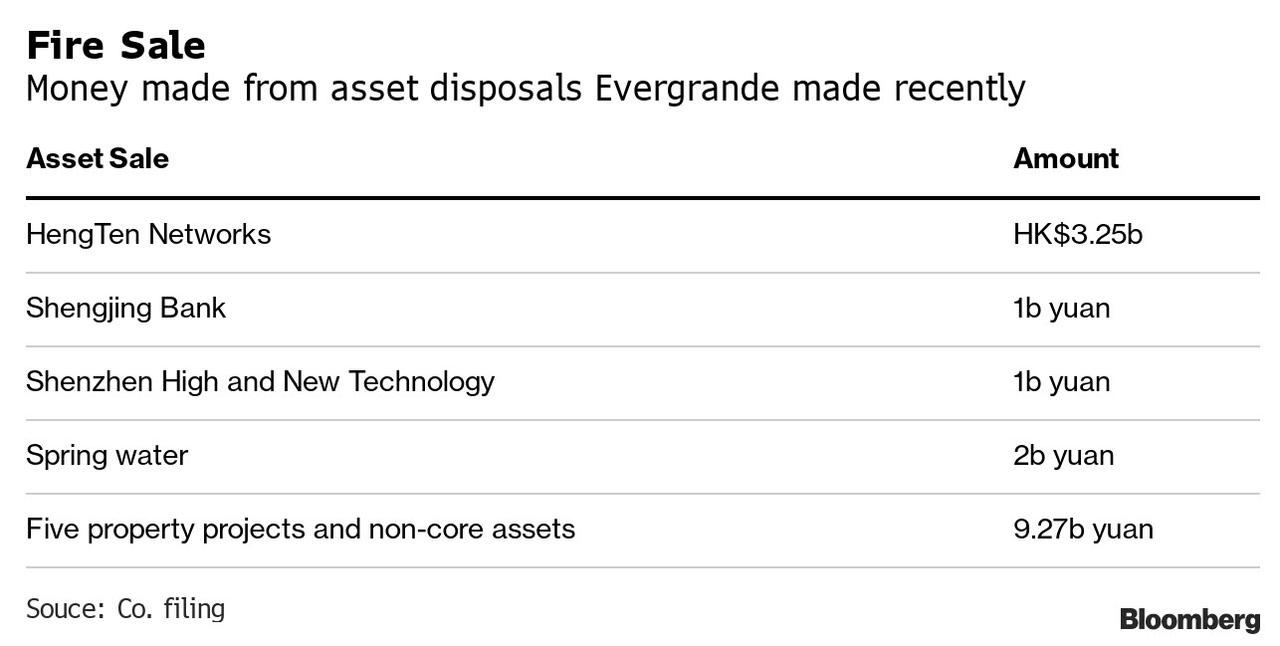
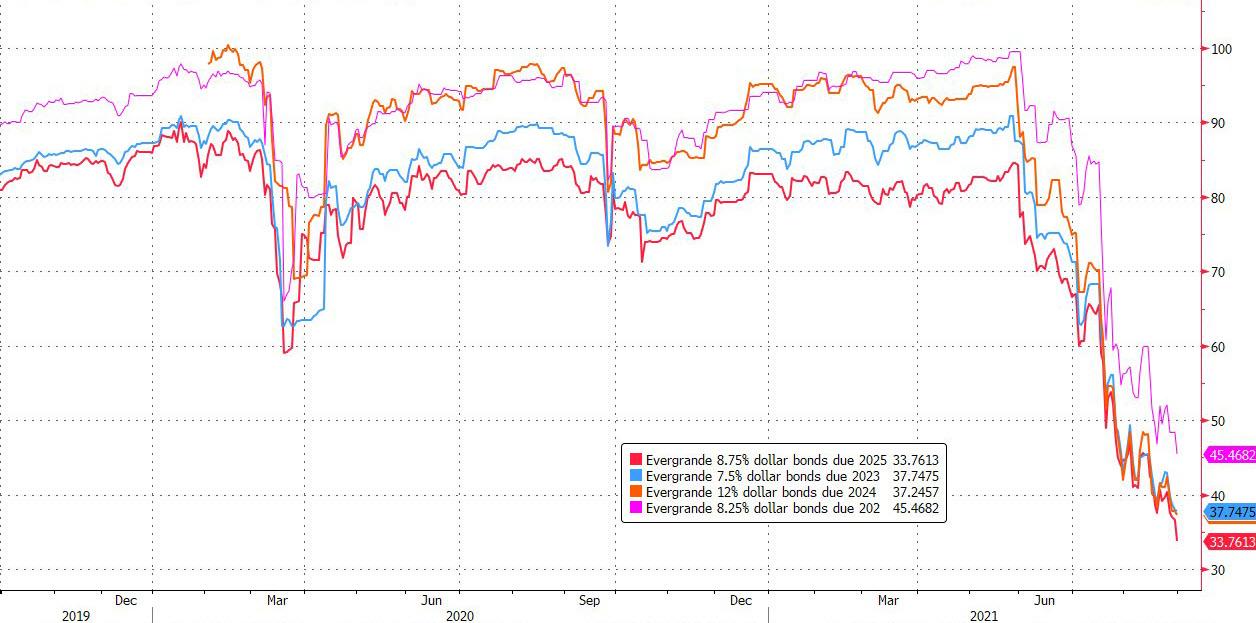
With Beijing refusing to come to the company's assistance (unlike the recent bailout of bad debt giant Huarong which two weeks ago finally got a state rescue after months of speculation as to its fate) Evergrande’s bonds sank toward fresh lows as investor confidence in its ability to repay debts has continued to erode.
“Evergrande’s gross margin could compress further on the potential fire sale of its properties,” said Bloomberg Intelligence analyst Lisa Zhou. The gauge of profitability is the lowest among major developers tracked by BI due to aggressive promotions and price cuts, Zhou wrote in a note.
And in another blow to the imploding real-estate conglomerate, even long-term allies are signaling they’ve had enough. Chan Hoi-wan, chief executive officer of Chinese Estates Holdings Ltd. and wife of Hong Kong billionaire Joseph Lau, made her first sale of Evergrande shares, cutting her holdings to 8.96% from 9.01%, a filing showed.
Evergrande’s 8.75% note due 2025 fell 1.5 cents on the dollar to 33.7 cents, according to Bloomberg-compiled data. Its shares earlier closed 0.7% lower in Hong Kong trading, taking this year’s decline to 71%.
Adding to the confusion, company executives refrained from commenting on the results (perhaps in response to the recent urging from Beijing that the company should keep its mouth shut), leaving investors and analysts to parse through the statement for guidance on its financial health.
Revenue recognized from projects delivered plunged 17% to 222 billion yuan, the lowest for the same period in four years. Gross margin almost halved to 12.9% from six months earlier, the lowest since at least 2008.
More troubling is that Evergrande said some property development payables were overdue - i.e., in technical default - leading to the suspension of work on some projects, but it added that the company is negotiating with suppliers and construction contractors to resume the work. “The group will do its utmost to continue its operations and endeavor to deliver properties to customers as scheduled,” it said.
For more details on the earnings, click here.
For more details on the earnings, click here.
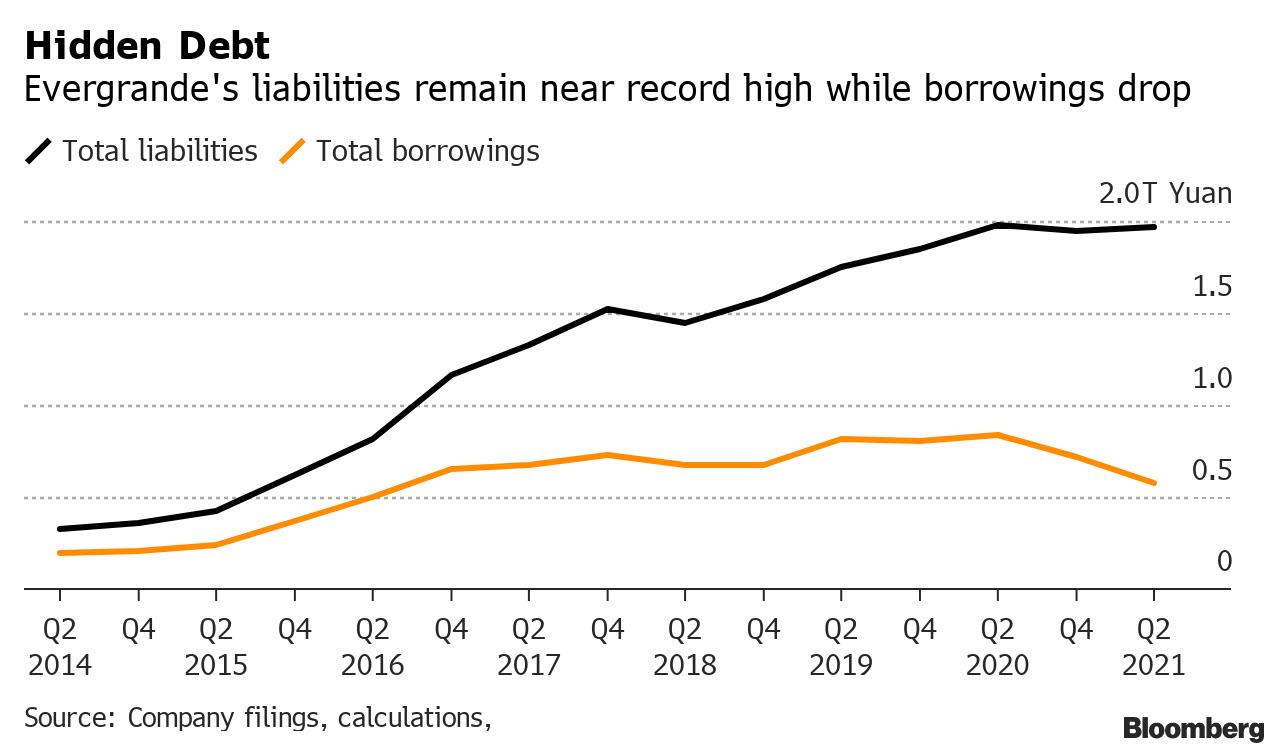
Additionally, while the company's borrowing fell, total liabilities that include bills owing to suppliers edged up to 1.97 trillion yuan, near a record high. Evergrande’s debt shrank to 572 billion yuan, the lowest in five years, according to Bloomberg calculations. That’s down 20% from 717 billion yuan at the end of last year and 15% from 674 billion yuan in March. But in what appears to just be a case of reshuffling liabilities, trade and other payables climbed 15% from six months earlier to a record 951.1 billion yuan.
Separately, the company still falls short on two of China’s so-called three red lines - metrics imposed by regulators on developers as part of a crackdown on leverage in the industry. It has pledged to meet all three by December 2022. One measure -- the ratio of cash to short-term borrowings, a gauge of liquidity -- worsened in the period to 36% from 47% at the end of last year, as its cash and equivalents plunged to the lowest in six years, Bloomberg calculations based on the results show.
With banks, suppliers and homebuyers exposed to the real estate giant, any collapse could roil China’s economy, raising questions over whether it might receive state support. Regulators urged Evergrande to resolve its debt woes in a rare public rebuke earlier this month. The problem - as is becoming obvious - is that Evergrande will not be able to resolve its "debt woes" without a bankruptcy or state bailout.
But will Beijing bail out the company if it realizes that there are no more options?
Addressing this question, UBS analyst Kamil Amin wrotes last week that "increased defaults coupled with above-average spread volatility in the Asia credit market throughout this year had led us to believe that the notion of "too big to fail" was diminishing. Instead, the Huarong rescue package illustrates to us that the notion does in fact still hold but be likely limited to higher quality SOE names, where spillover risks are much more profound."
Does Amin expect to see the same level for state support for Evergrande? "We are not yet convinced. Firstly, the issuer is a POE not an SOE and secondly, we expect the Chinese authorities to continue reigning in on excess leverage in the property sector and let defaults/restructurings drift higher. This view is consistent with the price action we have seen (Figure 2), with other higher quality SOE names across the financial sector having tightened post the Huarong news (China IG: -5bp), while China HY and Evergrande spreads have continued to trade >1150/5000bp."
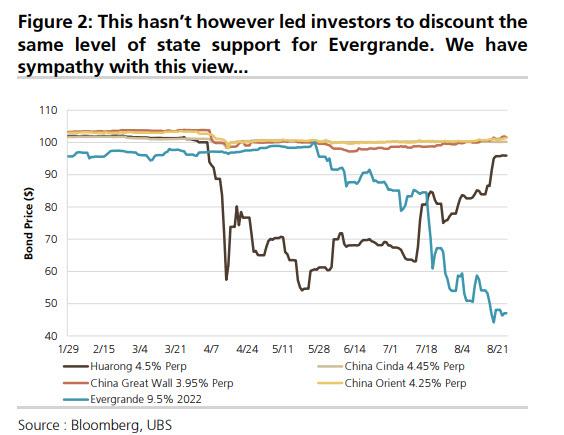
Judging by the continued selling of both Evergrande bonds and stocks, consensus agrees. Yet when faced with the task of cleaning up after what would be a huge shock to the system - and at $300 billion, Evergrande is orders of magnitude bigger than Lehman ever was - will China blink, or will Soros be right?
Tesla and the Metaverse
The self-driving car is taking a long time to arrive. Virtual reality may get here first.


A Tesla delivery location and service center in Corte Madera, Calif., April 2.
PHOTO: ERIC RISBERG/ASSOCIATED PRESS
Tesla chief Elon Musk was obliged to make an ignominious admission to the California Department of Motor Vehicles. What Tesla dubs its “Full Self Driving Capability,” and charges up to $10,000 for, is actually, in the jargon of the industry, a Level 2 driving aid. In other words, no different from what other car makers, from GM to Kia, provide as an option or even standard equipment. It can steer and match traffic speed on the highway or in bumper-to-bumper situations. In no case, though, are you encouraged to take your hands off the wheel and eyes off the road.
Tesla’s Level 2 package also appears to fail disconcertingly at a basic autonomous vehicle job, performed in many cars by a radar array costing less than $200. It doesn’t reliably avoid collisions with stationary objects such as emergency vehicles. A federal investigation has opened and we can already anticipate its findings: Tesla’s implementation of Level 2 is as good as anybody’s; the problem is caused by Tesla owners believing their cars to be more advanced than they are.
By now a succession of Mr. Musk’s claims have painted a trajectory to a universe still out of view. By last year, Tesla should have flipped a switch and turned every Tesla into a free-roaming robot taxi, earning its owner easy money when the car otherwise would be idle.
OK, it’s been three years since the media began backpedaling from its own role in self-driving hype. Uber and Lyft have sold off their autonomous vehicle experiments.
But while self-driving is stuck in neutral, the technology underlying it has advanced by leaps: artificial intelligence, machine vision, graphical computation, mobile bandwidth.
The problem for autonomous driving is the real-world complications: a heavy object collides with another heavy object, causing injury, death, property damage and lawsuits. But the same technology is increasingly capable of creating digital representations of the real world in which these untoward outcomes never arise.
These artificial worlds, ironically, are already at work trying to fix the challenges of autonomous driving. In simulated environments, software is being trained on unlikely scenarios involving, say, a combination of bicyclists, defaced stop signs and windblown plastic bags that even teams of thousands of networked cars might not encounter in years of driving.
But then a question comes up: Who needs a self-driving car when you can have a self-driving car simulator?
Think about it.
You might still jump into a car to avoid a Zoom meeting in favor of a real-world encounter with colleagues or friends. But how about the option demonstrated by Facebook’s Mark Zuckerberg, in which participants, using Oculus headsets, could feel uncannily present as a group of avatars, even hearing their voices from different directions? The avatars are Wii-like now but one day may be indistinguishable from real persons.
Facebook is not everybody’s bet to win the race for the “metaverse,” to use the word suddenly on the lips of every computing and telecommunications executive.
Nvidia, the graphics chip maker, recently launched an artificial environment suite called Omniverse, which tellingly includes Pixar’s (the animation movie studio) “Universal Scene Description” software. “The economy in the metaverse will be larger than the economy in the physical world,” predicts Nvidia chief Jensen Huang.
In another self-driving irony, BMW has adopted Omniverse to maintain an exacting simulation of its plant in Regensburg, Germany. BMW uses the artificial environment to experiment with new ways of building cars that fewer people in the future might need if it turns out they prefer to inhabit artificial environments.
It will be easier and more fun to go places artificially. In the metaverse, you can arrive instantly, or if you want the experience of traveling, arrive at any speed. If you feel like having an accident on the way, you can. If you want to experience a head-on collision with a tractor-trailer, feel free, just for fun. If you want to drive through New York City at 200 mph, you can. Cher can be waving at you from every corner. A parade of brontosauruses can be waiting to cross at the next light.
Human beings already interact by the thousands in videogame worlds they prefer to the real world. In another self-driving irony, Elon Musk has been artificial reality’s greatest salesman, with his frequent musing that we already exist in a simulation.
Yes, the self-driving car is coming. In fact, it’s here. Waymo (the Google affiliate) operates on the meticulously mapped, weather-free streets of Phoenix. Self-driving vehicles will soon be turning up in other controlled settings. Stretches of highway may one day be engineered to let drivers turn their attention to their iPads for extended periods.
But the day may never come when a self-driving car will be able to take you most places a real driver can, in every kind of weather. And, by then, so much of our lives may be in the cloud that it won’t matter.
White House to Unveil Steps Aimed at Easing Housing Supply Shortage
Moves are designed to encourage construction of homes for renters and first-time buyers
WASHINGTON—The Biden administration is poised to unveil a series of steps aimed at addressing the U.S. shortage of entry-level homes and rental properties, according to people familiar with the matter, moves designed to boost their financing and construction over the coming years.
The changes would draw upon the administrative authority of government regulators such as the Federal Housing Finance Agency as Congress weighs broader policy changes tied to the debate over revamping U.S. infrastructure, according to a draft plan reviewed Tuesday by The Wall Street Journal. Details could change before the White House releases its final version. FHFA oversees Fannie Mae and Freddie Mac, the two mortgage giants that back about half of the $11 trillion mortgage market.
Individually, each regulatory move is technical and modest. Collectively, though, “they should have a meaningful impact, particularly because they are all focused on the lower end of the market, where there is the most need,” said Jim Parrott, a former Obama administration housing adviser, commenting on the draft.
The White House was expected to announce the moves as early as Wednesday, one of the people said.
One change would allow Fannie and Freddie to invest more of their resources into rental housing by boosting an existing regulatory cap on their investments in apartment projects supported by the Low-Income Housing Tax Credit. A second would expand an existing competitive grant program for Community Development Financial Institutions, to encourage affordable housing production. Yet another would increase the financing available for manufactured homes, which are built in factories rather than on a lot. They typically cost much less than homes built on sites and are often occupied by lower-income residents.
Additional changes would give first-time home buyers and philanthropies a chance to buy distressed properties insured by the Federal Housing Administration, aiming to give them a leg up against investors that have snapped up many such properties in recent years.
The administration can make the changes without congressional action.
Limited supply has been a recent driver of rising housing prices for renters and home buyers, alongside robust demand. The median existing-home price in July was $359,900, the National Association of Realtors said earlier this month, up 18% from a year earlier. That was just slightly below the record $362,800 median price reported the prior month.
Construction of new housing in the past 20 years fell 5.5 million units short of long-term historical levels, according to a June report by the NAR.
This year’s housing boom has been unusually widespread, with house prices soaring in big cities, suburbs and small towns. The Covid-19 pandemic has reshaped where and how Americans want to live, as many households sought more space to work from home and remote workers could live farther from their offices.
The proposals come as Congress debates a series of additional moves backed by the Biden administration to boost the supply of affordable housing, including a grant program of at least $5 billion to ease so-called exclusionary zoning laws, such as minimum lot sizes or prohibitions on multifamily housing. The administration says such rules have inflated housing and construction costs and locked families out of areas with jobs and other economic opportunities.
Some economists and urbanists say easing such zoning rules would help expand the supply of dwellings available for rent or sale, which is the tightest in 30 years. Local regulations on environmental protection and road, school and sewer capacity often have strong support among residents, who generally want to keep property values high.
As part of the expected administration moves, the FHFA is expected to announce that it will study the degree to which Fannie and Freddie’s activities are concentrated in jurisdictions with exclusionary zoning.
Canadian National Voting Trust for Kansas City Southern Deal Denied by Regulator
Surface Transportation Board says Canadian National hasn’t demonstrated that use of voting trust would be consistent with public interest
Canadian National Railway Co. CNI 7.25% ’s $30 billion bid to buy Kansas City Southern KSU -4.39% ran into a major obstacle Tuesday, with regulators ruling the Canadian railroad won’t be permitted to complete a deal using a temporary voting trust that was a crucial part of the offer.
The Surface Transportation Board, a five-member panel that must bless mergers of freight railroads, said Tuesday in a filing posted to its website that Canadian National hadn’t demonstrated that its use of a voting trust would be consistent with the public interest.
The unanimous decision, which had been eagerly awaited by the companies and investors, is the latest twist in a slow-motion drama that has gripped the railroad industry since Kansas City Southern emerged as a takeover target roughly a year ago.
Canadian National had agreed to buy Kansas City Southern in May after prevailing in a bidding war with rival Canadian Pacific Railway Ltd. CP -4.52% , which received the go-ahead from regulators for a similar trust months ago.
“In view of the heightened scrutiny that both the use of a voting trust and the proposed transaction face under the current major merger regulations, it wouldn’t be in the public interest to allow CN to own KCS until the competitive issues have been thoroughly examined,” the STB said.
It isn’t necessarily a death knell for the deal: Canadian National could still press on with its bid by challenging the STB’s ruling in court. Meanwhile, the railroad could sweeten its terms to encourage Kansas City Southern to continue recommending its offer over a less valuable but potentially less risky one from Canadian Pacific.
Canadian Pacific recently made a higher offer itself, a move that prompted Kansas City Southern to adjourn a planned shareholder vote on the deal with Canadian National until after the STB ruling. The vote was scheduled for Friday.
Canadian National said in a statement Tuesday that it is disappointed in the STB’s ruling and evaluating its options. It said it remains confident that its deal is in the public interest.
Canadian Pacific Chief Executive Keith Creel said Tuesday that its most recent offer made Aug, 10 still stands and should be deemed superior given that it provides regulatory certainty.
Kansas City Southern shares closed down 4.4% on the news. In a sign of their shifting fortunes, Canadian National shares rose over 7%, indicating investors have less confidence it will ultimately close a deal—and are relieved. Canadian Pacific shares fell about 4.5%.
TCI Fund Management Ltd., a Canadian National shareholder and a vocal critic of its bid, urged the railway operator to abandon it on Tuesday. The London-based hedge fund, which also has a significant stake in Canadian Pacific, also called for the resignation of Canadian National CEO Jean-Jacques Ruest and Chairman Robert Pace.
Before it could submit its proposal to buy Kansas City Southern for STB approval—a process expected to last into 2022—Canadian National first sought the green light from the board to put its intended merger partner into a voting trust that could control Kansas City Southern during the course of the review.
In the 33-page decision released Tuesday, the STB denied the Canadian National voting-trust application, saying that permitting it “would insulate KCS and CN from the regulatory risks and uncertainties associated with the heightened scrutiny that the proposed transaction would face under the current major merger regulations and the heightened possibility of divestiture.” The board also pushed back against the argument that approving the trust would “respect KCS’ choice of a merger partner.”
The board wrote that “Negotiation choices by private parties cannot control agency decision-making.”
The Justice Department, which could ultimately challenge any deal, said this spring that the proposed merger “raises sufficient competition concerns on first blush that the CN should be prohibited from using a voting trust.”
A set of rules the STB imposed in 2001 has essentially prevented further consolidation among the major competitors in the industry. The board and its roughly 120-person staff had mulled the voting-trust application for weeks. Observers predict that almost any ruling on a deal for Kansas City Southern could wind up in court, given the high competitive stakes involved.
Kansas City Southern is the smallest of the major freight railroads in the U.S. It plays a big role in U.S.-Mexico trade, with a network stretching across both countries, which helps explain its desirability as an acquisition target. Of the two suitors, Canadian Pacific is smaller and has less overlap with Kansas City Southern.
Whoever ultimately succeeds in closing a deal would become a bigger rival to industry heavyweights including Union Pacific Corp.
Scientists warn that Covid will accelerate ‘dementia pandemic’
Experts point to mounting evidence that the virus can cause long-term brain damage in some patients
The degenerative effect on the brain of coronavirus will add fuel to the “pandemic of dementia” that will affect an estimated 80m by the end of the decade, scientists and psychiatrists have warned.
Alzheimer’s Disease International, the global federation of dementia associations, on Wednesday unveiled a specialist working group to understand better the scale of the problem and recommend ways to combat it.
“We don’t want to scare people unnecessarily,” said Paola Barbarino, ADI chief executive, “but many dementia experts around the globe are seriously concerned by the link between dementia and the neurological symptoms of Covid-19”.
Alireza Atri, a cognitive neurologist and chair of ADI’s medical and scientific advisory panel, continued: “Covid-19 can cause damage and clotting in the brain’s micro vessels, immune dysfunction and hyperactivation, inflammation, and, last but not least, direct viral brain invasion through the olfactory pathways.
“While there is still a way to go in understanding this, we know that anything that diminishes your cognitive reserve and resilience is going to allow neurodegenerative processes to accelerate, which can cause symptoms of neurological disorders, such as dementia, to show earlier.”
There is mounting evidence that Covid-19 can cause long-term brain damage. One piece is that similar biochemical changes are observed in some coronavirus patients and in people with Alzheimer’s — indicating neuronal injury and inflammation.
Another is the growing number of studies showing that many people with so-called long-Covid suffer from cognitive problems including “brain fog” as well as difficulties with memory, concentration and language. In most patients, such symptoms are expected to resolve themselves over time but the fear is that it may tip some into progressive dementia.
Besides formal scientific studies, clinicians such as Atri and Gill Livingston, professor of psychiatry at University College London, say they have noticed more patients whose dementia is progressing unexpectedly fast after coronavirus.
To make matters worse, Livingston said, “increased isolation because of Covid and social distancing is itself a risk factor for dementia. People are missing the cognitive stimulation that can help delay the onset of symptoms.”
Epidemiologists point out that Covid-19 would not be unusual among viral infections in causing progressive neurological disorders. The 1918 Spanish flu increased survivors’ long-term risk of developing Parkinson’s disease by a factor of two to three, Barbarino pointed out.
Some 55m people are currently living with dementia, according to World Health Organization estimates, which is predicted to rise to about 80m by 2030 as the elderly population increases.
Though it is too soon to quantify the exact effect of Covid-19 on future dementia cases, “it could have a large impact”, said Atri, who is also director of the Banner Sun Health Research Institute in Arizona. “This is a nasty, vicious virus and I’m sure it will tip some people over into dementia sooner than would otherwise be the case.”
Barbarino urged “the WHO, governments and research institutions across the globe to prioritise and commit more funding to research and establish resources . . . to avoid being further overwhelmed by the oncoming pandemic of dementia”.
KPMG warns that accounts at six H2O funds ‘impossible to certify’
Auditor could not collect enough data on funds, all of which had exposure to Windhorst-linked securities
KPMG has warned that accounts at six of H2O Asset Management’s funds are “impossible to certify”, citing a number of valuation uncertainties and rule breaches.
Once a star of European asset management, H2O was plunged into crisis in 2019 when the Financial Times revealed it had substantial exposure to illiquid securities tied to Lars Windhorst, a German financier and football club owner with a history of legal trouble.
In a series of audit letters this year, KPMG has stated that it could not verify that the accounts of six H2O funds — all of which were heavily exposed to the Windhorst-linked securities — gave “a true and fair view” of their financial situation. The auditor said it was “unable to collect sufficient and appropriate elements to base an audit opinion on these accounts”.
The six funds in question were all temporarily frozen in August last year, after France’s financial regulator raised concerns about their investments. H2O subsequently split these funds, setting up closed “side pockets” to house the Windhorst-linked bonds and shares, trapping more than €1bn of investor money.
Five of the audits cover periods before H2O divided the funds, while one reflects the balance sheet of one of the side pockets after the split.
The KPMG letters, the most recent of which was dated July this year, also flag activity that started in 2019 when H2O had responded to €8bn of investor outflows by trying to reduce the Windhorst exposure using a complicated series of “buy and sell back”, or “reverse repo”, trades.
Asset managers typically engage in buy and sell transactions by taking on liquid assets, such as government bonds, with the intention of selling them back again at a future date at a higher price. These in effect provide a short-term loan to the owner of the security.
In the case of H2O, the trades allowed it to reclassify some of the troublesome illiquid bonds away from its main portfolio holdings.
But the trades had a side-effect, which attracted fresh warnings from KPMG: they caused the investment firm to breach rules governing open-ended investment vehicles.
Funds that allow ordinary investors to withdraw their money on a daily basis are subject to strict rules around the assets they can hold and trade. This regulation restricts the level of illiquid investments they can hold as well as the amount of risk tied to a single counterparty.
In its audit letter for H2O’s €807m Allegro fund, KPMG noted that at the end of June 2020 the fund had breached risk limits in relation to each of the counterparties to the buy and sell transactions, which made up 29.2 per cent of the fund’s asset value.
These transactions also drew further regulatory scrutiny last year when one of the three counterparties listed in H2O’s fund filings, Antwerp-based Merit Capital, denied any involvement and threatened legal action.
H2O has since signed a settlement with Merit where the asset manager acknowledges documentation indicating that the trades had been executed by Shard Capital, a London-based brokerage with close ties to Windhorst.
The agreement, seen by the FT, also indicates that Shard carried out matching trades with Windhorst-linked entities — including his British Virgin Islands-registered company Sapinda Asia.
H2O said it was “legally bound” to not comment on the terms of settlement. Windhorst and Merit Capital did not provide a comment.
“Shard Capital does not have any open transactions of any nature with H2O,” the brokerage said. Shard last year told the FT it had acted as an “agency broker” on the transactions, without disclosing the ultimate counterparty to the trades.
While the fund risk rules state that transactions with a single broker cannot exceed 5 per cent of a fund’s assets, H2O’s Allegro fund reported transactions outstanding with Shard Capital equivalent to 13.4 per cent. It recorded a further 6.9 per cent outstanding with Merit and 8.9 per cent with Brandon Hill Capital, a London-based firm that describes itself as a “natural resources merchant bank”.
KPMG’s audit letter was signed in March 2021, before H2O’s settlement with Merit.
Asked about the settlement, H2O told the FT it would be “incorrect” to conclude that it wrongly attributed hundreds of millions of euros of trades to Merit Capital and that this therefore meant further breaches occurred.
“Following the settlement, [parties] agree that no buy and sell-back transactions exist between them at the date of the settlement”, H2O said.
Windhorst, who is a majority owner of Hertha Berlin football club, is being investigated by German authorities over suspected violation of the country’s banking act in connection with an investment vehicle through which he sought to buy back the securities from London-based H2O. Windhorst has denied any wrongdoing and said he has offered assistance to the authorities.
Crypto platforms need regulation to survive, says SEC boss
Gary Gensler warns $2tn industry is too big to exist outside of ‘public policy framework’
The chair of the US Securities and Exchange Commission is warning that cryptocurrency trading platforms are putting their own survival at risk unless they heed his call to work within the nation’s regulatory framework.
Gary Gensler told the Financial Times that while he remained “technology neutral”, crypto assets were no different than any others when it came to such public policy imperatives as investor protection, guarding against illicit activity and maintaining financial stability.
“At about $2tn of value worldwide, it’s at the level and the nature that if it’s going to have any relevance five and 10 years from now, it’s going to be within a public policy framework,” he said. “History just tells you, it doesn’t last long outside. Finance is about trust, ultimately.”
Gensler expressed disappointment with the industry’s response to his suggestion that trading platforms register with the SEC on the grounds that a sufficient number of cryptocurrencies qualify as securities.
“Talk to us, come in,” he said. “There are a lot of platforms that are in operation today that would do better engaging and instead there is a bit of . . . begging for forgiveness rather than asking for permission.”
Cryptocurrency trading platforms are a big business in the US — New York-listed Coinbase reported a $1.6bn profit in the second quarter. However, it is unclear which US financial regulator is supposed to oversee them. Gensler has called on Congress to make such authority more explicit.
Gensler’s crypto comments carry additional weight because he taught a course on the subject at the Massachusetts Institute of Technology. On Wednesday, he is set to testify on crypto and other matters before the European Parliament’s economic and monetary affairs committee.
Gensler said he had been focusing on cryptocurrency trading platforms because 95 per cent or more of the activity in this “highly speculative asset” takes place in such venues — with investor protections he described as “really sparse”.
He said cryptocurrencies and decentralised finance (DeFi) platforms pose a challenge for regulators because they exist without traditional brokers, to whom laws can be easily applied. Instead, they offer opportunities for investors to deal more directly with each other.
But he said regulators would be able to exercise authority over even supposedly decentralised platforms. He argued that DeFi was “not really a new concept”, but a variation on the peer-to-peer lending businesses that sprouted earlier in the century.
Just as there was “a company in the middle” of peer-to-peer lending, he said, the DeFi platforms have “a fair amount of centralisation”, including governance mechanisms, fee models and incentive systems.
“It’s a misnomer to say they are just software they put out in the web,” he said. “But they are not as centralised as the New York Stock Exchange. It’s sort of an interesting thing that is in between.”
Gensler also reiterated his concerns about Chinese companies listing in the US. He said the listed vehicles were typically shell companies based in offshore locations such as the Cayman Islands that strike service agreements with operating companies in China.
“Is there any real money flowing from the operating company in China to make payments or not?” he said. “There’s a service agreement, and generally speaking those payment entities do not pay dividends.”
The SEC is also finalising rules that would suspend trading in such companies if their auditors do not allow US regulators to scrutinise their books. Under the Trump-era Holding Foreign Companies Accountable Act, those companies have until 2024 to comply with such rules.
Congress is considering bringing that timetable forward by a year. Gensler said the commission would be ready to implement those rules under the accelerated schedule, meaning that Chinese companies could face greater scrutiny as soon as 2023.
After Hours Summary: Several names higher on earnings: PLAN +14%, PVH +7.4%, CAL +5.9%, AMBA +5%, but CRWD -4.6% lower on earningsAfter Hours Gainers:
Companies trading higher in after hours in reaction to earnings/guidance: PLAN +14%, PVH +7.4%, CAL +5.9%, AMBA +5%
Companies trading higher in after hours in reaction to news: CPLP +3.9% (to acquire three LNG carriersfor $599.5 mln), EGY +3.7% (announces Etame co-venturers' approval of FSO agreements), PLTK +1.5% (acquires Reworks Oy, maker of Design Entertainment app, Redecor), TEVA +1.5% (TEVA and MedinCell announce FDA acceptance of NDA for TV-46000/mdc-IRM for schizophrenia), FTI +1.1% (awarded long-term contracts by Petrobras), EVC +1.1% (acquires remaining 49% interest in Cisneros Interactive), UXIN +0.6% (files mixed securities shelf offering), MRK +0.1% (FDA approves updated indication for KEYTRUDA for urothelial carcinoma)
After Hours Losers:
Companies trading lower in after hours in reaction to earnings/guidance: CRWD -4.6%, PYCR -1.2%
Companies trading lower in after hours in reaction to news: CNTB -2.9% (provides clinical update, on track to report CBP-201 Phase 2B top-line data in Q4), PLBY -2.6% (stock offering), SFM -1.2% (names new CFO), RIOT -1% (files mixed securities shelf offering), TSLA -0.3% (full self-driving package take rate has declined, according to Electrek), INDI -0.2% (to acquire TeraXion for approx. $159 mln)
Closing Stock Market SummaryThe S&P 500 (-0.1%), Nasdaq Composite (-0.04%), and Dow Jones Industrial Average (-0.1%) closed fractionally lower on Tuesday in a quiet session. The small-cap Russell 2000 ended the session with a modest gain of 0.3%.
Buying conviction might have been lacking because of the softening economic data in the U.S. and China, a 16% decline in shares of Zoom Video (ZM 289.50, -58.00, -16.7%) following its earnings report, an observation that the gains were good in August, and a wait-and-see mindset for the August employment report at the end of the week.
Seven of the 11 S&P 500 sectors closed in negative territory, including energy (-0.7%) and information technology (-0.6%) at the bottom of the pack. The communication services (+0.3%), consumer discretionary (+0.4%), and real estate (+0.6%) sectors outperformed with modest gains.
Specifying the data, the Conference Board's Consumer Confidence Index decreased to 113.8 in August (Briefing.com consensus 123.0) from 128.9 in July, the Chicago PMI for August decreased to 66.8 (Briefing.com consensus 68.0) from 73.4 in July, China's August Manufacturing PMI decelerated to 50.1, and China's August non-Manufacturing PMI slipped into contraction territory at 47.5.
The slower growth appeared to weigh on oil prices ($68.44, -0.77, -1.1%), which gave back some rebound gains, but not as much on the Treasury market. The 10-yr yield increased two basis points to 1.30% while the 2-yr yield was unchanged at 0.20%. The U.S. Dollar Index was little changed at 92.66.
In other corporate news, Bloomberg reported on a study in Belgium that showed Moderna's (MRNA 376.69, +6.00, +1.6%) COVID-19 vaccine produced twice as many antibodies as Pfizer's (PFE 46.07, -0.69, -1.5%) vaccine. DigiTimes reported that Taiwan Semi (TSM 119.01, +0.02, unch) is in discussions with suppliers to lower prices for next year by 15% in order to cut costs.
Shares of Kansas City Southern (KSU 280.67, -12.89, -4.4%) declined 4% after the Surface Transportation Board announced a unanimous decision rejecting the use of a voting trust agreement in connection with the company's proposed M&A deal.
Reviewing Tuesday's economic data:
- The Conference Board's Consumer Confidence Index fell to 113.8 in August (consensus 123.0) from a revised 125.1 (from 129.1) in July. The August drop sent the Index to its lowest level since February.
- The key takeaway from the report is that it reflected some of the same concerns as Friday's release of the Consumer Sentiment Survey from the University of Michigan. Consumers were concerned with reports about the Delta variant of the coronavirus as well as rising food and gas prices.
- The Chicago PMI for August decreased to 66.8 (consensus 68.0) following an unrevised 73.4 reading in July.
- The S&P Case-Shiller Home Price Index increased 19.1% yr/yr in June (consensus 17.6%) following a revised 17.1% increase (from 17.0%) in May.
- The FHFA Housing Price Index increased 1.6% m/m in June following a revised 1.8% increase (from 1.7%) in May.
Looking ahead, investors will receive the ISM Manufacturing Index for August, the ADP Employment Change report for August, Construction Spending for July, and the weekly MBA Mortgage Applications Index on Wednesday.
- S&P 500 +20.4% YTD
- Nasdaq Composite +18.4% YTD
- Dow Jones Industrial Average +15.5% YTD
- Russell 2000 +15.1% YTD