(ZH) Here Is How Immunity To COVID Varies By Country: Goldman

Here Is How Immunity To COVID Varies By Country: Goldman

As evidenced by Goldman Sach's decision to cut its growth outlook for China to zero in the face of the unfurling energy crisis plaguing the world's second-largest economy with unexpected blackouts, the coronavirus is no longer the single biggest threat to global growth (particularly as Europe faces a potential energy crisis of its own).
That being said, gauging the global population's present (and projected) immunity levels is critical to an investment bank's broader global economic forecasts (along with being the subject of frequent client inquiries, we suspect). And so, after assiduously monitoring the global delta wave (with forecasts that have been mostly accurate with a few exceptions) Goldman's team is taking on the task of gauging global immunity. It's a hefty undertaking: after all, plenty of Democrats refuse to even acknowledge natural immunity, even as some studies have shown it might be even more effective against delta than the Pfizer jab.
Goldman's forecast relies on a few critical assumptions that are at least partly borne out by "the science":
  • Vaccine efficacy against hospitalizations remains close to 90% for most vaccines six months after vaccination.
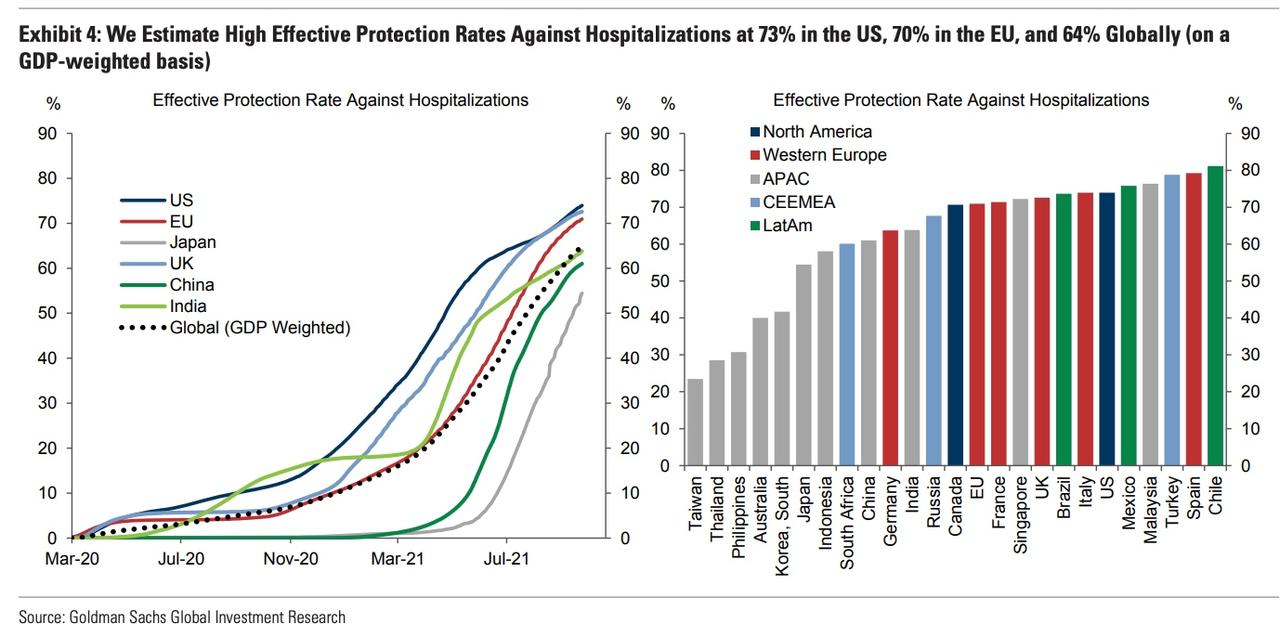
  • This implies elevated effective protection rates against hospitalizations across most major economies, at around 70% in the US, the UK, and the Euro Area, 60% in China and India, 50% in Japan, and 65% on a global GDP-weighted basis, nearly 50pp higher than six months ago.
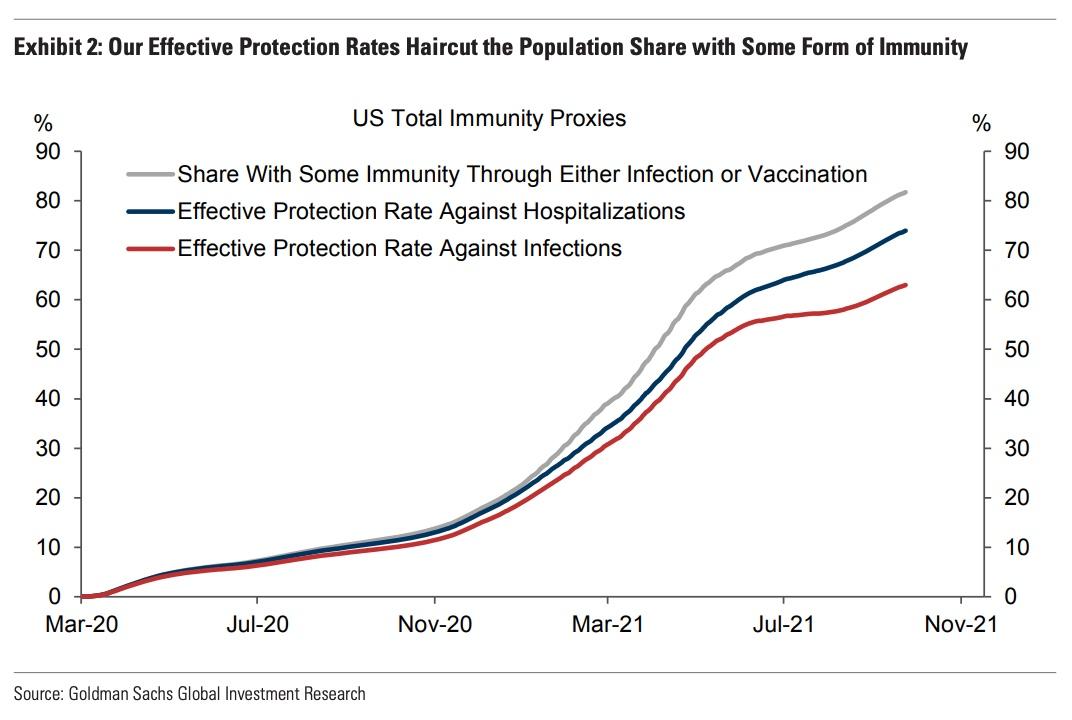
  • Presently, 80% of the American population now has some immunity through either vaccination or infection.
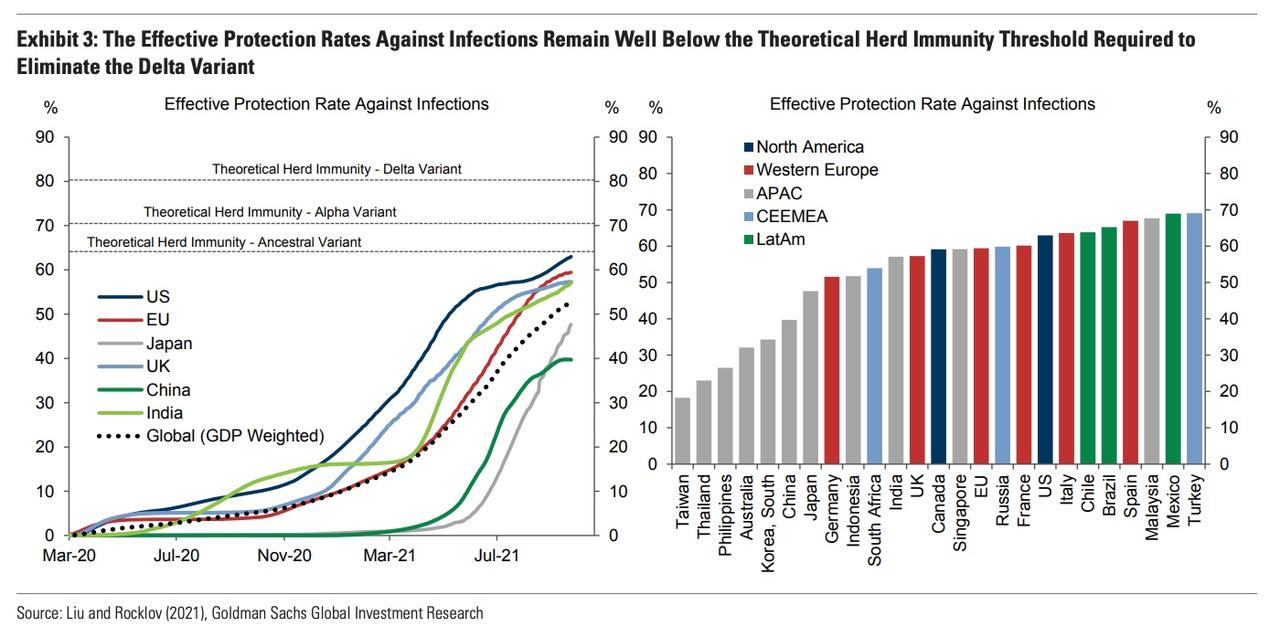
  • We find an effective protection rate against infections of around 60% in the US, the UK, and the Euro Area, 55% in India, 45% in Japan, 40% in China, and 50% on a global GDP-weighted basis, all below the theoretical herd immunity threshold required to eliminate the highly transmissible Delta variant.
Goldman points out that recent studies confirm that vaccine protection wanes over time and the rate varies by vaccine. But Goldman calculated an average rate and charted how odds of infection vs. hospitalization and death (which are much, much lower) decline over the first few months after vaccination.
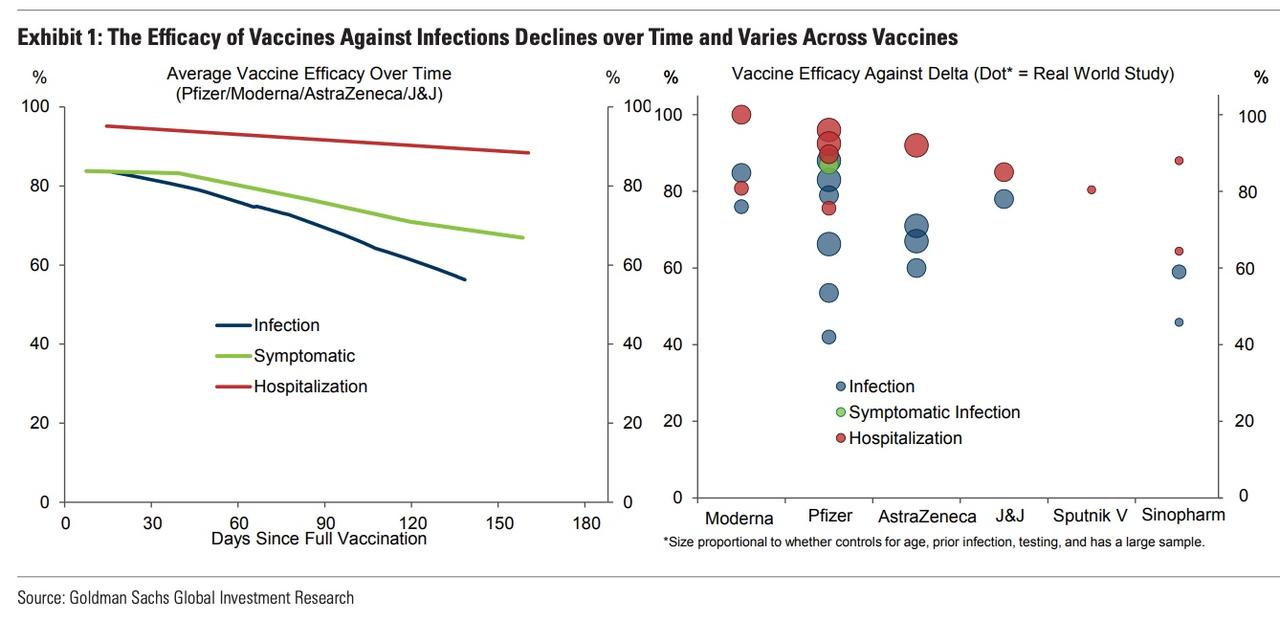
Exhibit 2 shows Goldman's latest US immunity estimates. The analysts estimate that 80% of the American population now has some form of immunity through either vaccination or infection. Combined, that leaves us with an effective protection rate against infections of 60%.
Looking at the emerging world, immunity rates are understandably significantly lower - by roughly 20% on average compared with the US.
Here's how that breakdown looks for the developed world.
According to Goldman, their analysis effectively comes with some good news, and some bad news. The bad news is that, since herd immunity is effectively out of reach for humanity at this point, reviving certain types of economic activity like nightclubs, concerts, and other live events to their pre-pandemic levels will be difficult. The good news is at least humanity's resistance to COVID is improving, not degrading.
>>> US After Hours Summary: Pretty quiet after hours; MLHR +2.3% higher on earni

After Hours Summary: Pretty quiet after hours; MLHR +2.3% higher on earnings; OPRX +11% jumps as it gets added to S&P SmallCap 600; SPCE soars +9.6% as it gets clearance to fly

After Hours Gainers:

Companies trading higher in after hours in reaction to earnings/guidance: MLHR +2.3%

Companies trading higher in after hours in reaction to news: ORN +17.3% (awarded two contracts for its marine segment, totaling nearly $200 mln), OPRX +11% (to join S&P SmallCap 600), SPCE +9.6% (receives clearance to fly following conclusion of FAA inquiry), GLDD +4.6% (announces partnership with Project Vesta), ARCB +4.2% (to acquire MoLo Solutions, a truckload freight brokerage, for $235 mln in cash), CHDN +1.7% (authorizes $500 mln for new share repurchase program), CSII +1.6% (first patient has been treated with ViperCross peripheral support catheter), MNKD +0.4% (enters into sale-leaseback transaction), SBUX +0.2% (increases dividend), KMI +0.2% (announces construction on three RNG facilities), JNJ +0.2% (FDA determined that GMP5 is suitable for use and that it meets the EUA standard), F +0.1% (renews $15.5 bln in revolving corporate credit lines), GE +0.1% (awarded $480 mln Navy contract)

After Hours Losers:

Companies trading lower in after hours in reaction to earnings/guidance: LNDC -14.9%

Companies trading lower in after hours in reaction to news: ACB -1.3% (announces launch of first medical CBD product in Uruguay), FTAI -0.1% (FTAI and AIR announce joint sustainability initiative)

(ZH) Is The Price Of Oil All That Matters To Central Banks

Is The Price Of Oil All That Matters To Central Banks

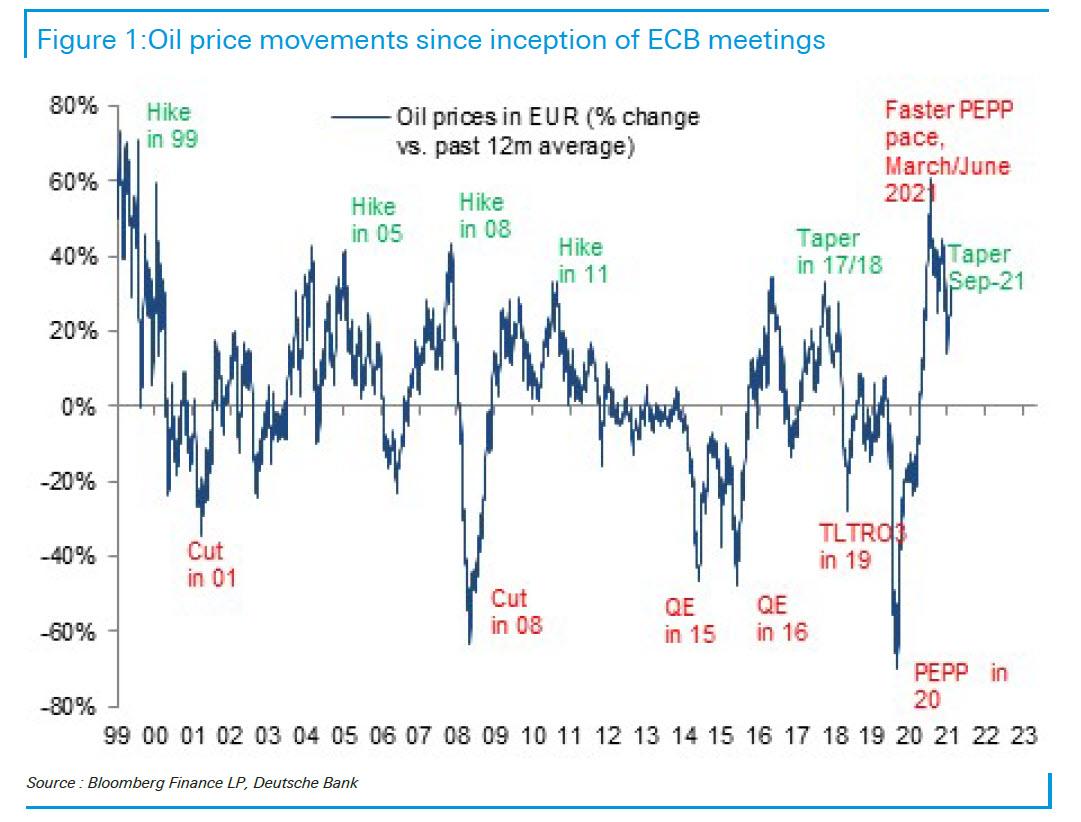
DB's Jim Reid has published a remarkable observation in his "chart of the day" note, one which suggests that at least for the ECB, the price of oil - with its widespread social, financial and economic implications - may be all that matters.
As Reid writes, "the financial world is trying to work out what the implications are for the energy price shocks we are seeing and whether central banks should tighten policy as a result or keep policy loose to reflect possible demand destruction that it might eventually bring." In response, ECB President Lagarde yesterday warned that the “key challenge is to ensure that we do not overreact to transitory supply shocks that have no bearing on the medium-term."
It appears that she was actually addressing her own ECB, referring to the missteps made by her central bank when responding to oil price shocks. Because for all of Lagarde's rhetoric, this is not how the ECB has traditionally respond to big energy moves. On the contrary.
As the chart below shows, ever since the ECB came into being they’ve tended to consistently tighten into rising oil prices (green on the graph) and loosen when they notably fall (red). The exception was in March/June this year when they loosened further by increasing the pace of the PEPP. And since the ECB works in concert with the Fed, once can extend this observation and correctly argue that all central banks respond to the price of one commodity.
What is remarkable about this chart is that while central banks claim they only care about core inflation instead of headline, it appears ECB’s monetary policy has been closely linked to the ebb and flow of commodities in general, and particularly oil prices, over the last 20 plus years.

WSJ : U.S., Europe Join Forces to Address Chip Shortage, Tech Issues

U.S., Europe Join Forces to Address Chip Shortage, Tech Issues
New trade and technology council seen as counterweight to China

PITTSBURGH—U.S. and European Union officials agreed to join forces in an effort to boost the semiconductor supply chain and maintain leadership in emerging technologies.

In a joint statement Wednesday, the new U.S.-EU Trade and Technology Council said the two governments will “seek to strengthen their competitiveness and technological leadership by developing common strategies to mitigate the impact of non-market practices at home and in third countries.”

While the statement didn’t mention China by name, analysts say Beijing’s economic practices—including subsidies for favored industries—are one of the factors behind the commission’s formation.

The statement was released after the commission’s inaugural meeting here Wednesday, where officials discussed ways to reinforce semiconductor supply chains and to strengthen export controls and investment screening to protect sensitive technologies and data. The two sides will also develop and implement artificial-intelligence systems that will protect privacy and human rights.

The U.S. was represented by Secretary of State Antony Blinken, Commerce Secretary Gina Raimondo and U.S. Trade Representative Katherine Tai. The EU was represented by Valdis Dombrovskis, executive vice president and trade commissioner and Margrethe Vestager, also an EU executive vice president as well as competition commissioner.

The meeting was held at a former steel mill on the outskirts of Pittsburgh that has been turned into a research facility for manufacturing and robotics by researchers at Carnegie Mellon University.

The council will continue to work on a range of issues over the coming years through working groups on 10 areas including technology standards, climate and clean technology, data governance and technology platforms, and misuse of technology. The group’s next meeting is scheduled for the spring.

One of the key outcomes of the meeting was to enhance cooperation on semiconductors to advance transparency and communication in their supply chains, the statement said. The two sides will together “identify gaps, shared vulnerabilities, and opportunities” to strengthen their respective domestic research, developing and manufacturing of semiconductors, it said.

The number of semiconductors in a modern car, from the ignition to the braking system, can exceed a thousand. As the global chip shortage drags on, car makers from General Motors to Tesla find themselves forced to adjust production and rethink the entire supply chain. Illustration/Video: Sharon Shi
The agreement came as U.S. officials grow increasingly concerned about supply shortages of semiconductors that have severely affected a swath of the U.S. manufacturing industry.

Biden administration officials last week invited representatives of auto makers, technology companies and semiconductor producers and pitched a program for companies to reveal more information about their supply chains to better understand the bottlenecks. Both the U.S. and EU plan to shore up domestic semiconductor production with government assistance.

The U.S. and the EU together represented 21% of the world’s semiconductor manufacturing capacity in 2020, according to the Semiconductor Industry Association, a trade group.

The group calls on the U.S. and EU officials to work together to strengthen rules for state-owned enterprises and distortive industrial subsidies and coordinate and target export-control policy.

>>> US Close Dow +0,26% S&P +0,16% Nasdaq -0,26% Russell -0,20%

Closing Stock Market Summary

The S&P 500 increased 0.2% on Wednesday amid a calmer Treasury market, although the benchmark index was up 0.8% at session highs. The Dow Jones Industrial Average increased 0.3% while the Nasdaq Composite (-0.2%) and Russell 2000 (-0.2%) coughed up gains and closed lower.    

The Treasury market stubbornly resisted buying interest, but at least yields were kept in check: the 10-yr yield increased one basis point to 1.54% (below yesterday's high of 1.56%) while the 2-yr yield decreased one basis point to 0.29%. The U.S. Dollar Index rose 0.7% to 94.41, signaling a defensive undertone. 

Likewise, the defensive-oriented utilities (+1.3%), consumer staples (+0.9%), health care (+0.8%), and real estate (+0.7%) sectors were today's leaders in the S&P 500. The materials (-0.2%), communication services (-0.2%), and information technology (-0.1%) sectors closed lower. The latter two groups were influential laggards. 

The semiconductor stocks held back the technology sector after Micron (MU 71.64, -1.46, -2.0%) issued downside guidance for its fiscal first quarter due to ongoing supply chain disruptions. The Philadelphia Semiconductor Index declined 1.5%.

Micron wasn't the only company that lowered expectations. Sherwin-Williams (SHW 282.26, +2.64, +0.9%) reduced its Q3 and FY21 guidance, citing worsening raw material availability and pricing inflation, and Generac (GNRC 406.53, -18.81, -4.4%) issued downside FY21 revenue guidance. SHW closed higher despite the bad news. 

Dollar Tree (DLTR 100.51, +14.23, +16.5%) was a prime example of "pricing inflation" with an announcement that it will start selling certain items for $1.25 to $1.50. DLTR shares rallied 16.5%, further supported by plans to increase its share buyback program to $2.5 billion.

Boeing (BA 225.36, +6.95, +3.2%), meanwhile, helped lead the Dow higher after the stock was upgraded to Outperform from Mkt Perform at Bernstein. The firm believes global travel is reaching an inflection point.

Elsewhere, WTI crude futures fell 0.5%, or $0.38, to $74.91/bbl amid an unexpected build in weekly crude inventories (4.58 million). Silver futures fell 4.3%, or $0.97, to $21.49/ozt amid the stronger dollar. 

Reviewing Wednesday's economic data:

  • Pending home sales jumped 8.1% m/m in August (consensus 1.0%) following a revised 2.0% decline (from -1.8%) in July.
  • The weekly MBA Mortgage Applications Index decreased 1.1% following a 4.9% increase in the prior week.
  • Weekly crude oil inventories increased by 4.58 mln barrels after decreasing by 3.48 mln barrels during the previous week.

Looking ahead, investors will receive the weekly Initial and Continuing Claims report, the third estimate for Q2 GDP, and the Chicago PMI for September on Thursday. 

  • S&P 500 +16.1% YTD
  • Russell 2000 +12.7% YTD
  • Nasdaq Composite +12.6% YTD
  • Dow Jones Industrial Average +12.4% YTD