>>> Europe : Brokers Upgrades & Downgrades - 30th of september 2021

>>> Up
* AJ Bell Raised to Outperform at Exane; PT 450 pence
* Aroundtown Raised to Buy at Goldman; PT 7.50 euros
* Atos Raised to Buy at HSBC; PT 55 euros
* Barclays PT Raised to 315 pence from 300 pence at Jefferies
* Dustin Raised to Buy at SEB Equities; PT 120 kronor
* Pearson Raised to Hold at Kepler Cheuvreux; PT 750 pence
* Simcorp Raised to Hold at SEB Equities; PT 775 kroner

>>> Down
* Beiersdorf Cut to Underperform at RBC; PT 82 euros
* Duerr Cut to Sell at Quirin Privatbank AG; PT 33 euros
* Euronext Cut to Neutral at JPMorgan; PT 108 euros
* Scout24 Cut to Neutral at JPMorgan; PT 64 euros
* Sobi Cut to Hold at Handelsbanken; PT 245 kronor

>>> Initiation
* BFF Bank Resumed Hold at Deutsche Bank; PT 9.10 euros

>>> Call
* Beiersdorf Cut at RBC on Bleaker Outlook for La Prairie Brand
* Colruyt Update Likely to Be ‘Painful’ For Shares, Jefferies Says
* DEUTSCHE POST (BUY) REMOVED FROM GOLDMAN SACHS CONVICTION LIST
* Eutelsat Attracting Drahi Interest Hard to Understand: Analysts
* Morgan Stanley Bullish on European Cyclical Value as Yields Rise

FT : Spacs’ fee problem

Spacs’ fee problem
Real financial innovation does not increase costs

The case of the 122 per cent Spac fee
Here’s my simplified understanding of how a special purpose acquisition company works:

A company without operating assets raises some money in an initial public offering, at $10 a share. The new shareholders generally also receive warrants, giving them the right to buy more shares in the company, at a later date and at a price somewhat higher than $10. The “sponsors” who set up the Spac also get a bunch of shares — perhaps 20 per cent of the total — in return for just a nominal fee, because they are so wonderfully clever.

The Spac then goes looking for an operating company to buy. If it finds one, it says to the shareholders, what do you think? The shareholders have the right to say “no thanks” and get their $10 back with interest — while keeping the warrants, if they like. The Spac then uses the remainder of the IPO proceeds, possibly supplemented by money from private investors, to invest in the target. Hopefully, under the management of the wonderfully clever sponsors, the value of the target then rises enough that the shares sold in the IPO are worth more than $10, even after they are diluted by the sponsors’ almost free shares and the warrants.

As a way to finance a company, this may or may not make sense. But there are definitely cases when it has not gone smoothly, as the FT reported this week. In the third quarter of this year, according to Dealogic, more than 50 per cent of Spac shareholders asked for a refund (“redemption” is the preferred term) when asked. At one company, it was way worse than that:

“Biopharmaceutical start-up eFFECTOR Therapeutics expected to receive at least $100m in proceeds from its merger with Locust Walk Acquisition, a Spac that raised $175m when it listed in January. However, the cash held in the trust account was almost entirely wiped out when 97 per cent of shareholders chose to redeem, leaving just $5.2m.

While some of the shortfall was covered by a $60m private investment in public equity transaction, eFFECTOR received just $53.5m after fees and expenses.”

Now, this is bad on several levels, and one of them — as Duncan Lamont of Schroders pointed out to me — is fees. One of the theoretically appealing features of a Spac is that the underwriting fee for the initial IPO tends to be a bit lower, at 5.5 per cent, than the 7 per cent investment banks charge in a standard IPO. But in a standard IPO, investors can’t get their money back from the company.

The result of the shareholder’s option, the underwriting fee Locust Walk paid to its IPO underwriters (Cantor Fitzgerald was the lead bank) was greater than the amount of money that the stock market listing ultimately raised. Here are how the numbers worked, according to Lamont. I checked them against the S-1 filings, and they look right (red marks mine):

Even after the underwriters waived half of the deferred underwriting fees (kind of them) they charged a commission of 122 per cent of final proceeds.

This is clearly not the standard case, but you can see how the math would work with the 50 per cent redemptions that were standard this quarter. Furthermore, according to an academic paper published last year, the average effective underwriting fee of the 47 Spacs that completed mergers between June 2019 and June 2020 — before things really got ugly for the industry — was more than 16 per cent.

Why should we care? I mean, buyer beware. But as Lamont points out, we have a real need for new ways to get companies on to public markets. The cost and hassle of being public has risen at the same time as venture capital and private equity funds have grown flush with funds, allowing them to fund private companies almost indefinitely. The number of public companies in the US is down by almost half over the past 25 years, according to World Bank data.

Big public markets are good because corporate equity is the asset class that creates the most wealth, and all investors should have good access to it — not just endowments, big pension funds and the very wealthy, who make up private equity’s core clients. Nor is it good news for investors if the only way to own the equity of a majority of American companies is to pay a private equity fund 2 per cent of assets and 20 per cent of profits, and to own those companies within the highly leveraged capital structure which the PE firm requires in order to achieve respectable returns after taking out those enormous fees.

Spacs, structured correctly, might have helped with this problem. But if their average fees are even higher than the usurious and absurd 7 per cent Wall Street changes for a standard IPO (the first price I think of whenever I hear the phrase “market failure”) then what’s the point?

The Spac trend appears to be in retreat. Good.

FT : Big investors plan to cut exposure to Chinese assets on regulatory worries

Big investors plan to cut exposure to Chinese assets on regulatory worries
Pension funds and insurers among those becoming more cautious, Invesco says

A growing number of asset allocators plan to reduce their exposure to China as regulatory turmoil has hit foreign investors in the country, according to a new survey by Invesco.

A poll by the $1.61tn fund manager of more than 200 professional investors including pension funds and insurers, conducted in June and July, found that 12 per cent expected to decrease China’s place in their portfolios — three times as many as in 2019 when it last conducted the survey.

Invesco also found that there had been a drop in the number of asset owners that expected to increase their exposure to China. In 2019, 80 per cent of investors said they were ramping up their positions, compared to 64 per cent this year.

China issued a series of regulatory shocks this summer targeting sectors from technology to property, as well as cracking down on companies listing overseas. The moves wiped billions of dollars from the holdings of major international investors and prompted a vigorous debate over the future of the world’s second-largest economy.

An estimated $3.2tn of market capitalisation could be exposed to further regulatory uncertainty — roughly a sixth of the stock market capitalisation of all Chinese listed companies — according to analysts at Goldman Sachs. Investors in Chinese bonds sold abroad are also facing uncertainty amid the looming risk of default from Chinese property developer Evergrande.

Some big overseas investors have reduced their China holdings, including George Soros and Cathie Wood. However, others, such as BlackRock and Bridgewater founder Ray Dalio, remain optimistic about the economy.

Andrew Lo, head of Asia Pacific at Invesco, said: “For those who have been investing in China for a long time and have seen the ups and downs, the case for investing in China continues to be very much intact despite [recent regulatory] issues.”

Lo acknowledged the sentiment among the respondents to Invesco’s survey was “mixed”, but noted that 86 per cent of those surveyed said they had grown or maintained their exposure to China over the past 12 months. However, that figure has fallen from 96 per cent in 2019.

“China is continuing to open up and become friendlier to global investors; access has become more convenient; and the attractiveness of the [domestic] assets has increased in the last few years as a result of the government’s effort to grow the economy and its capital markets,” Lo said.

Chinese regulators have taken a number of measures to make it easier for investors to access the country’s large equities and debt markets in the last two years. In 2019, Beijing scrapped a quota system for foreign institutional investment, and in 2020 said that asset managers and investment banks could own 100 per cent of their companies for the first time.

Invesco owns a large stake in its joint venture with Great Wall Securities, a partnership that is linked to Ant Group, the financial technology company founded by Jack Ma. Invesco has been growing in China’s mutual fund industry, with total assets under management increasing from $19bn in 2016 to $83bn this year.

WSJ : Infrastructure Bill in Peril as Democrats Strain to Unite Party

Infrastructure Bill in Peril as Democrats Strain to Unite Party
Party leaders meanwhile work to bridge gaps between moderates, progressives on $3.5 trillion bill on social policy and climate; Biden’s agenda under threat

WASHINGTON—Democrats hurtled toward a deadline for passing a roughly $1 trillion infrastructure plan in the House, with the bill’s fate in jeopardy as they struggled to mend intraparty rifts threatening to derail President Biden’s domestic agenda.

Party leaders are racing to unify Democrats around changes to a separate $3.5 trillion healthcare, education and climate package, which progressives want to see advance as a condition of supporting the infrastructure bill in the narrowly divided House. Speaker Nancy Pelosi (D., Calif.) so far has stuck to her plan to bring the infrastructure bill up for a vote Thursday, saying she was taking it “one hour at a time,” though she opened the door to further delay if talks don’t progress.

“We’re obviously at a precarious and important time in these discussions,” White House press secretary Jen Psaki said. “Members of Congress are not wallflowers. They have a range of viewpoints. We listen, we engage, we negotiate.”

The Thursday deadline for the infrastructure vote is one of several scheduling crunches Democrats face in the coming days. They are also rushing to pass a stand-alone measure extending government funding, currently set to expire on Friday at 12:01 a.m., through Dec. 3.

Republicans and Democrats in the Senate reached an agreement to pass the spending patch Thursday, Senate Majority Leader Chuck Schumer (D., N.Y.) said, and then send it to the House.

On the eve of the possible infrastructure vote, Mr. Biden met Wednesday evening at the White House with Mrs. Pelosi and Mr. Schumer. Mr. Biden also has held a series of meetings with moderate Democrats in recent days in a bid to lock down their support for the social-policy and climate bill. That, in turn, could mollify progressives’ fears that moderates would block that legislation.

Those efforts so far have fallen short: Critical centrist Sen. Joe Manchin (D., W. Va.) said Wednesday that he didn’t think he could reach an agreement with the White House soon. Democrats need all 50 senators in their caucus to remain united to pass the $3.5 trillion package through a process called reconciliation, which requires just a simple majority rather than the 60 usually needed to advance in the chamber.

Mr. Manchin repeated his concerns about additional spending fueling inflation and called for the bill’s measures to be means-tested. He didn’t outline a possible compromise with other Democrats.

“While I am hopeful that common ground can be found that would result in another historic investment in our nation, I cannot—and will not—support trillions in spending or an all or nothing approach that ignores the brutal fiscal reality our nation faces,” he said in a lengthy statement.

Mr. Manchin’s statement sparked outrage among liberal House Democrats, who said it had expanded the ranks of lawmakers willing to oppose the infrastructure bill, if a vote is held Thursday. Progressives see threatening to oppose the infrastructure bill in the House as a way to pressure moderate Democrats, particularly Mr. Manchin and Sen. Kyrsten Sinema (D., Ariz.), to agree to the contours of the education, healthcare and climate package.

“This is why we’re not voting for that bipartisan bill until we get agreement on the reconciliation bill and it’s clear we’ve got a ways to go,” said Congressional Progressive Caucus Chairwoman Rep. Pramila Jayapal (D., Wash.).

In comments later Wednesday, Mr. Manchin said he wanted to overhaul the 2017 tax law and continue the expanded child tax credit.

The White House has met repeatedly in recent days with Mr. Manchin and Ms. Sinema. Each has voiced opposition to a bill costing $3.5 trillion. Neither of the two lawmakers, though, have publicly indicated what size bill they would support.

Mrs. Pelosi after initially tying the two bills together, reversed course earlier this week and said that the infrastructure bill would come to the floor Thursday independent of the status of the other legislation. But she changed tack again Wednesday, appearing to condition consideration of the infrastructure bill on an agreement on the social-policy and climate effort.

“I think if we come to a place where we have agreement in legislative language, not just principle, in legislative language, that the president supports, it has to meet his standard, because that’s what we are supporting, and then I think we will come together,” Mrs. Pelosi told reporters Wednesday, referencing the $3.5 trillion proposal.

She held out the possibility of the House delaying a vote on the infrastructure bill for the second time. She previously had reached an agreement with moderate House Democrats to hold a vote on the infrastructure bill this past Monday.

“We take it one step at a time,” she said.

The possibility that the bill might not pass Thursday frustrated some centrists who had secured the initial promise from Mrs. Pelosi of a vote this week.

“If the vote were to fail tomorrow or be delayed there would be a significant breach in trust that would slow the momentum in moving forward in delivering the Biden agenda,” said Rep. Stephanie Murphy (D., Fla.), a co-chairwoman of the centrist Blue Dog Coalition.

Failing to pass the infrastructure bill, which reauthorizes the federal transportation programs, before Friday at 12:01 a.m. would put several thousand federal employees on furlough, according to the Transportation Department. Lawmakers are discussing a short-term extension of surface-transportation authorization in the event that the infrastructure bill doesn’t pass Thursday, according to Sen. Shelley Moore Capito (R., W.Va.).

In addition to the fracas over Mr. Biden’s policy agenda among Democrats, Republicans and Democrats are locked in a stalemate over raising the country’s borrowing limit. Treasury Secretary Janet Yellen told lawmakers Tuesday that the U.S. would be unable to pay its bills starting Oct. 18 unless Congress acts.

Republicans have blocked Democratic attempts to suspend the debt limit in the Senate, protesting the scope of Democrats’ spending ambitions and arguing that Democrats carry the responsibility for authorizing more borrowing.

Democrats have accused Republicans of creating the risk of a potentially catastrophic default on the debt, offering to pass the measure along party lines if Republicans first allow the process to move forward. Democrats do have the power without GOP votes to raise the debt limit through reconciliation. So far they have resisted going that route, calling reconciliation time-consuming and unnecessary.

Democrats had originally paired the debt-limit measure and the government-funding patch together, trying to raise pressure on Republicans to support the must-pass measures. Republicans still blocked the bill, which also includes $28.6 billion in emergency disaster aid and $6.3 billion to help resettle Afghan evacuees.

Separating the debt limit and the government-funding measures will ease passage of the stopgap spending bill in the Senate and likely avoid a shutdown this week, though the two parties will continue to clash over the borrowing limit.

The House approved a suspension of the debt limit on Wednesday in a 219-212 vote, with two Democrats opposing it and one Republican voting in favor. Mrs. Pelosi said Wednesday that she had no patience for Democrats who wouldn’t back a bill allowing more borrowing.

“These members have all voted for this last week, so if they’re concerned about how it might be in an ad, it’s already in an ad, it’s already in an ad, so let us give every confidence every step of the way,” she said.

FT : Crypto products offering returns cannot avoid regulation, says SEC boss

Crypto products offering returns cannot avoid regulation, says SEC boss
Gary Gensler warns ‘somebody is going to get hurt’ without safeguards

Cryptocurrency trading and lending platforms that promise returns to investors are wrong to think that they can avoid regulation by the US Securities and Exchange Commission, the agency’s chair has said.

Gary Gensler told the Financial Times’s Future of Asset Management North America conference on Wednesday that investors in such crypto products deserved the same kind of safeguards against fraud and manipulation as bank depositors or purchasers of insurance policies or mutual funds.

“This crypto space is now certainly of a size that without those investor protections of banking, insurance[and] securities laws [and] market oversight, I do think somebody is going to get hurt,” he said. “A lot of people are likely to get hurt.”

Gensler’s intervention comes days after Coinbase, the listed cryptocurrency exchange, shelved plans to offer a digital asset lending product, initially promising a 4 per cent yield, after running into resistance from the SEC.

Coinbase had argued that the product, called Lend, should not be considered a security under federal law. The SEC disagreed and threatened to sue the company it if launched Lend, Coinbase said.

The SEC’s position is based on a Supreme Court ruling, called the “Howey Test”. It holds that an investment contract subject to federal securities law exists if “a person invests his money in a common enterprise and is led to expect profits solely from the efforts of the promoter or a third party”.

In recent months, Gensler has urged cryptocurrency platforms to contact the SEC and discuss whether they should register with the agency. On Wednesday, he noted that some companies have “said things publicly about some of those conversations”.

“There are going to be times that people come in and we say: ‘Register,’” Gensler said. “It’s not going to be everybody comes in and says: ‘Can you please tell us we are not a security’.”

He said that crypto platforms that accepted funds from investors and offered returns “should consider the securities laws carefully and talk to the agency about getting registered”.

He added: “Many of them should [register] now — or should have even in the past.”

Gensler spoke at the FT conference after presiding over his first public SEC meeting as chair. During the meeting, the commission voted in favour of a proposal to expand requirements on proxy vote disclosure for investment managers including mutual or exchange traded funds.

The SEC said that the suggested amendments, including standardising proxy vote disclosure and reporting data in a machine-readable format, would help facilitate investor analysis. If ultimately approved, these measures would update a disclosure regime launched nearly two decades ago.

The SEC also voted in favour of a proposal to have institutional investment managers disclose votes on executive pay known as “say on pay”, a move that is part of the agency’s implementation of the Dodd-Frank Act.

The SEC’s recommendations will be open to public comment for 60 days after their publication in the Federal Register.

FT : Private equity trio close in on $15bn of debt for massive buyout

Private equity trio close in on $15bn of debt for massive buyout
Acquisition of Medline for $34bn is largest deal of its kind since 2008 financial crash

The private equity groups Blackstone, Carlyle and Hellman & Friedman are set to raise almost $15bn of debt on Thursday across bond and loan markets as they close in on financing the largest leveraged buyout since the 2008 crash.

The hefty debt issuance will go towards the buyout groups’ $34bn acquisition of a majority stake in family-owned Medline, one of the largest medical supply manufacturers in the US.

Investors have snapped up the debt, shrugging off the high leverage and weak covenants underpinning the deal and instead pointing to the strength of the underlying business, particularly after the pandemic added to demand for products such as face masks.

Debt holders also pointed to the fact that the Illinois-based company — which was founded in 1966 by brothers Jim and John Mills — was expected to stay in the family and still be run by the founders’ respective sons, Charlie and Andy.

The environment could not be better for borrowers but it is generating a lot of old school aggression. Some of it feels reminiscent of 2007

Christina Padgett, Moody’s
The Mills family is retaining equity in Medline worth $3.5bn while the buyout groups have written a $13bn equity cheque to supplement the bumper debt raising.

The fundraising underscores the ferocious pace of dealmaking so far this year, aided by wide-open capital markets, with private equity groups taking advantage of investor demand to help them acquire companies at elevated valuations using cheap debt.

“The environment could not be better for borrowers but it is generating a lot of old school aggression,” said Christina Padgett, head of leveraged finance research and analytics at Moody’s. “Some of it feels reminiscent of 2007.”

Buyout groups have clinched more than 10,000 takeovers so far this year, a record number, according to the data provider Refinitiv. The value of the deals, at more than $800bn, has already far surpassed the all-time high set in 2007.

The bumper debt deal will leave Medline with a high debt-to-earnings ratio of around seven times, according to rating agencies S&P Global and Moody’s. That will drag down the overall issuer rating to a B level.

Analysts at the research group Covenant Review also highlighted some weak investor protections in the deal documents. In particular, the company can take on $16.5bn in additional debt, and even more if certain financial ratio tests are met.


Nonetheless, investors remained bullish on the deal. “The quality of this business, the family equity rollover, family management continuity and overall size of the equity investment are enough to offset the negatives,” said Bill Zox, a portfolio manager at Brandywine Global Investment Management.

Blackstone declined to comment. Medline, Carlyle and Hellman & Friedman did not respond to a request for comment on the transaction.

(ZH) Here Is How Immunity To COVID Varies By Country: Goldman

Here Is How Immunity To COVID Varies By Country: Goldman

As evidenced by Goldman Sach's decision to cut its growth outlook for China to zero in the face of the unfurling energy crisis plaguing the world's second-largest economy with unexpected blackouts, the coronavirus is no longer the single biggest threat to global growth (particularly as Europe faces a potential energy crisis of its own).
That being said, gauging the global population's present (and projected) immunity levels is critical to an investment bank's broader global economic forecasts (along with being the subject of frequent client inquiries, we suspect). And so, after assiduously monitoring the global delta wave (with forecasts that have been mostly accurate with a few exceptions) Goldman's team is taking on the task of gauging global immunity. It's a hefty undertaking: after all, plenty of Democrats refuse to even acknowledge natural immunity, even as some studies have shown it might be even more effective against delta than the Pfizer jab.
Goldman's forecast relies on a few critical assumptions that are at least partly borne out by "the science":
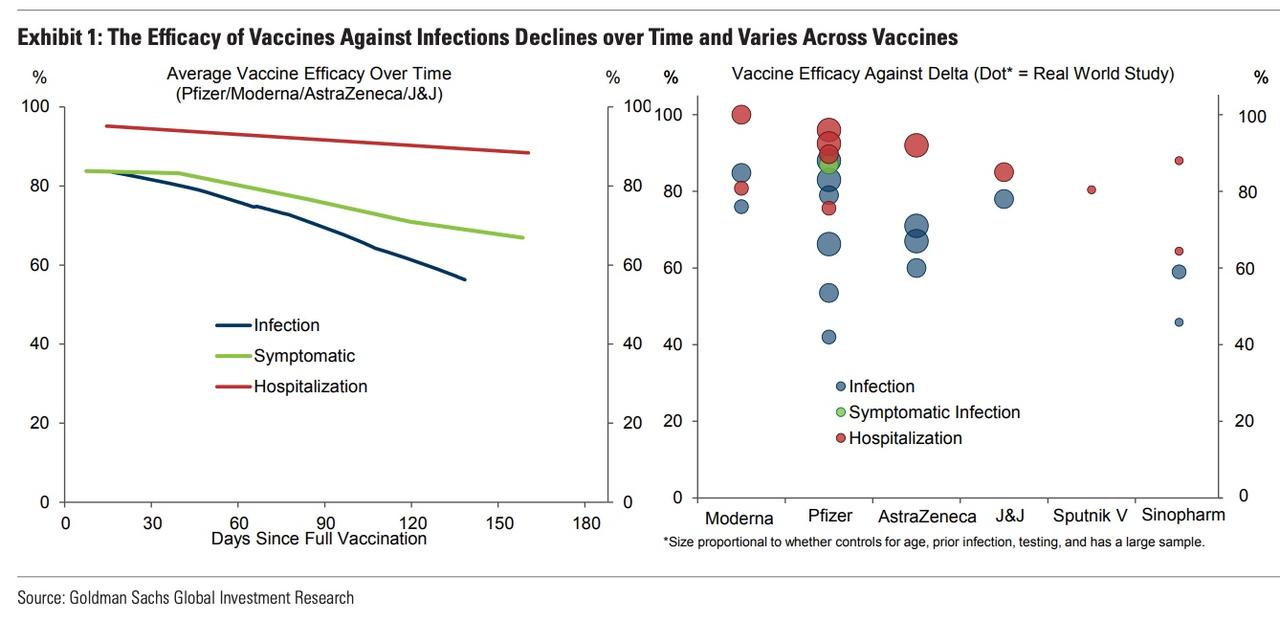
  • Vaccine efficacy against hospitalizations remains close to 90% for most vaccines six months after vaccination.
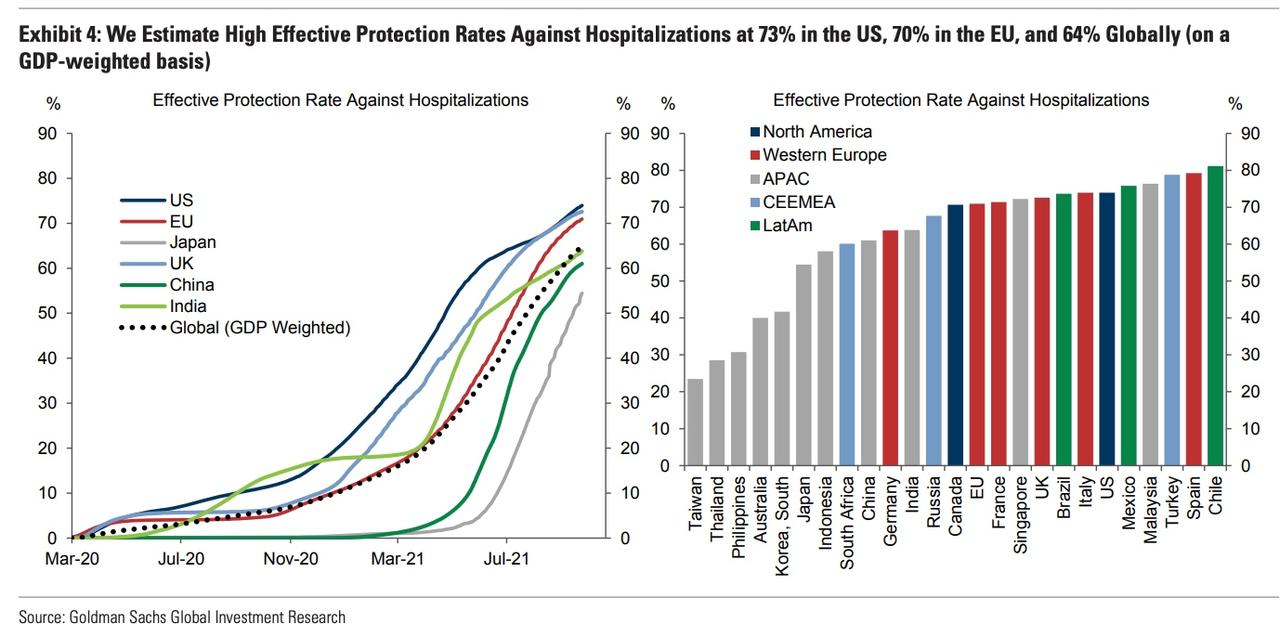
  • This implies elevated effective protection rates against hospitalizations across most major economies, at around 70% in the US, the UK, and the Euro Area, 60% in China and India, 50% in Japan, and 65% on a global GDP-weighted basis, nearly 50pp higher than six months ago.
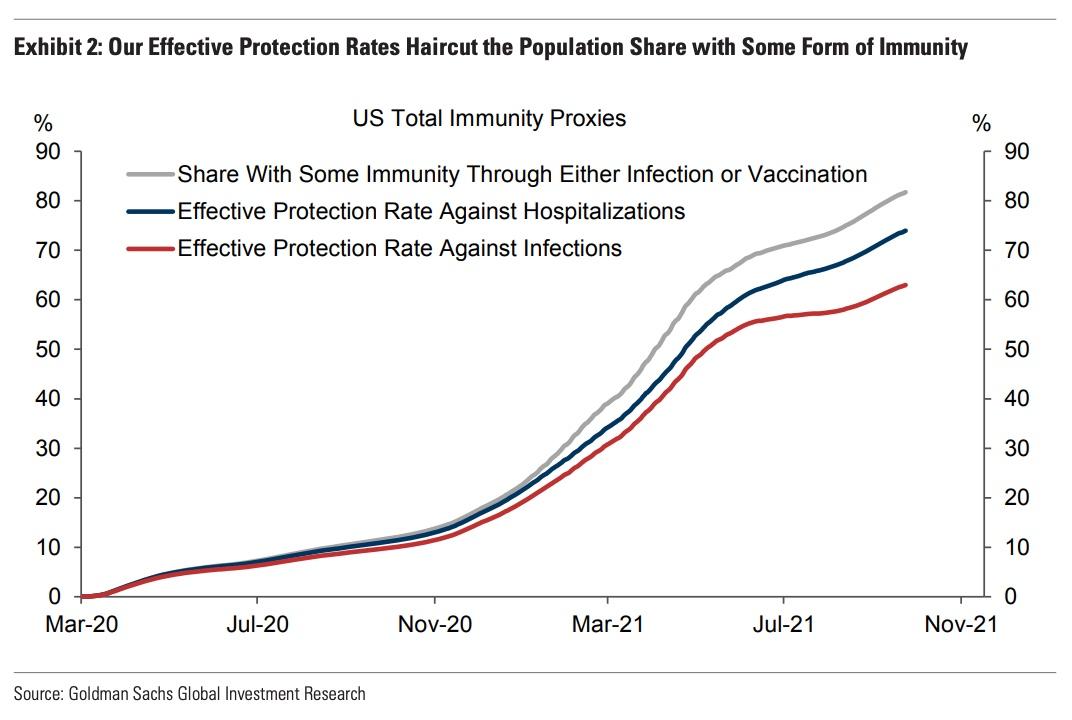
  • Presently, 80% of the American population now has some immunity through either vaccination or infection.
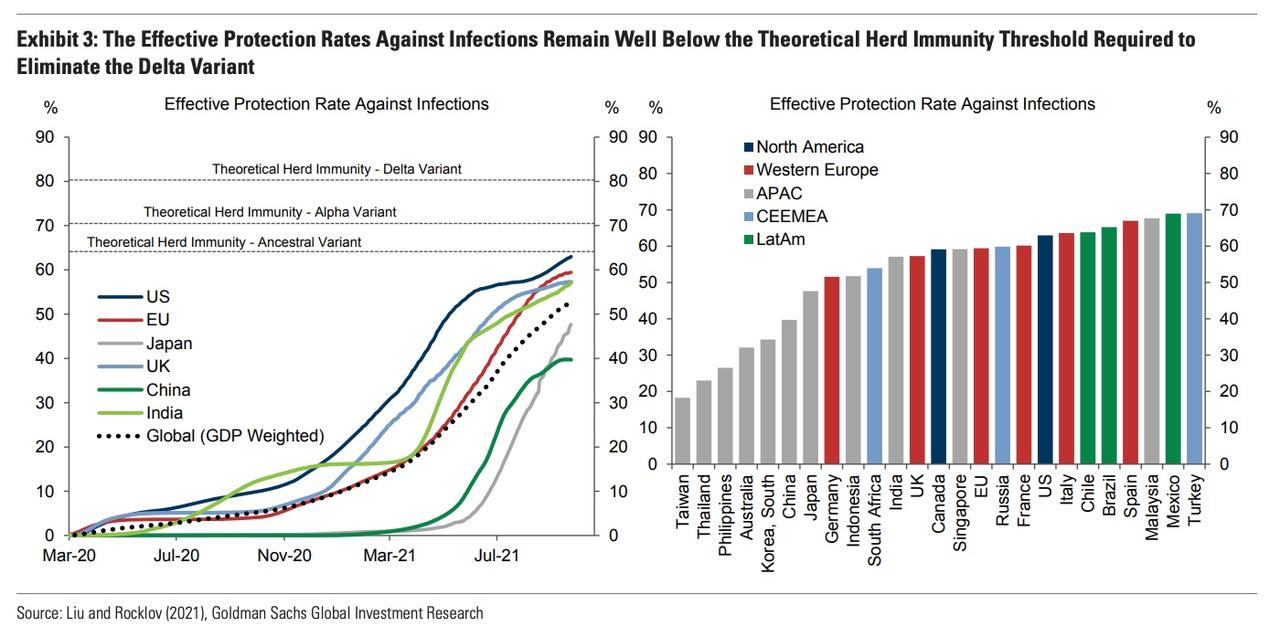
  • We find an effective protection rate against infections of around 60% in the US, the UK, and the Euro Area, 55% in India, 45% in Japan, 40% in China, and 50% on a global GDP-weighted basis, all below the theoretical herd immunity threshold required to eliminate the highly transmissible Delta variant.
Goldman points out that recent studies confirm that vaccine protection wanes over time and the rate varies by vaccine. But Goldman calculated an average rate and charted how odds of infection vs. hospitalization and death (which are much, much lower) decline over the first few months after vaccination.
Exhibit 2 shows Goldman's latest US immunity estimates. The analysts estimate that 80% of the American population now has some form of immunity through either vaccination or infection. Combined, that leaves us with an effective protection rate against infections of 60%.
Looking at the emerging world, immunity rates are understandably significantly lower - by roughly 20% on average compared with the US.
Here's how that breakdown looks for the developed world.
According to Goldman, their analysis effectively comes with some good news, and some bad news. The bad news is that, since herd immunity is effectively out of reach for humanity at this point, reviving certain types of economic activity like nightclubs, concerts, and other live events to their pre-pandemic levels will be difficult. The good news is at least humanity's resistance to COVID is improving, not degrading.

>>> US After Hours Summary: Pretty quiet after hours; MLHR +2.3% higher on earni

After Hours Summary: Pretty quiet after hours; MLHR +2.3% higher on earnings; OPRX +11% jumps as it gets added to S&P SmallCap 600; SPCE soars +9.6% as it gets clearance to fly

After Hours Gainers:

Companies trading higher in after hours in reaction to earnings/guidance: MLHR +2.3%

Companies trading higher in after hours in reaction to news: ORN +17.3% (awarded two contracts for its marine segment, totaling nearly $200 mln), OPRX +11% (to join S&P SmallCap 600), SPCE +9.6% (receives clearance to fly following conclusion of FAA inquiry), GLDD +4.6% (announces partnership with Project Vesta), ARCB +4.2% (to acquire MoLo Solutions, a truckload freight brokerage, for $235 mln in cash), CHDN +1.7% (authorizes $500 mln for new share repurchase program), CSII +1.6% (first patient has been treated with ViperCross peripheral support catheter), MNKD +0.4% (enters into sale-leaseback transaction), SBUX +0.2% (increases dividend), KMI +0.2% (announces construction on three RNG facilities), JNJ +0.2% (FDA determined that GMP5 is suitable for use and that it meets the EUA standard), F +0.1% (renews $15.5 bln in revolving corporate credit lines), GE +0.1% (awarded $480 mln Navy contract)

After Hours Losers:

Companies trading lower in after hours in reaction to earnings/guidance: LNDC -14.9%

Companies trading lower in after hours in reaction to news: ACB -1.3% (announces launch of first medical CBD product in Uruguay), FTAI -0.1% (FTAI and AIR announce joint sustainability initiative)