Early premarket gappers
- Gapping up:
- ATEN +9.7%, VCRA +8.7%, XELA +8.3%, TWNT +8.1%, X +7.8%, TEAM +7.8%, RILY +6.2%, FTDR +5.1%, NATI +4.7%, ACHC +3.6%, HLI +3.6%, AVT +3.2%, CWST +3.1%, MERC +2.6%, NXGN +2.5%, RMD +2.4%, PTCT +2.4%, OPK +2.2%, OYST +1.9%, IMMP +1.9%, HIG +1.7%, AX +1.7%, TFII +1.6%, NEU +1.5%, MSTR +1.5%, BIO +1.4%, HUN +1.4%, ECL +1.3%, SGEN +1.2%, CRI +1.1%, BCC +1%, ASPN +0.9%, FE +0.8%
- Gapping down:
- ZEN -20.2%, MNTV -14.7%, WDC -11.2%, POLY -10.9%, FDMT -10.5%, WERN -7.5%, DVA -6.3%, COHU -5.5%, AMZN -4.9%, SBUX -4.8%, FLR -4.7%, NWG -4.5%, MPWR -4.3%, POWI -4.2%, AAPL -3.9%, MGI -3.6%, TEX -3.1%, SYK -3%, ETSY -2.8%, EIG -2.4%, AON -2.4%, HVT -2.3%, LMAT -2.2%, STX -2.1%, ATR -2%, CRUS -1.9%, MU -1.7%, EB -1.7%, MESO -1.7%, GILD -1.6%, MHK -1.4%, AVGO -1.3%, CVA -1.2%, COLM -1.2%, KNSL -1.2%, FTS -1.2%, SWKS -1.1%, FTAI -1.1%, AUY -0.9%, VALE -0.9%, LITE -0.8%
Premium carmakers defy chip crisis with robust profits
Daimler, Porsche and Audi report strong earnings despite hit to deliveries from semiconductor shortage
Mercedes-Benz owner Daimler defied the semiconductor crisis to increase earnings by a fifth in its latest quarter, despite delivering almost 145,000 fewer vehicles than it did in the pandemic-ridden months last year.
The Stuttgart-based company had prioritised more profitable models, chief financial officer Harald Wilhelm said, helping it to report just under €2.6bn in net profit for the three months to the end of September, compared with almost €2.2bn in the same period in 2020.
“Despite considerably lower production and sales . . . we significantly improved our top line quality at Mercedes-Benz cars and vans with better product mix and optimised pricing,” Wilhelm told analysts on Friday.
In particular, Mercedes was selling more of its luxury S-Class model, as well as high-margin GLA and GLE SUVs, he said.
Other high-end German carmakers also reported encouraging numbers on Friday in the face of persistent headwinds.
Porsche, which belongs to the VW Group, said it had exceeded its profit margin target of 15 per cent so far this year, despite a backlog of 10,000 orders for its flagship electric Taycan model because of the shortage of crucial chips and components.
VW’s premium brand Audi, meanwhile, which delivered almost 24 per cent fewer cars in the last quarter in comparison with last year, also raised its revenue and profit guidance for the year, although operating profits fell to €740m, from €864m, in the three months to the end of September.
“Thanks to a strong operating performance, a favourable price position, and continuation of cost discipline, it was possible to largely compensate for volume lost because of the semiconductor crisis,” the Bavarian marque said.
But Porsche’s chief financial officer Lutz Meschke warned that “the fourth quarter will be a challenge”, saying the company would have to be in “absolute task force mode” to maintain its profit target over the next few months.
The premium and luxury carmakers’ relatively rosy results sharply contrast with losses endured by other mass-market manufacturers in recent months.
GM said this week its quarterly adjusted earnings before interest and tax had fallen by 45 per cent, while Ford’s were down by 17 per cent.
The mass-market Volkswagen brand, whose deliveries dropped by a more than a quarter between July and September, posted an operating loss of 184m, down from a 522m operating profit last year.
Separately on Friday, German supplier Bosch said it would invest a further €400m in expanding semiconductor plants in Europe and Malaysia to meet surging demand.
Bad bets trigger waves of tumult in short-term bond markets
Some investors have been caught off-guard by vicious moves, say analysts
A violent shake-up in bond markets has intensified as fund managers are wrongfooted by a global drop in short-term debt, say analysts and investors.
Stubbornly high inflation around the world and a hawkish response by some central banks have fuelled a rapid rise in short-dated government bond yields. At the same time, concerns about growth prospects in the coming years have kept a lid on long-term bond yields, resulting in a dramatic “flattening” of yield curves.
Short-term bond markets have “experienced unprecedented volatility” this week, said George Saravelos, Deutsche Bank’s global head of currency research. He said a sell-off in Australia’s market was the most severe since 1996, while Canada had been hit with its worst decline since 2009.
Saravelos said the moves have been exacerbated by investors being forced to abandon soured bets as markets move against them. “What is happening now runs beyond macro,” he said, using an industry phrase referring to economic trends. “This is the closest we can get to a distressed market.”
The upheaval was sparked by shifts in some relatively small government bond markets that generally do not affect others around the world. In Australia, higher-than-expected inflation figures this week prompted investors to aggressively sell short-term debt, prompting the central bank to abruptly ditch its yield target for three-year government bonds.
The Bank of Canada added to the short-end pullback by signalling it could raise rates as soon as the middle of next year. On the opposite end of the spectrum, longer-dated debt in the UK rallied on Thursday after the government slashed its debt issuance plans.
But the moves have driven a broader shift in global markets, reshaping yield curves around the world. In the US, the gap between two-year and 10-year bond yields has plunged to its narrowest level since the summer. US Treasuries have been hit by the biggest swings in eight months, according to an index compiled by Ice Data Services that tracks volatility in the world’s biggest bond market.

“The Bank of England and Bank of Canada are normally not huge movers for the US, but it’s clear they have been in this instance,” said Tom Graff, head of fixed income at Brown Advisory. Higher yields on sovereign debt outside of the US — which means investors get paid more to hold those foreign bonds — could reduce demand for Treasuries, said Graff.
Even the European Central Bank, which this week pushed back against bets on a 2022 rate rise, has appeared powerless to fight the sell-off, which was given further impetus by figures on Friday showing eurozone inflation surged to 4.1 per cent in September.
In the UK, investors such as hedge funds had positioned for a steeper yield curve, betting that the impending end of BoE bond purchases would undermine longer-dated debt, pushing up yields, according to Theo Chapsalis, head of UK rates strategy at NatWest Markets. But after the unexpectedly large cut in the government’s debt issuance plans, many of those investors have been forced to buy longer-dated bonds — and sell short-dated ones — to exit their “steepener” positions as markets moved against them.
“The steepener is a trade that a lot of people keep going back to, but most of the time it causes them trouble rather than joy,” Chapsalis said.
Bloomberg reported on Wednesday that hedge fund Rokos Capital Management was among the investors unwinding steepeners after losses of 11 per cent this month. Macro hedge funds such as Rokos make bets on the shape of the yield curve, so this month’s losses may be attributable to a misguided bet on a steeper curve.
“The word on the street was that a lot of this had to do with position unwinding,” said Graff.
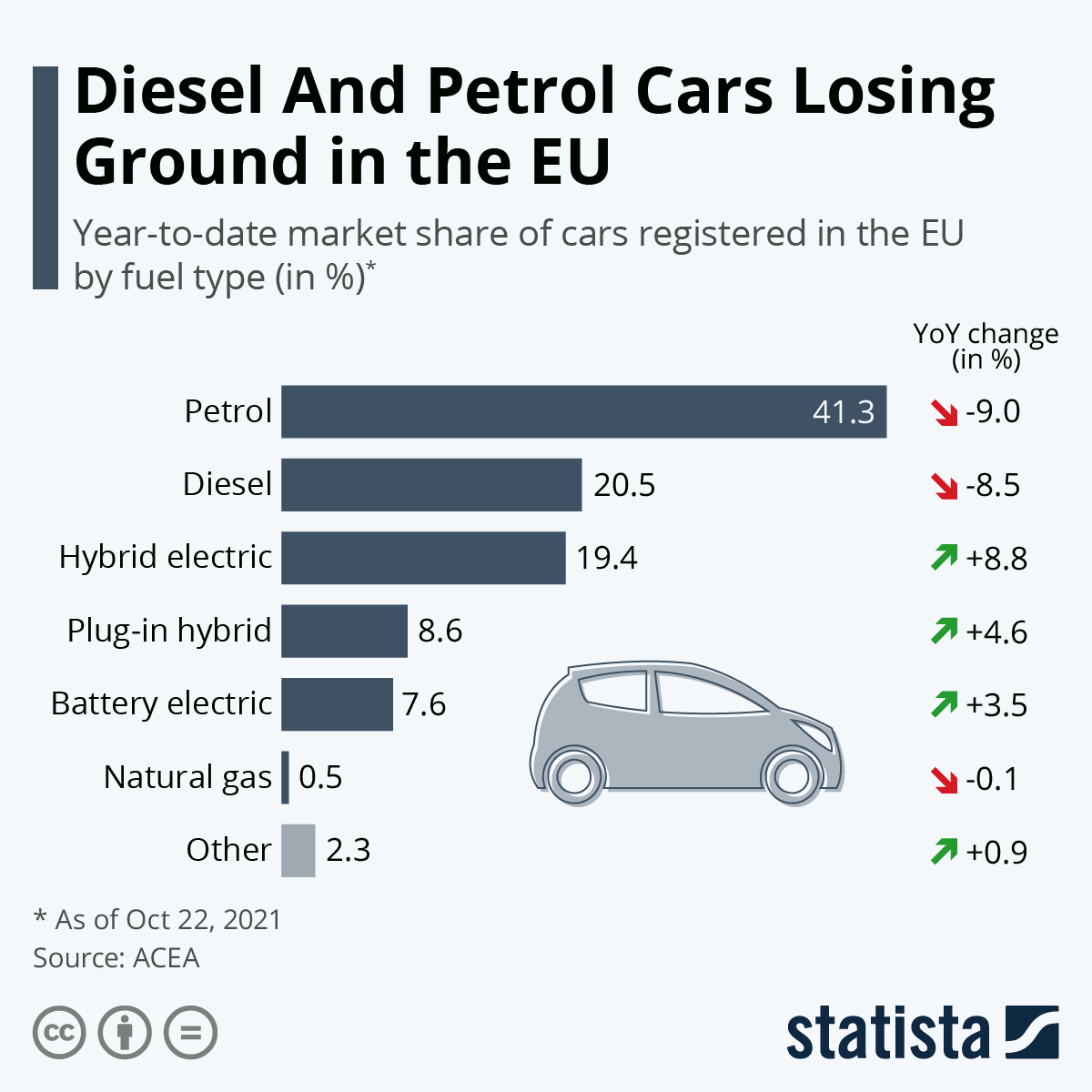
Diesel And Petrol Cars Losing Ground In The EU
The car industry is one of the sectors most impacted by supply chain disruptions and global chip shortages cause by the coronavirus pandemic. However, as Statista's Florian Zandt notes, this hasn't stopped it from being under scrutiny for its role in climate change, whether due to the production process or the cars manufactured.
When it comes to the latter, car buyers in the European Union seem to be doing their part to lessen the impact of fossil-fuel-powered automobiles.
You will find more infographics at Statista
In the first nine months of 2021, registrations of petrol and diesel cars went down by 9 and 8.5 percent, respectively, when compared to the previous year's timeframe according to data by the European Automobile Manufacturers' Association (ACEA). Vehicles with a hybrid electric powertrain, on the other hand, saw a rise in registrations of 8.8 percent, putting their market share of cars registered between January and September of 2021 about one percent behind diesel units. Overall, the share of cars with alternative power trains keeps rising steadily, making up more of a third of newly-registered automobiles in the EU in the first three quarters of this year.
The shift towards electric cars with chargeable batteries is also not without its downsides. Even though a study conducted by the Universities of Exeter, Cambridge and Nijmegen has shown that the total average carbon emissions of an electric vehicle are still far lower than of one powered by fossil fuels, even with production emissions factored in, there's still the issue of sourcing the minerals for batteries, their longevity and the increased production of e-waste.
Even though the automotive industry in the European Union continues to hit its target values for the reduction of average CO2 emissions according to data from the ICCT, those numbers are to be taken with a grain of salt: Without phase-in provisions and extra credits for low-emission vehicles and eco-innovation technology, most big manufacturers like Ford-Volvo, BMW and Volkswagen would miss the mark by a considerable margin. Out of the estimated 7 gigatonnes of CO2 emitted by the transport sector in 2020, passenger cars contributed 2.9 gigatonnes or 40 percent.
Demand For LNG Is Only Going To Rise
Cheniere Energy recently announced plans for a $7-billion expansion of its Sabine Pass liquefaction plant in response to the surge in demand for the superchilled fuel in Asia. India's biggest gas importer said that this strong demand would lead to another surge - in long-term contracts. There may be doubts about long-term oil demand, but LNG's future seems to be bright.

Morgan Stanley said earlier this week that it expected demand for liquefied natural gas to grow by between 25 and 50 percent by 2030. Spot prices for LNG over the next ten years, the bank's analysts also said, as quoted by Reuters, could be on average 40 percent higher than the last five-year average. The bank raised its long-term price outlook for the commodity to $10 per million British thermal units.
The long-term price forecasts compare to a spot price of $56 per mmBtu in Asia earlier this month, the Reuters report noted. This would explain a move to long-term contracts, as forecast by the chief executive of India's Petronet.
"Such a volatility was never seen in the history of LNG markets. We have seen the lowest and the highest prices in the last one year," he said, as quoted by Reuters, at an industry event last week."Every dark cloud has a silver lining and this (high price) situation is pushing people to have more long-term contracts than normally and that could be the best thing for the gas economy across the world," A. K. Singh said.
But for long-term contracts, there needs to be sufficient supply. The world seems to have swung into a deficit of the fuel and it needs new supply of at least 73 million tons by 2030, according to Morgan Stanley analysts. This would cost some $65 billion, and that's on top of $200 billion of LNG projects approved since 2019, Reuters noted.
"We think that Asia is the growth driver for our industry for LNG demand for decades to come, and China is the single biggest piece in that," said the chief commercial officer of Cheniere Energy last week, as quoted by the Financial Times.
Cheniere's $7-billion production expansion is part of a new wave of LNG projects that popped up amid the energy crunch that started in Europe and quickly spread to Asia. An earlier report by the Financial Times cited Tellurian, with plans for a $15-billion facility. NextDecade plans to sanction a new facility in Texas by the end of the year.
"Market conditions in Europe and around the world confirm that the call on LNG far exceeds available supply," said NextDecade's chief executive Matt Schatzman.Another executive, the CEO of Venture Global, said U.S. liquefied natural gas will be "critical to meeting this growing need and bringing energy security to Europe and beyond."
Meanwhile, the world's largest LNG exporter earlier this month said its production was maxed out as demand continued to outstrip supply.
"We are maxed out, as far as we have given all our customers their due quantities," said Saad al-Kaabi, Qatar's energy minister, as quoted by Al Jazeera."I am unhappy about gas prices being high."
Qatar, by the way, is working on a substantial increase in its LNG production capacity. The project, costing $28.75 billion, will boost the country's LNG production capacity from 77 million tons per year to 110 million tons. It should start producing in 2025.
The going seems to be particularly good for LNG producers and is getting better as buyers become more willing to reduce the risk of future price spikes by locking in lower rates in long-term contracts. This also confirms the long-term growth trajectory of liquefied natural gas despite warnings from the International Energy Agency that LNG demand needs to peak soon if we are to hit the Paris Agreement emission targets.
According to the IEA, gas demand must peak between 2025 and 2030 and start declining from 2030 onwards if the world is to achieve net-zero emission status by 2050. But the latest trends in LNG and gas make this doubtful. The fact that companies are willing to commit billions in upfront investments in new production capacity suggests that they expect quite the opposite of what the IEA advises. The Morgan Stanley forecast chimes in with these expectations.
"Contrary to investor expectations, the world is going to need more LNG in the initial phase of the energy transition," the bank's analysts wrote."Competing technologies for natural gas are not being developed fast enough, and there are significant benefits in reducing coal consumption while greener fuels are commercialised."
This was precisely the idea of Europe switching from coal to gas. Yet as the crunch showed, there is no guaranteed hedge against shortages. Now, it is this drive to minimize the chance of future shortages that is spurring demand. Once the long-term contracts are signed, a demand decline would be difficult to effect artificially to advance the Paris Agreement agenda.
Loro Piana Enters New Era With New CEO
LVMH, the Italian luxury brand's owner, said the goal is to evolve Loro Piana, including by adding new product categories.
Signaling a new development phase for Loro Piana — and underlining the stockpile of well-rounded management talent within LVMH Moët Hennessy Louis Vuitton — the French group has appointed dynamic Dior executive Damien Bertrand as the new chief executive officer of the Italian brand, which is known for its luxury fabrics and quiet chic.
Currently managing director at Christian Dior Couture, Bertrand, 48, is to take up his new role on Nov. 15. He succeeds Fabio d’Angelantonio, who is leaving Loro Piana after five years at the management helm.
Touting his “sense of product excellence, daring ideas and commitment to brand desirability,” LVMH group managing director Toni Belloni said Bertrand has “shown the ability to deliver great results” during his five years at Christian Dior Couture.
“He is a well-rounded leader, able to get the best from people, while maintaining a strong team spirit,” Belloni added. “This skill set will help him take the beautiful Loro Piana maison to the next level.”
After an 18-year career at French beauty giant L’Oréal, Bertrand joined the Dior fashion house in 2016 as managing director in charge of women’s departments, then a new position.
He would later add responsibilities for the Dior Men and Dior Baby business units, collaborating closely with multiple creative and management teams.
According to an internal announcement seen by WWD, Bertrand is to “lead a new phase of evolution at Loro Piana and the development of new product categories,” while ensuring the maison stays true to its “extraordinary fabrics and understated elegance.”
Bertrand reports to Andrea Guerra, CEO of LVMH’s hospitality businesses and a member of the LVMH executive committee. Guerra also has oversight of the Fendi business.
In recent years LVMH has steered Loro Piana in a younger direction, recently asking Hiroshi Fujiwara of Fragment to design a capsule collection, a first for the brand.
It is understood that collaborations are likely to continue for a brand that, unlike other LVMH fashion maisons, lacks a visible creative director.
According to sources, Phoebe Philo, who is gearing up to launch her own fashion brand with LVMH as a minority investor, has held discussions about a one-off side project with Loro Piana, though talks have yet to be concluded and any collaboration would not be imminent.
Philo confirmed her return to fashion last July, saying she would create clothing and accessories “rooted in exceptional quality and design” — and divulge more details about her eponymous new brand in January 2022.
Given Philo’s knack for sumptuous sweaters, eye-catching coats and great-fitting pants, a Loro Piana capsule signed by her would surely bring a lightning rod of attention to the Italian brand’s women’s department.
Loro Piana could also tap any number of buzzy designers within the LVMH galaxy — which spans from Jonathan Anderson to Virgil Abloh — for future capsules.
Antoine Arnault, chairman of Loro Piana, thanked d’Angelantonio for “steering the transformation of Loro Piana from a family business to an LVMH maison, with great respect for its heritage and people.”
Arnault also credited him for “leading performance improvement and the modernization of key functions and products.”
“We wish him well in his new endeavors,” he added.
D’Angelatonio’s next move could not immediately be learned. An Italian native, he has also worked at Luxottica and its Sunglass Hut unit.
LVMH acquired an 80 percent stake in Loro Piana for 2 billion euros in 2013.
Founded in 1924 and based in Quarona, Italy, the company is billed as the largest cashmere manufacturer and the biggest single purchaser of the world’s finest wools. The brand is vertically integrated, from access to the finest raw materials to distribution, and operates with an entirely made in Italy policy via nine production sites.
Loro Piana has a total of 152 stores, of which 135 are directly operated. The company has secured locations for units in Doha, Qatar, and Palo Alto, Calif., to open in the next 12 months.
The company reached the 1 billion euro sales mark in 2019, and revenues in 2021 are forecast to surpass the 2019 figures, as reported.
A graduate of elite French school HEC, Bertrand began his career at LVMH in 1998 as Guerlain’s marketing director for Australia.
At L’Oréal group, his roles included CEO of L’Oréal U.K.; president of Maybelline New York, and CEO of L’Oréal Brazil.
A raft of brand CEOs with LVMH’s linchpin fashion and leather goods division rose through the ranks of the French group, including Serge Brunschwig at Fendi; Pascale Lepoivre at Loewe; Renaud de Lesquen at Givenchy; Séverine Merle at Celine; Hugues Bonnet-Masimbert at Rimowa, and Lisa Attia at Moynat.
Bertrand’s successor at Dior has yet to be named.
Evergrande struggles to revive projects after last-minute payments
Beijing’s invisible hand seen in indebted Chinese developer’s efforts to avoid default
On the outskirts of Beijing, a banker smartly dressed in black slacks and white-collared shirt stands guard in front of an Evergrande residential development as trucks carrying tonnes of cement rumble by.
Construction at Evergrande Royal Peak — one of hundreds of projects in China involving the world’s most indebted real estate developer — was halted in July as a liquidity crisis at the group hampered its ability to pay contractors and suppliers.
But work resumed early this month, according to people at the site, even as the group’s plight and expectations of an imminent default sparked a global reckoning over the health of China’s vast property sector, an industry that underpins the country’s wider economic model.
“I’m here to watch that work is going on [and] make sure the workers haven’t left,” said the banker from Shanghai Pudong Development Bank, who declined to give his name. Tasked with monitoring the site every day, he added that the bank had lent against the project in June.
Other Evergrande creditors have much less clarity on what exactly is going on inside a company that rocked international markets late last month after failing to make a payment on an offshore bond, only to narrowly avoid default by transferring the funds last weekend before a 30-day grace period expired.
Another last-minute payment on a separate bond was reportedly made yesterday, with two bondholders telling the Financial Times today that fellow creditors had confirmed receipt. Evergrande did not immediately respond for a request for comment. Other deadlines loom in the coming months.
But international markets, where investors have ploughed about $20bn into a company with more than $300bn of liabilities as of June, remain in the dark about many aspects of the situation, despite advisers complaining weeks ago of a lack of “meaningful engagement” from the developer.
Evergrande has yet to provide any official disclosure on its bond payments. The transfer last week was initially reported in state media and subsequently confirmed by the FT.
Adding to the uncertainty is the Chinese government, which has downplayed the risks of Evergrande without clarifying its role in resolving the problem. Yet Beijing is believed to be deeply involved in the fate of the company that has come to embody the struggle of China’s property sector to deleverage, and which has taken customers’ prepayment for flats that have yet to be delivered.
“This is going to be very opaque — no one’s going to be telling the offshore bondholders what the position is in China,” said one person involved in the Evergrande situation, adding the “black box” nature of the process and lack of transparency was “absolutely standard” in the country.
At the residential development in Beijing, where cranes swing back and forth against the whirr of drills, construction is being run by CRCC, a state-owned rail company. A subcontractor, who oversees a team of 50 workers, said he resumed work after being told he would be paid through a deposit that Evergrande had placed with the government. “But we haven’t seen any money, they keep delaying,” he said.
He was resigned to working without being paid until the Spring Festival, a public holiday, next February. “They told us . . . that the government had taken over responsibility for the project — that it’s a people’s project,” he said. “If it’s the government doing it, you have to keep working.”
Projects like Evergrande Royal Peak are the lifeblood of the company and crucial for investors within and beyond China. If Evergrande can continue to build and sell new homes, it can generate cash to repay its debts. But in late August, the company initially warned markets through its interim results that work at some of its projects had been suspended.
On Sunday, after the last-minute bond payment, the group said on its WeChat social media account that work at nine projects had resumed. In Hong Kong, work is continuing at one of its sites, though a prominent sign on the building that previously displayed its name has been covered up. But the overall status of its 778 projects across more than 200 cities is unclear.
“There is little disclosure on the status and progress of Evergrande’s projects,” said Luther Chai, an analyst at CreditSights. “Site visits have been made difficult with Covid-19 border restrictions.”
But, Chai suggested, given the number of unfinished projects “it is in the government’s interest to protect homebuyers first, by ensuring that Evergrande prioritises project completion, in order to prevent large scale social unrest”.
The person involved in the situation said there was speculation that “there are representatives of the government taking control of projects at the moment”. Some local authorities in September seized control of customers’ presales money, while in July news of a project being halted in the city of Shaoyang dealt a significant blow to investor sentiment towards Evergrande.
For offshore bondholders, which recently included big investors such as BlackRock and UBS, there are uncertainties around any potential claim on the real estate projects at the core of Evergrande’s business model even in the event of an official default, which many still expect.
The person added there was a lack of clarity over what money raised in offshore bond markets was used for and whether, after passing through Evergrande subsidiaries, it ended up as debt or equity in specific projects on the Chinese mainland.
“Everyone wants to hope it’s just passed through as debt,” the person said, adding that if the money was used instead for equity financing, it would have a weaker claim in any restructuring process. “I don’t think anyone knows yet.”
Meanwhile, even if all of the group’s projects are completed, other analysts suggest the company’s timeline of looming debt repayments will still be difficult to meet without other asset sales.
Evergrande has missed interest payments but has not yet faced the principal payment on a maturing bond outside of China. It has, however, extended maturities on a bond issued by a company called Jumbo Fortune Enterprises that it guaranteed, according to media reports. The company did not immediately respond to a request for comment.
“We don’t really have a lot of time,” said Matthew Chow, an analyst at S&P, pointing to debts coming due in March and April. “I think the best case is still . . . hinging on whether the company can sell some assets.”
As of the end of June, Evergrande had $36bn of borrowings and $91bn of trade payables due in the next year — well over a third of its total liabilities — compared to $14bn of cash.
In the absence of any official explanation, theories abound as to why Evergrande made the last-minute bond payment last week rather than defaulting and entering restructuring talks. One is that the company is buying time to sell assets offshore to deal with creditors and other claims onshore, though an attempt to sell a stake in its property services unit fell through last week.
Another is that its billionaire chair Hui Ka Yan is under government pressure to avoid a default and is even using his own personal resources to do so. According to Hong Kong land documents, a mortgage was recently secured on a property Hui bought through a shell company in 2009.
Back on the outskirts of Beijing, one worker says he is not worried about Evergrande failing because “the government won’t let it happen”.
Nearby, a poster displays a blown-up photo of Hui from a report in state-owned newspaper People’s Daily. The image shows China’s former richest man at Tiananmen Square, attending the Communist party’s 100th anniversary in June, with a nervous smile on his face.
>>> Up
* Argenx ADRs Raised to Strong Buy at Raymond James; PT $390
* Argenx ADRs Raised to Strong Buy at Raymond James; PT $390
* Argenx ADRs Raised to Buy at Guggenheim; PT $330
* Bossard PT Raised to 460 Swiss francs at Berenberg
* Ence Raised to Neutral at Alantra Equities; PT 2.72 euros
* Great Portland Raised to Neutral at Citi
* Kingspan Raised to Outperform at Exane; PT 115 euros
* Scandic Raised to Buy at Handelsbanken; PT 50 kronor
* Scor Raised to Buy at SocGen; PT 32.50 euros
* SwedenCare Raised to Buy at Pareto Securities; PT 170 kronor
* United Utilities Raised to Hold at HSBC; PT 1,090 pence
>>> Down
>>> Down
* Aker BP Cut to Hold at SEB Equities; PT 325 kroner
* Aker BP Cut to Hold at Nordea (+)
* Altria Cut to Equal-Weight at Morgan Stanley; PT $47
* Arjo Cut to Hold at Handelsbanken; PT 130 kronor
* Catena Cut to Hold at ABG; PT 570 kronor
* Catena Cut to Hold at ABG; PT 570 kronor
* CNP Assurances Cut to Hold at HSBC; PT 21.90 euros
* EasyJet Cut to Sell at Citi; PT 450 pence
* JM Cut to Hold at Handelsbanken; PT 365 kronor
* J. Martins Cut to Hold at Jefferies; PT 20 euros
* OKEA Cut to Hold at SEB Equities; PT 28 kroner
* QT Group Cut to Reduce at Inderes; PT 160 euros
* Schaltbau Cut to Hold at Stifel; PT 53.50 euros
* SR-Bank Cut to Hold at Arctic Securities; PT 135 kroner
* SRV Group Cut to Reduce at Inderes; PT 55 euro cents
* STMicroelectronics Cut to Neutral at Citi; PT 45 euros
* Telecom Italia Cut to Equal-Weight at Barclays; PT 35 euro cents
* Telenet Cut to Hold at HSBC; PT 35 euros
* XXL Cut to Hold at ABG; PT 17 kroner
>>> Initiation
* M&G Rated New Neutral at Goldman; PT 200 pence
>>> Initiation
* M&G Rated New Neutral at Goldman; PT 200 pence
* Melia Hotels Re-Initiated Underperform at Exane; PT 5.70 euros
>>> Call
>>> Call
* BNP Paribas Results Mixed, Buyback is Surprise: Jefferies (+)
* CaixaBank Results “Lacklustre,” Jefferies Expects Shares to Fall
* Cellnex Results Solid and In Line With Expectations: Goldman (+)
* Daimler Stock Likely to React Positively After ‘Solid’ 3Q: RBC (+)
* EasyJet Cut to Sell at Citi on Pricing and Margin Pressures
* Safran Aftermarket Strength Bodes Well for Margins, Citi Says (+)
* Salzgitter Guidance Conservative After 3Q Beat, Jefferies Says
* Salzgitter Guidance Conservative After 3Q Beat, Jefferies Says
* UMG Reiterate Buy PT 27 euros (note attached)