>>> Russia's Most Downloaded Apps in March (Telegram Mentionned)

Russia's Most Downloaded Apps in March

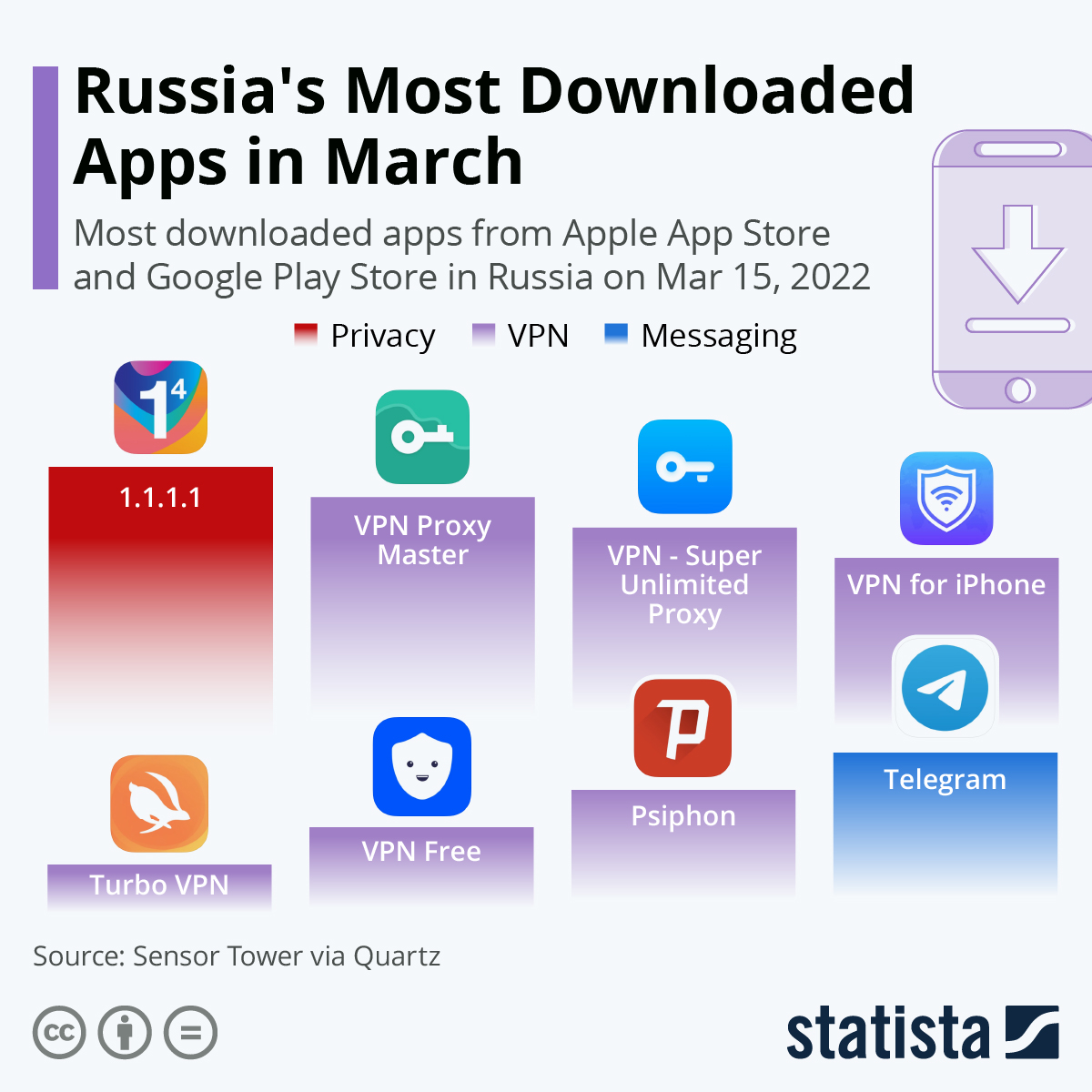
In early February, the most downloaded app from the App Store in Russia was 'Persona', a makeup filter app, followed by video conferencing provider Zoom and the online retailer AliExpress (according to a review of app data sources by The Economist). Since the invasion of Ukraine and the ensuing sanctions, pull outs and censorship, people in the country have been far more focused on finding a VPN or internet privacy app, as shown by this infographic based on analysis by Sensor Tower and Quartz.
On March 15, the internet privacy app 1.1.1.1. was the most downloaded app in Russia when taking into account the numbers from Apple's App Store and Google's Play Store. The top 8 list is dominated by VPN providers, with the encrypted messaging service Telegram making an appearance, too. Looking for solutions to problems of a far more serious nature, Quartz reports that the most downloaded app in Ukraine on this day was 'Air Alarm', which as described by the developer "generates a loud alert warning of an airstrike, chemical attack, technological catastrophe or other types of civil defence alerts."


DESCRIPTION
This chart shows the most downloaded apps from Apple App Store and Google Play Store in Russia on Mar 15, 2022.

(ZH) The Frozen Russian Superyachts (And Those That Got Away)

The Frozen Russian Superyachts (And Those That Got Away)

Reports about the superyachts of sanctioned Russian billionaires being frozen or detained came a dime a dozen in the aftermath of the invasion of Ukraine by the country at the end of February. But are these floating displays of obscene wealth now closely watched over in European harbors and marinas big or little fish when considering the most valuable superyachts owned by Russian billionaires?
The answer to this question is: they kind of are.
As Statista's Katharina Buchholz details below, among the megalomaniac yachts detained in Europe are some of the biggest known to be owned by now sanctioned Russians. This is according to information by the Russian Asset Tracker and several media reports by Forbes and others.
The Crescent, currently being held in Tarragona on the Spanish Mediterranean coast, is linked to sanctioned Rosneft CEO Igor Sechin. At an approximate value of $600 million and a length of 443 feet, it is one of the largest yachts in the world and is said to feature a large glass-bottom pool, a helicopter hangar and a two-story glass atrium.
Another enormous vessel - nabbed by authorities while undergoing repairs in Hamburg, Germany – is the Dilbar, owned by Metalloinvest’s Alisher Usmanov. It is the world’s largest yacht measured by interior volume and has a staggering length of 511 feet. The yacht is believed to have been even more expensive upon delivery in 2016 than the Crescent, which was finished in 2019. Finally, the world’s largest sailing yacht, three-master SY A, was detained in Trieste, Italy. It is owned by Andrey Melnichenko of EuroChem and coal company SUEK.
But several more of the biggest boats owned by sanctioned Russian oligarchs are currently out of reach of Western authorities.
You will find more infographics at Statista
These vessels have been sighted in the Maldives, Dubai or Turkey - all countries that haven't imposed sanctions on Russian individuals and have no extradition agreements with the West. The latter nation is currently hosting two boats of yacht afficionado and soon-to-be former Chelsea F.C. owner Roman Abramovich.
Compared to the value of these massive boats, some other superyachts that European countries detained seem rather modest despite their luxurious furnishings. The only ones valued at more than 100 million dollars were Sergei Chemezov’s Valerie, which was frozen by Spanish authorities, and another one of Igor Sechin’s yachts, Amore Vero, which was detained in France. Only the price at the time of delivery was available for the two boats, meaning the current value of the boats built in 2013 and 2011, respectively, would be lower now.
Other highly publicized detainments of superyachts included Alexey Mordaschov’s Lady M and Gennady Timchenko’s Lena, both held up in Italy. The vessels are valued at comparably low $27 million and $8 million, considering loss of value after delivery. The only other yacht of a value of more than $50 million belonging to a sanctioned Russian billionaire was detained in the islands of Mallorca – Victor Vekselberg’s Tango. The latest catch was a $38 million superyacht belonging to an unnamed Russian businessman, which was frozen by British authorities in London’s Canary Wharf in connection with sanctions, The Guardian reported Tuesday.

Barrons : Tobacco Stocks Are Cheap. But the Selloff in Imperial Brands Was Overd

Tobacco Stocks Are Cheap. But the Selloff in Imperial Brands Was Overdone.

Tobacco stocks are cheap, and Imperial Brands is just about the cheapest.

The British cigarette maker (ticker: IMB.UK) trades around 6.8 times projected 2022 earnings, significantly lower than the sector average of 11.4 times. There are quite a few reasons that the sector is so cheap, including regulatory concerns, falling cigarette sales, and the difficulties faced by cigarette makers in meeting environment, social, and corporate governance, or ESG, investing criteria.

But investors may be neglecting the positives and allowing a potential buying opportunity to go up in smoke.

For starters, tobacco stocks can be a good hedge against inflation, as higher prices typically don’t hurt demand. Plus, a lot of the bad news is priced in, hence the valuations.

That’s where Imperial Brands comes in. The stock fell 15% in the first 10 days of Russia’s invasion of Ukraine, having hit two-year highs earlier in February. Russia is the fourth largest cigarette market in the world by volume, so a reaction was understandable.

But it was overdone, and since the owner of brands including Davidoff and Winston announced a full exit from Russia, the stock has bounced back—although it’s still 10% off its recent high. The company said Russia and Ukraine represented just 0.5% of adjusted operating profit in 2021. With the Russia risk alleviated for now, it’s a big year for the company. In 2022, it will complete the first phase of CEO Stefan Bomhard’s five-year turnaround plan—investing in key markets and next generation products, or NGPs.

Tobacco companies have been pushing into cigarette alternatives, including heated tobacco and e-cigarettes. In November, when the company’s full-year earnings were released, Bomhard said that the focus would be on “the acceleration of returns and sustainable growth in shareholder value.” The company reported earnings per share of 246.5 pence ($3.24) in 2021, and analysts covering the stock estimate it could reach 283.9 pence by 2024, according to FactSet data.

The company’s trading update on April 6, and first-half results set to be released in May, could be near-term catalysts for a stock boost. J.P. Morgan analysts said they expect a positive update, particularly after the company said on March 25 that it was gaining traction in the U.S. market.

A possible share buyback announcement also is on the horizon. The company has a target leverage toward the lower end of a two-to-2.5 times net debt to earnings before interest, taxes, depreciation, and amortization, or Ebitda, range, before initiating potential share buybacks. At the end of September 2021, it stood at 2.2 times.

“While it is still early in his tenure as CEO, we believe Bomhard’s solid first year at the helm should reassure investors, with a valuation multiple expansion likely throughout the year as confidence builds ahead of a likely share buyback announcement in November,” said J.P. Morgan analysts.

The analysts forecast a double-digit earnings-per-share compound annual growth rate in the medium term, versus mid- to high-single digit rates for its peers. The analysts cite more-targeted NGP investment, tobacco margin expansion, and the boost from buybacks.

J.P. Morgan has a price target of 21 pounds sterling ($27.62) on the stock, implying a 29% upside to Tuesday’s price.

“In the case of tobacco, we are unequivocally of the view that share buybacks will be a good thing for shareholders,” said RBC Capital Markets analyst James Edwardes Jones, adding that it was “essential to unlocking” Imperial Brands’ undervaluation. He has a Buy rating and £20 price target.

Imperial Brands’ stock is at a stalemate. But the smoke may be about to clear.

Barrons : A Russian Default Would Stack Risks Onto a Stressed World

A Russian Default Would Stack Risks Onto a Stressed World

The global economy is facing a combination of challenges seldom seen before, and Russia’s war against Ukraine piles a host of new risks onto the pre-existing ones created or exacerbated by a once-in-a-century pandemic. Rising global inflation and an uneven economic recovery from the 2020 crash that widened the gap between rich and poor nations figure prominently in the long list of risks that mark 2022.

The war is already stoking global inflation. Its immediate economic impacts were forcefully felt in commodity markets in a supply shock reminiscent of the 1970s oil shocks—except this time it also involves spiking food prices. We know that the pandemic has seriously impaired global supply chains and led to soaring transport costs. Government and central bank intervention supported aggregate demand but did little to repair aggregate supply. This imbalance added to costs and set the stage for the return of global inflation. Disruptions from the war have further damaged trade links and stalled the agricultural production of two key global providers. This will fall hardest on developing countries and the poor, who will see much higher prices for food and other basic goods. However, the war’s adverse effects on advanced economies in Europe should not be underestimated, either.

Added to this pre-existing problem is a new one—the potential fallout in financial markets from a likely default by Russia at some point. Here, the more recent past does not necessarily provide a good road map, as the collapse of Lehman Brothers and the implosion of the housing market in 2008 were very much about advanced economies. This time, many emerging markets and developing countries are likely to be the most affected. Often, those impacts are underestimated because they occur in countries that are off the radar screen and not deemed as systematically important. They are the antithesis to too big to fail.

As for the first challenge, prior to the war, inflation was already proving to be much higher, more persistent, and broader-based than major central banks initially thought possible. In more than half of advanced economies, 12-month inflation through February 2022 was running above 5%. Over 70% of emerging markets and developing economies saw inflation at that level or above, more than double the share prior to the Covid-19 outbreak.

Food inflation is running particularly hot. The risks of a re-emergence of food crises in many parts of the globe and attendant social unrest loom large and should not be underestimated. About 80% of emerging market economies saw food price inflation over 5% in the year leading up to the war. Furthermore, the impacts of the war are likely to be persistent, as the ongoing conflict will continue to interrupt cycles of planting, production, and transport of food, making a bad situation worse. Inflation is a very regressive tax, and food inflation even more so. In lower-income countries, as in poorer households within countries, food and energy spending accounts for a much larger share of expenditure, and higher prices eat up a much larger share of their income. In many developing countries, government finances are poised to deteriorate as the pressure for higher food and fuel subsidies intensifies.

On the second challenge, the possibility that Russia will default on its sovereign external debt due to sanctions, the risks may be clustered on what we don’t see and can’t quantify. While markets are focused on the sovereign, Russian corporates also face the prospect of default. So far, financial spillovers have been limited, but it is premature to declare victory on that front. According to the Bank for International Settlements, European banks have limited exposure to Russia, but the extent of nonbank exposure is far more difficult to ascertain. Nonbank interlinkages are often revealed only at the time of default. The market volatility that ensued from the Russian default in the summer of 1998 took down the U.S. hedge fund Long-Term Capital Management and prompted the Federal Reserve to intervene to calm international capital markets.

The financial consequences of a Russian default may also fall disproportionately on emerging markets and developing countries, where economic recovery from the pandemic has been mostly disappointing. Many have simply not recovered yet. Developing countries were already finding it harder and harder to pay their debts. Almost 60% of the world’s poorest countries eligible for the Debt Service Suspension Initiative that ended last year are either in, or at high risk for, debt distress. More risk-averse investors and rising international interest rates will make it more costly to attract new financing and service existing debt. According to the World Bank’s International Debt Statistics, total external debt servicing relative to exports roughly doubled from 2010 to 2020. And this was during a period of exceptionally low international interest rates.

A developing-country crisis is not inevitable, but the risks are stacked. It is never a good time for war, but this one comes at a time with some glaring fault lines in the global economy.

FT : Roman Abramovich’s $1bn five-yacht fleet revealed

Roman Abramovich’s $1bn five-yacht fleet revealed
Latest vessel’s discovery highlights veil of secrecy over sanctions-hit oligarch’s assets

The luxury yacht Eclipse moored off Marmaris in Turkey. © Durmus Genc/Anadolu Agency/Getty Images

Russian oligarch Roman Abramovich owns or is linked to a collection of five yachts estimated to be worth almost $1bn, including several vessels whose ownership remained secret until this week.

A Financial Times investigation into the billionaire’s assets has lifted the veil of secrecy he maintains over his wealth, even after the UK and EU imposed sanctions on him following Russia’s invasion of Ukraine for his allegedly close relationship with President Vladimir Putin.

Authorities in the UK and EU are attempting to identify all of the assets owned by sanctioned oligarchs. Abramovich was already widely reported to be the owner of Solaris and Eclipse — worth $474mn and $437mn, respectively, according to yacht data service VesselsValue. But the FT revealed this week that he also owns Halo and Garçon, which are both moored in Antigua.

The Antiguan government was unaware of the ownership of the boats docked on the island before inquiries from the FT, highlighting the scale of the challenge UK and EU authorities face in enforcing sanctions.

Tom Keatinge, director of the Centre for Financial Crime and Security Studies at the Royal United Services Institute think-tank said governments, banks and other institutions trying to enforce sanctions had to navigate a world where “ownership trails run cold and morph into a haze of front companies, nominees and cut-outs”.

The yacht Amore Vero after being impounded by French authorities in La Ciotat, France, belonging to a company tied to Igor Sechin, head of Russian oil group Rosneft © Theo Giacometti/Bloomberg

Halo and Garçon are valued at $38mn and $20mn, respectively, and are now at risk of being seized.

In a letter to the British high commissioner to Barbados regarding the yachts, Antiguan minister of foreign affairs Paul Chet Greene said the island would “provide full assistance to the government of the United Kingdom” if it receives a request under the two nations’ Mutual Legal Assistance Treaty.

The letter noted that Antigua had requested information on the company that owns the two boats — British Virgin Islands-registered Wenham Overseas Limited — after “persistent allegations by the Financial Times that the vessels could be owned by Mr Roman Abramovich”.

In response, the British high commission provided Antiguan authorities with a letter, seen by the FT, “from the Financial Investigation Agency of the British Virgin Islands which states the beneficial owner of Wenham Overseas Ltd is Roman Abramovich”.

The letter also shows the billionaire’s address in Switzerland is listed simply as “Immeuble, Gatzby Le Magnifique”, which translates as “The Great Gatsby Building”.

Keatinge described the UK’s ability to demand full ownership information of companies registered in any of its overseas territories or crown dependencies as its “most powerful global weapon” in combating financial secrecy.

However, he asked: “How much is that weapon being used?”

A person with knowledge of Abramovich’s boat collection and documents seen by the FT indicate that the oligarch may also still be the owner of Sussurro, the first yacht he bought in 1998, despite reports he had given it to an ex-wife in a divorce.

The person who correctly identified the two yachts in Antigua as belonging to Abramovich told the FT the oligarch still owned Sussurro.

The vessel’s owner is listed in maritime registers as Vesuvius International Limited in the British Virgin Islands. BVI documents show this company was deregistered there in 2017. Another Vesuvius International was registered in Jersey the same year.

The owner of Jersey-based Vesuvius International is listed as Wotton Overseas Holdings Limited. This entity — which shifted from the BVI to Jersey in 2017 — is also the owner through a subsidiary of a helicopter that has been photographed landing on Abramovich’s Solaris several times.

Maritime tracking services show Sussurro, which means “whisper” in Italian and is valued at $11mn, is moored in La Ciotat in the south of France — the same port where the French government last month seized a $116mn superyacht belonging to a company tied to Igor Sechin, head of Russian oil group Rosneft.

Sussurro’s management company is Blue Ocean Management, a Cyprus-based company that also manages Le Grand Bleu, a 113-metre superyacht that Abramovich reportedly gave to his business associate Eugene Shvidler.

The UK placed Shvidler under sanctions last week.

The letter from the BVI’s financial investigation agency to its British counterparts also reveals that the owner of Le Grand Blue — Ashchurch Holdings Limited — is owned by “Zarui Shvidler”. Shvidler’s wife is commonly known as Zara Shvidler.

VesselsValue pegged Le Grand Bleu’s market value in a range of $110mn-$130mn, noting that the boat had last been tracked this week in the Caribbean Sea off the coast of Puerto Rico.

Representatives for Abramovich and Shvidler did not respond to requests for comment.

FT : Energy expert slams UK’s net zero strategy as ‘hopelessly unrealistic’

Energy expert slams UK’s net zero strategy as ‘hopelessly unrealistic’
Sir Dieter Helm questions costs underpinning government’s 2050 decarbonisation target

A leading energy expert has warned that the UK government’s pledge to reach net zero emissions by 2050 at minimal cost is “hopelessly unrealistic”.

Sir Dieter Helm, a professor of energy policy at Oxford university — who has recently been advising the prime minister Boris Johnson — made the comments ahead of next week’s new energy plan designed to bolster Britain’s domestic resilience following Russia’s invasion of Ukraine.

Helm’s intervention is awkward for Johnson, who has said the energy crisis will not derail his faith in Britain’s legally-binding carbon targets. He has instead insisted that the war, which has led to a spike in gas prices, has reinforced the need for more domestic, low-carbon energy.

The long-awaited strategy is to include targets for the wind, solar and nuclear power sectors. It will also endorse greater exploitation of North Sea oil and gas reserves to minimise UK reliance on imports.

Johnson is expected to restate his commitment to the target of reducing carbon emissions to net zero by 2050, arguing that the “green transition” will generate jobs and investment as well as curbing climate change.

The Climate Change Committee, which advises the government, has estimated that the gross cost of achieving net zero will be £1.4tn spread over three decades, while creating an estimated £1tn of benefits in energy efficiency savings and lower fuel running costs.

The £400bn net figure is equivalent to about 0.6 per cent of gross domestic product a year, according to economists. But Helm has poured scorn on estimates that the transition to clean energy will be “very low-cost”.

“This is hopelessly unrealistic — it assumes . . . not only that the costs of renewables and low-carbon technologies will keep falling but also that government policy will be perfect,” he wrote in a blog published on his website on Friday. “This is nonsense . . . the unfortunate reality is that the costs do not go away by assumption.”

Recommended
UK energy
UK minister aims to triple solar power capacity by 2030

Helm said that even a higher-cost assumption of 2 per cent of GDP “might be an underestimate”.

“The CCC assumes ever lower costs and, incredibly, that there will be no government failures — that the government will go for and achieve the most efficient solutions. History suggests otherwise,” he added.

Johnson’s opponents have used the rising cost of energy to attack his government ahead of the energy cap being lifted on Friday which caused energy bills for 22mn households to jump by 54 per cent to an average of £1,971.

Some politicians on the right of the ruling Conservative party have called on the prime minister to remove the “green levies” that fund energy-efficiency improvements and renewable projects, which will account for £153 of electricity bills for some households this year.

Helm said he doubted the government would reach its target of decarbonising the electricity sector, which represents about a third of all energy use, by 2035 under the current policy.

He added that the net zero target was misleading and “poorly defined” because it only applied to carbon emissions within the UK and not those embedded in imports from countries such as China with higher emissions.

“If energy policy is to be effective, the government needs to revisit its net zero objective, define it properly and admit that the costs will be a lot higher than it currently claims,” he wrote.

The government said: “Our net zero strategy sets out specific, detailed measures we will take to transition to a low-carbon economy, including helping businesses and consumers to move to clean and more secure, homegrown power . . . leveraging up to £90bn of private investment by 2030.

“We will shortly be setting out our plans to boost UK energy independence and security, which will build on our existing, ambitious plans set out in the ‘ten point plan’ and net zero strategy.”

The CCC declined to comment.

FT : US probes Activision Blizzard CEO’s brunch meeting with trader before Micro

US probes Activision Blizzard CEO’s brunch meeting with trader before Microsoft deal
Authorities investigate possible insider dealings made on behalf of Barry Diller and David Geffen

US officials are probing a meeting between the chief executive of Activision Blizzard and a person who days later traded on behalf of media tycoon Barry Diller and music mogul David Geffen, as authorities examine whether there were any insider dealings in the gaming company, according to people familiar with the matter.

The inquiry is focusing on a brunch that Alexander von Furstenberg — the son of Diller’s wife, fashion designer Diane von Furstenberg — had with Activision’s CEO Bobby Kotick days before buying options in the group that later agreed to be acquired by Microsoft in a blockbuster $75bn deal.

Officials at the US Department of Justice and Securities and Exchange Commission are trying to determine whether von Furstenberg used non-public information about Microsoft’s takeover plan that would subsequently benefit him personally, as well as Diller and Geffen.

The three people bought Activision options for $40 per share on January 14 in a transaction executed by JPMorgan. Four days later, Microsoft said it would acquire Activision in an all-cash deal valuing the Call of Duty and World of Warcraft maker at $95 a share. The people had bought about $108mn worth of Activision options, which earned them about $60mn in paper gains.

“Mr Kotick had a social brunch with his friends at a popular restaurant. He, of course, didn’t share any information with them regarding a possible transaction with Microsoft,” a Kotick representative said in a statement.

Diller said the trades were “a simple coincidence” and clarified that the original suggestion to invest in Activision did not come from von Furstenberg. Activision’s shares had fallen almost 30 per cent since mid-2021 after a lawsuit that had alleged sexual harassment and gender pay issues at the company.

“David Geffen told me he felt Activision was undervalued and that it would either be taken private or bought out. I told Alexander von Furstenberg, who is our chief investment officer [at Arrow Capital], to discuss it with Mr Geffen. They decided that morning to buy the stock. One business day later the Microsoft purchase was announced,” Diller said in a statement.

“We had zero knowledge of that transaction and it belies credulity to think that if we did we would have proceeded,” he said, adding: “All the information and records we are giving to the investigators will support that.”

The SEC declined to comment. The DoJ and a representative for von Furstenberg did not immediately respond to requests for comment. The probe into the meeting was first reported by the Wall Street Journal.

JPMorgan Chase reported the trades to US authorities after the deal was announced, said a person briefed on the matter. Microsoft’s acquisition of Activision is the biggest corporate takeover agreed this year. It is still awaiting approval from regulators.

Diller, who heads IAC, a holding company that has backed numerous media and internet companies including Tinder and Expedia, is a friend of Kotick. Von Furstenberg, who is also close to Kotick, regularly trades on behalf of Diller through a family office vehicle.

Geffen is one of the world’s most successful music producers, working with artists such as Jackson Browne, Bob Dylan and Guns N’ Roses. He is a serial investor who has made billions betting on companies such as Apple.

FT : German industry sounds alarm over energy rationing plan

German industry sounds alarm over energy rationing plan
Supply crunch could devastate companies and cost economy tens of billions of eur

For 400 years, Carletta Heinz’s family has produced bespoke glass bottles for the world’s leading perfumeries in a factory on the edges of Germany’s Franconian forest.

But Russia’s invasion of Ukraine may force the 38-year-old chief executive to close the business before it enters its fifth century.

In the event of prolonged gas shortages, if Moscow decides to cut supplies to European countries that have imposed sanctions on Russia over the war, “we won’t be able to survive as a company”, she said. “We’d have to shut down the [glass-melting furnaces] completely, we’d lose the workforce . . . and it would be very hard to just restart production after a year or two.”

Heinz-Glas is not the only German company raising the alarm. More than half the natural gas consumed in the country each year comes from Russia — the highest share for any major EU economy — and gas-reliant industries are warning that by winter their operations could be at the mercy of Moscow.

Their fears were heightened on Wednesday when the German government, worried Russia would cut off gas supplies after EU states rebuffed Moscow’s demand to be paid in roubles, activated the first of three warning stages in its emergency supply plan.

Under a law put in place during Arab exporters’ oil embargo of the 1970s, German industry would be forced to curtail gas consumption in the event of a shortage, with supplies reserved for critical infrastructure and households.

Such a step would cost Europe’s largest economy tens of billions of euros, estimates suggest, and could plunge it into recession. Union leaders have warned hundreds of thousands of jobs would be at risk.

The German economy could even enter its “worst crisis since the end of the second world war”, Martin Brudermüller, chief executive of BASF, the world’s largest chemical company by sales, told the Frankfurter Allgemeine Sonntagszeitung broadsheet on Thursday.

Christian Seyfert, the head of VIK, which represents energy-intensive German groups such as steel or chemical manufacturers, said the crisis “could definitely be worse than the [Covid-19] pandemic”.

Coronavirus “hit our members very hard, but thanks in part to demand from China, there was soon an economic recovery”, he said. “This is a situation of even greater concern.”

While many German companies have adjusted their earnings forecasts to account for rising energy costs as a result of the war, some of the country’s core industries say they will not be able to operate without sufficient gas supplies.

Heinz-Glas’s furnaces — most of which are heated with gas to 1,600C — run round the clock, with roughly six glowing bottles emerging from the production line every second of the day. They are delivered to prominent customers across the world, including Yves Saint Laurent, Tiffany and Estée Lauder.

If cooled, the molten glass in the furnaces would solidify and the equipment would have to be replaced, at a cost of millions of euros.

The much larger chemical and steel industries face a similar predicament. About 15 per cent of Germany’s gas supply is consumed by the chemical sector, according to VCI, its representative body. BASF’s plant in Ludwigshafen in south-west Germany — the world’s largest integrated chemical complex — uses almost 4 per cent of the country’s gas.

While gas used for electricity generation can be replaced by coal-fired power stations, its role as a raw material or a fuel for blast furnaces and other industrial processes is not easily substituted.

BASF told the FT that steam crackers — units that break hydrocarbons into basic chemical components — at its Ludwighsafen site would come to a complete standstill if gas deliveries dropped below 50 per cent of their normal level, endangering the supply of substances used for medical, hygiene and food products.

Henrik Follmann, head of family-owned chemicals manufacturer Follman Chemie, based in North Rhine-Westphalia in western Germany, said gas supplies were crucial to making naphtha. “We need this feedstock,” he said. “If we don’t get it, the refineries are going to stop, then the chemical industry will stop and the whole of German industry will stop.”

He added: “I supply chemicals to the wood and furniture industries — if they don’t get it from me what are they going to do? It is the same for the chipmaking industry, which relies on chemicals, or the carmaking industry.”

Steelmakers are similarly alarmed by the government proposals. In the western city of Duisburg, the blast furnaces at Europe’s largest steelworks rely on gas as a back-up if their coal supplies run short.

A person close to Thyssenkrupp, which owns the plant, said: “Going under a critical amount of gas [supply] would be dangerous. It would cause serious damage to our assets.”

Any cut in Germany’s gas supplies is unlikely to exceed 50 per cent, say analysts. So-called “demand destruction” caused by soaring prices would cut gas consumption, they argue. Meanwhile, roughly a third of Russian imports could be replaced by deliveries from other countries, according to BDEW, which represents German utilities.

Efforts to curb domestic gas use could further reduce the pain. In the event of a supply crunch, according to Allianz economists, “for every one [percentage point] reduction in the gas consumption of households . . . up to 25,000 jobs will be protected in manufacturing”.

It is unclear whether energy suppliers would be deemed liable if they failed to deliver gas to customers. If the government forced suppliers to cut deliveries, utility groups would be shielded from compensation claims, according to Christian Hampel, a partner at BDO Legal who is advising companies on the potential fallout from gas shortages.

But “as long as a replacement procurement is possible, the gas supplier must deliver”, he added. Suppliers’ economic existence “may be at risk” if they are forced to pay exorbitant prices for replacement gas or compensate customers, he said.

While German industry has faced energy crises in the past, the government seemed unprepared this time, according to executives.

Carletta Heinz’s father, Carl-August, led the family’s glass company through the 1970s oil embargo. But the retired 71-year-old said this crisis was “clearly the more dangerous one”.

Moving production away from Germany “would be the very last resort”, Carletta Heinz said. She remained unimpressed by the political decisions that had led to her company facing an existential threat.

“Our country has really failed to secure a second source [for gas],” she said. “No company would do it this way.”

FT : Michelangelo’s Three Pietàs come face to face in Florence

Michelangelo’s Three Pietàs come face to face in Florence
The intimate, close-up presentation at the Opera del Duomo Museum is a unique opportunity to consider the trio together


“No one thinks how much blood it costs” is the subtitle of The Three Pietàs of Michelangelo, an intensely affecting, small and momentous exhibition at Florence’s Opera del Duomo Museum. Michelangelo inscribed that quotation — from Dante — on a Pietà drawing, to express his own difficulties. In concentrated form, his depictions of the Virgin Mary supporting the body of the dead Christ map his artistic and spiritual evolution: the famous, classically beautiful early one (1498-99) at St Peter’s, which established his reputation; the Duomo Museum’s contorted, enigmatic, four-figure Bandini Pietà (1547-55); and the (deliberately?) unfinished Rondanini Pietà, kept secret until his death in 1564 and, to our eyes, a masterpiece of modern fragmentation.

Working on the Bandini, Michelangelo wondered what he was doing “with false conceptions and great peril to my soul, to be here sculpting divine things”. During the pandemic, Florence took the opportunity to clean and restore the piece, which had accumulated centuries of dust, obscuring the marble’s delicate colouration and patina. Gleaming, it returns to display in the Tribuna gallery, flanked by loans from the Vatican of plaster casts of the St Peter’s and Rondanini Pietàs. The three pieces face one another in an intimate, close-up presentation. This is a unique opportunity to consider the trio together. It offers much nearer, eye-level access than in Rome — the St Peter’s Pietà is placed (since a 1972 attack) behind bulletproof glass — and is especially fascinating in exploring links between the Bandini and Rondanini, housed in Milan. (A version of the show travels there in the autumn.)


At the threshold of the group in Florence stands the gaunt, wooden “Penitent Magdalene” by Donatello — an important example of the older artist’s expressive realism, a shaping force on Michelangelo. You also pass Ghiberti’s glittery bronze doors, engraved with animated, fluid figures, which Michelangelo admiringly named the “Gates of Paradise”. The context shows influences absorbed and transformed — emphasising the original genius of the first Pietà, and the oddness of the later ones, which Michelangelo was so reluctant to show. Forbidden to enter, Vasari glimpsed the Bandini from the artist’s doorway one evening. When Michelangelo saw him peering in, he dropped his lamp and said: “Soon I shall fall like this lantern and my light will go out.”

The Three Pietàs is about light in darkness. Brilliant spotlights shine on the works in which Michelangelo invented an iconography of suffering, redemption through love and, perhaps, faith. Florence’s exhibition, conceived amid pandemic grief, necessarily relates now to European war. Duomo Museum director Monsignor Timothy Verdon says that Mary holding her dead son seems to evoke “the personal suffering of mothers who hold their children not knowing if their children will survive”. The huddled Bandini figures call to mind families sheltering in bombed-out basements. The dead Christ in the Rome Pietà represents every slain young soldier — partly because he is modelled on ancient reliefs of warriors being carried after heroic death in battle.

Commissioned by enlightened diplomat Cardinal Bilhères, the St Peter’s Pietà marks a signal moment of convergence between classical and Christian thinking, amid the rediscovery of the antique. In their naturalism and grace, the figures show Michelangelo’s study of anatomy through life drawings, dissection and attention to ancient models. Christ’s body is that of a Greek god, physically perfect, as if asleep — scarcely violated by torture and death. This makes the expression of Mary psychologically possible: a young-looking Virgin of the Annunciation, rather than the mother of a 33-year-old corpse. Eyes downcast, her veil shadowing her face, she looks almost as if she is gazing on a slumbering infant.


Michelangelo called the Roman Pietà “the heart’s image”. Although small wooden German renderings appear in medieval times, it was Michelangelo, at a zenith of youthful ambition and confidence, who defined for all time the motif of the mother supporting her dead son. The proportions, the pyramid structure of Mary protecting Christ within her robes, which in turn form pockets of light and shadow, convey harmony, peace, acceptance.

Revisiting the subject in his seventies, Michelangelo’s impetus was different. Creating the Bandini Pietà for his own tomb, he chiselled his features in the face of Nicodemus, a huge presence, supporting the others. All four figures are carved from a single block of marble weighing 2,700kg, though Michelangelo complained that the stone was “full of impurities”, adding to his torment over the work. He broke parts of it in frustration.

Pathos here is harrowing. A crumpled Christ is no longer the human body triumphant but slumped, left leg missing, right one broken. The geometry of the figural relationship, a tense criss-cross, implies pain and doubt. Mary’s expression and gestures are distraught, her arms hardly bear the weight of her son. The fourth figure, Mary Magdalene, looks away, dissociated, disbelieving. Rilke, responding to this vision of alienation in his poem “Pietà”, has her cry: “Jesus, when was our time? Now, strangely, we perish together.”

How much this was Michelangelo’s intention is uncertain — after the banker Francesco Bandini bought the work, an assistant “restored” ruptured limbs and “completed” the Magdalene’s face. But what becomes clear here is how the Bandini’s fierce lamentation prepared for the greater extremes of fragility and imperfection in the smaller, condensed Rondanini.


From Nicodemus’s pose comes Mary’s supporting stance. From the agonised connections between the Bandini quartet comes the fusion of the two Rondanini figures, mother and son. Drapery is gone, pared down, bodies are almost dematerialised into abstraction. Alongside stands, bizarrely, a free-floating limb. Restlessness is palpable.

Michelangelo laboured on this meditation on art and mortality until his death. Interpretations have varied, from the official inventorying his possessions — “Christ with another figure above, stuck together, rough and unfinished” — to Henry Moore’s celebration of “the most moving sculpture” ever made. “In the Rondanini Pietà,” Moore said, “there’s a whole of Michelangelo’s 89 years’ life . . . the kind of quality you get in the work of old men who are really great. They can simplify; they can leave out.”

The Duomo catalogue argues for Christian hope but you don’t need to be religious to feel the power of the turbulent, non-finito late manner. The final Pietà expresses uncertainty and struggle, and also that love and pain are infinite.

--> To August 1, duomo.firenze.it