The Information : Why AWS Makes Money and Google Cloud Doesn’t
Why AWS Makes Money and Google Cloud Doesn’t

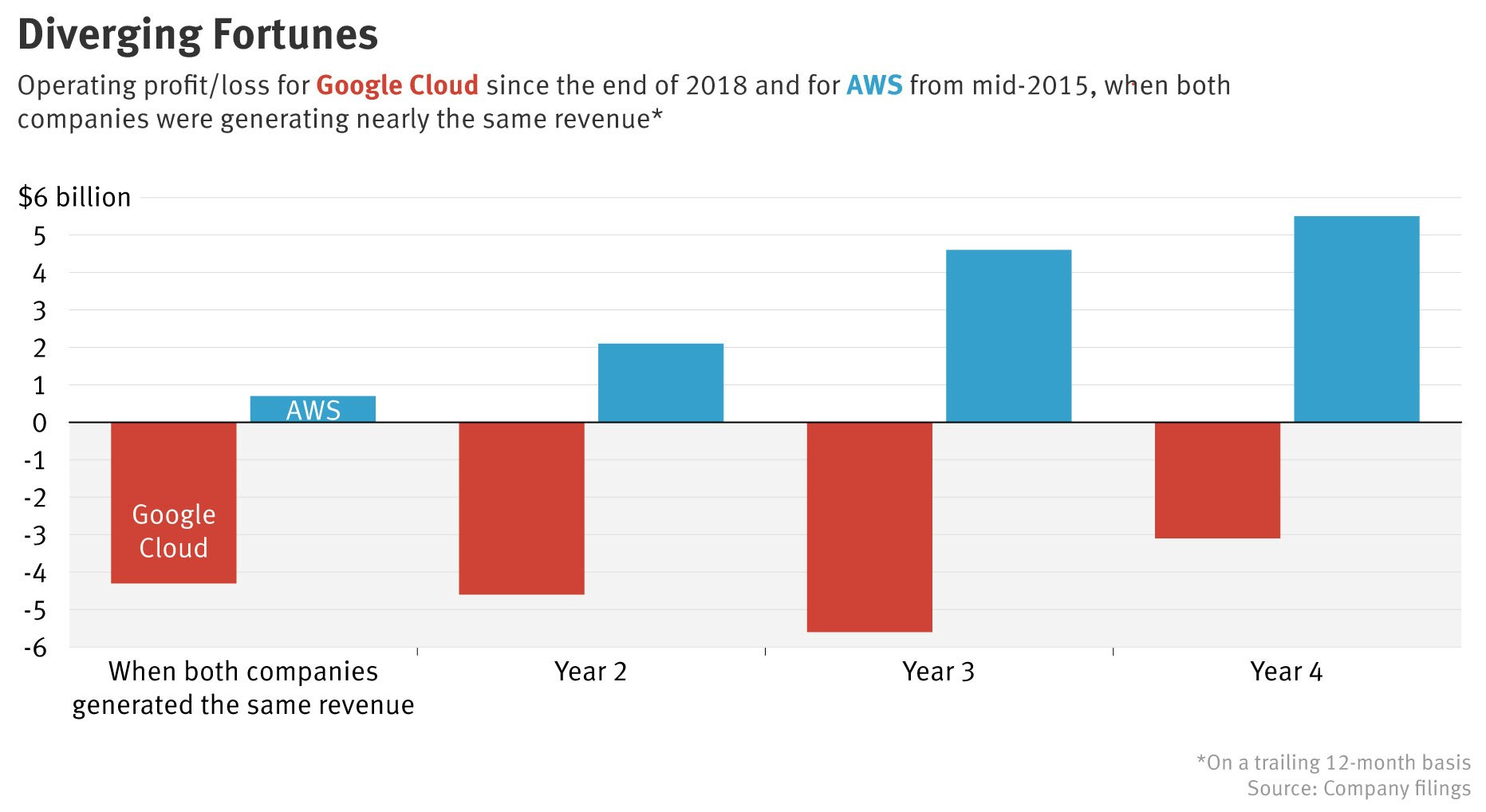
Google’s cloud computing arm is the company’s biggest hope of creating a substantial moneymaker outside of advertising, but it has been struggling to make up meaningful ground against industry pioneer Amazon Web Services. That extends to profitability: Last year, despite generating $19 billion in revenue, the kind of scale that generally brings profits, Google Cloud lost more than $3 billion. And the unit lost more than $17.6 billion over the past four years.
To put those losses in perspective, the above chart shows that AWS generated about $13 billion in profits from mid-2014 to mid-2018, a four-year span in which it was generating around the same amount of revenue that Google Cloud has generated in the past four years.
The data underscore how Google Cloud, despite recent financial improvements, is contending with a host of expenses and business challenges AWS doesn’t have. They also highlight why Google Cloud will have a hard time getting within striking distance of AWS’ profit margins in the future. Several former employees and people who do business with Google Cloud said the issues range from having fewer high-margin services to sell to customers to having higher overhead costs and a more lackadaisical engineering culture. In a positive sign, Google Cloud CEO Thomas Kurian last month told colleagues during an internal all-hands meeting that he expects the cloud unit to be profitable later this year, according to a person who viewed the event.

THE TAKEAWAY
• Google Cloud has expenses and challenges that AWS doesn’t have
• Google Cloud’s profit potential will decrease if it doesn’t grow faster
• Aping Microsoft, Google is making equity investments in cloud customers

Kurian’s proclamation, which hasn’t previously been reported, suggests a shift in the way he runs Google Cloud. In addition to reintroducing a salary cap for salespeople last year, Kurian is making changes to the way the company pays them, such as cutting the amount of commission they get when selling third-party products through Google Cloud’s online marketplace. Those changes are expected to improve Google Cloud’s profit margin. (After publication, Ted Ladd, a Google Cloud spokesman, said Kurian hasn't told employees Google Cloud would be profitable this year and said his leadership team has a clear view of when they could make the business profitable and plans to balance that with long-term investments in engineering and other areas.)
To its credit, as Google Cloud grew in recent years, its negative profit margins improved considerably. But AWS, which is critically—and increasingly—important to Amazon as growth in its core commerce business slows, last year generated an operating profit of $18.5 billion. That was almost as much as Google Cloud’s total revenue for the year.
Google also has a growth problem. Ruth Porat, Chief Financial Officer of Google’s parent company Alphabet, boasted about the cloud unit’s 47% annual revenue growth during a call with analysts last month, but comparing that result to AWS’ past—and current—growth makes it look far less impressive. Starting in mid-2015, when AWS was generating the same amount of revenue, on an annual basis, as Google Cloud did at the end of 2018, AWS grew faster in the subsequent three years compared to Google (see chart below). Google Cloud grew more slowly during that span despite the fact that it was operating in an era when more businesses were embracing the cloud.
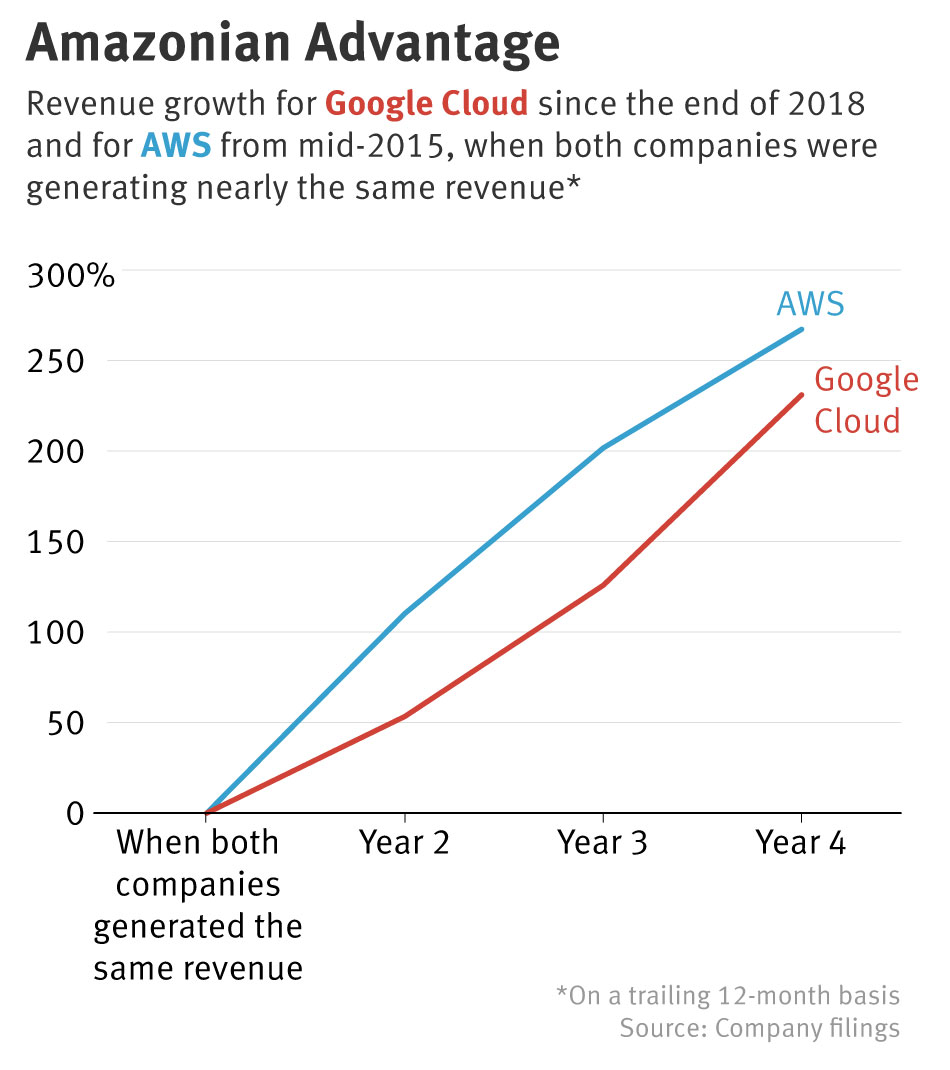
And AWS has been on a growth tear in the past year. Its revenue grew 37%, or just 10 percentage points slower than Google Cloud’s growth, despite being three times bigger than Google Cloud in terms of revenue. The limitations Google will face in generating cash from its cloud business will be compounded if the unit doesn’t start growing revenue a lot faster than AWS has been doing.

Key Disadvantages
One obvious factor is that Google didn’t get serious about competing in the cloud market until 2014, eight years after AWS launched, and has had to invest heavily in data centers and hiring staff just to keep pace with AWS and Microsoft’s Azure, the No. 2 cloud storage and computing provider by revenue. Microsoft’s decadeslong relationship with enterprises using its Office software has given it a leg up on Google, and sometimes Amazon as well, when it comes to selling large customers on buying cloud services.
Google’s “lack of profitability is almost certainly because they’re investing in the growth of the platform itself,” said Corey Quinn, chief cloud economist at The Duckbill Group, a firm that helps AWS customers save money on their bills. “When AWS was at a similar level of revenue, they were far in front and didn’t have that same competitive pressure of trying to catch the leader,” he said.
Another issue is that Google Cloud has fewer high-margin services—such as cloud database and analytics software—to sell to customers than AWS does. These services are strategically important for all cloud providers because once customers adopt them, it’s harder for them to switch to similar services developed by rivals. Former employees say AWS relies on these offerings for a large portion of its operating profit.
And while AWS has several database and analytics services that generate hundreds of millions of dollars in annual sales, Google Cloud’s revenue is more concentrated among a handful of such products. A significant majority of its data analytics revenue, for example, comes from a product called BigQuery, which had accounted for $1.5 billion of its 2021 revenue as of early December, as we’ve reported.
Although Google Cloud touts its long-term cloud agreements with some well-known customers, its margins may also suffer from some customers consuming those services at a slower-than-expected rate. An example is travel firm Sabre Corp., which inked a 10-year, approximately $2 billion cloud deal with Google Cloud in early 2020 but had spent less than $10 million as of mid-2021—roughly $80 million less than expected, as we’ve reported.

Paying the Customer
Then there are Google’s capital investments in companies that turn around and spend money on Google Cloud services, including biotechnology startup Tempus Labs, financial derivatives exchange CME Group and telemedicine firm Amwell Group. It is unclear how Google Cloud accounts for these agreements and whether they are included in its cloud profit and loss statement. Regardless of the accounting, the deals represent costs Amazon generally doesn’t face.
Differences between the engineering cultures at each company, and the expectations that Google’s and Amazon’s leaders place upon them, may be another factor behind the profitability of their respective cloud businesses. AWS is known for fostering a breakneck pace of innovation, using its annual re:Invent customer conference to unleash a barrage of new services and features that some industry watchers find borderline overwhelming. That’s part of the reason AWS lists more than 200 different cloud services for sale on its website.
At Google, engineers traditionally have had the leeway to pursue their own coding projects without facing consequences for missing internal development deadlines, according to two former employees. That started to change after Kurian joined. Google Cloud’s database teams faced criticism for not shipping products and features quickly enough, as we reported in late 2019.
“It was a big culture shift for them to be held to committed release dates, which enterprises expect,” said one of the former Google Cloud employees.
>>> Early premarket gappers

Early premarket gappers

  • Gapping up:
    • VYGR +14.5%, CLAR +11.1%, MASS +6.8%, HPK +6%, AZZ +5%, AVDX +4%, ALK +3.3%, AAL +3.1%, DAL +2.7%, USO +2.4%, JETS +2.4%, SAVE +2.4%, BP +2.1%, UAL +2.1%, AXNX +1.6%, XLE +1.6%, APA +1.5%, HAL +1.5%, ORAN +1.4%, PSX +1.3%, XOM +1.1%, SLB +1%, LUV +1%, IPI +0.6%, OIH +0.5%, SHEL +0.5%
  • Gapping down:
    • ROVR -13.1%, TDUP -7.9%, ROAD -2.2%, MNDT -1.9%, BRO -1.7%, VAL -1.3%, ADMA -1.2%, IVT -0.8%, CNM -0.5%, CBRE -0.5%, NVRO -0.5%

The information : Tiger Global Partners Commit $1 Billion for Early-Stage Tech F

Tiger Global Partners Commit $1 Billion for Early-Stage Tech Funds

Tiger Global Management, the world’s most active startup investor last year, is trying a new way to get the inside track.

Partners at the firm, known for its big bets in companies including Coinbase and Roblox, have committed $1 billion of their own cash to invest in seed funds that focus on backing the youngest startups, said a person with direct knowledge of the matter. Under the initiative, the partners would invest a little over $300 million in the funds every year, the person added.

The commitment, unprecedented for its size, would allow Tiger Global to become the largest investor in dozens of new seed funds that would want its cash. The firm would then get exposure to more early-stage startups it could invest in later. So far this year, Tiger Global has already backed or agreed to back funds for more-established firms including Better Tomorrow Ventures, Moxxie Ventures and Chapter One Ventures, a separate person with direct knowledge added, as well as less well-known funds such as Maple VC.

THE TAKEAWAY
• Tiger partners are putting their own money into seed funds
• Investments should help Tiger secure early-stage VC deals
• Better Tomorrow Ventures, Moxxie, Chapter One agreed to take Tiger cash

And the firm is staying true to its aggressive approach. In October 2021, Maple VC general partner Andre Charoo asked Tiger Global to invest in his new $16.5 million fund after hearing that the firm was backing other new fund managers. Tiger agreed to invest $2.5 million—the largest check in the fund—less than eight hours after receiving the investment deck, Charoo said.

The move shows how Tiger, which invested in more startups than anyone else last year, is shifting its focus to back younger companies amid a broader sell-off in public technology stocks. The firm, known for its flagship hedge fund, has rattled Silicon Valley in recent years by paying high prices for multibillion-dollar private companies, including data labeling firm Scale AI and banking app Revolut.

But over the past few months, the New York–based investment firm’s public stock portfolio has been hit hard by the sell-off. Tiger’s flagship hedge fund, which is separate from its private funds, lost 10% last month and is down 23% for the year, according to Bloomberg. Amid the retreat, Tiger also made the rare decision to lower the prices it offered for larger startups even after signing the initial investment agreements, The Information earlier reported.

Venture firms or their partners regularly act as limited partners in seed funds as a way of getting early financial knowledge about startups and making connections with founders. For example, Andreessen Horowitz partners Marc Andreessen and Chris Dixon as a duo have written checks ranging between $100,000 and $1 million to back small funds to gain early insight into promising startups, The Information reported in 2020.

But no firm has deployed the strategy at Tiger’s scale. A $1 billion commitment would allow Tiger to invest in dozens, if not hundreds, of seed firms. These firms usually operate small funds that take commitments of just a few million dollars from limited partners, deep-pocketed external investors that usually include pension funds and endowments. Tiger’s checks have ranged from $2.5 million for smaller funds like Palo Alto, Calif.–based Maple VC to $15 million or higher for more-established firms, said three people with direct knowledge of the matter.

It’s unclear why Tiger’s partners are committing their own cash instead of investing out of their existing venture funds or a new fund. But the personal stake underscores how serious the firm is about its focus on early-stage investments.

In September, it hired new investor Grant Ebenger from private equity firm Blackstone to help work on the new seed initiative, said the person with direct knowledge. Then, earlier this year, Tiger partner Scott Shleifer told Tiger’s own investors it would avoid late-stage funding rounds to focus instead on backing Series A and B companies, The Information earlier reported. In recent pitches to some investors of seed funds, Tiger’s partners said they intended to move quickly when deciding to invest in their portfolio companies’ subsequent funding rounds, said another person with direct knowledge of the matter.

Indexing the Market

Tiger’s full-throttle push into early-stage investing is another sign that the influx of capital going into the private market won’t dry up anytime soon, even as large investment firms like D1 Capital Partners slowed their investment pace amid concerns about the sell-off in technology stocks. Tiger Global as of January had raised more than $11 billion for its latest VC fund, The Information first reported. Earlier this month, San Francisco–based VC firm Founders Fund announced it had raised over $5 billion for two new funds dedicated to private investments.

Tiger’s shift toward the early-stage market could give it a bigger shot at outsize returns, regardless of market volatility, because it will be backing companies long before they prepare for a public listing. The strategy also comes with its own risks: Such startups are often run by inexperienced executives whose products are still in their infancy, reasons why Wall Street investment firms focused on backing more mature startups during the pandemic boom in tech investing.

At least one seed firm also did not want to have Tiger as a limited partner for future funds, in part because it had enough existing investors and didn’t want to seem beholden to another VC firm when pitching founders, said an investor involved in the discussions.

Tiger Global, led by partners Scott Shleifer and Chase Coleman, has already inked more early-stage deals this year than some competitors. The firm has invested in 36 seed and early-stage funding rounds, according to data firm PitchBook. By comparison, Sequoia Capital has invested in 20 seed and early-stage deals, according to PitchBook.

The influx of new capital going into early-stage investing has pushed more traditional seed firms to adapt their business models. Seed firm Homebrew, an early investor in fintech app Plaid and consumer bank Chime, in February said that, rather than raising a larger venture fund, it would take the opposite tack—turn itself into a family office, where its partners would only invest their own capital in startups.

>>> The World's Largest Nickel Mining Companies

The World's Largest Nickel Mining Companies

The World’s Top 10 Nickel Mining Companies
As the world transitions towards electric vehicles and cleaner energy sources, nickel has emerged as an essential metal for this green revolution.
Needed for the manufacturing of electric vehicles, wind turbines, and nuclear power plants, nickel is also primarily used to make stainless steel alloys more resistant to corrosion and extreme temperatures.
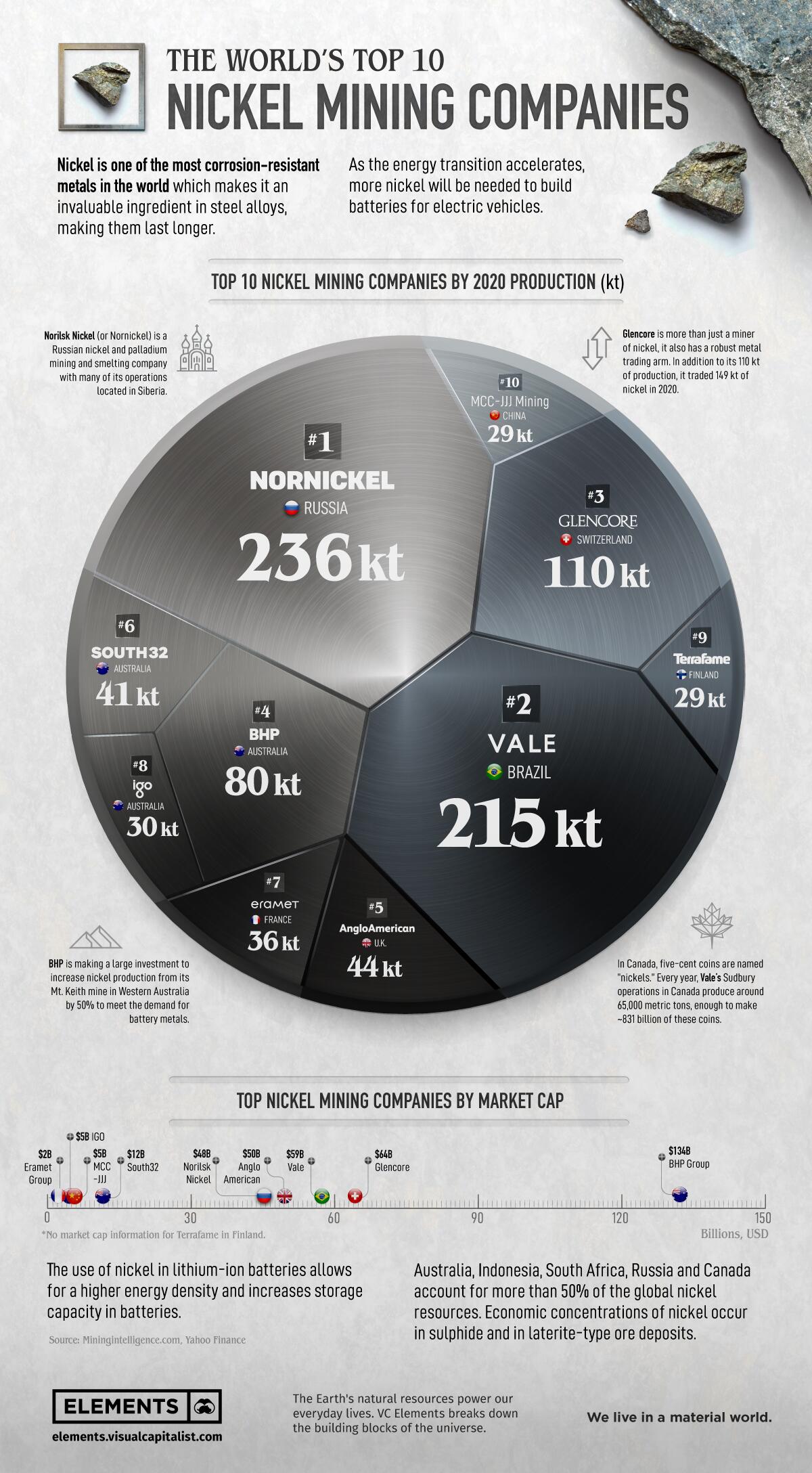
Using data from Mining Intelligence, this graphic shows the top 10 companies by nickel production along with their market cap.
The Biggest Nickel Miners by Production in 2020
Nickel has long been an important mineral for batteries, plating, and steelmaking, but it was only recently added to the USGS’s proposed critical minerals list.
As countries and industries realize the importance of nickel for the development of sustainable technologies, nickel mining companies will be at the forefront of supplying the world with the nickel it needs.
The 850 kt of nickel mined by the top 10 nickel mining companies is worth around $17.3B, with both production and price expected to grow alongside nickel demand.
Nickel and palladium miner and smelter Nornickel leads the list with 236 kt of nickel produced in 2020, the majority coming from its Norilsk division of flagship assets in Russia.
With 46% of Nornickel’s energy mix sourced from renewable power, the company is pushing the development of carbon neutral nickel, starting with reducing carbon dioxide emissions by 60,000-70,000 tons in 2022.
Vale follows closely behind in production and in its carbon footprint goals. The Brazil-based company’s Long Harbour processing plant in Newfoundland and Labrador produces nickel with a carbon footprint about a third of the industry average–4.4 tonnes of CO2 equivalent per tonne of nickel compared to Nickel Institute’s average of 13 tonnes of CO2 equivalent.
With the top two companies producing more than half of the nickel produced by the top 10 miners, their efforts in decarbonization will pave the way for the nickel mining industry.
The Need for Nickel in the Energy Transition
Alongside the decarbonization of the nickel mining process, nickel itself powers many of the technologies crucial to the energy transition. Vehicle electrification is highly dependent on nickel, with a single electric car requiring more than 87 pounds of nickel, making up almost 1/5th of all the metals required.
With a history of being used in nickel cadmium and nickel metal hydride batteries, nickel is now being increasingly used in lithium-ion batteries for its greater energy density and lower cost compared to cobalt. Alongside the increase in usage, not all nickel is suitable for lithium-ion battery production, as batteries require the rarer form of the metal’s deposits known as nickel sulphides.
The more common form of the metal, nickel laterites, are still useful in forming the alloys that make up the frames and various gears of wind turbines.
Nickel is also essential to nuclear power plants, making up nearly a quarter of the metals needed per megawatt generated.
The Future of Nickel Mining and Processing
With nickel in such high demand for batteries and cleaner energy infrastructure, it’s no wonder that global nickel demand is expected to outweigh supply by 2024. The scarcity of high grade nickel sulphide deposits and the carbon intensity to mine them has also incentivized the exploration of new methods of harvesting the metal.
Agro-mining uses plants known as hyperaccumulators to absorb metals found in the soil through their roots, resulting in their leaves containing up to 4% nickel in dry weight. These plants are then harvested and incinerated, with their ash processed to recover the nickel “bio-ore”.
Along with providing us with metals like nickel, lead, and cobalt through a less energy intensive process, agro-mining also helps decontaminate polluted soil.
While new processes like agro-mining won’t replace traditional mining, they’ll be a helpful step forward in closing the future nickel supply gap while helping reduce the carbon footprint of the nickel processing industry.

(ZH) One Of China's Largest Banks Fails To Pay Margin Call After Today's Monster

One Of China's Largest Banks Fails To Pay Margin Call After Today's Monster Nickel Squeeze

Around the time Peabody was served with a $534 million margin call on its hedging coal futures short, which it funded with a new $150MM unsecured (10%) revolver from Goldman Sachs, one of China's largest banks was also served with a margin call for hundreds of millions of dollars on a nickel short gone terribly bad after the price of Nickel did... well this:
However, unlike Peabody, a unit of China Construction Bank Corp - one of China's "Big Four" banks - was given additional time by the London Metal Exchange to pay hundreds of millions of dollars of margin calls it missed Monday amid an unprecedented spike in nickel prices. The reprieve from the LME - which just last week sent out thousands of erroneous margin calls on metals contracts - means that the unit, called CCBI Global Markets, is not formally in default, Bloomberg reported citing sources.
The details of the non-payments aren't quite clear: Bloomberg notes that the deferred default "isn’t necessarily an indicator of any problems at the parent company" although Bloomberg may be merely trying not to antagonize a major client. Instead, the media conglomerate suggests that the non-payment is more likely due to a failure by one of its metals-industry clients to make margin payments to CCBI Global Markets, which is a broker on the LME’s open-outcry trading floor. That in turn, left CCBI Global Markets struggling to arrange payment of the unusually large margin calls after the end of the business day in Asia, as nickel prices exploded throughout Monday.
As reported earlier, Monday’s monster squeeze was driven by market participants with short positions being forced to close out as they couldn’t meet margin calls.
But while a big Chinese bank may have had immunity, others may not be so lucky: Bloomberg previously reported that Chinese entrepreneur Xiang Guangda - known as “Big Shot” - had a large short position on the LME through his company, Tsingshan Holding Group, the world’s largest nickel and stainless steel producer. It's unclear whether that particular trader received a margin call and if he paid it.
And so, as we wait for more massively short squeezed names to emerge, we can't help but wonder if this is precisely the start of the "liquidity crisis" predicted by Zoltan Pozsar; after all, he has called virtually everything else spot on so far...

WSJ : Foreign Companies in China Are Less Optimistic About Investing There

Foreign Companies in China Are Less Optimistic About Investing There
Business-chamber survey finds Covid-19 restrictions, opaque rules and persistent U.S.-China tensions damp sentiment

HONG KONG—Foreign companies in China are feeling less confident about investing in China, citing concerns of slowing economic growth and political tensions with the U.S., an annual survey by an American business group found.

Less than one-half of members surveyed by the American Chamber of Commerce in China said they were optimistic that the Chinese government was committed to opening its market to more foreign investment over the next three years, down from 61% a year earlier. More than one-third said they would reduce investment in the country because of an uncertain policy environment.

Many survey respondents said China’s travel restrictions related to its zero-tolerance policy toward Covid-19 was a headwind when it came to attracting and retaining talent. More than three-fourths said qualified job candidates were unable to move to China, up from 37% the previous year. Almost one-third said candidates were unwilling to move, up from 18%.

Collectively, businesses said tensions between the U.S. and China remained the top concern, despite high expectations in the prior year’s survey that relations would improve under the Biden administration. Inconsistent or unclear regulations in China and rising labor costs, were other leading worries.

“I think reality has in a way set in, in that at least some, if not many, of the actions by the Trump administration remain in place,” said Alan Beebe, the president of AmCham China. They included launching a trade war and imposing a raft of sanctions against Chinese technology companies.

Foreign companies in China have faced an expanding array of challenges as relations between Washington and Beijing have soured, with companies operating in the country finding themselves under fire from political figures from both sides for their actions or statements on subjects such as forced labor in supply chains.

Although the survey found growing pessimism about some aspects of the business environment in China, many businesses reported on-the-ground improvements.

China’s economy grew 8.1% last year as it pulled out of its pandemic slump. That growth was reflected in the bottom lines of survey respondents: Nearly 60% of companies surveyed said the revenue from their China operations rose last year, up from 35% the previous year.

Almost 90% said they were either profitable or breaking even in China, up from 80% the prior year.

Economists don’t expect China’s growth pace to be sustained.

Last week, Beijing set a growth target this year of around 5.5%, the slowest pace in about a quarter-century of economic planning, reflecting growing domestic and global uncertainties.

AmCham surveyed its members between Oct. 22 and Nov. 19, with 353, or 49%, responding. To be eligible, respondents had to have a U.S. business entity, meaning the response pool included some companies with headquarters in Europe and other regions.

Nearly all members surveyed said the pandemic was disrupting global business travel, while more than half said it was leading to higher costs of products and services.

Despite the challenges, 60% of respondents said China remained a priority, and 83% said they weren’t considering relocating manufacturing or sourcing outside of the country, a figure that held steady the past three years.

More than 40% of respondents in the AmCham survey reported increased pressure to either make or not make politically sensitive statements compared with the previous year. Companies operating in the consumer and tech sectors reported the largest increase in such pressure.

U.S. businesses have faced growing pressure from Washington to curb their ties to Xinjiang amid concerns over forced labor and a broader crackdown in the region.

Foreign brands that have taken a stand on Xinjiang have faced backlash from the Chinese government and boycotts by consumers.

Last March, Chinese internet regulators all but erased H&M Hennes & Mauritz HM.B +2.52% AB from the Chinese internet after its decision to stop sourcing from Xinjiang. The fast-fashion company has said it follows international guidelines for supply-chain sustainability.

Corrections & Amplifications
AmCham surveyed its members between Oct. 22 and Nov. 19, with 353, or 49% responding. An earlier version of this article incorrectly said it surveyed 353 of its members. (Corrected on March 8)

WSJ : Secret Surveillance Program Collects Americans’ Money-Transfer Data, Senat

Secret Surveillance Program Collects Americans’ Money-Transfer Data, Senator Says
Hundreds of federal and local law-enforcement agencies have access to the records, Sen. Ron Wyden says in a letter

WASHINGTON—A law-enforcement arm of the Department of Homeland Security participated in a secret bulk surveillance program that collected millions of records about certain money transfers of some Americans without a warrant, according to officials and a U.S. senator.

The surveillance program, overseen by investigators with U.S. Immigration and Customs Enforcement, collected records of any money transfer greater than $500 to or from Mexico, Sen. Ron Wyden (D., Ore.) said in a letter sent to the DHS inspector general. It also collected information on domestic or international transfers exceeding $500 to or from the states of Arizona, California, New Mexico and Texas.

Officials at the Homeland Security Investigations unit at DHS provided staffers for Mr. Wyden with details about the surveillance activity last month after the senator’s office first contacted the agency seeking information about the previously undisclosed program. The briefing was the first time Congress was made aware of the program’s existence, according to Mr. Wyden’s letter.

“Given the many serious issues raised by this troubling program, I request that you investigate the program’s origins, how the program operated, and whether the program was consistent with agency policy, statutory law, and the Constitution,” Mr. Wyden wrote in his letter to DHS Inspector General Joseph Cuffari, which was reviewed by The Wall Street Journal. Mr. Wyden also asked the inspector general to probe whether Homeland Security Investigations was operating similar programs and to ensure that such activities were subject to congressional oversight.

A spokeswoman for DHS said the department is “committed to ensuring that our criminal investigative methods are not only effective in combating transnational criminal actors and other security threats, but also consistent with the law and best practices.”

It couldn’t be determined exactly how authorities were using the data at issue, which appeared to solely involve money-transfer services rather than banks. Such services are popular among people who don’t have bank accounts and are commonly used to send money abroad, such as to family members back in an immigrant’s country of origin.

The surveillance program’s origins date to at least 2010, when the Arizona attorney general’s office began collecting similar data from Western Union following a money-laundering settlement, according to Mr. Wyden’s letter. Another money-laundering settlement between the two in 2014 included the creation of a nonprofit organization called the Transaction Record Analysis Center, or TRAC, to host the money-transfer data. Money-transfer companies including Western Union shared records voluntarily with TRAC until 2019, when its agreement with the Arizona attorney general’s office ended, the letter states.

During that time, the nonprofit shared the money-transfer data with hundreds of federal, state and local law-enforcement agencies, who could mine the data for leads without being required to issue a warrant, according to Mr. Wyden’s letter.

When its agreements with the companies lapsed, the letter says, the Arizona attorney general turned to ICE to compel the companies to continue sharing data, using its authority under law to investigate people and goods moving across borders. ICE issued six summons to Western Union, between July 2019 and January 2022, and two to Maxitransfers Corp., both in 2021.

“Western Union works with law enforcement to comply with valid subpoenas and other legitimate requests,” said Claire Treacy, a spokeswoman for the company. “We are also committed to protecting the personal data of our customers and take our obligations regarding privacy very seriously.”

Maxitransfers and TRAC didn’t respond to requests for comment.

“Our office uses TRAC, a federally-funded program to legally monitor international wire cash transfers from border states to Mexico,” Katie Conner, a spokeswoman for the office of Arizona Attorney General Mark Brnovich (R), said in a statement. “This is done to combat human and drug trafficking. It is ironic that during a historic border crisis, this would be the focus of any U.S. senator.”

Under the program, ICE investigators collected approximately six million records of international money transfers from Western Union and Maxitransfers since 2019, the letter states. The agency issued eight customs summonses, a type of subpoena, to the two companies asking them to share all relevant money-transfer data for six months at a time. The data at issue is believed to have included names, addresses, and identification numbers associated with senders of the money transfers, as well as names and addresses of the recipients, a Wyden aide said.

Dozens of other money-transfer companies have voluntarily shared data through the program, the letter said.

DHS told Mr. Wyden’s office that the six million records collected through the subpoenas amount to 3% of data held by TRAC, an aide for the senator said.

The arrangement that involved customs summonses issued to Western Union and Maxitransfers ended in January after Mr. Wyden’s office contacted DHS, according to the senator’s office. Other aspects of the program that involved voluntary submission of records from other money-transfer entities are continuing, the Wyden aide and another government official said.

Though ICE has agreed to stop using its summons authority, it—along with U.S. Customs and Border Protection—still uses the data made available through TRAC for investigations, a government official said. ICE used data from the project to seize 150,000 counterfeit painkiller pills in Oregon, brought to the state by a Mexican drug smuggler whose financial transactions the government was able to track, the official said. Border agents and other officials also use the data as part of the process of vetting foreigners entering the country, the official said.

The official said lawyers at the DHS and officials with its Office for Civil Rights and Civil Liberties are reviewing the department’s use of its customs authority to create guidelines so it is used more narrowly in the future.

Privacy advocates briefed on the program by Mr. Wyden’s staff said the use of a nongovernmental entity to act as a sort of clearinghouse for data that state and federal law-enforcement agencies could access was unusual.

“I cannot think of another arrangement like this that combines an illegal use of subpoenas with an inscrutable, private nonprofit just for the purposes of housing this information,” said Nathan Freed Wessler, senior staff attorney with the American Civil Liberties Union. Such an entity may not be subject to government public records laws, which “has the effect of shielding this tremendously concerning program from public scrutiny,” he said.