(ZH) Ukraine, Russian Negotiators Say "Significant Progress" Made In Ceasefire T

Ukraine, Russian Negotiators Say "Significant Progress" Made In Ceasefire Talks, Expect Signed Deal In "Next Few Days"

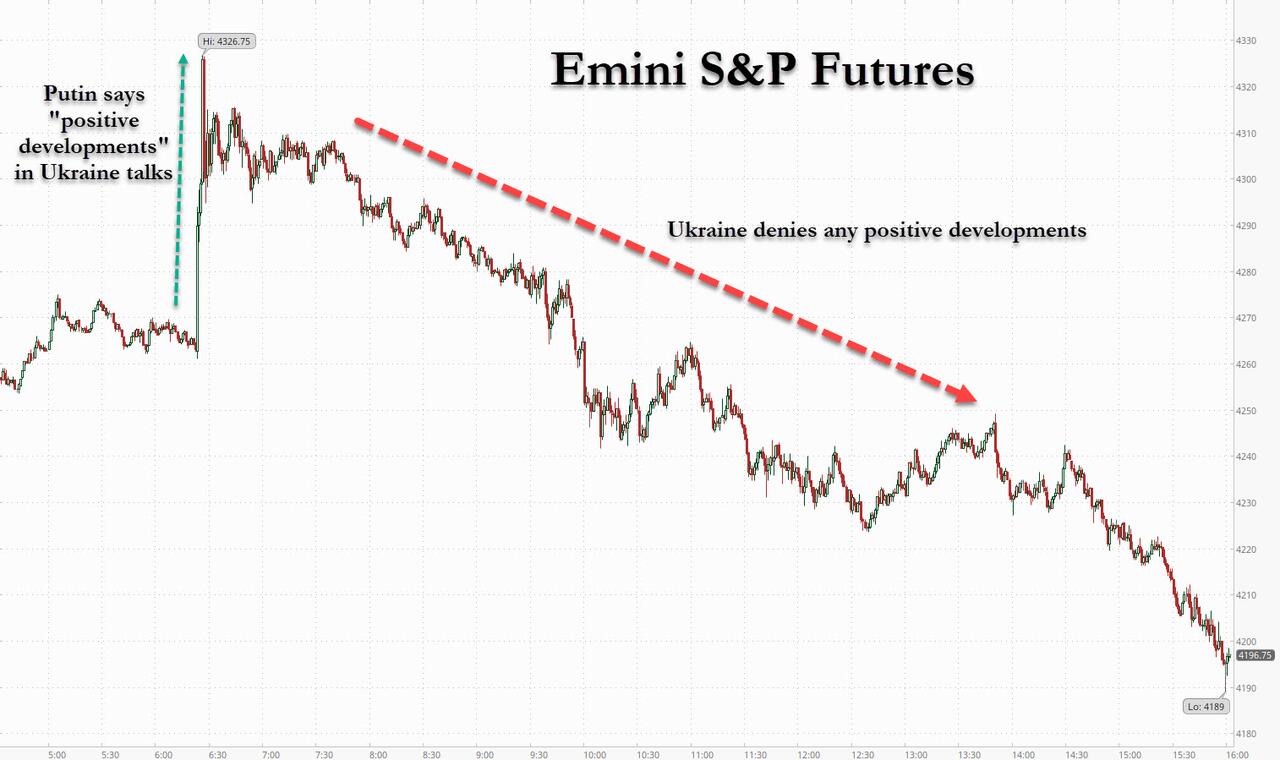
While we saw as recently as Friday what happens when the market gets overly optimistic that a Ukraine ceasefire is imminent, only to get the rug pulled from underneath it just hours later ...
... on Sunday - day 18 of the Russia-Ukraine war - we are getting the same distinct case of optimistic deja vu, as delegates from both sides of the Ukraine peace talks sounded positive ahead of more negotiations in the next few days. It remains to be seen if this is the start of a peaceful resolution to the war or just another false dawn.
According to the Guardian, Ukrainian negotiator and presidential advisor Mykhailo Podolyak said talks had become more constructive.
“We will not concede in principle on any positions. Russia now understands this. Russia is already beginning to talk constructively. I think that we will achieve some results literally in a matter of days,” he said in a video posted online.
At the same time, Leonid Slutsky, member of the Russian negotiating delegation and head of the State Duma Committee on International Affairs also said there had been significant progress and they hoped to soon arrive at a “joint position”, Sky News reports.
According to the state-owned RIA news agency said that when Slutski compared the state of talks now with those when they first started, there had been “substantial progress”.
“According to my personal expectations, this progress may grow in the coming days into a joint position of both delegations, into documents for signing,” Slutsky said. It was not clear what the scope of any such documents might be.
As Slutsky pointed out , the agreements between the parties will help reduce tensions and "save many people."
Three rounds of talks between the two sides in Belarus, most recently last Monday, had focused mainly on humanitarian issues and led to the limited opening of some corridors for civilians to escape fighting. This comes a day after the French and German presidents, Emmanuel Macron and Olaf Scholz said Vladimir Putin did not show a willingness to end the war during a call on Saturday.
The peace process is also getting a fresh kick start after Bloomberg reported that the U.S. and China will hold the first high-level, in-person talks since Russia’s full invasion of Ukraine, as the Biden administration continues to try to enlist Beijing to exert influence on its neighbor to end the crisis.
National Security Adviser Jake Sullivan will meet in Rome on Monday with China’s top diplomat, Communist Party Politburo member Yang Jiechi, according to a person familiar with the details of the plan.
President Joe Biden’s top advisers have been working to increase pressure on China to enforce sanctions on Russia’s economy imposed by the U.S. and its European and Asian allies. So far, U.S. officials have said they haven’t seen evidence that Beijing has tried to circumvent them, although that just means that they haven't looked hard enough.
In any case, if China does agree to mediate talks, it would be seen as a significant development toward peace. Then again, since the Biden admin has little to gain from an accelerated return to normalcy ahead of the midterms - after all the inflationary impulse will be here to stay well into 2023 - especially if the president can no longer blame Putin for everything that is wrong in the US domestically, we expect that this glimmer of hope will be promptly dashed over the next 24-48 hours.

(ZH) Goldman Trader: "The Past Few Weeks Have Poured Kerosene On A Tectonic Shif

Goldman Trader: "The Past Few Weeks Have Poured Kerosene On A Tectonic Shift That's Taken Shape Over The Past Six Years"

On the same day that Goldman's chief of US equity research David Kostin capitulated for the second time in the past month, and one month after cutting his year-end S&P price target from 5,100 to 4,900, the Goldman strategist followed up with another 200-point cut to his S&P price target after the close on Friday (he now expects the S&P to close the year at 4,700, i.e., down on the year) but even so Kostin is trying to spin this latest deterioration as a positive outcome, saying it represents a generous 10% "upside" from current levels. There was no positive spin, however, in the far more downbeat thoughts that Goldman's actual traders are sending out to their clients (trading desk research represents what Goldman actually believes, as opposed to the wholesale propaganda that emanates from sellside research).
So for an honest glimpse of how Goldman's traders view what is the most unstable and chaotic market since March 2020, we excerpt from the latest note (available to pro subs in the usual place) written by Goldman's head of hedge fund sales, Tony Pasqsuariello, who has aptly dubbed what is taking place a...
"paradigm shift."
I’ve been banging away at this craft for 23 years, and the past few weeks rank right up there with some of the highest velocity periods for markets that I’ve ever seen.
There are no mysteries here: global growth was slowing ... major policy shifts were underway ... then the geopolitical variable exploded.
Given that setup, my risk framework starts with a concession to reality: the range of possible outcomes from here are exceptionally wide.
Said another way: market dynamics were becoming significantly more complicated -- and, the degree of difficulty around money management was appreciably rising -- for several months in advance of the Russia/Ukraine situation, and that mess has opened the door to a set of potential tail risks that most folks never had to contemplate.
So, amidst a period that’s featured epic volatility and risk transfer, my instinct is to approach the path ahead with a high degree of both humility and simplicity.
Therefore, what follows from here is a stripped-down take on the core issues of the day:
1. The week began with a one-day, $1tr loss of US equity market cap and a very serious amount of portfolio de-leveraging. the middle of the week was a textbook illustration of why timing from the short-side must be impeccable. This week we confronted another scorching CPI report (e.g. the highest m/m increase in primary rent since ... 1987), a hawkish surprise from the ECB and ongoing headline ping-pong surrounding Eastern Europe. While that environment has generated some high quality, hyper-tactical opportunities along the way -- arguably well captured by the macro community -- it’s not for the faint of heart (and, it’s almost impossible to believe a not-so-distant year like 2017 saw a median daily market move of just 18bps, a max peak-to-trough drawdown of 2.8% and full-year realized volatility of 6%).
2. More broadly, and to borrow a thought experiment from a hot-handed client, consider this: in June of last year, just before Powell’s first pivot, S&P was trading around 4200. if you were told at that time ... come March of 2022 ... we’d be confronting $110 crude oil, 8% inflation and the invasion of a sovereign nation by a neighboring nuclear power ... would you guess that S&P would still be trading around 4200 (or, that NDX would still be up 100% from the lows of March 2020)?
3. While you can poke holes in that approach -- it ignores the rip higher that followed in H2’21, the S&P doesn’t represent the breadth of damage that’s actually taken place at the single stock level, look how crazy easy US real rates still are, on and on -- the point is more that we’re confronting a set of issues that are far more complicated than what I’d instinctively associate with a multiple that’s still in the 87th percentile of market history. it’s also not what I would associate with the immediate removal of a G-20 economy from the global financial system.
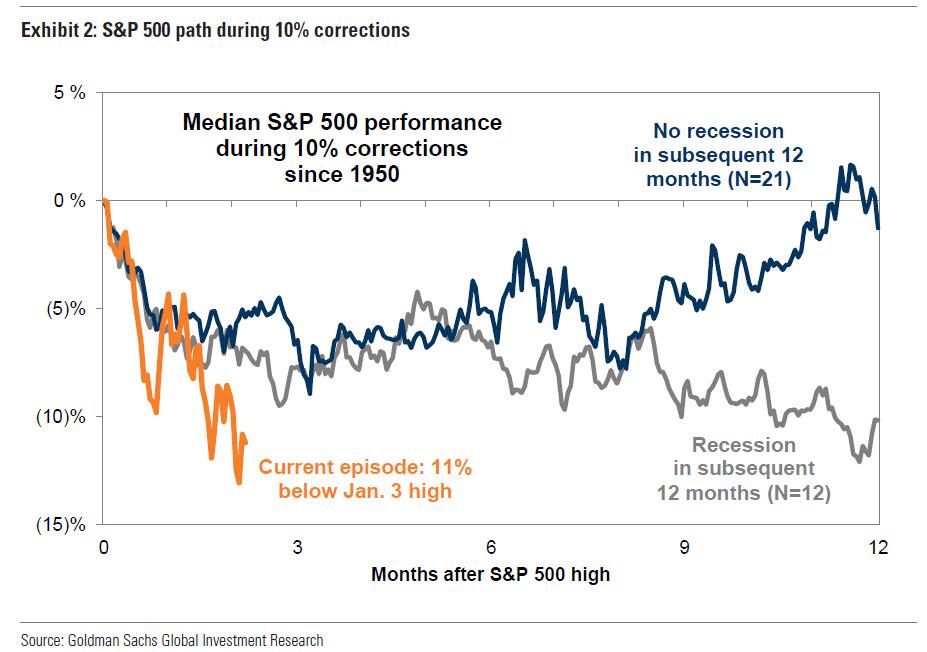
4. As noted before, the history of buying 10-20% drawdowns in the S&P when the economy is NOT headed towards a recession is very compelling.
That said, I find that I’m starting to worry more about the accumulation of downside risks to growth, which again I admit is more of an instinct than anything more sophisticated. in this regard, I think we should all be keeping a close eye on the funding markets -- and, perhaps more importantly, the corporate credit markets -- for signs that something more significant is manifesting.
5. Relative to most every other major equity market, S&P has seemingly benefited from “repatriation” and offered an element of safe haven status over the recent period. in the doing, one could argue we’re forcing more and more capital into a smaller set of the highest quality US names (the likes of MSFT and AAPL, and dare I say TSCO and DLTR). while I sincerely believe those are the right places to allocate your equity capital, for the avoidance of doubt, the ante has been upped -- so, for the index to be ok, those names really, really need to hold the line.
6. If you take a really big step back, one can argue the past few weeks have poured kerosene on a tectonic shift that’s taken shape over the past six years: a push away from globalization and towards regionalization. in essence, we’re witnessing an inflection that is the photographic negative of the period that spanned from the fall of the Berlin Wall in 1989 to the Brexit vote in 2016. far be it from this English major to go too far with this line of deep thinking, but I think the trend is clear for all to see now ... it has only been amplified by the East/West geopolitical tension ... and, it marks a paradigm shift from the world I came up in.
7. Some superficial market thoughts follow from there, throw tomatoes at me if you wish:
  • it argues for the increased consumption of commodities and affirms the underlying super cycle, link;
  • it argues for a major retooling of the West’s power and defense complexes;
  • it ultimately argues for more spending on alternative energy, while probably later in the sequence;
  • it seems to strongly very argue for more inflation, higher wages and less corporate efficiency;
  • it argues for more investment in technology, but in a two-sphere sense;
  • from a growth and capital markets perspective, it argues for North America as it argues against China;
  • more broadly, it argues for a schism between DM and EM markets. on that last point, in the context of the UN General Assembly Resolution censoring of Russia, of the five BRICS countries, just one voted for it (Brazil) … three abstained … and (obviously) one voted against.
8. If this argument for regionalization is more or less directionally correct, it likely involves some hard truths -- some basic cause-and-effect -- for financial market participants: more fragility, more volatility, less liquidity. I don’t think it’s an “all-bad” scenario, however, and the investing implications are immense. while some of these recalibrations are clearly underway (witness price action HSCEI, which is back towards to lows of Lehman), I have to think this is a theme that’s here to stay. and, I think it’s ultimately highly accretive to active managers and stock selection.
9. Much more locally -- and, at the risk of sounding too-clever-by-half -- I’m still of the view that S&P is range-bound with ongoing downside asymmetry. therefore, I’d stick with the goal posts of buying below 4200 and selling over 4500. next week is a huge one, featuring the FOMC on Wednesday and a major derivatives expiry on Friday (as ever, I’m respectful of quarterly expiries as markers of inflection points). along the way, I tend to think the market goes into the next phase of the game with a very de-risked and de-levered trading community (the past week has seen immense volume and risk transfer, note GSTHHVIP now down 20% since November), while also featuring a retail investor who is full of risk and likely confronting a large capital gains tax bill next month. where I’m going with this: the market is susceptible to more short-cycle squeezes, while the broader cut of positioning is still too long ... and, I worry my 4200/4500 tactical framework may be obscuring the bigger stories.
10. You don’t need me to tell you that the past few weeks have featured a set of extraordinary rallies in the commodities space. More broadly, on a 2-month lookback, we’ve just witnessed the biggest rally in commodity indices since ... the 1970s. I mention this not because I’d expect those moves to necessarily extend in the short-term. I say it because when you sit around the dinner table with a set of very senior risk takers, it’s hard NOT to conclude that most everything still points in the direction of a world that will be very, very commodity intensive. Even though last week’s statement on the relatively tiny size of commodities relative to both Equities and Fixed Income resulted in some spicy Twitter comments (“Nobel Prize material type of analysis, Tony”), I stand by the claim and think it’s inherently very bullish for the space.
11. I don’t know what to think of European equities right now, other than to say that my year-end optimism was perhaps the worst idea since Robin Ventura charged Nolan Ryan. To be clear, the recent period has featured some of the worst underperformance of SX5E relative to S&P in the post-GFC period -- that’s saying something -- and it’s hard to see how the European industrial sector doesn’t suffer. that said, if stocks are to live in the future, one can see a path to major fiscal expansion -- and, more elementally, a much strong European Union (emphasis on Union). which segues to this ...
12. Mark Wilson, GMD: “for the second time in as many years, Europe experienced its ‘Hamilton moment.’ ever since its founding, the fractured politics of the European ‘Union’ have been all too evident, perhaps best illustrated in numerous episodes of the last decade as the uneven financial consequences of the GFC roiled a still adolescent political construct. yet, the unified strength of purpose shown by the European alliance in response to recent events is mightily impressive -- this time led by Germany, as she showed willingness to subjugate the gigantic cost of an increasingly expensive commodity burden to the broader political will of her allies. Merkel’s recent departure may have emboldened Putin’s resolve to take his chosen course, given the presence of newer and (perceived) untested European leadership; yet, Germany’s metamorphic developments in response to this crisis have been dramatic: Schulz has overseen 3 seismic policy initiatives in shockingly short order –
  • a historic expansion in re-armament spend,
  • the cancelled certification of NordStream 2, and
  • a radical new energy plan aimed at cutting dependence on Russian gas [this is even more radical when you consider this government includes the world’s strongest Green Party representation].
Ultimately, the unanimity & assumed political influence of the European Union has come of age in the last 2 weeks.”
13. worth clicking on:
  • i. sticking with the focus on the low-end consumer :: link.
  • ii. the economic impact of cyber, a theme that must only be gaining steam :: link.
  • iii. America the generous: link.
  • iv. no meetings before 11:00 am: link.
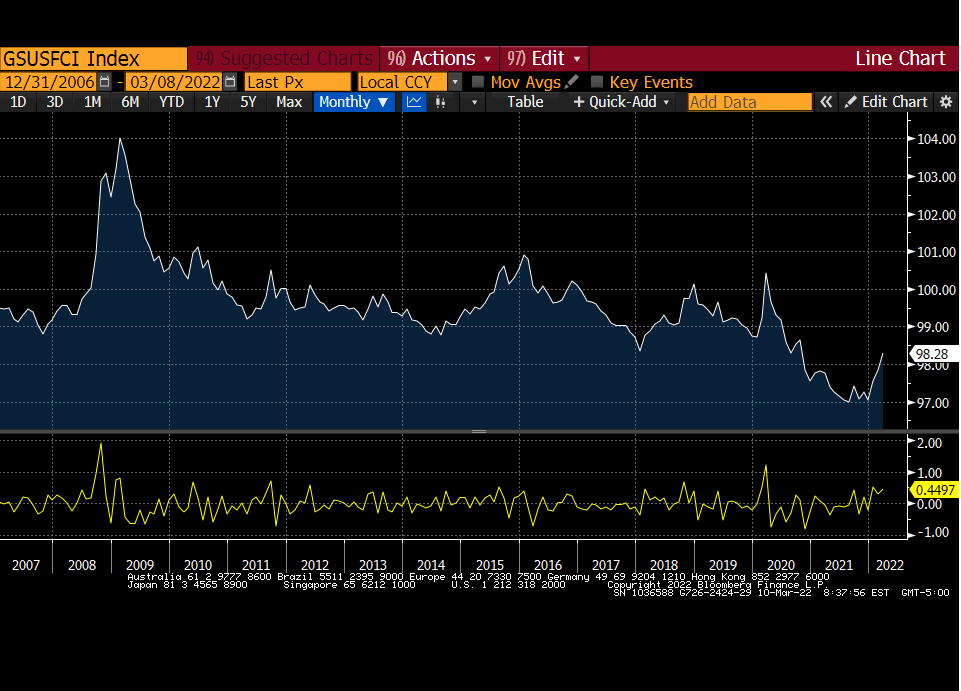
14. a chart of US financial conditions ... as I see it, clearly tightening, but still quite loose over the longer history:
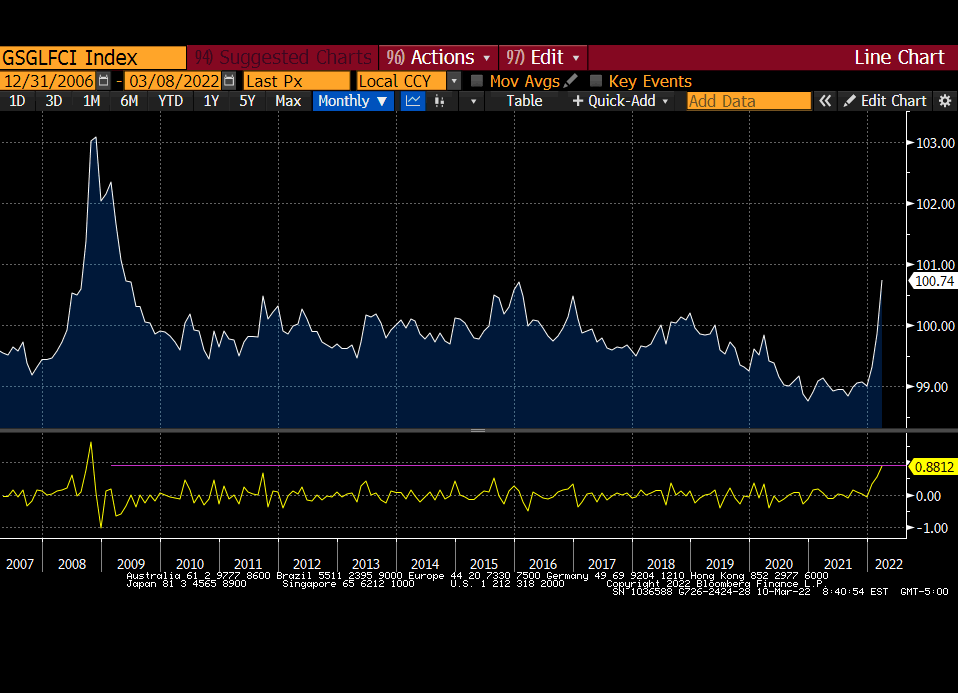
15. and, now a chart of global financial conditions ... note the past month has seen the greatest rate-of-change since the GFC:
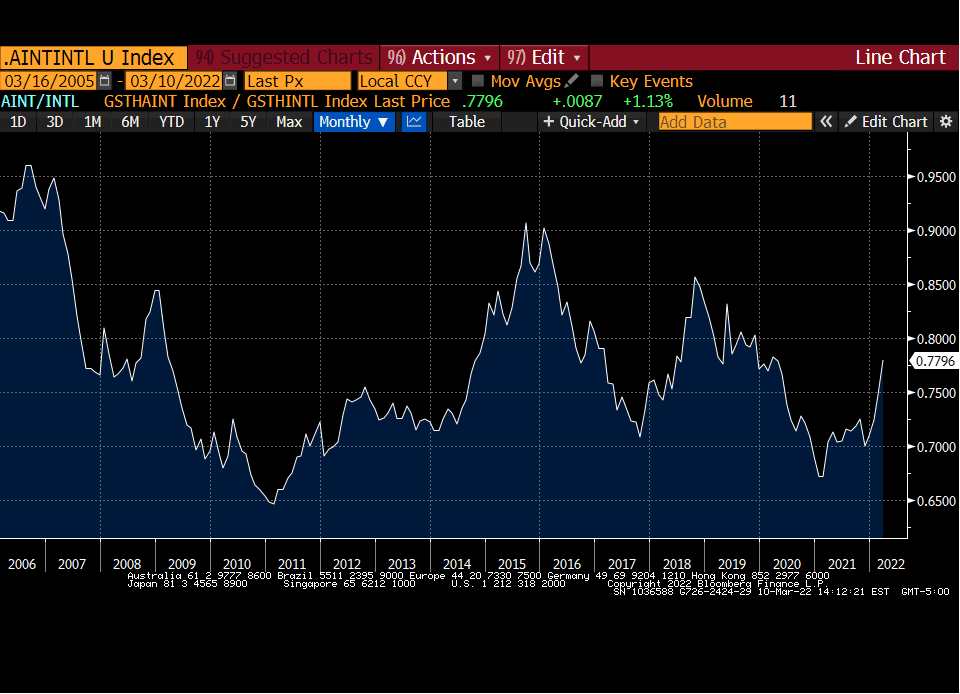
16. a basket of stocks leveraged to US growth ... vs those leveraged to non-US growth ... following from the prior points, you can probably guess where I’m going with this:
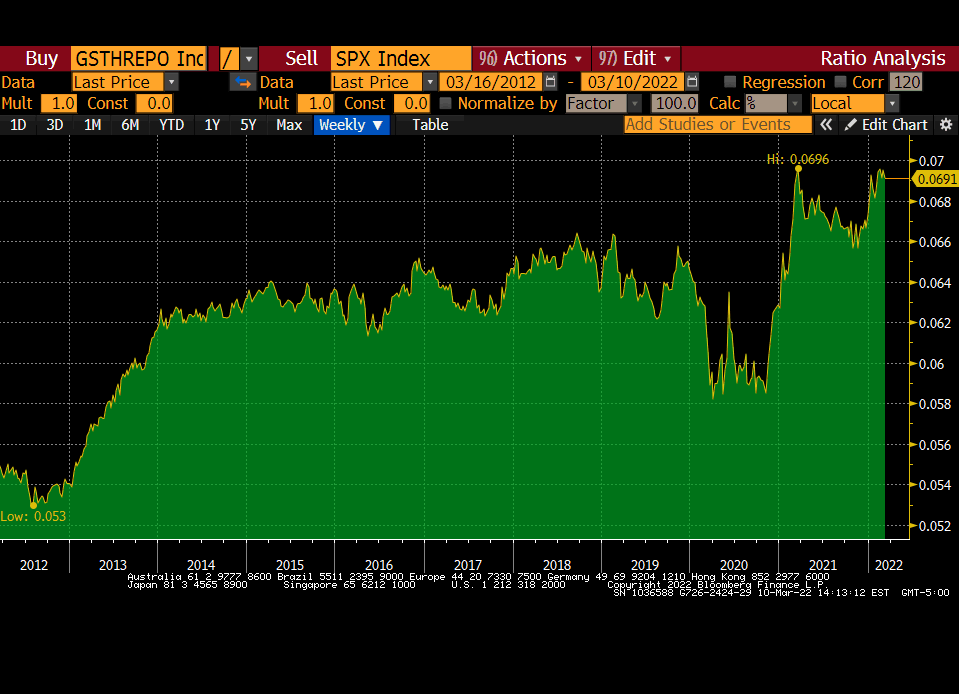
17. a GS custom basket of stocks with large buybacks vs the market. Given this chart, it’s perhaps no surprise that Goldman research expects $1tr of actual repurchase in 2022 (link):
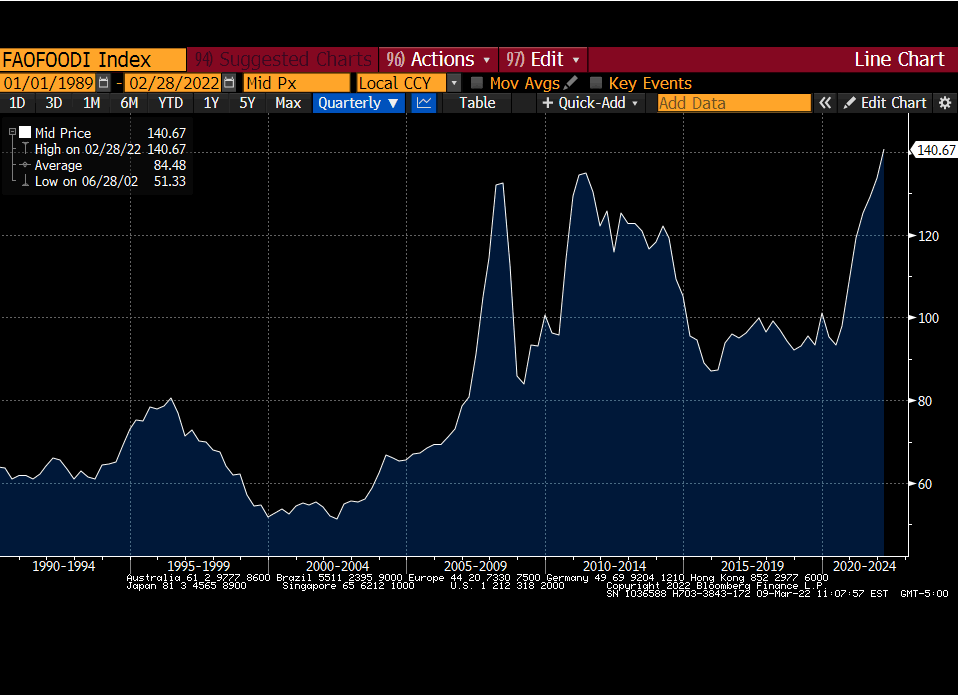
18. this is not a comforting chart ... the UN index of world food and agricultural prices:

FT : US and China to meet in Rome for high-level talks focusing on Ukraine

US and China to meet in Rome for high-level talks focusing on Ukraine
Washington expected to raise Beijing’s refusal to condemn Moscow’s invasion of its neighbour

Jake Sullivan, US national security adviser, will travel to Rome on Monday to meet Yang Jiechi, China’s top foreign policy official, in talks that are expected to focus on the war in Ukraine, the highest level US-China face-to-face meeting since the Russian invasion began.

The White House said Sullivan would lead a delegation of National Security Council and state department officials for what would be only his third meeting with Yang since the Biden administration took office in January last year.

“This meeting is taking place in the context of Russia’s unjustified and brutal war against Ukraine and as China has aligned itself with Russia to advance their own vision of the world order,” said one person familiar with the agenda, adding that they would discuss the impact of the Russian invasion on “regional and global security”.

The “war in Ukraine will certainly be a significant topic of conversation”, said the person. “It is important for PRC [People’s Republic of China] officials to hear directly from the [US] national security adviser.”

Speaking to CNN on Sunday, Sullivan said that while China “was aware” that Putin was “planning something”, Beijing “may not have understood the full extent of it”. He added: “It’s very possible that Putin lied to them the same way that he lied to Europeans and others”.

On NBC, Sullivan also warned China against any steps to “bail out” Russia or make it easier for them to circumvent western sanctions.

“We will ensure that neither China, nor anyone else, can compensate Russia for these losses. In terms of the specific means of doing that, again, I’m not going to lay all of that out in public, but we will communicate that privately to China, as we have already done and will continue to do,” he said.

Emily Horne, NSC spokesperson, said Sullivan and Yang, who have met twice over the past year, would also discuss efforts to manage competition between the US and China. The person familiar with the situation said the Rome talks were a follow-on meeting from President Joe Biden and President Xi Jinping’s virtual meeting in November.

The meeting comes as Beijing and Washington remain at odds over a wide range of issues. Over the past year, Biden has implemented policies that have maintained the tough stance struck by his predecessor, Donald Trump.

The Chinese embassy said it had “no information to offer” about the Rome meeting. The discussions come at a pivotal time as Washington grows increasingly alarmed over China’s relationship with Russia, which has been starkly illustrated by its refusal to condemn the invasion and willingness to place the blame on the US and Nato.

China continues to insist that it is a neutral party in the Ukraine conflict, but is also increasingly vocal in its support of Moscow’s justifications for its actions.

Earlier this week Chinese diplomats and state media called for the investigation of Russian accusations that the US supported biological warfare research in Ukraine. The US has ridiculed the claims as “preposterous” and warned that Russia might be prepared to use chemical weapons in Ukraine.

Beijing has also parroted Moscow in citing Nato’s eastward expansion in recent decades as a catalyst for the war, and condemned US-led sanctions against the Putin regime as part of a larger effort to contain Russia and China.

Horne said Sullivan would also meet Luigi Mattiolo, a top adviser to Italian prime minister Mario Draghi, as part of US efforts to co-ordinate a “strong, united international response to President Putin’s war of choice”.

WSJ : China Pursues Afghanistan’s Mineral Wealth After U.S. Exit

China Pursues Afghanistan’s Mineral Wealth After U.S. Exit
Chinese company is negotiating with Taliban to mine one of world’s largest untapped reserves of copper

MES AYNAK, Afghanistan—Following the American exit from Afghanistan, China’s move to claim the country’s vast mineral wealth is centered on a mountain south of Kabul.

The mountain and the barren surrounding valley, in Logar province, a two-hour drive from the capital, contain one of the world’s biggest untapped reserves of copper.

China is negotiating with Taliban authorities to start mining at the site, called Mes Aynak, according to Chinese and Taliban officials. Beijing is also in talks to begin work on oil-and-gas reserves in the north of the country, Amu Darya. Both projects were on hold for years because of the war, which ended when the Taliban seized power in August.

Dozens of Chinese mining companies have descended on Kabul in recent weeks seeking contracts for other mines.

U.S. officials say they are concerned that China will fill the vacuum left by the American withdrawal from Afghanistan. Beijing developed a relationship with the Taliban in recent years and kept its Kabul embassy functioning when Western missions fled the Taliban takeover.

Iran, another U.S. rival, is in talks to secure a huge iron ore deposit in the west of the country. Tehran, too, has fostered good ties with the Taliban.

Afghanistan is one of the world’s poorest countries, but its mountainous geology contains huge riches: gold, precious stones, coal, oil and gas, lithium, and rare-earth minerals. China already controls most of the world’s rare-earth minerals, which are used to manufacture a variety of technologies, including components in electric vehicles and smartphone touch screens.

American experts a decade ago estimated the value of Afghanistan’s mineral resources at $1 trillion. While the U.S. deployed tens of thousands of troops there and spent hundreds of billions of dollars, it was never able to unlock this bounty.

“The rest of the world have extracted their mines and have used them for their countries’ development while we were engaged in war for 43 years and, hence, our resources have remained untouched,” said the Taliban’s minister for minerals and petroleum, Shahabuddin Dilawar.

Mr. Dilawar said he wants American and other Western companies to also come to Afghanistan now that the American military presence is gone. He said he would prefer American mining companies over Chinese companies because of their expertise.

With commodities in a bullish cycle that could keep prices buoyant for years and the end to fighting between U.S. forces and the Taliban, the time might be right for mining in Afghanistan, according to analysts.

Neal Rigby, a mining consultant who formerly advised the Pentagon and the Afghan government on Afghanistan’s mining assets, said the world is facing a shortage of copper.

“Hence the importance of Afghanistan and its minerals endowment,” Mr. Rigby said. “If you look around the world, everywhere has been explored to hell. But Afghanistan is wide open.”

Mining looks like the Taliban’s best chance of creating big new business activity as it grapples with the economic collapse that was triggered by their takeover. The new government, which has been cut off from international aid, needs to raise revenue fast and provide jobs for a population facing mass starvation.

Yet for Western companies, U.S. and international sanctions on the Taliban mean that dealing with Afghanistan is risky, while environmental and human-rights standards and security concerns also loom large.

Mr. Rigby said Mes Aynak held the highest-grade copper, which is why China wanted it so badly—to ship home and blend with its own lower-grade copper.

He said that Mes Aynak was a world-class reserve but that there are likely more such deposits to be found in what is believed to be a central Afghanistan copper belt.

The copper has one big complication: It sits under the ruins of a vast ancient city, Mes Aynak, dating back about 2,000 years. Mes Aynak was a grand outpost of a Buddhist civilization that thrived in Afghanistan and what is now northwestern Pakistan centuries before Islam rose.

Mes Aynak flourished between the first and seventh centuries. There are Buddhist monasteries, stupas, graveyards and wall paintings. The eastern flank of the mountain is covered with antique structures that formed the city.

Mr. Dilawar said that the antiquities would be protected but that authorities hadn’t decided how. His preference would be to move the whole city to somewhere nearby and reconstruct it. Many prize artifacts have been shifted to the Kabul Museum.

Noor Agha Noori, who served as Afghanistan’s director of archaeology until the Taliban takeover, when he left the country, said excavation of the site was about 70% complete after a decade of work on it. “No mining should be done until the excavation is finished,” he said.

He said that if the Chinese were prepared to mine underground through tunnels, which would enable the city ruins to remain where they are, it would take at least three more years of archaeological excavation before mining could begin.

If the Chinese plan to do open-pit mining, which means digging from the surface, eating up the whole mountain, seven to 10 years would be needed to document and move the ancient remains. Under that scenario, more than half of the antiquities would be lost and the archaeological integrity of the site gone, he said, because it isn’t possible to relocate everything.

There is also copper in the valley adjacent to the mountain, which doesn’t have ancient ruins on it.

China’s state-owned mining company Metallurgical Corp. of China, which was awarded the contract for Mes Aynak in 2007 by the then-U.S.-backed government in Kabul, didn’t respond to a request for comment. After it won the contract, mining never began because of the scale of the antiquities discovered, the war and disagreements over terms with the Afghan government.

The mining minister said the contract required China to build a power plant that would supply energy to the site, surrounding area and Kabul; process the copper in Afghanistan; construct a railway to the Pakistani border at Torkham; transfer the antiquities; and buy land from villagers.

The Chinese company has tried to back out of all those obligations, he said. “We want them to stand by their commitments. We’re committed to ours as well,” Mr. Dilawar said. “We have given two projects to the Chinese, and we may not give them a third until we see practical actions in those two.”

China’s ambassador in Kabul, Wang Yu, confirmed that talks were going on over the Mes Aynak copper mine and the Amu Darya oil and gas project in the north. He, however, said that better terms were needed to make the investment worthwhile for the Chinese. “It is very important that both parties have reasonable returns,” Mr. Wang said.

State-owned China National Petroleum Corp., which never developed the three exploratory blocks in the Amu Darya basin that it was awarded by the Afghan government in 2011, didn’t respond to a request for comment. The basin, centered in neighboring Turkmenistan, is the most abundant hydrocarbon resource in Central Asia and a mainstay of Turkmenistan’s economy.

The Mining Ministry, unlike some of the other departments taken over by the Taliban, is busy, with businessmen regularly turning up in a flurry of SUVs. The ministry has signed contracts on some new small-scale mines, the minister said.

Entrepreneurs have come calling to discuss mining the lithium and rare-earth deposits, which are considered to be the big prize in Afghanistan, but the mining minister said those wouldn’t be tendered yet.

“Given China’s stranglehold on the global rare-earths market—and the West’s commitment in blood and treasure to Afghanistan—allowing China to stroll in and harvest Afghanistan’s rare-earth riches seems both unwise and unfair,” said Alan Dowd, senior fellow at the Fraser Institute, a Canadian think tank.
WSJ : Hedge Funds’ Commodity Bets Soar After Russia’s Invasion of Ukraine

Hedge Funds’ Commodity Bets Soar After Russia’s Invasion of Ukraine
Soroban Capital notches hundreds of millions of dollars in gains since February, and some commodities-focused funds post gains, too

Hedge funds that placed bullish bets on commodities are notching sizable returns from the biggest rally in decades following Russia’s invasion of Ukraine.

Soroban Capital Partners LP, a $10 billion stock-picking hedge fund in New York, is one of the biggest winners, making at least several hundred million dollars on the trade since February, a person familiar with the matter said. Other winners include New York macro fund Castle Hook Partners and value investor Pilgrim Global. The bet was that a yearslong drop in spending on new commodity supply and efforts to limit carbon emissions would push up materials prices and shares of producers, according to people familiar with the firms.

Commodities-focused funds that made similar wagers are posting outsize returns—about 30% in the first two months of the year in some cases—after years of poor performance.

After a decade of distress, energy has become one of the biggest winners on Wall Street, supercharged in the last two weeks by Russia’s invasion of Ukraine. The S&P 500 energy sector has recently outpaced the broad index by the largest margin on record in data going back three decades, according to Dow Jones Market Data. The energy sector is up 37% so far this year, while the broad index has slid 12%. U.S. crude recently topped $130 a barrel, its highest level since 2008, after briefly dipping below zero two years ago after the onset of the coronavirus pandemic.

“We are in the early innings of a generational investment opportunity,” wrote Soroban founder Eric Mandelblatt in an annual letter to investors dated Jan. 20.

Many of the assets Soroban or other hedge funds scooped up recently—such as shares of oil producers, fertilizer makers or commodity-futures contracts—have soared as the war disrupts already tight markets.

Russia accounts for more than 10% of the globe’s oil, natural gas and wheat supply. It is also a major source of potash that fertilizes crops around the world. Ukraine is a key exporter of agricultural crops as well.

Traders say replacing materials that have been removed from global markets through sanctions, export bans and the war itself will be difficult. Reserves are low after years of dwindling capital expenditures, and it can take years to permit and develop new, large-scale projects.

Commodities prices have gone haywire amid the disruption. Prices of the industrial metal nickel doubled in just a few hours Tuesday to all-time highs, turbocharged by a short squeeze in which a Chinese producer was forced to unwind a bet on falling prices. Aluminum also recently hit records, as did wheat.

Few have made as big a wager on commodities as Mr. Mandelblatt, who started his Wall Street career in the 1990s as an energy analyst for Goldman Sachs Group Inc. Soroban profited from energy and materials bets for several years after its founding in 2010, but as excess supply depressed commodity prices, the hedge fund took a yearslong hiatus from the sector.

That changed last year, when soaring natural-gas prices in Europe drew Mr. Mandelblatt’s attention. Limited capacity for renewable power forced many companies to turn back to coal, highlighting the world’s dependence on fossil fuels despite its green-energy ambitions. Volatile commodities prices plus pressure on companies to limit emissions have made it less likely new commodity projects will move forward, Mr. Mandelblatt has told investors.

At the same time, Soroban believed the move toward clean energy would supercharge demand for metals such as copper, nickel and aluminum that are building blocks for electric cars and solar projects.

Soroban went from having no exposure to commodities in its flagship hedge fund at the end of September to having more than $3 billion in the trade early this year, people familiar with the firm said. Companies Soroban backed in the fourth quarter, when it made the bulk of its commodities-tied investments, include oil producers Canadian Natural Resources Ltd. and Suncor Energy Inc., mining company Vale SA, and fertilizer makers Mosaic Co. and Nutrien Ltd. , according to a regulatory filing.

Gains from the trade in Soroban’s $10 billion main fund offset losses from its bets on shares of fast-growing companies for the year through February, people familiar with the firm said. A separate fund Soroban launched Feb. 1 dedicated to the wager notched a double-digit percentage return for the month.

Castle Hook, which manages $2 billion, and the $250 million Pilgrim Value, began putting their versions of the wager on in 2020. They were both up by double-digit percentages this year through February, said people familiar with the firms.

The commodities recovery has also been a boon to the few investment firms that still focus solely on the sector. Houston-based Bison Interests, a roughly $50 million hedge fund that invests in small oil-and-gas producers, gained about 30% in the first two months of the year, according to a person familiar with the firm. A roughly $130 million mutual fund run by Goehring & Rozencwajg Associates LLC that owns commodity producers is up about that much this year.

“I don’t think the severity of the supply-demand mismatch and the likely longevity of that mismatch is well understood,” Bison’s chief investment officer Josh Young said in an interview.

Business Of Fashion : Prada’s Growth Plans

Prada’s Growth Plans
By Brian Baskin
This week, everyone will be talking about Prada’s growth plans, updates on Russia, China and other geopolitical hotspots from H&M and Inditex, plus Alexander McQueen’s show in New York.

Prada Climbs the Ranks
* Prada reports financial results for 2021 on Monday, and executives will speak to analysts
* In January, the company said sales rose 41 percent to $3.8 billion last year, and were up 8 percent from 2019
* Prada has pulled back from wholesale, which will help margins as sales climb

Prada needs only two or three years like the last one to reach its goal of $5 billion in annual sales. The group, which also includes Miu Miu and Church’s, already released its 2021 sales in January, two months earlier than scheduled. It was a show of strength for a company that is riding high. Sales are up from 2019, and Prada ranked third in Lyst’s most recent index of fashion’s hottest brands, its best showing to date. Sister label Miu Miu has been in the news nonstop for its now-ubiquitous micro-mini skirts.
As with most big luxury brands, there’s a world of difference between what’s driving the hype on the runway and magazine covers and what’s driving sales. Miu Miu skirts are impossible to avoid on TikTok and are selling out in stores, but it’s Prada handbags and pumps – sold in brand-owned stores at full price – that will get the company to $5 billion (leather goods and footwear made up nearly three-quarters of Prada Group’s sales in the first half of 2021, though apparel’s share is rising). So will expansion in categories such as jewellery and beauty, where a long-gestating partnership with L’Oréal is finally materialising, starting with the launch of men’s fragrance Luna Rossa Ocean last fall.
The Bottom Line: Prada could use Monday’s call with analysts to outline its pricing strategy for 2022. The brand has reined in discounting in recent years, but has yet to join Chanel, Louis Vuitton and other rivals in aggressively raising prices on leather goods.