- Leonardo (FMNB TH) +5.1%
- VW (VOW3 TH) +3.9%
- Volkswagen Targets Stable Returns as War Clouds Outlook (2)
- Raiffeisen (RAW TH) +3.9%
- Alstom (AOMD TH) +3.8%
- Imperial Brands (ITB TH) +3.6%
- Fuchs Petrolub (FPE3 TH) +3.5%
- Credit Agricole (XCA TH) +3.4%
- Lufthansa (LHA TH) +3.2%
- BMW (BMW TH) +3.2%
- TUI (TUI1 TH) +3.1%
- Dassault Systemes (DSYA TH) -0.9%
- SES (SES TH) -1%
- Fitch Assigns Rating, Stable Outlook On Satellite Operator SES
- Glencore (8GC TH) -1.1%
- Eurofins Scientific (ESF0 TH) -1.2%
- Adyen (1N8 TH) -1.3%
- Sanofi (SNW TH) -1.5%
- Sanofi Says Amcenestrant Phase 2 Trial Didn’t Meet Primary Goal
- Tesco (TCO0 TH) -1.6%
- Volvo Cars (8JO TH) -1.8%
- Prosus (1TY TH) -2.1%
- Panic Selling Grips China Tech Stocks Again as Concerns Pile Up
- EDF (E2F TH) -7%
- EDF Sees EU26.2B FY Impact From Regulatory Measures, Output Cut
DAX:
- VW (VOW3 TH) +3.7%
- BMW (BMW TH) +3.1%
- Mercedes (MBG TH) +2.9%
- Deutsche Bank (DBK TH) +2.6%
- Deutsche Bank Upgraded at Berenberg With Concerns Priced In
- Puma (PUM TH) +2.5%
- Vonovia (VNA TH) +1.1%
- German Holdings Round-Up: Vonovia, Symrise, LEG Immobilien
- Siemens (SIE TH) +1.1%
- Bayer (BAYN TH) +0.5%
- Bayer a Buy at Jefferies on Valuation, Improving Fundamentals
MDAX:
- Uniper (UN01 TH) +4%
- Cash-Strapped German Utilities Seek Government Aid: Reports (1)
- Commerzbank (CBK TH) +3.7%
- Fuchs Petrolub (FPE3 TH) +3.7%
- Lufthansa (LHA TH) +3.4%
- Lanxess (LXS TH) +3.1%
- Freenet (FNTN TH) +1.3%
- Evotec SE (EVT TH) +1.2%
- Rheinmetall (RHM TH) +1.1%
- K+S (SDF TH) +0.3%
- K+S Cut to Hold at Berenberg; PT 22 euros
SDAX:
- Deutz (DEZ TH) +7%
- Deutz FY Adjusted Ebit Misses Estimates
- Traton (8TRA TH) +4.1%
- Schaeffler (SHA TH) +4.1%
- Vitesco (VTSC TH) +3.8%
- LPKF (LPK TH) +3.1%
- Hamborner REIT (HABA TH) -1%
- Adler Group (ADJ TH) -8.6%
>>> Up
* Biotage Raised to Buy at Nordea; PT 200 kronor
* Byggfakta Group Nordic Holdco Raised to Overweight at Barclays
* Carlsberg Raised to Hold at Berenberg; PT 835 kroner
* Deutsche Bank Raised to Hold at Berenberg; PT 11 euros
* Nestle Raised to Outperform at Exane; PT 135 Swiss francs
* PGS Raised to Neutral at SpareBank; PT 1.80 kroner
* Reckitt Raised to Neutral at Exane; PT 6,100 pence
* Remy Cointreau Raised to Outperform at Exane; PT 205 euros
* SMCP Raised to Neutral at Goldman; PT 8.30 euros
* Subsea 7 Raised to Buy at SpareBank; PT 90 kroner
* Titanium Raised to Buy at Inderes; PT 16 euros
* UMG Raised to Overweight at Barclays; PT 24 euros
* Unilever Raised to Market Perform at Bernstein
* Wolters Kluwer Raised to Overweight at Barclays; PT 110 euros
>>> Down
* Atresmedia Cut to Underweight at Barclays; PT 3.50 euros
* BBVA Cut to Neutral at JPMorgan; PT 6.20 euros
* Chevron Cut to Equal-Weight at Morgan Stanley; PT $166
* Coca-Cola HBC Cut to Neutral at JPMorgan; PT 1,900 pence
* Credit Agricole Cut to Neutral at JPMorgan; PT 12.50 euros
* Fevertree Drinks Cut to Neutral at Exane; PT 1,870 pence
* Hella Cut to Hold at Jefferies; PT 60 euros
* Interpublic Cut to Equal-Weight at Barclays; PT $42
* K+S Cut to Hold at Berenberg; PT 22 euros
* Nordea Bank Cut to Reduce at AlphaValue/Baader
* Occidental Cut to Equal-Weight at Morgan Stanley; PT $52
* Omnicom Cut to Equal-Weight at Barclays; PT $90
* Publicis Cut to Equal-Weight at Barclays; PT 65 euros
* Reckitt Cut to Underperform at Bernstein; PT 5,300 pence
* Stroeer Cut to Underweight at Barclays; PT 65 euros
* Umanis Cut to Hold at Gilbert Dupont; PT 17.20 euros
* UniCredit Cut to Neutral at JPMorgan; PT 12 euros
* Wizz Air PT Cut to 2,300 pence from 3,500 pence at Citi
* WPP Cut to Equal-Weight at Barclays; PT 1,250 pence
>>> Initiation
* Bayer Reinstated Buy at Jefferies; PT 64 euros
* Constellation Energy Rated New Buy at Goldman; PT $62
* Peloton Rated New Equal-Weight at Morgan Stanley; PT $32
>>> Call
* Bayer a Buy at Jefferies on Valuation, Improving Fundamentals
* Belimo’s Strong Growth Seen to Continue, Morgan Stanley Upgrades
* Deutsche Bank Upgraded at Berenberg With Concerns Priced In
* Glaxo Most Exposed to Inflation Impact in EU Pharma: Intron
* Westwing PT, Estimates Cut at Jefferies Due to Macro Headwinds
Asian stocks fell Monday on a rout in Chinese technology shares, while Treasuries slid as elevated commodity prices stoke concerns that the U.S. may need aggressive monetary-policy tightening to tame inflation. The 7% plunge in a gauge of Chinese tech firms reverberated around the region, leaving an Asia-Pacific equity index in the red for a second session. A Covid lockdown in Shenzhen, a tech hub, added to geopolitical and regulatory risks facing the sector in part from strained ties between the U.S. and China. A climb in Japanese shares amid a weaker yen and gains for S&P 500, Nasdaq 100 and European futures eased some of the gloom. Investors were parsing efforts at diplomacy as Russia continues its war in Ukraine, as well as comments from a U.S. official that Moscow askedChina for military assistance. Treasuries extended a rout, taking the five-year U.S. yield above 2% for the first time since May 2019. The Federal Reserve on Wednesday is expected to begin a cycle of rate increases to tame inflation, starting with a 25 basis-points move. Crude dropped while remaining above $106 a barrel. The dollar climbed, commodity-linked currencies weakened and gold retreated. The ruble was indicated slightly stronger versus the greenback. The flattening U.S. Treasury yield curve, and a 12% drop in global stocks this year, signal worries that receding stimulus and higher costs for energy, grains and metals may choke the world economic recovery. Investors are also waiting to see if Russia defaults on its international debt after losing access to almost half of its foreign exchange reserves. Senior U.S. and China officials are set to meet Monday to discuss Ukraine. Russian missiles hit a military training facility in western Ukraine close to Poland, raising new concerns about the conflict potentially spilling over Ukraine’s borders.
Nikkei +0.58% Hang Seng -4.13% CSI -2.71% Shanghai -2.23% Shenzen -2.50%
Eur$ 1.0916 CNH 6.3649 CNY 6.3517 JPY 117.78 GBP 1.3019 CHF 0.9359 RUB 132.7260 TRY 14.85 WTI$ 106.03 -3% Gold 1973.60 -0.74% BTC 38,500 -0.48% ETH 2,570 +0.90%
S&P +0.75% Nasdaq +0.56% EuroStoxx +1.15% FTSE +0.43% Dax +1.33% SMI +0.60%
Macro :
- Italy Will Need to Borrow More to Face Crisis, Minister Says
- What Happens to Stocks When the Fed Hikes: A Historical Guide
- Goldman Cuts S&P 500 Target to 4,700 on Dimming Profit Outlook
- U.S. State Dept. Issues Additional Russian Oligarch Sanctions
- Abramovich’s U.S. Hedge Fund Investments to be Frozen: WSJ
- VIX Drifts Below 30 Despite Continued Market Selloff
- *FITCH DOWNGRADES 11 RUSSIAN UTILITIES TO 'CC'
Keep an eye on :
- AKZA NA : Akzo Nobel Sees Its Russian Operations Folding in Weeks: FT
- AAPL US : Foxconn Halts IPhone Shenzhen Site Due to Covid Lockdown
- BATS LN : BAT's Reduced Russia Guidance Likely Only Short-Term Drag: React
- BBVA SM : *SANTANDER, BBVA, CAIXABANK READY SOURED ASSETS SALES: EL CONFI
- BEAN SW : Belimo’s Strong Growth Seen to Continue, Morgan Stanley Upgrades
- BRK/A US : Family of Late Berkshire Billionaire Retains $7.5 Billion Stake
- FBAV BB : BNP Paribas Fortis Sells Euroclear Stake to SFPI-FPIM
- BCHN SW : Burckhardt Suspends New Business With Russia
- CS SS : Crypto Firm Raises Stake in Swiss Bank in $26.5 Million Tie-Up
- AM FP : Germany Wants to Equip Airforce With Lockheed Martin F-35s: DPA
- DBK GY : Deutsche Bank Joins Peers in Winding Down Operations in Russia
- DEZ GY : Deutz FY Adjusted Ebit Misses Estimates
- DB1 GY : Huntsman Wins Glass Lewis Support in Fight With Starboard
- EDF FP : EDF Sees EU26.2B FY Impact From Regulatory Measures, Output Cut
- EDF FP : Billionaire Al Amoudi Backs Small Reactor Project in Sweden: DI
- EBS AV : Russia Risk Unlikely to Wreck Erste's CEE Growth Story: BI Focus
- Ferretti IPO : Ferretti Starts Gauging Investor Demand for H.K. IPO: Terms
- HSBA LN : HSBC's Chinese CRE Exposure Modest at $21 Billion; Still a Risk
- KESKOB FH : Kesko Feb. Sales From Continuing Operations EU852.1M
- TL5 SM : Berlusconi’s Broadcaster MFE Said to Weigh Bid for Spanish Unit
- TYRES FH : EU Auto Suppliers Could Face Inflation Risk; Nokian Most Exposed
- ORP FP : Orpea Says 2021 Ebitda Rose 12% to 1.04 Billion Euros
- OXY US : Berkshire Bought 27.1 Million Occidental Shares, Filing Shows
- RNO FP : Renault Is Said to Be Reluctant to Leave Russia Over Costs
- SPM IM : Saipem Postpones Board Meeting to March 24
- SAN FP : Sanofi Says Amcenestrant Phase 2 Trial Didn’t Meet Primary Goal
- SAP GY : SAP Seeks to Raise Fees for Largest Partners in Program Revamp
- STAN LN : StanChart Searches for Risk Head, Starts Plan for Next CFO: FT
- TLX GY : Talanx FY Gross Written Premiums Beats Estimates
- TIT IM : Telecom Italia Said to Empower CEO to Discuss KKR Bid Details
- UTDI GY : United Internet to Start German Mobile Network This Year: Welt
- UN01 GY : Cash-Strapped German Utilities Seek Government Aid: Reports
- FR FP : EU Auto Suppliers Could Face Inflation Risk; Nokian Most Exposed
- VOW3 GY : VW Targets Stable Profit Margin as War Clouds Outlook
- WDI GY : Prosecutors Charge Ex-Wirecard Chief Braun, Handelsblatt Says
China backs Russian allegations about US biological weapons ahead of Rome talks
Beijing’s official news agency repeats claims America is trying to spread pathogens through animals
Chinese diplomats and prominent state media are parroting Russian disinformation reports about US-run biological laboratories in Ukraine, deepening tensions between Washington and Beijing ahead of a critical security meeting in Europe.
Yang Jiechi, China’s top foreign policy official, and Jake Sullivan, US national security adviser, will meet in Rome on Monday, the first face-to-face meeting between senior China and US officials since Vladimir Putin ordered troops into Ukraine.
The talks come against a backdrop of rising frustration in the west over China’s relationship with Russia and Beijing’s refusal to condemn the invasion.
The Financial Times reported on Monday that Russia has asked China for military equipment to support its invasion of Ukraine, sparking concern in the White House that Beijing could undermine western efforts to help Ukrainian forces defend their country.
However, China’s official rhetoric on the Ukraine conflict over the weekend concentrated on wild allegations that the US was using Ukraine to research dangerous pathogens and biological weapons.
Xinhua, the official state news agency, on Sunday published a “satellite investigation”, posting satellite images of supposed US labs identified by Russia. Xinhua repeated Russian claims that the US was seeking to learn how to spread pathogens through animals.
The Global Times, a nationalist tabloid, ran a story based on an article published in Russian daily newspaper Izvestia, in which an unnamed former Ukrainian official claimed that Ukraine had a network of military research facilities under the supervision of its security services and modernised by the US.
The reports appeared after Zhang Jun, China’s permanent envoy to the UN, on Friday dismissed the US assertion that the biological laboratories allegations were “groundless”. He said that the “concerns raised by Russia should be properly addressed”.
“The US always says they advocate transparency. If they believe the relevant information is fake, they can just provide us with relevant data for clarification, so that the international community can draw a conclusion by itself,” Zhang said.
The Chinese foreign ministry has also backed the claims, with spokesperson Zhao Lijian telling reporters in Beijing that US “biological military activities” in Ukraine are “merely the tip of the iceberg”.
Ukrainian officials have expressed hope that China might play a role in mediating the conflict, with foreign minister Dmytro Kuleba saying that the country “has sufficient tools to make a difference” in bringing an end to the war.
Highlight text
Beijing’s response to the invasion has sharpened criticism of the role of Chinese technology companies in spreading Kremlin talking points — as well as in silencing pro-Ukrainian voices.
Chinese media platforms were “absolutely complicit” in censoring information about Ukraine and spreading propaganda, said Yaqiu Wang, a China expert at Human Rights Watch, a US-based campaign group.
While Chinese companies have always facilitated state propaganda, a big difference over recent weeks has been the proliferation of Russian propaganda, including from broadcasters RT and Sputnik, Wang said.
“People within the Great Firewall and outside the Great Firewall, they’re living in an increasingly parallel information universe,” she added.
Historic Market Dislocations In 35 Charts
Amid the unprecedented market turmoil, Deutsche Bank's head of thematic research Jim Reid looks at some of the dislocations and extremes that the current Russia/Ukraine crisis has thrown up. In particular, Ried looks at commodities, rates and equities, as well as the dilemma that central banks find themselves in given high inflation and how loose policy is right now.
Let's start with energy dislocations
The amount of backwardation in WTI futures contracts (1st contract versus 6th contract, left chart) is at an all-time high in dollar terms, showing how dislocated oil prices are over the near term. When looking from a ratio basis (on the right), the 1st contract is 20% more expensive than the 6th and not quite as extreme but still the highest for 20 years.

European natural gas prices have also shot higher, and backwardation has taken hold. However both the EUR and ratio difference between the 1st and 6th TZT contract are not as drastic as oil and not as dramatic as in December, suggesting the market now believes ultra high price pressures are here to stay.

Gas prices are extraordinary relative to anything seen in the past whereas oil is only at the upper end of historical range in real terms

According to DB chief equity strategist, Binky Chadha, oil is way above fair value implied by dollar and global growth. Oil prices typically trade +/- 30% around fair value. The current premium is over 90%.

There have been some extraordinary commodity moves in recent days/weeks. Nickel trading was suspended after 250% intra-day move over 2-days on margin calls, short squeeze and supply concerns

Oil has been a big driver of inflation expectations over the last decade… Will this latest commodity shock start to impact long-run inflation expectations.

Despite fears that a restriction of gas supplies will lead to greater coal usage, carbon prices have dropped as large open-interest in put options at €60-€80 has evaporated, a potential signal of profit taking. It’s created a big dislocation to the rest of the commodity complex

Wheat saw the largest weekly increase on record w/e March 4th. Over three times largest previous week in 60 years

However wheat spike hardly shows up in long-term real adjusted price… over time production techniques become more and more efficient which has driven the price down for such a renewable commodity.

Next, we look at more marketwide VaR shocks:
The week ending March 4th saw largest move higher in commodity index on record

The US CPI number on Feb 10th saw a huge VAR shock at the front end of US treasury curve.

... However three weeks later 10yr Bunds saw a huge VAR shock in the opposite direction… volatility in rates is immense

US rates volatility has increased to its highest levels since the GFC. This is seen in the cost of buying options that expire in the next 3-months on 10- year USD swap rates.

Similarly, the US MOVE Index (US implied vol of 1-month treasury options) is also at the highest since GFC outside of initial Covid shock.

Ten-year bund breakevens have seen their biggest ever move and now at the highest since data started

Egypt 5yr CDS has seen a huge spike to all time highs partly due to the commodity spike and worries about the impact on tourism

Focusing on the European financial sector, we find that some European assets trading at previous break up risk levels:
10yr Bund ASW traded at all time low on March 4th. Previous lows were either in deep recessions or at a time of Euro existential crises.

German 10yr Real yields using breakevens at extremes… breakevens at ATH while bunds have been back in negative territory in recent days.

European equity volatility only higher in 00-02 dotcom bust, GFC, Greek default, EU Sovereign crisis and Covid

European banks seen one of the biggest 20-day declines on record… most of the move in line with bunds but in recent days the decoupling has grown as bund yields have climbed back up.

With all these dislocations, Reid asks "is the equity market telling us that a recession is imminent?" Let's see: the S&P 500 is pricing a big fall in ISM to mid-40s (i.e. recession) whether you use tech dominated index or the equal-weight one.

This takes us to some valuations observations: are EU,EM and US small cap equities very cheap vs S&P 500? According to Reid, European equities very cheap to US now… with or without mega-cap growth and tech

EM equities also very cheap to the US now

In US small caps are back close to the Covid extremes versus S&P 500

Which brings us to the central bank dilemma: Current Fed policy is the loosest ever outside of the WWII period… and policy looks extraordinarily extreme

The Covid M2 spike has taken us well beyond pre-covid trend. Note again that GFC period saw no such spike…. Back then banks, consumers were aggressively de-levering and governments soon moved to austerity… very different this time with helicopter money and no delevering.

Are Fed policy moves still mispriced? The war might mean huge swings in expectations or risks of policy errors in both directions

Unfortunately the Fed is about to start a tightening cycle with the 2s10s at close to the flattest its ever been at this point… doesn’t bode well for the duration of the cycle… however not embarking on a hiking cycle could be worse longer term in terms of embedding inflation in the economy…

3y1y – 1y1y OIS rates are at their lowest in a decade. That is, markets are pricing the Fed funds rate to be 36bps higher from 2023-2024 than 2025- 2026. Markets are expecting the Fed to have to quickly cut rates shortly after the hiking cycle begins, which looks like a hard landing.

US inflation is already broad based

The Fed also has to deal with the highest house price growth on record outside of two post WWII years

Which brings us to what may be our favorite chart: as DB's Jim Reid notes, every Fed hiking cycle in the fiat high debt era has led to some kind of financial crisis somewhere across the world

Confirming that the Fed is hiking to purposefully spark a recession - if not depression - in order to destroy enough commodities demand, consumer sentiment gap between present and expected conditions at extremes and suggesting a recession is imminent…

The ECB has almost always been pro-cyclical in terms of energy prices… can they justify easing on lower energy prices in 2014 and not tightening due to higher energy in 2022.

Finally, DB notes that typically flights to liquidity force issuers to pay higher rates for unsecured funding, at both term and overnight tenors. But this time, the cost of 3m funding has spiked while overnight funding rates have been flat, suggesting there are dislocations in filtering the glut of USD in the system to borrowers.

Growing Number Of Countries Identify Cases Of 'Deltacron' Variant
A growing number of cases of a hybrid COVID-19 variant dubbed “Deltacron” are being identified, including several cases in the United States.
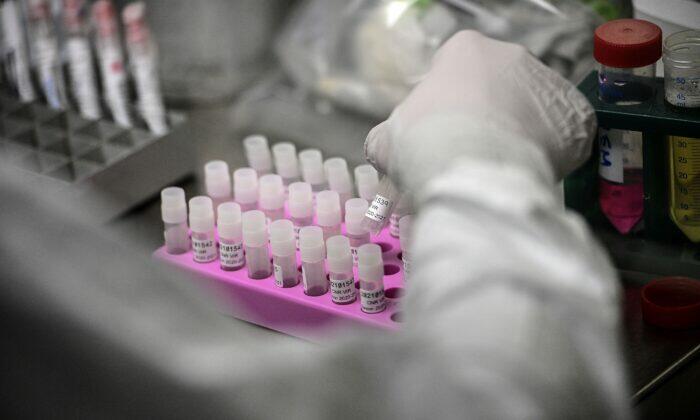
Genomic sequencing is performed in France in this file photograph. (Christophe Archambault/AFP via Getty Images)
Researchers with Helix, a California-based genomic company, found two cases of COVID-19 infection caused by a hybrid of the Delta and Omicron variants, while researchers in France determined 18 people were infected by the hybrid.
Cases have also been detected in the Netherlands and Denmark, according to the World Health Organization (WHO).
Delta was the dominant version of COVID-19, in many countries in 2021 but was displaced in most of them by Omicron by the end of the year.
Experts so far haven’t seen any difference in the characteristics of patients who are infected with the hybrid and haven’t seen any signs that the Deltacron causes more severe cases of COVID-19, Dr. Maria Van Kerkhove, WHO’s COVID-19 technical lead, told reporters in a recent briefing.
“Unfortunately, we do expect to see recombinants, because this is what viruses do, they change over time,” she said, adding later that, “this pandemic is far from over.”
In the United States, Helix scientists and collaborators with the University of Washington Medical Center and Thermo Fisher Scientific sequenced 29,719 samples between November 2021 and February 2022 and identified 20 cases where a person was “co-infected” with the Delta and Omicron variants and two additional cases where the infection was pinpointed as being caused by the variant resulting from the recombination of Delta and Omicron.
“Our study demonstrates the existence of co-infections, the presence of a recombinant population in at least one of these co-infections, and the existence of two infections consisting almost entirely of multiple copies of a recombinant virus. However, the mechanism by which a recombinant virus comes to dominate an infection remains somewhat of a puzzle,” researchers wrote in the study, which was obtained by The Epoch Times prior to publication. It’s scheduled to be published as a preprint on the server medRxiv in the coming days.
Possibilities include the two infections starting as co-infections before the hybrid virus outcompeted the Delta and Omicron variants, according to the researchers, who were backed by the U.S. Centers for Disease Control and Prevention and the National Institutes of Health.
In France, a team funded by the government identified three cases infected by the recombinant, following earlier identification of 17 others, the team reported in a preprint study.
Professor Phillipe Colson, one of the authors, told The Epoch Times in an email that there are too few cases right now “to figure out the epidemiological and clinical features of this hybrid.”
“We wonder what a large part of an Omicron BA.1 spike (without the N-terminal domain) may change in a Delta genome regarding virus transmissibility and clinical presentation,” he added.
Scientists in Cyprus were said to initially report the hybrid in January, though some experts said the identified strain appeared to be a result of lab contamination.
John Moore, a virologist with Cornell University, said he wasn’t sure the more recently reported hybrid was real or not; both the U.S. and French teams said their results are legitimate.
Regardless, for now, there’s no reason to worry, Moore told The Epoch Times in an email.
“What’s the point? If it’s not real, it will soon fizzle out. If it is real, what good does worrying about it do? Let’s see what emerges over time, but I need a LOT more than what’s here to be concerned about yet another ‘scariant’ story,” he said.
JPMorgan Leads Talks to Contain Nickel Crisis Damage
The meltdown bled into the financial system, with nickel giant Tsingshan’s brokers owed several billion dollars in the upfront cash required to make trades
Some of the world’s biggest banks worked over the weekend to resolve a crisis in the nickel market that leaves them on the hook for billions of dollars owed by a Chinese metals giant.
JPMorgan Chase JPM -2.25% & Co., Standard Chartered STAN -0.41% PLC and BNP Paribas SA BNPQY -3.09% were among the banks and brokers seeking to reach an agreement with Tsingshan Holding Group, people familiar with the discussions said. Trades placed by the Chinese steel and nickel producer on the London Metal Exchange contributed to an uncontrollable rise in prices that led the exchange to halt trading and cancel eight hours’ worth of transactions last Tuesday.
Nickel, a cog in the world economy for its use in stainless steel and electric-vehicle batteries, hasn’t traded since.
The meltdown bled into the financial system, leaving Tsingshan’s banks and brokers with several billion dollars in unpaid margin, the upfront cash brokers require to make trades, some of the people familiar with the discussions said.
The talks between Tsingshan’s creditors, led by JPMorgan, have focused on extending the Chinese company credit lines so that it can pay them the margin it owes, some of the people familiar with the discussions said. One plan under discussion was to secure this lending against Tsingshan’s steel and nickel assets in China and Indonesia, some of the people said.
Despite Tsingshan’s troubles, with nickel prices close to records, extending such credit could be highly profitable given the company’s vast production capabilities, some of the people said.
Nickel prices began to rise after Russia, a major producer of the metal, invaded Ukraine, a high-profile example of how the war and punishing Western sanctions have upended the world’s commodity markets, sending prices for metals and energy to their highest levels in years.
The rally morphed into a crisis for the LME last week. Producers such as Tsingshan often sell forward contracts as a way to lock in prices on the physical nickel they mine and refine. In effect, they hold positions that benefit when prices fall, and lose money when prices rise.
Some of Tsingshan’s brokers desperately tried to buy those nickel contracts back to stem losses and avoid escalating margin calls. That buying pushed prices for benchmark three-month forward contracts up 66% in a single session.
Wild trading continued early last Tuesday as brokers kept trying to cover short positions they held on behalf of Tsingshan and other producers. Hedge funds and other participants, meanwhile, aggressively bought nickel, propelling the market higher, people familiar with the trades said.
At one point, nickel prices had more than doubled to a record of more than $100,000 a metric ton. After receiving calls from several smaller brokers saying they would default at the 9 a.m. margin call if prices stayed at records, the LME suspended the market shortly after 8 a.m. local time, a person familiar with the exchange said.
Shortly after noon local time, however, the LME dropped a bombshell: To save the brokers from margin calls they couldn’t afford to pay, it canceled trades that took place before the suspension, wiping out $3.9 billion in transactions.
The decision infuriated money managers who thought they had profited from the rally.
“Halting trading and giving members time to be able to find the funds that they need again is perfectly legitimate,” said Jordan Brooks, co-head of the macro strategies group at AQR Capital Management. “What I think is striking for us and other participants in the market, and the financial industry as a whole, is the decision to wipe out trades that happened without coercion and happened in good faith.”
The suspension and the canceled trades, however, have given the market time and space to clean up the damage and prevent a wider reverberation.
After winding back the clock on Tuesday’s trades, the exchange said brokers had paid it the margin they owed in full.
Tsingshan still owes its brokers, which included JPMorgan, Standard Chartered and BNP as well as a unit of state-owned China Construction Bank Corp. , some of the people familiar with the discussions said. Bloomberg News reported earlier about the creditor talks.
“In the interests of systemic stability and market integrity, we suspended the market as soon as we could and canceled trades from the point at which the LME no longer believed that prices reflected the underlying physical market,” a spokeswoman said. She said the exchange was working to open the market as soon as possible.
The company whose trades precipitated the crisis was founded by entrepreneur Xiang Guangda and his wife, He Xiuqin, as a car-window producer in 1988. Mr. Xiang remains a controlling shareholder of Tsingshan, now one of China’s biggest private companies.
When China’s economy accelerated in the 2000s, the availability of nickel posed a roadblock. China’s voracious appetite for the metal to shovel into steel furnaces sent prices above $50,000 a metric ton in 2007, a record that stood until last week.
Tsingshan, a stainless-steel producer, solved China’s nickel shortfall by pioneering rotary-kiln electric furnaces to produce a low-cost material known as nickel-pig iron. The development weighed on prices and was hailed in the local media as a victory for the Chinese metal industry.
China’s Belt and Road initiative, President Xi Jinping’s flagship infrastructure strategy, helped fuel Tsingshan’s growth. In 2013, Mr. Xi and Indonesia’s then-President Susilo Bambang Yudhoyono attended the official launch of one of Tsingshan’s Indonesia industrial parks.
Metal producers typically sell forward contracts on exchanges to lock in prices, known as hedging. Tsingshan, however, has both sold and bought nickel contracts over the past decade, people familiar with the company said, making the activity more akin to trading.
Early last year, the company began to accumulate a short position, the people said. It made statements on its website and panels suggesting the market was flush and prices should fall. Tsingshan’s position was equivalent to having sold about 190,000 metric tons on the LME, traders, bankers and analysts estimate. That would be worth $9.1 billion at last Monday’s closing prices.
Labour calls for probe into peerage for Russian businessman
Opposition party wants details of advice on Boris Johnson’s nomination of Evgeny Lebedev to House of Lords
The Labour party on Sunday called for an investigation into Boris Johnson’s nomination of the Russian businessman Lord Evgeny Lebedev for a peerage.
Labour leader Sir Keir Starmer wrote to Lord Paul Bew, chair of the House of Lords appointments commission, to ask him to “make available to the public the vetting advice provided” on Lebedev’s peerage.
The Sunday Times reported the UK intelligence services in 2020 warned against granting a peerage for Lebedev, a close friend of the prime minister and proprietor of the Evening Standard newspaper, on national security grounds.
Lebedev is the son of Alexander Lebedev, a billionaire former banker and KGB agent.
The Sunday Times reported that in 2013 Sir John Sawers, then head of MI6, declined to meet Evgeny Lebedev at a lunch with one of his newspaper editors.
When Lebedev was put forward for a peerage by Johnson in 2019, the newspaper said the House of Lords appointments commission advised against the nomination.
Johnson reportedly said any objections to Lebedev being nominated for a peerage constituted “anti-Russianism”. Lebedev took up his seat in the Lords in 2020.
Lebedev has been criticised by Labour for past comments that appeared to echo arguments used by Russian president Vladimir Putin, who he has praised multiple times.
In 2014, Lebedev defended Russia’s annexation of Ukraine’s Crimea peninsula.
He told the BBC that Crimea was part of Russia “for many years” and the situation was “very complicated”. He called on western governments to “stop cold war rhetoric”.
In 2013, Lebedev tweeted a newspaper article that suggested Russia was not responsible for the murder of former KGB agent Alexander Litvinenko.
He said: “Was Litvinenko murdered by MI6? . . . Certainly more to it than the generally accepted Putin link.”
In 2016, a UK public inquiry found that Putin “probably” approved the murder of Litvinenko with a radioactive poison in London.
Starmer said in his letter to Bew: “It is important that the money and influence of those who support the barbarity of the Putin regime is removed from our politics. In such extraordinary circumstances, it seems only appropriate that all advice to the prime minister on the vetting process for Lord Lebedev is made available for public review.”
Starmer told Sky News that Johnson had “serious questions to answer” about what advice he received on Lebedev’s peerage.
“This is a question of national security, let’s just have a process to look into what actually happened,” he said.
Lebedev’s spokesperson did not respond to a request for comment. On Friday, he released a statement to the Evening Standard saying he was not an “agent of Russia” or a security risk. He has previously called on Putin to halt military action in Ukraine.
The government said: “All individuals nominated for a peerage are done so in recognition of their contribution to society and all peerages are vetted by the House of Lords appointments commission.”
Whitehall insiders said that Lebedev was nominated for a peerage “in recognition of his contribution to society and public service”, including his charity work, and his campaigns on poverty in London and Aids.