(Wash. Post) The Search for Oligarchs’ Wealth in U.S. Is Hindered By Investment

The Search for Oligarchs’ Wealth in U.S. Is Hindered By Investment Loopholes

Two years ago, a leaked FBI intelligence bulletin warned that a gap in U.S. rules aimed at fighting dirty money probably allows so-called threat actors to place funds with private investment firms. The FBI gave as an example an unnamed New York-based private equity company that took in more than $100 million from a Russian business with alleged ties to organized crime.
This loophole has worried authorities for years, because although banks and most securities brokers are required by law to identify the true owners behind investments and report any red flags, private equity firms, venture capital funds and hedge funds are not.
The result is a puzzling hole in the regulations designed to stop criminals and corrupt politicians around the world from accessing the U.S. financial system — a situation the private investment industry has repeatedly downplayed as it has successfully fended off reform attempts by Treasury officials and anti-corruption groups.
This lack of insight into the $11 trillion U.S. private investment industry threatens to complicate the White House's push to punish the financial elite close to President Vladimir Putin over Russia's invasion of Ukraine.
"They're hunting in the dark," said Lakshmi Kumar, policy director for Global Financial Integrity, an anti-corruption think tank in Washington. "The way the rules are set up, there's a black hole of information."
President Biden in his State of the Union address earlier this month issued a warning to oligarchs that his administration was "coming for your ill-begotten gains." The Justice Department announced the next day that it had created Task Force KleptoCapture to pursue sanctions against what it called "corrupt Russian oligarchs."
But U.S. authorities lack a clear road map of the assets invested in private equity funds, venture capital funds or hedge funds.
Under current law, private equity firms and hedge firms do not need to verify their investors' identities or how they made their money — requirements that U.S. banks have followed under the anti-money laundering Bank Secrecy Act, passed in 1970, and other anti-corruption laws. The rules are known as "know your customer," a due diligence process for assessing and monitoring a customer's risk and verifying identity.
Anti-corruption groups and Treasury officials have pushed for private investment operations to act more like banks in rooting out money laundering.
These private investments are increasingly important players in financial markets. Each year for the past decade, more money has been raised in private markets than in public markets, such as on stock exchanges, according to the Securities and Exchange Commission. Private markets now hold about half as many assets as all U.S. commercial banks, which stand at about $22.5 trillion in deposits.
But little is known about where private funds get their money.
While megayachts, private jets and palatial mansions are obvious signs of potential oligarch wealth, untold fortunes can remain hidden in different private investments.
"Luxury residences — that's what is visible. People can see that. But if you own stuff through an entity with a limited partnership in a private equity fund, no one does," said Joshua Kirschenbaum, a former Treasury official who works on illicit finance as a senior fellow at the Alliance for Securing Democracy.
Occasionally, there are hints of the degree of potentially suspicious activity. The 2020 FBI intelligence memo — obtained by online hackers and published by the activist group Distributed Denial of Secrets — briefly described a plan by an official from a hedge fund based in New York and London to create companies "to buy and sell prohibited items" from sanctioned countries.
Sen. Ron Wyden (D-Ore.), who has proposed a bill to close the disclosure loophole, said in a statement that he considers the massive U.S. private equity and hedge fund industry to represent "a much bigger problem" for hiding Russian oligarch assets than real estate.
The Treasury Department is concerned about the lack of anti-money laundering regulations for private investments and plans to continue pushing for change, said a senior Treasury official, who spoke on the condition of anonymity to discuss agency deliberations. The goal is to have these funds following the lead of banks and setting up programs to verify client identities and the source of funds, as well as file "suspicious activity reports" if they think there were problems.
Leaders in the private equity industry argued in interviews and comment letters that these kinds of transparency requirements are unnecessary because their sector is at low risk for money laundering because funds are often tied up for two to 10 years, and often the client's investment comes through a bank, which is already required to take steps to weed out dirty money.
Some private equity firms also already conduct their own due diligence, despite not being required to by law, said Michael Gershberg, an attorney in Washington with Fried Frank, where he advises clients on anti-boycott and anti-money laundering rules.
"I'm not sure there would be a huge change if they were subject to [the anti-money laundering rules]," he said.
But anti-corruption advocacy groups said the gap in oversight is one reason the United States remains a popular place to secretively stash cash.
"If you're a person who faces U.S. sanctions, then the best place to hide your assets is in the U.S.," Kumar said, "and that's a problem."
It can be impossible to know if an investment belongs to a person facing sanctions because of the anonymity allowed under current law.
For example, a U.S. private equity firm can accept money from a limited liability company based overseas without knowing who owns the business or how they got their funding, according to anti-corruption experts.
In contrast, banks are required to verify their clients' identities when they open an account. Banks also need to report to the Treasury Department's Financial Crimes Enforcement Network if they suspect money laundering or fraud.
Private equity firms in the European Union and the United Kingdom follow similar guidelines.
U.S. private investments were supposed to be covered by the new "dirty money" laws that followed the Sept. 11, 2001, terrorist attacks and the sudden interest in rooting out terrorist financing. But Treasury officials gave a range of businesses, including investment firms and real estate, temporary exemptions so regulators could focus on other industries.
Those temporary exemptions are now two decades old.
Treasury has repeatedly proposed ending the carve-outs and requiring private equity firms and hedge funds to conduct due diligence on potential investors.
The agency last tried in 2015, when it was met with industry opposition.
The proposed regulation would have applied to most registered investment advisers who managed more than $100 million in assets.
Private equity firms and hedge funds would essentially need to start reporting like banks.
While some hedge funds appeared willing to accept new regulations, the private equity industry objected, lobbying and filing comment letters against the proposal.
One group of smaller private equity funds called the Small Business Investor Alliance argued in a comment letter that criminals were not attracted to its funds because they are "long-term, illiquid investments."
The Association for Corporate Growth, a group that includes more than 1,000 private equity firms, said the rule "would impose significant costs upon advisers to private equity funds and other illiquid pooled investment vehicles but not prevent or deter money laundering in any meaningful way."
And the American Investment Council — a trade group formerly known as the Private Equity Growth Capital Council — wrote that its products "present negligible risks of money laundering."
Today, the American Investment Council's stance has not changed.
While it supports anti-money laundering regulations, "Congress and [the Treasury Department's Financial Crimes Enforcement Network] have consistently chosen not to impose new AML requirements on private equity because of the lower risk profile," Emily Schillinger, a spokeswoman for the group, said in a statement.
Gary Kalman, U.S. director of the anti-corruption group Transparency International, is skeptical of these industry claims.
"It seems improbable to me that the U.S. private equity market is as pure as the driven snow," Kalman said. "I think that's the dirty little secret: We don't know how much money is hidden away because no one has to report anything."
The loophole for private equity looms even larger since the United States overhauled its corporate transparency laws last year.
Lawmakers passed a bill that will eventually require any company created or registered in the United States to report its owners' identities to the Financial Crimes Enforcement Network, ending the anonymity once promised by shell companies — shields often wielded by wealthy investors or others trying to avoid exposure. The reports are intended for law enforcement, and they are not required to be made public.
Last fall, a small group of U.S. lawmakers proposed a bill to include art dealers, investment advisers and others under anti-money laundering rules. No action has been taken on the measure. In December, the Treasury Department proposed new anti-money laundering rules for the real estate market, which would bring that sector in line with transparency requirements for other financial services. The White House announced that same month a "strategy on countering corruption" that includes a plan to ask the Treasury Department to re-examine its 2015 proposal for anti-money laundering rules for private investments.
For now, private equity remains untouched.
As the United States and other countries impose sanctions on wealthy Russians, experts said the job is harder without transparency for a huge investment sector.
"We simply don't know what's out there," said Kirschenbaum, the former Treasury official.

(ZH) Mapped: Global Happiness Levels In 2022

Mapped: Global Happiness Levels In 2022 (Full Report attached)

What really makes people happy? While countless academic researchers have tried to get to the bottom of this, the truth is, it’s a complicated question to answer.
As Visual Capitalist's Carmen Ang details below, happiness levels depend on a number of factors, including one’s financial security, perceptions of social support, feelings of personal freedom, and much more.
This map pulls data from the World Happiness Report to uncover the average happiness scores of 146 countries. It shows average scores from 2019 to 2021, and highlights which countries are the happiest—or unhappiest—and why.
How is Happiness Measured?
Before diving in, let’s briefly touch on how happiness levels are measured in this report. Some clear indicators are health and wealth, which are measured using key metrics like GDP per capita and life expectancy rates.
The report also looks at more intangible aspects by collecting survey responses from each country, to gauge things like:
  • Social support
  • Freedom to make life choices
  • Generosity
  • Perceptions of government/ business corruption
  • Positive affect
  • Negative affect
Similar to last year, the report takes special considerations to track how COVID-19 has impacted aspects of our daily lives, and how it’s affected global happiness levels.
Editor’s note: there are several countries covered in last year’s report that were not included in this year’s dataset, including Haiti, Maldives, and Burundi.
Zooming in: Regional Happiness Levels
Worldwide happiness comes in at an average score of 5.6, which is a slight improvement since last year’s report. Below, we dive into each region’s happiness levels.
North America
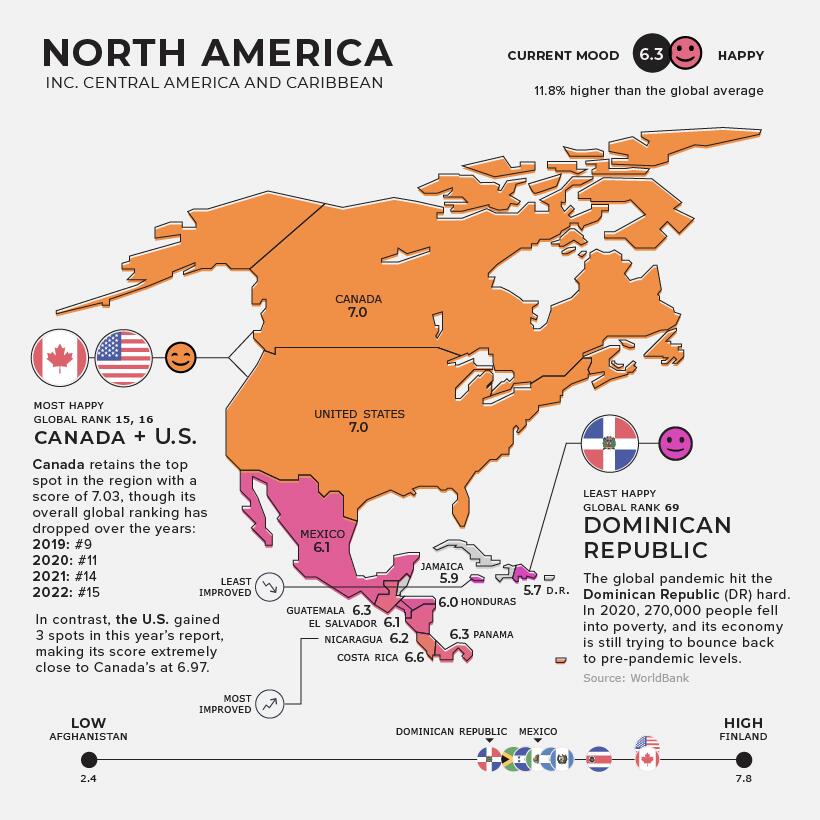
Current Mood: Happy (6.3)
Like last year, Canada ranks first as the happiest country in North America. However, it’s lost some ground on the global ranking, placing 15th this year compared to 14th the year prior. In contrast, the U.S. climbed three places in this year’s report and ranked just under Canada with a score of 6.97 (7.0 after rounding).
The Dominican Republic comes in last place in the region. While the Dominican Republic has experienced impressive economic growth over the last 25 years, the country was hit hard by the global pandemic—in 2020, approximately 270,000 people fell into poverty, and the economy is still struggling to reach its pre-pandemic levels.
South America
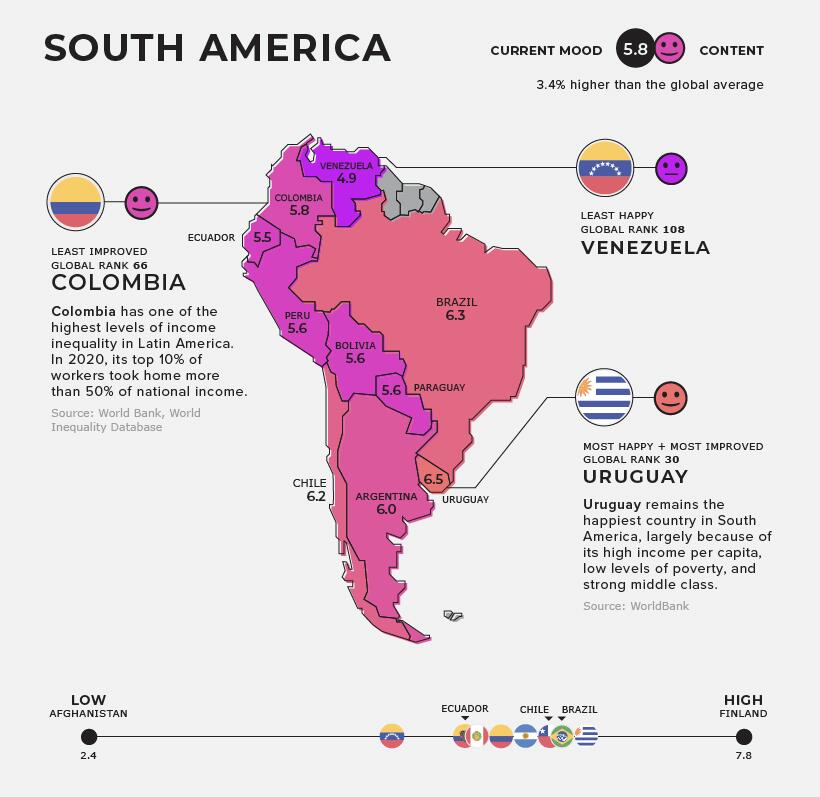
Current Mood: Content (5.8)
Uruguay retains its top spot as the happiest country in South America. It continues to rank high on the list because of its high income per capita, relatively low levels of poverty, and strong middle class.
While Uruguay was not immune to the impacts of COVID-19, the country was able to transition smoothly to online learning and was the first country in the region to reopen schools.
In last year’s World Happiness Report, Colombia was the most improved country in the region. But this year, it’s dropped 14 places on the global ranking, making it the least improved country in this year’s report.
While Colombia has made significant strides towards elevating extreme poverty in the last few decades, it still has one of the highest levels of income inequality in Latin America. In 2020, its top 10% of workers took home more than 50% of national income.
Europe
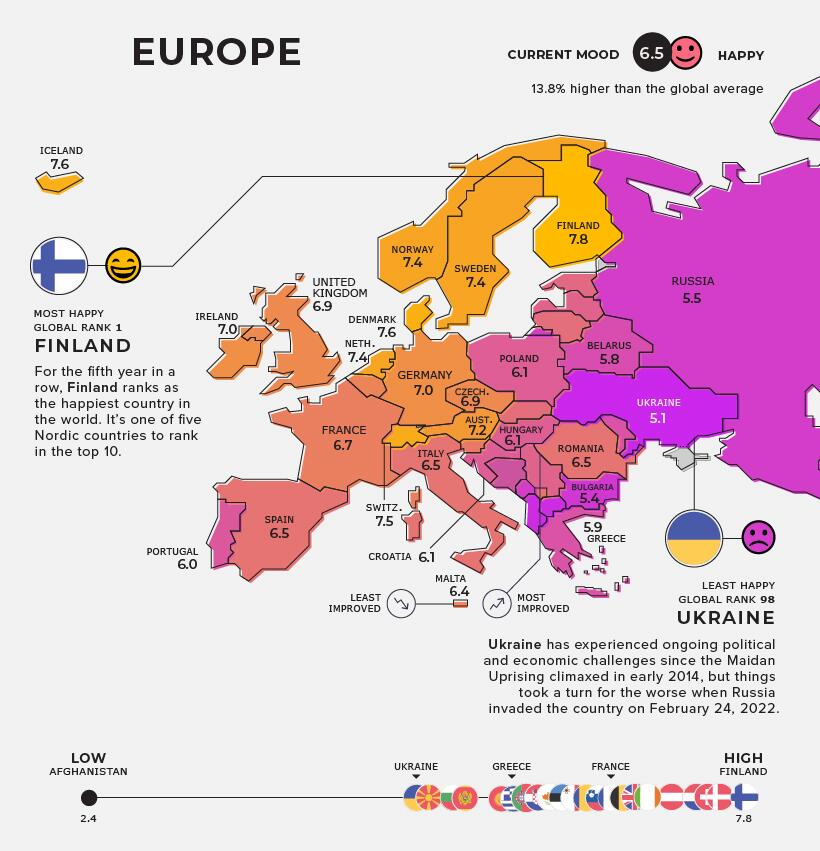
Current Mood: Happy (6.5)
Finland is not only the happiest country in Europe, but it also takes the top spot as the happiest country in the world, for the fifth year in a row. Finland is one of five Nordic countries to place in the top 10. Denmark comes in second place, followed by Iceland in third.
Romania was the most improved country in Europe, climbing 18 spots on the global ranking since last year’s report. Over the last decade, the country has seen some of the most significant economic growth in the European Union and was able to bounce back quickly from its COVID-19- triggered slump.
Ukraine ranks in last place, making it the unhappiest country in Europe. Ukraine has experienced ongoing challenges since the Maidan Uprising peaked in 2014. Events in the country have recently taken a turn for the worse, when Russia launched a full-scale invasion of Ukraine on February 24, 2022. As a result of the conflict, over 3 million people have fled the country.
Middle East and Central Asia
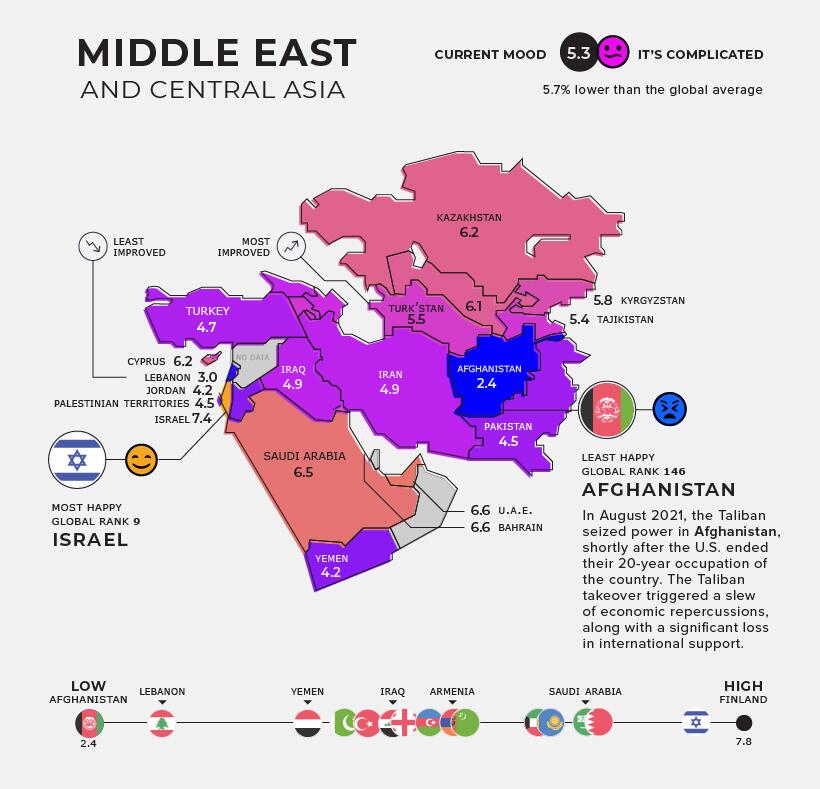
Current Mood: It’s Complicated (5.2)
Turkmenistan is the most improved country in the region, rising 19 places on the global ranking since last year’s report. The country’s boost could be explained by its rapid economic growth in recent years. In 2021, the country’s GDP grew by an estimated 6.3%.
For the last two years, Lebanon has been dealing with a slew of crises. In 2020, COVID-19 spurred an economic crisis that’s been ranked as one of the top 10 most severe economic crises since the mid-nineteenth century. And on August 4th, 2020, a massive ammonium nitrate explosion left the country’s capital city, Beirut, in shambles.
East Asia and Oceania
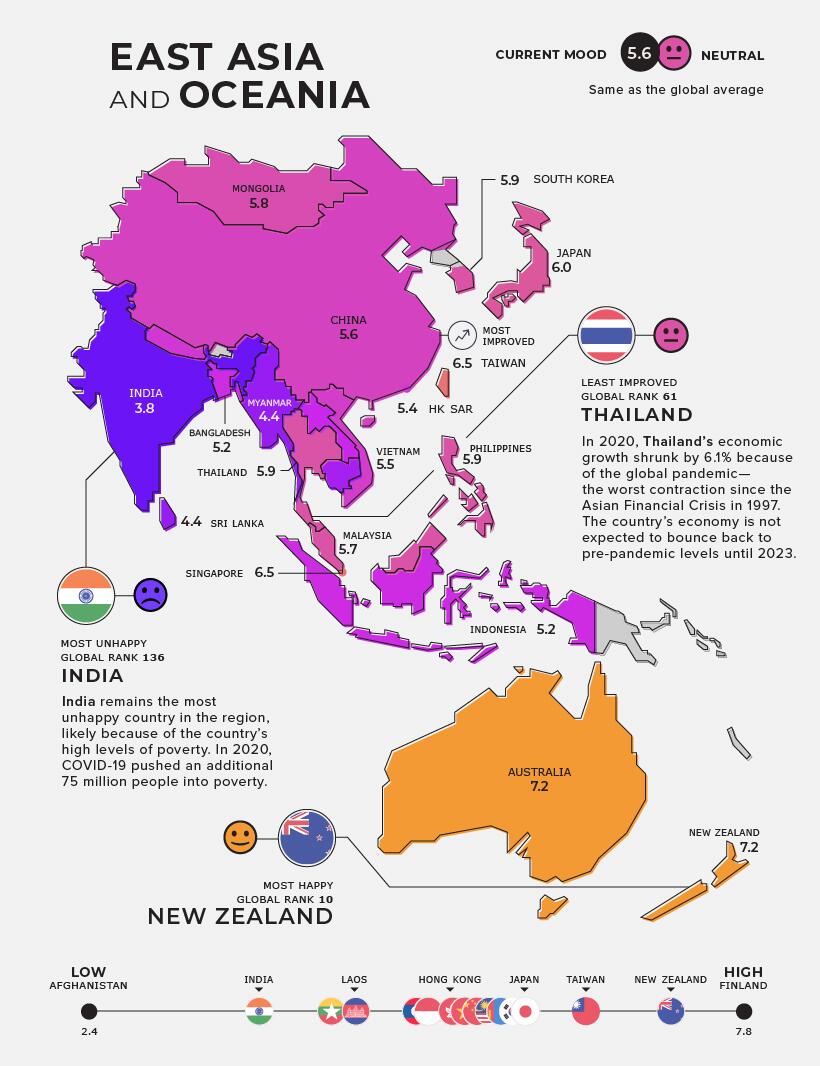
Current Mood: Neutral (5.6)
Note: As the report only covers 146 countries, “Oceania” only refers to Australia and New Zealand in this instance.
In this year’s report, China climbed 12 places on the global ranking, making it the most improved country in East Asia and Oceania. The Chinese government recently identified “common prosperity” as a top priority, and has made numerous policy shifts in an effort to combat inequality and eradicate poverty.
On the flipside, Thailand has improved the least in the region, likely because of the significant toll that COVID-19 had on the country’s economy. In 2020, economic growth shrunk by 6.1% in Thailand—the country’s worst contraction since the Asian Financial Crisis in 1997. Thailand’s economy is not expected to bounce back to pre-pandemic levels until 2023.
Africa
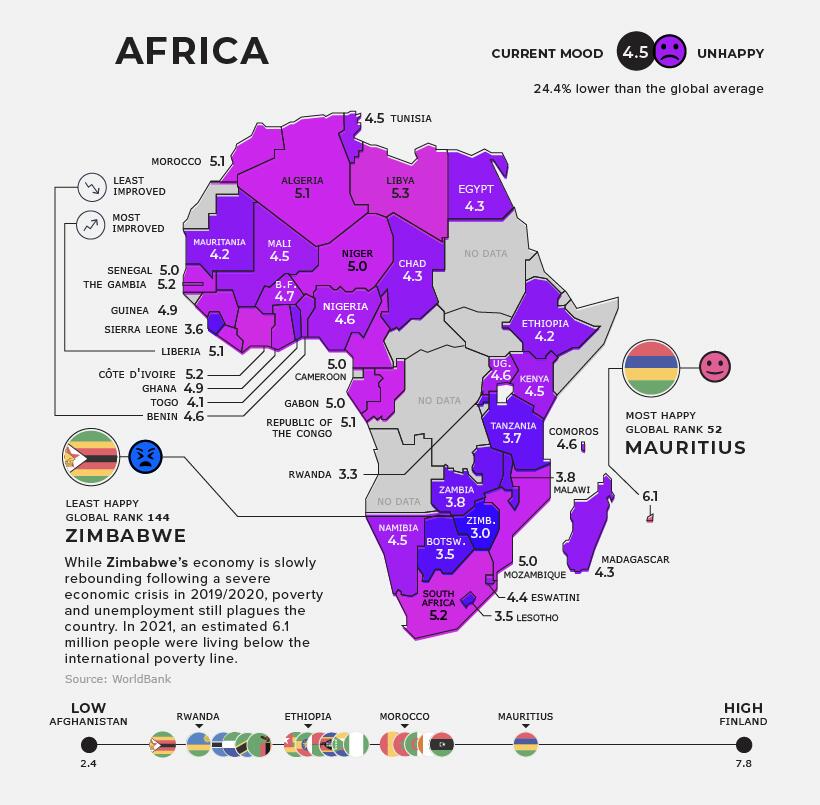
Current Mood: Unhappy (4.5)
With a regional score of 4.5, Africa ranks as the unhappiest region worldwide. Zimbabwe remains the most unhappy country in the region, as it continues to struggle with high levels of poverty. In 2021, approximately 6.1 million people were living below the international poverty line.
Mauritius remains the happiest country in the region, likely because of its relatively high levels of income. It’s worth noting that Mauritius became a High-Income country in July 2020, but slipped back to its Upper-Middle-Income status in 2021 because of the global pandemic.
We’re into our third year of dealing with the COVID-19 pandemic, and it’s clear that countries worldwide are still reeling from the pandemic’s devastating health, social, and economic impact. It’s unclear when things will fully return to normal—if ever. But on the bright side, countries are slowly showing signs of recovery.

(ZH) Zelensky Says WWIII Assured If Negotiations With Russia Break Down

Zelensky Says WWIII Assured If Negotiations With Russia Break Down

Ukrainian President Volodymyr Zelensky said on Sunday that he's "ready for negotiations" with Russian President Vladimir Putin, but that if they break down, it will lead to World War III.
"I'm ready for negotiations with him. I was ready for the last two years. And I think that without negotiations we cannot end this war," Zelensky told CNN's Fareed Zakaria.
"I think that we have to use any format, any chance in order to have a possibility of negotiating, possibility of talking to Putin. But if these attempts fail, that would mean that this is a third World War."
Zelensky's comments come as Turkey claims Moscow and Kiev are close to an agreement on key points - despite the Kremlin turning to "more destructive artillery" after revealing it used hypersonic "Kinzhal" missiles at least twice on Ukrainian targets.
In a Saturday video message, Zelensky called for talks "without delay," warning that Russia would suffer "huge" losses if they don't come to the table.
"We have always insisted on negotiations. We have always offered dialogue, offered solutions for peace," he said. "And I want everyone to hear me now, especially in Moscow. It's time to meet. Time to talk. It is time to restore territorial integrity and justice for Ukraine."
Ukraine's priorities are: "The end of the war, security guarantees, sovereignty, restoration of territorial integrity, real guarantees for our country, real protection for our country."
Russia's priorities - laid out in a call with Turkey last week - consist of two categories of demands; Ukraine must remain neutral and not apply to join Nato, a point Zelensky has already conceded. Ukraine would also need to undergo a disarmament process to ensure it isn't a threat to Russia, as well as 'de-Nazify' its armed forces.
The second category of Russian demands is where more difficulty will lie, according to top Turkish government adviser Ibrahim Kalin, and will require face-to-face negotiations between Putin and Zelensky.
Mr Kalin was much less specific about these issues, saying simply that they involved the status of Donbas, in eastern Ukraine, parts of which have already broken away from Ukraine and stressed their Russianness, and the status of Crimea.
Although Mr Kalin didn't go into detail, the assumption is that Russia will demand that the Ukrainian government should give up territory in eastern Ukraine. That will be deeply contentious. -BBC
On Sunday, Zelensky told CNN that if Ukraine "were a NATO member, a war wouldn't have started."
"I'd like to receive security guarantees for my country, for my people. If NATO members are ready to see us in the alliance, then do it immediately. Because people are dying on a daily basis," he continued, adding that he's been grateful for NATO's aid since the invasion began.

WSJ : Pentagon’s Work With Ukraine’s Biological Facilities Becomes Flashpoint in

Pentagon’s Work With Ukraine’s Biological Facilities Becomes Flashpoint in Russia’s Information War
Moscow falsely accuses U.S. of funding biowarfare in Ukraine despite Kremlin once benefiting from Pentagon program

On his first official visit abroad, the new senator from Illinois, Barack Obama, was taken to a facility in Ukraine where the U.S. helped scientists working with dangerous biological materials. But rather than produce biological weapons, U.S. officials in that ramshackle building were trying to prevent lethal pathogens from falling into the hands of terrorists.

“I removed a tray of glass vials containing Bacillus anthracis, which is the bacterium that causes the anthrax,” recalls Andrew Weber, the Pentagon official who was in charge of the U.S.-funded program that worked with the Ukrainian government. Mr. Weber said he showed the tray “to a very concerned-looking young senator.”

Mr. Obama himself recalled seeing in his 2005 trip to Ukraine “test tubes filled with anthrax and the plague lying virtually unlocked and unguarded.”

A decades-old Pentagon program that was used to secure biological weapons across the former Soviet Union—and to build trust between Washington and Moscow after the Cold War—has instead become a new flashpoint in an information war between the two countries in the wake of Russia’s invasion of Ukraine.

Moscow has accused the Pentagon of funding weapons work in Ukraine’s biological laboratories. “These were not peaceful experiments,” Russian Foreign Minister Sergei Lavrov said earlier this month.

China, whose leader Xi Jinping has cultivated a close relationship with Russian President Vladimir Putin, has echoed those allegations. “Russia has found during its military operations that the U.S. uses these facilities to conduct bio-military plans,” the Chinese Foreign Ministry spokesman told reporters.

U.S. officials have flatly denied those claims and warned that Moscow could use its allegations to justify its own use of weapons of mass destruction in Ukraine.

“We believe that Moscow may be setting the stage to use a chemical weapon and then falsely blame Ukraine to justify escalating its attacks on the Ukrainian people,” Secretary of State Antony Blinken said last week. “Manufacturing events and creating false narratives of genocide to justify greater use of military force is a tactic that Russia has used before.”

The allegations have shocked those who are most familiar with the Pentagon’s post-Cold War initiative, called the Cooperative Threat Reduction program. That is because not only has Russia been aware of the Pentagon’s work securing chemical, biological and nuclear facilities across the former Soviet Union, but it had also been its beneficiary for many years.

“They’re outrageous claims,” said Robert Pope, the head of the Defense Threat Reduction Agency, or DTRA, the arm of the Pentagon in charge of running the program. “We were created 30 years ago to eliminate weapons of mass destruction, and Russia knows well we eliminate weapons of mass destruction.”

The program, which dates back to 1991 and continues today, stretches across the former Soviet Union. Since the program started, the Pentagon has spent approximately $12 billion on securing material used in weapons of mass destruction in post-Soviet republics, according to a DTRA spokeswoman. Of those funds, about $200 million has been spent on the biological work in Ukraine since 2005. The funds have supported dozens of labs, health facilities and diagnostic sites around the country, the DTRA spokeswoman said.

Mr. Weber, who was in charge of negotiating the initial agreement with Kyiv to work on securing the country’s biological materials and facilities, said that work expanded to Ukraine after the 9/11 attacks, when al Qaeda terrorists hijacked aircraft and crashed them into the World Trade Center towers and the Pentagon. U.S. policy makers grew worried about the potential for terrorists to steal biological materials—fears that were heightened after letters containing anthrax were sent in the U.S. mail to congressional offices and media outlets. The FBI eventually concluded that an American scientist employed at a military lab sent the letters.

The president of Ukraine at the time, Leonid Kuchma, concerned about the threat of terrorism in his own country, asked the U.S. for help. Since the collapse of the Soviet Union a decade earlier, Ukraine had been starved of the funds needed to secure its biological facilities.

Mr. Weber put together a team that visited Ukraine’s biological and chemical facilities, which ranged from large laboratories to small veterinary research centers. “We found that a number of them had dangerous pathogen collections left over from Soviet days,” he said. “They were in pretty bad shape.”

Ukraine’s laboratories—unlike some in other former Soviet republics—weren’t directly involved in the Cold War biological-weapons program, but they did have pathogens that fed into offensive work, according to Mr. Weber.

Those pathogens, like anthrax, could pose a threat if released, whether accidentally or on purpose. The focus of U.S. work in Ukraine was to consolidate that biological material, much of it related to agriculture, into secure facilities, which the U.S. would pay to build or upgrade.

Paul McNelly, who from 1995 to 2003 directed the Defense Department’s chemical and biological elimination programs in Russia, Kazakhstan and Uzbekistan, said he was stunned with what he saw inside the former Soviet facilities.

“You would walk into these places and the refrigerators that stored these dangerous pathogens, they had no locks on them at all,” Mr. McNelly said. “There would be vials that were labeled tularemia, plague, different things like that. And these people, most of them, weren’t masked. Their gowns were antiquated.” He added: “It was horrible.”

As part of the program, the Pentagon spent $1 billion to build the Russians a facility in Shchuchye, Siberia, to demilitarize some two million chemical weapons. By the time it was done in 2009, ties with Moscow were growing tense. The price of oil was going up, giving Russia more revenue to wean itself off foreign assistance. At the same time, Mr. Putin was consolidating power.

As a result, the Russian government became a less-willing partner to the Pentagon’s drive to secure the deadly materials, according to James Tegnelia, who served as the head of DTRA from 2005 to 2009. “They wanted our money, but they didn’t want to admit that we built the facility,” Mr. Tegnelia said. “You could see that they were getting ready to pull back.”

Russia’s Foreign Ministry had in the past praised the program. But by 2012, Moscow declined to renew cooperation, saying it could pay for the work on its own.

In 2014, the year Moscow illegally annexed Crimea and began backing separatists in Ukraine’s Donbas region, the program in Russia drew to a close.

A spokesman for the Russian Embassy in Washington, D.C., didn’t respond to a request for comment on the Pentagon program.

Yet even with that chapter of its cooperation over, the Russian claims about the Pentagon conducting secret weapons work in Ukraine came as a surprise not only to those who have worked on the program but also to other Western officials. The Kremlin has in the past used such charges as cover for its own actions, they say.

“We are concerned that Moscow could stage a false-flag operation, possibly including chemical weapons,” North Atlantic Treaty Organization Secretary-General Jens Stoltenberg said last week.

U.S. officials have declined to discuss what specific intelligence, if any, they have to indicate Russia might be preparing to deploy chemical or other unconventional weapons to Ukraine. But they say Russia has a history of using chemical weapons, including against Mr. Putin’s domestic political opponents, and it has encouraged their use in Syria by President Bashar al-Assad’s government.

The Russian government shot back against the U.S. allegations, denying plans to use chemical weapons. In a post last week on its official Telegram channel, the Russian Defense Ministry said the units fighting in Ukraine “do not have chemical munitions.”

Mr. Tegnelia, the former DTRA director, views Russia’s allegations as a path to an even more dangerous escalation. “If you see them using chemical weapons in Ukraine, watch out,” he said, “because they’re only one step away from nuclear weapons.”

WSJ : How Miu Miu Made the World’s Skimpiest Luxury Outfit a Viral Success

How Miu Miu Made the World’s Skimpiest Luxury Outfit a Viral Success
The ‘Miu Miu set,’ a crop-top and miniskirt combo, has been worn this spring by Zendaya and Nicole Kidman on magazine covers, and a seemingly endless stream of models and influencers. Now, it’s filtering down to high-schoolers and DIY-ers.
It took a 72-year-old designer to wake up the luxury fashion establishment. Miuccia Prada, one of its queens, sent a jarring new silhouette down the runway for her spring Miu Miu collection, shown in Paris in October 2021. There were several iterations, but the gist of it was an ultra-low-rise pleated miniskirt (so short the pockets peek out) paired with a teensy crop top. Some tops were abbreviated sweaters or button-ups; others appeared to be the waistband of a pair of pants, refashioned into a bra-like band. The look was preppy, yet naughty; think early 2000s Avril Lavigne with a pop of Ivy League nostalgia. It captured the current Y2K-obsessed, pandemic-fatigued party-girl aesthetic that thrives online.

“It’s become a meme,” said AJ Tinsley, 24, an Irish fashion designer living in London, who posted his own DIY version of the outfit to TikTok.

No spring 2022 designer look has been more relentlessly copied, flaunted, gawked at, criticized, admired, reproduced, photographed and talked about than what’s come to be known as “the Miu Miu set.” The outfit began appearing on magazine covers last month, worn by everyone from Nicole Kidman for Vanity Fair to the model Paloma Elsesser for i-D. While the set is often photographed on young, extremely thin models and influencers, those two covers made headlines for featuring it on a woman in her 50s and a plus-size model, respectively. In Miu Miu’s bubblegum-pink advertisements, It-girl-of-the-moment Hailey Bieber poses in versions of the set. And the pieces barely had time to hit stores before they were sold out. A second delivery, due soon, has already been pre-sold-out, according to Prada. The tiny miniskirts, which retailed for $995 for the Chino version and $1,200 for the Prince of Wales checked one, are going for twice that on eBay.

Lookalike sets have predictably been spotted on cheap ecommerce sites like Fashion Nova. Chinese fast-fashion retailer Shein currently offers over 8,000 styles of sorta-Miu-Miu pleated miniskirts. The garment’s relative simplicity has also made it a prime target for fashion DIY-ers on TikTok and YouTube. These cunning crafters teach viewers how to tailor their own sets, usually using thrifted men’s chino pants. Mr. Tinsley, the Irish fashion designer, said he achieved his version for just a “fiver.”

Shuang Bright, a 26-year-old New York City videographer, started doing DIYs because she wanted to make fashion accessible to more people. She jumped on the Miu Miu set right after the spring runway show, excited by how easily people could recreate it using pieces they might already have, like preppy sweaters and khakis. She did note that, although the DIYs couldn’t match the quality of the real Miu Miu deal, they let young people feel like they’re part of the moment. “The silhouette was particularly appealing to Gen Z,” she said, “because of how closely it aligned with the 2000s trends of…really short and revealing [clothing].”

In that sense, the Miu Miu set is an interesting case study of fashion that syncs with youth-led internet culture, rather than speaking to the same old clients who generally shop at high-end boutiques. Some credit Mrs. Prada’s collaborator on the show, Lotta Volkova—a stylist and cohort of Balenciaga creative director Demna—with reinvigorating the brand. But she’s the stylist; Mrs. Prada still created the designs. Regardless of who did what, the nerve-hitting collection resonated well beyond the typical fashion circuit. The fashion designer Mr. Tinsley said, “In a sense it’s a good marketing thing for Miu Miu because a lot of people who are not too into fashion know it now…It’s introducing Miu Miu to a new generation.” Miu Miu, whose brand name derives from Mrs. Prada’s family nickname, was founded in 1993 as a kind of younger sister to the Prada brand. But since then, it’s increasingly emerged from Prada’s shadow, showing in Paris instead of Milan and becoming a luxury player in its own right.

Even high-schoolers, at least those with more lenient parents and teachers, are getting in on the trend. Ashley Langholtz, a 17-year-old high-school senior at Fox Lane High School in Bedford, N.Y., started the Instagram account @miumiuset to chronicle the look’s appearances in magazines and out in the wild. She decided to start the account when, a few weeks ago during her winter break, she awoke to find that her entire feed consisted of Miu Miu posts. She has noticed students at her school wearing versions of the set that adapt thrifted pieces. So far this hasn’t been policed by the school’s imprecise dress code.

Mr. Tinsley mused that the miniskirt might become Miu Miu’s signature luxury item, the equivalent of Chanel’s 2.55 quilted purse or a Burberry trench coat. The brand certainly seems eager to continue its success story. For its fall collection, shown earlier this month in Paris, it reprised the low-slung pleated miniskirt in several looks.

The risqué look has its limits. Jennifer Girukwishaka, one of the most in-demand models of the moment, walked in the spring Miu Miu show and recently wore the outfit in a British Vogue shoot shot by Craig McDean. While she said that her first impression of the skirt was, “Wow!” (in a good way) she said it might be better suited for fashion cities like Milan and Paris than those in her African home country. “In Burundi we wouldn’t wear that,” she said. She giggled imagining what her mother would think of the outfit. “She wouldn’t let me out of the house wearing that.”

WSJ : Elon Musk’s Business Ties to China Create Unease in Washington

Elon Musk’s Business Ties to China Create Unease in Washington
Tesla, SpaceX are at the center of discussions; some lawmakers fear Beijing could access secrets as ‘Congress doesn’t have good eyes on this’

Elon Musk’s ties to China are causing unease in Washington, including among some Republican lawmakers who have been among the billionaire entrepreneur’s ardent supporters.

The concerns center on the potential for China to gain access to the classified information possessed by Mr. Musk’s closely held Space Exploration Technologies Corp., including through SpaceX’s foreign suppliers that might have ties to Beijing.

Some lawmakers also are troubled by the lack of clear lines between SpaceX and auto maker Tesla Inc., which also is run by Mr. Musk and has extensive operations in China. Tesla has developed advanced battery packets sought by the Chinese, and China has adopted a less-expensive battery technology championed by Mr. Musk.

The concerns come amid a fierce rivalry between the U.S. and China that recently has been stoked by China’s focus on space technology. Tensions are also rising because of Chinese President Xi Jinping’s partnership with Russian President Vladimir Putin.

Rep. Chris Stewart (R., Utah), is seeking confidential briefings on Capitol Hill with officials from agencies including the National Reconnaissance Office, which coordinates the launch of intelligence satellites, to determine whether the Chinese government has any direct or indirect links to SpaceX.

“I am a fan of Elon Musk and SpaceX, but anyone would be concerned if there are financial entanglements with China,” said Mr. Stewart, a senior member of the House Intelligence Committee. “Congress doesn’t have good eyes on this.”

Representatives of Mr. Musk, SpaceX and Tesla didn’t respond to requests for comment.

Mr. Stewart also wants to find out whether any companies with Chinese ties have invested in SpaceX, which isn’t publicly traded.

WSJ : China Says Housing Prices Are Stable, but Developers See Significant Decli

China Says Housing Prices Are Stable, but Developers See Significant Declines
One reason for diverging picture is the composition of the official data, economists and analysts say

HONG KONG—According to government statistics, China’s housing market has cooled from its hot gains of years past but is still ticking along. The average new-home price rose 1.7% year over year in January and 1.2% in February.

Yet financial filings, marketing materials for apartments, property agents and analysts tell a different story: Debt-burdened developers are selling apartments at falling prices and in some cases providing big discounts to get cash in the door.

Since last summer, most residential real-estate developers in China have reported steep drops in contracted sales. Many have also disclosed substantial declines in average selling prices this year, according to a Wall Street Journal analysis of their monthly stock-exchange filings.

Industry giant Country Garden Holdings Co. , one of China’s financially stronger developers, reported a 14% decline in its average selling price in January and February from the same months in 2021. A midsize developer, Logan Group, said its average selling price tumbled close to 40% year over year in the first two months of 2022.

“The market has yet to show a clear recovery,” said Lin Bo, vice-research director at CRIC, a real-estate-industry data provider. “The supply, demand and prices are going down,” he added, referring to homes.

Property developers in China have been under pressure since the government imposed curbs on their extravagant borrowing in the summer of 2020. Investors have dumped their dollar bonds, pushing average yields above 30% recently and making it too costly for most developers to raise money in the debt markets. To avoid defaulting, many real-estate companies are rushing to sell apartments, which are now one of their biggest sources of cash.

Earlier this month, Soho China, a developer of mixed-use commercial and residential buildings, said it would sell nine projects in Beijing and Shanghai at a 30% discount and use all the proceeds to pay off its debts

In Zhengzhou, the capital of central China’s Henan province, property developers have been struggling to sell their inventory of homes while many buyers remain sidelined, according to property agents and online discussion forums. Over the past decade, industrialization and rapid urbanization transformed Zhengzhou into a mega city that real-estate developers flocked to.

“People have lost confidence,” said a property agent surnamed Li who sells apartments in Zhengzhou, referring to home buyers. “On one hand, they are worried that developers won’t be able to finish the construction; therefore, they will lose money. On the other hand, they are worried that prices will keep dropping.”

Some developers have been offering big discounts to draw buyers. On social media, an apartment from China Vanke Co. —another stronger developer—that was listed at 21,500 yuan per square meter, roughly equivalent to $314 a square foot, last July, was recently marketed by agents at about a 19% discount. Some local home buyers, meanwhile, complained online last month about similar discounts being offered on a Country Garden project in Zhengzhou, saying that had a negative effect on the value of apartments they had recently purchased.

China Vanke didn’t respond to a request for comment. Country Garden said it “adjusted the prices of some buildings in some projects at times” in Zhengzhou, based on the market situation and selling prices of neighboring projects, and called it a normal promotional practice.

Economists and property analysts say one main reason the country’s official home-price data has shown muted changes is because of its composition. The national index surveys property prices in 70 out of China’s nearly 700 cities, and the largest and richest cities like Beijing, Shanghai and Shenzhen have registered stronger price gains.

The average selling prices that developers report, though, can vary a lot based on the companies’ geographical coverage, timing of project launches and any discounts they have provided to buyers, said Franco Leung, head of China property corporate ratings at Moody’s Investors Service.

The government’s home-price data also serves as a measure to influence the market, and officials have an interest in smoothing out the data and keeping it relatively stable, some analysts say. Big price drops in the official numbers could make people even less eager to buy homes, which would worsen conditions in the property market.

Li Yujia, chief researcher with the Guangdong Housing Policy Research Center, wrote in a newspaper column last month that the relatively stable home-price data in January aimed to “ease the pessimistic mood” of the sector and prevent a downward trend in new-home prices. He also noted that the government’s goal has been to maintain land- and home-price stability and that the gradually declining year-over-year growth in prices helps guide market expectations.

China started to compile its housing-price index about two decades ago. The National Statistics Bureau decided on the list of 70 cities in 2005, when many other Chinese cities were still villages. Some analysts think it doesn’t reflect the reality of today’s property market.

The index has a disproportionate focus on cities whose housing prices are stronger, analysts say. Those that have seen the biggest price drops are often not in the index.

“I believe most of those developers’ properties are in lower third- or fourth-tier cities,” said You Zipei, an analyst with Huaxi Securities. China’s tier classification system is based on a city’s population, political administration level and economic growth.

Third- and fourth-tier cities are economically and industrially weaker, and have limited demand for housing compared with first- and second-tier cities, according to Zhang Bo, director with 58 Anjuke Real Estate Research Institute.

Unsold homes are piling up in tier-three and tier-four cities. According to a recent report from Shanghai E-House Real Estate Research Institute, the number has been growing for nearly 40 months.

To bring in sales, some developers have been giving out free cars, parking spots, decorations or household items to home buyers when they can’t lower their apartment prices, according to Chinese state media.

Logan Group, which has a major presence in southern China, has been promoting some of its properties in the region. One in Liuzhou, a third-tier city in Guangxi province, has offered buyers incentives comprising discounts of more than 20% off the property’s price, five years’ worth of management fees and a raffle for home appliances.

In Xinyang, a third-tier city in Henan province, a developer recently advertised: “Buy a house and get a luxury car.” Buyers of selected apartments can get cars worth 100,000 yuan, the equivalent of about $16,000, while some purchasing villas could receive a Mercedes-Benz worth 300,000 yuan.

The government’s official price index shows the general trend of China’s property market with a few months of lag time, said Logan Wright, director of China research at Rhodium Group, a consulting firm, but it fails to reflect the magnitude of price moves.

“This can be for any number of reasons: the projects and housing units sampled by the city, government price controls, hidden price adjustments by developers using different incentives,” he said.
To make a transaction official, home buyers need to register their properties with the local housing bureau after signing a contract with a developer or seller. Local statistics bureaus sample registered prices, according to analysts and property agents.

Yang Hongxu, deputy director of real-estate services provider E-House China, said that price controls have been a major reason that the official home-price data has remained stable while market-price changes have been bigger—in both directions.

Mega cities like Beijing, Shanghai and Shenzhen, where property values have risen the most, have imposed price limits and taxes to curb the prices. There are also cities that in recent months have imposed minimum prices to stop home prices from falling further.

Some analysts suspect local housing bureaus delay the registration of certain properties whose prices are very high or very low to keep the official data relatively stable from month to month. “They control prices this way,” said Mr. You, with Huaxi Securities in Shanghai.

WSJ : Ukraine’s World-Class Drug-Molecule Industry Imperiled by Russia Invasion

Ukraine’s World-Class Drug-Molecule Industry Imperiled by Russia Invasion
Enamine and Life Chemicals, which supply molecules to drug developers, work to resume shipments as staff flee war

Russian attacks are endangering Ukraine’s world-leading medicinal chemistry industry, which supplies scientists across the globe with molecular building blocks needed for early drug development.

Ukraine’s dominance in medicinal chemistry is little known beyond drug developers, who fine-tune a drug’s molecular design to give it the best chance of hitting the desired biological target in the body. Kyiv-based Enamine Ltd. has become a go-to supplier for drug-discovery scientists at academic laboratories and the largest pharmaceutical companies.

“It’s a bit like Amazon for chemistry,” said Ed Griffen, a U.K.-based medicinal chemist working with closely held Enamine on a low-cost Covid-19 antiviral pill.

Now the Russian invasion has scattered Enamine’s roughly 700 scientists across Ukraine and nearby countries as they sort out how to resume their work.

Ivan Kondratov, a senior scientist at Enamine, said he fled Kyiv on Feb. 24 to get his wife and two children, ages 10 and 6, to safety. His family is now in Münster, Germany. Mr. Kondratov, 39 years old, is staying near Lviv in western Ukraine, forbidden to leave the country like many men because of the war.

He said some colleagues remained in Kyiv, while some moved to western Ukraine and others went abroad. Enamine quickly uploaded data stored in Ukraine to servers elsewhere. The company’s laboratories and main warehouse are closed—and so far intact—although deliveries from two smaller warehouses in Riga, Latvia, and New Jersey are continuing.

Ukraine’s dominance in medicinal chemistry grew out of its Soviet history. During the Cold War, Soviet and Western chemists worked in spheres with little overlap. When the Iron Curtain fell, it revealed techniques and molecules unseen in the West. Some former Soviet scientists seized the opportunity to start companies to sell their collections of novel molecules to Western academics and drug developers. Enamine was established in 1991.

“For all the Eastern Bloc countries that came out of the Soviet Union that managed to keep their scientists at home, those scientists are top-notch,” said David Lewis, a professor emeritus of chemistry and biochemistry at the University of Wisconsin-Eau Claire.

Scientists said Enamine gives them ready access to compounds that would be time-consuming and expensive for them to build in house. Drug design is an iterative process of testing large collections of molecules against the biological target, with the aim of arriving at a molecule that fits the target, a bit like a lock and a key. Enamine provides the molecular building blocks needed to make drug developers’ tweaks, or can produce the modified molecules ready for a fresh round of testing.

“They’ve reached that level where they are the trusted partner for most of us in the U.K.,” said Ed Tate, professor of chemical biology at Imperial College London and the Francis Crick Institute, who uses collections of Enamine compounds to research new drug targets.

Even large pharmaceutical companies, which have vast libraries of molecules for early drug development, commonly use Enamine to supplement their own collections. Without companies like Enamine, the universe of molecules available to test against new disease targets would be far narrower and would likely lead to missed opportunities in drug discovery, researchers said.

“We are going to have early-stage projects that are not going to progress as well or at all because we’ve lost a bunch of potential things we could have tried,” said Derek Lowe, a drug-discovery researcher who works for Novartis AG , speaking in a personal capacity.

Life Chemicals Inc., a smaller Kyiv-based company that runs a service similar to that provided by Enamine, is trying to regroup after Russia’s invasion. Scientists who remained in Kyiv have moved flammable solvents into special storage, according to Vasily Pinchuk, who runs the company’s North American sales operation from Canada.

Enamine and Life Chemicals said they hope to resume deliveries from the Ukrainian capital soon for orders placed and prepared before the invasion. Enamine is running pilot deliveries from its Kyiv warehouse to test how long it takes to get packages out of Ukraine, Mr. Kondratov said.

A Ukrainian courier company, Nova Poshta, should be able to take parcels to the border, said Mr. Pinchuk of Life Chemicals. “As long as the facility and vicinity is not bombed, we’ll try to work and to carry out the orders from the stock that we have,” he said. Life Chemicals also has smaller warehouses in Munich and Connecticut, which have continued to send out orders for a limited range of products.

Enamine and Life Chemicals are working on contingency plans to relocate some stock and staff. A laboratory in Riga has offered bench space for up to 20 Enamine scientists. Alexey Poyarkov, who leads a team of seven scientists at Life Chemicals, said he is trying to relocate members of his team to Western Europe until the fighting is over. He said he has received offers of lab space from scientists in Austria, Italy and Greece.

Both companies said that their Kyiv facilities are intact and that they hope scientists will eventually be able to return. Mr. Kondratov said he couldn’t bear to consider the alternative.

“If we lost everything in Kyiv, all the instruments, all the labs, all the compounds, that would be a disaster,” he said. “Even though we know all the chemistry, from zero, it will take years.”

FT : EU seeks to boost stockpile of iodine pills and nuclear protective gear

EU seeks to boost stockpile of iodine pills and nuclear protective gear
The war in Ukraine has prompted Brussels to speed up plans to improve bloc’s response in case of a nuclear incident

Brussels has accelerated plans designed to improve the EU’s health response in case of a nuclear incident following Moscow’s invasion of Ukraine, according to EU officials.

The European commission is seeking to encourage EU members to stockpile iodine pills, protective suits and other medicine. It is also working on ways to deal with possible chemical and biological attacks after the US warned that Russia could use such weapons in Ukraine.

A commission spokesman said: “The commission is working to ensure it enhances preparedness in the area of chemical, biological, radiological, nuclear threats (CRBN) generally, and this predates the war in Ukraine.”

The move comes as Vladimir Putin, Russian president, put his nuclear weapons forces on high alert.

Earlier this month pharmacies in countries including Belgium, Bulgaria and the Czech Republic ran out of iodine pills after Russian forces targeted and damaged a Ukrainian atomic power station. The attack prompted warnings about the risks if a radioactive leak spreads across the continent.

Such leaks release radioactive iodine, which concentrates in the thyroid gland when it is inhaled and can lead to cancer. Potassium iodine tablets saturate the gland with iodine, preventing the absorption of the radioactive material.

Brussels is applying the lessons learned from the Covid-19 pandemic, which caught Europe without sufficient supplies of personal protective equipment or a vaccine.

Last September it established the European Health Emergency Preparedness and Response Authority (HERA) to identify possible future health emergencies and be ready for them.

European parliamentarians say HERA needs to move faster to keep pace with developments in Ukraine.

Véronique Trillet-Lenoir, an MEP for French president Emmanuel Macron’s En Marche party, said: “We need to draw strong lessons from Covid. We require specific measures for nuclear sites. We are not ready. We do not have the stocks.”

“We have a nuclear threat from a mad guy in the Kremlin,” she said. “We need a European stockpile and to have a system of alert and monitoring. We need to do simulations to be ready.”

National governments decide most health matters in the EU but the Covid crisis led to more joint action in Brussels, such as vaccine procurement.

In case of an emergency HERA will be in charge of the response. It will activate funding and launch mechanisms for monitoring, targeted development, procurement and purchase of medical countermeasures and raw materials. It also has production facilities ready to fulfil demand for drugs.

FT : Finland warns of ‘major escalation risk’ in Europe amid Nato membership deb

Finland warns of ‘major escalation risk’ in Europe amid Nato membership debate
Moscow’s invasion of Ukraine means Nordic country needs to boost its security, president tells FT

Finland’s president has warned that applying for Nato membership would carry a “major risk” of escalation in Europe as the Nordic country explores ways to improve its security set-up after Russia’s invasion of Ukraine.

Sauli Niinisto said that joining Nato was one of the two main alternatives to Finland’s current position inside the EU but outside a military alliance. The other option is a deepening of its defence co-operation with the US and neighbouring Sweden.

“The starting point is that we are looking at something else than continuing just like this,” Niinisto told the Financial Times. “All these alternatives have an advantage that our security will improve. Or we make sure that our stability remains and that we can make sure we live in [a] secure environment . . . Our main headline is: Finnish security.”

For the first time a majority of Finns want to join Nato; a poll by state broadcaster Yle last week found that 62 per cent were in favour and only 16 per cent against. For decades, support ran at about 20 per cent. If Finland’s political leadership backed Nato membership, 74 per cent of Finns said they would be in favour of joining.

Niinisto, who as president exercises considerable influence over Finland’s foreign policy, said: “I understand very well that, for example, [joining] Nato might seem like our worries are over. But all the different alternatives include risks we have to recognise . . . At the moment the major risk is escalation of the situation in Europe.”

Russia’s invasion of Ukraine is upending decades of thinking about security in Finland and Sweden as people in the two Nordic nations see what is happening to a fellow non-Nato European country.

Finland’s government is preparing a white paper on security options including potential Nato membership. Parliament is set to make a decision on whether to apply for it in the coming months.

Finland is the EU country with the longest border with Russia, at 1,340km, and was invaded by the Soviet Union during the second world war. It is one of the few European nations not to have ended conscription or cut defence spending sharply after the Cold War.

Finland has long wanted to act in concert with Sweden but there are signs that the Nato debate has progressed further in Helsinki. Sweden’s Social Democrat prime minister Magdalena Andersson recently ruled out a Swedish application to Nato, saying it would “further destabilise” the region.

Asked if he endorsed her comments, Niinisto replied: “We have no escalation in this region. That is the starting point. I would only say that we have to study very closely all the elements that we have to take account of.”

The Finnish president said he saw the “escalation risk in Europe” as different to its debate on security solutions. “If there is an escalation it would have a huge impact [on] everybody. That is why I underline the risk of escalation, not linking that to Finnish behaviour or our decision-making.”

Niinisto underscored that deepening defence co-operation with Sweden and the US was a real possibility, alongside Finland’s status as an enhanced partner of Nato. “It is a large network of different co-operation that we have created. One alternative is to create it more and more,” he said.

He added that in his recent meeting with US president Joe Biden “Swedish-Finnish-American co-operation was discussed, and we got a lot of understanding from Washington”.

The Finnish president also stressed that the “tradition has been to keep our own defence forces as strong as possible”. Finland, a country of 5.5mn people, can call on up to 280,000 troops. “We will strengthen them further,” Niinisto added.

Finland has long tried to imbue the EU’s mutual defence clause — article 42.7 — with more power and make it akin to Nato’s article 5, which promises that an attack on one member state is an attack on all. But few other EU members have been willing to put much stock in it.

Niinisto called article 42.7 “stronger than article 5 in expression, but behind that we don’t find much”. But he added that Germany’s recent decision to almost double its defence spending had “turned a page in European security and defence discussions”.

He added: “We see a stronger Europe . . . participating in transatlantic co-operation, and thus we see also a stronger Nato in Europe. That is one element we need to take account of. It’s not an immediate solution, it takes time.”