Global fundraising in capital markets shrinks by $900bn in first quarter
Flow of deals evaporates as investors take fright at volatility and US interest rate path
Global fundraising in capital markets shrivelled by more than $900bn in the first quarter from the same period in 2021 as surging inflation, war in Ukraine and volatile asset prices delayed stock listings and hampered bond deals.
Businesses raised $2.3tn in the first three months of the year through equity sales and new borrowings in bond and loan markets, the smallest sum in six years and down from more than $3.2tn from a year ago, according to data provider Refinitiv.
Bankers and investors say the drop-off in activity stems from dramatic swings in global stock markets and the start of interest-rate rises from the Federal Reserve, which has prompted money managers to shy away from riskier investments and high-flying stocks.
“The hard part and what has been scary about this quarter is the volatility,” said Richard Zogheb, global head of debt capital markets at Citi. “When you have equity markets up a lot and then down a lot, it’s just insane. There is such uncertainty about where things are going.”
New stock market debuts all but dried up in the US, with fewer than two dozen businesses going public in a traditional initial public offering so far this year. Globally, equity sales have raised $131bn, about half the level of last year. That sum is roughly in line with activity in 2019 and 2020, but it is largely because of a string of big listings in Asia, where nine of the year’s 15 largest IPOs have launched. In the US, stock sales are at the lowest since 2009 in the depths of the financial crisis.
The year’s blockbuster stock market debut of LG Energy Solutions in South Korea, which raised nearly $11bn, dwarfs any other float so far this year. That includes the $1.1bn raised by buyout shop TPG Partners in the US and $1bn by Vaar Energi, one of Norway’s biggest oil and gas producers.
Market volatility also pushed borrowing costs in the $10tn US corporate bond market higher, although companies have still been able to raise needed cash.
Total issuance of corporate bonds fell 7 per cent to $1.36tn, just over $100bn short of last year’s levels. The dip was led by a noticeable decline in borrowing from companies that rating agencies consider to be more risky.
Some lenders backed away given the volatility, refusing to provide credit or seeking higher borrowing costs when they could get comfortable with the risks. Lending in the high-yield bond market globally fell 72 per cent to $59bn. Issuance in the US totalled just $34bn for the first quarter, down from $139bn a year prior and the lowest first quarter tally since 2016, when an economic slowdown in China sent shockwaves through global markets.
Yields on junk bonds, debt of lowly-rated corporate issuers, climbed from 4.3 per cent to over 6 per cent, largely as a result of rising benchmark interest rates, rather than a dramatic reassessment of the risk of lending to low-quality companies.
Some stability has crept in to equity and corporate bond markets lately, even as sovereign bonds — the backbone of the global financial system — have continued to slide in value. That has opened the door for some companies, including financial technology company SS&C Technologies, to tap investors for capital after postponing planned borrowings earlier this year.
“Companies can’t wait for ever,” said Alexandra Barth, co-head of US leveraged finance at Deutsche Bank. “There is a hope that we see some stability in Europe. There is an ability to wait for some time but eventually that patience will dissipate and we will see more deals that have to come to market. Eventually companies have to accept that this is the new reality.”
Bankers and investors are waiting for the IPO market to reopen in the US, with several — private companies worth at least $1bn — angling to go public. The recent volatility has prompted some investors, including Fidelity and T Rowe Price, to scale back their assumptions for what some private holdings are now worth. Earlier this month, grocery delivery company Instacart decided to cut its own valuation by 40 per cent to $24bn in a new funding round.
Although some companies have delayed listing plans until the second half of the year, many businesses such as eyecare company Bausch & Lomb have continued to update paperwork with US securities regulators so they are ready to list quickly when market conditions improve.
“The backlog is high and investors have a lot of capital to put to work,” said David Ludwig, head of equity capital markets at Goldman Sachs. “The combination of those two things means once we see more stability in the broader markets, [IPOs] will be welcome.”
Kering Settles Bottega Veneta Tax Dispute
Kering is settling a tax case related to Bottega Veneta by paying 186.7 million euros to the Italian Revenue Agency.
MILAN — Kering is settling a tax dispute pertaining to its controlled Bottega Veneta brand through the payment of 186.7 million euros to the Italian Revenue Agency, the Agenzia delle Entrate.
Investigations made by the prosecutor’s office in Milan determined that two Bottega Veneta foreign branches were allegedly actually operating in Italy. The amount due to be paid by Kering relates to additional taxes and interest the prosecutor claims is owed to the Italian government.
“In the spring of 2019, given the rapid changes in its business environment, its strong international growth and some uncertainties of Italian legislation, Bottega Veneta proactively made contact with the Italian Revenue Agency to discuss its tax position,” Kering said Friday in a statement. “This agreement is the result of those discussions. Given the prudent assessment of tax liabilities in Kering’s accounts in recent years, this will have no impact on the group’s results in 2022 or on the normative recurring tax rate in future years. Kering will continue to base its relationship with tax authorities on trust and transparency over the long term.”
Similarly, in 2019, Kering concluded a settlement with the Italian Revenue Agency relating to claims connected to its Swiss subsidiary Luxury Goods International S.A. (LGI). The claims regarded “the existence of a permanent establishment in Italy in the period 2011-2017 with the associated profits, and the transfer prices applied by LGI in the same period with its related party Guccio Gucci SpA.” Kering paid 897 million euros in additional taxes, along with further payment for penalties and interest. The total required payment amounted to 1.25 billion euros.
The investigations identified an alleged tax evasion of 1.4 billion euros. According to the Italian tax authorities, in distributing Gucci products in Italy through a directly operated Switzerland-based company named Luxury Goods International, Kering had intentionally avoided the payment of taxes in Italy.
Among the international companies that have settled with the Italian Revenue Agency, in 2016, Apple paid a sum of 318 million euros and the following year, Google paid a total of 306 million euros to regularize its fiscal position in the country. Other fashion companies that have settled with the Italian tax authorities over the years range from Prada to Bulgari.
Yield Curve Inversions & Media's Denial Of History
Yield curve inversion conversations are dominating the media to the point it almost sounds like the start of a bad joke.
“A yield curve inversion walks into a bar. The bartender asks ‘hey, what’s got you down?'”
The conversations are primarily dismissive under the “this time is different” scenario. As noted by Yahoo Finance last week:
“Take a look at the August 2019 inversion. A recession did happen a year and a half later. But it was triggered by a global pandemic — something bond markets could not have possibly foreseen or predicted.”
That isn’t accurate as the recession occurred only 6-months later. Furthermore, the bond market did know there was something very wrong economically as the Fed was engaged in a massive repurchase operation to bail out hedge funds.
As we noted then, all that was required to push the economy into a recession was an “unexpected, exogenous event.” That event turned out to be a pandemic.
Notably, when psychology changes, for whatever reason, the rotation from “risk-on” to “risk-off” will find Treasury bonds as a “store of safety.”Historically, such is always the case during crisis events in markets.
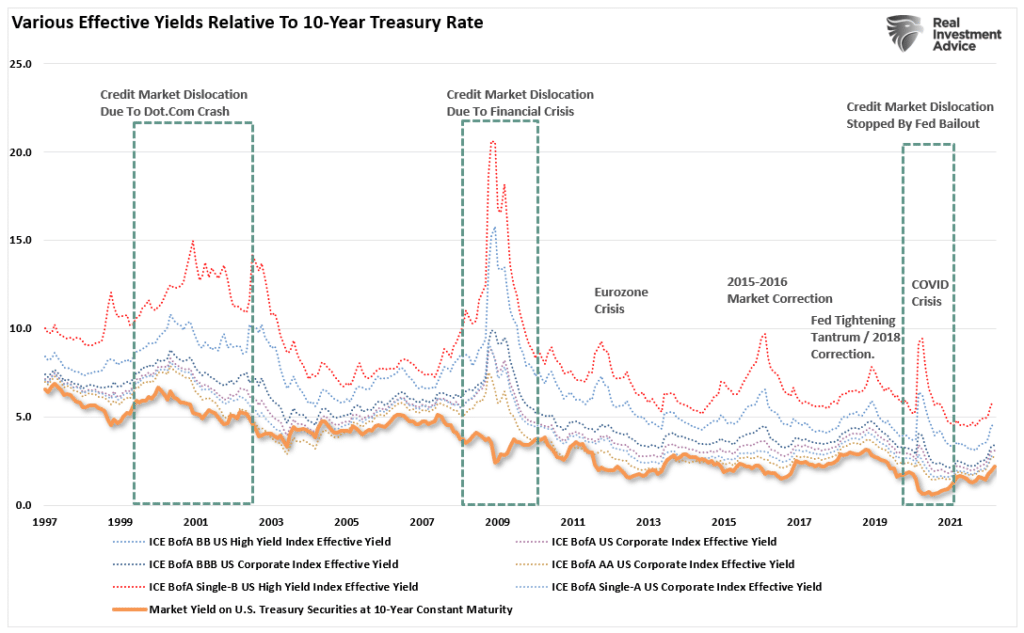
Once again, it is pretty likely investors should not overlook the message from the bond market. Bonds are essential for their predictive qualities, so analysts pay enormous attention to U.S. government bonds, specifically to the difference in their interest rates.
This data has a high historical correlation to where the economy, stock, and bond markets generally head longer term. Such is because everything from volatile oil prices, trade tensions, political uncertainty, the dollar’s strength, credit risk, earnings strength, etc., reflects in the bond market and, ultimately, the yield curve.
Yield Curve Inversions
When it comes to yield curve inversions, the media always assumes this time is different because a recession didn’t occur immediately upon the inversion. There are two problems with this way of thinking.
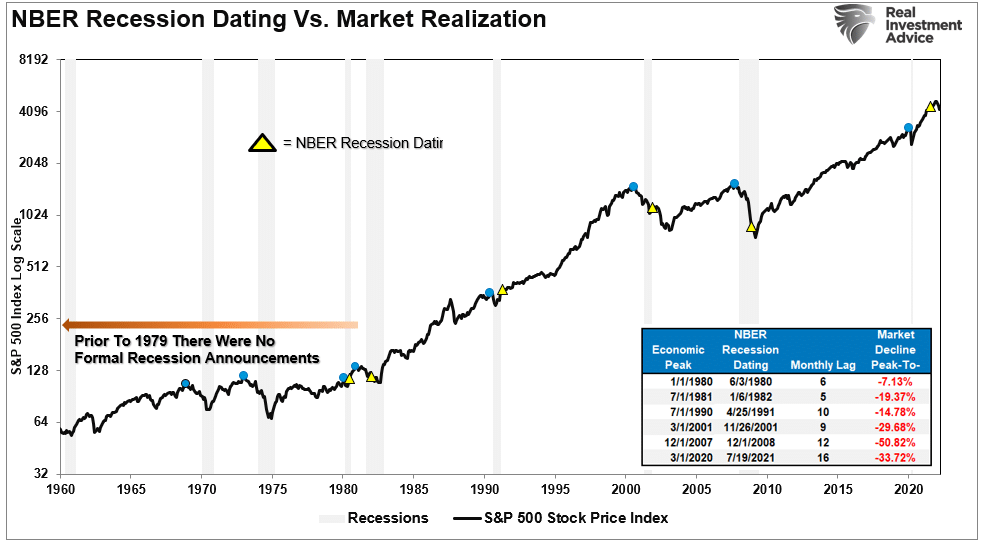
- The National Bureau Of Economic Research (NBER) is the official recession dating arbiter. They wait for data revisionsby the Bureau of Economic Analysis (BEA) before announcing a recession’s official start. Therefore, the NBER is always 6-12 months late dating the recession.
- It is not the inversion of the yield curve that denotes the recession. The inversion is the “warning sign,” whereas the un-inversion marks the start of the recession, which the NBER will recognize later.
As discussed in “BTFD Or STFR,” if you wait on the official announcement by the NBER to confirm a recession, it will be too late. To wit:
“Each of those dots is the peak of the market PRIOR to the onset of a recession. In 9 of 10 instances, the S&P 500 peaked and turned lower prior to the recognition of a recession.“
Most of the yield spreads we monitor, shown below, have yet to invert. However, the best signals of a recessionary onset occur when a bulk of the yield spreads turn negative simultaneously. However, even then, it was several months before the economy slipped into recession.
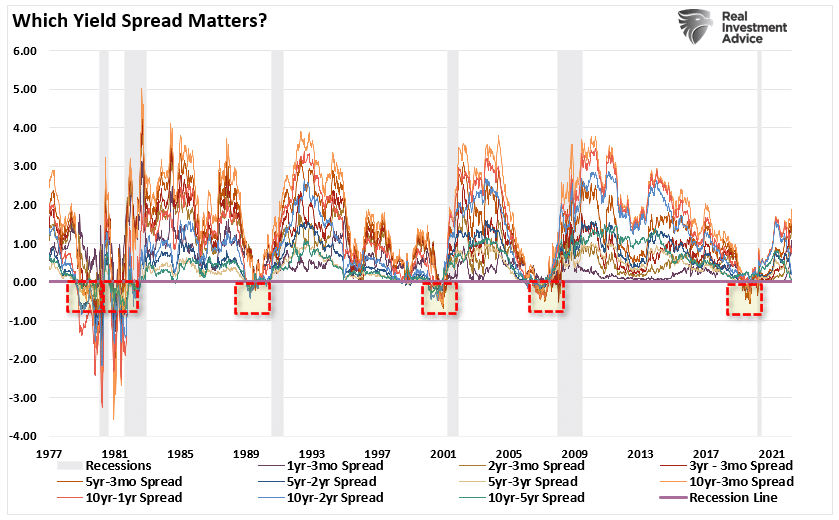
When numerous yield spreads turn negative, the media will discount the risk of a recession and suggest the yield curve is wrong this time. However, the bond market is already discounting weaker economic growth, earnings risk, elevated valuations, and a reversal of monetary support.
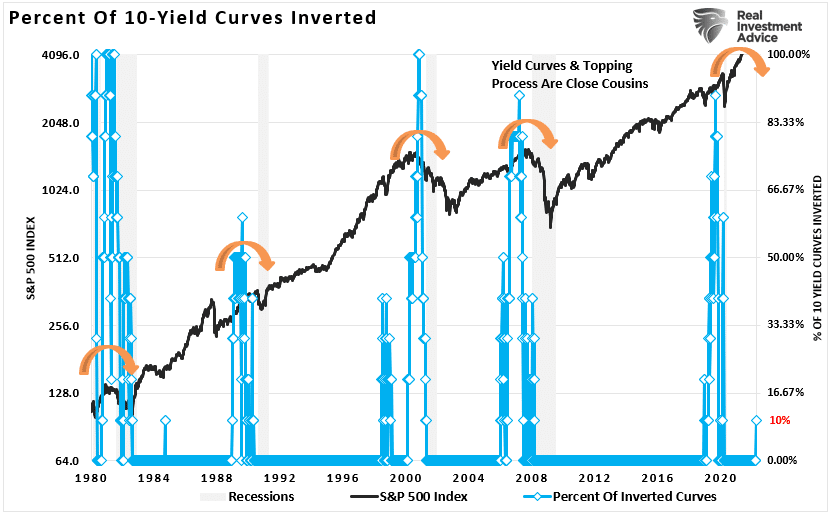
Historically, a recession followed when 50% or more of the tracked yield curves inverted. Every time. (Read this for a complete history.)
Ignore At Your Own Risk
In the World War II real-time strategy (RTS) game Company of Heroes, the engineer squad would sometimes say:
“Join the army they said. It’ll be fun they said.”
Since then, the statement has become a common meme on the internet to espouse the disappointment from various actions, from doing the laundry to getting a job.
Well, the latest suggested action, which will ultimately lead to investor disappointment, is:
“Ignore the yield curve they said. It’ll be fun they said.”
In March 2019, Mark Kolanovic of J.P. Morgan stated:
“Historically, equity markets tended to produce some of the strongest returns in the months and quarters following an inversion. Only after [around] 30 months does the S&P 500 return drop below average,”

12-months later, the market was down 35%, and the economy was in the deepest recession since the “Great Depression.”
The yield curve is sending a message that investors should not ignore. Furthermore, it is a good bet that “risk-based” investors will likely act sooner than later. Of course, the contraction in liquidity causes the decline, which will eventually exacerbate the economic contraction.
Despite commentary to the contrary, the yield curve is a “leading indicator” of what is happening in the economy currently, as opposed to economic data, which is “lagging” and subject to massive revisions.
More importantly, while the consumer may be continuing to support growth currently, such can, and will, change dramatically when job losses begin to occur. Consumers are fickle beasts, and it will happen very rapidly when a change in psychology occurs.
While using the “yield curve” as a “market timing” tool is unwise, it is just as foolish to dismiss the message it is currently sending entirely.
History has not been kind to those that do.
Russia's Most Downloaded Apps in March
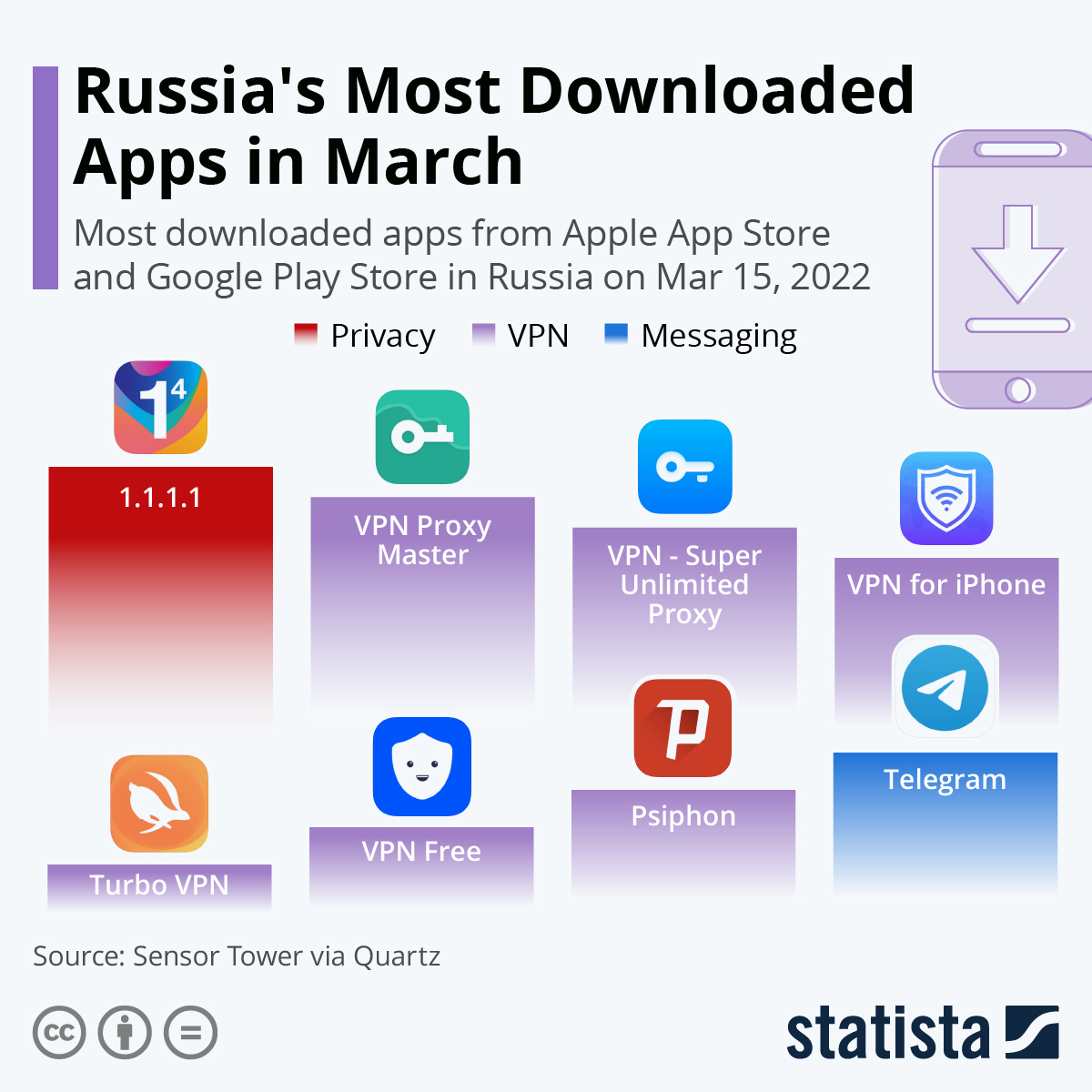
In early February, the most downloaded app from the App Store in Russia was 'Persona', a makeup filter app, followed by video conferencing provider Zoom and the online retailer AliExpress (according to a review of app data sources by The Economist). Since the invasion of Ukraine and the ensuing sanctions, pull outs and censorship, people in the country have been far more focused on finding a VPN or internet privacy app, as shown by this infographic based on analysis by Sensor Tower and Quartz.
On March 15, the internet privacy app 1.1.1.1. was the most downloaded app in Russia when taking into account the numbers from Apple's App Store and Google's Play Store. The top 8 list is dominated by VPN providers, with the encrypted messaging service Telegram making an appearance, too. Looking for solutions to problems of a far more serious nature, Quartz reports that the most downloaded app in Ukraine on this day was 'Air Alarm', which as described by the developer "generates a loud alert warning of an airstrike, chemical attack, technological catastrophe or other types of civil defence alerts."

DESCRIPTION
This chart shows the most downloaded apps from Apple App Store and Google Play Store in Russia on Mar 15, 2022.
The Frozen Russian Superyachts (And Those That Got Away)
Reports about the superyachts of sanctioned Russian billionaires being frozen or detained came a dime a dozen in the aftermath of the invasion of Ukraine by the country at the end of February. But are these floating displays of obscene wealth now closely watched over in European harbors and marinas big or little fish when considering the most valuable superyachts owned by Russian billionaires?

The answer to this question is: they kind of are.
As Statista's Katharina Buchholz details below, among the megalomaniac yachts detained in Europe are some of the biggest known to be owned by now sanctioned Russians. This is according to information by the Russian Asset Tracker and several media reports by Forbes and others.
The Crescent, currently being held in Tarragona on the Spanish Mediterranean coast, is linked to sanctioned Rosneft CEO Igor Sechin. At an approximate value of $600 million and a length of 443 feet, it is one of the largest yachts in the world and is said to feature a large glass-bottom pool, a helicopter hangar and a two-story glass atrium.
Another enormous vessel - nabbed by authorities while undergoing repairs in Hamburg, Germany – is the Dilbar, owned by Metalloinvest’s Alisher Usmanov. It is the world’s largest yacht measured by interior volume and has a staggering length of 511 feet. The yacht is believed to have been even more expensive upon delivery in 2016 than the Crescent, which was finished in 2019. Finally, the world’s largest sailing yacht, three-master SY A, was detained in Trieste, Italy. It is owned by Andrey Melnichenko of EuroChem and coal company SUEK.
But several more of the biggest boats owned by sanctioned Russian oligarchs are currently out of reach of Western authorities.

You will find more infographics at Statista
These vessels have been sighted in the Maldives, Dubai or Turkey - all countries that haven't imposed sanctions on Russian individuals and have no extradition agreements with the West. The latter nation is currently hosting two boats of yacht afficionado and soon-to-be former Chelsea F.C. owner Roman Abramovich.
Compared to the value of these massive boats, some other superyachts that European countries detained seem rather modest despite their luxurious furnishings. The only ones valued at more than 100 million dollars were Sergei Chemezov’s Valerie, which was frozen by Spanish authorities, and another one of Igor Sechin’s yachts, Amore Vero, which was detained in France. Only the price at the time of delivery was available for the two boats, meaning the current value of the boats built in 2013 and 2011, respectively, would be lower now.
Other highly publicized detainments of superyachts included Alexey Mordaschov’s Lady M and Gennady Timchenko’s Lena, both held up in Italy. The vessels are valued at comparably low $27 million and $8 million, considering loss of value after delivery. The only other yacht of a value of more than $50 million belonging to a sanctioned Russian billionaire was detained in the islands of Mallorca – Victor Vekselberg’s Tango. The latest catch was a $38 million superyacht belonging to an unnamed Russian businessman, which was frozen by British authorities in London’s Canary Wharf in connection with sanctions, The Guardian reported Tuesday.
Tobacco Stocks Are Cheap. But the Selloff in Imperial Brands Was Overdone.
Tobacco stocks are cheap, and Imperial Brands is just about the cheapest.
The British cigarette maker (ticker: IMB.UK) trades around 6.8 times projected 2022 earnings, significantly lower than the sector average of 11.4 times. There are quite a few reasons that the sector is so cheap, including regulatory concerns, falling cigarette sales, and the difficulties faced by cigarette makers in meeting environment, social, and corporate governance, or ESG, investing criteria.
But investors may be neglecting the positives and allowing a potential buying opportunity to go up in smoke.
For starters, tobacco stocks can be a good hedge against inflation, as higher prices typically don’t hurt demand. Plus, a lot of the bad news is priced in, hence the valuations.
That’s where Imperial Brands comes in. The stock fell 15% in the first 10 days of Russia’s invasion of Ukraine, having hit two-year highs earlier in February. Russia is the fourth largest cigarette market in the world by volume, so a reaction was understandable.
But it was overdone, and since the owner of brands including Davidoff and Winston announced a full exit from Russia, the stock has bounced back—although it’s still 10% off its recent high. The company said Russia and Ukraine represented just 0.5% of adjusted operating profit in 2021. With the Russia risk alleviated for now, it’s a big year for the company. In 2022, it will complete the first phase of CEO Stefan Bomhard’s five-year turnaround plan—investing in key markets and next generation products, or NGPs.
Tobacco companies have been pushing into cigarette alternatives, including heated tobacco and e-cigarettes. In November, when the company’s full-year earnings were released, Bomhard said that the focus would be on “the acceleration of returns and sustainable growth in shareholder value.” The company reported earnings per share of 246.5 pence ($3.24) in 2021, and analysts covering the stock estimate it could reach 283.9 pence by 2024, according to FactSet data.
The company’s trading update on April 6, and first-half results set to be released in May, could be near-term catalysts for a stock boost. J.P. Morgan analysts said they expect a positive update, particularly after the company said on March 25 that it was gaining traction in the U.S. market.
A possible share buyback announcement also is on the horizon. The company has a target leverage toward the lower end of a two-to-2.5 times net debt to earnings before interest, taxes, depreciation, and amortization, or Ebitda, range, before initiating potential share buybacks. At the end of September 2021, it stood at 2.2 times.
“While it is still early in his tenure as CEO, we believe Bomhard’s solid first year at the helm should reassure investors, with a valuation multiple expansion likely throughout the year as confidence builds ahead of a likely share buyback announcement in November,” said J.P. Morgan analysts.
The analysts forecast a double-digit earnings-per-share compound annual growth rate in the medium term, versus mid- to high-single digit rates for its peers. The analysts cite more-targeted NGP investment, tobacco margin expansion, and the boost from buybacks.
J.P. Morgan has a price target of 21 pounds sterling ($27.62) on the stock, implying a 29% upside to Tuesday’s price.
“In the case of tobacco, we are unequivocally of the view that share buybacks will be a good thing for shareholders,” said RBC Capital Markets analyst James Edwardes Jones, adding that it was “essential to unlocking” Imperial Brands’ undervaluation. He has a Buy rating and £20 price target.
Imperial Brands’ stock is at a stalemate. But the smoke may be about to clear.
A Russian Default Would Stack Risks Onto a Stressed World
The global economy is facing a combination of challenges seldom seen before, and Russia’s war against Ukraine piles a host of new risks onto the pre-existing ones created or exacerbated by a once-in-a-century pandemic. Rising global inflation and an uneven economic recovery from the 2020 crash that widened the gap between rich and poor nations figure prominently in the long list of risks that mark 2022.
The war is already stoking global inflation. Its immediate economic impacts were forcefully felt in commodity markets in a supply shock reminiscent of the 1970s oil shocks—except this time it also involves spiking food prices. We know that the pandemic has seriously impaired global supply chains and led to soaring transport costs. Government and central bank intervention supported aggregate demand but did little to repair aggregate supply. This imbalance added to costs and set the stage for the return of global inflation. Disruptions from the war have further damaged trade links and stalled the agricultural production of two key global providers. This will fall hardest on developing countries and the poor, who will see much higher prices for food and other basic goods. However, the war’s adverse effects on advanced economies in Europe should not be underestimated, either.
Added to this pre-existing problem is a new one—the potential fallout in financial markets from a likely default by Russia at some point. Here, the more recent past does not necessarily provide a good road map, as the collapse of Lehman Brothers and the implosion of the housing market in 2008 were very much about advanced economies. This time, many emerging markets and developing countries are likely to be the most affected. Often, those impacts are underestimated because they occur in countries that are off the radar screen and not deemed as systematically important. They are the antithesis to too big to fail.
As for the first challenge, prior to the war, inflation was already proving to be much higher, more persistent, and broader-based than major central banks initially thought possible. In more than half of advanced economies, 12-month inflation through February 2022 was running above 5%. Over 70% of emerging markets and developing economies saw inflation at that level or above, more than double the share prior to the Covid-19 outbreak.
Food inflation is running particularly hot. The risks of a re-emergence of food crises in many parts of the globe and attendant social unrest loom large and should not be underestimated. About 80% of emerging market economies saw food price inflation over 5% in the year leading up to the war. Furthermore, the impacts of the war are likely to be persistent, as the ongoing conflict will continue to interrupt cycles of planting, production, and transport of food, making a bad situation worse. Inflation is a very regressive tax, and food inflation even more so. In lower-income countries, as in poorer households within countries, food and energy spending accounts for a much larger share of expenditure, and higher prices eat up a much larger share of their income. In many developing countries, government finances are poised to deteriorate as the pressure for higher food and fuel subsidies intensifies.
On the second challenge, the possibility that Russia will default on its sovereign external debt due to sanctions, the risks may be clustered on what we don’t see and can’t quantify. While markets are focused on the sovereign, Russian corporates also face the prospect of default. So far, financial spillovers have been limited, but it is premature to declare victory on that front. According to the Bank for International Settlements, European banks have limited exposure to Russia, but the extent of nonbank exposure is far more difficult to ascertain. Nonbank interlinkages are often revealed only at the time of default. The market volatility that ensued from the Russian default in the summer of 1998 took down the U.S. hedge fund Long-Term Capital Management and prompted the Federal Reserve to intervene to calm international capital markets.
The financial consequences of a Russian default may also fall disproportionately on emerging markets and developing countries, where economic recovery from the pandemic has been mostly disappointing. Many have simply not recovered yet. Developing countries were already finding it harder and harder to pay their debts. Almost 60% of the world’s poorest countries eligible for the Debt Service Suspension Initiative that ended last year are either in, or at high risk for, debt distress. More risk-averse investors and rising international interest rates will make it more costly to attract new financing and service existing debt. According to the World Bank’s International Debt Statistics, total external debt servicing relative to exports roughly doubled from 2010 to 2020. And this was during a period of exceptionally low international interest rates.
A developing-country crisis is not inevitable, but the risks are stacked. It is never a good time for war, but this one comes at a time with some glaring fault lines in the global economy.