FT : French music streaming group Deezer to go public via Spac deal

French music streaming group Deezer to go public via Spac deal
Merger with blank-cheque company values Spotify rival at €1.05bn

French music streaming company Deezer is planning to go public by merging with a Spac backed by billionaire Francois Pinault’s investment group and investment banker Matthieu Pigasse.

The deal values the streaming service at €1.05bn and comes as music companies including Spotify and Universal have tried to capitalise upon the streaming music boom with public offerings in recent years.

Deezer is merging with I2PO, a Paris-listed special purpose acquisition company sponsored by several prominent figures in French banking and media.

France’s billionaire Pinault family backed the blank-cheque company through its Artemis investment arm, alongside Iris Knobloch, a director at Lazard and former president of WarnerMedia in France and Germany, and Pigasse, head of Centerview Partners in France.

François-Henri Pinault, the son of French billionaire Francois Pinault and founder of luxury group Kering, represents the family on the board. Punk rock aficionado and co-owner of the Le Monde newspaper, Pigasse was head of Lazard France before he joined Centerview in 2020.

The Spac deal has raised €135mn in the form of Pipe financing and a non-redemption agreement, where investors agree to not withdraw their funds from the deal, from Deezer’s existing investors including Universal Music Group, Warner Music and Orange.

Investor appetite for Spac deals has significantly dried up in recent months and blank-cheque teams have been forced to sweeten the terms on offer to investors in order to minimise the amount of withdrawals. Investors in blank-cheque vehicles who dislike the merger target can pull their funds and soaring withdrawals have led to the collapse of several deals.

With 9.6mn paying subscribers compared to Spotify’s 180mn, Deezer is a small player in the music streaming market, where it competes with some of the largest technology companies in the world. Deezer last year made up about 2 per cent of global music streaming subscribers, compared to Spotify’s 31 per cent, Apple’s 15 per cent and Amazon’s 13 per cent, according to research group Midia.

Deezer in 2015 attempted to go public via an IPO, but ultimately scrapped the plans.

In 2015, streaming earned $2.8bn in revenue for the global recorded music industry, but that surged to $16.9bn last year, according to the IFPI, a trade group. Total recorded music revenue last year grew to $25.9bn, an 18 per cent increase from 2020.

Some of the world’s last music companies — including industry leader Universal Music — have also gone public in recent years as they look to cash in on the jump in revenue.

Billionaire Len Blavatnik, who has already been handsomely rewarded by betting on the music industry revival, is also set to benefit from the listing of Deezer, which he majority owns through his holding company, Access Industries. Blavatnik in 2011 bought Warner for $3.3bn, and the company now trades publicly at a valuation of $17.9bn. 

>>> US Close Dow -0.11% S&P -0.02% Nasdaq -0.14% Russell -0.74%

Closing Stock Market Summary

The S&P 500 (unch) closed little changed on Monday in a session that lacked conviction. The Nasdaq Composite (-0.1%) and Dow Jones Industrial Average (-0.1%) both declined 0.1% while the small-cap Russell 2000 fell 0.7%. 

Buying interest was restrained by the upwards pressure in interest rates and oil prices ($108.18, +1.24, +1.2%), technical resistance near the underside of the S&P 500's 50-day moving average (4417), and lingering growth concerns attributed to the Fed, China's COVID restrictions, and the Ukraine-Russia situation. 

The defensive-oriented S&P 500 health care (-1.1%), consumer staples (-0.8%), utilities (-0.5%), and real estate (-0.3%) sectors were among today's laggards. Conversely, the energy sector (+1.5%) unsurprisingly outperformed given the higher oil prices. 

The financials (+0.6%) and information technology (+0.3%) sectors provided key support with the latter benefiting from dip-buying activity in the semiconductor stocks. The Philadelphia Semiconductor Index rose 1.9%. 

Separately, there might have been a wait-and-see mindset for the diversified batch of Q1 earnings reports this week. Today, the market heard from more banks. 

Bank of America (BAC 38.85, +1.28, +3.4%) stood out with a 3% gain after beating EPS estimates and providing encouraging commentary about a strong recovery in spending trends. Charles Schwab (SCHW 74.94, -7.81, -9.4%) dropped 9% on disappointing results while BNY Mellon (BK 46.21, -1.08, -2.3%) set a 52-week low after reporting in-line results. 

Shares of Twitter (TWTR 48.45, +3.37, +7.5%), meanwhile, jumped 7.5% as the company adopted a "poison pill" measure amid takeover pressure. 

In the Treasury market, the 2-yr yield increased two basis points to 2.47%, and the 10-yr yield increased three basis points to 2.86% after flirting with 2.88% overnight. The U.S. Dollar Index increased 0.5% to 100.80. 

Monday's economic data was limited to the NAHB Housing Market Index for April, which decreased two points to 77, as expected. Looking ahead, investors will receive Housing Starts and Building Permits for March on Tuesday.

  • Dow Jones Industrial Average -5.3% YTD
  • S&P 500 -7.9% YTD
  • Russell 2000 -11.4% YTD
  • Nasdaq Composite -14.8% YTD

(ZH) If The Fed Is Fighting Inflation Why Is The Balance-Sheet Still Expanding?

If The Fed Is Fighting Inflation Why Is The Balance-Sheet Still Expanding?

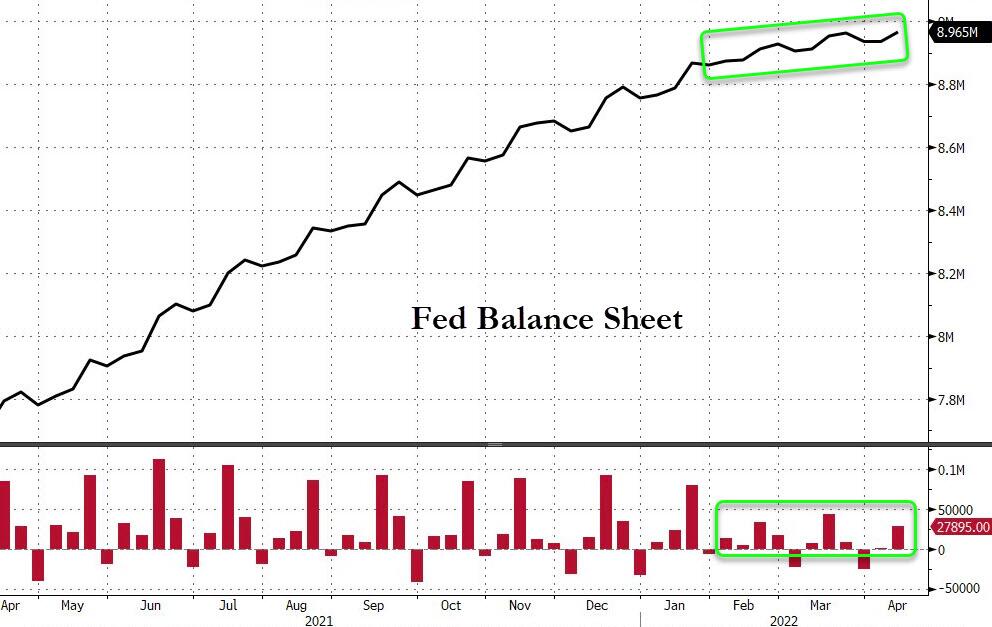
If the Fed is fighting inflation and has ended quantitative easing, why is its balance sheet still going up?
In the week ending April 13, the balance sheet grew by $27.9 billion, hitting a new record of $8.965 trillion. This is up about $3 billion from its previous high in March.
As Peter Schiff put it in a tweet, “For all the talk of fighting inflation and shirking its balance sheet, the Fed continues creating more inflation and expanding its balance sheet!”
At the end of March, it looked as if the Fed had ended QE. The balance sheet fell between March 21 and March 28 but then increased slightly the following week prior to the nearly $28 billion increase last week.
Looking at the graph, QE has clearly slowed down, but balance sheet expansion hasn’t stopped. Despite the taper having supposedly ended at the beginning of March, the Fed still appears to be running quantitative easing. In effect, the central bank continues to print money out of thin air to buy bonds. This is the exact opposite of fighting inflation.
We shouldn’t be seeing a growing balance sheet in the midst of historically high inflation.
Even if balance sheet expansion has slowed to a trickle, it continues to expand. Given the inflation problem and all the talk about fighting rising prices, you would expect the Fed to be shrinking its balance sheet. It certainly would be if it was serious about an inflation fight.
That raises a question: given the surging CPI, why wait to begin running off the balance sheet?
This is the worst war on inflation ever.
To put that in perspective, the balance sheet stood at $4.16 trillion in February 2020, as the coronavirus pandemic started to unfold. That was up from a low of $3.76 trillion in September 2019, when the Fed gave up on tightening because the stock market tanked and the economy was getting wobbly.
That means most of the Treasuries the Fed bought in the first rounds of QE after the 2008 financial crisis remain on the balance sheet today — plus trillions more.
And we’re supposed to think the Fed is going to successfully shrink its balance sheet this time around?
It seems unlikely. Heck, it can’t even seem to finish the taper.
Here’s the reality; while the Fed is talking about fighting the inflation fire, it is still pouring gas on the inflation fire. An expanding balance sheet means the Fed is still engaged in expansionary monetary policy. So far, the inflation fight is a lot of talk and not much action.

(ZH) Gold Tops $2000 As Crypto-Correlation Crashes

Gold Tops $2000 As Crypto-Correlation Crashes

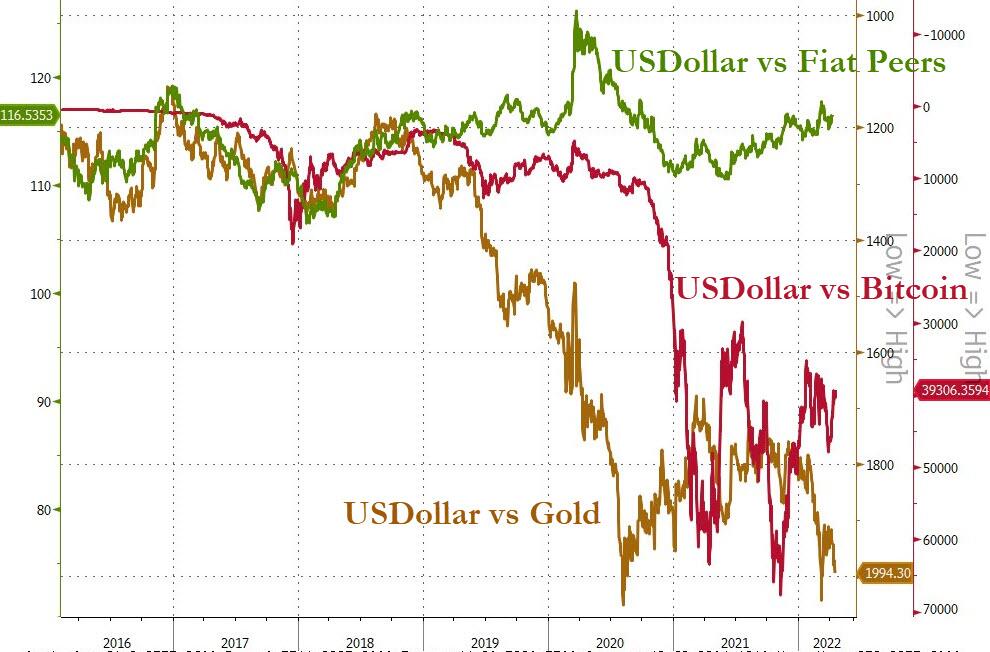
Since the beginning of the year, gold has surge over 9%, topping $2000 again this morning amid geopolitical crises and global stagflation fears...
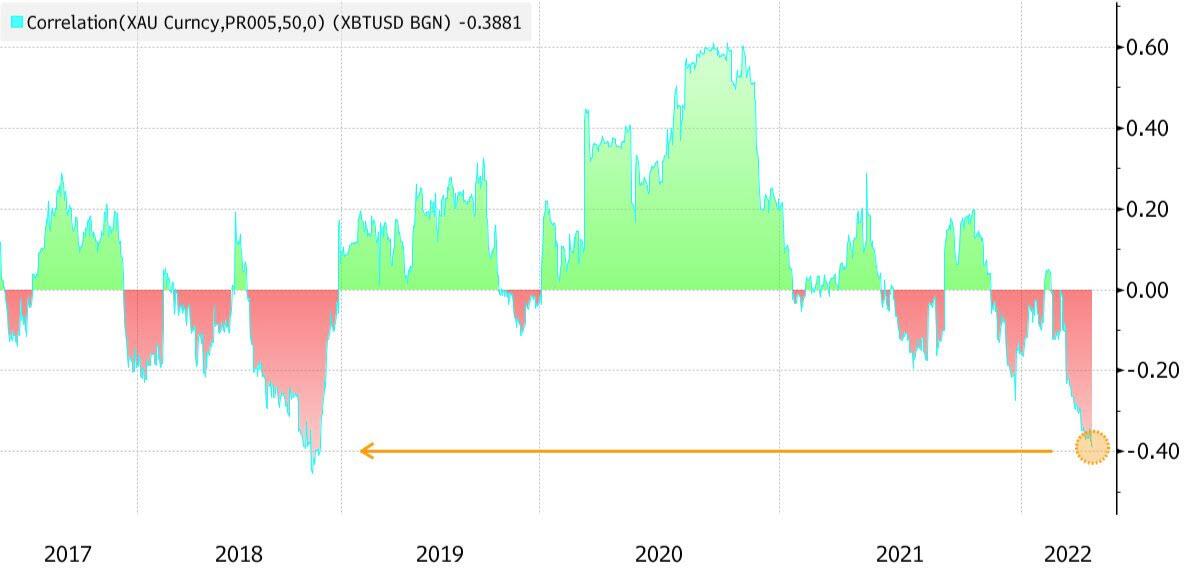
At the same time, cryptocurrencies have suffered with Bitcoin down around 15% (back below $40,000 this morning), with the most aggressive shift from 'digital gold' to 'real gold' occurring since Putin invaded Ukraine...
Source: Bloomberg
The barbarous relic's besting of bitcoin has may questioning the latter's 'inflation-hedge' status:
“It could well be that as Bitcoin is tested in a high inflation, rising rate environment for the first time, investors are choosing tradition over a new frontier,” said Jeffrey Halley, senior market analyst at Oanda Asia-Pacific Pte.
“Gold has been an inflation hedge for millennia.”
In fact, the 50-day correlation between 'new' and 'old' gold is at its lowest since 2018 while the correlation between bitcoin and Nasdaq stocks has soared as 'risk' assets in general have suffered amid rising rates and increasingly hawkish central banks.
Of course, the last few years of massive global money printing has seen cryptos dramatically outperform every other asset class.
MicroStrategy founder Michael Saylor said in a recent Bloomberg Television interview that he can’t think of “anything better to position our company in an inflationary environment than to convert our balance sheet to Bitcoin.”
Nevertheless, while the short-term correlation between gold and crypto is significantly negative, over the medium-term they both are shouting the same message of dedollarization and a loss of faith in the global hegemon...
And maybe, just maybe, the soaring price of oil is also reflective to some degree of a weaker perspective on the dollar.

(ZH) Stagflation Fears Soar As World Bank Slashes Global Growth Outlook

Stagflation Fears Soar As World Bank Slashes Global Growth Outlook

The World Bank just slashes its forecast for global economic expansion this year, blaming Russia’s invasion of Ukraine for their outlook shift.
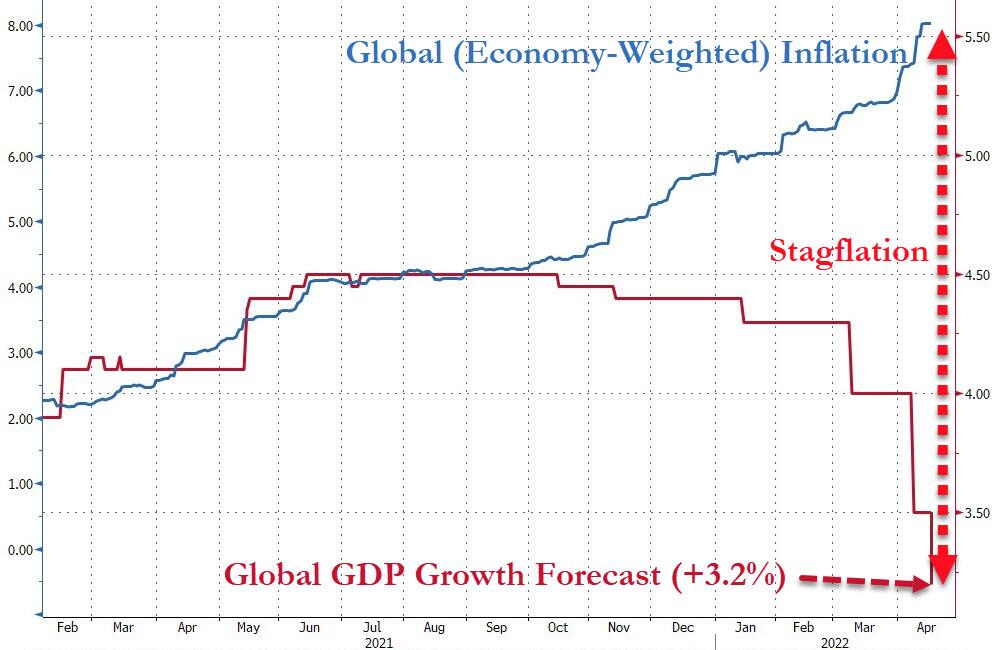
The Washington-based institution cut its estimate for global growth in 2022 to 3.2% from a January prediction of 4.1% (which compares with 5.7% expansion in 2021).
President David Malpass told reporters on a call on Monday that the decline was spurred by a cut in the outlook for Europe and central Asia, which include Russia and Ukraine.
With inflation continuing to soar and The Fed only tip-toeing into its rate-hikes and QT, stagflation anxiety globally is exploding...
Source: Bloomberg
The cut in growth has prompted calls for ever more money to be pumped into various economies (which will of course do nothing to tame inflation). As Bloomberg reports, Malpass expects to discuss a new 15-month crisis-response package of about $170 billion to cover April 2022 through June of next year with the bank’s board in coming weeks, with about $50 billion of this amount to be deployed in the next three months.
“This is a continued, massive crisis response given the continuation of the crisis,” he said, adding that the new initiative will exceed the $157 billion mobilized for the initial phase of the Covid-19 pandemic.
Malpass’s comments and plans come ahead of the International Monetary Fund and World Bank spring meetings taking place this week in Washington, where food security, inflation, debt and the shock of Russia’s invasion of Ukraine are set to feature.
For now, all of the 'solutions' to growth problems appear to only make the food security problems worse, but since when have the repeated lessons of the past ever stopped a good spend-fest

WSJ : What Elon Musk Would Do With Twitter

What Elon Musk Would Do With Twitter
The Tesla CEO has said his vision is a private social-media company with less content moderation and an edit button

Elon Musk wants to make substantial changes to Twitter Inc. TWTR +4.06%

During the past two weeks, he has indicated through regulatory filings, tweets and a recent interview at a TED conference how he thinks about the company and what he would do if he were to successfully acquire the social-media site used by more than 200 million people world-wide.

The Tesla Inc. chief executive offered to buy Twitter with a $43 billion bid last week. In response, the company adopted a so-called poison pill, which makes it difficult for Mr. Musk to increase his stake in the company beyond 15%.

The board has yet to formally respond to the details of the proposal. In the meantime, here is a list of what Mr. Musk has said he would like to do with the platform.

Soften its stance on content moderation.
Mr. Musk, a self-described “free speech absolutist,” said in an interview during a TED conference last week that Twitter is the “de facto town square,” and that “it’s very important for there to be an inclusive arena for free speech.”

He said Twitter should be more cautious when deciding whether to take down tweets or permanently ban users. Timeouts are better, he added.

The platform should also follow the laws of the countries it provides services in, Mr. Musk said. And when Twitter does make changes to amplify or reduce a tweet’s reach, it should give users insight into what happened, he said.

Mr. Musk also said that he doesn’t have all the answers. Twitter, meanwhile, has spent years trying to promote what it calls healthier discourse on the platform, adding content moderation in part under the argument that it is good for business.

Create an edit feature for tweets.
An edit button has long been requested by Twitter users. Earlier this month, Mr. Musk polled Twitter users on whether they wanted one. More than four million accounts voted, and more than 70% said yes. Twitter later said it had already been working on an edit button since last year.

Mr. Musk reiterated his support for an edit button in the TED interview, and mused about ways the platform might implement the feature.

Take the public company private.
Mr. Musk said in a regulatory filing he wants to take Twitter private.

“Twitter needs to be transformed as a private company,” he said. “Twitter has extraordinary potential. I will unlock it.”

Taking Twitter off the public stock exchange would likely make it easier for Mr. Musk to implement his desired changes to the company, since much of the shareholder pressure would dissolve. However, Mr. Musk also said in the TED interview that he would want to retain as many shareholders as possible if he succeeds in taking the company private.

Make Twitter’s algorithm open source and put the code on GitHub.
In the TED interview, Mr. Musk suggested making Twitter’s algorithm open source, meaning others outside the company would be able to view and recommend fixes and changes. One way to do that, he said, is to put the code on GitHub, a site that is used for storing software projects.

Take the public company private.
Mr. Musk said in a regulatory filing he wants to take Twitter private.

“Twitter needs to be transformed as a private company,” he said. “Twitter has extraordinary potential. I will unlock it.”

Taking Twitter off the public stock exchange would likely make it easier for Mr. Musk to implement his desired changes to the company, since much of the shareholder pressure would dissolve. However, Mr. Musk also said in the TED interview that he would want to retain as many shareholders as possible if he succeeds in taking the company private.

Make Twitter’s algorithm open source and put the code on GitHub.
In the TED interview, Mr. Musk suggested making Twitter’s algorithm open source, meaning others outside the company would be able to view and recommend fixes and changes. One way to do that, he said, is to put the code on GitHub, a site that is used for storing software projects.

Allow for longer tweets.
In a tweet last week, Mr. Musk advocated what he called long-form tweets.

On Friday, he responded to a lengthy Twitter thread from Yishan Wong, a former chief executive of social-media company Reddit Inc., who offered his take on the Twitter takeover situation. Mr. Musk didn’t respond to Mr. Wong’s thoughts, he responded to the form they took.

“My most immediate takeaway from this novella of a thread is that Twitter is *way* overdue for long form tweets!” he said, without offering any more explanation.

In most cases, tweets can contain up to 280 characters, double the previous limit of 140.

Twitter declined to comment. Mr. Musk didn’t respond to a request for comment.

FT : UK households cancel streaming subscriptions in record numbers

UK households cancel streaming subscriptions in record numbers
About 1.5mn accounts terminated within three months as inflation squeezes finances

British households have cancelled video subscriptions in record numbers as they curb non-essential spending to cope with the cost of living squeeze, reinforcing concerns that a pandemic-fuelled boom in streaming is over.

Consumers walked away from about 1.5mn video on-demand accounts such as Disney Plus, Apple TV Plus and Now during the first three months of the year, according to figures from analytics group Kantar.

While 58 per cent of households retain at least one streaming service, a decline of only 1.3 per cent from the end of 2021, the terminations suggest that viewers have become more discerning about subscribing to multiple platforms.

A desire to save money was the most important reason for the cancellations and young adults have become particularly wary of paying for television on top of the £159 annual licence fee, the researchers found.

The findings were “sobering” for streaming providers, said Dominic Sunnebo, global insight director at Kantar. He said streaming services had to prove their worth to consumers “in what has become a heavily competitive market”.

Households are looking for ways to trim budgets to cope with rising bills. Surging energy, clothing and food prices pushed inflation to a 30-year high in March, data from the Office for National Statistics showed last week.

Media investors have become increasingly concerned that the rapid worldwide growth of video streaming — encouraged by demand for home entertainment during the pandemic — has peaked.

Shares in Netflix, which is due to release first-quarter earnings on Tuesday, have dropped 43 per cent so far this year as global subscriber numbers have disappointed.

Consumers are re-evaluating subscriptions in response to higher charges. Several providers have raised prices in markets including the UK, in part to compensate for rising costs of labour and facilities that have made TV and film production more expensive.

Among them is Netflix, which recently implemented its second round of UK price increases within 18 months, raising standard monthly subscriptions from £10 to £11.

At the same time, options for British viewers have continued to widen. Recently introduced offerings include Peacock from Sky, which features content from NBCUniversal. Viaplay, the Scandinavian streamer, is planning to launch in the UK this year.

Many consumers are still signing up for streaming services. Kantar’s research, which was based on interviews with 14,500 people, found that about 3 per cent of British households took out a subscription during the first quarter.

However, this was a marked slowdown from the 4.2 per cent that did so in the same period a year ago.

Cancellations, meanwhile, accelerated, from 1.2mn a year ago and from 1.04mn during the final three months of 2021.

After budgetary concerns, the most frequently cited reasons given by those who terminated their subscriptions were that they did not use them often enough and that the platforms lacked new shows they wanted to watch.

The net effect was for the number of households with at least one paid subscription to decline by 215,000 compared with the previous quarter, to 16.9mn.

Britbox, Apple TV Plus and Discovery Plus had the highest churn rate — meaning they lost the most users on a gross basis.

Disney Plus had the biggest increase in its churn rate, Kantar said. Its quarterly churn tripled from the previous quarter to 12 per cent.

Netflix and Amazon’s Prime Video had the lowest churn rates in the quarter. Kantar said this was a sign they were “the last to go when households are forced to prioritise”.

FT Lex : Twitter: Musk should focus on knockout bid, not fighting poison pill

Twitter: Musk should focus on knockout bid, not fighting poison pill
A knockout bid is the best vindication of the rights of minorities

Elon Musk was already an advocate of free speech. Now he is an unlikely champion of shareholder democracy too. Twitter, which he wants to buy for about $43bn, just adopted a defensive “poison pill”. The Tesla boss responded by tweeting cryptic disdain for the gambit.

Poison pills are open to litigation. But Musk should focus on wooing Twitter shareholders financially, rather than fighting its management.

If triggered, the poison pill would destroy the value of Musk’s stake and dilute his votes. Twitter would give other investors the right to buy a flood of new shares cheaply when he, or anyone else, exceeded a 15 per cent ownership threshold.

Twitter has put shareholder rights plans, as poison pills are formally known, back in the headlines. After poison pills were developed in the 1980s, hundreds of large companies deployed them with 10-year lifespans to keep would-be acquirers at bay.

Big shareholders and investment advisers complained they were too effective in deterring activist investors and unsolicited bidders, which depressed share prices. Today, less than 2 per cent of companies in the S&P 1500 have a shareholder rights plan, according to data service Deal Point Data.

Critics of poison pills have regularly contested their validity in US courts. The mechanisms may conflict with the fiduciary duties of directors. Case law still gives boards wide latitude to use their judgment to deal with threats.

Today, poison pills are generally only invoked in the face of an interloper and have short expiration dates. Twitter’s rights plan lasts for one year. In March 2020, many poison pills were created in a hurry by companies that feared hedge funds would exploit the market crash to build big positions.

Musk has railed at the possible disenfranchisement of shareholders mulling his unsolicited offer at $54.20 a share. The Twitter board wants a breathing space to consider his bid and any rival offers without the risk of anyone acquiring control — or a blocking stake — in the open market.

The Twitter poison pill should encourage Musk to negotiate with the board at a higher price, showing meanwhile that he has finance lined up. If directors are uncooperative, the entrepreneur can run a proxy contest seeking shareholder approval for his offer. A knockout bid is the best vindication of the rights of minorities, not wrangling over poison pills.

FT : Antibiotics: new incentives needed to fight superbugs

Antibiotics: new incentives needed to fight superbugs
Global co-operation is desperately needed to overcome threat from drug-resistant infections

The pharmaceutical industry rose to the challenge of Covid-19. But it has largely failed to address the threat posed by antibiotic resistance, which also kills millions. A pioneering subscription-style payment mechanism, announced by the UK last week, could provide new incentives for developers while curbing overuse.

Under the deal, the NHS in England will pay £10mn a year to Pfizer for its Zavicefta combination antibiotic. It will pay the same fixed fee to Japan’s Shionogi for Cefiderocol, an innovative antibiotic that — Trojan horse-style — uses the bacteria’s own iron uptake system to gain cell entry.

Such originality is rare. In 2020, drug companies were testing only 41 new antimicrobials compared with about 1,800 immuno-oncology drugs. Although antibiotics fuelled the growth of Big Pharma last century, the industry has retreated since. Many small innovators have collapsed.


Profiting from drugs used by the small number of patients with drug-resistant infections for a short time is difficult. The research, development and commercialisation costs of creating a novel antibiotic is more than $1bn. Cumulative revenues over 10 years are likely to be less than half that, according to consultants BCG. After taking account of factors like a 10-12 per cent investment hurdle rate and a contribution to the cost of failed drug candidates, it calculates the minimum incentive per antibiotic would need to be at least $2bn.


See the £10mn on offer from the UK in that light. By itself, the amount is hardly a game changer. Just maintaining Shionogi’s manufacturing plant for its antibiotic drug will require about $100mn in revenue a year. But if other G20 countries chipped amounts proportionate to their GDP, the figure adds up to £3bn over 10 years.


That supposes countries can agree on what constitutes a fair share, as well as the best incentive mechanism. While the subscription model has important merits, other options being discussed include one-off payments, minimum price guarantees and “transferable exclusivity vouchers”, which reward antibiotic developers with patent extensions on other medicines.

International co-operation is desperately needed to solve this market failure. There is little chance of overcoming antibiotic resistance unless Big Pharma can be induced to overcome its own resistance to antibiotic research.