(ZH) Currency Angst Signals Worse To Come For Investors

Currency Angst Signals Worse To Come For Investors

By Garfield Reynolds, Bloomberg Markets Live Commentator and reporter
Foreign-exchange traders are getting more nervous than at any time since the pandemic meltdown, underscoring concerns that the worst is yet to come for risk assets this year.
Developed-market currency volatility just surged past highs generated by the war in Ukraine and the Federal Reserve’s initial interest-rate hike for the cycle, while the Treasuries fear gauge has approached last month’s peak.
Anxiety in foreign-exchange markets has been led by the spike in yen implied volatility, as Japan’s currency suffers collateral damagefrom the yawning policy divergence between Federal Reserve Chair Jerome Powell and Bank of Japan Governor Haruhiko Kuroda.
Powell and Kuroda are offering radically different signals, but the zeitgeist seeping through from bond and currency markets is that recessions may be coming for numerous economies, just as the antidote of central bank stimulus that investors have come to rely on is off the menu.
Powell’s strident calls for rapid rate hikes reflect the extreme concern that the inflation genie is out of the bottle and has to be shoved back in at almost any cost. The Fed is striving to reassure investors that it can do that without damaging the economy too severely. Fixed-income markets, from eurodollars to Treasuries, beg to differ.
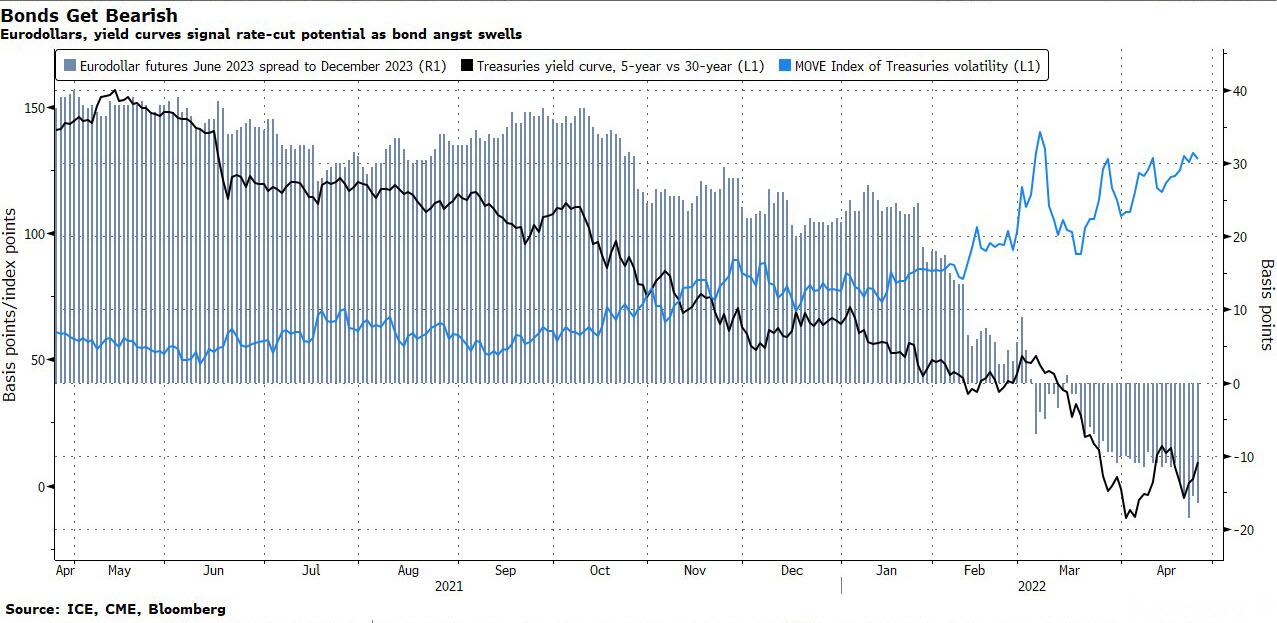
Kuroda meanwhile is sticking with extreme easing because the BOJ remains convinced that inflation is not about to become sustainably higher in Japan, despite a cratering currency and soaring prices for commodities the nation has to import.
The policy divergence is even starker when it comes to China, which has seen the yuan drop at a frantic pace and volatility surge as the PBOC tries to turn the economy around.
The concern for investors should be that currencies and bonds imply that inflation will prove far more resilient than GDP growth. Concerns are growing that the devastation delivered to the economies of Russia and Ukraine, and the further damage looming for China as omicron spurs lockdowns, will result in further supply shocks to drive commodity-fueled inflation higher still.
That underscores the likelihood that Treasuries curves will go on flattening along with eurodollar futures as recession risks intensify
The dollar is set to keep strengthening in good times and bad, as will the cost of options used to hedge against the sudden reversals that continue to hit Treasuries, currencies and commodities.
The one shoe that had failed to drop was stocks, though Tuesday’s turmoil signals it may now be doing so. Equity volatility is threatening to bust out of what had been relatively tight ranges -- gauges of implied vol for U.S. and Japanese indexes jumped to more than 1.5 points above their 50-day moving averages for the first time in more than a month.
Currencies and bonds look set to remain on edge, and if equities start to feel the same sort of sustained fear, then 2022 can get a lot worse for most investors.

FT : Grayscale targets European financial hub for crypto expansion

Grayscale targets European financial hub for crypto expansion
Fund manager has $36bn in assets tracking tokens such as bitcoin and ethereum

Grayscale Investments, the world’s biggest investment vehicle for cryptocurrencies, is scouring Europe’s top financial hubs to launch expansion beyond its North American base.

The fund manager, whose $36bn of assets are invested in funds tracking digital tokens such as bitcoin and ethereum, is holding a series of meetings with possible partners, according to Michael Sonnenshein, chief executive.

He told the Financial Times that the company was excited “by the potential to bring what we’ve learned from the US market to places like Europe”.

“We’re conducting some research, meeting with different organisations and different partners to determine what is going to be the best way for Grayscale to bring a lot of that accessibility, a lot of the insights we have to European investors.”

“We’re exploring a lot of European financial hubs, to really think about what is going to be the right approach for us and how best to bring Grayscale to Europe,” he told the FT’s Crypto and Digital Assets summit.

A move into Europe comes as the UK and EU step up their efforts to lay out a regulatory framework that will both protect investors and encourage them to explore the benefits of owning and trading digital assets.

FT : Elon Musk loses bid to escape SEC deal over tweet saying ‘funding secured’

Elon Musk loses bid to escape SEC deal over tweet saying ‘funding secured’ for Tesla
US judge says chief of carmaker cannot cast off agreement with regulator because ‘he wishes he had not’

A federal judge rejected Elon Musk’s request to quash a 2018 agreement with the Securities and Exchange Commission over his claim he had “funding secured” to take his electric vehicle maker Tesla private.

The regulator sued Musk after he allegedly engaged in fraud in August 2018 by telling his 22mn followers on Twitter that had secured financing to take Tesla private at $420 per share.

Musk ultimately settled, agreeing to pay a $20mn fine and step down as Tesla chair. The agreement also forced the billionaire to obtain preapproval for any written communications material to Tesla, including on Twitter, the social media platform that he is now taking private in a $44bn deal.

Musk also agreed he would not deny the allegations of the complaint or imply it was without factual basis.

The SEC subsequently subpoenaed Musk last November after he asked Twitter users if he should sell part of his stake in Tesla, the ruling said, in order to determine if he had sought approval for them. Musk in March asked the court to quash portions of the subpoena and terminate the consent decree, saying the regulator lacked authority to issue the demand and arguing the subpoena was issued in bad faith.

US District Judge Lewis Liman denied the request in a decision on Wednesday: “Musk cannot now seek to retract the agreement he knowingly and willingly entered by simply bemoaning that he felt like he had to agree to it at the time but now — once the spectre of the litigation is a distant memory and his company has become, in his estimation, all but invincible — wishes that he had not.”

Musk did not immediately return a request for comment on the decision.

The SEC case against Musk has been a headache for the world’s richest man for years, as the regulator has pressed him to produce documents detailing whether certain tweets had been preapproved.

In February 2019, Musk had tweeted that Tesla will produce “around 500k” cars in 2019 — a claim he later clarified was meant to say an annualised rate of 500,000 by the end of the year. The SEC argued the first tweet was false and material. Musk called it merely “celebratory”, but the federal judge said a reasonable observer could have been misled.

Musk had repeatedly clashed with the SEC, and earlier this week referred to its San Francisco office as “shameless puppets of Wall Street”, alleging in a series of tweets that they were colluding with “short seller sharks” to attack Tesla and “doing nothing to protect actual shareholders”.

FT : Boeing: aerospace group has industrial strength headaches

Boeing: aerospace group has industrial strength headaches
Cost inflation, supply chain hiccups and war in Ukraine have dented early enthusiasm for a post-Covid resurgence

Just when long-suffering Boeing investors thought the worst had finally passed, more cracks appear in the fuselage.

The US aviation group not only racked up a hefty loss during the first quarter amid an array of one-off charges, but also burnt through more cash than Wall Street had expected. Worse, Boeing has decided to push back the debut of its newest passenger jet to 2025. The delay will result in an added $1.5bn in abnormal production costs in future quarters.

The market’s punishment was swift. The share price plummeted more than 10 per cent. The poor financial performance raises questions over the ability of David Calhoun — who took over the top job in 2020 — to correct Boeing’s operational problems following three tumultuous years

Heading into 2022, skies were clearing for Boeing. The rebound in air travel brought a resurgence in demand for its 737 Max plane, which returned to service in late 2020 after two fatal crashes. However cost inflation and supply chain hiccups have beset both its commercial and military aircraft businesses, all exacerbated by Russia’s invasion of Ukraine.

These were blamed for the $1.2bn worth of one-off charges Boeing took during the first quarter, including higher production costs and losses related to two defence-side fixed-price aircraft projects. Even excluding those charges, Boeing still posted a core operating loss of $1.5bn, far worse than the $279mn loss consensus from Visible Alpha.

This result is jarring — given that its peers have suffered less. General Dynamics, which also reported on Wednesday, delivered a 3 per cent rise in quarterly earnings despite flat revenues.

Meanwhile, Boeing’s debt balance stands out at around $56bn compared with its market value of $88bn — down two-thirds from its 2019 peak. Boeing insists it will turn operating cash flow positive in 2022, for the first time since 2018. But $3.57bn of negative cash flow in the quarter will cause scepticism.

Boeing’s latest results underscore how deep its problems run. Best to keep seat belts buckled as it returns to the sky.

FT : Spotify chief distances music streaming group from Netflix

Spotify chief distances music streaming group from Netflix
Daniel Ek says pair are ‘vastly different businesses’

Spotify chief executive Daniel Ek has sought to distance his company from Netflix, telling investors the two are “vastly different businesses”, after the recent crash in the video streaming service’s stock price sliced Spotify’s value by a fifth.

“I think a lot of people are grouping us and Netflix together . . . despite both being media companies and primarily subscription revenue companies, that’s kind of where the similarities end for me,” Ek said on Wednesday.

“With Spotify we are a platform, Netflix is not. With Spotify we have a free service, Netflix does not . . . it’s vastly different businesses,” he added.

Shares in the music streaming service have dropped nearly 20 per cent since Netflix revealed its subscriber growth had stalled, fuelling fears over the business model as inflation soars.

Although Ek is demurring from comparisons with Netflix, Spotify has in the past tried to convince investors it could imitate the path of Netflix, which has been one of the most successful stocks of recent years.

Spotify hired Barry McCarthy, Netflix’s former chief financial officer, to lead it through a public listing. He has often compared Spotify to Netflix, telling investors that the music streaming group “reminds me of my first 10 years at Netflix” and likening Spotify’s podcast push to Netflix’s initial move into streaming video.

Spotify’s stock has dropped more than 50 per cent this year. The company has been hit by macroeconomic concerns over inflation and the war in Ukraine, as well as a fundamental reassessment of streaming as a business model. The group’s market value has shrunk to $21bn, a third of its size during its pandemic highs last year.

However, chief financial officer Paul Vogel said he had not seen any indication that the macro environment was affecting its numbers. “We definitely think Spotify is a product that people want to continue to have,” he said. “Any uncertainty whether its war or macro, it’s always going to be there.”

The company added 2mn subscribers in the first three months of the year, even as it lost customers after shutting down in Russia and despite protests against the service over podcaster Joe Rogan and misinformation regarding coronavirus vaccines.

The group reached 182mn paid subscribers and 422mn total users by the end of March. During the quarter, Spotify stopped billing subscribers in Russia because of its attack on Ukraine, which the company last month warned would cost it about 1.5mn subscribers.

Spotify predicted it would add 5mn subscribers in the three months to the end of June, accelerating again despite an expected additional loss of 600,000 subscribers in Russia. The company’s first-quarter revenue rose 24 per cent from the same period a year ago to €2.7bn.

Spotify’s shares are down more than 12 per cent by mid-afternoon in New York.

FT : Arm takes action to regain control at its renegade China unit

Arm takes action to regain control at its renegade China unit
UK chip designer will this week submit paperwork in Shenzhen in effort to replace chief executive Allen Wu

Arm has moved to regain control of its renegade China unit and replace its chief executive Allen Wu, as the UK chip designer seeks to clear its path to a successful public listing.

The UK chip designer will put forward two individuals to act as co-chief executives of its China joint venture and has received official sign-off to submit the paperwork, according to two people with direct knowledge of the matter.

The proposed candidates to take over as co-CEOs are Dr Liu Renchen, a government adviser and vice-dean of the Research Institute of Tsinghua University in Shenzhen and Vision Fund managing partner Eric Chen, who has been leading SoftBank’s negotiations with Chinese officials.

Arm has been trying to oust Wu for almost two years, after he disregarded a 7 to 1 board vote for his removal and unilaterally took control of the company.

“Discussions have been going on for a while and this is the proposed solution,” said one person close to Arm China’s board. “But submission is not the problem, getting authorities to sign off on it is,” the person said.

The person noted that prior deals to resolve the stand-off had fallen through at the last minute and cautioned: “We still have to see if Allen will be able to derail it.”

People close to the matter say Arm’s move to transfer shares of the joint venture to SoftBank had spurred Chinese officials to action in an effort to maintain the UK chip designer’s stake in the unit.

Last week’s appointment of a new Communist party secretary, Meng Fanli, in Shenzhen has also helped speed up difficult negotiations over removing Arm China chief Wu, the people said.

The talks between Arm, its owner SoftBank and representatives of the Shenzhen government have been going on for months, with Chinese officials determined to use the impasse with Wu to ensure the country’s continued access to the UK company’s semiconductor blueprints. Arm’s chip designs power almost every smartphone.

Wu’s possession of Arm China’s “chop” — through which official documents are authorised — and position as the company’s legal representative has made it difficult to remove him under Chinese law, making government intervention necessary.

The paperwork to be submitted in Shenzhen proposes to replace Wu as the company’s legal representative with Liu and enables the company to make a new chop, the two people said.

Arm’s proposed share transfer, which spurred the government action, would leave the UK chip designer owning less than 10 per cent of the China venture, down from 47.3 per cent today. This would remove the need to audit Arm China’s financials for an IPO.

The prospect of Arm withdrawing from the venture, or retaining only a very small stake, has made stakeholders in China uneasy.

“Can you even call it ‘Arm China’ without Arm,” said one person close to the company.

It has also become clear in recent weeks that leaving Wu in place threatened to undermine Arm’s business and could be an obstacle to gaining strong investor interest in the listing.

Arm China has a perpetual and exclusive licence to market and sell Arm’s chip blueprints in the country and receives a cut of the sales. But for its internally developed intellectual property (IP), it receives 100 per cent of the income.

The structure’s inherent incentives mean that in practice Wu works to sell as much of Arm China’s internally developed IP as possible, often by bundling it with deals for Arm’s IP, three people close to the company said. They added that demand for Arm China’s IP was probably not high.

“It’s hard to say if Arm China’s [proprietary] IP is actually worth anything. All customers are forced to buy it to get Arm’s IP and they also have to say good things about it,” said one person close to Arm China.

Arm declined to comment. A spokesperson for Wu and Arm China did not immediately respond to questions on his removal, but said Arm China relied on Arm’s “comprehensive global pricing system” to price deals and that its self-developed IP had had “strong market success”.