(ZH) Watch: Autonomous Chinese Drone Swarm Flies Through Forest While Hunting Fo

Watch: Autonomous Chinese Drone Swarm Flies Through Forest While Hunting For Humans

A swarm of micro-drones autonomously navigated a dense bamboo forest in China without GPS, able to avoid trees, branches, and brush. The incredible footage suggests these drones could one day be used for search and rescue efforts or even put to sinister use: hunting humans.
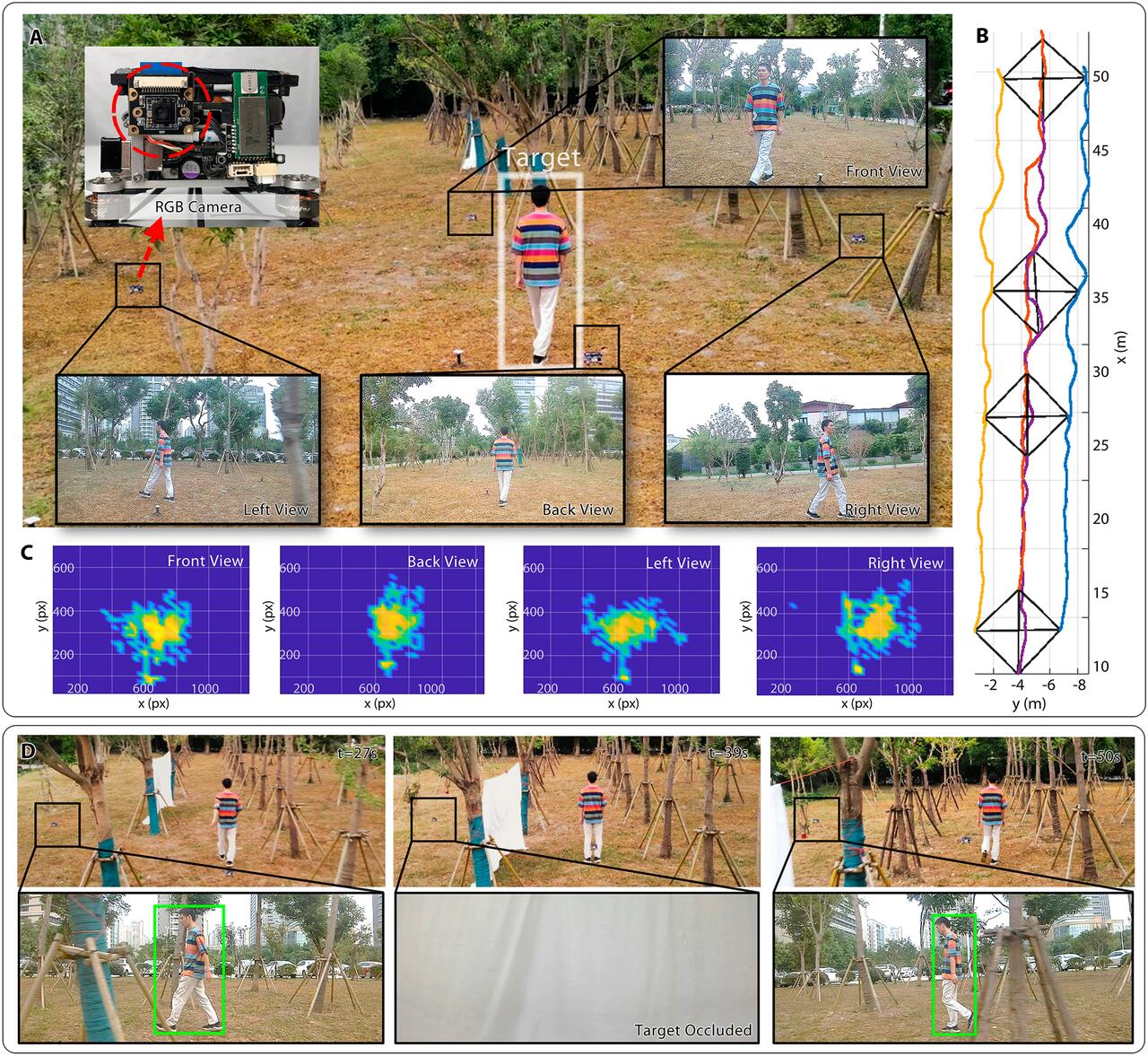
Chinese scientists from Zhejiang University published a report and footage of ten lightweight drones maneuvering at speed through a forest. The technology behind the drones autonomously navigates the best flight path through high-tech sensors.
Lead author Xin Zhou wrote in a paper published Wednesday, in the journal Science Robotics, that "multi-robot aerial systems are a symbol of future technology" and cited science fiction films, Prometheus (2012), Ender's Game (2013), Star Wars: Episode III (2005), and Blade Runner 2049 (2017), where drones or drone swarms were used, which ultimately "inspired" the research team.
Here is the drone swarm navigating through the woods. Full video below.
--> Link to Video :
In another experiment, Zhou and his team showed the drone swarm could track a human "target" through a field of trees.
Commenting on the breakthrough research is Enrica Soria, of the laboratory of intelligent systems at the Swiss Federal Institute of Technology in Lausanne, Switzerland, who told The Telegraph:
"This work presents a notable contribution to the robotics community and an important step towards the application of drone swarms beyond the constrained environment of a laboratory, not only for exploration in forests but also for a range of safety-critical missions in human-made environments, such as urban areas with humans and buildings."
What's terrifying is if researchers transfer the technology to Beijing, or even the military, who could use the advanced drone software for hunting humans, if that's for domestic surveillance purposes, or equip it with weapons for the modern battlefield.
About five years ago, the world's leading AI researchers and humanitarian organizations warned about lethal autonomous weapons systems, or killer robots, that select and kill targets without human control. Future of Life Institute released this dystopic video of "slaughter bots."

--> Link to Video :

(ZH) "AnalF**k69": Hunter Biden's Password Revealed In Whistleblower Tell-All

"AnalF**k69": Hunter Biden's Password Revealed In Whistleblower Tell-All

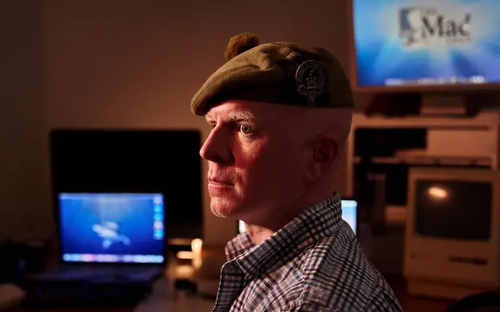
A Delaware computer repair shop owner who was driven out of business for blowing the whistle over Hunter Biden's abandoned laptop has written a book, "American Injustice: My Battle to Expose the Truth, in which he details what went down behind the scenes with the sitting president's crack-addict son.
According to an excerpt published by the New York Post, John Paul Mac Isaac was about to close up shop on a Friday night when Hunter Biden 'stumbled' in carrying three MacBook Pros.
"I’m glad you’re still open," Hunter reportedly said with an "air of entitlement" radiating off of him. "I just came from the cigar bar, and they told me about your shop, but I had to hurry because you close at seven."
John Paul Mac Isaac (James Keivom)
One of the computers, writes Mac Isaac, had a Beau Biden Foundation sticker covering the Apple logo. He proceeded to inspect the computers, when Hunter revealed his password: Analf**k69
For some reason, maybe misplaced compassion, I decided to check them over then and there. One at a time, I performed a quick inspection of the machines. The 15-inch laptop was a complete write-off. It had extensive liquid damage, and because the drive was soldered to the logic board, data recovery was beyond my capability. (If a Mac can’t power on, you won’t be able to access the drive and get to the data.)
The 13-inch 2015 MacBook Pro was in slightly better shape. It could boot up, but the keyboard was unresponsive. I pulled out an external keyboard and asked for permission to log in.
Hunter started laughing.
My password is f–ked up. Don’t be offended!” he said, before announcing that it was “analf–k69” or something to that extent. His inebriated condition made it difficult to understand is speech. My eyes widened a bit, and I told him that maybe it would be best if he tried to log in himself. -via the NY Post
Mac Isaac then offered to loan Hunter the keyboard so he could perform his own hard drive recovery on one of the other laptops, before discovering porn on what would come to be known as the 'laptop from hell.'
"Scrolling down, I started to see files that didn’t align. I started to individually drag and drop the files to the recovery folder. It took only a few files before I noticed pornography appearing in the right column," he writes.
How many of these does he have?” I wondered. It wasn’t just him alone either. Although it looked like he was having a love affair with himself, there also were photos with women. I decided I’d had enough, that I was no longer going to preview the data. I would just go by the file name and hope for the best. And I tried to work out how to keep a straight face when he returned for the recovery data.
He then writes that there was a file labeled "income.pdf," which showed what Hunter made in 2013, 2014 and 2015. "Next to each year was the amount of taxable income earned: $833,000+ in 2013, $847,000+ amended to $1,247,000+ in 2014, $2,478,000+ in 2015." - all while Joe Biden was the sitting Vice President.
Another note read, "Since you couldn’t have lived on $550,000 a year, you ‘borrowed’ some money from RSB in advance of payments."
The whole document seemed shady. I saw that a lot of money had exchanged hands, and it didn’t seem like it had been recorded lawfully. But what did I know? Plus, it was none of my business. It wasn’t my job to judge — just to transfer and verify. So I kept transferring data until I hit a rather large file. The file was about half transferred when the screen went blank. Dammit, the battery had run out.
Now while all of this is certainly entertaining, what's it going to take for the DOJ to launch a special counsel - given all the evidence of international dealings and other malarkey involving Joe Biden? If it was Don Jr's laptop we would have already moved on to impeachment. Then again, we're sure big tech platforms wouldn't have interfered in the 2020 election by censoring the original story if the shoe was on the other foot.

FT : Lex in depth: why the luxury market needs to hedge against China

Lex in depth: why the luxury market needs to hedge against China
A shift in spending habits in Asia and a crackdown on wealth by Beijing threaten a profit squeeze for high-end brands

Customers at the exclusive Shinsegae department store in the Gangnam district of Seoul prefer to display their wealth discreetly. But their high spending was exposed to the wider world when it revealed annual sales had topped $2bn in 2021 — the highest turnover for a single store in the world. It outpaced even Harrods in London, which before the coronavirus pandemic had long held the world’s top spot.

Global travel restrictions partly explain the success of department stores such as Shinsegae across Asia. Chinese and Korean luxury consumers previously reserved their biggest shopping sprees for European holidays. Covid-19, however, prompted them to pick up high-priced items at local department stores, which were unaffected by lockdowns.

This shift of turnover from Europe to Asia could mark a more permanent change in the balance of power within the global luxury industry. These changes in the spending habits of Asian consumers — the driving force of the luxury goods sector worldwide — have far-reaching implications for global brands and even some economies.

Asian shoppers, who accounted for more than 60 per cent of global luxury spending in 2021 — a market worth $300bn excluding cars — have delivered record profits for brands such as LVMH, with its shares more than doubling during the pandemic to become the most valuable stock in Europe by market capitalisation at the start of 2022.

But against this backdrop China’s economy is slowing and Beijing has unleashed a crackdown on its billionaires. That could trigger a rerun of the plunge in luxury demand seen during the country’s last anti-corruption drive in 2012.


A long-term shift in sentiment and spending habits cannot be ruled out. Nor can a profitability squeeze. Luxury brands are losing their lucrative premium pricing strategies in Asia which could trigger a lasting reversal in the lofty valuations of European luxury goods companies.

The sector now needs a hedge against its biggest customer: China.

China’s luxury open runs
Lines of up to 300 people outside Chanel boutiques in Beijing and Seoul department stores hours before opening have become a common sight in the past year, with some camping overnight to protect their place in the queue.

These so-called open runs have even created their own job opportunities. For $150 a morning, a substitute will queue for you. Or, to guarantee success, you can pay an 80 per cent premium on the product price for a reseller to stand in line until they get their hands on the desired object. Chanel and other brands have responded by rationing handbags. In Seoul, for example, sales of its most popular bags are limited to just one per person, per year, and passport and identification numbers are employed to track every sale.

The rationing, long lines and occasional loud quarrels associated with open runs have made headlines, providing free marketing for brands and contributing to a bumper 2021 for the world’s top five luxury brands: Gucci, Dior, Louis Vuitton, Chanel and Prada.

LVMH’s 2021 group sales were up a fifth compared to its previous record in 2019 to €64.2bn, led by its fashion and leather goods unit, its largest business, which analysts estimate generates profit margins of more than 40 per cent. “The business is showing some very good momentum in many countries outside China too,” says LVMH chief financial officer Jean-Jacques Guiony. “This includes Korea, whose contribution in terms of revenue is not far off that of France.”

The surge in prices for assets ranging from equities — especially US tech stocks — to bitcoin during the pandemic has helped drive wealth creation.

Asia-Pacific now has more billionaires than any other region of the world. Yet less than a third of global luxury brand sales come from these ultra-high net worth shoppers. The rest is from the rising middle class.

In 2019, Chinese consumers bought luxury goods worth about $120bn: about 70 per cent of that spending was made outside the country. But as overseas sales of personal luxury goods fell to near zero over the past two years, those inside mainland China climbed. In 2021 alone, they increased more than a third to Rmb471bn ($71bn), according to Bain estimates. That’s more than double the 2019 luxury spending in mainland China.


Asia’s price premium evaporates
The lack of flights to Europe is not the only reason Asian shoppers are doing their luxury spending at home. An equally important factor is the narrowing of the price differential between Europe and Asia. Traditionally there has been a significant gap that made the same products far more expensive in Asia due to the pricing strategies of luxury brands, local taxes and logistics.

The premium, which added up to 80 per cent on the same products in China a few years ago, meant a first-class flight to Paris for a shopping trip still cost less than the same spree at home.

That price gap — the reason Chinese consumers have long been the most profitable for global luxury brands — has, since the pandemic, narrowed to an average of 30 per cent. For some brands such as Chanel, the price differential between China and Europe is even lower — down to just about a tenth.

At the same time, the war in Ukraine means that the rebound in Europe is unlikely to be swift. “Even beyond Covid, the social and political turbulence in Europe does not pave the way for any immediate resumption of tourism,” says Claudia D’Arpizio, Bain’s global head of fashion and luxury. “Even when the Chinese are free [from Covid restrictions] and willing to travel back to Europe, I don’t see them buying abroad as they [used to].”

Another byproduct of the pandemic is the way the luxury goods industry has embraced ecommerce after years of snubbing it, over fears that an online presence could potentially damage the image of some brands. Now, such platforms are critical to the marketing and sales strategies of those same brands. In China, sales of luxury goods, which accounted for just a tenth of total online market share in 2019, have surged to 80 per cent by total sales.


That gives luxury brands the opportunity to cut costs in Asia and take full advantage of trends towards online purchases, including direct sales through messaging apps and courier delivery services. That also puts at risk the once-seemingly bulletproof revenue streams of Asian department stores and their business models, built around receiving 30 to 40 per cent of total sales as a commission.

European luxury groups have traditionally cultivated demand by selling their brands as status symbols in China, a country that has seen a huge growth in its middle class over the past two decades, with many of them working in the booming tech sector.

“This group earns big bonuses, usually multiples [of their] annual salary. That is where their purchasing power has been coming from,” says Iris Pang, chief economist for greater China at ING.

That in turn helped boost the value of shares in Europe’s luxury groups. LVMH and Hermès reached decade high valuations last year on a forward earnings basis, with the latter reaching 65 times at the end of 2021, reflecting the buying frenzy in Asia. Current valuation levels, while short of those highs, imply that the current double-digit earnings growth will continue.

But longer term, lower average selling prices could hold back the profitability of luxury brands. A return to the operating margins of 24 per cent enjoyed a decade ago is unlikely. Indeed, the risk of further lockdowns and restrictions in China’s wealthiest cities means a return to 2020’s operating margins of just 10 per cent cannot be ruled out.

The shift in spending to Asia means entire economies are taking a hit. Hong Kong, which does not tax luxury goods sales, has long benefited from being an important shopping destination for mainland Chinese, Korean and Japanese tourists, who all faced higher domestic prices for the same items.

Mainland Chinese visitors made up about 80 per cent of total Hong Kong tourists before the pandemic and accounted for 60 per cent of total luxury sales in the city — a figure that has since fallen more than 90 per cent.

At the same time, Hong Kong residents are leaving the city at a record rate, according to official data. The city’s retail sales in March fell almost 14 per cent from a year earlier. Lifestyle International, which owns and operates Hong Kong’s Sogo department stores, reported a record loss in 2021.

“Hong Kong has long been one of the most important hubs for luxury consumption [in Asia], but that is no longer the case,” says D’Arpizio at Bain, adding that mainland Chinese tourists are unlikely to return in the same numbers. “We do not expect Hong Kong to recover on this front as people can buy luxury goods duty-free in China now, [in places] such as Hainan. There will be a period of Hong Kong store closures for luxury brands.”

Xi’s ‘common prosperity’ drive
Shanghai, home to the flagship stores of global brands, has for weeks been living with a lockdown that has trapped 26mn residents in their homes. The city’s economy “will shrink 6 per cent in the month of April alone if the current lockdown persists”, says Pang at ING. And luxury sales will not escape that second quarter hit. With restrictions spreading to other cities, including Beijing, analysts expect annual growth across the country of just 4.2 per cent, well below the official state forecast of about 5.5 per cent.

Beyond the shorter-term impact of the lockdowns and the country’s zero-Covid policy, mainland China’s shopping habits are expected to undergo profound change. The biggest risk to global brands remains political: President Xi Jinping’s commitment to “common prosperity” and a pledge to redistribute wealth.

When the policy was announced in August, shares in the largest luxury groups plummeted. Paris-listed Kering, owner of the Gucci brand, fell by a fifth as did LVMH and Switzerland’s Richemont, the company behind the watchmakers Cartier and Piaget. But since then most investors have shrugged off the plunge.

Yet if China’s anti-corruption drive of 2012 is any guide, the worst is still to come for the luxury groups. Back then the clampdown led to a sharp drop in profits for Europe’s luxury brands and shattered sales expectations for everything related to luxury, from handbags to private jets. It lasted four years.

The latest crackdown has drawn in a range of characters from tech billionaires to film stars, social media influencers and private tutoring start-ups. Its breadth suggests it may be more enduring than its 2012 forerunner.

Meanwhile Chinese officials have blamed foreign brands for creating the consumer credit bubble, claiming millennials — the driving force behind new luxury goods purchases in China — borrow money to pay for them. The debt-to-income ratio of China’s post-1990s generation had already reached a record of more than 1,800 per cent in 2018, according to an HSBC survey. Since then official household debt levels have grown further.

In this environment, prudent Chinese shoppers may decide it is better to hide rather than flaunt their wealth. That could mean moving away from luxury brands entirely.


That is a problem for an industry that is expected to rely on the under-40s for almost three-quarters of its total sales by 2025. And may force the brands, as part of their hedge, to shift resources to other markets.

Some argue that if common prosperity expands the middle class in China that may be positive for luxury sales. Yet such arguments look overly optimistic. The middle class has expanded, but its growth and spending power remains fragile. At $10,400, gross domestic product per capita remains far behind the luxury sector’s next biggest market, the US.

The greatest risk: China
Lockdowns are weighing heavily on an already slowing Chinese economy. The youth jobless rate climbed to 16 per cent, a two-year high, at the end of March, nearly triple the national average. Patriotic shoppers, championing domestic brands, who have previously led boycotts against the likes of Burberry and Dolce & Gabbana, could also apply a brake on luxury goods sales.

Sectors outside luxury have already taken a hit. Canadian winter wear producer Canada Goose has slashed revenue and profit expectations after it was hit by nationalist backlash over a no-returns policy in 2021. H&M and Nike have faced boycotts over their refusal to use cotton sourced from Xinjiang, where Beijing is accused of detaining Muslim Uyghurs. That has sparked a shift to home grown brands.

“The increasing support for homegrown brands is a long-term trend, which we believe will persist.” says Scott Chen, managing partner at private equity group L Catterton. “[This is] in part due to rising national pride, but more importantly because of improving product quality and narratives that resonate with consumers.” 

Brands already face rising costs of transport, logistics and raw materials. The headwinds in Asia mean shoppers have become more selective. Traditionally, in the years following an economic slowdown, sales of hard luxury — watches and jewellery — have taken a prolonged hit. In China, the sector outlook for luxury watches, which during the 2012 anti-graft drive became a national symbol of corruption, is more vulnerable.

The biggest risk according to D’Arpizio is that “luxury brands are so dependent on a single market”.

For years Chinese consumer appetite for luxury products moved in lockstep with the nation’s economic growth. When China was growing at 10 per cent a year, as it did for the decade leading up to 2012, so did luxury goods sales.

The reality remains that global luxury demand will face pressure as long as Chinese growth keeps slowing. The looming political risks make it hard to trust the sustainability of the buying frenzy of the past two years. There is now a greater need for investors and luxury brands to hedge against China.
FT : Mario Draghi and Olaf Scholz show how Europe’s power balance is shifting

Mario Draghi and Olaf Scholz show how Europe’s power balance is shifting
The contrasting fortunes of the German and Italian leaders mirror changing relations between north and south

What a difference leadership makes. The leaders of Germany and Italy have offered contrasting examples of how to pursue a painful uncoupling with Russia.

Olaf Scholz and Mario Draghi are on the frontline of the EU’s dramatic foreign policy shift spurred by Russia’s invasion of Ukraine. Their economies — the largest and third-largest in the eurozone — are heavily reliant on Russian energy. Scholz and Draghi’s predecessors sought a rapport with Vladimir Putin and fostered economic ties. Severing these connections will hurt them more than most in the bloc. But while the two men are following a shared path, one is wavering where the other is decisive. And this will have consequences for the balance of power within the bloc.

Scholz’s cautious approach has looked like reluctance to act. From the suspension of the Nord Stream 2 gas pipeline to EU embargoes on Russian coal and oil, he has pushed back before caving in. His multiyear €100bn plan to modernise the German military has been overshadowed by hesitations over the more urgent question of supplying heavy weaponry to Ukraine. In an interview with Der Spiegel, he emphasised the nuclear escalation risks of doing so, only to send anti-aircraft tanks days later.

In Rome Draghi told Italians they needed to choose between “peace” and “air conditioning,” and in an interview with Corriere della Serra he confessed to doubts over the value of engaging with Putin. He has pushed for harsher EU sanctions and suggested a price cap to curtail the flow of gas revenues to Moscow. In a speech to the European parliament, he outlined an overhaul of the EU to achieve “pragmatic federalism”.

“Draghi is trying to conceptualise the role the EU should play in this crisis, while Scholz is focusing on the mechanics,” Susi Dennison, senior fellow at ECFR in Paris, says. “Draghi’s narrative is about how Ukraine fights for democracy and freedom, while Scholz highlights the risks,” her Berlin-based colleague Jana Puglierin adds.

Both leaders head disparate coalitions, but Draghi is helped by his stature abroad and popularity at home. He “sits one level above”, Dennison notes. With no aspirations to seek another mandate, the 74-year-old former head of the European Central Bank is a “liberated man”. He uses the prestige he earned a decade ago as saviour of the eurozone to convince voters to accept a difficult path, says Enrico Letta, a former Italian prime minister and now head of the centre-left Democratic Party (PD).

After succeeding the long-serving Angela Merkel as chancellor last year, Scholz also has to manage a bigger shift, Dennison argues. “Italy was one of the more sympathetic countries to Russia, but Scholz is not only reversing the Merkel years in terms of sympathy to Putin, but also a long tradition of pacificism.”

To be sure, Draghi’s decisiveness has not entirely suppressed Russophile or anti-Nato sentiment in Italy. Aside from president Sergio Mattarella and the PD, “the rest of the political system is either much more nuanced or opposed” to Draghi’s pro-EU, Atlanticist views, Letta says. “For now Putin is the bad guy but if this narrative changes, those parties could cause trouble” — and sway a population still unsure over how much it is willing to sacrifice to help Ukraine.

Still Draghi’s ability to turn a position of weakness into one of strength — and the difficulty Scholz has in doing so — is shifting the power dynamics within the EU. The south, chastised by the north for its fiscal laxity and the danger it posed to the union a decade ago, has defied expectations, Dennison says. She points to southern and peripheral countries’ ability to absorb Ukrainian refugees as well as show solidarity to other member states, such as Greece’s offer to help Bulgaria after Moscow halted gas supplies to the latter. In this crisis, geography is playing to the south’s advantage, Letta notes. Proximity to the Mediterranean — once a problem during the Syrian and Libyan refugee crises — now means access to more diversified energy supplies from Algeria and the Middle East.

While Scholz begins to come around, Germany’s internal difficulties could impede the running of the EU. It is increasingly absent from debates over what the EU’s new energy model should be while meeting its climate change goals, Dennison notes for instance. “It is quite worrying because European voters need strong leadership, a clear pathway as sacrifices will have to be made.”

FT : CFA Institute calls for tougher disclosure rules for Spac sponsors

CFA Institute calls for tougher disclosure rules for Spac sponsors
Professional group’s recommendations come as regulator seeks sweeping reform of blank-cheque companies

The professional body for the investment industry is urging regulators to toughen disclosure requirements for Spac sponsors in an effort to make the blank-cheque companies more transparent.

The CFA Institute is recommending that Spac sponsors fully disclose any affiliations with investors and target companies, as well as the existence of side deals with anchor or Pipe investors. The recommendations come in a report soon to be published and seen by the FT.

Improved sponsor disclosures are one of seven recommendations made by the organisation that is best known for overseeing the popular tests to become a chartered financial analyst, and comes after the SEC outlined sweeping reforms of Spacs in March. The CFA’s recommendation regarding sponsors goes further than the regulator’s proposals by urging more detailed information from Spac executives.

Amy Borrus, executive director of the Council of Institutional Investors and a member of the CFA’s Spac working group, said that enhanced disclosures are important “because of the opacity of so many Spacs and the potential for conflicts of interest”. 

“There’s a lot of detail investors need that they don’t get from Spacs now,” she added.


The CFA is also urging the regulator to examine whether further rules are needed to tackle Spac insider trading. “Of particular concern is the high potential for rumour and ‘priming the pump’ type communications on various social media channels,” the report said.

Special purpose acquisition companies soared in popularity at the peak of the coronavirus pandemic and became Wall Street’s most sought-after investment product. Sponsors raise money from investors and publicly list the vehicles as a cash shell before searching for a private company to take public through a merger.

The Spac boom has since fizzled out as investors have soured on the investment vehicles after a string of scandals, poorly performing deals and heightened regulatory scrutiny. Global market volatility caused by rising interest rates and the war in Ukraine has also led investors to pivot away from the growth companies that are typically listed via a Spac merger.

More Spac listings were withdrawn in the past two months than there were new listings, according to Dealogic data, showing how sharply the investment vehicles have fallen out of favour.

The crucial Pipe financing market has also dried up and dealmakers have been forced to sweeten the terms on offer or source more expensive financing. Pipes, or private investment in public equity, help raise extra funding and provide a stamp of approval for companies in Spac mergers.

The SEC’s proposed reforms, which were outlined in March, include stripping Spacs of legal safeguards that have allowed sponsors to present rosy revenue projections to potential investors and require banks that underwrite deals to be potentially liable for misstatements. The proposals are up for public comment, after which the regulator will decide whether to enact them.

“Sponsors are frequently making side deals to induce some hedge funds not to redeem, or giving discounted shares to Pipe investors,” said Jay Ritter, Cordell professor of finance at the University of Florida and a working group member.

“Those types of side payments aren’t always transparent and I definitely am supportive of the notion that there ought to be more disclosure there,” he added.

WSJ : China’s Economy Appears to Be Stalling, Threatening to Drag Down Global Gr

China’s Economy Appears to Be Stalling, Threatening to Drag Down Global Growth
While a traditional recession remains unlikely, economists see worrisome signs of a slowdown

Throttled by Beijing’s zero-tolerance approach to Covid-19, China’s economy is facing a spell of slower growth. Economists are toying with the term “recession” to describe it.

A recession commonly means two straight quarters of contraction, and that remains unlikely for China, many economists say. The country has many ways to ensure it posts stronger growth than the U.S. and Europe this year, including the ability to unleash heavy government spending.

But economists say that underlying conditions, worsened by Covid lockdowns in Shanghai and elsewhere, are starting to feel more akin to a recession—something China hasn’t experienced in decades.

Millions of new graduates are struggling to find a job. Business confidence has fallen. Imports have plummeted and nervous Chinese are socking away more savings.

On Saturday, purchasing manager indexes released by China’s government showed contractions in factory and service-sector activity for a second straight month in April. They fell to their lowest levels since the pandemic began in 2020.

Cement production in mid-April was less than 40% of full capacity. Shipments of smartphones dropped 18% from a year earlier in the first quarter. Excavator sales within China were down 61% in April compared with the previous year.

China’s challenges go beyond the latest lockdowns. The fallout from the war in Ukraine has pushed up costs for Chinese businesses and contributed to fading overseas demand for their exports.Regulatory crackdowns have hit high-growth sectors such as technology and education. Real estate, a primary driver of the nation’s economy, went into free fall last year as developers buckled under heavy debts and home sales slumped.

Any sustained slowdown in China will be felt globally, depriving the world economy of one of its most dependable engines when inflation and war are raising recession fears in the U.S. and Europe this year. The U.S. economy shrank at a 1.4% annual rate in the first quarter, data released last week showed.

China was projected to account for a quarter of global economic growth in the five years through 2026, according to data released by the International Monetary Fund last year.

Commodity-exporting countries like Brazil that count on Chinese demand for products such as iron ore and other metals could see demand wane. Exporters of components and machinery to China, such as Taiwan, South Korea and Japan, have already reported weaker sales after lockdowns shut Chinese factories.

Ford Motor Co. said vehicle sales in China dropped by 19% in the first quarter from a year earlier. Dallas-based chip maker Texas Instruments Inc. cut its revenue forecast for the second quarter due to reduced demand related to Covid restrictions in China.

A loosening of China’s “zero Covid” lockdowns, which have crippled cross-country supply chains and kept consumers at home as Omicron has spread this year, would likely spark a partial recovery. Caseloads in Shanghai, the worst-affected city, have fallen in recent days, though a handful of cases in Beijing have led to new restrictions there.

Unlike in 2020, when China’s economy snapped back quickly from its first bout with the pandemic, the country’s additional problems mean there’s lessening hope of a major resurgence later this year.

Li Haitao, a manager with Zhejiang Taotao Vehicles Co., based in the eastern Zhejiang province, said that Covid lockdowns have made it harder to get supplies and keep workers on site. He has also seen a 40% decline in orders for his firm’s electric scooters and dirt bikes compared with last year, due to slowing demand in Western economies. Higher prices for raw materials such as copper, steel and aluminum are eating into profit margins.

The company has cut one working day a week for each staff member, resulting in a salary cut of about a fifth for each employee, said Mr. Li.

Surveyed unemployment in China’s 31 largest cities has surpassed the level it hit when Wuhan was locked down in 2020. Youth unemployment is now 16%, according to official data.

“It’s too hard for young people to find a job nowadays,” said Jessica Fan, a project manager for an internet company in China. The country’s technology giants have laid off employees en masse since Beijing launched a sweeping crackdown on them last year to ensure they followed government dictates more closely. Ms. Fan said that every time her team advertises a new position, résumés land in her mailbox “like snowfall” for weeks.

More than 10 million college students are due to graduate this year, a record for China, but a gauge of vacancies compiled by the China Institute for Employment Research at Renmin University of China and job search website Zhaopin suggests there aren’t nearly enough jobs for them all.

About a third of China’s 290 million migrant laborers haven’t returned to their cities of employment since the Lunar New Year in February amid the Covid restrictions. The number of people employed at small- and medium-size businesses has shrunk by around 30%, according to research firm J Capital Research, based on interviews with Chinese labor agencies.

Chinese stocks suffered their worst selloff in more than two years last Monday, though they recovered somewhat later in the week. A slide in China’s yuan currency rekindled memories of a heady drop in 2015 that unnerved global markets.

China’s economy is “in the worst shape in the past 30 years,” said Weijian Shan, chairman and chief executive of PAG, a Hong Kong-based private-equity firm that manages about $50 billion, in a video for investors reviewed by The Wall Street Journal.

“I also think the public discontent in China is at the highest point in the past 30 years,” added Mr. Shan, who attributed China’s current crisis to policy decisions, though he said that his firm remains confident in the long term in China’s growth and market potential. His comments were first reported by the Financial Times.

Weaker demand in China could have one positive: somewhat reduced inflation pressure for the world, if it consumes less oil and other imported goods.

Many economists say any upsides could be offset by the inflationary impact of Covid-related disruptions to China’s supply chains, which are crimping its ability to supply the world with manufactured goods. If that continues, it could contribute to the much-feared combination of anemic growth and high inflation known as stagflation.

That’s especially true for parts of Asia which trade heavily with China, contributing to a “stagflationary outlook” for the region, said Anne-Marie Gulde-Wolf, an official at the International Monetary Fund, at a conference on April 25.

In April, the IMF cut China’s full-year growth forecast to 4.4% from 4.8% earlier this year, and well below the government’s target of around 5.5% for 2022. Barclays said on April 29 that it believes China’s full-year GDP growth could dip below 4% if lockdowns extend into the second half of this year.

The IMF’s forecast, if accurate, would be the worst year for China’s growth since 1990 aside from 2020, when it was 2.2%.

Lengthy bouts of weak growth or falling economic output are rare in China. Until 2020, it hadn’t reported a single quarter of contraction since 1992, the earliest year for which quarterly data is available.

Ting Lu, chief China economist at Nomura in Hong Kong, said he’s forecasting a small quarter-to-quarter contraction in China in the second quarter. He said if the government doesn’t modify its pandemic strategy, there’s a chance of another fall in output in the third quarter, though he added that he expects aggressive government action to mitigate that risk.

Craig Botham, chief China economist at Pantheon Macroeconomics in London, said he thinks China already experienced a fall in output in the first three months of the year on a quarter-to-quarter basis, despite official statistics showing growth of 1.3% on the same measure.

His own estimates of changes in China’s gross domestic product, which draw on official data but adjust for inflation in a different way, point to a quarter-on-quarter contraction of 1.8% in the first quarter on an annualized basis. He expects a bigger fall in output, of 2.5%, in the April to June quarter.

Many economists say China is at risk of a growth recession, a term used to describe a spell of weak expansion when the economy isn’t close to its full potential and isn’t creating many new jobs.

Such a situation is reminiscent of the jobless recoveries of the U.S. and other advanced economies after the 2008-09 financial crisis. It isn’t a label commonly stuck on China, which averaged 7.7% GDP growth in the decade through 2019.

“There’s clearly a risk of a standard type of growth recession,” said Jonathan Ashworth, China economist at Fathom Consulting in London.

Chinese officials are pledging to get the economy back on track, without abandoning their tough Covid-control policies.

President Xi Jinping, who is angling to stay in power for a third term at an important party conclave later this year, has called for an all out campaign to rev up growth through more infrastructure spending. Beijing has frowned on such outlays in recent years because of fears they could exacerbate China’s debt problems.

Other plans under consideration include coupons for shoppers to lift consumption and steps to rein in regulatory campaigns against the technology and real-estate industries that have slowed their growth.

The policy response from the government and central bank has disappointed many economists so far. The People’s Bank of China has trimmed banks’ reserve requirements but kept interest rates steady since January, fearful of pushing investors into looking for better returns elsewhere.

Many economists are skeptical that traditional stimulus policies will work in any case due to Covid lockdowns. Some question whether China needs much more infrastructure—and how the government will fire up construction projects while sticking with its zero-tolerance approach to Covid.

“You’ve still got the problem of actually getting the shovels in the ground if all the shovels are locked in a shed somewhere,” said Mr. Botham, of Pantheon Macroeconomics.

A real-estate agent in Guangzhou, who asked to be identified by only his surname, Mr. Du, said he has been looking for a job since November.

The 28-year-old said he used to sell properties for real-estate developers, including the beleaguered property giant Evergrande Group, which has defaulted on its international bonds.

Mr. Du said he is skeptical the market will recover soon. “For many people, their whole life’s savings is just enough for buying a house,” he said. “Now that they may stop working anytime due to lockdowns, they won’t easily put their money down.”

WSJ : Taliban Orders Women to Cover Their Faces

Taliban Orders Women to Cover Their Faces
Women have also been told to avoid going out in public

The Taliban on Saturday ordered Afghan women to cover their faces in public and to avoid leaving their homes, in the latest restrictions they have imposed on women since taking power last year.

The decree, issued by the Taliban’s Ministry for the Propagation of Virtue and the Prevention of Vice, addresses how women should appear in public, saying they must observe “proper hijab,” an Islamic concept of modesty that applies to women’s clothing, whenever they are in public environments.

Afghanistan is a deeply traditional country, where the overwhelming majority of women dressed conservatively long before the Taliban takeover last August.

Women almost always wear headscarves and loose, fully-covering clothes. But in big cities such as Kabul, face coverings aren’t as common, particularly among younger and educated women.

Now, under the new rules, “women, unless they are very young or very old, must cover their faces except for their eyes whenever they see or meet an unrelated man,” such as in most public places, according to the text of the decree.

The decree also advises women to stay home saying “the best way to observe hijab is to not go out unless it’s necessary.”

Akif Muhajir, spokesman at the ministry of vice and virtue, said the face-covering rule applies to all women of reproductive age, from when they are teenagers. Mr. Muhajir said those women now basically have two dress options: They can either wear the traditional Afghan blue burqa, which has a lace grill over the eyes, or they can wear a niqab, a black veil that leaves open a slit for the eyes, worn over a loose black gown.

No other country currently mandates such a strict interpretation of Islamic dress for women. Punishments for repeat offenders include jail time for the women’s male relatives. The few female civil servants still working will be fired if they break the rules, the decree says.

Shahrbanu Hassanzada, a 48-year-old old mother of five, said she was outraged by the mandate.

“All these restrictions on women are an injustice,” she said. “The Taliban should focus on women’s education and development—that’s what we need, not these hijab rules.”

Marwa Stanikzai, a 32-year-old female dentist, said the Taliban “are bringing women back to the Stone Age.”

“I am a doctor, I am well-educated and I know that none of these rules are in the Quran,” the holy book of Islam.

The decree says that the hijab is required by Islam. The announcement is the latest in a series of increasingly repressive policies targeting girls and women that the Taliban have imposed since they took control of Afghanistan.

Teenage girls aren’t allowed to go to school. Most female civil servants were barred from working. Women are required to be accompanied by a male relative, or mahram, whenever they travel outside their hometown or abroad. University classes are segregated by gender, as are public parks.

“If our hijab distracts men, the Taliban should control men, not women,” said Najla Mastoor, an 18-year-old who has been mostly confined to her home since the Taliban shut down secondary schools for girls, including her own. “Us women are always paying the price for men.”

The Taliban’s treatment of women is being closely watched by the international community. When they first took control of Afghanistan, the Taliban said they would respect the rights of women within the framework of Islam. It was part of a broader effort to present a more moderate image of themselves than when they were in power in the 1990s and Afghanistan was politically and economically isolated.

Since then, however, the more religiously conservative elements within the movement have asserted their influence on policy more forcefully—confirming some of the worst fears many Afghans had about what life under Taliban rule would be like.

Socially repressive rules have also provoked discontent from within the Taliban movement, with many of its members complaining its leadership is out of touch with the country after 20 years of war—and warning such policies risk alienating the Afghan population.

Restrictions on women are already making it harder for Afghanistan to receive political recognition and the financial assistance it needs to address its devastating economic crisis.

In March, after the Taliban reneged on their promise to reopen schools for girls over sixth grade, the World Bank suspended development projects worth $600 million, citing the group’s failure to respect the rights of women. No country has yet recognized the Taliban government as legitimate.

FT : West End landlords Shaftesbury and Capco close to £3.5bn merger

West End landlords Shaftesbury and Capco close to £3.5bn merger
Central London neighbours in detailed negotiations to combine portfolios to create company worth around £3.5bn

Two of the biggest landlords in the West End are in talks over a £3.5bn merger which would bring together some of central London’s best known tourist destinations under the ownership of a single company.

Capital & Counties, which owns Covent Garden and the surrounding area, and Shaftesbury, which has a portfolio spanning parts of Soho, Chinatown and Carnaby Street, are in detailed negotiations over plans to combine their portfolios.

The deal could be agreed in the next few weeks and the merged businesses would have a combined valuation of around £3.5bn, according to people familiar with the discussions.

There has been persistent speculation over the past two years that the two businesses might come together, stoked by Capco buying a 26 per cent stake in Shaftesbury from Hong Kong real estate tycoon Samuel Tak Lee in the early months of the pandemic in 2020.

The companies share a major shareholder in Norges Bank, the Norwegian state fund which, according to one person with knowledge of the matter, has played a role in brokering the talks.

The neighbouring landlords have worked in tandem on their response to coronavirus over the past two years, a period in which tourism and visits from shoppers have collapsed and dragged down the value of properties in the area considerably.

Management teams at both companies have previously spoken about the potential advantages of bringing together the businesses, which include the ability to curate large swaths of the West End.

A combined entity would have the ability to more readily raise cash to invest in the estate and potentially to expand, said one person with knowledge of the talks, which were first reported by Sky News.

With a market capitalisation of £2.2bn, Shaftesbury is the larger of the two companies, with Capco valued at £1.4bn. 

It is not clear how a combined entity would be managed, but according to one person familiar with the discussions Brian Bickell and Ian Hawksworth, chief executives of Shaftesbury and Capco respectively, would both remain involved.

Shaftesbury and Capco both declined to comment.