(ZH) The "Scariest Paper Of 2022" Reveals The Terrifying Fate Of

The "Scariest Paper Of 2022" Reveals The Terrifying Fate Of Biden's Economy: Millions Are About To Lose Their Job

For much of the past year (and certainly at the time, more than a year ago, when the so-called experts, central bankers and macrotourists were still yapping about "transitory inflation" and other things they were wrong about and do not understand), we were warning that at some point the Fed will realize that it is simply impossible to contain supply-driven inflation through stubborn rate hikes which instead would lead to a dire alternative - millions in mass layoffs and newly unemployed workers ...
... and will revise its 2% inflation target higher, a move which will send every risk asset - from high-beta trash and meme stonks, to blue-chip icons, to bitcoin and cryptos limit up.
To remind readers of this coming phase shift, we most recently warned in June that "at some point Fed will concede it has no control over supply. That's when we will start getting leaks of raising the inflation target"...
Well, it turns out that we were right, and not just about the coming mass layoffs, but also about the inflation target leaks. But first, lets back up a bit.
A little over one year after nobody expected the Fed would be hiking rates like a drunken sailor until some time in late 2023 or 2024, it has now become fashionable to not only predict that the Fed will keep hiking rates at every FOMC meeting and at the fastest pace since the near-hyperinflation of the 1980s, but that the central bank will somehow manage to avoid a hard landing (i.e., the hiking cycle won't end in a recession or depression), even though every single Fed tightening cycle since 1913 has ended in disaster.
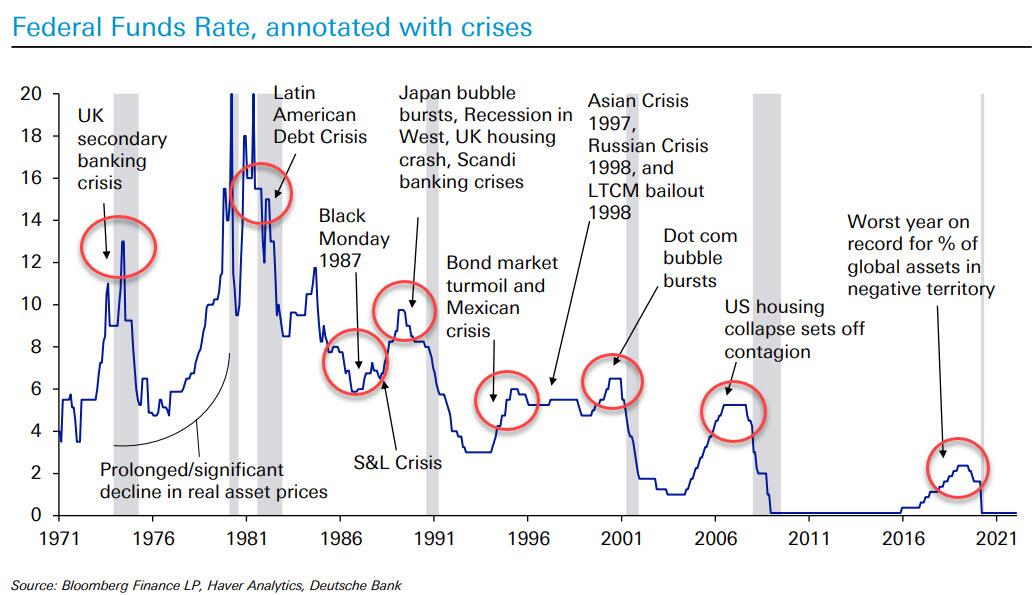
An example of this was the statement by former Fed vice chair (and PIMCO's "twice-revolving door") Rich Clarida, who told CNBC that "failure is not an option for Jay Powell," adding that "I think they're going to 4% hell or high water. Until inflation comes down a lot, the Fed is really a single mandate central bank."
Of course, if one could hike rates in a vacuum that could work - after all, Clarida himself, who admits he got this year's soaring inflation dead wrong when he was still a daytrading god and part oft he Fed in 2021, said that the Fed may as well have just one mandate, namely to tame inflation. But what so few seem to recall is that the Fed is "hiking to spark a recession", or as CNBC's Steve Liesman put it, there is no such thing as "immaculate rate hikes" meaning that rate hikes have dire tradeoffs in other sectors of the economy. In other words, if the Fed's intention is to spark a recession, it will spark a recession... leading to millions of Americans losing their jobs, something which even Elizabeth Warren appears to have grasped.
Yet due to the recency bias of Biden's trillions in stimmies, and a world where workers - whether working form home or the office - have virtually all the leverage, few today can conceive of a world where inflation is zero or negative and is instead replaced with millions in unemployed workers, an outcome which one could (or rather should) say is even worse for the ruling democrats than roaring inflation. At least, with runaway prices, most people have a job and their wages are rising (at least nominally, if not in real terms).
However, the higher rates rise, the closer we get to that inevitable moment when the BLS - unable to kick the can any longer - admits what has been obvious to so many for months: the US is facing a labor crisis of epic proportions with millions and millions of mass layoffs. And for those to whom it is not yet obvious, we urge to read a WSJ op-ed published by none other than Jason Furman, who is not some crackpot republican but Obama's own top Economic Adviser from 2013-2017 and currently economic policy professor at Harvard.
In "Inflation and the Scariest Economics Paper of 2022", Furman summarizes a paper written by Johns Hopkins macroeconomist Larry Ball with co-authors Daniel Leigh and Prachi Mishra of the International Monetary Fund released by the Brookings Papers on Economic Activity, whose conclusion is as follows: "To bring price increases down to 2%, we may need to tolerate unemployment of 6.5% for two years."
In other words, just as we said, inflation - much of which is supply-driven, which the Fed can do nothing about - will force the Fed to crush the economy by keeping rates for much longer, the result of which will be many millions in unemployed workers, or as Furman puts it, the paper "shows why the Federal Reserve will likely need to maintain its war on inflation, even if unemployment continues to rise."
What is more remarkable about Furman's read of the economist paper is that in addition to its primary theme (the lack of labor slack, or labor tightness, is responsible for some 3.4% of underlying inflation in July 2022), the paper admits precisely what we have been saying all along - that the Fed can't control supply-side variables:
The paper also argues, convincingly in my view, for a different measure of underlying inflation. Fluctuations in energy and food prices are generally due to factors outside the control of macroeconomic policy makers. Geopolitics and weather have elevated the inflation rate in recent years. Plunging gasoline prices are temporarily lowering the inflation rate now. That’s why economists since the 1970s have focused on “core” inflation, which excludes food and energy.
But food and energy aren’t the only things people buy that are subject to supply-side volatility. Prices of new and used cars, for example, have gyrated over the past two years for reasons that are mostly unrelated to the strength of the overall economy. Both regular and core inflation are based on taking averages of price increases and can be distorted by large changes in outlier categories. The median inflation rate calculated by the Federal Reserve Bank of Cleveland drops outliers to remove these distortions.
According to Furman, median inflation - which is a statistically better measure of the underlying inflation that policy makers can actually control - is well above the Fed’s preferred headline inflation print (which fell to zero in July on a sequential basis and has stabilize) and shows no sign of moderating and has run at a 6.6% annual rate in the last three months.
But the "scariest" part of the new paper, Furman reveals, is when the authors use their model to forecast the unemployment rate that would be needed to bring inflation down to the Fed’s 2% target. He explains why this is so scary:
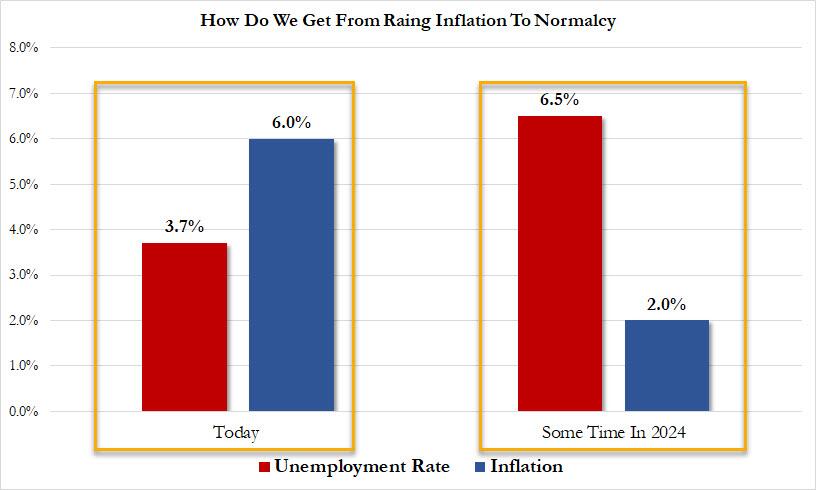
The authors present a range of scenarios, so I ran their model using my own assumptions... Under these assumptions, which are more optimistic than the authors’ midpoint scenario, if the unemployment rate follows the Federal Open Market Committee’s median economic projection from June that the unemployment will rise to only 4.1%, then the inflation rate will still be about 4% at the end of 2025. To get the inflation rate to the Fed’s target of 2% by then would require an average unemployment rate of about 6.5% in 2023 and 2024.
Where is unemployment now: it's 3.7% (6.014 million unemployed workers vs 164.746 million civilian labor force). This matters, because according to one of the most erudite economist Democrats, by the end of the Biden admin in 2024, the unemployment will have to soar to 6.5% for inflation to plunge to the Fed's historical target of 2.0%
What does this mean in absolute numbers? Assuming a modest increase in the US labor force, a 6.5% unemployment rate in 2024 would translate into no less than 10.8 million unemployed workers, an 80% increase from the 6 million today!
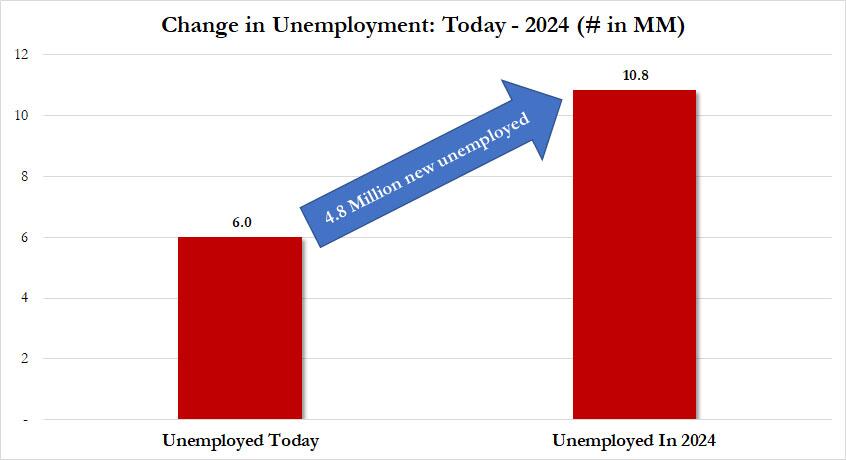
Still think that politicians - and especially Democrats - will sit quietly and blindly ignore how high the Fed is hiking rates if it means that to normalize inflation back to 2% it means nearly doubling the number of unemployed Americans (and a crushing recession to boot). Spoiler alert: no, they won't, and this may be one of the very rare occasions when Elizabeth Warren is actually right to worry about what the coming mass layoff wave means for Democrats... and the 2024 presidential election.
So what should the Fed do? Well, according to Furman, the Fed has four options:
  1. First, place more emphasis on the ratio of job openings to unemployment and median inflation as it assesses the tightness of labor markets and the underlying rate of inflation.
  2. Second, the new paper shows how much easier it will be to tackle inflation if expectations remain under control. The Fed should follow up on Chairman Jerome Powell’s tough talk at Jackson Hole with meaningful action such as a 75-basis-point increase at the next meeting.
  3. Third, be prepared to accept the unemployment rate rising above 5% if inflation is still out of control.
While we doubt #3 is actionable, what is more remarkable is Furman's final proposal: it's the one that, like the Dude's proverbial rug, ties the room together and sets the stage for what is coming:
Finally, stabilizing at a 3% inflation rate is probably healthier for the economy than stabilizing at 2%—so while fighting inflation should be the central bank’s only focus today, at some point the Fed should reassess the meaning of victory in that struggle.
And just in case his WSJ proves too complicated for some mainstream experts and economists, here it is in truncated, twitter format:
And there you have it: remember what we said on June 21: "At some point Fed will concede it has no control over supply. That's when we will start getting leaks of raising the inflation target." Well... there it is.
And while mainstream economists and the market may require quite a few months to grasp what is coming, it is the only way out of a crisis of commodities - as Zoltan has repeatedly and correctly put it - and which central banks have no control over, and thus will have to move not only the goalposts but the entire football field to avoid a social revolt or something even scarier.
While we wait, we can't help but snicker at what the 79-year-old figurehead in the White House tweeted today...
... because what Biden calls "the strongest economic recovery in recent history" is - even according to Democrats - about to be the biggest economic disaster in modern history.

Barrons : El Salvador’s Lonely Bitcoin Experiment: ‘It’s Either the Biggest Fail

El Salvador’s Lonely Bitcoin Experiment: ‘It’s Either the Biggest Failure or the Biggest Con.’

For those who believe in Bitcoin, El Salvador looks like a crypto paradise. It’s one of the few places in the world where you can use Bitcoin to buy a Coke or cerveza on the beach. In theory, you can pay rent in Bitcoin, buy a house, pay off a credit card, or send a payment to a Mayan pottery vendor in the local market.

Yet El Salvador is far from a crypto lover’s dream. Instead, it has turned into a cautionary tale of what happens when a country adopts a cryptocurrency, tries to weave it into its economy, and rebrands itself as a tech-friendly haven: It isn’t working as advertised.

Barron’s visited El Salvador to gauge BitcoinBTCUSD +0.14% ’s impact a year after the country passed a law that established the crypto as a legal currency. El Salvador made history when its 41-year-old president, Nayib Bukele, signed the Bitcoin Law last September, becoming the first country to fully legalize the crypto for domestic use. Banks, businesses, and merchants of all sizes have since been required to accept it, alongside the country’s other official currency, the U.S. dollar.

By almost all measures, Bitcoin appears to be doing more harm than good. The government has plowed scarce resources into the crypto and related projects, its fiscal health has deteriorated as Bitcoin crashed, and hardly anyone uses it outside a few pockets in the capital and crypto-friendly beach spot.

“The Bitcoin experiment is working as well as one might have expected—which is not too well,” says economist Eswar Prasad, professor of trade policy at Cornell University.

The crypto collapse hasn’t helped. Losing more than 70% since last November, Bitcoin has shed about $1.5 trillion in value, wiping out many investors and fueling a selloff in the broader crypto market. Along the way, it has drawn the wrath of governments, notably China, that have come to view it as a subversive threat to their monetary control and a profligate consumer of electricity due to the steep energy toll of crypto “mining.”

In El Salvador, the crypto still has its boosters, notably Bukele, a Twitter-loving millennial who heralded it as an economic savior. “We must break with the paradigms of the past,” he said when announcing the Bitcoin Law. “El Salvador has the right to move toward the first world.”

One year later, critics say, Bitcoin has been little more than a distraction from deep-seated economic problems and a mechanism for Bukele’s increasingly authoritarian rule. Indeed, it has been a divisive force, causing street protests and fear of reprisals to anyone who criticizes it—including residents of a fishing village who may be forcibly relocated by a government-backed “Bitcoin City.”

“It’s either the biggest failure or the biggest con,” said Claudia Ortiz, an opposition member of congress in El Salvador and one of the dwindling opponents of Bukele.

Bitcoin’s Bad Timing
On a macro level, the country’s embrace of Bitcoin has taken a toll. Bukele inherited a highly indebted nation when he won the presidency in 2019. The situation worsened as the pandemic hit and the government ramped up spending. Debt grew from 71% of gross domestic product in 2020 to 85% at the end of 2021.

As the debt load rose, Bukele started buying Bitcoin and legalized the crypto, complicating the country’s financial profile with creditors and pushing up its sovereign bond yields. A lack of hard currency is now raising alarms over two $800 million government bonds, maturing in January 2023 and 2025. The country had raised only $560 million to repay bondholders as of July, according to finance minister Alejandro Zelaya, who acknowledged that repaying the entire debt would be “almost impossible.”

The 2023 bond trades at 90 cents on the dollar with a 37% yield to maturity. The 2025 bond trades at 51 cents, yielding 39%. Both reflect market skepticism about the country’s debt profile and make it prohibitively expensive to issue more bonds.

Former government officials see more fiscal trouble ahead. “With international markets closed, I don’t see how it’s possible for the country to pay upcoming bonds with the resources of the domestic market,” says Carlos Acevedo, a former president of El Salvador’s Central Bank and now an independent consultant and economist.

Confidence in Bukele spending the government’s revenue wisely is also being undermined by his crypto plans. They have included doling out at least $250 million on “digital infrastructure,” according to estimates from opposition leaders. Those funds have gone to things like a government-backed digital wallet—distributed to adult citizens and preloaded with a $30 bonus in Bitcoin. The money also went to setting up more than 200 Bitcoin ATMs, and a $150 million “Bitcoin trust” to ensure convertibility between the crypto and the dollar.

Bukele widened the fiscal hole. While the government refuses to disclose its Bitcoin holdings or spending, Bukele’s tweets indicate that he bought 2,381 Bitcoins for the treasury, costing about $107 million. As prices slid, Bukele repeatedly tweeted that he “bought the dip.” The strategy appears to have lost tens of millions of dollars, based on falling prices for the crypto and Bukele’s tweets.

That isn’t fatal for a country with an $8 billion annual budget. But it has rankled opponents. “This is like gambling with the public money of a poor and indebted country,” said Ortiz. “A country that needs those resources now can’t afford to wait for them to gain value in an undetermined amount of time,” she said at her office, a small space tucked away in the congressional building, grouped with other Bukele opponents.

Turning El Salvador into a Bitcoin ATM has also rattled lenders like the International Monetary Fund. The government applied for a loan package from the IMF in 2020 and was negotiating a $1.3 billion agreement when Bukele signed the Bitcoin Law. Talks have broken down, partly due to the IMF’s concerns about the crypto’s destabilizing effect. “A program with the IMF would have to address all major economic vulnerabilities,” the fund said in a statement to Barron’s. “These include those related to the adoption of Bitcoin as legal tender.”

Bukele appears intent on turning the country into a global hub for Bitcoiners—from miners to crypto tourists. This past November—when the crypto was trading at peak prices around $68,000—he unveiled plans to issue Bitcoin-backed bonds, designed to fund the construction of an oceanside “Bitcoin City” nestled at the base of the Conchagua volcano. The city will be a tax haven for crypto investors, free of income, property, and procurement taxes, Bukele said. The country also aims to lure crypto miners—who use huge amounts of electricity to process transactions—by generating geothermal electricity from the volcano.

Yet the bonds, scheduled to be issued this past March, have been postponed. The country is doing some crypto mining—partially powered by geothermal energy from a pre-existing plant. But development of a volcano-powered Bitcoin City is nowhere in sight in the tropical forest. The volcano isn’t even a viable geothermal reservoir, says Carlos Martinez, an electrical engineer who works at the University of El Salvador.

Bukele’s promise of using Bitcoin to bank the unbanked and catapult the country into the digital era remains unfulfilled. Beyond a few pockets on the coast, a tiny sliver of people are using crypto—no surprise, perhaps, in a country where even apps like PayPal PYPL +0.06% ’s Venmo service aren’t widespread. More than four million people downloaded the wallet, called Chivo—Salvadoran slang for cool. A $30 bonus preloaded in Bitcoin was no doubt enticing in a country where the minimum wage is $13 a day.

Yet only 20% of Salvadorans used the app after spending the bonus, according to one recent study. Nearly 92% of small and medium-size businesses said Bitcoin has been immaterial for them. “Bitcoin is absolutely irrelevant for the country,” says Luis Membreño, a Salvadoran economist and critic of the Bitcoin Law, who lives in exile out of fear of government persecution.

The country continues to grapple with gangs, poverty, and rising unemployment. If Bitcoin is having an impact, critics say, it’s within a parallel world of crypto-tourists, techies, and well-connected elites.

Bukele declined interview requests, and a government spokesperson declined to make any officials available for this article.

A Bitcoin Surfer’s Paradise
To see Bitcoin in action, it helps to hit the beach. Specifically, El Zonte, an area that has been nicknamed “Bitcoin Beach” by crypto enthusiasts because it’s one of the few places where the crypto is readily accepted.

There, you might meet Wilfredo Urias, a 28-year-old surfer who started his own surfing school, in part thanks to profits he made from trading Bitcoin. Urias bought his first $100 of Bitcoin in 2020, promptly turned it into $500 as prices soared and then continued to trade and profit, eventually making enough to buy 12 surfboards and hire instructors—some who want to get paid in the crypto. Bitcoin has been “very beneficial” for El Zonte, he said, as an ocean breeze ruffled his hair and surfers dotted the black sand beach.

Urias’ story isn’t representative of much of the country. Few merchants or stores that Barron’s encountered were equipped with the QR code readers necessary to process a transaction. Nor do they see much reason to go through the hassle.

“Tourists don’t shop; they just come to sight-see,” said a vendor in a local market, explaining why she didn’t take Bitcoin as a payment.

Some vendors say they lost sales because of hacks in the digital wallets. A beach vendor selling baskets in El Zonte said he had been locked out of his wallet due to a hacking alert and couldn’t access the funds or take more Bitcoin payments. “It’s better to keep using cash than virtual money,” he said. “I’m not getting into that again.”

Bitcoin complicates even 1980s technology, like using an ATM. Bitcoin ATMs convert a traditional currency into Bitcoin, stored in a digital wallet. But they are slow; it took six hours for a $20 Bitcoin deposit to show up in our Chivo wallet. A government subsidy covered the transaction fee, usually steep at a Bitcoin ATM. When we tried to buy snacks, however, the money was nearly useless; only three merchants out of 10 that we met would accept payment in Bitcoin.

There is some crypto development in the capital. Companies that have set up shop include Strike, Bitrefill, and Binance. At a weekly meetup of Bitcoiners in a swanky bar, attendees swapped ideas for apps and exchanged tips for obtaining residency permits, buying property, or investing.

“If you’re somebody who has Bitcoin and fiat money, you’re in these worlds that don’t mix. Here, the two worlds have merged,” said Dallas Rushing, a California-based app developer, visiting as a crypto tourist.

Bitcoin investors are interested in buying property, said William Velasco, co-founder of a real estate brokerage. “We’ve noticed an influx of foreigners from nationalities that we never thought would invest here,” he said.

Nonprofits, meanwhile, are trying to teach students to use crypto. A nonprofit called My First Bitcoin holds classes across the country. Bitcoin could propel the country into the digital economy, said Napoleón Osorio, an instructor who had just returned from a class on Bitcoin at a school in Apaneca, a rural town in the coffee-bean-growing highlands. But foisting the crypto on the population was akin to a “technological coup,” he added, and it will take much education, time, and technological investment to catch on.

Outside of crypto circles, Bitcoin has scant discernible impact. On a recent Friday in the town of Conchagua, where the future “Bitcoin City” is planned, street vendors were setting up shop, milling around, and swatting flies while waiting for the shopping crowd. Few could conjecture what the future city would look like. Even fewer were familiar with how to use Bitcoin.

Local officials aren’t sure what to make of “Bitcoin City.” Oscar Parada, the mayor of the neighboring city of La Unión, said he doesn’t know when or where the development would start, adding that carving out the infrastructure would be a challenge. Parada, a member of Bukele’s New Ideas party, said he hasn’t been focused on Bitcoin. “Right now, I don’t think it’s necessary, but medium or long term, it will be,” he said.

One community feeling the impact is La Criba, a poor fishing village near the Conchagua volcano that has also been targeted for development of the “Bitcoin City.” More than 50 families live there, making a humble living through fishing and agriculture. Residents are under pressure to sell their land—often at a steep discount—as developers look to transform the region into a crypto destination.

“We live on standby,” said Hugo Guevara, 61, a resident and community leader of La Criba. Guevara gestures at the small, rundown cement houses with aluminum roofs nestled between the sand and lush mangrove trees. “We live like this because we can’t build anything better, out of fear that we’ll be evicted tomorrow.”

The Promise of Digital Money
One could argue that El Salvador was never a great proving ground for Bitcoin. Internet penetration is just 50%, and commerce is largely conducted in cash or credit cards backed by hard dollars.

Bitcoin might have a better shot in countries without a stable currency or financial system, where hyperinflation can be corrosive and people fear for access to their savings. El Salvador has none of that. It has used the dollar as official currency since 2001, posing steep hurdles to any rival, let alone something as baffling as Bitcoin—a 13-year-old set of software rules with no intrinsic value, existing solely as code on computers worldwide.

As for whether more countries follow in El Salvador’s path—the great hope of Bitcoin lovers—that is looking less likely. The Central African Republic made Bitcoin legal currency in April, but the country’s top court is putting up roadblocks to its use.

Opposition to Bitcoin from organizations such as the IMF, the World Bank, and international bond markets will likely deter other governments. Crypto also remains a conduit for money-laundering and evading government sanctions. And the environmental toll of mining—spewing out country-size carbon emissions each year—makes it controversial for any country, especially as other types of crypto have moved beyond Bitcoin’s energy-intensive system for processing transactions.

Even if Bitcoin were more stable, traceable, and eco-friendly, its technology wasn’t designed to scale up for an entire country. Its blockchain handles seven transactions per second, compared with 24,000 for Visa’s card network. An add-on “Lightning” network can process Bitcoin transactions faster, but that adds more complexity to the system, and it doesn’t address the high underlying fees and congestion on the original blockchain, where all transactions are recorded.

“There’s a cautionary tale here about the inability of Bitcoin to meet the needs of even a tiny country,” said David Yermack, a finance professor at New York University.

None of this should be viewed as an indictment of digital money or peer-to-peer transactions through apps. In Kenya, a mobile app allows people to deposit traditional currency on accounts stored on cellphones and transferred via text messages. For international remittances, or money transfers, a central bank digital currency, or CBDC, could cut fees compared with commercial services like Western Union. That would have big benefits in countries like El Salvador where a quarter of gross domestic product comes from remittances.

Indeed, the future of tokenized money is far more likely to be a CBDC or stablecoin—privately issued tokens backed, in most cases, by a hard currency like the dollar. China is well on its way to tokenizing its currency. In the Bahamas, the “sand dollar,” a digital version of its currency, can be loaded on a smartphone app and used at resorts or anywhere cash is taken. The U.S. is studying CBDCs, along with dozens of other countries.

Perhaps the best outcome of El Salvador’s Bitcoin experiment may be its failure. “If the law had been successful, Bitcoin’s drop would have been a catastrophe,” said Acevedo, the former central banker. “The Bitcoin Law’s failure has saved us.”

Barrons : How Europe’s Energy Crisis Could Play Out

How Europe’s Energy Crisis Could Play Out

The energy crunch in Europe escalated into a full-blown crisis this past week after Vladimir Putin cut off the pipeline that supplies a third of the natural gas that Russia sends to Europe. Natural-gas prices soared 30% at one point, and Goldman Sachs analysts projected that Europeans will see their monthly energy bills triple this winter to an average of 500 euros, or almost $500, per family at the peak.

When the worst of it hits, utility bills could account for 15% of European gross domestic product, crowding out other kinds of spending and investment. Goldman warns that the repercussions “will be even deeper than the 1970s oil crisis.”

Europe is now on the verge of recession, if not already in one, and the worst looks yet to come. Graham Secker, Morgan Stanley’s chief European equity strategist, expects an imminent recession in Europe that will pull earnings growth into negative territory next year. Result: Europe’s stocks, already off 14% this year, could well fall another 15%, Secker says.

Plenty of investors have already headed for the doors. Withdrawals from European exchange-traded funds last month hit the highest level since the Brexit panic of 2016, BlackRock reported.

European policy makers, initially slow to respond, have snapped into action, but they have few easy options. The European Central Bank has the near-impossible task of dampening inflation while avoiding a deep recession. The ECB raised interest rates by 0.75 percentage points on Thursday, its largest hike ever, and ECB President Christine Lagarde warned of a “really dark downside scenario.”

Countries are reducing power use, mostly through voluntary measures. Thermostats in Spanish office buildings were turned above 80 degrees last month. The lights that normally illuminate Berlin’s famed Brandenburg Gate have gone dark. European Union energy ministers are considering mandatory electricity limits and caps on Russian energy prices, among other measures.


Hundreds of billions of dollars in government support—potentially exceeding Covid bailouts—will soften the blow of high prices. Germany has already authorized €65 billion to help households, and the United Kingdom capped household gas and electric bills at 2,500 pounds sterling ($2,898) a year for the next two years.

The lifeline being extended to households and small businesses may not save larger firms, however. Many are already reeling.

“If there are any shortages, it’s going to be on the industrial side,” says Jack Ablin, chief investment officer at Chicago-based Cresset Capital. While natural gas is used to produce electricity and heat homes, it’s also a key input for industrial plants.

The metals industry is facing a “life or death winter” after electricity and gas costs soared over 10 times last year’s levels, a group of chief executives wrote in a letter asking the European Parliament for emergency aid. The products they make sell for less than the cost of keeping the plant running, they argued. Half of the EU’s zinc and aluminum production has already been halted. “We know from experience that once a plant is closed, it very often becomes a permanent situation.”

Government bailouts are likely to soften the pain, but not eliminate it. “You’re talking about a ballpark of over €1 trillion of extra energy costs for people,” Secker says. “Governments will try to socialize some of that with fiscal support. They’re not going to have the ability to do all of it. The number’s too big.” Politically tricky decisions on rationing energy use could still be ahead.

As the crisis deepens, analyst estimates of corporate earnings could well prove too rosy. Analysts on average expect 17% growth in European earnings this year and 2% next year, Secker says. By comparison, Morgan Stanley sees 12% growth this year and a 10% contraction in 2023.

The MSCI Europe Index990400 +2.38% , which contains companies from 15 countries, is now trading at 11.5 times expected earnings, below its historical average of 13.5. Secker sees that dropping to 10 as stocks flag in coming months.

To understand why the outlook is so bleak, it helps to look at how the European power crisis came to be.

The problems actually began more than a year ago. Natural-gas prices in Europe had already more than quadrupled on a year-over-year basis as of last September. Demand had risen as Covid lockdowns waned, and supplies were slow to catch up. In addition, a cold prior winter had depleted the amount of gas in storage.

Russia’s invasion of Ukraine in February vastly exacerbated the problem, because buying Russian energy meant funding Russia’s war. Oil prices have been volatile since the war began, but the impact on natural gas is a bigger deal. Europe relies on gas for about a quarter of its needs, from heating to electricity to industrial production. In some countries, it makes up much more. Italy, now the “sick man of Europe,” relies on gas for 40% of its energy. Europe needs to import most of its natural gas because it has limited capacity to produce it.

Russia provided Europe with 40% of its natural gas before the war. For years, cheap Russian gas powered the economies of countries such as Germany, which was directly linked to Russian supply via the Nord Stream 1 pipeline that runs under the Baltic Sea. Germany was on the brink of doubling its imports from Russia through a new pipeline called Nord Stream 2 when the war broke out.

The war turned the energy crisis into a political one, too. European sanctions against Russia initially spared most energy sources, but European countries began to transition away from Russia regardless. And Russia accelerated the process, ratcheting down the amount of gas it sent through pipelines. The announcement from Russia’s state-controlled energy giant Gazprom that Nord Stream 1 needed maintenance and wouldn’t come back on is the latest blow; analysts think it’s likely the pipeline stays off through the winter. Europe now gets just 9% of its gas from Russia.

The crisis has been particularly acute because other sources of power have underperformed. Droughts have left rivers at a trickle, reducing hydropower by 26%. And a larger-than-usual number of nuclear plants, particularly in France, have been shut down for maintenance this summer. An increase in solar power has taken up some of the slack, but Europe remains undersupplied heading into the winter.

Russia says that Europe started the economic war by imposing sanctions, and sealed its own fate this winter. “We will not supply gas, oil, coal, heating oil. We will not supply anything,” Putin said at a forum in Vladivostok on Wednesday.

There are some positive developments, though, that should give Europeans hope for the next few months. Natural gas spiked briefly above $100 per million British thermal units on Aug. 26 just ahead of the Nord Stream shutdown—six times recent historical levels—but that price didn’t hold. By shutting off Nord Stream 1, Putin has now played his most powerful card and prices have still retreated to $60.

“In terms of power-price hikes, we’ve probably seen the worst,” says Deepa Venkateswaran, a Bernstein utilities analyst. Months of preparation have paid off. Europe vowed to fill its storage tanks to 80% capacity by the end of October, and has already hit 82%, giving it several months of spare capacity. And record cargoes of American liquefied natural gas have been making their way to Europe to fill the gaps. Venkateswaran expects French nuclear plants to come back on-line in coming weeks. Gavekal Research’s Cedric Gemehl thinks “the shortage is unlikely to prove catastrophic.”

Still, the crisis has upended power markets and put the entire electrical system in jeopardy. An executive at Norwegian utility Equinor says that utilities could be on the hook for as much as €1.5 trillion worth of margin calls, and Finland warned of a “Lehman moment” in power markets. Utilities that sell power to traders and to one another use the futures market to hedge. When prices rise, they face margin calls. Some countries have already announced bailouts. Venkateswaran doesn’t expect those margin calls to be anything like the collapse of Lehman Brothers, however, because it’s driven by a sudden spike in prices, not speculation. “It’s contained within the energy system probably,” she says.

In all, it could take months for the crisis to play out and stocks to settle. Ablin is sitting in cash, waiting for more clarity on interest rates. When the Federal Reserve’s cycle of tightening rates slows down, he expects that the euro will rise against the dollar and open up a buying opportunity in European stocks. At that point, he’ll start buying names that pay stable and growing dividends, like the stocks in the First Trust S&P International Dividend AristocratsFID +2.38% ETF (ticker: FID). Among the European names in that index are financial company Allianz ALV +0.63% (ALIZY) and pharmaceutical giant Novartis NOVN +0.74% (NVS).

“What appeals to me is you’re dealing with very high-quality companies,” he says. “Their balance sheets can withstand a pretty ugly quarter. Management has been dedicated to maintaining and growing their dividend. And, as a result of that, they’re going to do whatever they can to manage their cash flow.”

Barrons : Volkswagen Is One of the Cheapest Stocks. A Porsche IPO Could Change T

Volkswagen Is One of the Cheapest Stocks. A Porsche IPO Could Change That.

With the exception of Tesla , auto makers are out of favor with investors. Their shares carry some of the stock market’s lowest price/earnings multiples. Concerns include an expensive transition to electric vehicles over the next decade, and the sustainability of currently high profitability with a potential recession looming in late 2022 or 2023.

Volkswagen (ticker: VOW3.Germany), the world’s biggest auto maker in annual sales, at $275 billion, is a prime example. Its U.S.-listed preferred shares of Volkswagen (VWAPY)—effectively nonvoting common shares—are down 25% this year to $15, and trade for just four times projected 2022 earnings of $3.50 per share. The shares yield 5% based on VW’s annual dividend, paid earlier this year.

Volkswagen plans to address its low valuation with an initial public offering in late September or early October of a 25% stake in its Porsche division. A successful offering would be a positive catalyst for VW’s stock.

The auto maker’s U.S.-listed common shares (VWAGY) trade for around $19. The preferred and common each are equivalent to 1/10th of a German-listed share.

Porsche could be valued at $60 billion to $85 billion, based on published reports, close to Volkswagen’s current market value of $87 billion. Porsche is the most valuable part of Volkswagen’s impressive automotive portfolio, which includes its mass-market VW brand, premium Audi unit, and ultrahigh-end Bentley and Lamborghini marques.

Porsche is a leading luxury-car maker, producing the 911 and 718 sports cars, the popular Cayenne and Macan sport-utility vehicles, the Panamera sedan, and the all-electric Taycan, introduced in 2019, that competes against Tesla’s (TSLA) Model S. Porsche produces about 300,000 vehicles a year, which sell for an average of close to $100,000 each. It has an enviable 20% operating profit margin.

Porsche generated 25% of Volkswagen’s $13 billion operating profit in the first half of 2022, meaning investors effectively could be paying little for the rest of the company’s earnings. Porsche could be valued at 15 to 20 times net earnings. That’s a discount to high-end luxury-auto maker Ferrari ’s (RACE) 40 times, but well above most auto stocks’ single-digit multiples.


“We see incredible value in VW,” says Lawrence Paustian, an equity research analyst at Pzena Investment Management, which holds VW shares. He says VW is attractive, based on its profits and a sum-of-the-parts analysis, and may be the best-equipped incumbent to take on Tesla.

Morningstar analyst Richard Hilgert is bullish on VW, and both he and Paustian favor the cheaper preferred shares. Hilgert has a price-target equivalent to more than $30 per U.S. share. “If any of the traditional auto makers can catch Tesla, it’s VW,” Hilgert says.

Volkswagen is ahead of rivals in developing electric vehicles and constructing battery plants. It has a strong balance sheet, with $28 billion of net cash at its automotive business.

The stock’s low valuation reflects the industry’s challenge of going all-electric in the next 15 to 20 years. Then, there is VW’s complex corporate and governance structure.

VW expects to be able to produce a million EVs in 2023 and possibly two million by 2025, when Tesla could be selling over four million.

It’s unlikely that the Porsche IPO will be followed by distribution of the remaining 75% stake to shareholders, given the integration of Porsche within VW. That’s a mild negative.

VW is controlled by the Porsche and Piech families, which hold a 50% stake in Porsche Automobil Holding (PAH3.Germany), owner of 53% of VW’s voting shares. Investors can also play VW through the U.S.-listed nonvoting shares (POAHY), recently around $6.

Porsche Automobil trades at an estimated 30% discount to the value of its VW stake, but has billions of dollars of potential legal liabilities related to its aborted VW takeover bid more than a decade ago, and VW’s “dieselgate” scandal that started in 2015. Porsche Automobil plans to buy 12.5% of the Porsche IPO.

Like other big German companies, VW has a supervisory board of 20 members, half elected by shareholders and half by labor. But two of the shareholder representatives are named by the German state of Lower Saxony, where VW is based, and they tend to back labor. Lower Saxony owns 20% of VW’s voting stock. This has made it difficult for VW to cut labor costs, which could be a challenge as the industry shifts to the less labor-intensive manufacturing of EVs.

Still, VW is emerging as a legitimate challenger to Tesla. It has a blue-chip brand, a cheap stock, and now, a possible catalyst to create value.

>>> US After Hours Summary: DOCU +17.9%, ZS +10.6% up big on earnings; ZUMZ -10.4%, AOUT -7%, SWBI -6.6% lower on earnings

After Hours Summary: DOCU +17.9%, ZS +10.6% up big on earnings; ZUMZ -10.4%, AOUT -7%, SWBI -6.6% lower on earnings

After Hours Gainers:

Companies trading higher in after hours in reaction to earnings/guidance: DOCU +17.9%, ZS +10.6%, CXM +2%, RH +1.8%

Companies trading higher in after hours in reaction to news: CTLP +3.1% (names new CEO, also reports earnings), DHT +2.1% (announces new dividend policy with 100% of net income being paid out as dividends), DDD +2% (forms new, wholly-owned biotech called Systemic Bio), AMPY +0.7% (reaches agreement with California to resolve all criminal matters), KR +0.5% (launches Smart Way, a new product line), CAT +0.5% (reaches settlement with IRS that resolves all issues for 2007-2016, without any penalties), VICI +0.2% (increases dividend), CVX +0.1% (granted an interest in three permits offshore Australia)

After Hours Losers:

Companies trading lower in after hours in reaction to earnings/guidance: ZUMZ -10.4%, AOUT -7%, SWBI -6.6%, FIZZ -5.3%, AVO -2.9%

Companies trading lower in after hours in reaction to news: RCM -7.5% (files for 179,754,055 share offering by selling shareholder; announces commencement of 15 mln share offering by selling stockholder), PLCE -1.4% (CFO to step down), HMTV -0.6% (shareholders approve previously announced acquisition bid), NLY -0.5% (approves 1-for-4 reverse stock split), LUV -0.3% (reaches labor deal with mechanics), PZN -0.2% (reports August AUM), TMUS -0.1% (authorizes new $14 bln share repurchase program)