FT : El Bagholder strikes again

El Bagholder strikes again
El Salvador’s president is frittering more of his country’s money away

We all complain about politicians. But spare a thought for the people of El Salvador, whose laser-eyed crypto bro president is day-trading an already troubled country into even deeper penury.

Here is Nayib Bukele’s latest. A reminder, this is the president of one of the world’s poorest countries, not a spotty Reddit trader who took shrooms while watching Michael Saylor videos and decided to embrace the “cyber hornets serving the goddess of wisdom”.

The story of El Salvador’s pivot to bitcoin has been well told many times before — car crashes always attract rubbernecking, and it’s not often you can see the accident before it happens — but we were curious over how bad its P&L was now.

Having spent a few unhappy hours trawling through Bukele’s Twitter account, we think we’ve found all the official purchases, for a total of 2,280 bitcoin since the first announced 200 on September 6 2021, the day before bitcoin officially became legal tender in El Salvador. A day later, “El Hodlador” said he had already bought another 200.

In some cases Bukele announced the average purchase price. In the others FT Alphaville simply took the price on the day of announcement as a reasonable proxy for the cost. Bitcoin purchases totaling 150 coins were not announced on Twitter, but just announced as part of El Salvador’s stash. And obviously we don’t know what the country actually holds itself at the moment, and how much might have “leaked”.

But taking the announcements at face value, and with the mentioned assumptions, We found that El Salvador has spent about $101.5mn on its 2,280 bitcoin. Despite Bukele comically bragging about already turning a profit on yesterday’s purchases, its crypto trove is at pixel time worth $72.6mn

A country with GDP per capita of $3,799, reserves of under $4bn (only equivalent to three months of imports, typically seen as a danger level) and government debts of over $13bn (about 85 per cent of GDP) has lost about $28.9mn on its crypto punts over the past half year.

Here’s a chart showing the grim trajectory of the world’s first sovereign bitcoin bagholder.

Of course, bitcoin bros will shout that the bitcoin acquired by El Salvador will prove a bargain when the cryptocurrency eclipses gold and even the US dollar. It seems that Bukele remains popular domestically, though mostly thanks for taming violence. (That already seems to be reversing after a truce between gangs and the government unravelled).

The IMF has already made its views clear. The market’s view of El Salvador’s bitcoin huffing is also pretty unequivocal: A country that was probably bankrupt is now almost certainly bankrupt.

El Salvador’s mooted “bitcoin bond” looks DOA. But here is the price of its $800mn bond that comes due next January. Despite maturing in less than a year, it’s trading at 76.9 cents on the dollar. That makes for a yield of over 50 per cent.

UPDATE: We were planning to also highlight the timely work of our colleague Ethan Wu over on Unhedged, but the tragicomedy of the situation distracted us.

In today’s Unhedged, Ethan explored an interesting paper on El Salvador’s bitcoin experiment, and the results have been predictably underwhelming.

The typical Chivo user was a young, high school-educated man with access to the internet and the formal financial system — undermining Bukele’s claims the tech would boost financial inclusion. The most common reason for using Chivo was cashing out the $30 bonus; 61 per cent of users abandoned the app immediately after.

Even among Chivo users who did take remittances, most did so in dollars, not bitcoin. Likewise, some businesses, about 20 per cent, do accept bitcoin. But these are mostly bigger firms, and nearly all convert to dollars immediately after making bitcoin sales.

NY Post : Elon Musk says he may die ‘under mysterious circumstances’ in cryptic

Elon Musk says he may die ‘under mysterious circumstances’ in cryptic tweet

Elon Musk suggested he might die “under mysterious circumstances” in a cryptic tweet that appeared to be referring to a threat by the chief of Russia’s space agency.

“If I die under mysterious circumstances, it’s been nice knowin ya,” Musk said in the tweet Sunday night.

The Tesla and SpaceX CEO posted the ominous tweet shortly after he shared a message from Dmitry Rogozin, who accused him of being “involved in supplying the fascist forces in Ukraine with military communication equipment.”

“And for this, Elon, you will be held accountable like an adult – no matter how much you’ll play the fool,” added the former deputy Russian prime minister who now heads the country’s space agency.

In February, Musk provided SpaceX Starlink terminals to Ukraine at the request of top government officials who worried that the country would lose internet access due to Russian attacks. The terminals receive internet from SpaceX’s 2,000 satellites, allowing users to get online even if their service has been disconnected.

Rogozin blasted Starlink on Sunday for enabling the “Nazi Azov Battalion” to access the internet, Fox News reported.

From the testimony of the captured commander of the 35th Marine Brigade of the Armed Forces of Ukraine, Colonel Dmitry Kormyankov, it turns out that the internet terminals of Elon Musk’s Starlink satellite company were delivered to the militants of the Nazi Azov Battalion and the Ukrainian Marines in Mariupol by military helicopters,” Rogozin wrote, according to a translation Musk shared.

“According to our information, the delivery of the Starlink equipment was carried out by the Pentagon,” Rogozin wrote. “Elon Musk, thus, is involved in supplying the fascist forces in Ukraine with military communication equipment.”

Musk wrote that the “word ‘Nazi’ doesn’t mean what he seems to think it does.”

From the testimony of the captured commander of the 35th Marine Brigade of the Armed Forces of Ukraine, Colonel Dmitry Kormyankov, it turns out that the internet terminals of Elon Musk’s Starlink satellite company were delivered to the militants of the Nazi Azov Battalion and the Ukrainian Marines in Mariupol by military helicopters,” Rogozin wrote, according to a translation Musk shared.

“According to our information, the delivery of the Starlink equipment was carried out by the Pentagon,” Rogozin wrote. “Elon Musk, thus, is involved in supplying the fascist forces in Ukraine with military communication equipment.”

Musk wrote that the “word ‘Nazi’ doesn’t mean what he seems to think it does.”

From the testimony of the captured commander of the 35th Marine Brigade of the Armed Forces of Ukraine, Colonel Dmitry Kormyankov, it turns out that the internet terminals of Elon Musk’s Starlink satellite company were delivered to the militants of the Nazi Azov Battalion and the Ukrainian Marines in Mariupol by military helicopters,” Rogozin wrote, according to a translation Musk shared.

“According to our information, the delivery of the Starlink equipment was carried out by the Pentagon,” Rogozin wrote. “Elon Musk, thus, is involved in supplying the fascist forces in Ukraine with military communication equipment.”

Musk wrote that the “word ‘Nazi’ doesn’t mean what he seems to think it does.”

“Sorry! I will do my best to stay alive,” her son assured her.

Some Twitter users drew comparisons between Musk’s tweet and those by anti-virus software entrepreneur John McAfee, who died in a Spanish jail in 2021.

Authorities determine that the eccentric antivirus software creator hanged himself in the Barcelona lockup — though in 2020, he said he had no intentions of committing suicide after he was arrested on tax evasion charges.

“I am content in here. I have friends. The food is good. All is well. Know that if I hang myself, a la Epstein, it will be no fault of mine,” he tweeted.

On Sunday, Musk liked a tweet by Pranay Pathole, an Indian engineer who appeared to express concern for his safety.

“Elon & his ventures are the reason I wake up every morning filled with hope, optimism, joy, & excitement that humanity has a better future with Elon around,” Pathole wrote. “I’m sure I’m not the only one to wake up with that optimism.

He added: “Take care, Elon. Stay safe. The world needs you.”

Musk last month secured a deal to buy Twitter for $44 billion.

NY Post : How China could force Elon Musk to censor Twitter

How China could force Elon Musk to censor Twitter

Elon Musk’s purchase of Twitter could spell disaster for the social media platform because there’s a danger China may leverage Tesla’s footprint there to force him to censor content online, according to an expert.

Scott Sheridan, the CEO of online brokerage platform Tastyworks, told The Post that Musk’s $44 billion acquisition of Twitter doesn’t bode well for the social media company as well as his other prized businesses — Tesla and SpaceX.

“I have a difficult time believing Elon’s purchase of Twitter can possibly end well,” Sheridan told The Post.

Musk, the world’s richest person whose personal wealth — valued by Forbes at $241 billion — is derived mainly from his stake in Tesla, has deep business ties to China.

Tesla’s largest factory is in Shanghai, China’s financial hub. It is the only China-based factory that is fully owned and operated by a non-Chinese entity.

In order for US-based companies to do business in China, the government in Beijing normally requires that they form “joint ventures” with domestic firms. Tesla was exempt from this stipulation.

Tesla’s access to China — the world’s largest electric vehicle market — has paid enormous dividends. Last year, Tesla sold $13.8 billion worth of electric cars to Chinese consumers — which accounts for a quarter of the company’s worldwide revenue.

In 2021, Tesla sold more than 470,000 electric cars that were manufactured in its Shanghai gigafactory. That’s more than half the number of vehicles that Tesla has sold worldwide.

Tesla’s growing reliance on China could give the Communist Party-run government leverage over Musk once he acquires Twitter.

Musk has vowed to take Twitter private and liberalize its content moderation policies in order to allow for more free speech.

But Sheridan predicted that China may squeeze Musk in an effort to force him to tailor Twitter’s censorship policies so that they are aligned with Beijing’s political interests.

“China embraces free speech about as well as [Chicago] Bears fans embrace [Green Bay Packers quarterback] Aaron Rogers at their dinner table,” Sheridan said.

He predicted to The Post that if Musk plays ball with China, that could endanger SpaceX’s contracts with NASA.

“If Elon’s history on Twitter isn’t cause for concern and you believe he will in fact take this seriously, you still can’t get around the potential conflicts he’ll encounter with respect to China and even the US government,” he said.

“You don’t have to try too hard to envision a scenario where China exerts pressure on Elon to censor criticism,” Sheridan continued.

“And any potential special treatment with respect to China could potentially cost SpaceX existing and/or future US government contracts.”

After Musk’s $44 billion bid for Twitter was approved by the company’s board of directors last month, billionaire rival Jeff Bezos wondered whether the deal would end up empowering China.

“Interesting question. Did the Chinese government just gain a bit of leverage over the town square?” Bezos asked.

He shared a New York Times reporter’s tweet that noted how China was the second-biggest market for Tesla, Musk’s pioneering electric car company that also opened its first overseas factory in Shanghai.

Twitter is blocked in China, giving it no leverage over the site — which the Bezos-shared conspiracy suggested could change under Musk.

Reuters - Germany prepares crisis plan for abrupt end to Russian gas

Germany prepares crisis plan for abrupt end to Russian gas - sources - Reuters News

By John O'Donnell
BERLIN, May 9 (Reuters) - German officials are quietly preparing for any sudden halt in Russian gas supplies with an emergency package that could include taking control of critical firms, three people familiar with the matter told Reuters.
The preparations being led by the Ministry for Economic Affairs show the heightened state of alert about supplies of the gas that powers Europe's biggest economy and is critical for the production of steel, plastics and cars.
Russian gas accounted for 55% of Germany's imports last year and Berlin has come under pressure to unwind a business relationship that critics says is helping to fund Russia's war in Ukraine.
Germany has said it wants to wean itself off Russian supplies but expects to be largely reliant on Moscow for gas until the middle of 2024.
It remains unclear whether an abrupt halt would happen and the officials said Germany wanted to avert an escalation, such as by backing a European gas embargo, having already supported sanctions against Moscow on coal and oil.
But they now fear Russia could cut off gas flows unilaterally and want to be able to cope if it does.
While a broad framework is in place and the government is determined to help, the details of how it will put the plan into action are now being thrashed out, the officials said.
The government would back granting further loans and guarantees to prop up energy firms, helping them cope with soaring prices, and could take critical companies, such as refineries, under its wing, the three officials said.
Asked for comment on the measures, Germany's economy ministry pointed to statements by its head, Vice-Chancellor Robert Habeck, that the country had made "intense efforts" in recent weeks to reduce its use of Russian energy.
Last month, Berlin approved a legal change to allow it take control of energy companies as a last resort.
It is now discussing how it could use the measure in practice, such as by taking control of the PCK refinery operated by Russia's Rosneft ROSN.MM in Schwedt near Poland, two of the people said. It accounts for most of Germany's remaining Russian oil imports and could be hit by a European Union oil embargo.
Rosneft declined to comment on any possible German action.

ENERGY NATIONALISATION?
One of the people said the nationalisation of energy companies was an option being considered but it would have to be weighed carefully and justified on the grounds of securing energy supplies rather than to punish Russia.
Germany could also take stakes in other companies, said two people familiar with the matter. In 2018, it made a similar move when state development bank KfW bought 20% of energy network operator 50Hertz to fend off an offer from China's State Grid.
The final government emergency package has not yet been finalised. One of the people cautioned that taking minority stakes in companies and intervention at the Schwedt refinery remained under discussion but had not been decided.
Officials are also examining how KfW can alleviate pressure on critical companies by supporting them with further loans, or emergency credit lines they could use if energy prices soar and trigger costly margin calls on their market positions.
Earlier this year, KfW helped German energy firm Uniper UN01.DE, EnBW's EBKG.DE gas division VNG and coal-fired power plant operator Leag cope with volatility in energy markets.
KfW declined to comment on which companies it had helped.
Germany is also examining how it would ration gas in an emergency. Its regulator is considering whether to give industry priority over households, which would be a reversal of the current policy where businesses would be cut off first.
The discussions are unfolding against the backdrop of war in Ukraine and an increasingly charged stand-off between Moscow and Brussels, which has backed tough sanctions to isolate Russia.
Russian President Vladimir Putin told his armed forces at a parade on Monday they were fighting for their country but offered no clues as to how long their assault on Ukraine, which the Kremlin calls a special military operation, would last.

ECONOMIC SPIRAL
Russia's Gazprom GAZP.MM halted gas exports to Poland and Bulgaria last month after they refused to pay in roubles but the Kremlin has rejected accusations by the European Commission that Moscow was using natural gas supplies as blackmail.
The Kremlin and Gazprom have repeatedly said that Russia was a reliable energy supplier.
The Kremlin and Gazprom did not immediately respond to a request for comment about the reliability of supply.
After hesitantly backing sanctions on coal and oil, Berlin also now wants to draw a line, four officials said.
They are concerned that curbing gas as well could send prices rocketing, allowing Moscow to cash in on sales outside the EU and thus still failing to drain its war chest.
The officials said Germany was reaching the limit of sanctions it could impose without triggering an economic spiral, with even those in the governing coalition wholeheartedly behind penalising Moscow wary of imposing sanctions on gas.
Berlin has also been swayed by captains of German industry, including chief executives of its biggest listed companies and representatives of firms with ties to Russia, who have regularly met and lobbied officials not to ban gas, one person with knowledge of the matter said.
Company executives have told Berlin they are preparing to pare back Russian energy ties in any event, but appealed to the government not to force them to do so immediately, said a second person familiar with those discussions.

(ZH) Did The Biggest Recent Buyer Of Bitcoin Just Become A Forced-Seller?

Did The Biggest Recent Buyer Of Bitcoin Just Become A Forced-Seller?

As the Terra stablecoin becomes depegged from the U.S. dollar, the biggest buyer of bitcoin in recent months could become its biggest forced seller.
UST DOLLAR PEG COLLAPSES
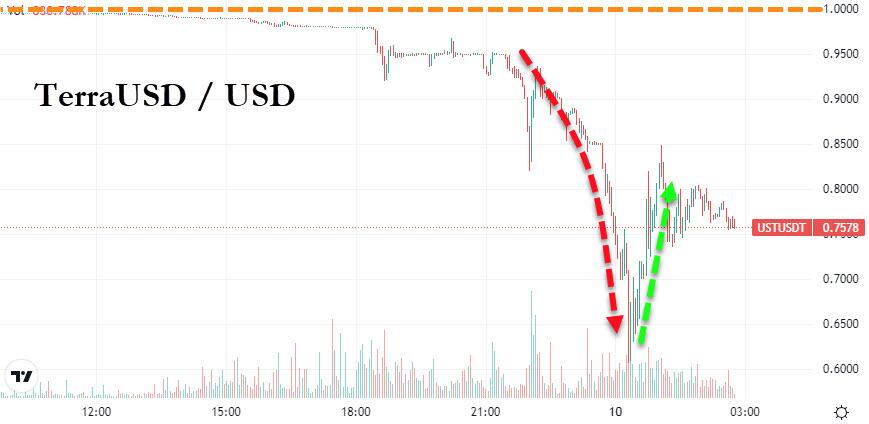
What’s been developing over the weekend and has been amplified today is the depegging of the Terra stablecoin (UST) to the U.S. dollar now with Terra currently trading at $0.85. Many of these market dynamics have been playing out in near real time today as the situation worsens and will likely change again over the next 24 hours.
It started with billions of dollars in UST leaving the high-yielding Anchor Protocol over the weekend and turned into a full-on digital bank run.
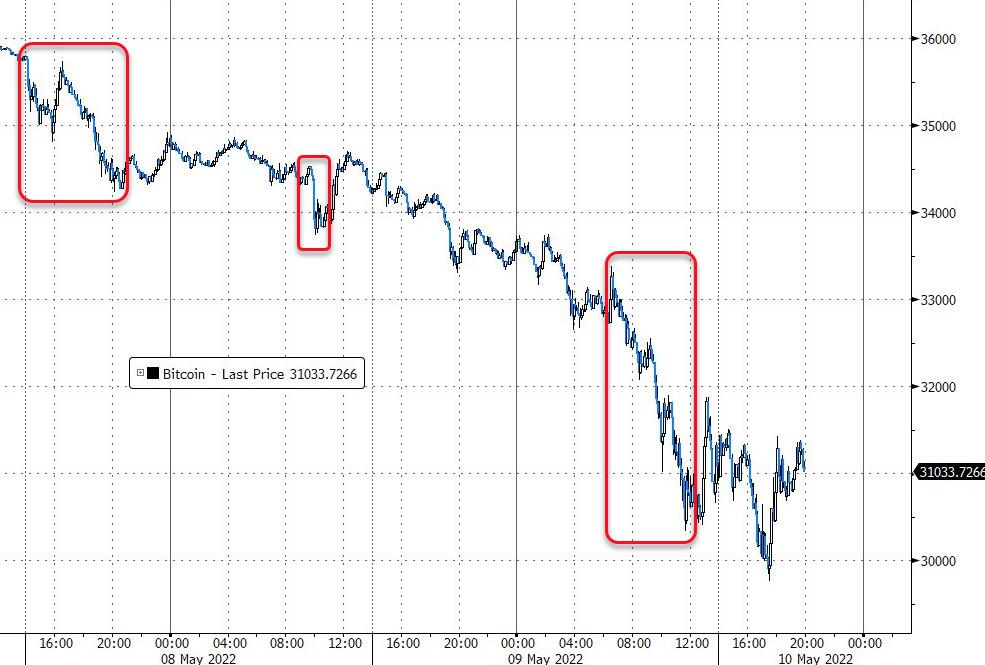
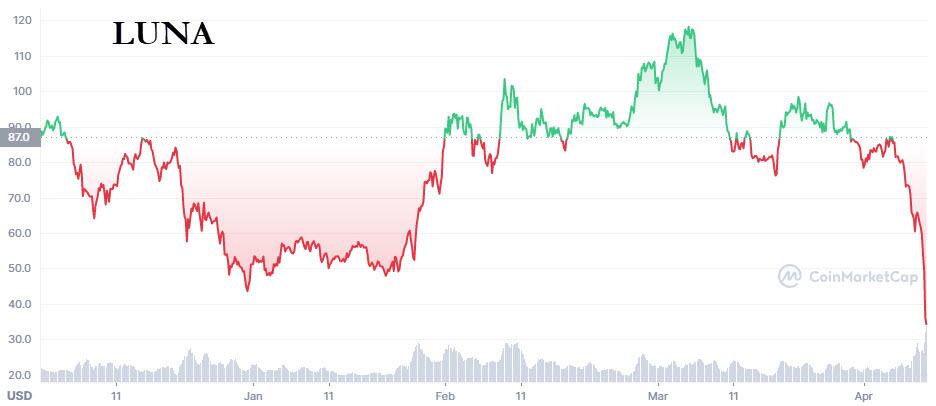
UST relies on the LUNA token to maintain its price through algorithmic minting and burning mechanics. Through this method, an arbitrage opportunity is created when UST is off its $1 peg. Traders can burn LUNA and create new UST when UST is priced over $1 and profit. When UST is below $1, UST gets burned and LUNA is minted to help stabilize the peg. Yet, as UST has suffered a blow to demand and liquidity, LUNA has fallen nearly 26% in just one day while BTC is down nearly 8%.
As UST has suffered a blow to demand and liquidity, LUNA has fallen nearly 26% in just one day while BTC is down nearly 8%.
Why this matters for bitcoin is because the centralized Luna Foundation Guard (LFG) has accumulated 42,530 bitcoin ($1.275 billion at a $30,000 price) as reserves to be used in these exact situations, to defend the UST peg when it sustains below the $1. And currently, that is exactly what they are attempting to do.
Luna Foundation Guard is attempting to leverage its BTC reserves to defend its UST peg.
As a response, the LFG voted earlier today to loan out $750 million of bitcoin and $750 million of UST to OTC trading firms in efforts to help sustain the UST peg. Later in the day, the LFG announced a withdrawal of nearly 37,000 BTC to loan out to market makers highlighting that it is currently being used to buy UST.
Now the main risk to the market is that the biggest buyer of bitcoin over the last couple months will now become the market’s biggest forced seller.
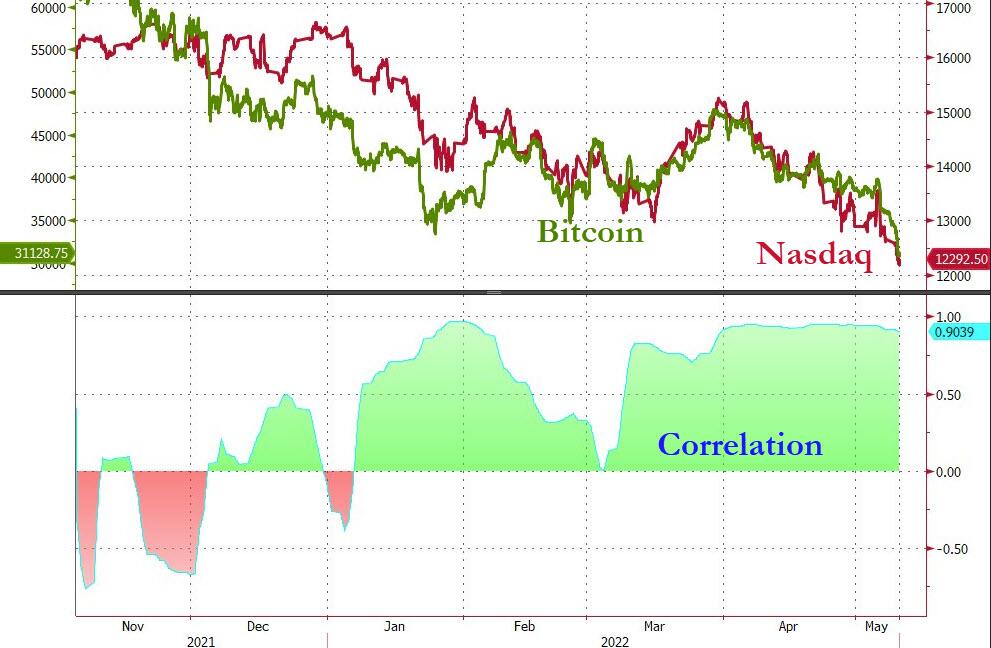
The market expectations and potential selling have certainly played a role in bitcoin’s historic selloff today, but it comes at the same time that broader equity markets have been selling off in tandem.
Bitcoin’s correlation to broader equity indexes and tech stocks is at historic highs and is following the same market dynamics since November 2021.

WSJ : Elon Musk Says His Twitter Plans Align With EU’s New Social-Media Rules

Elon Musk Says His Twitter Plans Align With EU’s New Social-Media Rules
Tech entrepreneur has emphasized free speech, leading to speculation he might relax content moderation on the social-media platform

Elon Musk said his plans for Twitter Inc. TWTR -3.69% are aligned with new European Union rules aimed at compelling social-media companies to do more to police illegal content, after his initial vision for the platform raised concerns among regulators in Europe.

Mr. Musk made the comments in a video posted Monday to the Twitter account of Europe’s commissioner for the internal market, Thierry Breton. Mr. Breton met Mr. Musk during a visit to Austin, Texas, where the two discussed the EU’s new Digital Services Act, or DSA, which lawmakers agreed to last month.

“I think we’re very much of the same mind,” Mr. Musk said in the video, in which he is standing with Mr. Breton. “Anything that my companies can do that would be beneficial to Europe, we want to do that.”

The new rules, which aren’t yet in effect, would require major social-media platforms to swiftly address illegal content and conduct regular risk assessments, among other measures, or face hefty fines.

Mr. Musk, the chief executive of Austin-based Tesla Inc. TSLA -9.07% whose $44 billion bid to buy Twitter was accepted last month, has previously said that he views the company as an important platform for free speech, leading to speculation that he intends to relax Twitter’s content moderation rules. Mr. Musk has said Twitter should be more cautious about removing content and permanently banning users, but hasn’t given precise details on how the company’s policies could change.

Twitter declined to comment. Mr. Musk didn’t immediately respond to a request for comment. He wrote on Twitter on Monday that his preference is “to hew close to the laws of countries” in which the company operates. “If the citizens want something banned, then pass a law to do so, otherwise it should be allowed.”

The exchange with Mr. Breton came two weeks after the EU official cautioned on social media and in interviews that a Twitter under Mr. Musk’s ownership would need to comply with the bloc’s new rules. “They can do whatever they want outside of Europe,” Mr. Breton said at the time. “But in Europe they will just have to fulfill rules and obligations which are very clear now.”

In the video Monday, Mr. Breton said he was “happy to be able to explain” the DSA to Mr. Musk. He said he thinks Mr. Musk understands the new rules well.

After Mr. Breton posted the video to Twitter, Mr. Musk responded, saying: “Great meeting! We are very much on the same page.”

Mr. Musk, at times, has had an adversarial relationship with U.S. regulators. For instance, he has criticized the Securities and Exchange Commission and has been seeking to overturn a settlement he agreed with the SEC in 2018. Mr. Musk also has made fun of the Federal Aviation Administration after it criticized Space Exploration Technologies Corp., the space launch company known as SpaceX that he runs, for launching a rocket without all the required paperwork.

In China, where Tesla has a large car factory, he has struck a more conciliatory tone. Tesla issued a humbling apology last year after a driver at an auto show publicly blamed Tesla brakes for an accident, after which China’s top legal-affairs agency chimed in, calling the company arrogant.

WSJ : Cryptocurrency TerraUSD Falls Below Fixed Value, Triggering Selloff

Cryptocurrency TerraUSD Falls Below Fixed Value, Triggering Selloff
Drop causes ripples in ether and bitcoin, exacerbating recent declines in their dollar values

One type of cryptocurrency, a so-called stablecoin, is meant to keep its value at $1. But on Monday, the third-biggest stablecoin, TerraUSD, fell as low as 69 cents, causing a flood of investors to sell their holdings.

Stablecoins get their name from their being tied to the value of government-issued currencies, such as the dollar. These $1 pegs are usually backed by Treasurys, cash and other dollar debt that is easily sold in times of market stress.

More than $18 billion was invested in TerraUSD as of this past weekend, making it the third-largest stablecoin, according to crypto data provider the Block. But unlike traditional stablecoins, TerraUSD is an algorithmic stablecoin. These pseudo dollars aren’t necessarily backed by any assets at all, instead relying on financial engineering to maintain their link to the dollar.

Such designs have been criticized by market observers as risky because they rely on traders to push the value back to $1 rather than having assets that continuously support the price. If traders aren’t willing to buy them, coins can go into a so-called death spiral. TerraUSD has mostly maintained its dollar peg, but it has been broken in bouts of heavy volatility.

In TerraUSD’s case, if its price falls below $1, traders can “burn” the coin—or permanently remove it from circulation—in exchange for $1 worth of new units of another cryptocurrency called Luna. That reduces the supply of TerraUSD and raises its price. Conversely, if TerraUSD climbs above $1, traders can burn Luna and create new TerraUSD. That increases supply of the stablecoin and lowers its price back toward $1.

The break in the peg, which began over the weekend, started with a series of large withdrawals of TerraUSD from Anchor Protocol, a sort of decentralized bank for crypto investors, said Ilan Solot, a partner at crypto hedge fund Tagus Capital LLP. Anchor Protocol—which is built on the technology of the same Terra blockchain network that TerraUSD is based on—had been a major factor in the growth of the stablecoin in recent months, by allowing crypto investors to earn returns of nearly 20% annually by lending out their TerraUSD holdings.

In tandem with the big withdrawals, TerraUSD was also being sold for other stablecoins backed by traditional assets through various liquidity pools that contribute to the stability of the peg, as well as through cryptocurrency exchanges.

Bitcoin’s volatility has limited its adoption for payments, so entrepreneurs created stablecoins: cryptocurrencies pegged to assets such as the U.S. dollar. But the recent settlement of a probe into the most popular stablecoin, tether, shows the need for transparency in the growing industry. Photo illustration: Sharon Shi/WSJ
The dislocation of TerraUSD from its peg caused some traders to panic and sell. To reinstate the peg, others began selling ether and buying TerraUSD, weighing on the dollar value of the second-largest cryptocurrency by market value. Some traders also sold bitcoin over the weekend in anticipation that the platform would need to sell its bitcoin reserves to support the peg, Mr. Solot said. Bitcoin fell 10% Monday to about $31,076 amid a broad selloff in the crypto markets.

TerraUSD in Monday evening trading was at about 80 cents, after touching the low of 69 cents earlier, according to CoinMarketCap. Panic selling also hit the related Luna cryptocurrency, which plunged 50% from Sunday to Monday, wiping out more than $10 billion of market value, CoinMarketCap data show.

The Luna Foundation Guard, a nonprofit supporting Terra, said it voted to support TerraUSD by lending $750 million of bitcoin to trading firms to protect the stablecoin’s peg and lending out an additional 750 million in TerraUSD to buy more bitcoin.

​Do Kwon, the South Korean developer behind TerraUSD, co-founded the Luna Foundation Guard and said this year it would run a huge bitcoin reserve fund that would spend heavily if needed to protect the stablecoin’s peg. His company, Terraform Labs, has donated several billions of dollars of crypto to the nonprofit.

“Deploying more capital—steady lads,” Mr. Kwon tweeted on Monday.

The selloff might have stemmed from someone or a group of people trying to break the peg, Mr. Solot of Tagus Capital said. Regardless of the cause, he doesn’t expect TerraUSD to return to $1 immediately since a queue of sell orders are still waiting to be processed.

“I don’t think this peg is going to come back soon,” he said. “There’s so much [TerraUSD] still to come out of the system, and that’s going to continue putting pressure on the peg.”

WSJ : Shanghai’s Covid Lockdown Gets Tougher: ‘If One Person Tests Positive, the

Shanghai’s Covid Lockdown Gets Tougher: ‘If One Person Tests Positive, the Whole Building Isolates’
Residents say authorities in Shanghai, now in its sixth week under strict lockdown, have begun forcing more people into centralized quarantine facilities

HONG KONG—After six weeks of strict lockdown, Shanghai authorities are again tightening Covid-19 restrictions amid a renewed push by central-government officials to eradicate the virus, sparking a new wave of frustration in the coastal city of 25 million people.

Though Shanghai officials haven’t formally announced any new citywide measures, residential communities and grass-roots authorities have expanded the scope of people being taken into centralized quarantine while cutting off deliveries of nonessentials to swaths of the city, according to half a dozen Shanghai residents who have received notices and shared them with The Wall Street Journal.

On Sunday and Monday, many residents received written statements and messages from neighborhood committees that manage residential communities announcing a “quiet period,” effective immediately and lasting between three and seven days, depending on the neighborhood, during which most deliveries would be halted and residents would be barred from stepping outside.

The abrupt halt in deliveries is a blow to the city’s homebound residents, tens of millions of whom have relied on deliveries as a lifeline during the extended lockdown. One residential community in Shanghai’s Xuhui district halted the distribution of medicine to residents during its three-day “quiet period,” according to a notice seen by the Journal. Authorities at another community in Huangpu district asked residents to inform them if they had any essential medicine deliveries so that they could make alternate arrangements, according to the notice, which was seen by the Journal.

Separately, Shanghai residents over the weekend began sharing their experiences of having been forced into temporary isolation facilities or hotels after their neighbors tested positive for Covid-19. A hashtag on China’s Twitter-like social-media platform Weibo reading: “If one person tests positive, the whole building isolates,” has garnered more than five million views since Saturday.

Some said their apartment units were either next to, above or below the apartment of someone who had tested positive for Covid-19. Some said they live on the same floor and some in the same building. Two Shanghai residents said they knew people who had been taken away to quarantine after a neighbor had tested positive. The Journal couldn’t independently verify those claims.

The Shanghai government didn’t respond to a request for comment.

The tightened measures in Shanghai come as daily Covid-19 cases in the city have dropped after six weeks of severe restrictions on people’s movement. On Monday, Shanghai authorities reported 3,947 new infections for the previous day, marking the sixth consecutive day that cases were below 5,000. The city, which is battling China’s worst outbreak since the virus emerged in China two years ago, has recorded more than 620,000 cases and 547 deaths since March 1.

Despite the steady decline in infections, Shanghai authorities’ tighter measures appear to be a response to a renewed push by senior Communist Party officials in Beijing to smother any traces of the highly transmissible Omicron variant of the coronavirus. Following a meeting Thursday, the Communist Party’s Politburo Standing Committee, China’s top decision-making body, compared the pandemic measures in Shanghai with a war that must be won.

After the meeting in Beijing, Shanghai’s top Communist Party and municipal officials echoed that language, vowing to follow orders and triumph in what they called the “Great Shanghai Defensive War.” Employing military metaphors, the officials, led by Shanghai’s Communist Party chief Li Qiang, pledged to “set down military orders and overcome 10,000 difficulties to charge forward in attack!”

Shanghai has been trying to contain all infections to isolation facilities, with the aim of eliminating every Covid-19 case in the wider community before reopening. But it has been struggling to do so.

Forcibly transferring neighbors of infected people to centralized quarantine would mark an escalation from the current practice of transferring only those who have tested positive for Covid-19—and, on occasion, those who live with them. That policy had already triggered widespread criticism for forcing the elderly into poorly equipped temporary isolation facilities without providing access to appropriate care.

As Shanghai authorities’ restrictions have gotten tougher, some prominent voices in the city have begun to openly question the legality of the measures.

Tong Zhiwei, a professor of constitutional law at Shanghai’s East China University of Political Science and Law, wrote in a widely circulated open letter, which he shared on several chat groups on Sunday, that practices such as forcing residents into quarantine can’t be undertaken without formal approval from the State Council, China’s cabinet, or the Standing Committee of the National People’s Congress, its legislature.

Mr. Tong confirmed in a phone interview that he had written the letter, which disappeared from Chinese websites almost as soon as it was shared by others. Mr. Tong said in the interview that some residents had reached out to him to express concerns that their personal freedoms were being threatened by Shanghai’s Covid-19 control measures. “As someone who studies constitutional laws, I feel a responsibility to speak up,” he said.

Another open letter, attributed to Liu Dali, a corporate lawyer in Shanghai, and addressed to the Shanghai Municipal People’s Congress, the city’s local legislative body, also circulated widely online on Sunday. The letter called on authorities to reverse the policy of quarantining neighbors of infected patients, which he said the government was enforcing without any formal announcement. The letter said the measures infringed on people’s basic rights, wouldn’t help the fight against the pandemic and didn’t give residents time to prepare. Mr. Liu couldn’t be reached for comment by phone or through his WeChat account. Three people who know Mr. Liu said he had written the letter.

The letters struck a nerve among frustrated Shanghai residents after a month and a half of strict lockdowns. The decline in cases had raised hopes that pandemic measures could ease further, but the new round of tightening has pushed that prospect further into the future.

On Chinese social-media platforms, videos of officials in white, full-body protective medical suits announcing and enforcing what appeared to be the new rules circulated widely, prompting further anger and confusion.

“Residents, please don’t go out. If one person gets positive, everyone in the building will be taken away,” officials could be seen shouting while patrolling a neighborhood in a video on Douyin, the domestic version of short-video platform TikTok.

Another video showed police officers in protective suits telling residents living on the same floor with a confirmed Covid-19 case that they too would be transferred to a centralized quarantine facility.

“I hope you cooperate. Only when you don’t cooperate will we force you to be transferred,” one man is heard saying in the video. “But we are not sick,” a woman replied. The authenticity of the videos couldn’t be verified.

Across the city, public-health measures haven’t always been consistent and, even before the latest measures, some residents in Shanghai had reported signs of tightened rules.

Xu Ziwen, a 37-year-old finance employee who lives in central Shanghai’s Huangpu district, said her compound had reported no infections before the lockdown but has since reported hundreds of cases. On Saturday, 33 of the 35 buildings in her apartment complex—where positive cases had been detected—were boarded up with wooden planks and locked by men in white protective suits, she said. Her account couldn’t be independently confirmed.

“What if there is a fire?” she said. She said she has only been allowed to leave her apartment unit twice since March 15, other than to do Covid-19 tests.

One woman, a 30-year-old teacher in Shanghai who asked to only be identified by her surname Wu, said after positive cases were found on three floors of her apartment building in Shanghai’s Minhang district earlier this month, all residents on those three floors were transferred to a serviced apartment for quarantine.

“I am really scared,” she said. “I don’t know who lives next to me. What if the person who lives next door is positive?”
>>> Stoxx 600 Pre-Market Indications

  • Swedish Match (SWMC TH) +17%
    • Swedish Match Confirms Talks on Possible Philip Morris Offer (1)
  • IAG (INR TH) +2.9%
  • ING (INN1 TH) +2.4%
  • Rio Tinto (RIO1 TH) +2.4%
  • Erste (EBO TH) +2.1%
  • Rational (RAA TH) +2%
  • Lanxess (LXS TH) +2%
    • Lanxess at Non-Deal Roadshow Hosted By Stifel, Nicolaus & Co
  • Renault (RNL TH) +1.9%
    • Renault Confirms Mobilize to Account for 20% of 2030 Group Rev.
  • Prosus (1TY TH) +1.8%
  • Vestas (VWSB TH) +1.8%
  • Just Eat Takeaway (T5W TH) -0.6%
  • Enagas (EG4 TH) -0.7%
  • Sartorius (SRT3 TH) -0.7%
  • Shell (R6C0 TH) -0.8%
  • Evotec SE (EVT TH) -0.9%
  • Novo Nordisk (NOVC TH) -1%
  • Qiagen (QIA TH) -1.4%
  • Tomra (TMR TH) -1.7%
  • Equinor (DNQ TH) -2.3%
    • Equinor Sells Assets in Ekofisk Area, Martin Linge for $1B
  • Argenx (1AE TH) -3.5%