FT : There will be blood

There will be blood
Deutsche Bank predicts that the US corporate default rate will spike to 10 per cent

When he is not regaling us with daily tales of shrubbery thefts, a medley of injuries, golf and some markets, Jim Reid writes Deutsche Bank’s annual Default Study. The 24th one just landed in FT Alphaville’s inbox, and, as ever, it makes for interesting reading.

First of all, it is remarkable just how tranquil a period it has been for corporate debt.

Last year saw one of the lowest junk bond default counts in a decade, and despite the recent market jitters, only 31 companies have defaulted globally this year, the lowest run rate since 2014 according to S&P Global. Even the rolling default rate of uber-junky triple-C rated US companies is the lowest it’s been for nearly four decades, according to Deutsche Bank.

The reality is that aside from a few notably awful spells in the immediate aftermath of the Covid-19 outbreak and the 2008 financial crisis, it’s been a pretty great two decades for corporate debt, with defaults trending lower and lower.

But Reid now sees a regime change lurking.

For most of this study’s history we’ve been convinced the ultra-low default world would hold for as far as the eye can see. However, this year we speculate that things might become more difficult for corporates in the years ahead.

Our view has long been that inflation would rise this decade for structural reasons. The pandemic and the aftermath has accelerated and exaggerated this. We’ve previously been relaxed about higher inflation vis-à-vis defaults as we’ve thought the authorities would still have to heavily rely on financial repression to ensure the mammoth global debt pile could be smoothly financed in such a world.

However, we now think that such a scenario might be more challenging for funding than we’ve believed in years gone by. Although financial repression will likely stay to some degree, policymakers may find it more difficult to pull all the easy policy levers as they’ve done in the last few decades.

As such, we think there’ll be a tug of war between real yields and term premium naturally trending higher (bad for defaults) versus a desire (or need) for the authorities to intervene to prevent the debt super cycle from being exposed (good for defaults). The latter support may be slower to materialise, less aggressive, and more targeted than we’ve been used to if we move to a higher inflation world.

The “good” news is that Reid doesn’t think creditpocalypse is already upon us, as some have fretted. DB forecasts that the overall US junk bond default rate will climb to 5 per cent by the end of 2023 — the year it expects a recession to start — before peaking at 10.3 per cent in 2024.


The default rate for top-tier junk bonds (rated double-Bs) will only peak at 2 per cent, but Deutsche Bank thinks almost half of all triple-C bonds will end up in default.

Defaults will then moderate, but more slowly than has been the norm over the past two decades, and remain elevated at around 4-5 per cent by the end of 2025, DB predicts.

Europe will probably experience a notably less acute default cycle, with the default rate there climbing to 3.8 per cent by the end of 2023, peak at a more sedate 6.6 per cent in 2024 and then drift back to 2-4 per cent.

Defaults in emerging markets, meanwhile, are already on the rise. “Many issuers in the region have been able to pass through rising costs to customers — at least for now — though financing conditions are also tightening,” according to a report from S&P Global Ratings.


There are many reasons why Reid thinks defaults are likely to be structurally higher in the coming era, such as corporate profit margins becoming compressed.

But his central argument is that business cycles will become shorter than more volatile they have been in recent decades, as faster and more entrenched inflation limits how aggressively central banks can react to downturns.

I’ve been on the record as saying that with the debt mountain as it is, the authorities had to almost permanently use financial repression to keep spot real yields negative for the rest of my career. If they turned positive for any length of time, I felt the global debt mountain would be at risk of seeing hard defaults and systemic attacks.

I must admit now inflation is raging, I’m more nervous that there could be periods where the authorities are more powerless when it comes to controlling yields than they have been for the last couple of decades.

. . . If inflation proves stickier over the next decade, then policymakers will have less flexibility to rapidly and aggressively respond to wobbles, crises and recessions. As such, the central bank put may be more difficult to rely on. Business cycles may roll over more frequently than they have over the last few decades, which will likely add to the structural default rate as investors can no longer rely on the authorities in the same way as they have done over the last few decades.
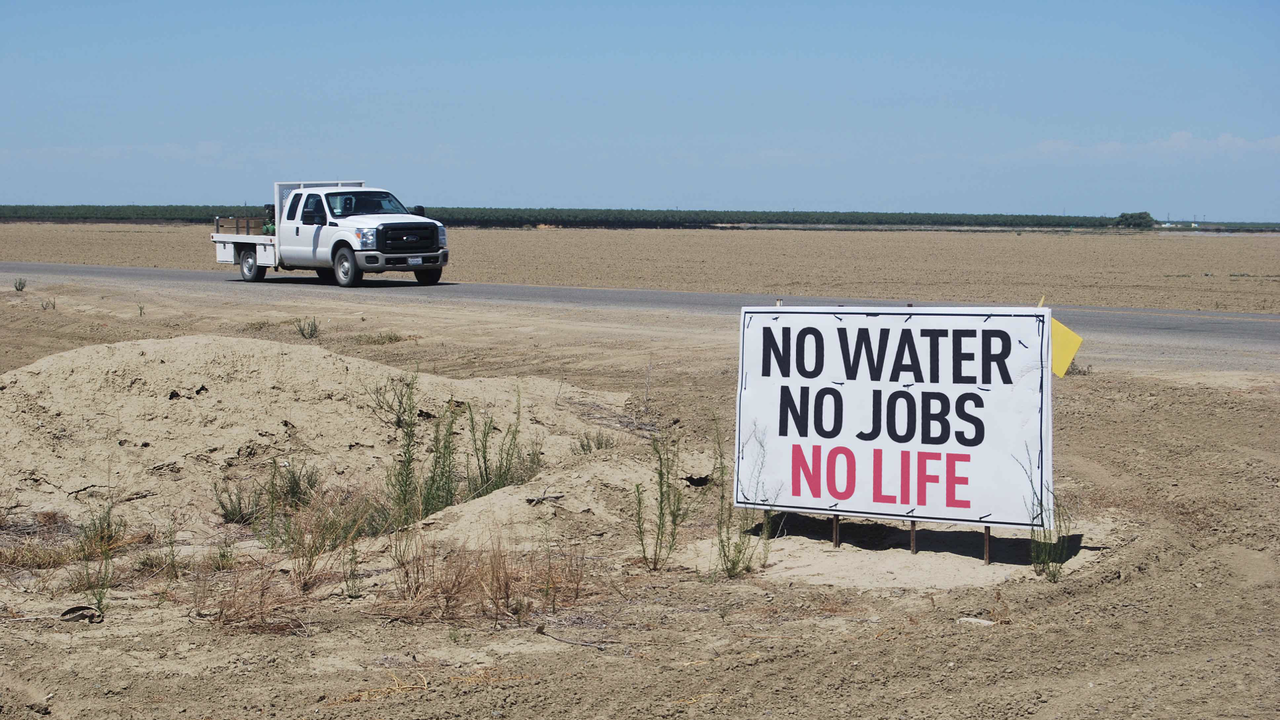
(ZH) California Lawmakers Want To Buy Up Water Rights And Cut Farming To Stave O

California Lawmakers Want To Buy Up Water Rights And Cut Farming To Stave Off Drought

In places like California, water is a hot commodity these days. With a drought in play everyone is looking for someone else to blame, various cities are ordering cuts to daily use for families and individuals, and the primary target for now is California farmers and their legally protected water rights. It is these same rights that legislators now want to "buy" in order to shut down or greatly decrease agricultural production.
California, like most of the world, has a long history of intermittent droughts. Such droughts are simply a fact of life and there is nothing abnormal or extreme about today's conditions when taking past weather events into account. If you ask the mainstream media, though, they will tell you this is the "worst drought in 1200 years" and climate change is the cause.
This is, of course, simply not true. The California droughts in 1976-1977 and 1987-1992 were just as bad if not worse overall than the conditions of today. That's not to say that the current situation is stable, far from it, but the Chicken Little panic on display in the media is driven far more by agenda than by reality. It has become a standard tactic these days to connect every single inconvenient weather scenario to "global warming" despite the fact that there is no evidence to support the claim. There has been an endless array of droughts in CA long before man-made carbon existed.
Climate cultism has perhaps obscured the much bigger problem of water resources in one of the biggest produce growing states in the US, all in the middle of an inflationary crisis that is heading towards mass food shortages according to every single international economic foundation in the world and the Biden Administration. Of course, these foundations helped create the inflationary problems we are facing, and diverting public attention over to weather events and so-called climate change is rather advantageous for them.
In the midst of this circus rages a longstanding battle between California farmers with "senior water rights" and the state government. The majority of California farmland rests in the Central Valley with access to the Sacramento river and other tributaries, and water rights legally protect those farms and their access to these resources. State legislators, environmentalists and people who don't know any better argue that these farms use too much water and should be restricted while the state is under drought conditions.
Some of the more exaggerated stats suggest farms use up to 80% of the state water supply, but more grounded estimates place their usage closer to 40%. Over 50% of California water is already protected and reserved for environmental purposes. Already, hundreds of thousands of acres of farmland are idle and unproductive due to federal cutbacks.
California grows around 30% of America's vegetables and 60% of US fruits and nuts, so it's not surprising that these farms need large amounts of water to operate. This is also the only major industry within the state (beyond shipping ports) that produces necessary commodities for the nation. The tech industry and social media, tourism and Hollywood are not necessary when it comes to an inflationary crisis and are currently shriveling on the economic vine. What matters are commodities that keep people alive and produced in large quantities in order to keep prices down.
The hostility towards CA farmers underscores a misunderstanding of the importance of the industry and in some ways distracts from the mismanagement of ground water resources within major cities. Los Angeles is a notorious water hogging mess of a town, siphoning H2O from the Sacramento River, the Sierras and the Colorado River, and not producing anywhere near enough locally through wells and aquifers. According to the Sierra Club, LA snatches 85% of its water from outside sources.
Essentially, the city should not exist in its current form if logistics are taken into account. And, let's be honest, California is run out of LA and San Fransisco, not Sacramento. The rest of the state is treated as secondary or unimportant by these two population centers.
This has triggered a bit of animosity from many in rural areas and other western states towards California. LA and its inability to provide for itself may have helped inspire a recent agreement reducing water usage from the Colorado River in December of last year. These cuts affect LA the most and this is likely why the city and the state seem to be panicking even more than usual over supplies.
Water management and increasing local sources usually falls at the bottom of the list of solutions among state legislators. It may be that farmers in the state could make some cuts; we have yet to see an analysis on how this would negatively affect crops. But why should they? At bottom, CA farmers are far more important because they actually produce something useful at a time when the country desperately needs to meet food demands and prevent further price inflation. What does LA and San Fransisco produce, other than complaints?
Finally, we have to ask, what if legislators try to buy senior water rights but farmers refuse to sell? What happens then?

>>> US Research Calls

Research Calls

  • Upgrades:
    • AmerisourceBergen (ABC) upgraded to Buy from Hold at Deutsche Bank; tgt raised to $178
    • Anglo American (NGLOY) upgraded to Buy from Hold at Jefferies
    • Arch Coal (ARCH) upgraded to Buy from Hold at Jefferies; tgt raised to $225
    • BHP Group (BHP) upgraded to Buy from Hold at Jefferies; tgt raised to $82
    • British Land (BTLCY) upgraded to Overweight from Underweight at Barclays
    • Exxon Mobil (XOM) upgraded to Outperform from In-line at Evercore ISI; tgt raised to $120
    • Lear (LEA) upgraded to Overweight from Equal Weight at Wells Fargo; tgt raised to $180
    • Liberty Global (LBTYA) upgraded to Buy from Hold at Berenberg; tgt $30
    • McKesson (MCK) upgraded to Buy from Hold at Deutsche Bank; tgt raised to $378
    • Mirati Therapeutics (MRTX) upgraded to Mkt Outperform from Mkt Perform at JMP Securities; tgt $72
    • Novo Nordisk A/S (NVO) upgraded to Overweight from Neutral at JP Morgan
    • Plexus (PLXS) upgraded to Outperform from Mkt Perform at Raymond James; tgt $100
    • Peabody Energy (BTU) upgraded to Buy from Hold at Jefferies; tgt raised to $36
    • Ramaco Resources (METC) upgraded to Buy from Hold at Jefferies; tgt raised to $25
    • Rio Tinto (RIO) upgraded to Buy from Hold at Jefferies; tgt raised to $93
    • South32 (SOUHY) upgraded to Buy from Hold at Jefferies
    • Tyler Tech (TYL) upgraded to Overweight from Equal Weight at Wells Fargo; tgt raised to $435
    • Vale S.A. (VALE) upgraded to Buy from Hold at Jefferies; tgt raised to $24
    • Warrior Met Coal (HCC) upgraded to Buy from Hold at Jefferies; tgt raised to $50
    • XP (XP) upgraded to Buy from Neutral at UBS; tgt lowered to $31
  • Downgrades:
    • Booz Allen Hamilton (BAH) downgraded to Equal Weight from Overweight at Barclays; tgt $95
    • Devon Energy (DVN) downgraded to In-line from Outperform at Evercore ISI; tgt $80
    • Leidos (LDOS) downgraded to Equal Weight from Overweight at Barclays; tgt $105
    • Occidental Petro (OXY) downgraded to In-line from Outperform at Evercore ISI; tgt $74
  • Others:
    • GXO Logistics (GXO) resumed with an Equal Weight at Barclays; tgt $60
    • Marqeta (MQ) initiated with a Buy at UBS; tgt $14
    • ProFrac Holding (PFHC) initiated with a Buy at Seaport Research Partners; tgt $26
    • ProFrac Holding (PFHC) initiated with a Buy at Stifel; tgt $24
    • ProFrac Holding (PFHC) initiated with an Overweight at JP Morgan; tgt $25
    • ProFrac Holding (PFHC) initiated with an Overweight at Morgan Stanley; tgt $30
    • ProFrac Holding (PFHC) initiated with an Overweight at Piper Sandler; tgt $31.50
    • RLI Corp (RLI) initiated with a Mkt Perform at Raymond James
    • WalkMe Ltd. (WKME) resumed with an Equal-Weight at Morgan Stanley; tgt $13

>>> US Gapping down

Gapping down
In reaction to earnings/guidance
:

  • TGT -9.1% (lowers guidance), MOMO -5%, WELL -2.3% (raises its Q2 FFO guidance), REVG -1.8%, SJM -1.6%, TSCO -1.3% (guides Q2 EPS and revs slightly above consensus)

Select TGT peers showing early weakness:

  • WMT -3.4%, COST -3.3%, M -3.2%, WSM -3.2%, JWN -2.1%, BBBY -2.1%, TJX -2%

Other news:

  • ENOB -9% (provides updates to previously disclosed misrepresentations)
  • RVP -8% (announces workforce reduction)
  • TWTR -1.7% (Texas AG launches investigation into TWTR over fake bot accounts)
  • EBS -1.5% (JNJ plans to terminate Covid-19 vaccine supply deal with EBS, according to WSJ)
  • ZM -1.5% (hires Google Cloud exec to oversee go-to-market strategy)

Analyst comments:

  • LDOS -1.1% (downgraded to Equal Weight from Overweight at Barclays)
  • BAH -1% (downgraded to Equal Weight from Overweight at Barclays)
  • OXY -0.8% (downgraded to In-line from Outperform at Evercore ISI)

>>> US Gapping up

Gapping up
In reaction to earnings/guidance
:

  • GTLB +8.5%, UNFI +6.9%, PLAY +6.3%, GIII +5.6%, HQY +4.2%

Other news:

  • KSS +10.4% (Board of Directors enters into three-week exclusive negotiations with Franchise Group (FRG)
  • ANNX +4.6% (reports phase 2 clinical trial results demonstrating upstream classical complement inhibition associated with clinical benefit in Huntington's disease)
  • NVAX +3.7% (FDA will hold meeting regarding NVAX COVID-19 vaccine for individuals 18 and older today at 8:30 ET)
  • VERU +2.7% (Tang Capital discloses 5.2% stake; submits emergency use authorization application to U.S. FDA for Sabizabulin)
  • FRG +2.7% (KSS Board of Directors enters into three-week exclusive negotiations with Franchise Group (FRG)
  • DNA +1.4% (collaboration with Novo Nordisk (NVO) to create novel expression hosts for pharmaceutical products)
  • RELY +1.1% (names new CFO)
  • FSM +1.1% (drills 18.3 g/t gold over 11.9 meters at the Séguéla Project, Côte d'Ivoire)
  • LSCC +1% (expands partnership with AMI)
  • PTON +1% (CFO to step down; names new CFO)

Analyst comments:

  • MRTX +4.5% (upgraded to Mkt Outperform from Mkt Perform at JMP Securities)
  • ARCH +2.5% (upgraded to Buy from Hold at Jefferies)
  • NVO +2.1% (upgraded to Overweight from Neutral at JP Morgan)
  • BTU +1.8% (upgraded to Buy from Hold at Jefferies)
  • METC +1.5% (upgraded to Buy from Hold at Jefferies)
  • RIO +1.4% (upgraded to Buy from Hold at Jefferies)
  • ABC +0.9% (upgraded to Buy from Hold at Deutsche Bank)

>>> US Early premarket gappers

Early premarket gappers

  • Gapping up:
    • KSS +14.3%, RWT +12.5%, GTLB +10.7%, NVAX +4.1%, EBS +3%, FRG +2.7%, HQY +2.5%, VERU +1.9%, LLY +1.2%, RELY +1.1%, FSM +1.1%, LSCC +1%, PTON +1%, TNDM +0.8%, COUP +0.8%, NHI +0.6%, KKR +0.5%, TSCO +0.5%
  • Gapping down:
    • RVP -8%, SDC -3.1%, MOMO -2.7%, WELL -2.3%, TWTR -1.6%, RIG -1.4%, GVA -1.1%, ZM -0.8%

>>> BAE Systems : To showcase combat vehicles and advanced defense technologies

To showcase combat vehicles and advanced defense technologies during Eurosatory defense and security tradeshow in Paris June 13-17

Will display a broad range of capabilities during the Eurosatory defense and security tradeshow in Paris June 13-17; including combat vehicles, artillery systems, and technologies for precision strike and situational awareness.

The full size vehicles on display at outdoor stand C371 in area Pe6a are the CV90MkIV infantry fighting vehicle which was recently selected by the Slovakia Ministry of Defence as its preferred system for the procurement of Infantry Fighting Vehicles (IFVs) for the Slovak Army, the ARCHER 155mm mobile howitzer, and the BvS10 all-terrain vehicle, along with advanced guided weapon systems and situational awareness technologies.

>>> Tuesday Morning Papers Summary

Tuesday Morning Papers Summary

LA REPUBBLICA
-European Best Destinations is a Brussels-based organization that promotes travel in Europe. Each year the association draws up rankings based on real surveys conducted among the European population. This year, those surveyed have identified seven ‘dream beaches’ from the top 22 located throughout the European continent. Therefore, one in three of the most coveted and fascinating beaches in Europe is located in Italy. Due to waters, which have long been counted among the cleanest and richest in biodiversity in the world, Sardinia has three of the seven starting with Cala Goloritzé , in the province of Nuoro. Then there is Cala dei Gabbiani , a natural continuation of the very popular Cala Mariolu, also on the Gulf of Orosei, and Cala Cipolla, one of the pearls of the Chia bay, in the south of the island. In Tuscany there’s the island of Elba along with Cavoli beach and La Sorgente. Puglia could not be missing from the list, now a beloved destination by tourists from all over the world. Baia delle Zagare in the Gargano promontory was one of the top beaches. Last but not least, in the list of European Best Destinations there is Campania with the Cauco beach , of sand and gravel, unique for its crystalline sea and the sloping seabed towards the open sea. It is located less than half an hour southwest of Salerno.

FRANKFURTER ALLGEMEINE ZEITUNG
-In the Baltic States, Scholz will find little support for his and Paris's policies. The Baltics do not fear Putin's humiliation as much as they do humiliation from the West. After his Berlin meeting before the Russian invasion, Chancellor Olaf Scholz will meet the heads of government from Latvia and Estonia and the Lithuanian President in Vilnius today. There has been a slightly different philosophy towards Russia than in Berlin for the past three decades. In this corner of Europe, experience has taught (them) not to underestimate Russia's will to expand.
-What does former Chancellor Angela Merkel say about her successor Chancellor Scholz and the war? Half a year after the end of her chancellorship, Angela Merkel has engaged in a ‘public discussion’ for the first time. She wants to face “the challenging questions of our time”.Relations with Russia: The conversation between Merkel and "Spiegel" editor Alexander Osang will take place on Tuesday at 8 pm in the Berliner Ensemble and will be broadcast live. In addition to the war in Ukraine, it should also be about Merkel's relationship with Russia and her view of the work of Chancellor Olaf Scholz and the current political situation in Germany.

HANDELSBLATT
The software from Volkswagen should be groundbreaking according to the website of the subsidiary Cariad, which was founded in 2020. But after start-up investments valued at some EUR6B, the future project mainly produces trouble. The various programs are very slow and not compatible with each other, while the promised leaps in quality are not forthcoming. The cause of the ‘misery’ stems from a fundamental rift on the board. At the beginning of the year, VW CEO Herbert Diess took over responsibility for Cariad from Audi CEO Markus Duesmann. Today they both blame each other for the problems. Porsche CEO Oliver Blume is also upset, as the controversial software does not fit into the success story of the sports car manufacturer's planned IPO.
-As a result of the war in Ukraine, the current German government coalition (so-called ‘traffic light’) has had to change course on energy policy. Security of supply has become just as urgent as climate protection. The situation has forced consumers to reconsider their energy consumption: there are new arguments for electric cars or heat pumps.People are dramatically feeling the rising prices for electricity, oil and gas. Is it really realistic to extract 100% of a country’s energy needs from renewables? How will the CO2 price develop?

IL SOLE 24 ORE
-The European Union has reached an agreement on the minimum wage, announcing it through the Social Affairs Commission of the European Parliament’s Twitter account. The new directive on the European minimum wage now awaits the approval of the Plenary of the EU Parliament (which, however, can no longer amend the text) and the ratification of the EU Council. It will then be up to the member countries to implement it. According to the latest rumors about the agreement in the EU, there will be no maximum and minimum wages. Instead, the directive will aim to establish a framework for setting adequate and fair minimum wages. Italy is among the six EU countries without regulation on the subject: the issue is at the center of a political clash in the majority and it has fueled the debate between the social forces.
-Energy might be expensive for consumers, but it has made the state richer. In the first four months of the year, the Italian Treasury collected between VAT and excise duties on energy products, earning some EUR3.7B more than in the same period of 2021. Driving the higher revenue is above all the VAT on imports, which has grown by almost EUR2B, accounting for a 55.1% increase. An increase which, as the Finance Department explains, is largely attributable to the dynamics of the oil price. In the month of April alone, crude oil experienced a trend rise of 62 percent. Not least the excise duties, despite the government's actions to soften the increases in the bill and at the pump. On electricity and gas, for example, the highest overall revenues for the state amounted to over EUR1.3B.

LES ECHOS
-Inflation will give the budget management teams cold sweats this summer. The bill on purchasing power, which provides for new public spending (pensions, food, etc.), must be presented at the end of June but it will not end the problem. Far from that. The exceptionally high rise in prices that we have been seeing for months – the 5% bar was crossed in May – will also raise the question of the level of revaluation of the income tax scale. In its draft budget for 2023, will the finance minister maintain indexation to inflation? This would protect the purchasing power of taxpayers. But it would also be expensive for the state.
-Globalization has never been completely accepted even though it has lifted hundreds of millions of people out of poverty. It was also accompanied by a problem of redistribution of wealth between countries and within countries themselves. These inequalities in distribution gave rise to a second wave of recriminations from anti-globalists. Their movement has been fueled by a perception that China's entry into the World Trade Organization (WTO) has led to job losses in Western countries, for example.

ABC
-During the gradual US rapprochement with Spain that should culminate in Joe Biden's trip to Madrid to participate in the Atlantic Alliance summit at the end of this month, there is an unresolved issue on which Pedro Sánchez's Executive has managed to convince his counterpart only partially: a series of harsh penalties for Spanish producers and companies, in the form of tariffs and sanctions that have lasted since the Trump era: Large Spanish companies continue to pay a high price for the sanctions against Cuba and Venezuela, and the harmful tariffs on black olives and wind towers have not been completely withdrawn, as the Spanish government expected after several ministerial visits to Washington. It is true that Repsol has now been allowed to send a limited amount of Venezuelan crude to Europe, but this is minimal and covers debt, and the company cannot, unlike the North American Chevron, explore new agreements with the Venezuelan government.