(ZH) Hedge Funds Had A Horrible May... And Then They Missed The Month-End Ramp

Hedge Funds Had A Horrible May... And Then They Missed The Month-End Ramp

May was a volatile month for equity markets, starting off ugly and closing strong, but while most equity indices were able to finish slightly green for the month given the large rally in the final full week of May, the same cannot be said for hedge funds.
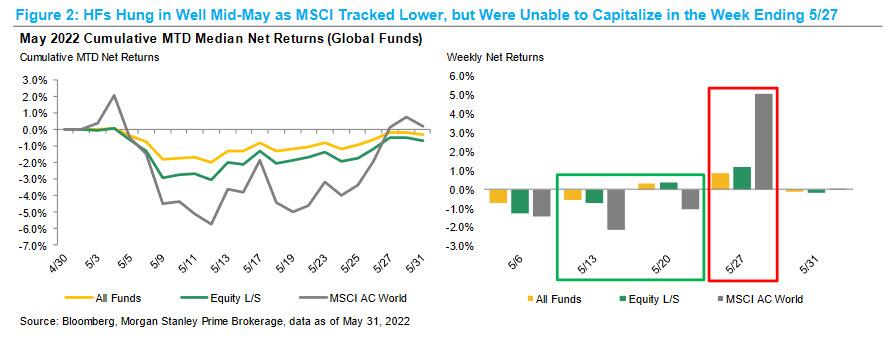
According to the latest weekly report from Morgan Stanley Prime Brokerage (available to pro subscribers), Hedge Funds had felt (and were hammered by) a large portion of the market downside in the first part of May but then hung in well mid-month given most strategies were running lighter net levels at the time. That was as good as it gets however, and HFs then struggled to make back their losses in the final full week of May, capturing only a portion of the rally. This left the average global fund down ~1% for the month.
Digging deeper we find that while the performance of equity markets was quite volatile throughout the month, we did not see nearly the same levels of volatility in HF returns, perhaps due to most strategies running at much lighter net leverage levels (more on HF leverage and positioning below).
According to MS, most of the performance ‘pain’ was felt in the week ending May 6, with HFs posting losses in-line with the MSCI – this also coincided with L/S funds beginning to de-gross. HFs then performed in line with the market for two weeks (weeks ending May 13 & May 20) as HF de-grossing took a pause after May 9, and then HFs returned to adding to gross exposure while keeping nets light.
However, the moderate levels of net leverage then caused HFs to miss out on a large portion of the rally in the week ending May 27 – this lack of upside capture amidst this rally is what ultimately led HFs to lag the index for the month
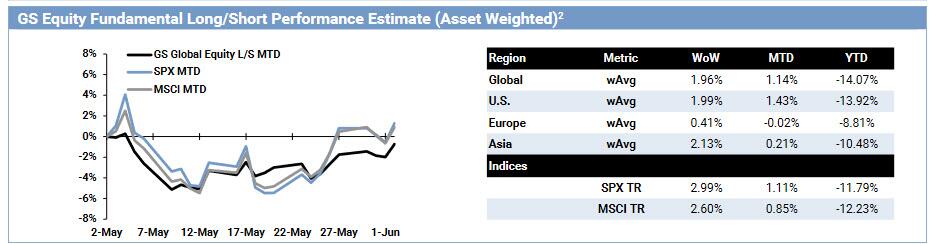
Goldman's Prime Desk makes a similar conclusion in its May performance post-mortem.
Another notable observation: while performance across all strategies tracked indices relatively well (except for the late month ramp), there is a lot of dispersion both across strategies and intra-strategy through May – the spread between the 90th %-tile and 10th %-tile performers is currently the 2nd widest Morgan Stanley Prime has seen since 2010, trailing only 2020 by a small margin. Among the top performers this year based on investor letters received through April are Systematic Macro (+14.3%), Disc. Macro (+8.3%) and Energy-focused (+4.2%), and while there has been only a small sample of funds who’ve reported for May, these strategies all outperformed the avg. global fund last month. The weaker performers this year have been traditional L/S strategies (-8.4% through May based on our prop estimate), particularly TMT-and HC-focused funds (both down ~14% through Apr based on letters).
Drilling down into L/S fund performance, global Equity L/S total alpha was negative this past month, all of which was driven by the long side given shorts generated positive alpha of ~1%. Longs held globally by L/S funds fell ~2.4% last month vs. the MSCI ending up +0.2%, representing a negative spread of -2.6%.
Even more embarrassing for the billionaires who make up the 2 and 20 crowd - like Gabe Plotkin - this was the 8th consecutive month where long alpha has been negative, the longest stretch we have seen since we began tracking the data in 2010.
Meanwhile, the spread of -2.6% represented the 6th time in the past 8 months where the spread was lower than -2%. To put this into perspective, for the period from the start of 2010 through the end of 3Q 2021, the spread between longs and the MSCI was worse than -2% only nine times.
Looking at global HF positioning and leverage, MS Prime finds two main themes:
  • THEME #1: HFs Continue to Sell Global Equities, Led by US and China
HFs sold global equities for the 6th consecutive month, with the magnitude of the selling in May larger than what we saw in
April, but smaller than March’s flow.
The selling can be attributed to Equity L/S (long selling) and Stat Arb/Quant (short adds)
funds, and by region, split between N. America, Asia ex-Japan, and LatAm – HFs were, however, net buyers of both Europe
and Japan.
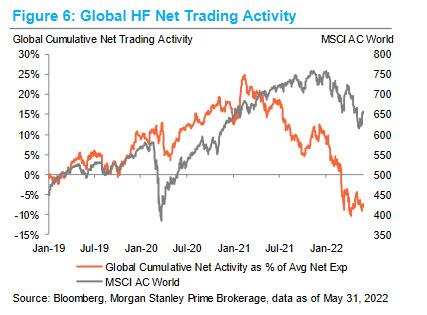
The Global L/S ratio (ex. Quants) ended just above 2.0x at the end of May, right around where it ended in Apr. At its low, the ratio fell all the way to 2.01x but has yet to break below the 2.0x barrier – the last time it did so was in April of 2020.
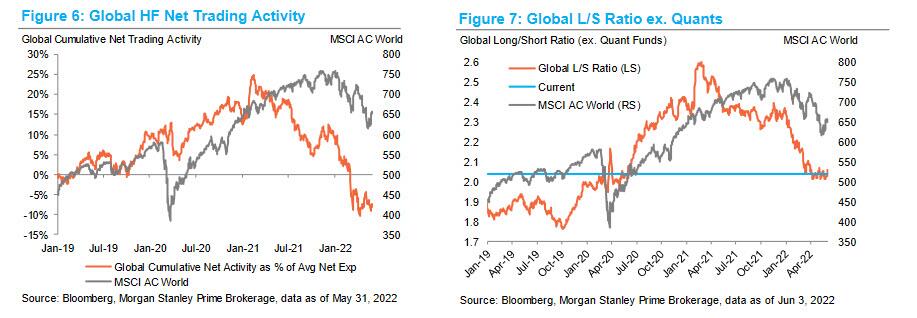
  • THEME #2: L/S Funds Trim Gross Exp; Gross Lev Now Light Across Most Major Strategies
More important even than dismal performance, May ended up being one the largest month in terms of active gross reductions Morgan Stanley Prime has seen YTD by L/S funds, with most of the gross exposure trimmed specifically within the US and China. While this month was far from the most extreme seen in recent years (Jan ’21 was ~4x larger), it is still a notable break in trend from the gross adds that occurred in April. US L/S gross leverage reached a ~2-year low of ~175% intra-month before recovering to 182% by month-end – in addition to US L/S gross lev, gross across many of the major strategies also hit a 12M low in May and remains in the <10th %-tile both over the last 12M and the last 5 years as of last week.
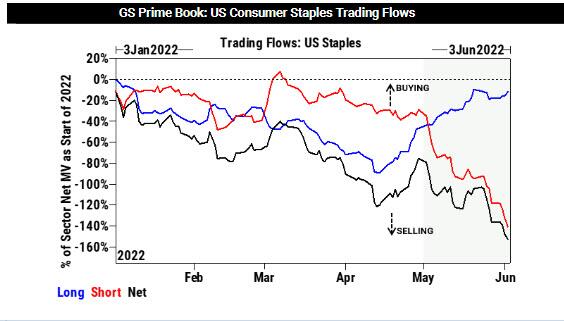
Goldman's Prime Desk makes another interesting observation, which is apropos in light of today's 2nd consecutive guidance cut by Target. According to GS, following challenging earnings results from various companies, Consumer Staples is one of the most net sold sectors in the US, driven entirely by short sales, with short sales outpacing long buys by nearly 5:1. Selling was consistent over the past week as the sector experienced net selling (and short selling) every day over the past week. All industry groups were net sold for the week, with the exception of Food & Staples Retailing, which was marginally net bought. Food Products and Beverages accounted for a large proportion of the net selling flow for the overall sector. Amid this shorting frenzy it is not surprising that relatively within the US, Consumer Staples was one of the worst performing sectors on a five-day basis.
There is much more in the full Morgan Stanley and Goldman Sachs notes, including much more granular detail and in depth analysis of nascent hedge fund themes, with both available to professional subs in the usual place.
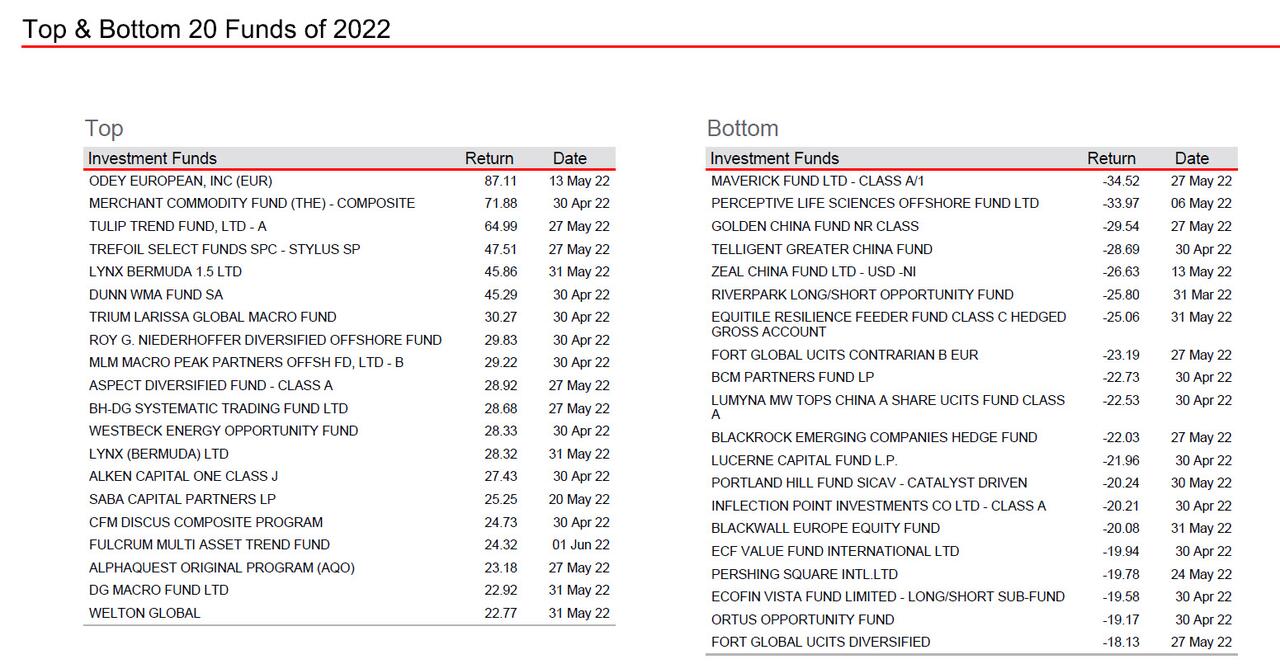
One final observation: courtesy of the latest HSBC hedge fund weekly report (also available to pro subs) here are the best and worst performing hedge funds of 2022:
WWD : Digimarc Cloud-based Technology Makes Authenticity of Products More Secure

Digimarc Cloud-based Technology Makes Authenticity of Products More Secure
The company also released a consumer behavior report showing differences between Generation Z and Baby Boomers.

Digimarc combines product triggers with cloud technology to thwart counterfeiting. WHO IS DANNY - STOCK.ADOBE.COM

Digimarc Corp., a next-generation digital identification and detection-based solution provider, is rolling out a new solution to help brands verify the authenticity of products.

Separately, Digimarc has released insights about consumer behavior in a report that looks at differences in shopping preferences between generational cohorts, including the importance of product authenticity.

Regarding the launch of the Digimarc Brand Integrity digital solution, the company said it works by assigning each product with a serialized digital identity “that can be tracked in the cloud and accessed through a variety of on-package digital triggers, including the industry’s most secure and covert: the Digimarc digital watermark. Adding that this combination of digitized products and cloud-based data “makes the process of authenticating items more accurate and scalable than traditional physical authentication measures,” the company said.

Related Galleries
Queen Elizabeth II and Prince Phillip visit Arlington National Cemetery on July 7, 1976.
PEOPLE
Queen Elizabeth II’s Style Throughout the Years
Saucy Santana
PARTIES
Inside the Coach x The Monster Party
Digimarc also noted that the support of dual-factor authentication, “such as scanning both QR codes and digital watermarks on a single package, provides a strong defense against bad actors accustomed to easily circumventing lesser brand protection measures.”

Ken Sickles, chief product officer at Digimarc, said as counterfeiters have become more sophisticated and supply chains more diffuse, “companies are recognizing that traditional brand protection approaches that are largely reactive and reliant on trained inspectors and specialized equipment are both ineffective and inefficient.”

“Digimarc has created a uniquely digital solution that leverages the ubiquity of smartphones and other digital devices to make product authentication much more streamlined and less prone to human error,” Sickles said, adding that while digitizing products with QR codes is a great starting point, “when coupled with a robust product cloud and covert digital watermarks, brands can gain even greater visibility into their products and offer their consumers the chance to do the same.”

Sickles said the company’s brand integrity solution helps brands “to protect their reputations by giving every product a digital presence connected to a cloud-based record of its journey and interactions proving products’ authenticity, uncovering counterfeits and their origin, and gaining insight into products’ supply chains so that brands can anticipate issues and act fast.”

In the consumer behavior report, Digimarc teamed up with Censuswide to survey shoppers on several topics. Some of the top takeaways include that 80 percent of Baby Boomers “care about whether products they buy are authentic, versus 53 percent of Gen Zers.”

“Boomers also care more about whether brands are reputable and take their environmental responsibilities seriously, with 63 percent of the group saying they are concerned about these factors, followed by 58 percent of Gen Zers, 56 percent of Gen Xers and 55 percent of Millennials,” Digimarc said in a statement.

Sickles said the recent consumer study “shows that Baby Boomers are, surprisingly, more concerned than the youngest shoppers are about buying genuine products from reputable brands that are committed to sustainability,.”

“However, consumers of all ages have significant concerns about how the products they buy are made, where they’re made and what’s in them,” he said. “To address these concerns of shoppers of all demographics, brands need to not only ensure their product and brand integrity, but clearly communicate their trustworthiness and authenticity to consumers.”

Digging deeper into the results showed that Baby Boomers are most concerned about counterfeit goods. “Whether buying new or secondhand, Boomers are most concerned about whether the items they buy are counterfeit (new: 64 percent; secondhand: 54 percent)” while Gen Zers are “the least concerned (new: 53 percent; secondhand: 50 percent).”

Authors of the report said a majority of all age groups are concerned with the ethics of buying something that may be counterfeit, but Baby Boomers are most concerned at 64 percent, followed by Gen Xers with 60 percent and Millennials at 56 percent. Generation Z came in at 52 percent.

Other findings include that with luxury goods, product quality is important to more than three-quarters of all age groups when shopping for luxury goods, “but Boomers and Gen Xers (both at 73 percent) care most about where the luxury goods they purchase were made.”

Additionally, Baby Boomers are much more concerned than Generation Z with what products are made of with — 80 percent of Baby Boomers polled said they are concerned with the ingredients or materials in the products they purchase, compared with 54 percent of Generation Z.

WWD : Amazon Luxury Stores to Make Its European Debut With Kristen McMenamy

Amazon Luxury Stores to Make Its European Debut With Kristen McMenamy
Amazon Fashion Luxury Stores Europe will debut with a campaign featuring Kristen McMenamy, Precious Lee, Leon Dame and Dara.

LONDON — Amazon Fashion Luxury Stores is taking a long-awaited leap into Europe, nearly two years after launching the concept in the U.S.

An announcement is expected on June 8.

The retail brand, which was originally set to make its European debut last November, according to industry sources, will come to market with a roster of names including Christopher Kane, Dundas, Elie Saab, Mira Mikati, Boglioli and Altuzarra, many of which already sell on the U.S. version of the site.

The shop will initially be available in the U.K., Germany, France, Italy and Spain at Amazon.co.uk/luxury stores.

“Fashion is an area where we continue to innovate and add selection, and we’re always looking for opportunities to offer our diverse, fashion-engaged customers more of their favorite brands and styles,” said Ruth Diaz, vice president of Amazon Fashion Europe.

“This is just the beginning, and we look forward to continuing to support brands with innovative tools and resources, so they can share their latest collections and unique stories with our customers across Europe season after season,” she added.

The collections will be sold directly by the brands and designers, which make “independent decisions regarding their inventory, selection and pricing,” Amazon said.

The digital retail giant said customers in Europe and the U.S. can shop Luxury Stores on devices such as the Amazon mobile app, desktop, mobile and tablet browsers.

When the Luxury Stores concept launched two years ago in the U.S., it was much more limited: It was by-invitation-only platform for top-spending Prime members, with its own site located inside the Amazon app.

As the months have progressed — and the competition has stiffened — the site has progressively opened to a broader customer base. On Instagram, it is also working with influencers including Imaan Hammam, Tommy Dorfman and Camille Rowe.

Xavier Flamand, vice president of Amazon Seller Services, said Amazon offers client brands digital enhancements such as motion graphics and auto play imagery, “to further share their stories and connect to a fashion-engaged customer base.”

Amazon Luxury Stores Europe will launch with a campaign shot by Angelo Pennetta and styled by Charlotte Collet. It features Kristen McMenamy, Precious Lee, Leon Dame and Dara.

Sally Singer, head of fashion direction, said: “We have a unique opportunity to bring directional, inclusive storytelling and technology to the business of fashion with exciting opportunities for designers and customers alike.”

As reported, the European arm of Luxury Stores is launching as competition for brands — and customers’ wallets — is more ferocious than ever.

While some of the brands on the U.S. platform have been reporting robust sales and remain transfixed by the potential of reaching even a fraction of Amazon’s customers, there are those who believe the momentum might not transfer to Europe.

Europe is brimming with homegrown, multibrand fashion and luxury sites such as Zalando, Farfetch, Mytheresa, Net-a-porter, Matchesfashion and the LVMH Moët Hennessy Louis Vuitton-owned 24 Sèvres.

Add the Tmall and JD.com dynamics to the punchbowl, and it makes for one potent cocktail of competition.

In the nearly two years since Amazon Luxury Stores launched, those European sites have been forging new, international alliances, such as Compagnie Financière Richemont and Farfetch’s impending deal, and making further inroads in luxury.

Some brand managers interviewed by WWD last year said they were disappointed that Amazon had opened Luxury Stores to a broader audience (no longer restricting it to top Prime customers) and that the big-name luxury brands from groups such as Kering and LVMH never arrived.

“There are no adjacencies to elevate the smaller brands that are already on the site,” said one manager who asked not to be named. Another one added: “We were expecting them to come up with the heavy hitting brands, but they haven’t so far.”

Another company chief who asked not to be named told WWD that Luxury Stores makes more sense in the U.S., because the wholesale market is smaller with the recent closure of so many department stores in the region.

WSJ : Publicis Sees Ukraine War Weighing on Advertising Growth

Publicis Sees Ukraine War Weighing on Advertising Growth
Its Zenith ad-buying unit expects global ad market to remain strong despite inflation, supply-chain issues

Advertising giant Publicis Groupe SA PUBGY -1.08% pared back its global ad-spending forecast for 2022 due to the war in Ukraine, but said the advertising market remained healthy despite macroeconomic challenges.

Zenith, an ad-buying unit of Publicis, PUBGY -1.08% said it expects global ad spending to grow 8% to $781 billion this year, a downgrade from the 9.1% growth it predicted in December.

The firm said it reduced its projections because of the sharp cuts to advertising in Russia and neighboring countries. Since the war began in February, hundreds of companies such as McDonald’s Corp. , Anheuser-Busch InBev SA and Netflix Inc. have suspended their businesses in Russia or pulled out entirely from the country.

The conflict has had a chilling effect on advertising spending in the region, something that many tech companies including Facebook parent Meta Platforms Inc. noted in their most recent quarterly earnings. Zenith estimates that Russia’s invasion of Ukraine will lead to a 26% decline in ad expenditures in Central and Eastern Europe this year.

Still, Zenith expects overall ad spending to be buoyed by the Beijing Winter Olympics, the midterm elections in the U.S. and the soccer World Cup in Qatar, events that all attract significant amounts of advertising.

“We expect a strong year of growth,” said Jonathan Barnard, Zenith’s director of global intelligence.

Analysts and observers have grown increasingly worried over the past few months that the global advertising market could falter due to macroeconomic headwinds such as high inflation, supply-chain problems and higher commodity prices.

Those fears were ratcheted up after retailers such as Walmart Inc. and Target Corp. posted weaker-than-expected quarterly earnings and most major digital-ad players reported a notable slowdown in ad-revenue growth during their latest earnings reports. Social-media giant Snap Inc., which generates most of its revenue from advertising, recently warned investors that its second-quarter revenue and earnings would be lower than expected because the macroeconomic environment had deteriorated further and faster than the company had expected.

Despite these headwinds, ad spending has “remained on track,” Zenith said. The firm expects ad spending in North America to grow by 12% to $332 billion this year.

Zenith attributes the ad market’s resiliency partly to consumer spending, which continues to grow, as people are looking to travel and enjoy entertainment such as going to the movies, experiences that they missed during the global pandemic.

“Some consumers are reassessing where their budgets are going given the rapid rise in prices for energy and food, but overall consumer spending has maintained because a lot of people still have a cushion of savings that they built up during the pandemic,” Mr. Barnard said. “People are keen to get back to their prepandemic life.”

Ad executives said many companies have refrained from making deep cuts to advertising since consumer spending has managed to remain relatively healthy.

Cleaning products maker Clorox Co. said last month that it remained on track to spend 10% of its revenue on ads, and consumer-goods giant Kraft Heinz Co. told analysts in April that it had no intentions of cutting marketing. “We want to continue investing in our brands,” said Heinz CEO Miguel Patricio.

Ad and media executives have said advertising categories doing well include pharmaceuticals, entertainment and travel, while others such as cars have been shrinking, partly due to supply shortages.

Automotive ad spending in the U.S. declined about 8% in the first quarter from a year earlier, according to estimates from Standard Media Index, whose research captures data from national-brand spending with major ad-buying companies.

Zenith said it expects digital-ad spending globally to grow by 13% to $472 billion, down slightly from the 13.7% growth it expected in December. Zenith said that higher prices for TV ads, caused by lackluster ratings, are causing brands to accelerate their shift to digital ads. The ad firm estimates that 62% of ad budgets will be spent on digital media in 2022, up from 59% in 2021.

WSJ : Western Digital Reaches Settlement With Activist Investor Elliott

Western Digital Reaches Settlement With Activist Investor Elliott
Company says it will consider alternatives including a split of traditional hard drives from flash memory

Western Digital Corp. WDC 1.00% reached a settlement with activist investor Elliott Management Corp. that calls for the $19 billion company to consider splitting into two.

The company said in a statement that it would consider strategic alternatives including a separation into businesses focused on traditional hard drives for computers and flash memory, respectively, confirming an earlier report by The Wall Street Journal.

Elliott in May revealed a 6% stake in Western Digital and sent a letter calling on the company to explore a breakup.

San Jose, Calif.-based Western Digital, which has a market value of around $19 billion, previously said it would consider Elliott’s ideas. At a conference in late May, Western Digital Chief Executive David Goeckeler said the company and Elliott had been discussing additional ways to improve the company’s valuation.

Western Digital in 2020 decided to form separate units for its two businesses, a move Elliott praised and some saw as a precursor to a split.

Meanwhile, Japanese chip maker Kioxia Holdings Corp. is still open to a possible deal with Western Digital, according to people familiar with the matter.

Western Digital and Kioxia had been speaking since early 2021 and were working on a stock deal that would have created a memory-chip powerhouse, the Journal reported last summer. But the talks stalled, partly because of a steady decline in Western Digital’s shares.

Kioxia’s business would be a logical fit for Western Digital’s flash unit, which Elliott estimated could command an enterprise value of $17 billion to $20 billion. That is roughly equal to Western Digital’s market capitalization before its shares rose when Elliott’s campaign surfaced.

Elliott also said in the letter to the company that it would invest an additional $1 billion or more in equity in a potential spinoff or merger of the flash business in conjunction with another industry player.

>>> Stoxx 600 Pre-Market Indications

  • Prosus (1TY TH) +2.8%
  • Voestalpine (VAS TH) +1.3%
  • Orsted (D2G TH) +1.3%
  • Yara (IU2 TH) +1.2%
    • Yara Now Top Fertilizer Pick at Morgan Stanley, OCI Downgraded
  • Inditex (IXD1 TH) +1%
    • *INDITEX 1Q EBIT EU1.03B, EST. EU1.05B
  • Air Liquide (AIL TH) +0.8%
  • Adidas (ADS TH) +0.8%
  • ASML (ASME TH) +0.8%
  • Bechtle (BC8 TH) +0.8%
  • Bawag (0B2 TH) -0.8%
  • Publicis (PU4 TH) -0.8%
    • Publicis Cuts Forecast Of World Ad Spending