After Hours Summary: ADBE -3% heads lower on weak guidance, but rebounds off lows; X +5.6% is latest steel name with bullish guidance; ROKU +4% higher on deal with WMTAfter Hours Gainers:
Companies trading higher in after hours in reaction to earnings/guidance: X +5.6% (issues upside EPS guidance)
Companies trading higher in after hours in reaction to news: CO +12.1% (FDA recently cleared Cellenkos' IND application for CK0804 as add on therapy to Ruxolitinib), ROKU +4% (ROKU and WMT announce partnership to bring comerce to TV ads), FTI +3.9% (awarded a significant contract by TotalEnergies Angola), TRGP +2.9% (to acquire Lucid Energy for $3.55 bln; also updates 2022 standalone outlook), BHC +2.3% (provides update on Solta Medical; IPO process suspended in light of market conditions), UWMC +2.1% (CFO takes leave of absence for health reasons), EFC +2% (reports book value per share), OAS +1.2% (declares $15 special dividend in connection with closing of merger with WLL), BGS +0.7% (forms four business units), OEC +0.1% (to raise prices for rubber carbon black products), MLNK +0.1% (names new CFO)
After Hours Losers:
Companies trading lower in after hours in reaction to earnings/guidance: ADBE -3%
Companies trading lower in after hours in reaction to news: RYTM -14.6% (FDA issues CRL for the sNDA for setmelanotide in Alström syndrome; FDA approves sNDA for IMCIVREE; also enters into Revenue Interest Financing Agreement with HealthCare Royalty for a total investment up to $100 mln), DRTS -1.4% (Israeli govt grants radioactive license), PII -1% (announces sale of Transamerican Auto Parts to Wheel Pros), WPC -0.3% (increases dividend), OWL -0.3% (files $1 bln mixed securities shelf offering), MPLN -0.2% (invests $15 mln in Abacus Insights), MEI -0.1% (authorizes $100 mln increase to its existing share buyback program), GVA -0.1% (awarded two contracts worth a combined $38 mln), KBR -0.1% (its commercial cloud and mission service platform is FedRAMP Ready)
Closing Market SummaryThe stock market could not hold onto its late session gains from Wednesday, succumbing to aggressive selling. The S&P 500 (-3.3%) and Nasdaq Composite (-4.1%) were on a slow decline most of the day with the Dow Jones Industrial Average (-2.4%) exhibiting more volatile price action.
The stage was set before today's open with several central banks announcing a shift to more aggressive policies. These shifts coming on the heels of the Fed raising the fed funds rate by 75 basis points exacerbated existing worries about growth and earnings.
The Swiss National Bank announced a surprise rate hike of 50 basis points, the Bank of England increased its key rate by 25 basis points while also projecting a decline of 0.3% in Q2 GDP, and Brazil's central bank raised its key rate by 50 basis points.
The added rub is that their moves are generally being perceived as a catch-up trade, which is feeding worries about a policy mistake that leads to a recession.
Treasuries faced some selling at the start of the session, but they rebounded strongly as stocks struggled, sending the 10-yr yield lower by nine basis points to 3.31% while the 2-yr yield fell eleven basis points to 3.16%.
Stagflation worries were in today's trading mix, emanating from the ongoing inflation pressures and the Atlanta Fed's GDPNow model estimating Q2 real GDP to be flat versus a prior projection calling for 0.9% growth.
With these factors on the forefront, the sell-off was broad-based. The declining issues outpaced the advancing issues by a greater than 9-to-1 margin at the NYSE and an almost 4-to-1 margin at the Nasdaq. Today's session saw above-average volume with more than 1.3 bln shares changing hands at the NYSE floor.
All 11 of the S&P 500 sectors closed in the red with the selling paced by energy (-5.6%), consumer discretionary (-4.8%), information technology (-4.1%), and materials (-3.7%). The best performing sectors were the consumer staples (-0.7%), health care (-1.5%), and the utilities (-1.9%), but they could not stay out of the red.
Profit-taking in the best performing sector of the year narrowed energy's year-to-date gain to 39.2% while the remaining ten groups now show year-to-date losses between 9.2% (utilities) and 34.7% (consumer discretionary).
The energy sector finished near its session low even though crude oil recovered its early loss to end the pit session little changed at $115.28/bbl. WTI crude climbed toward the midpoint of yesterday's range in after-hours trade, but the late rally failed to lift the energy sector out of the last slot on today's leaderboard.
Top-weighted technology suffered from broad-based losses with roughly half of its components hitting fresh 52-week lows. Top component Apple (AAPL 130.06, -5.37, -4.0%) stopped within a point of a 52-week low of its own, but still lost more than 4.0% while Adobe (ADBE 365.08, -11.84, -3.1%) fell to its lowest level in over two years ahead of tonight's release of quarterly results. Chipmakers had an even worse showing than the tech sector, as the PHLX Semiconductor Index fell 6.2%.
Reviewing today's data:
- Housing starts declined 14.4% month-over-month in May to a seasonally adjusted annual rate of 1.549 million units (consensus 1.730 million) while building permits -- a leading indicator -- declined 7.0% month-over-month to 1.695 million (consensus 1.800 million).
- The key takeaway from the report was the broad-based softness in single-family starts and permits. To that end, starts declined month-over-month in three of the four geographic regions while permits declined in all regions with the largest region -- the South -- seeing the largest decline in permits.
- Initial jobless claims for the week ending June 11 decreased by 3,000 to 229,000 (consensus 215,000) while continuing jobless claims for the week ending June 4 increased by 3,000 to 1.312 million.
- The key takeaway from the report is that the improvement in initial jobless claims appears to have stalled, suggesting it could be hitting an inflection point that marks peak conditions for the labor market.
- The Philadelphia Fed survey fell to -3.3 in June (consensus 5.0) from 2.6 in May.
May Industrial Production (consensus 0.5%; prior 1.1%) and Capacity Utilization (consensus 79.3%; prior 79.0%) will be reported tomorrow at 9:15 ET.
- Dow Jones Industrial Average -17.6% YTD
- S&P 400 -22.5% YTD
- S&P 500 -23.1% YTD
- Russell 2000 -26.5% YTD
- Nasdaq Composite -32.0% YTD
Crypto hedge fund Three Arrows fails to meet lender margin calls
BlockFi was among a clutch of firms that liquidated the Singapore-based group’s positions
Three Arrows Capital failed to meet demands from lenders to stump up extra funds after its digital currency bets turned sour, tipping the prominent crypto hedge fund into a crisis that comes as a credit crunch grips the industry.
The group’s failure to meet margin calls this past weekend makes the group the latest victim of an acute fall in the prices of many tokens like bitcoin and ether that is rippling across the market. Singapore-based Three Arrows is among the biggest and most active players in the crypto industry with investments across lending and trading platforms.
Lenders have sharply tightened up how much credit is on offer following tremors over the past month. Celsius, a major crypto financial services company, blocked withdrawals last week, while a pair of major tokens collapsed in May.
US-based crypto lender BlockFi was among the groups that liquidated at least some of Three Arrows’s positions, meaning it reduced its exposure by taking collateral the fund had put down to back its borrowing, according to people familiar with the matter.
Three Arrows, which made a “strategic” investment in BlockFi in 2020, had borrowed bitcoin from the lender, the people said, but had been unable to meet a margin call. One of the people said the liquidation had occurred by mutual consent.
“We are in the process of communicating with relevant parties and fully committed to working this out,” said Su Zhu, Three Arrows co-founder, on Twitter on Wednesday, without specifically identifying any counterparty. The company did not respond to a request for comment.
Yuri Mushkin, BlockFi’s chief risk officer, said the group “can confirm that we exercised our best business judgment recently with a large client that failed to meet its obligations . . . We believe we were one of the first to take action with this counterparty.”
He added that BlockFi had held collateral in excess of the size of the loan.
“BlockFi’s prudent and proactive risk management is for the benefit of our broader client base and allows us to remain open for business during times of market stress,” Mushkin said.
The troubles at Three Arrows ricocheted to Finblox, a platform that offers traders 90 per cent annualised yields to lend out their crypto. Finblox, which is backed by venture capitalist firm Sequoia Capital and received an investment from Three Arrows, reduced its withdrawal limits by two-thirds late on Thursday London time, citing the situation at the hedge fund.
Three Arrows, run by Zhu and his co-founder Kyle Davies, is known for its bullish levered bets on crypto. Zhu had espoused a “supercycle” view of crypto, in which increasing mainstream adoption meant prices would continue rise without falling back into a near-term bear market.
Last month, he acknowledged the current sell-off had proved him wrong. “Supercycle price thesis was regrettably wrong, but crypto will still thrive and change the world every day,” Zhu tweeted in late May.
“They were really big and really active. They went into some enormous positions,” said David Siemer, chief executive of Wave Financial, a digital asset manager. He added that major crypto firms across the space likely had exposure to Three Arrows: “They worked with everybody.”
Three Arrows was mainly, if not exclusively, managing Zhu and Davies’ own capital, according to industry sources. One person who has spoken with the managers in recent months said they were told the fund’s total value was $4bn. Blockchain analytics firm Nansen has previously estimated the funds assets at $10bn.
Another person, who works at a crypto trading firm, said they had been unable to reach Three Arrows in recent days. “They’re not responding to anyone,” they said.
Among Three Arrows’s big bets was luna, the sister token to the algorithmic stablecoin terra. Both imploded in May, going to zero, a market shattering event that turned what had been months of steady declines in crypto prices into a more dramatic rout.
The fund had holdings in a variety of crypto ventures whose tokens have performed badly in recent months, including Avalanche, Solana and the game Axie Infinity, all of which are down around 90 per cent since their November peaks.
Three Arrows was also the biggest investor in units of the Grayscale bitcoin trust, GBTC, according to FactSet data. GBTC currently trades at a 30 per cent discount to the price of bitcoin as the US Securities and Exchange Commission has thus far declined to approve it as an exchange-traded fund that would be open to retail investors.
Until early 2021, GBTC had traded at a premium to the price of bitcoin. That offered an arbitrage opportunity for funds like Three Arrows which could borrow bitcoin, deposit it with Grayscale in return for GBTC units, which could then be sold at a profit on the open market. Grayscale does not allow redemptions of GBTC for the underlying bitcoin.
Three Arrows owned almost 39mn units of GBTC at the end of 2020 then worth $1.2bn, according to its last report to the SEC in January 2021. The same position today would be valued at just $550mn.
Michael Sonnenshein, CEO of Grayscale said he had no knowledge of Three Arrows’ trades, but added: “There are players here that have employed too much leverage . . . a major correction in prices is sending shockwaves through the ecosystem”.
Ferrari to make almost half of its models fully electric by 2030
Italian luxury carmaker will launch first electric-only vehicle in 2025
Ferrari will make almost half of its models fully electric by 2030 as the Italian luxury carmaker tries to balance the need to reduce emissions with a reputation built on the prowess of its traditional combustion engines.
The company unveiled plans to power 40 per cent of its cars by battery alone, another 40 per cent will be hybrid and just 20 per cent combustion engine with the aim of becoming carbon neutral by the end of the decade.
At the moment, just 20 per cent of its cars are hybrid and it does not have an electric-only model.
The plans were among a range of pledges, including increasing its dividend and buying back shares, made at an investor day at its Maranello headquarters in northern Italy.
“I believe ICE [internal combustion engine] has a lot to give,” chief executive Benedetto Vigna told investors.
“On one side, we have to cope with emissions regulations, but most importantly we see electrification as a way, as a technology, that can enhance the performance of what we do.”
Alongside ambitions to introduce electric-only models from 2025, Ferrari said earnings would increase to between €2.5bn and €2.7bn this year, up from €1.5bn last year. It is also aiming for margins of 38 per cent to 40 per cent, up from 35 per cent last year.
Its payout to investors will climb from 30 per cent of the group’s adjusted net income last year to 35 per cent from this year. The carmaker also intends to buy back roughly €2bn of shares by 2026, compared with €1.1bn it has repurchased since 2018.
The brand’s first pure electric model will use technology from Ferrari’s racing team, including its electric engine and its understanding of how to reduce energy loss, Vigna said on Thursday.
Vigna, who joined last September from chipmaker STMicroelectronics, said there is a “misconception that doing an electric car requires a lot of” spending.
Ferrari believes its racing heritage, and its first use of batteries in hybrid supercars, will give it a head start when developing battery-only models.
“We started this journey 13 years ago,” he added. By 2026, only 25 per cent of its R&D investment will be into engine-only models, with the rest split between battery systems and hybrid technology.
The group will also avoid making investments in full self-driving technology.
The brand will launch its first sport utility vehicle, called the Purosangue, which is Italian for “thoroughbred”, later this year, but does not expect to increase sales significantly because of the model.
This is in contrast to rivals such as Bentley and Lamborghini that have enjoyed the doubling of volumes after adding high-riding models to their range.
Vigna said the Purosangue would still be a “sports car” in spite of its larger size.
Ferrari, which refreshes its sports car range frequently with limited-run models, will launch 15 vehicles by 2026, though the company did not specify how many would be fully electric.
Sidney Toledano Is New Chair of IFM
Toledano is chairman and chief executive officer of LVMH Fashion Group.
“Having an education is a big, big asset in life,” says Sidney Toledano, who this week was elected chairman of the Paris fashion school Institut Français de la Mode, or IFM.
Toledano, who takes on the IFM title in addition to his full-time job as chairman and chief executive officer of LVMH Fashion Group and a member of the LVMH executive committee, has been on the IFM board for 24 years and vice chairman the last five, demonstrating his commitment to the transmission of knowledge that is key in fashion and luxury.
Toledano was elected at a closed-doors assembly on June 14, and he succeeds André Beirnaert, the textile executive who took over the presidency following IFM founder Pierre Bergé’s death in 2017.
Anne Dellière, Compagnie Financière Richemont’s group marketing and strategic plan director, succeeds Toledano as vice chairman.
Toledano was previously president of the École de la Chambre Syndicale de la Couture Parisienne, which in 2019 merged with France’s IFM management school in a bid to become a world-class fashion school uniting business, design and savoir-faire.
That year, Condé Nast France executive Xavier Romatet was named general manager and dean of the IFM.
In a statement following Toledano’s election, Romatet lauded his “incomparable experience, his in-depth knowledge of global fashion and his multiple connections.
“His presence at our side will enable us to strengthen the influence of Institut Français de la Mode and its international appeal,” Romatet added.
In an exclusive interview with WWD, Toledano said his ambition is to elevate the school’s reputation as “one of the best for fashion management and fashion design.
“The main objective is to attract an international audience, to assure excellence in the level of teaching and research, and to be as inclusive as possible,” he added.
And as the conversation around fashion enlarges to NFTs, the metaverse and Web3 applications, his goal is to build bridges with educational and research institutions dedicated to technology and digital innovation, in addition to centers dedicated to textile research.
Toledano lauded the steady hand of Beirnaert’s long tenure, and gave a shout-out to Ralph Toledano, president of the Fédération de la Haute Couture et de la Mode, for helping to mobilize the industry behind the creation of a larger, stronger IFM.
An engineering graduate of École Centrale Paris, Sidney Toledano began his career at market research firm AC Nielsen, eventually finding his way into fashion when he took the helm of footwear concern Kickers and leather goods brand Lancel. But he is best known for his illustrious 20-year career helming Christian Dior, catapulting it to the pinnacle of luxury.
He now oversees an array of LVMH Moët Hennessy Louis Vuitton brands including Celine, Loewe, Givenchy, Kenzo, Pucci, Marc Jacobs, Patou and Moynat.
He described education as “the best passport, the best bridge to succeed in a career, or in entrepreneurship” and noted that today’s fashion students enter an increasingly complex industry grappling with digitalization, sustainability and a turbulent socio-political backdrop.
He touted that about a fifth of students at IFM have a scholarship, thanks largely to generous contributions from corporate donors. “We want it to be accessible to people, particularly on the creative side,” he said. “I’d love to see our design students competing for the LVMH Prize or the ANDAM prize, opening their own companies or joining big studios.”
Despite the challenges posed by the coronavirus pandemic, the IFM has charted rapid growth, tripling the number of students over the last four years, and more than tripling the number of academic programs to 17.
Come September, when classes resume, the IFM is expecting 400 students in fashion design, 400 students in management and 300 students in savoir-faire.
A suave, warm and wise figure on the Paris fashion scene, Toledano has had ties to the IFM when there were fewer than 100 people at the school. “I’ve always been excited by this school and its spirit,” he enthused.
Over the years, Toledano has addressed students innumerable times about the realities of creative management and business imperatives, always appreciating their no-holds-barred questions, and relishing visits to classrooms where prototypes for dresses, bags and shoes are created.
“Presence is important: doing a course, helping, encouraging,” he said. “I’m really passionate about studios and ateliers, and you see these students are really well prepared to enter large fashion companies, or start their own brands.”
Toledano’s election comes as the IFM gears up for its first physical fashion show on the eve of Paris Fashion Week for menswear. The June 20 display at IFM’s new campus in Paris will showcase the final collections by 32 bachelor of arts in fashion design students.
Each is to parade six looks that integrate a sustainable development, technological or ethical element, according to the IFM, which introduced the three-year bachelor design program in 2019.
The program has attracted about 250 students, 44 percent of them from outside of France, over the past three years, according to the IFM, noting that “a significant need-based scholarship fund sponsored by the companies of the IFM Foundation allows the school to welcome all creative talents into the program, regardless of their financial situation.”
The foundation is funded by 35 companies including Adidas, Balenciaga, Burberry, Celine, Chanel, Chloé, Dior, Farfetch, Hermès, Kering, L’Oréal, Louis Vuitton and Saint Laurent, and offers scholarships to about 130 students per academic term. Fashion executives also teach, offer masterclasses, and participate in juries.
The IFM’s new 86,000-square-foot headquarters, designed by architect Patrick Mauger and built at a cost of 15 million euros, opened in January and now houses courses catering to all levels of fashion education, from vocational training to Ph.D.
Founded in 1986 by Pierre Bergé, Yves Saint’s Laurent’s business partner, the IFM has produced designers such as Guillaume Henry and Nadège Vanhee-Cybulski, though it is mainly known for churning out world-class managers who have filled the ranks of leading luxury groups.
It is supported by the French Ministry of Industry and is known for its academic and market research. Nina Ricci’s Guillaume Henri and Ami designer Alexandre Mattiussi are among graduates of the IFM’s design program.
Famous alumni of the the École de la Chambre Syndicale, founded in 1927, include Valentino Garavani, Yves Saint Laurent, André Courrèges, Issey Miyake and Tomas Maier, though in recent decades it has been overtaken by overseas competitors such as London’s Central Saint Martins and the Royal Academy of Fine Arts in Antwerp, Belgium.
Toledano wears a few other hats in the industry: He’s also a committee member of the Chambre Syndicale de la Haute Couture and on the executive committee of the Fédération de la Haute Couture et de la Mode.
Capitulation? Stocks Hit With 4th Largest 'Sell Program' In History This Morning
The difference between upticks and downticks on the NYSE this morning hit a stunning -2,057. There have only been three other 'sell programs' of this size or larger in market history...
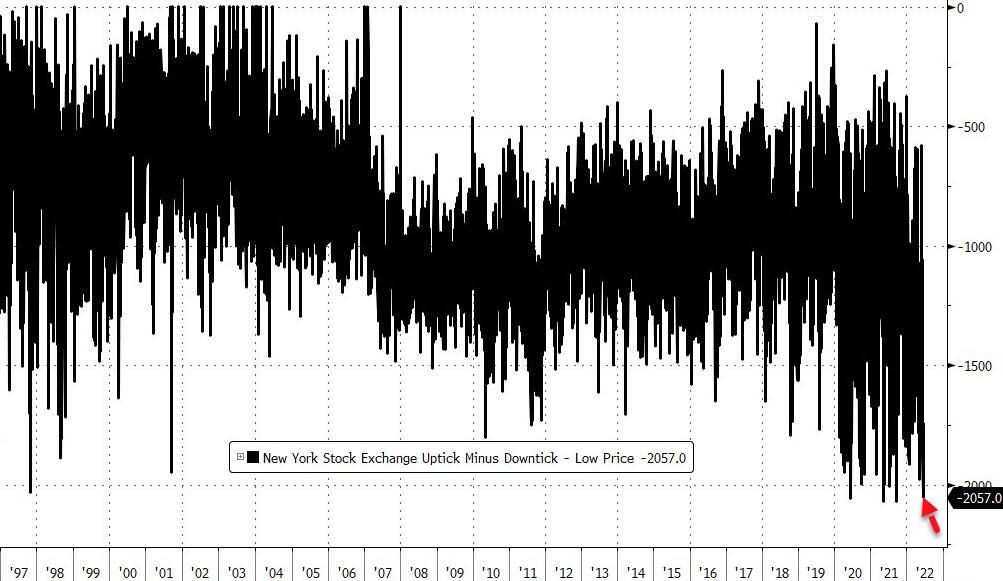
On the three prior events (6/11/20, 5/11/21, 9/20/21), the S&P bounced in the following days...

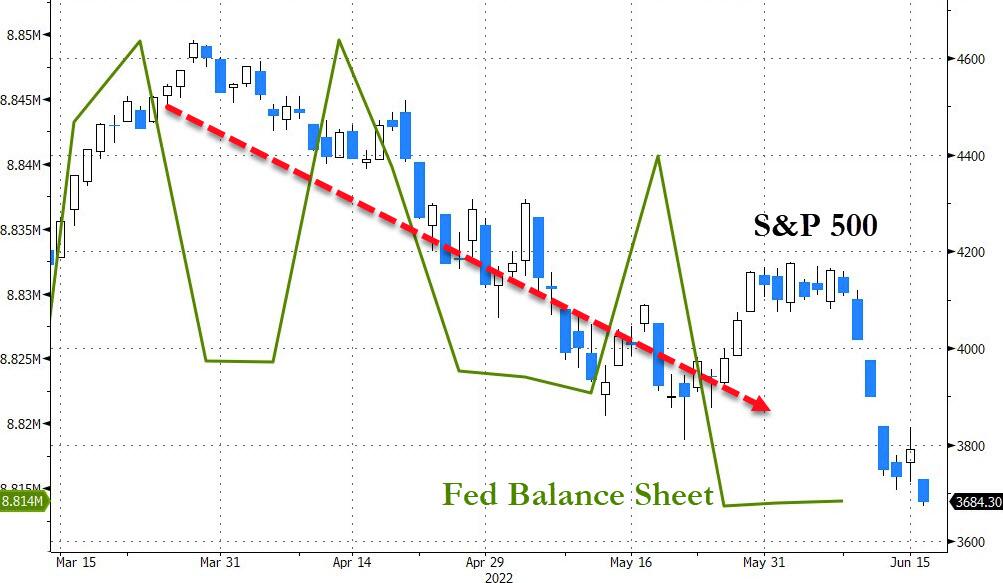
But, as the following chart shows, it's different this time - The Fed Balance Sheet is shrinking!!
In case you think this is the 'capitulation' moment, BofA suggests no...
This is a list of “capitulation” levels in various FMS and other positioning indicators.
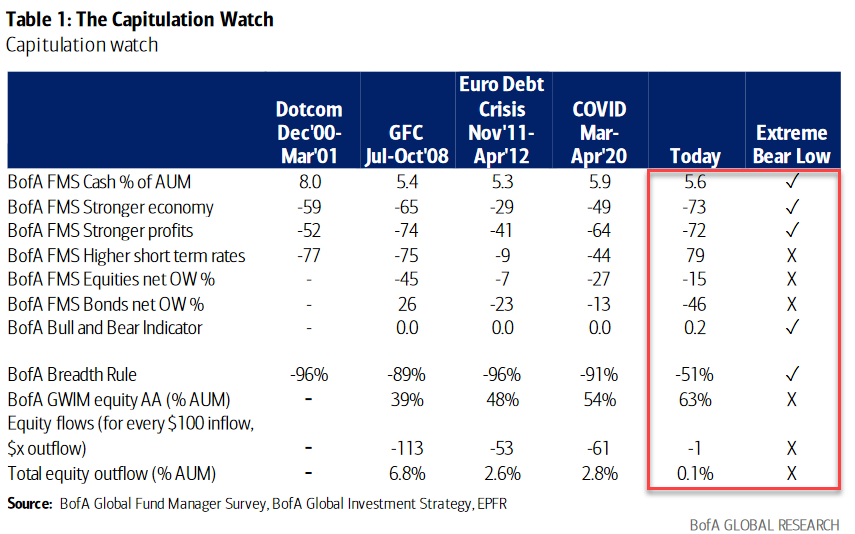
FMS indicators mostly are at capitulation levels...the one exception is short-term interest rates...normally at a “big low” investors universally expect central banks to panic and cut rates...in 2022 the central bank panic is in the other direction, hiking rates to desperately reverse their excess stimulus of 2020 & 2021.
Put simply: Equity flows are not near capitulation levels.