FT : Citi’s missing €10bn that wasn’t

Citi’s missing €10bn that wasn’t
A Saudi prince, a Taliban financier, international spycraft and pallets of US dollars — it’s a story with everything. Except evidence.

Bad news for Lex Foundation, the obscure and asset-free UK family office that last year sued Citibank for purportedly losing €10bn. Its case has been thrown out of court.

Lex Foundation is Olgun Halil Shah, a 65-year-old British Cypriot national, his wife and his son. The suit filed at the London High Court last July alleged that their shell company was in line to receive €100bn for United Nations-approved funding of humanitarian projects, but that the first instalment of €10bn had never arrived in its Citibank account. Citi said the money did not exist and called Shah a “fantasist”.

Justice Henshaw ruled in a summary judgment dated June 7 that Lex Foundation had “no realistic prospect of showing that the alleged transfer took place, and that there is no other compelling reason why the case should proceed to trial.”

For a full backgrounder, see Alphaville’s earlier reporting. The short version is that Shah opened a private banking account at Citi in February 2021 with the help of a Saudi prince not named in the judgment, who had joined Lex Foundation as a director in June 2019 and resigned six days after the alleged cash transfer in April 2021.

A $10mn initial deposit Shah had promised Citi on opening the account never arrived. Shah then showed the prince what appeared to be a Swift money transfer docket showing a €10bn transfer from a purported Deutsche Bank account holder, Intrepid Capital. One of the prince’s people took this to Citi. (“The Prince’s staff member expressed shock at the amount.”)

Shah explained to Citi that Intrepid was a Swiss family office running funds controlled by “powers above”, namely the Bank for International Settlements and the European Central Bank, and that the documentation attached looked out of the ordinary because it was being tracked by “a US federal agency”. Citi’s inquiries led it to reject all three Swift dockets Shah had provided and by late April 2021 the bank had closed his account with zero balance.

A flavour of how the caper played out can be found in Shah’s correspondence trail.

In May 2021, Shah emailed Jane Fraser and Sunil Garg, CEOs of Citigroup and Citibank respectively, saying that unless he received €10bn within three days he would create a “shitstorm that is going to wreak havoc on your bank and end your careers”.

The next day he followed up with a letter that copied in the Governor of the Bank of England:

By now you should have realised that the dishonest dealings between Deutsche Bank and other financial institutions, including your own, have come to the attention of security services and evidence is being made available to law enforcement agencies. The extent of the dishonesty goes well beyond the €10 billion remitted to the Lex Foundation. I have been advised that it extends to around €400 billion. I have reason to believe that there are grounds to invoke RICO in this case. That will make your bank culpable in an affair that substantially exceeds the market capitalisation of Citigroup.

The evidence against your bank is inescapable. I write this letter to propose a solution. That is my profession; I find ways to win in no-win scenarios. I also create no-win scenarios. If you co-operate with me and my associates, this could be your Kobayashi Maru moment. I could be your white knight or your worst nightmare; the choice is yours.

Kobayashi Maru is a Star Trek reference, in case you were wondering.

His solution proposed was for Citi to give €10bn to Lex Foundation immediately, with a further €90bn to come, in exchange for a non-disclosure agreement and waiver of claim. Shah also requested that Citi sell 10 per cent of its shares via private placement to Lex Foundation and another family office, SpiritShifting AG, so they would be incentivised to protect its reputation.

The letter continues:

The Lex Foundation takes its name from the root of the Greek name Αλέξανδρος (Aléxandros), meaning “protector of mankind”. To that end we undertake our mission with fearless vigour, because we are doing God’s work. History has shown that boundless power is bestowed upon the meek when love of humanity is in their hearts. Do not underestimate it. If financial institutions have to be sacrificed for the greater good, so be it. However, we aim to serve as agents to maintain stability of the global financial system. It is the dishonesty of bankers that puts the system at risk.

Three months of back-and-forth followed in which Shah sent Swift documentation to Citi, which the bank dismissed as likely forgeries. By late August Shah had escalated his correspondence campaign to include Christine Lagarde, President of the European Central Bank, and had changed tack from UN humanitarianism to clandestine statecraft:

I am an undercover agent for security services. I was given the mission to receive EUR 100 billion (x2) into my humanitarian foundation for approved projects, which includes a number of African infrastructure and economic development projects. I played out the process of transferring the first tranche of EUR 10 billion and was confronted by the disingenuous antics of Citibank

Shah’s version of events was that Deutsche Bank had a US fund “comprised in large part of money derived from Chinese and Russian heritage assets”, as well as cash collected through “secret commercial dealings between the US government and Iranian regime (contrary to sanctions).” Chinese State Security was introduced to this already convoluted plot, as was BOE chair Andrew Bailey and a Taliban chief with whom Shah says he “had financial dealings”:

The letter continues:

Thousands of pallets of cash US dollar notes reside in depositories around the world; including London, Moscow, Oman, Hong Kong and Istanbul, some of which I have personally inspected. The safe keeping receipts are issued by the depositories in favour of Deutsche Bank. [ . . . ]

[T]here is a plethora of evidence that will emerge in the course of Lex Foundation’s action. This will inevitably become a criminal matter and the careers of certain public officials will end badly. I will make sure of it.

One has to consider the possibility that I am being used to trigger the crash of the prevailing global financial system, to enable those higher up the food chain to reset the debt system.

I want it on record that I tried to resolve this matter discretely for the sake of stability of the global financial system. I am not responsible for what happens next.

This is not a “bargaining tool” as [Citi’s lawyer] Clifford Chance called it; it is a tactical nuclear weapon, and I am going to use it.

Justice Henshaw found no credible evidence of any cash transfer, nor that any of the parties on the claimant’s side might have €10bn, nor that any of those parties had a Deutsche Bank account.
FT : UK imposes sanctions on Russian oligarch Vladimir Potanin

UK imposes sanctions on Russian oligarch Vladimir Potanin
Chief of mining group Norilsk faces asset freeze and travel ban

The UK has imposed sanctions on Vladimir Potanin, one of Russia’s richest oligarchs, along with several other individuals close to President Vladimir Putin’s inner circle.

The Foreign, Commonwealth and Development Office announced on Wednesday that Potanin, owner of the Interros conglomerate with an estimated net worth of £13bn, would face an asset freeze, travel ban, transport sanctions and a block on technical advice relating to aircraft.

Potanin is the chief executive and main shareholder of Siberian mining company Norilsk Nickel, which dominates the world’s supply of nickel and palladium.

The company’s central role in global metals production meant Potanin had been one of the few Russian oligarchs not targeted for sanctions by western countries except Canada.

Norilsk is crucial to supplies for electric batteries, a sector already dealing with a nickel shortage, and the automotive industry, which needs palladium for the catalytic converters of normal cars.

After the news, the price of nickel rose 6.5 per cent to $24,650 a tonne on the London Metal Exchange, while palladium gained 5.8 per cent to $1,982 an ounce.

Rhona O’Connell, analyst at StoneX, said it was not clear whether the sanctions imposed on Potanin, who owns 36 per cent of Norilsk, would extend to the company but “under common practice, it usually does”.

“UK auto production is 1.1 per cent of the global total,” she added. “So disruption would be more a question of logistics than market disarray.”

While his oligarchical peers have seen their empires crumble under the sanctions, Potanin’s eye for a bargain and fealty to the Kremlin have enabled him to snap up banking assets from owners fleeing Russia at knockdown prices.

He recently acquired Société Générale’s subsidiary Rosbank after the French group left the country, then purchased Oleg Tinkov’s stake in online bank Tinkoff after the founder said he had come under Kremlin pressure for criticising Putin and the war in Ukraine.

The UK government said: “Potanin is obtaining a benefit from or supporting the government of Russia by owning or controlling Rosbank” because financial services are a “sector of strategic significance”.

The US and EU have yet to sanction Potanin, who spent much of his time in France before this year. US officials are wary of repeating mistakes when they imposed sanctions on aluminium magnate Oleg Deripaska in 2018, which sparked turmoil in global metals markets.

The chaos forced the US into an embarrassing climbdown. Sanctions against Deripaska’s companies Rusal and En+, which own the second-largest stake in Norilsk, were removed in exchange for the oligarch surrendering control.

The UK has also imposed sanctions on Anna Tsivileva, president of the Russian coal mining company JSC Kolmar Group, who is Putin’s first cousin once removed. Tsivileva took over the company, which has operations in Siberia’s coal-rich Kemerovo region, where her husband Sergei Tsivilev became governor in 2018.

Other names added to the UK’s sanctions list included several less prominent figures and companies in sectors including financial services, technology, oil pipeline construction and transport.

The UK government said the latest round of sanctions “show that nothing and no one is off the table, including Putin’s inner circle”. The UK has placed more than 1,000 individuals and 120 businesses under sanctions since Russia’s invasion of Ukraine.

FT : UK to extend tariffs on steel imports for two years

UK to extend tariffs on steel imports for two years
Move risks a legal challenge from the World Trade Organization

Britain will extend a package of quotas and tariffs on foreign steel imports by two years in an effort to protect domestic steelmakers, trade secretary Anne-Marie Trevelyan has announced.

Trevelyan admitted that the move would risk a legal challenge at the World Trade Organization, which oversees global trade, but said it was essential to protect Britain’s steel industry.

“We have concluded that it is in the economic interest of the UK to maintain the safeguards to reduce the risk of material harm if they were not maintained,” she told the House of Commons.

The government will extend existing steel tariffs, largely on developed countries and China, by a further two years. At the same time it will expand import limits to other, mostly developing, countries — which were previously exempt — to prevent a flood of steel imports.

Trevelyan said that Ukraine would not be included in that decision in order to help its steel industry.

The UK inherited “safeguard” measures in 2018 while it was part of the EU and has since rolled over most of them.

The limits, which apply to 15 categories of steel, restrict how much a country can export to Britain before being hit with a 25 per cent tariff.

Nick Thomas-Symonds, shadow trade secretary, welcomed the decision, saying it would provide “welcome relief” to the steel industry, but criticised the government for not moving faster.

Lord Christopher Geidt quit this month as Boris Johnson’s ethics adviser citing his disapproval of the plan to breach international law through the steel tariffs.

Fwd:Briefing; CALLS; Research Calls

Research Calls

  • Upgrades:
    • Federated Hermes (FHI) upgraded to Outperform from Mkt Perform at Keefe Bruyette; tgt raised to $40
    • Cadence Design (CDNS) upgraded to Neutral from Underperform at BofA Securities; tgt raised to $175
    • McDonald's (MCD) upgraded to Overweight from Neutral at Atlantic Equities; tgt raised to $278
    • Oracle (ORCL) upgraded to Outperform from Neutral at Exane BNP Paribas; tgt $90
    • Seven Hills Realty Trust (SEVN) upgraded to Mkt Outperform from Mkt Perform at JMP Securities; tgt $13.50
    • Synopsys (SNPS) upgraded to Neutral from Underperform at BofA Securities; tgt raised to $360
  • Downgrades:
    • Accenture (ACN) downgraded to Neutral from Outperform at Exane BNP Paribas; tgt $320
    • Altria (MO) downgraded to Underweight from Equal Weight at Barclays; tgt lowered to $36
    • Bath & Body Works (BBWI) downgraded to Neutral from Overweight at JP Morgan; tgt lowered to $30
    • Cognyte Software (CGNT) downgraded to In-line from Outperform at Evercore ISI; tgt lowered to $5
    • Crown Castle (CCI) downgraded to Hold from Buy at Deutsche Bank; tgt lowered to $183
    • Franklin Resources (BEN) downgraded to Underperform from Mkt Perform at Keefe Bruyette
    • Janus Henderson Group (JHG) downgraded to Underperform from Mkt Perform at Keefe Bruyette; tgt lowered to $22
    • JOANN Inc. (JOAN) downgraded to Hold from Buy at Loop Capital; tgt lowered to $8
    • Pearson Plc (PSO) downgraded to Sell from Neutral at UBS
    • Qorvo (QRVO) downgraded to Underperform from Neutral at BofA Securities; tgt lowered to $95
    • Skyworks (SWKS) downgraded to Underperform from Neutral at BofA Securities; tgt lowered to $105
    • Texas Instruments (TXN) downgraded to Neutral from Buy at BofA Securities; tgt $175
    • Upstart (UPST) downgraded to Underweight from Equal-Weight at Morgan Stanley; tgt lowered to $19
    • Victory Capital (VCTR) downgraded to Mkt Perform from Outperform at Keefe Bruyette; tgt lowered to $29
  • Others:
    • Addus HomeCare (ADUS) initiated with a Buy at Stifel; tgt $101
    • Amazon (AMZN) initiated with a Buy at Redburn; tgt $270
    • Amedisys (AMED) initiated with a Hold at Stifel; tgt $128
    • Bally's Corporation (BALY) initiated with an Equal Weight at Barclays; tgt $21
    • Blue Bird (BLBD) initiated with a Buy at DA Davidson; tgt $13
    • Boise Cascade (BCC) initiated with a Hold at Truist; tgt $64
    • Boyd Gaming (BYD) initiated with an Overweight at Barclays; tgt $63
    • Caesars Entertainment (CZR) initiated with an Overweight at Barclays; tgt $56
    • Carnival (CCL) initiated with an Overweight at Barclays; tgt $14
    • Digital Turbine (APPS) initiated with a Buy at B. Riley Securities; tgt $29+
    • DraftKings (DKNG) initiated with an Equal Weight at Barclays; tgt $14
    • Energy Vault (NRGV) initiated with a Buy at Chardan Capital; tgt $13
    • ESS Inc. (GWH) initiated with a Neutral at Chardan Capital Markets; tgt $3.50
    • Franklin Resources (BEN) resumed with a Sell at Goldman; tgt $23
    • Generac (GNRC) initiated with an Overweight at Wells Fargo; tgt $285
    • Hilton (HLT) initiated with an Equal Weight at Barclays; tgt $125
    • Hilton Grand Vacations (HGV) initiated with an Overweight at Barclays; tgt $50
    • Hyatt Hotels (H) initiated with an Overweight at Barclays; tgt $103
    • Las Vegas Sands (LVS) initiated with an Overweight at Barclays; tgt $39
    • Lion Electric (LEV) initiated with a Buy at DA Davidson; tgt $7
    • Marriott (MAR) initiated with an Overweight at Barclays; tgt $164
    • Marriott Vacations (VAC) initiated with an Overweight at Barclays; tgt $136
    • Microsoft (MSFT) initiated with a Buy at Redburn; tgt $370
    • MongoDB (MDB) initiated with a Sell at Redburn; tgt $190
    • Norwegian Cruise Line (NCLH) initiated with an Equal Weight at Barclays; tgt $14
    • R1 RCM (RCM) resumed with an Overweight at Barclays; tgt $29
    • REV Group (REVG) initiated with a Neutral at DA Davidson; tgt $11
    • Royal Caribbean (RCL) initiated with an Overweight at Barclays; tgt $56
    • Snowflake (SNOW) initiated with a Neutral at Redburn; tgt $125
    • Solid Power (SLDP) initiated with a Buy at Chardan Capital Markets; tgt $8
    • Sunnova Energy (NOVA) initiated with an Equal Weight at Wells Fargo; tgt $22
    • SunPower (SPWR) initiated with an Underweight at Wells Fargo; tgt $17
    • Sunrun (RUN) initiated with a Equal Weight at Wells Fargo; tgt $27
    • Travel + Leisure Co (TNL) initiated with an Equal Weight at Barclays; tgt $39
    • Vail Resorts (MTN) initiated with an Underweight at Barclays; tgt $217

>>> US Gapping down

Gapping down
In reaction to earnings/guidance
:

  • BBBY -12.9%, AVAV -12.5%, MKC -6.1%, PRGS -1.8%, MSM -0.8%

Other news:

  • ASPN -22.8% (to offer $225 mln of common stock and $150 mln of green convertible notes in separate offerings)
  • ICVX -13.4% (announces topline interim Phase 1/1b results for IVX-121)
  • NIO -7.1% (continued weakness; responds to short seller report)
  • HUDI -5.2% (files for $300 mln mixed securities shelf offering)
  • NVAX -3.9% (presents COVID-19 data at FDA VRBPAC meeting demonstrating broad antibody responses to both Prototype and Omicron-specific variants)
  • ZY -3.4% (announces R&D supply agreement with 3D4Makers)
  • GLPI -3.3% (BALY announces sale-leaseback transaction with GLPI for two casinos for $1 bln; prices offering of 6.9 mln shares of common stock for gross proceeds of $308.8 mln)
  • NOAH -3.2% (launches global offering of an aggregate of 1.1 mln Class A ordinary shares)
  • MARA -3.1% (Bitcoin mining ops in Montana currently without power)
  • MNSO -3% (files prospectus supplement relating to an offering of an aggregate of 41.1 mln ordinary shares)
  • OMCL -2.4% (moving to S&P MidCap 400 from S&P SmallCap 600)
  • CALT -1.7% (files for $200 mln mixed securities shelf offering)
  • LYLT -1.2% (to be removed from S&P SmallCap 600)
  • TSLA -1.2% (has laid off hundreds of workers on its Autopilot team according to Bloomberg)
  • SWN -1.1% (moving to S&P MidCap 400 from S&P SmallCap 600)

Analyst comments:

  • BBWI -5% (downgraded to Neutral from Overweight at JP Morgan)
  • ACN -1.4% (downgraded to Neutral from Outperform at Exane BNP Paribas)

>>> US Gapping up

Gapping up
In reaction to earnings/guidance
:

  • PDCO +10.6%, GIS +3.1%

Other news:

  • XAIR +17.5% (FDA approves LungFit PH to treat neonates with hypoxic respiratory failure)
  • ALXO +13.2% (FDA grants orphan drug designation to evorpacept for the treatment of patients with acute myeloid leukemia)
  • INO +10.4% (EU announces start of delivery of vaccines in response to the monkeypox outbreak)
  • AGEN +7.6% (shows unprecedented activity for botensilimab/balstilimab combination in microsatellite stable colorectal cancer at ESMO World GI Congress)
  • LRN +6.9% (to join S&P SmallCap 600)
  • FREY +6.5% (Sanctions Construction of its Inaugural Gigafactory)
  • KULR +6.5% (receives follow-on phase change material heat sink order from Lockheed Martin (LMT))
  • FTDR +6.3% (to join S&P SmallCap 600)
  • SNCY +5.9% (to join S&P SmallCap 600)
  • ORA +5.4% (to join S&P MidCap 400)
  • AGI +3.9% (plans to expand Island Gold mine)
  • PINS +3.3% (CEO Ben Silbermann is stepping down; Google exec Bill Ready named new CEO)
  • BALY +3.2% (BALY announces sale-leaseback transaction with GLPI for two casinos for $1 bln)
  • ACHR +2.4% (says it is confident it will achieve its goal of flying full transition flights with Maker by year end)
  • GATO +1.7% (names new CFO)
  • IMO +1.4% (announces sale of interests in Montney and Duvernay assets)
  • CNNE +1% (completes repurchase of shares held by FNF)
  • EVH +1% (acquires IPG for $375 mln plus additional contingent consideration of up to $87 mln; reaffirms Q2 and FY22 outlook)

Analyst comments:

  • MCD +0.7% (upgraded to Overweight from Neutral at Atlantic Equities)

(ZH) The Best Early Recession Indicator

The Best Early Recession Indicator

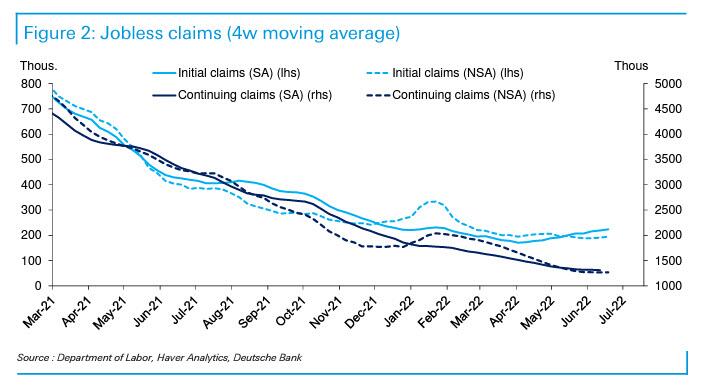
As we approach the end of the first half, it’s safe to say that how the second progresses will likely be determined by whether the US moves into recession or not (and how soon). In regards to this key question, Deutsche Bank's Jim Reid writes that those readers looking for lead indicators, the bank's economists have long believed that continuing claims are the best signal for an imminent slide into recession. In a recent piece, they show how an +11.5% rise above the minimum level over the previous year provides the most accurate and timely signal of recession risks since the data becomes available in the 1960s. It works for each recession and normally leads by around 2 months.
In this cycle, the current low was 1306k hit on May 20th 2022. So far it’s up less than 1% to 1315k and would need to hit 1456k for the 2-month recessionary countdown clock to start ticking.
However, as one can can see from the chart below, this isn’t a big pick-up in historical terms so although we’re not trending there at the moment, it wouldn’t take too much to change the picture.
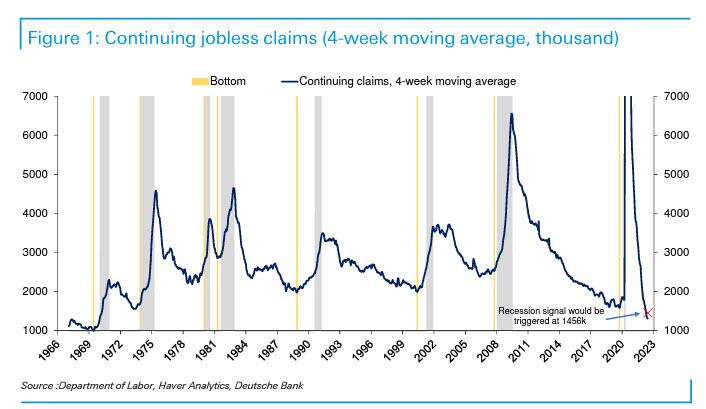
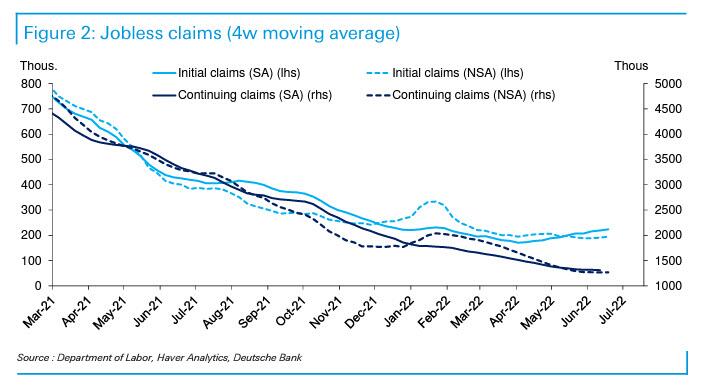
Indeed one concern is that initial jobless claims are up from a trough of 166k in March to 229k last week. Over time, Reid writes, these two series are very well correlated so this is a big enough move to confirm an imminent recession if continuing claims catch up. However this series is seasonally adjusted and non-seasonally adjusted claims are still bumping along the bottom and DB economist Matt Luzzetti thinks there may be some issues with seasonally adjusting so he wouldn’t yet read anything too significant into the pick-up in SA claims.
In any case, Thursday 8:30am EST when the weekly claims data is released, is "showtime" each week for the foreseeable future according to Reid.
Separately, DB's asset allocation team put out an excellent piece last week (available to professional subscribers) looking at what all the short, medium and long-range US recession indicators are currently telling us. In brief, most that turn down early (6-14 months before a recession) are flashing red, most that warn 1-5 months out are mixed, whereas those that turn late are still mostly showing no signs of recession, however these can often turn only in real time.

>>> US Early premarket gappers

Early premarket gappers

  • Gapping up:
    • XAIR +15.9%, INO +10.4%, LRN +6.9%, FTDR +6.7%, SNCY +5.9%, ORA +4.7%, PINS +3.9%, ACHR +3.6%, BALY +3.2%, AGI +2.9%, FREY +2.3%, SIGA +1.4%, CNNE +1%, EVH +1%, TU +0.8%
  • Gapping down:
    • ASPN -25.2%, ICVX -13.7%, AVAV -9.4%, NIO -8.1%, LYLT -6.2%, HUDI -5.2%, ZY -3.4%, NVAX -3%, GLPI -2.8%, MARA -2.8%, OMCL -2.8%, TSLA -1.7%, SWN -1.6%, STT -1.5%, OBSV -1.2%, CALT -1.1%, PRGS -1.1%, MRNA -0.9%, PLTR -0.9%, BNTX -0.8%

WSJ : Behind the Celsius Sales Pitch Was a Crypto Firm Built on Risk

Behind the Celsius Sales Pitch Was a Crypto Firm Built on Risk
The lender had little cushion in the event of a downturn or mass withdrawals, investor documents show

Celsius Network LLC CEO Alex Mashinsky built his cryptocurrency lender into a giant on a pitch that it was less risky than a bank with better returns for customers.

But investor documents show the lender carried far more risk than a traditional bank.

The lender issued numerous large loans backed by little collateral, according to Celsius investor documents from 2021 reviewed by The Wall Street Journal. The documents show that Celsius had little cushion in the event of a downturn, and made investments that would be difficult to quickly unwind if customers raced to withdraw their money. Celsius didn’t respond to requests for comment from the Journal.

Celsius had $19 billion of assets and roughly $1 billion of equity as of last summer, before it raised new funds, according to Celsius investor documents from 2021 reviewed by the Journal. The median assets-to-equity ratio for all the North American banks in the S&P 1500 Composite index was about 9:1, or about half that of Celsius, according to data from FactSet.

For banks, that ratio is of great importance: Regulators look at it as an indicator of risk. For unregulated companies like Celsius, the ratio of 19-1 is particularly high given that some of its assets were investments in the extremely volatile crypto sector, said Eric Budish, an economist at the University of Chicago’s business school who studies cryptocurrencies. Large banks often have ratios near Celsius’s, but they hold much more stable assets and have access to central-bank loans for ready cash.

“It’s just a risky structure,” Mr. Budish said of Celsius. “It strikes me as diversified as the same way that portfolios of mortgages were diversified in 2006,” referring to a feature of the 2008 financial crisis. “It was all housing—here it’s all crypto.“

The five-year-old company is now one of the highest profile crypto firms fighting for survival, as the sector is struggling amid a plunge in cryptocurrency values. Last week, Celsius tapped consultants to advise on a potential bankruptcy filing, the Journal previously reported. That followed the company’s June 12 freeze on all withdrawals, citing “extreme market conditions.”

Celsius’s future is being watched closely in a market that features a web of crypto financial firms lending to each other, where many investors fear contagion. With sliding crypto prices, crypto investors are being asked to put down more collateral on their loans to prevent liquidation.

Crypto broker Voyager Digital issued a default notice to Three Arrows Capital after the hedge fund failed to make payments on its loan of $675 million. The hedge fund suffered heavy losses on the collapse of the cryptocurrency TerraUSD. Last week, rival lender BlockFi announced it had struck a deal for a $250 million line of credit from a cryptocurrency exchange amid concerns by its own depositors. Smaller firms have frozen withdrawals, too.

Founded in 2017 by Mr. Mashinsky, Celsius surged amid the crypto boom to become one of the biggest crypto lenders, with more than $12 billion in deposits. Customers, wooed by high interest rates, flooded in, while venture capitalists showered it with money.

Contrasts with banks were at the center of Mr. Mashinsky’s public persona. Mr. Mashinsky frequently said Celsius passed along 80% of its lending revenue to customers in the form of its high yields. He often wore a black T-shirt reading, “Banks are not your friends.”

Compared with banks, “we have much less risk, but we’ve managed to deliver high single-digit, low double-digit numbers,” Mr. Mashinsky told the YouTube channel CTO Larsson in August. Mr. Mashinsky said on a podcast last month that while “normally in panic, everybody runs to the bank and withdraws their money because they’re afraid the bank is going to fail,” Celsius had proven different in crypto downturns, as its business increased.

With growth rocketing upward, the company raised $750 million last fall in a round led by venture-capital investor WestCap and Canadian pension fund Caisse de dépôt et placement du Québec. The funding, which could have lowered Celsius’s leverage ratio depending how it was deployed, valued the company at more than $3 billion.

Key to Celsius’s fundraising pitch was its fast-growing profits. Celsius gave projections to investors last spring showing deposits would top $108 billion in 2023, and revenue would hit $6.6 billion, according to documents it provided to investors in advance of raising money. It forecast that its earnings—before accounting for charges such as interest or depreciation—would be $2.7 billion in 2023, more than six times its 2021 profit projection.

Adding to Celsius’s leverage was money borrowed from others including Tether International Ltd., which issues a cryptocurrency pegged to the U.S. dollar. As of last summer, Celsius had a credit facility for up to $1.1 billion from Tether, which itself was an early investor in Celsius with a 7.8% stake in the lender as of last spring, Celsius told investors.

A spokeswoman for Tether said that there is no link between the company’s investment in Celsius and Tether’s reserves or stability. She added that the credit facility has been liquidated with no losses to Tether, without saying when and why it had been liquidated.

Celsius’s appeal to consumers lay with high interest rates offered on their deposits. Customers parking their crypto with Celsius were rewarded with annual yields up to 18.6% on some cryptocurrencies and 7.1% on stablecoins—cryptocurrencies pegged to the dollar—that was much higher than rates of about 0.1% offered by many U.S. bank savings accounts.

Like a bank, Celsius was able to pay yields to customers largely by making money through lending at even higher yields to others.

One of its biggest units was lending to other crypto financial businesses, including digital-asset manager Galaxy Digital and institutional crypto-lending firm Genesis, Celsius told investors. Celsius projected in May 2021 that institutional lending would bring in about $290 million of revenue for the year, more than one-quarter of total revenue, the documents reviewed by the Journal show.

While banks like loans to be overcollateralized—homeowners taking out a mortgage post their house as collateral, which is valued at more than the loan—Celsius required its business borrowers to post only an average of about 50% collateral on its $2.7 billion of loans as of last spring, the documents show. Undercollateralized lending is considered a risky practice, one that was more generous than that of many of Celsius’s competitors.

Celsius used some of that collateral to borrow more money itself, a process known as rehypothecation, adding additional risk.

While regulators push big banks to keep some of their assets in categories such as cash or bonds that can be liquidated quickly, Celsius had large portions of its assets tied up investments in financial products that are difficult or impossible to cash out of quickly, adding to its vulnerability in the event of a wave of withdrawal.

Many of these investments were done through a technique called “staking” cryptocurrencies, which is akin to a certificate of deposit account at a bank, in which Celsius was guaranteed a high interest rate in exchange for not being able to access the cryptocurrencies for months.

One of Celsius’s such investments was known as Synthetix, offering Celsius around 23% annual yield, though Celsius had to keep the money in the investment for about a year, according to one of the documents. Celsius owned $90 million of Synthetix’s tokens as of May.

Another big investment was related to the cryptocurrency ether. Celsius recently placed at least $470 million in so-called Lido-staked ether, an investment product managed by Lido Finance that prohibited Celsius from quickly removing its assets, the Journal previously reported. Staked ether is tied up until the long-delayed release of a new version of the Ethereum blockchain that the Ethereum platform said would happen “soon” but didn’t specify a date.

Celsius’s investor documents said it had $3.7 billion in assets as of spring 2021 in a broad category of staking and decentralized finance, which includes other forms of crypto lending.

Other Celsius investments included its own bitcoin-mining operation and a futures-arbitrage practice. The falling price of bitcoin has eaten into bitcoin miners’ bottom line in recent months.

Smaller crypto lenders are facing problems similar to Celsius’s, with their investments tied up amid a wave of margin calls and withdrawals. Given that lenders often borrow from other lenders, companies throughout the sector are rapidly depleting on-hand cryptocurrency reserves, analysts say.

Many see notes of past banking busts. Contagion was a feature of the 2008 global financial crisis, when bank-lending practices—including rehypothecation—left them short on cash.

“None of this is new. We’re just kind of repeating everything we’ve done before,” said Joe Abate, a research analyst at Barclays.