FT : Japan seeks first-mover advantage with stablecoin regulation

Japan seeks first-mover advantage with stablecoin regulation
Plus, Klarna struggles to get investors to ‘buy now’

Japan forges ahead on stablecoin regulation as cryptomarkets fall
Earlier this month, Japan became the first major economy to impose formal regulation on stablecoins, setting a global precedent while most market observers were preoccupied with the broader crypto meltdown.

The stablecoin bill breezed through the upper house of parliament on June 3. The law legally defines stablecoins — which help underpin the wider realm of cryptocurrency by providing a peg to fiat currencies — as digital currencies and requires that the coins maintain a fixed peg to the yen.

The law also guarantees investors the right to redeem stablecoins at face value, which it aims to do by limiting the institutions that can issue the coins to banks, trust companies and a limited number of money transfer agents.

While the significance of the new regulation was somewhat lost after the collapse of TerraUSD and Luna shook faith in stablecoins and decentralised finance, the move marked a quietly pivotal moment for both progressive and conservative thinking on the issue. 

Stablecoin regulation elsewhere may look similar if and when it is laid out. Officials involved in drafting the bill told the FT that the Japanese approach drew heavily upon the debates among financial regulators in the US and UK. 

However, critics of the law say that handing this new stablecoin issuance business line to established players will fail to encourage the growth of start-ups that would fulfil the vibrancy Tokyo has long sought as a financial centre.

Casting itself as an early mover on digital assets is part of Japan’s years-long attempt to brand Tokyo as a high-tech financial hub. In 2017, Japan became the first advanced economy to recognise bitcoin as a currency and soon afterwards became the first to set out a licensing system for crypto exchanges.

But while all these legal milestones have been reached with a speed and decisiveness that makes Japan look pioneering, the fundamental motive is the more pragmatic. While the broad mission of Japan’s Financial Services Agency may include awakening the “animal spirits” of a flourishing financial sector, it knows it will bear a massive burden of blame if large numbers of Japanese individuals are burned. 

This is a financial regulator that has repeatedly learned the hard way that the praise received for a light touch can never outweigh the public backlash at having left an ageing, bubble-prone public at risk. (Leo Lewis)

Fintech fascination
Klarna struggles to get investors to ‘buy now’ Swedish “buy now, pay later” provider Klarna, once the largest private company in Europe, has had to lower its valuation multiple times during recent negotiations with investors for a fresh round of capital. The deal currently in discussion would value the company at less than half of its last public valuation of $46bn, underscoring how investors have turned on many of the fintech unicorns minted during the pandemic.

Bitcoin drops below key threshold Bitcoin briefly fell below a key support level over the weekend wiping out years of gains for long-term holders. Analysts feared that if the price of the largest cryptocurrency fell below $20,000, it could trigger a wave of forced liquidations adding further pressure on the freefalling crypto market. The price had recovered to $20,819.90 as of Monday afternoon. 

Banks build their own tech talent US banks are taking a more hands-on approach to developing technology talent as they try to rely less on third-party providers. With an ongoing labour shortage and war for the available talent, many are launching training programs to fill the gaps from scratch.

>>> Aston Martin : Issues statement regarding media commentary; Company 'regular

Issues statement regarding media commentary; Company 'regularly keeps its funding options under review'; Affirms FY22 outlook; 'Order books are robust'
- The Company continues to trade in line with expectations for full year 2022 and reaffirms its financial guidance for full year 2022, subject to movements in FX rates, as provided at First Quarter results on 4 May 2022.
- Order books are robust and have strengthened further in recent months, with sports cars sold out into 2023 and order intake for DBX more than 40% higher than the previous year. In addition, Aston Martin Valkyrie production continues to pick up pace. The Company is delighted with the customer and market reaction to new model derivatives and its recently enhanced management team are increasingly focussed on new model launches from 2023 onwards.
- As noted at the Full Year 2022 results on 23 February 2022 and Annual General Meeting on 25 May 2022, the Company regularly keeps its funding options under review. Any funding option, if explored and executed, would be to support and accelerate the Company's future growth.

FT : Saudi Arabia in talks to take stake in Aston Martin

Saudi Arabia in talks to take stake in Aston Martin
Latest fundraising will help indebted luxury carmaker invest in new models

Saudi Arabia’s Public Investment Fund is in talks with Aston Martin about taking a stake in the business, as the luxury carmaker seeks to raise additional finances for its next range of cars, according to four people.

The PIF, which already has holdings in Lucid Motors and McLaren, is in talks to take fresh equity in the business that could be worth £200mn, the people said. Talks are at an early stage, they added.

Aston is facing the challenge of funding its next generation of sports cars, and its first push into electric vehicles, at a time when the business is saddled with debt and producing no net cash.

The company does not expect to begin generating cash until 2023, and one of Aston’s first priorities is to start paying down some of its high-interest debt.

The group has £957mn of net debt at the end of March, and expects to pay about £130mn in debt interest this year.

Lower car sales due to the company cutting reliance on selling wholesale models to dealerships, as well as a much slower rollout of its Valkyrie hypercar than expected, have all led Aston to seek other sources of funding for its upcoming generation of vehicles, which are key to the company’s survival.

The discussions represent a reversal from the company’s publicly stated position in February, when chair and owner Lawrence Stroll insisted that the business did not need additional funding.

“Let me be crystal clear, black and white: we do not need money,” he said at the time.

Aston’s latest fundraising talks were first reported by Autocar magazine. Aston shares dropped 18 per cent on Thursday, following Autocar’s report.

Aston Martin declined to comment. The PIF did not respond to a request for comment.

Aston already has a relationship with the kingdom, after a deal with Aramco to rename the F1 team.

Stroll, who invested in the company in January 2020, has been trying to orchestrate a turnround of the business, emptying showrooms of excess cars and trying to realign supply with genuine customer demand to help rebuild the brand’s luxury credentials.

Last month, Stroll revealed Aston turned down an approach from Audi about its Formula One team entering the sport from 2026. Stroll, whose son Lance races in the team, told analysts last month he was “very happy with our Mercedes relationship”.

Mercedes team principal Toto Wolff told the Financial Times last month that the brand may cut one of its three F1 engine customers, of which one is Aston, because of new rules.

Two people said that Audi was still in talks with Aston, though not over an equity stake.

Any investment by an existing carmaker would be complicated by Aston’s relationship with Mercedes-Benz, which owns a fifth of the carmaker’s shares and a technology deal to supply engines and other systems to Aston.

Last month, Aston appointed former Ferrari boss Amedeo Felisa as its new chief executive, replacing ex-Mercedes director Tobias Moers. The replacement makes Felisa Aston’s third chief executive within two years.

NY Post : Big ego, big palazzo: Critics bash bachelor Bill Gates’ Roman real est

Big ego, big palazzo: Critics bash bachelor Bill Gates’ Roman real estate conquest

The billionaire — who is the brand-new owner of more than 2,000 acres of prime farmland in northeastern North Dakota — is adding something more luxe to his burgeoning real estate portfolio: the Palazzo Marini in Rome. Reports say Gates plans to convert the 17th-century structure, located near the fabled Spanish Steps, into a six-star hotel.

The building is very close to the Trevi Fountain, Piazza di Spagna and Via Condotti, and not far from the Piazza Navona and Via Veneto.

Gates, 66, the former CEO of Microsoft and its largest shareholder, and his frequent investment partner, Saudi Arabian Prince Alwaleed bin Talal, 67, are paying about $170 million for the property, Corriere della Sera reported.

The palazzo is reportedly a “real fixer upper” that’s been used as a pop-up Ikea shop selling kitchenware and as a canteen for legislators in the country’s lower house of Parliament in recent years.

Gates and the prince likely will shell out big bucks to turn the building, which spans four city blocks in the heart of Rome, into a luxury hotel that reportedly will include about 100 rooms and possibly space for a conference center, gym and spa.

It’s planned as a “six star” hotel, even though such a ranking doesn’t officially exist. According to at least one travel writer, other extremely high-end hotels worthy of six stars include the Burj Al Arab in Dubai, the Baur au Lac in Zurich, Le Bristol in Paris, the Mandarin Oriental in Thailand and the Taj Falaknuma Palace in south India.

Gates and Prince Alwaweed were stymied in their efforts to buy the venerable Danieli Hotel on Venice’s Grand Canal earlier this year because Venetians didn’t want foreign investors taking control of the property.

Gates’ real estate ventures, which are managed by Cascade Investments LLC, the non-philanthropic arm of the his empire, have sometimes caused controversy.

North Dakota’s attorney general recently asked the Gates trust that acquired the North Dakota land to explain how it will be used, to ensure rules outlined in the state’s anti-corporate farming law are met. That law prohibits all corporations or limited liability companies from owning or leasing farmland or ranch land, with some exceptions.

North Dakota’s Agriculture Commissioner also told an area TV station that many people feel they are being exploited by the super-rich who scoop up local land but don’t necessarily share local values.

Some of Gates’ numerous critics have long been skeptical of how some of his philanthropy appears to benefit himself and other large corporations. The Nation reported in 2020 that, out of 19,000 charitable donations made by the Gates Foundation, almost $2 billion in tax-deductible charitable donations went to some of the biggest and most powerful companies in the world, like GlaxoSmithKline, Unilever, IBM and NBC Universal Media.

Gates is now the is now the largest owner of private farmland in the country as well as a blossoming hotelier — ventures that have picked up steam since his messy divorce from his wife of 27 years, Melinda French, last May.

“‘Gates’s vanity decisions, like this reported six-star palazzo luxury hotel venture, seem to suggest what he is: a restless new bachelor with a lot of time to burn and a big ego to self-satisfy,” Linsey McGoey, author of “No Such Thing as a Free Gift: The Gates Foundation and the Price of Philanthropy,” told The Post.

“The question is why people saw him as a benevolent czar for global wellbeing when usually his own wellbeing seems paramount.”

Gian Lorenzo Bernini began construction on the Palazzo Marini in 1650, and it housed many noble families over the years. Pope Innocent XII took over at one point and it briefly became the headquarters of the Pontifical Tribunal.

The building languished in recent years after a developer had to sell it at a discount after he was arrested in 2016 on bribery charges.

Locals hope that transforming the Palazzo Marini is transformed into a top-of-the-line hotel will inject life into the sagging Roman tourist economy. During the pandemic, 410 hotels out of 1200 in the city closed down.

Gates’ Cascade Investment took control of Four Seasons Hotels and Resorts in Sept. 2021 by buying about half of Prince Alwaleed bin Talal’s stake for $2.21 billion.

Prince Alwaleed, through his investment vehicle Kingdom Holding Co, will continue to own the remaining stake, Four Seasons said in a statement last year. Alwaleed is worth about $18 billion.

The Four Seasons did not respond to a call from The Post.

The prince’s holdings include stakes in Lyft, Twitter, Citigroup, the Hotel George V in Paris and the Savoy Hotel in London. Alwaweed is also one of the outside backers of Elon Musk’s upcoming takeover of Twitter.

Gates’ myriad real estate investments are often much less flashy than his new Rome acquisition.

Last year, a reporter for the Land Report tracked down the new owner of 14,500 acres of prime eastern Washington farmland — purchased for $171 million — to an LLC with revenues of less than $300,000 and just two employees in the tiny bayou town of Monterey, Louisiana.

He eventually traced the LLC to Cascade Investments and Gates. Cascade has been managed since 1994 by the publicity-shy Michael Larson, who The New York Times last year said fostered a “culture of fear” at the firm.

(ZH) Who's Still Buying Fossil Fuels From Russia?

Who's Still Buying Fossil Fuels From Russia?

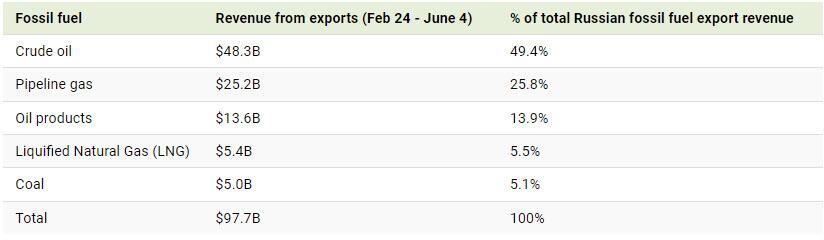
Despite looming sanctions and import bans, Russia exported $97.7billion worth of fossil fuels in the first 100 days since its invasion of Ukraine, at an average of $977 million per day.
So, which fossil fuels are being exported by Russia, and who is importing these fuels?
The infographic below, via Visual Capitalist's Niccolo Conte and Govind Bhutada, tracks the biggest importers of Russia’s fossil fuel exports during the first 100 days of the war based on data from the Centre for Research on Energy and Clean Air (CREA).
In Demand: Russia’s Black Gold
The global energy market has seen several cyclical shocks over the last few years.
The gradual decline in upstream oil and gas investment followed by pandemic-induced production cuts led to a drop in supply, while people consumed more energy as economies reopened and winters got colder. Consequently, fossil fuel demand was rising even before Russia’s invasion of Ukraine, which exacerbated the market shock.
Russia is the third-largest producer and second-largest exporter of crude oil. In the 100 days since the invasion, oil was by far Russia’s most valuable fossil fuel export, accounting for $48 billion or roughly half of the total export revenue.

While Russian crude oil is shipped on tankers, a network of pipelines transports Russian gas to Europe. In fact, Russia accounts for 41% of all natural gas imports to the EU, and some countries are almost exclusively dependent on Russian gas. Of the $25billion exported in pipeline gas, 85% went to the EU.

The Top Importers of Russian Fossil Fuels
The EU bloc accounted for 61% of Russia’s fossil fuel export revenue during the 100-day period.
Germany, Italy, and the Netherlands—members of both the EU and NATO—were among the largest importers, with only China surpassing them.

China overtook Germany as the largest importer, importing nearly 2 million barrels of discounted Russian oil per day in May—up 55% relative to a year ago. Similarly, Russia surpassed Saudi Arabia as China’s largest oil supplier.

The biggest increase in imports came from India, buying 18% of all Russian oil exports during the 100-day period. A significant amount of the oil that goes to India is re-exported as refined products to the U.S. and Europe, which are trying to become independent of Russian imports.
Reducing Reliance on Russia
In response to the invasion of Ukraine, several countries have taken strict action against Russia through sanctions on exports, including fossil fuels.
The U.S. and Sweden have banned Russian fossil fuel imports entirely, with monthly import volumes down 100% and 99% in May relative to when the invasion began, respectively.
On a global scale, monthly fossil fuel import volumes from Russia were down 15% in May, an indication of the negative political sentiment surrounding the country.
It’s also worth noting that several European countries, including some of the largest importers over the 100-day period, have cut back on Russian fossil fuels. Besides the EU’s collective decision to reduce dependence on Russia, some countries have also refused the country’s ruble payment scheme, leading to a drop in imports.
The import curtailment is likely to continue. The EU recently adopted a sixth sanction package against Russia, placing a complete ban on all Russian seaborne crude oil products. The ban, which covers 90% of the EU’s oil imports from Russia, will likely realize its full impact after a six-to-eight month period that permits the execution of existing contracts.
While the EU is phasing out Russian oil, several European countries are heavily reliant on Russian gas. A full-fledged boycott on Russia’s fossil fuels would also hurt the European economy—therefore, the phase-out will likely be gradual, and subject to the changing geopolitical environment.

9to5Mac : Most Americans want App Store competition, claims Epic Games and pals

The Coalition for App Fairness (CAF) claims that the majority of Americans want to see App Store competition, alongside other antitrust legislation.
CAF commissioned two polls which show strong support for antitrust bills, one of which would mean opening up Apple and Google app stores to third-party competitors and/or sideloading …

About CAF
CAF was formed back in 2020 by a small group of companies, led by Epic Games, Spotify, and Tile – each of which was battling with Apple at the time. The lobbying group made no secret of its nemesis.
Every day, Apple taxes consumers and crushes innovation. The Coalition for App Fairness is an independent nonprofit organization founded by industry-leading companies to advocate for freedom of choice and fair competition across the app ecosystem.
The group has been calling for independent iOS app stores and lower commissions for developers.
Says most Americans want App Store competition
CAF says that 79% of voters support the Open App Markets Act, which, among other things, calls for an end to monopoly control of the iOS app market by Apple.
Recent research conducted by OnMessage Public Strategies and Lake Research Partners found likely voters in both parties back legislation to address the anticompetitive practices of app store gatekeepers.
The surveys found that 68% of voters think Big Tech has too much power and 79% support efforts by Congress to pass the Open App Markets Act and open up the mobile app ecosystem to competition. In California, polling showed that 69% of likely California voters believe Big Tech has too much power and 75% support the Open App Markets Act […]
There is clear, overwhelming, and bipartisan support for Congress to pass the Open App Markets Act and other legislative measures. Across all states and key political demographics, likely voters believe Big Tech companies are too powerful and have not been regulated enough. Likely voters in these key political states are rejecting the arguments being made by Big Tech companies and their allies as they attempt to stave off new regulation.
The organization claims that getting behind antitrust legislation is a good move by politicians across the aisle.
“The numbers don’t lie – voters across the country overwhelmingly want their members of Congress to stop Big Tech’s anticompetitive practices,” said Rick VanMeter, Executive Director for the Coalition for App Fairness. “Voters have made clear that they want flexibility and choice in how they access apps on their mobile devices. These findings demonstrate that reining in mobile app store gatekeepers by passing the Open App Markets Act is a winning issue for Republicans and Democrats alike. Congress has a simple choice: side with Big Tech or support the American people.”
The Open App Markets Act, would fix the broken mobile app marketplace by requiring mobile gatekeepers to allow third party app stores and third party in-app payment systems. Additionally, the legislation prohibits anti-competitive practices, such as “self-preferencing,” by banning app stores from engaging in behaviors that put their products at an advantage over independent developers and competitors.
Asked about the amount of power Apple wields, 59% said that it was too much, 28% the right amount. On the regulation of Apple and Google, 65% felt there should be more, 20% that it’s about right now, and 6% felt they should be regulated less.
9to5Mac’s Take
CAF is keen to point out that one of the research firms backs the Republican party while the other supports the Democratic party, in an attempt to show lack of political bias. But anyone involved in polling will tell you that you can get any results you like by asking the right questions in the right way.
For example, when asking about regulation, the poll lumps together Apple and Google, which have very different business models.
The phrasing of the question about the Open App Markets Act – the most relevant one where App Store competition is concerned – is also strongly biased.
As you may have heard, there is [another] bill being debated in Congress, known as the Open App Markets Act, regarding the two largest mobile app stores, Apple App Store and Google Play store. Currently, Apple and Google have monopoly control over what apps are allowed in their app stores and how consumers are able to download the apps. The legislation would force Apple and Google to compete and give consumers more flexibility to download apps of their choice. With this in mind, would you support or oppose this bill?
To CAF’s credit, it does list the actual questions asked, but it knows that most media outlets are only going to cover the headline results.
Other polls show that there is majority support for antitrust legislation, but these particular polls should be taken with a very large serving of salt.

FT : Tether’s mystery commercial paper exposure

Tether’s mystery commercial paper exposure
Tweets from the stablecoin’s CTO are raising new questions about reserve quality

The public face of crypto’s biggest stablecoin, Tether chief technology officer Paolo Ardoino, laid down the gauntlet this week to hedge funds who are shorting the $66bn market cap token.

Over 12 tweets on Monday, he decried “FUD, troll armies, clowns etc” and said that Tether was “the only stablecoin that is proven with fire under extreme pressure”, referring to the $17bn in redemptions it has processed in May and June.

“Eventually these hedge funds, that borrowed and shorted billions of USDt will need to buy them back. What will happen then?,” he warned.

But in one message, Ardoino may have flagged something important about the reserves backing crypto’s most widely used and most controversial stablecoin.

Some background: Tether issues ‘USDT’ tokens that are used by crypto traders as a dollar substitute. Its $1 value is backed 1-to-1 by dollar assets held in Tether’s reserves.

Controversy about these reserves has raged for years. Tether in 2021 paid tens of millions to US regulators in settlements over its past disclosures.

Today, hedge funds including Fir Tree Partners and Viceroy Research have shorted USDT, the idea being that the assets currently backed Tether are worth less than the tokens in circulation. Tether has strenuously denied that claim.

One suggestion is that Tether may have suffered losses on its commercial paper holdings, which according to a Bloomberg report last year included Chinese commercial paper. Earlier this month, Tether put out a blog post:

Tether is aware of rumours being spread that its commercial paper portfolio is 85% backed by Chinese or Asian commercial papers and being traded at a 30% discount. These rumours are completely false and likely spread to induce further panic in order to generate additional profits from an already stressed market. Tether condemns such attempts which oftentimes see simple users take the biggest hit, while few co-ordinated funds increase their profits.

The post added that Tether’s “current portfolio of commercial paper has since been further reduced to 11bn (from 20bn at the end of Q1 2022), and will be 8.4bn by end June 2022”.

Ardoino this week made a similar comment in his Twitter thread:


So, here’s what one hedge fund that’s short Tether has been pointing out to clients on the back of Ardoino’s tweets.

Looking at the quarterly breakdown Tether has put out about its reserves, the commercial paper holdings should be far lower than $8.4bn if the company had been simply rolling them off into US treasury bills.

An attestation from Tether’s Cayman Island accountant on Tether’s reserves says that as of March 31, 2022, there was $20.1bn in commercial paper holdings and certificates of deposit.

Most of that was short duration. Specifically, $18.9bn was set to reach maturity within 90 days. If Tether was letting its commercial paper holdings roll off, in other words, then by the end of June there should have been just $1.2bn, not $8.4bn.

What explains that gap? Has Tether given payment extensions to someone? Was some commercial paper not fully repaid at maturity? We don’t know. We asked Tether, but have yet to hear back.

FT : Barcelona sells media rights stake to Sixth Street in bid to repair finance

Barcelona sells media rights stake to Sixth Street in bid to repair finances
Deal with private equity group will deliver Spanish club more than €200mn over 25 years

FC Barcelona has agreed to sell a 10 per cent stake in its media rights to US investment group Sixth Street, in a deal that will deliver more than €200mn to shore up the Spanish football club’s troubled finances.

The deal, announced on Thursday, will hand Sixth Street a slice of the Catalan club’s media rights for a 25-year period. The club may consider selling another 15 per cent stake later this summer, according to people familiar with the matter, which could allow Sixth Street to increase its share further.

Barcelona’s financial health has been hampered by a pile-up of short-term debt obligations after a season that began with the departure of its longtime star, Lionel Messi. The club’s president Joan Laporta had likened its finances to a Formula One racing car that has run out of fuel, but said his aim was to “leave the pits and return to the front row of the grid to compete and win again”.

The club opted to sell its own share of TV rights instead of participating in La Liga’s leaguewide €2bn deal with private equity group CVC Capital Partners, which provided a capital injection in exchange for 11 per cent of media rights over 50 years.

La Liga, which runs the top two divisions in Spain, originally agreed a €2.7bn financing package, but was forced to reduce the size of the CVC deal because of opposition from Barça and Real Madrid, both of which refused to join. The two clubs, which receive a greater share than their rivals of the broadcast revenue generated by La Liga, failed in a late bid to thwart the CVC deal with a counterproposal to other clubs that involved bank financing.

Spain’s two leading clubs — arch-rivals on the pitch but increasingly aligned off it — were founding members of the European Super League, an attempted breakaway competition that collapsed rapidly after its unveiling in April 2021. La Liga opposed the ESL and publicly criticised Barça and Real Madrid over their role in its creation.

For Sixth Street, the deal comes soon after it agreed to a separate investment in Real Madrid. The San Francisco-based fund, which manages more than $60bn in assets, will pay €360mn to partner with Real Madrid on refurbishing its Santiago Bernabéu stadium and a live events package over a 20-year period. Sixth Street also has a minority stake in US basketball team San Antonio Spurs.

The stake sale of Barcelona’s media rights was led by Key Capital, the Spanish brokerage that previously advised Real Madrid on its stadium deal with Sixth Street.

It also follows a vote at Barcelona’s general assembly this month, which granted the club permission to sell stakes of up to 25 per cent in the Catalan football empire’s media rights and up to 49 per cent in Barça’s merchandising and sponsorship business. At the time, Barcelona said the assets had the potential to provide a €600mn boost.

Barcelona’s financial descent was exacerbated by the coronavirus pandemic, when matches at its famous 99,000-capacity Camp Nou stadium were played behind closed doors.

Despite the €222mn sale of Brazilian striker Neymar to Paris Saint-Germain in 2017, Barcelona has over the years generated a deficit from player transfers. A high wage bill has added to the pressure and led to Messi’s departure to the same club.

Only three clubs in Europe’s big five leagues have had a worse result from transfer dealings than Barcelona’s negative net spend of €650mn in the decade since summer 2012, according to research by CIES Football Observatory.